Search

Bo Sanders: Public Theology

updating & innovating for today

Month

March 2017

Pre-Woke Worship

It has been an interesting couple of weeks! I found out that I did not get the professor jobs I applied for and at the same time, I have been talking with churches and denominations about becoming a pastor again.

I have also been visiting different churches every Sunday to see what is happening out there. I figure that if I am headed back into local church ministry this might be a one time opportunity to do so. It has been an amazing experience and I will write more about it later.

Today I wanted to tell you about a podcast that I have really enjoyed listening to. The show is called Represent, where host Aisha Harris tackles different themes each week. Some weeks focus on pop culture, others on politics, some on media, others on relationships.

A new segment that has become a reoccurring feature is called ‘Pre-Woke Watching’ where the host and at least on other friend talk about some movie, TV show, or song that they used to enjoy but which needs reconsidering. It is fascinating series of conversation where young adults revisit things that they loved as children or teens in order to examine elements that now seem racist, sexist, hurtful, and dangerous.

In a recent episode, they evaluate a song from the original ‘Jungle Book’ animated movie from 1967. The song ‘I want to be like you’ is iconic and epic … but upon further review it is highly problematic with themes of colonialism superiority and racial undertones. Kids, obviously don’t know about Roger Kipling and Disney is not obligated to be forthright about his influence.

Where the conversation gets even more interesting is in the final assessment when they ask each other, “So … can you watch/listen to that anymore?”. It is fascinating to listen to the rational/justification regardless of whether the answer is yes or no. My favorite answer is

“I’m going to keep listen to/watching it because I have really fond memories and associations with it … but my kids will not be watching it because I don’t want them to be introduced to it.”

It is in the inverse of so many conversations I get to have with people who are rethinking-reevaluating the way that they and their families are participating in faith/church. From them I hear things like “I just can’t sing that song anymore in good conscience … but I my kid really likes it and I want them to have good feelings about the church/faith.”

These are interesting conversations because for so many people their faith/ view of the Bible  or understanding of God / prayer has changed or matured from what they grew up with. They are truly concerned both with finding a posture and practice of faith that has integrity for them and works for their kids/teens.


I like the podcast partly because it is interesting to listen in to folks wresting with similar issues only in a very different arena. It reminds me of the journey through criticism into a second faith that I referenced (about Ricouer) a couple of weeks ago. I referenced it again at the ‘Theology on Tap’ event the other night about how our views on the afterlife mature and evolve.

Worship songs, however, seem to be the biggest point of contention. Wether it is bloody penal substitutionary atonement songs about the cross, exclusive masculine and heavy use of father language, overly sappy romantic imagery, or my least favorite – the unnamed ‘You’.

Side-note: pronouns such as ‘you’ need an antecedent such as ‘Doug’ or ‘Mom’ or ‘God’. Last week at church the opening song used ‘You’ sixteen times without even saying ‘god’ or  ‘Lord’. It drives me crazy. If we never stipulate who it is we are addressing …

So I sang the song to the guy sitting in front of me!  “You are great, you have a good heart, I trust you and I need more of you in my life.” 

Anyway – I would love to hear about any pre-woke worship experiences, practices, or songs that just don’t seem the same now that you know what you know.


Hope They Serve Tacos In Hell

I am speaking at a ‘theology on tap’ event this evening hosted by the local Lutheran congregation. I agreed to do it and then I was informed the this month’s topic is the afterlife.

I had planned on wearing a “I hope they serve tacos in hell” T-shirt to the event. Unfortunately, they were sold out of them in my size [which makes you wonder about big guys being really invested in the cause].

I made the mistake of telling some friends and coworkers about this plan and it did not go over well. At first, their resistance came from the fact that a pastor and theology professor might be sending mixed messages by seeming  to endorsing hell.

Then I realized that we were coming at this from completely different directions. Here is my two-fold logic on the issue:

  • If there is a hell, it is probably going to be a pretty bad place – by the very nature of what it is. I just think that for as bad as it is going to be, it would be nice if there was something good in the day!

This just seems like a kind and Christian heart of compassion to me.

  • There is a chance that I am going to hell. I don’t mean that in an “I deserve it for what I’ve done” sorta way. I just mean that statistically I have run the numbers. If the Mormons, or the strict Catholics, Hindus or any number of other groups turn out to be correct, I could (statistically speaking) end up in that group’s version a bad place.

If that is the case, I would like to know that I get tacos from time to time.

This line of reasoning is slightly tongue-in-cheek but I have found it to be an amazing litmus test. I have actually been shocked at now almost no one has thought about the fact that they could end up in a place other than the eternal penthouse.

I’m really looking forward to tonight and I will let you know how it goes.

There Is No Neutral Anymore

Perhaps the most important theme that has developed for me in 2017 is the ongoing realization that there is no neutral position. This has been with me conceptually for the past decade but the seminary classroom has made it less abstract.

One of the great challenge and great opportunities of the multi-denominational seminary is that students come in with layers of experiences, perspectives, loyalties, and insights. They do not come in as clean slates or blank canvases. We never start from scratch (thank God).

Training for ministry does not happen in a vacuum. It happens some where and some when. That is why yesterday I wrote that truth is not dead, it just needs to be understood as situated.

This is a big revelation and a potential stumbling block for some! Truth and meaning do not materialize out of thin air – they are constructed socially. The realization that our access to truth is partial, provisional, and perspectival comes with some profound implications.

Meaning, then, is correspondingly understood to be:

  1. Mediated
  2. Located
  3. Contested

Meaning is mediated because our understanding comes to us through inherited language, social constructs, and mental frameworks (paradigms).

Meaning is located because the same event or data may look very different or be interpreted differently by a different person in another place or time.

Meaning is contested because in a partial/perspectival understanding, no one interpretation gets a free ride or an automatic pass. Everything is up for review.


This realization can have a disrupting effect and can lead to disorientation. However, once it is embraced, there is a comforting peace that can settle in as knowledge of the world and claims within faith correspond more accurately to history and to the world as it really is.

Perhaps the two most significant implications are for the person who has been sold an ideology and for the perennial skeptic. Those two positions are tough to maintain in this new reality. There is no neutral (or exempt) position anymore. One does not simply get to sit back and poo-poo other’s perspective without providing an alternative. It is not sufficient to take shots at or poke holes in opinions that you disagree with.

Because our culture, and our understanding of truth, is so fractured … one has to make the claim or justify ones position in the arena of ideas or the court of public discourse. Nothing gets off scot-free, no idea gets a free ride, and no position is exempt from examination.

There is no neutral anymore. Inactivity reinforces the status quo and is, by default, taking a position.*

Two quick examples: theology and hair.

Whether the topic is women in ministry or speaking in tongues, it is not sufficient for the cynic to encounter a new perspective and simply say “I don’t know about that”. 20 or 40 years ago that may have worked, but it works no longer. If a young man wants to be skeptical after reading feminist theology or looking at charismatic excesses, he gets to do that, but he must bring something to the table in its stead. No longer can one take the privileged position of retreating to the way things are as a defense against engaging new ideas and challenging critiques.

This is a new reality that takes some adjustment. It can be uncomfortable for those who have been groomed or conditioned to succeed in the traditional way things have been.

Hair is an interesting example. It is not enough to make snarky comments about how trendy beards are without realizing that shaving in a social performance as well. One may feel free to criticize the money and attention that a women puts into her hair – but not doing your hair is a decision as well. For both men and women, shaving your legs and armpits are both political statements. For women of a certain age, coloring the gray and not coloring become an issue. A womanist friend of mine explained that African-American women can go-natural, use product, straighten or braid (among a myriad of other options) but they all make a statement (sometimes political) and that position will be reviewed and will likely be contested. There is no neutral.

Sir, you can criticize my expensive organic fair-trade cotton Tshirt, but your $4 Walmart knockoff sweatshop shirt or not wearing any shirt at all are both up for review as well.

Like it or not, the age of inactivity is over. Sitting in your house or protesting the government, cooking at home or going out to eat, buying nice furniture or going off the grid, having kids or using protection  are all statements and they are all consequential.


*Academics might reference this as the nature of the hegemonic order. The 20th century saw the ability to presume the established order of things dissolve at every level. Economy, politics, military, ecology, morals, religion, civility, marriage, gender, sexuality, occupations and trades are just a few examples of categories that display this loss of fixed and stable assumptions.  

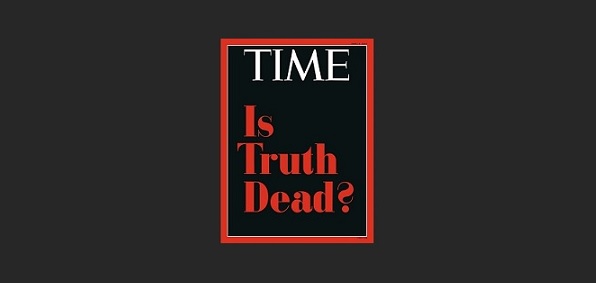
Is Truth Dead?

You have probably seen the attention-grabbing cover of this week’s Time magazine. It is a very real issue in our culture and it has serious implications for how we approach faith and church.

Truth has been an urgent topic this semester in the seminary classroom as some students have been asking what it means to think about religion and faith in a “post-truth” society.

I know that some status quo cynics and kind conservatives will smirk and try to dismiss these developments as just the latest assault on ‘what the church has always believed’. They will point to Herod asking “what is truth” in John 18:38 or quote Jude 1:3 and attempt to hide behind “the faith which was once for all handed down to the saints”.

Both of those attempts at dismissive evasion miss the point that something has shifted in our culture.

My hope is to seize this moment and to have an honest-to-God reality check that engages in an open-eyed assessment of the actual situation that we find ourselves in.

Here is the approach that I am taking with my students: 

We are exiting a time when truth has been purported to be both universal and timeless. IF that were ever true, and that is debatable, then it is certainly less true today than it ever has been.

First, nothing is timeless. Even if one wants to assert that something is not time-bound, it at least has to be time-ly. 2nd Temple Judaism, Pentecost, the Council of Constantinople, the Nicene Creed, Augustine’s confessions, Thomism, the Protestant Reformation, the birth of Methodism, the 2nd Great Awakening, and the Azusa Street revival were not timeless. They were all timely.

Second, things are not universal – they a situated, located, and particular. Things can not be presumed to be the same everywhere and simply applied anywhere. When and where (not to mention how and why) matter deeply.

Having said that, we have an opportunity (here and now) to evaluate our approach to truth and assess how we want to address this crisis in our culture.

Side-note: perhaps the worst thing that we could do at this kairos moment is to double-down on our truth claims of past centuries and continue to ignore the fact that things may not work as well, as smoothly, as predictably, or as justly as we had been told.

A great start begins with this realization:

Any claim to truth is:

  1. Partial
  2. Provisional
  3. Perspectival

It is partial because I never have all of the information – if there is a ‘god’s eye view’ I do not have access to it. Reality check: if there is a God, you are not God. This doesn’t mean that you have no access to truth – only that you have limited access to truth.

It is provisional because it will need to be amended as new data becomes available. I am free to say ‘at this point, here is what I understand’. If you are under the impression that something is ‘set in stone’, you need to come to terms with the fluid nature of our understanding and the perpetual/liquid nature of our access to all that is going on both in what we can see and the stuff behind the scenes.

It is perspectival because you can only see things from where you stand. Get rid of any notion of being ‘objective’ – you are subjective (thank God) and any access we have to truth is subject to review.

Is truth dead? Not exactly. 

Is our understanding of truth in need of adjustment for our liquid era of perpetual motion and exponential change? Yes. 

Do we still get to believe that things are true? Yes! 

Does that require a little bit of humility and even repentance from our addiction to certainty? Absolutely. 

Mid-March Madness

The past month has been incredibly intense.

I had the honor of flying to NY to meet with my father and his board about rebooting his global ministry.

I am mid-semester at the seminary with 4 amazing classes (ecclesiology, essentials of christian theology, culture & system change, and world religions)

C3rhitkVcAAxGmD

While I was back east, I went to the Methodist Archives at Drew University and found the documents that I needed to complete my dissertation!!!

I have been applying to professor jobs in the areas of religion, theology & ministry.

I have been talking with denominations about the possibility of being a pastor with them (come August) and have great hope that something is going to work out.

Lastly, I have also been developing a model for revitalizing existing churches AND connecting with post-evangelical / this-is-not-for-me 20 and 30 somethings. [more on this to come]

As you can see, I could use some prayer.

I want to finish this season of being a professor and writing the dissertation well.

I also have an eye toward pastoring again and what it might mean to model what it looks like to do church in a different way.

Thank you for your care, notes, prayers, and engagement. It means a LOT during this time.   -Bo


Create a free website or blog at WordPress.com.

Up ↑