Search

Bo Sanders: Public Theology

updating & innovating for today

Palms Are Political

A friend reminded me this week that I used to write about Easter frequently. Then in theology class this week several topics came up that related to Lent and Easter subjects. SO I thought it might be fun to rework some archived material and post it on Maundy Thursday and Good Friday. I would love to hear your thoughts.

When I was a children’s and family minister, Palm Sunday was fun. At our stained-glass and organ church did it up big. We got lots and lots of palm branches for folks to wave during the singing of the hymns and we had the kids process down the aisle and march around the sides of the pews. It is quite a visual.

That is the modern version of Palm Sunday. It is kids choirs and photo-ops and party-like atmosphere.

The original Palm Sunday was little bit different. It was not so cutesy and hallmark holiday. It was aggressive and it was deeply political.

The politics of Palm Sunday:

The Jewish people were under occupation. Roman occupation was especially repressive and brutal.IMG_0332.JPG (2)

The last time that the Jewish people had been free and self-governed also meant that they had their own currency. On their big coin, a palm branch was prominently displayed.

Laying down palm branches ahead of a man riding a colt/donkey was an act of defiance and an aggressive political statement.

We want to be free. This guy is going to change things and restore what was lost.

Having children wave palm branches in the equivalent to teaching a child to stick up her middle finger in anger… only more political. kid_soccer_fan

I am troubled by the lack of context regarding the palms of Palm Sunday. It reeks of both willful ignorance and religious disconnect.

I’m afraid the palms are just one more migrating signifier that no longer re-presents that which is supposed to signify. 

In so many ways we have sanitized, sterilized and compartmentalized the teaching of scriptures. We proudly and loudly defend the Bible – all the while neglecting the actual reality talked about in that Bible. Continue reading “Palms Are Political”

Race Research

This winter has been a fruitful time of researching issues related to race for my dissertation. Academic approaches to race, and specifically ‘whiteness’, are central to my examination of  ethnic, gender, and racial diversity within church and denominational leadership.

I know that academic stuff is not for everyone – so here are 6 amazing articles that I have found that I would love to pass along:

This is the best 3 page article I found. It is The Christian Century and it could be useful to teachers or to Sunday School classes. 

This article explains the idea of  ‘structuration’ introduced by Giddens which refers to the observation that:

“actors are as much producers as they are also products of society’s structurations.”

This is one of the more unique approaches that I have encountered. It is hard hitting and is primarily concerned with the language related to the struggle to understand race. 

There are few articles that I have highlighted more than this one. 

Rieger is one of my favorite authors. His ‘No Rising Tide’ on the economy and ‘Christ & Empire’ are classics. He also writes on Globalization and does interesting collaborations.

This last one is a little different. It does require that you have access to a research library to download [email me at anEverydayTheology@gmail.com] if you can’t get it. 

It is also an update / challenge to the famous 2000 book “Divided by Faith: Evangelical Religion and the Problem of Race in America

Race not only continues to be an issue of great importance to the church of N. America but some of us think that it is an increasingly critical issue for our lifetime.

 Please pass along any articles or links that you have found helpful! 

Pre-Woke Worship

It has been an interesting couple of weeks! I found out that I did not get the professor jobs I applied for and at the same time, I have been talking with churches and denominations about becoming a pastor again.

I have also been visiting different churches every Sunday to see what is happening out there. I figure that if I am headed back into local church ministry this might be a one time opportunity to do so. It has been an amazing experience and I will write more about it later.

Today I wanted to tell you about a podcast that I have really enjoyed listening to. The show is called Represent, where host Aisha Harris tackles different themes each week. Some weeks focus on pop culture, others on politics, some on media, others on relationships.

A new segment that has become a reoccurring feature is called ‘Pre-Woke Watching’ where the host and at least on other friend talk about some movie, TV show, or song that they used to enjoy but which needs reconsidering. It is fascinating series of conversation where young adults revisit things that they loved as children or teens in order to examine elements that now seem racist, sexist, hurtful, and dangerous.

In a recent episode, they evaluate a song from the original ‘Jungle Book’ animated movie from 1967. The song ‘I want to be like you’ is iconic and epic … but upon further review it is highly problematic with themes of colonialism superiority and racial undertones. Kids, obviously don’t know about Roger Kipling and Disney is not obligated to be forthright about his influence.

Where the conversation gets even more interesting is in the final assessment when they ask each other, “So … can you watch/listen to that anymore?”. It is fascinating to listen to the rational/justification regardless of whether the answer is yes or no. My favorite answer is

“I’m going to keep listen to/watching it because I have really fond memories and associations with it … but my kids will not be watching it because I don’t want them to be introduced to it.”

It is in the inverse of so many conversations I get to have with people who are rethinking-reevaluating the way that they and their families are participating in faith/church. From them I hear things like “I just can’t sing that song anymore in good conscience … but I my kid really likes it and I want them to have good feelings about the church/faith.”

These are interesting conversations because for so many people their faith/ view of the Bible  or understanding of God / prayer has changed or matured from what they grew up with. They are truly concerned both with finding a posture and practice of faith that has integrity for them and works for their kids/teens.


I like the podcast partly because it is interesting to listen in to folks wresting with similar issues only in a very different arena. It reminds me of the journey through criticism into a second faith that I referenced (about Ricouer) a couple of weeks ago. I referenced it again at the ‘Theology on Tap’ event the other night about how our views on the afterlife mature and evolve.

Worship songs, however, seem to be the biggest point of contention. Wether it is bloody penal substitutionary atonement songs about the cross, exclusive masculine and heavy use of father language, overly sappy romantic imagery, or my least favorite – the unnamed ‘You’.

Side-note: pronouns such as ‘you’ need an antecedent such as ‘Doug’ or ‘Mom’ or ‘God’. Last week at church the opening song used ‘You’ sixteen times without even saying ‘god’ or  ‘Lord’. It drives me crazy. If we never stipulate who it is we are addressing …

So I sang the song to the guy sitting in front of me!  “You are great, you have a good heart, I trust you and I need more of you in my life.” 

Anyway – I would love to hear about any pre-woke worship experiences, practices, or songs that just don’t seem the same now that you know what you know.


Hope They Serve Tacos In Hell

I am speaking at a ‘theology on tap’ event this evening hosted by the local Lutheran congregation. I agreed to do it and then I was informed the this month’s topic is the afterlife.

I had planned on wearing a “I hope they serve tacos in hell” T-shirt to the event. Unfortunately, they were sold out of them in my size [which makes you wonder about big guys being really invested in the cause].

I made the mistake of telling some friends and coworkers about this plan and it did not go over well. At first, their resistance came from the fact that a pastor and theology professor might be sending mixed messages by seeming  to endorsing hell.

Then I realized that we were coming at this from completely different directions. Here is my two-fold logic on the issue:

  • If there is a hell, it is probably going to be a pretty bad place – by the very nature of what it is. I just think that for as bad as it is going to be, it would be nice if there was something good in the day!

This just seems like a kind and Christian heart of compassion to me.

  • There is a chance that I am going to hell. I don’t mean that in an “I deserve it for what I’ve done” sorta way. I just mean that statistically I have run the numbers. If the Mormons, or the strict Catholics, Hindus or any number of other groups turn out to be correct, I could (statistically speaking) end up in that group’s version a bad place.

If that is the case, I would like to know that I get tacos from time to time.

This line of reasoning is slightly tongue-in-cheek but I have found it to be an amazing litmus test. I have actually been shocked at now almost no one has thought about the fact that they could end up in a place other than the eternal penthouse.

I’m really looking forward to tonight and I will let you know how it goes.

There Is No Neutral Anymore

Perhaps the most important theme that has developed for me in 2017 is the ongoing realization that there is no neutral position. This has been with me conceptually for the past decade but the seminary classroom has made it less abstract.

One of the great challenge and great opportunities of the multi-denominational seminary is that students come in with layers of experiences, perspectives, loyalties, and insights. They do not come in as clean slates or blank canvases. We never start from scratch (thank God).

Training for ministry does not happen in a vacuum. It happens some where and some when. That is why yesterday I wrote that truth is not dead, it just needs to be understood as situated.

This is a big revelation and a potential stumbling block for some! Truth and meaning do not materialize out of thin air – they are constructed socially. The realization that our access to truth is partial, provisional, and perspectival comes with some profound implications.

Meaning, then, is correspondingly understood to be:

  1. Mediated
  2. Located
  3. Contested

Meaning is mediated because our understanding comes to us through inherited language, social constructs, and mental frameworks (paradigms).

Meaning is located because the same event or data may look very different or be interpreted differently by a different person in another place or time.

Meaning is contested because in a partial/perspectival understanding, no one interpretation gets a free ride or an automatic pass. Everything is up for review.


This realization can have a disrupting effect and can lead to disorientation. However, once it is embraced, there is a comforting peace that can settle in as knowledge of the world and claims within faith correspond more accurately to history and to the world as it really is.

Perhaps the two most significant implications are for the person who has been sold an ideology and for the perennial skeptic. Those two positions are tough to maintain in this new reality. There is no neutral (or exempt) position anymore. One does not simply get to sit back and poo-poo other’s perspective without providing an alternative. It is not sufficient to take shots at or poke holes in opinions that you disagree with.

Because our culture, and our understanding of truth, is so fractured … one has to make the claim or justify ones position in the arena of ideas or the court of public discourse. Nothing gets off scot-free, no idea gets a free ride, and no position is exempt from examination.

There is no neutral anymore. Inactivity reinforces the status quo and is, by default, taking a position.*

Two quick examples: theology and hair.

Whether the topic is women in ministry or speaking in tongues, it is not sufficient for the cynic to encounter a new perspective and simply say “I don’t know about that”. 20 or 40 years ago that may have worked, but it works no longer. If a young man wants to be skeptical after reading feminist theology or looking at charismatic excesses, he gets to do that, but he must bring something to the table in its stead. No longer can one take the privileged position of retreating to the way things are as a defense against engaging new ideas and challenging critiques.

This is a new reality that takes some adjustment. It can be uncomfortable for those who have been groomed or conditioned to succeed in the traditional way things have been.

Hair is an interesting example. It is not enough to make snarky comments about how trendy beards are without realizing that shaving in a social performance as well. One may feel free to criticize the money and attention that a women puts into her hair – but not doing your hair is a decision as well. For both men and women, shaving your legs and armpits are both political statements. For women of a certain age, coloring the gray and not coloring become an issue. A womanist friend of mine explained that African-American women can go-natural, use product, straighten or braid (among a myriad of other options) but they all make a statement (sometimes political) and that position will be reviewed and will likely be contested. There is no neutral.

Sir, you can criticize my expensive organic fair-trade cotton Tshirt, but your $4 Walmart knockoff sweatshop shirt or not wearing any shirt at all are both up for review as well.

Like it or not, the age of inactivity is over. Sitting in your house or protesting the government, cooking at home or going out to eat, buying nice furniture or going off the grid, having kids or using protection  are all statements and they are all consequential.


*Academics might reference this as the nature of the hegemonic order. The 20th century saw the ability to presume the established order of things dissolve at every level. Economy, politics, military, ecology, morals, religion, civility, marriage, gender, sexuality, occupations and trades are just a few examples of categories that display this loss of fixed and stable assumptions.  

Is Truth Dead?

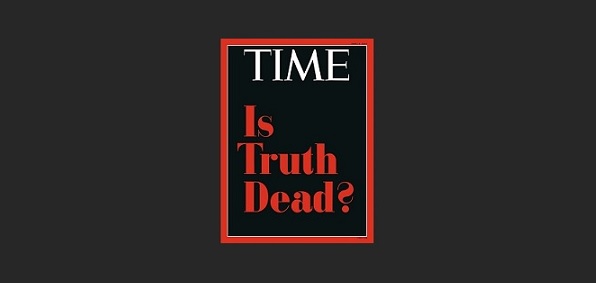
You have probably seen the attention-grabbing cover of this week’s Time magazine. It is a very real issue in our culture and it has serious implications for how we approach faith and church.

Truth has been an urgent topic this semester in the seminary classroom as some students have been asking what it means to think about religion and faith in a “post-truth” society.

I know that some status quo cynics and kind conservatives will smirk and try to dismiss these developments as just the latest assault on ‘what the church has always believed’. They will point to Herod asking “what is truth” in John 18:38 or quote Jude 1:3 and attempt to hide behind “the faith which was once for all handed down to the saints”.

Both of those attempts at dismissive evasion miss the point that something has shifted in our culture.

My hope is to seize this moment and to have an honest-to-God reality check that engages in an open-eyed assessment of the actual situation that we find ourselves in.

Here is the approach that I am taking with my students: 

We are exiting a time when truth has been purported to be both universal and timeless. IF that were ever true, and that is debatable, then it is certainly less true today than it ever has been.

First, nothing is timeless. Even if one wants to assert that something is not time-bound, it at least has to be time-ly. 2nd Temple Judaism, Pentecost, the Council of Constantinople, the Nicene Creed, Augustine’s confessions, Thomism, the Protestant Reformation, the birth of Methodism, the 2nd Great Awakening, and the Azusa Street revival were not timeless. They were all timely.

Second, things are not universal – they a situated, located, and particular. Things can not be presumed to be the same everywhere and simply applied anywhere. When and where (not to mention how and why) matter deeply.

Having said that, we have an opportunity (here and now) to evaluate our approach to truth and assess how we want to address this crisis in our culture.

Side-note: perhaps the worst thing that we could do at this kairos moment is to double-down on our truth claims of past centuries and continue to ignore the fact that things may not work as well, as smoothly, as predictably, or as justly as we had been told.

A great start begins with this realization:

Any claim to truth is:

  1. Partial
  2. Provisional
  3. Perspectival

It is partial because I never have all of the information – if there is a ‘god’s eye view’ I do not have access to it. Reality check: if there is a God, you are not God. This doesn’t mean that you have no access to truth – only that you have limited access to truth.

It is provisional because it will need to be amended as new data becomes available. I am free to say ‘at this point, here is what I understand’. If you are under the impression that something is ‘set in stone’, you need to come to terms with the fluid nature of our understanding and the perpetual/liquid nature of our access to all that is going on both in what we can see and the stuff behind the scenes.

It is perspectival because you can only see things from where you stand. Get rid of any notion of being ‘objective’ – you are subjective (thank God) and any access we have to truth is subject to review.

Is truth dead? Not exactly. 

Is our understanding of truth in need of adjustment for our liquid era of perpetual motion and exponential change? Yes. 

Do we still get to believe that things are true? Yes! 

Does that require a little bit of humility and even repentance from our addiction to certainty? Absolutely. 

Mid-March Madness

The past month has been incredibly intense.

I had the honor of flying to NY to meet with my father and his board about rebooting his global ministry.

I am mid-semester at the seminary with 4 amazing classes (ecclesiology, essentials of christian theology, culture & system change, and world religions)

C3rhitkVcAAxGmD

While I was back east, I went to the Methodist Archives at Drew University and found the documents that I needed to complete my dissertation!!!

I have been applying to professor jobs in the areas of religion, theology & ministry.

I have been talking with denominations about the possibility of being a pastor with them (come August) and have great hope that something is going to work out.

Lastly, I have also been developing a model for revitalizing existing churches AND connecting with post-evangelical / this-is-not-for-me 20 and 30 somethings. [more on this to come]

As you can see, I could use some prayer.

I want to finish this season of being a professor and writing the dissertation well.

I also have an eye toward pastoring again and what it might mean to model what it looks like to do church in a different way.

Thank you for your care, notes, prayers, and engagement. It means a LOT during this time.   -Bo


Intensifying Cycles

Being a professor is amazing. I am grateful for the opportunity and I am enjoying it so much. Do I miss being in pastoral ministry? Yes. Would I be a pastor again? Absolutely. Am I called to help the next generation of women & men find their way into ministry in the church? Yes!

Since my last post I have had 2 sets of intense conversations about the degree & type distinction – the first centers around the internet and the second relates to 9/11.

We live in a politically turbulent time and many people harken back to the 60’s/1968. This is a 100% valid claim. Many people alluded to the similarities and made a case that our current environment/situation is even worse than it was back then. Those who like to quote that ‘there is nothing new under the sun’ shrug these similarities off by talking about how things are cyclical and how people like to hit the panic button but in the end we figure it out and things just keep on going.

That might all be true. The differences that I want to account for, however, are three-fold:

  1. the internet
  2. 24 hour news cycle
  3. increased cynicism, distrust, and discouragement

The growing disillusionment with the system, the fatigue from the constant barrage or coverage, and the crisis overload of manufactured spectacle causes me to ask …

Is it possible that our political, economic, racial, domestic, foreign, and environmental concerns are not just different in degree from 1968 but are in fact a new type or different kind of crisis?

I at least want to be open to the possibility that we have crossed into a different sort of quagmire and that we don’t want to simple shrug that off with a ‘this happens every generation or so‘ kind of mentality. Which brings me to the second point.

9/11 was a watershed. It just so happens that the readings for all 3 of my classes this week are from the 1990’s. I can not overstate how old they all sounded. It was like they were from a different era. I started pastoring in the 90’s and every time I talk about the changes that I have seen in just those 20 years, people laugh in recognition of how quickly things have moved.

Invariably the nothing new under the sun crowd says that God is still on the throne and that things have been changing since Bible times.

I just want to be open to the possibility that we have crossed into a different era. Between the internet, airline travel, farming practices (industrial agro), constant media, the global war on terror (not a country) and 1,000 other factors … the change is coming not incrementally any more – but exponentially.

Something is definitely different. That can not be questioned. The question is, “is it different in degree only, or is it different in kind?”

I would love to hear your thoughts.

Different in Degree or Kind?

In an either/or world where things are so often presented to us as binary options, it is vital for the thoughtful christian to have maneuvers or techniques to counter the paralyzing confinements of the dominant framework.

The problem with these either/or options is not necessarily with the two options themselves. In fact, they both might be valid in and of themselves. The primary problem is that they are conceived of (or presented as)  A) non-overlapping and B) adversarial.

It is this dual-ism that results from the inherent divide of nearly every topic in modern American life: republican/democrat, creation/evolution, protestant/catholic, white/ person of color, lost/saved, married/single, male/female, gay/straight, conservative/liberal, etc. The list just goes on and on. Nearly everything is framed in this oppositional binary way, then turned inward toward  a ‘silo’ it becomes an echo chamber which then becomes a shouting contest and the volume goes up to 10. It is deafening.

In the past, I have used a simple technique of 3-4 to disrupt the either/or (1-2) stalemate. For instance, in the creation/evolution divide I look to a 3rd way (often a middle-way) of intelligent design to ‘split the middle’ and then look for an approach completely outside the bounded-set. Vine Deloria Jr. helps me there with his book Evolution, Creationism, and Other Modern Myths  to introduce the category of non-western origin epics.

I do the same with politics when the either/or mistakenly talks about ‘half of the country’. I point out that actually most of the country didn’t vote at all (3rd category) so while half of those who voted did so one way or another, the majority opted out of the system all together. Then as a dual-citizen with Canada I talk about the advantage of coalition governments (4th perspective) and the need for cooperation & compromise instead of ideology and ‘my team’ mentality which leads to a zero-sum winner/loser scenario.

Side note: earlier, I used the word ‘techniques’  and I just want to give a nod to the work of Michel de Certeau in The Practices of Everyday Life where he differentiates between the ‘strategies’ of the system and the ‘tactics’ of those who are trying to survive, subvert, and adapt to the established (dominant) order.  My use of ‘techniques’ is a homage to his ‘tactics’.

Recently, I have tried a new technique that seems to bear good fruit, even if it is different  than the 1-2-3-4 approach.

The question is: “Are these different only in degree or type?”

This started with christology when asking “is Jesus’s humanity different from ours in degree (more intense) or was he an entirely different kind of human than we are? The answer, of course, is that Jesus was fully human and thus differs from us in degree (faithfulness or openness to the divine). Jesus was the same kind or type of human as we are. This saves us from the popular modern misconception that has Jesus in some sort of Clark Kent  mud-suit which covered his divine super-man underneath.*

That conversation was so fruitful that I have begun to adapt it for other topics. My favorite one so far is in ecclesiology when asking about denominations. Are these two groups different in degree only or are they entirely different types of christianity? It is really helpful, at some level, to have permission to say ‘while these two groups both claim to be christian, they are so different that it may be difficult to find a common thread to link them’.

Degree & Type is especially helpful to correct the soft-cynic type who loves to quote that “there is nothing new under the sun”. When it comes to things like war, we need to ask if modern warfare differs in degree or type from the kind of military strategies that we see in the bible or in colonial history. The truth is that with the introduction of nuclear weapons, war needs to be thought of as a different type. It is not simply an escalation in degree but we have graduated to a different kind of military.

I have been in the classroom a lot lately and I have been finding the degree & type tool for analysis very helpful. It seems to open up new possibilities for people to look at classic sticking points and contemporary conundrums in ways that are not so limiting.

I wanted to introduce it here because I plan on employing in on some upcoming topics. It has added helpful richness and nuance to conversations about Jesus, church, the bible, denominations, politics, military, sexuality, and so many other relevant issues for 21st century expressions of faith.

Let me know what you think.


*  If I ask you “how did Jesus turn water into wine or do other miracles” and your answer is “he was god” then you have missed the full humanity of Jesus and we need to talk about the work of Holy Spirit.


Create a free website or blog at WordPress.com.

Up ↑