Search

Bo Sanders: Public Theology

updating & innovating for today

Excited about Easter: resurrected faith

Across N. America, the two largest groups of people who are reclaiming their faith are traditionally parents of little ones who are settling down and putting down roots – and those who are finding a different version of faith in a new community or expression.

Various labels are often assigned to this second group: unchurched, post-christian, or the ‘nones’. However one classifies this trend, this category is often populated by those who were raised in a fundamentalist, evangelical or even mainline tradition and have walked away.

The faith of their upbringing either doesn’t fit, doesn’t make sense or just isn’t useful anymore.

But then something happens.

The trigger may be a crisis or an unsatisfied hunger or the birth of child. Whatever initiates the change of season is not predictable. What is predictable, however, is that in a search for a community or church there is a tangible desire to connect with a vibrant but thoughtful expression of ones faith.

In my dual-role at the church, I am in a unique position to see both groups

  • finding something lost
  • connecting with something deep
  • awakening to something new

There is something so refreshing and hopeful about finding a spiritual community where you can plug-in to ministries that are making the world a better place and you don’t have to check your brain at the door.

As the Minister of Children, Youth and Families I have seen dozens of young families tie into the life of the church community through the liturgical Sanctuary worship. It brings great joy to my heart to watch their little one get settled into the nursery, Pre-K or Sunday School routine and know that their child has a spiritual home that will nurture them and facilitate that child’s growth into a mature believer who can intelligently embrace a faith that will carry them for the rest of their life. Touch screen mobile phone, in hand

As the co-Pastor of the Loft I have heard dozens of stories from people who had walked away from faith and who have seen that faith resurrected in our unique environment filled with coffee, couches and conversation.

As someone raised evangelical, I confess that it makes my heart sing to hear stories of resurrected faith!

I don’t apologize for my inherited soft-spot toward stories of renewal and awakening.

Many people have stories of reclaiming their childhood faith but have no interest in continuing to hold onto childish ideas. Our faith is supposed to be child-like but the 21st century requires that it be thoughtful and vibrant.

Heading into Easter this year, I have been thinking about all of the young families who have dusted off their commitment to a faith community as well as those for whom faith had all but died, and how for both this Easter is going to seem especially meaningful.

It is an exciting time to be at a church that is committed to issues of justice, thoughtful in its approach and expanding its ability to connect with the community.

Whether it is an awakening of a dormant faith or the resurrection of something that had completely died, faith is being renewed in the life of the church.

We are an Easter people and that means we are always coming into new life.

I pray that you are as encouraged and excited as I am in the lead up to Easter. 
On This MLK Holiday

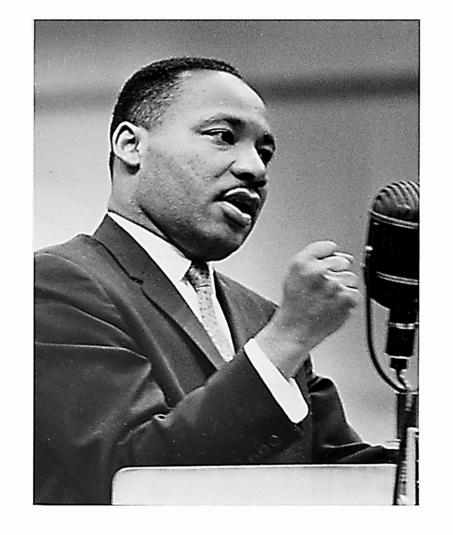
Dr. King has given me the direction for my next 41 years.
Understand, the loss of my mother has caused me a nearly indescribable amount of pain. I have given great thought to changing the entire direction of ministry – it has to be about more than just helping people understand the Bible better or be a better person.
Dr. King’s ‘triplets of evil’ are alive and well in our world and impact us all everyday … but because they are imbedded in larger structures they can hide from people’s awareness and so they need to be investigated, exposed and subverted.


After my mom’s passing I flew to NY for my dad’s birthday, and over the course of that weekend my father and I were able to return again and again to a conversation about why this has become such a conviction for me. It was probably one of the most important conversations I have ever had with my father. He really heard my heart and came to understand why I have gone the direction I have with life and ministry.


In honor of this holiday and my mother’s memory I want to say two things:

  1. Be kind to each other. We are all carrying hurts and concerns and scars that may be impossible to see from the surface. As humans, we are all in this together … the world doesn’t need more strife and violence and division.
  2. We are all caught up in systems and structures that work against the ‘common-wealth’ of humanity and the planet. They need to be confronted and radically dismantled.

Now, as a christian minister I have chosen to stick with the gospel as I think that it provides the tools to do these two things.
On this MLK holiday I just wanted honor the legacy of a man and movement that has deeply impacted me and inspired my vision for the next 41 years.

“We must rapidly begin the shift from a “thing-oriented” society to a “person-oriented” society. When machines and computers, profit motives and property rights are considered more important than people, the giant triplets of racism, materialism, and militarism are incapable of being conquered.” Dr. Martin Luther King Jr.

Born Of A Virgin? It happened a lot back then

I posted this 2 years ago and thought it might be fun to revisit. 

As Christians we confess that Jesus was born to a virgin.  Some people doubt the accuracy of that – but they may not realize that it was not that uncommon back then.

Here are just 10 people born of a virgin in the ancient world: 

  • Buddha
  • Krishna – born without a sexual union, by “mental transmission” from the mind of Vasudeva into the womb of Devaki, his mother.
  • Odysseus
  • Romulus
  • Dionysus*
  • Heracles – Son of a god (Zeus)
  • Glycon – son of the God Apollo
  • Zoroaster/Zarathustra
  • Attis of Phrygia
  • Horus

One theory is that when somebody who led a deeply impactful life died, those who wrote about them later would attempt to say something special about them. One of the ways that they could do that was to say something extraordinary about their birth. It was a way of that there was something significant, even about they way that they were conceived.

Sometimes it was that they were born to people that were really old (past the age of child-bearing age).

Think of Issac born to Abraham and Sarah in the Old Testament or John the Baptist born to Zechariah and Elizabeth in the New (Advent).

Now, If somebody wanted to take the origin of their hero up a notch, they could say that there was no human dad … it was a god!  (like Zeus)

This is why some think that Jesus’ autobiographers took it up even one more notch! Not only did a God not have sex with women … there was NO sex at all!

 Now some say “yeah, lots of people were said to be born of a virgin … but Jesus actually was.”

This is where the problem starts. As best as I can discern, there basically three ways to approach the problem: physics, meta-physics or linguistics. 

Physics:

Some people take an approach that is so certain that even science itself would be proved wrong. This usually comes up around issue like the Shroud of Turin (the cloth Jesus was buried in). I once heard a very confident person say that if we did DNA test on the blood on the shroud it would show that Jesus was fully human with 46 pairs of chromosomes – only instead of 23 from the female mother and 23 from the male father – Jesus would have 46 human ones from Mary.

I find this problematic for the same reason that I do not believe in the super-natural. It concedes the rules of the games to science (reductive naturalism) then tries to fill in the gaps with God.  That is a losing game-plan if ever I heard one.

Meta-Physics: 

Other people try to get around the whole reductive scientific debate by saying “Look, if God could make the world in 6 days out of nothing, then what is to make a virgin pregnant?  God does whatever God wants to do and who are we to question that?”

I am not a big fan of this approach either. It seems to say that revelation doesn’t have to report to reason and that God can not be evaluated on any reasonable standard conceived of by humans.

It seems just a short leap to say that God can elect who God wants for salvation God can pick favorites if that is what ‘He‘ wants to do.

It seems to retreat into the silo of ecclesiastic isolation and unaccountability. I think we have to look a little deeper ask some bigger questions.

 Linguistics:

This is an interesting approach that some in the post-liberal camp or comparable schools of thoughts might take.

The basic line is that it’s not the physics or meta-physics of the virgin birth that matters, its the way that it impacts us as people and forms us as a community. The importance of the language found in the gospels has to do with how it functions for us as a community and tradition.

Some folks don’t like this linguistic approach because it seems like theologically ‘thin soup’ to them. They look at the formulations that are quantified in the early creeds and they make definite and literal assumptions about what is behind them.

I am however nervous that all of this controversy is simply because we don’t know how to read a gospel. It’s like when we get sucked into debates about talking snakes in the garden of Eden or trying to prove scientifically how a man like Jonah could stay alive in the belly of a whale for 3 days and not be eaten by the stomach acid (or something).

It would be the equivalent of people 1,000 years from now arguing that we actually thought there was a place called Mudville and that a man named Casey was literally up to to bat.  It is because we don’t know how to read the genre of literature.

Jesus was born of a virgin – we confess that by faith, it is affirmed in our ancient creeds and it functions in our community to form us as people.    

* I even found one internet source that claims Dionysus was born of a virgin on December 25 and, as the Holy Child, was placed in a manger. He was a traveling teacher who performed miracles. He “rode in a triumphal procession on an ass.” He was a sacred king killed and eaten in an eucharistic ritual for fecundity and purification. Dionysus rose from the dead on March 25. He was the God of the Vine, and turned water into wine. He was called “King of Kings” and “God of Gods.” He was considered the “Only Begotten Son,” Savior,” “Redeemer,” “Sin Bearer,” Anointed One,” and the “Alpha and Omega.” He was identified with the Ram or Lamb. His sacrificial title of “Dendrites” or “Young Man of the Tree” intimates he was hung on a tree or crucified.

Wrapping Up Advent – as far as the curse is found

This has been the most interesting Advent I have ever participated in.KONICA MINOLTA DIGITAL CAMERA

Between the High Gravity class following the lectionary texts and the Loft LA delving deep into the season, I have learned and experienced a lot of things that are heavy on my mind as we head into the final week of Advent.

Far As The Curse Is Found

The hymn ‘Joy To The World‘ has some amazing lines in it:

Joy to the world, the Lord is come!
Let earth receive her King;
Let every heart prepare Him room,
And Heaven and nature sing,
And Heaven, and Heaven, and nature sing.

Joy to the earth, the Savior reigns!
Let men their songs employ;
While fields and floods, rocks, hills and plains
Repeat the sounding joy,
Repeat, repeat, the sounding joy.

No more let sins and sorrows grow,
Nor thorns infest the ground;
He comes to make His blessings flow
Far as the curse is found,
Far as, far as, the curse is found.

He rules the world with truth and grace,
And makes the nations prove
The glories of His righteousness,
And wonders of His love,
And wonders, wonders, of His love.

Far as the curse is found is one of the most poignant lines in any hymn ever. Think about it … Romans 5 is about the same theme:

12 Therefore, just as sin entered the world through one man, and death through sin, and in this way death came to all people, because all sinned—

18 Consequently, just as one trespass resulted in condemnation for all people, so also one righteous act resulted in justification and life for all people. 19 For just as through the disobedience of the one man the many were made sinners, so also through the obedience of the one man the many will be made righteous.

Unfortunately, many have been taught to read the Bible in a way that makes Adam way more powerful than Jesus. Ouch.

Far as the curse is found means that God is interested in redeeming the whole damned thing. 

There is no other way to say it.

In fact, this past weekend we tackled the genealogy of Jesus from Matthew’s gospel and I was struck again with how shocking and scandalous Jesus’ family tree is. It’s not just the unorthodox inclusion of those with dubious reputations and questionable qualifications – and that’s not even including that women! It is the fact that God is involved in the whole damned thing.

It all belongs. God is active in redeeming the whole thing.

It’s not just that Jesus leaves behind his family tree or simply overcomes his heritage to become an exalted figure … he is both the outcome of God’s activity IN his family and the result OF his heritage.

Speaking of which: here is an amazing rendition of Jesus’ genealogy sung to the tune of R.E.M.’s ‘its the end of the world as we know it’ by Brad Hooks

Genealogy of Jesus (and I feel fine) from Bo Sanders on Vimeo.

Lyrics:

That’s great it starts with the birthday
Of the very first man, yeah his name was Adam
Skip a couple thousand years, there was a dude
Who was looking for the Promise Land,

call him Father Abraham, Abraham had a kid, Isaac had a kid
Judah had a kid, Perez he did too
No I’m not talking Perez Hilton
But the one who had a son named Hezron

Ram, Amminadab, Nashon, Salmon,
Boaz, Obed, Jesse, David, right, right
Don’t forget Solomon, He was a wise man,
Who had a son named Rehoboam

Abijah, Asa, Jehoshaphat, Joram
Uzziah, Jotham, Ahaz, more then
That brings us to Hezekiah, Hezekiah
Manasseh, Amon, Josiah

Here is the good news and the bad: 

Good – God is interested in redeeming your family tree, heritage, history and the entire road that has led up to this point in your story!

Bad – God loves them too … the things you regret, the people you would distant yourself from, the choices you would change …. the whole damn thing.

There is no ‘us/them’. It is a facade – an illusion. We are all us. We are all in this together. The slave is our brother – we are all God’s family.

  • The good and the bad.
  • The oppressed and the privileged.
  • The sacred and the secular.
  • The holy and the profane.

The hard truth is that our apparent divisions are but an illusion. God is in the process of redeeming the whole damned thing.

Police Violence Is The Exception

I posted this last week in response to two conversations with friends who are very upset by the failure of the justice system to protect unarmed black men (and boys)  from those who act on behalf of the law.

I have not been blogging much as I am in preparation for my qualifying exams in the Spring. Part of my reading has been in ‘political theology’ so I thought I might share some relevant items that I have gleaned from my studies.

______________

“Sovereign is he who decides on the exception” is a sentence by Carl Schmitt that introduces ‘political theology’. That word ‘exception’ is a key to understanding what is going on in our nation right now.

In the last four centuries ‘sovereignty’ has shifted from God and the King to the Nation and State. In that same work, Schmitt also says that “All significant concepts of the modern theory of the state are secularized theological concepts.”‘

The State* now has both the ceremony (pledge of allegiance – national anthem at all sporting events, etc.) and the power (rightful claim to foreign and domestic violence).

In a fantastic article by Bruno Gulli examining Schmitt, Gulli explains “any person with special powers (or even simply a special sensibility) could be recognized as sovereign. This would be an honorary status conferred on him.”

 The State, and those who defend it – whether police or military – have the power of exception. It is important to understand it that:

  •  The playing field is not level. It is slanted.
  •  The rules do not apply equally. There is an exception.

Citizens who are upset are not permitted to be violent. They must protest in an orderly and civilized manner.

The police/riot-squad/ military are seemingly allowed to escalate and utilize violence because they have the exception of the state behind them.

We are not all playing by the same rules. Citizens have an asymmetrical relationship with the State when it comes to violence.

It is vital here to understand the insight of Max Weber when he talks about the State’s monopoly on violence. The link explains that:

“Weber describes the state as any organization that succeeds in holding the exclusive right to use, threaten, or authorize physical force against residents of its territory. Such a monopoly, according to Weber, must occur via a process of legitimation.”

Violence is a one-sided relationship. The State – and those who act on its behalf – may behave in violent ways because it will always be construed as exceptional.

Bonnie Honig, in Emergency Politics, says “The state of exception is that paradoxical situation in which the law is legally suspended by sovereign power.”

The problem is that we now live in a permanent state of emergency.

September 11, 2001 ushered in a state of perpetual exception. This applies to racial profiling, police brutality, State surveillance of its citizenry in the NSA – to name only a few.

When people are scared they willingly sacrifice their freedom and privacy in exchange for safety. The State benefits from a frightened population and people are more willing to accept the exceptional violence and excessive forced used by law enforcement. They are more likely to turn a ‘blind-eye’ or call them ‘isolated incidents’ and claim that they are being ‘blown out of proportion’.

A population is more willing to view as exceptional the excessive tactics and escalation of violence precisely because we now live in a permanent state of exception (or emergency).

What do we do now, however, when communities are not sure they are being protected by the police and in fact need protection from the police?

In the article cited earlier, Gulli reports, “At the end of his critique of the state of exception, Giorgio Agamben addresses the question of contingency, which is very important in all of his work, when, with a reference to Benjamin, he speaks of “the urgency of the state of exception ‘in which we live’” (2005)

In his eighth thesis on the philosophy of history, Walter Benjamin says:

“The tradition of the oppressed teaches us that the ‘state of emergency’ in which we live is not the exception but the rule. We must attain to a conception of history that is in keeping with this insight. Then we shall clearly realize that it is our task to bring about a real state of emergency.” (1968)

I hear people asking about the current protests, “What are they hoping to accomplish?”

One thing they could accomplish is to create a real sense of emergency that will call into question in the larger American conscience a question about the permanent state of exception that has crept in over the past decades. The supposed ‘war on terror’ and ‘war on drugs’ are but two examples of this.

None of us want to live in a police state.
No one I know wants to live in a state of fear.
That it why we must question the exceptional violence and emergency politics that have become too normalized and quietly accepted in our society.

The people are raising their voice in protest of this exceptional violence.

_______________________

* I will be capitalizing ‘State’ to illustrate its elevated and exceptional status.

** I know four people in law enforcement and they are all amazing, loving, kind, people. My concern is about a larger mechanism in our society.

For a powerful response to Schmitt, see Paul Kahn’s Political Theology: Four New Chapters On the Concept Of Sovereignty 

Wake Up! Advent, Shopping and Sleeping

We are trying something new for Advent this year at Homebrewed Christianity. Each week we are looking at the 4 suggested texts from the lectionary and talking about how we would approach them.KONICA MINOLTA DIGITAL CAMERA

In week one there were 3 texts that we resonated with and a fourth that we struggled with. That fourth text was Mark chapter 13 where Jesus talks about signs of the end, fig trees and catastrophe.

The one thing that I do like about the fourth text is the exhortation to ‘stay alert’. There are many passages in the Bible that call us to wake up or stay alert. It is a theme that always gets my attention.

 What are we in danger of falling asleep to?

What is causing that slumber?

Some would want to answer with a classic concepts like human nature, the effects of sin, or some other predictable formulation. While those may all be true, the danger has never been greater nor the effects as pervasive as they are in 21st century.

We live in an odd time of global markets, multi-national corporations and rampant consumerism. Ours is an age of media saturation, electronic daze and commercial overload.

I have found the tool of Critical Theory helpful in analyzing our age of what Cornell West calls ‘weapons of mass distraction’. High modernity has brought us both amazing goods and services (think cell phones and the internet) as well as unprecedented capacity for destruction and devastation.

The formative thinkers in the field of Critical Theory were responding to the massive shifts of the 20th century and the realities of two World Wars that exposed human suffering and the capacity of evil in new ways. Not only did we have Hiroshima and Auschwitz but we had them on film. Some talk about this being the end of ideology (utopia) and the resulting loss of hope.

I have adapted and modified some relevant concepts from my reading and will be using them this weekend for Advent week 1. The questions this week are:

What have we fallen asleep to?

What is causing the slumber?

To what do we need to be awakened?

Black Friday is the high holy day of capitalism. Consumerism is a seductive and intoxicating atmosphere – it is the air that we all breathe in late modernity.

Consumerism, however, has a numbing effect that dulls our senses and saps our energy. This happens in 3 predictable phases.

  1. Alienation
  2. Disillusionment
  3. Resignation

 Alienation is the result of humans being commodified and thus separated from that which they produce. It also isolates us from one another as we are simultaneously objectified as consumers and subjected to an onslaught of ads that inform us we are not good enough, we don’t have enough and that the thing we don’t have would make us happy-attractive-successful.

 This leads to disillusionment because we buy stuff, we pay for services, we upgrade, we super-size … and yet it does not satisfy. We are dis-couraged. Aren’t we supposed to live in a post-racial America? What is one supposed to do in the fallout from the recent economic collapse and ongoing environmental devastation?

The final stage is resignation. The machine is too big. It feels like we are just cogs in a giant mechanism of consumption, corruption and growing disparity. The game is rigged and we know it. But we need stuff so we work more than we ever have and are less satisfied. We watch the news and see how bad is out there and we want to retreat into our screens and games. From Candy Crush to Fantasy Football we are active participants relegated to passive spectators.

We are slowly lulled to sleep in the system and numbed to the needs of our neighbors.

What can one person do in the face of this overwhelming and all-encompassing structure of society?

 Wake Up! Stay Alert! Don’t be dis-couraged.

That is the call of the texts this week. Don’t get distracted by falling stars and light-less moons. Listen to what Jesus is saying. He is telling you that it is going to get bad. Yes there will be progress in certain ways … but don’t be deceived: evil just morphs and takes on other forms.

We can celebrate that slavery ended for one part of the population… but realize that there are more humans in slavery right now than at the height of the slave trade.

Racism is not as overt as it once was … but now it morphed into a New Jim Crow and Dog Whistle Politics.

Wake Up! Stay Alert!

If the slumber results from alienation, disillusionment and resignation then the beginning of waking up is three-fold as well.

  • Realize that the game is rigged. The rich get richer and the poor get poorer.
  • Admit when you feel giving up, giving in and checking out. We need each other (see the 1 Cor text from Advent 1)
  • Listen to a community that is different from your own. Don’t be deceived that all you can see is all that is going on.

Do these three things and you will be amazed at what you are awakened to.

If you are interested you can listen to the episode – Mark 13 starts around the 1 hour mark.

You can also sign up for the class for December.

Advent is Almost here : High Gravity Class

highgravity_RadTheo
Advent is on the way! I thought you might like to try something different this year and join an online reading group that meets every Thursday evening.
What better way to practice the holy waiting of this Advent season than streaming weekly with some Wise-ish Nerds on the internet?
Each week Tripp and Bo will be looking at the liturgical texts for the upcoming week of advent and using a different theologian to dig deeper into the themes of the week.
Expect to encounter Jack Caputo’s discussion of the ‘to come,’ Catherine Keller’s Parabolic Christology, Kathryn Tanner’s incarnational Christology, reflections on Ebenezer Scrooge, New Testament fun with Borg, Wright, and Horsley & hopefully Tripp will talk Bo into reading his theologically revised version of ‘The Night Before Christmas’ in a deep sultry radio voice.
Each session will be at least 90 minutes, maybe 2 hours, that covers a bible episode and a theology episode, and available as a live stream or as a download afterward.  We will post some readings for each week and will be taking questions before and during each session.  We hope the mix of theology, bible and liturgical season makes this a sermon or small group leader prep session and for the many Deacons without a faith community a chance to find some online partners during the advent season.
Head over to the High Gravity class page and sign up today!KONICA MINOLTA DIGITAL CAMERA
Thursdays @6pm (pst) / @9 (est)
  • 11/27
  • 12/4
  • 12/11
  • 12/18

More on Miracles

Last week I got a comment on an old blog post. Since this subject comes up frequently, I thought it would be good to respond.

I hope you get some sort of update from comments posted on old posts.

Indeed I do! Thank you so much for taking the time to write in.

I’ve been trying to work through how I understand God working in the world and have felt pretty comfortable with saying that God doesn’t make things happen in this world. For me, that still allows for relational interaction with God but the one place that I am getting stumped on is miracles or even just praying for things that may be outside of personal introspection or transformation. I have never seen any miracles like the ones I’ve heard about by several very close people I know. When I say miracles I mean things like paralyzed people being healed and even people’s limbs growing back. I know it sounds crazy but I hear really sound people that I respect telling about how they have done these things. Now, I don’t want to discredit it just because I personally haven’t seen it. Then there are things like Jesus healing a blind man with mud and spit, was it psychosomatic? I don’t know how to approach these things.

The one thing I would say is that we have not taken the gospel stories about Jesus seriously enough. We look at them from a very mechanistic point of view: What was the product? What was the process? Can it be replicated? Are there measurable outcomes?
We get very focused on the byproduct or the outcome (healing) and miss the rich narrative and literary emphasis of the story itself. “Jesus healed a guy” I hear people say … “Yes but notice how and where” I want to respond.

The two things people often fail to notice is that:

  • It was almost never in the same way twice. That signals to me that healing is neither formulaic nor is it reproducible. Something was going on in those stories that is tailored to that person and that time. I love the gospel stories of Jesus’ healings … almost as much as I hate it when people try to make healing standard and ritualistic.
  • Those stories play a role in the gospels that they are found in. These accounts in John 9 and Mark 8 function in the narrative that both John and Mark give us. Synoptic studies are one of my favorite hobbies and one of the things you quickly learn is that those stories can not be lifted out of their gospel and simply cut & pasted into another gospel. The story is told a certain way and plays a unique role within the larger text.

The stories of Jesus’ healings don’t happen in a vacuum. That play a performative function with the gospel narrative and must be read within that context.

One of my first clues that this was true is that no one – even those of us who believe in healing – spit on the ground and put mud on people. Why? Because it is not a formula! Something unique was happening in that story and we all sort of secretly know that.

Just because Jesus walked on water doesn’t mean that you don’t need a boat!

The gospel stories about healing had to do with Jesus’ messianic claims and that is why the Bible is not a how-to play book or manual. The formulaic mentality around healing today is a disastrous byproduct of the Industrial Revolution … oddly the same era (thanks to Gutenberg) that allowed for mass-produced Bibles so that we can all read it for ourselves! But that is a different blog post.
The Secret Message of Jesus is the best book I have ever found for talking respectfully about the role that these healings play in their unique gospel accounts.

I have much more to say about this … but I need to get to your real question!

With this being said, if miraculous healing through prayer is possible (which I sort of hope is) my question would now be why does God only choose to heal some people and let others who are being prayed for suffer? Or why would we have to pray for certain sufferings to stop? Why isn’t it enough for a certain person to be suffering and need God’s healing? Do our prayers make God’s intervention possible in a way that he couldn’t do without? Let me know what you think and thanks for giving your time!

Let me begin by saying that you have perfectly asked the central questions of this difficult issue. This is why some people walk away from the subject all together and dismiss any accounts of modern-day healing. Even those of us who try to practice the way of Jesus and follow his example are often baffled and left either shaking our heads or shrugging our shoulders.

If God can heal and doesn’t …
If we have to be good enough …
or believe hard enough …
or pray long enough …
or pray good enough …
If this is in any way based on our merit … this seems like a problem.

On the other hand – if God can do something and doesn’t …
maybe it is for a larger purpose …
or maybe it is just ‘not yet’ …
or maybe we just look forward to our heavenly bodies on the other side …
or maybe God is really finicky.
These are all possibilities and actual things that I have heard people say.

Here is where I am on the issue: God is doing the best that God can do. I don’t believe that God is holding out or that God’s goodness will run out.

I have said before that I have become very comfortable with the possibility that the world as it exists is the best that God can do. I’m not saying that I believe that – just that I am open to that possibility.

  • What if God is doing all that God can do in the world right now?
  • What if God isn’t all-powerful but only very powerful?
  • Or that God’s power is a different kind of power?
  • What if God isn’t pretending or self-limiting?
  • What if God is giving all that God has to the moment?

Once you move on from an ‘interventionist’ notion of God the whole world looks different. The word ‘supernatural’ is one of the worst concessions that modern christians have made. I believe in miracles (outside the ordinary expected) and I remind folks that the Biblical formulation of ‘signs and wonders’ is not the same as ‘super-natural’. These phrases get all mashed together by those who have taught this way. We need to take the Gospel accounts seriously enough to slow down and reexamine our assumptions.

There is no such thing as ‘super-natural’.
God’s work is the most natural thing in the world.

I do not believe in a realm (the natural) that is without God. As a Christian, I believe that God’s work is the most natural thing in the world. I am unwilling to concede the natural-spiritual split and then leave less and less room for God as science is able to explain more and more. The church is foolish to accept the dualism (natural-supernatural) and then superintend only the spiritual part.

Thank you so much for writing in! It has been fun to revisit this concept. You may want to check out my post on Prayer and Poetry and Dealing with Demons as well.

Let me know your thoughts or any questions you have. This is a difficult topic but a very necessary conversation.

small prayers to a big god

When life gets rough it can have the effect of wearing you down. I’ve heard analogies of sandpaper, being sand-blasted or being caught in a sand-storm. However you phrase it, it seems like the end result (or the silver lining) has something to do with being refined or that the rough edges are smoothed off.

To me, it feels more like being cut down to size or chopped at the knees. It doesn’t always feel like a good thing.

People try to assure me in the end the difficult process will have been worth it. The pain is temporary, the product is what lasts.

This past Sunday at the Loft, I shared that I pray much smaller prayers than I used to. I used to be very focused on two things:

  1. personal holiness and piety
  2. spiritual warfare in the heavenly realms

The problem that emerged for me is that the gap between little ole’ me and the massive cosmos became too large. I was missing that connective layer between my personal goodness and the ‘principalities and powers’ in spiritual realms. ‘Personal piety’ and ‘spiritual warfare’ are probably fine on their own. For me, however, the gap between them became too wide and I fell through the cracks.

I have never stopped praying – but the way that I pray is a little bit different. I now pray small prayers to a big god.

There is a god and that god – by the very nature of being god – can handle god’s self and take care of the types of things that god would be concerned with. Prayers aren’t so much focused on my goodness or on angels and demons anymore.

Prayer allows me to make my self available to the good things that god has and to align myself with what god might be doing. Aligning myself is done in the hopes that I might be the kind of person that god could use in the world. I ask god’s spirit to examine my orientation, trajectory, and speed as I recalibrate my journey.

I jokingly call these small prayers ‘nuclear prayers’. It is a funny play on words because in a post-holocaust world where we now know that humans have the ability to commit atrocities on a massive scale and to blow up the whole planet … one needs to be a little more humble about one’s prayers and their power.

My prayer life has changed a lot in the last 10 years. I now pray small prayers to a big god.

That is a part of my story … How has your prayer life changed in the past 10 years?

smallprayerBIGgod

Create a free website or blog at WordPress.com.

Up ↑