Search

Bo Sanders: Public Theology

updating & innovating for today

Liberal Question part 3: Music and Whiteness

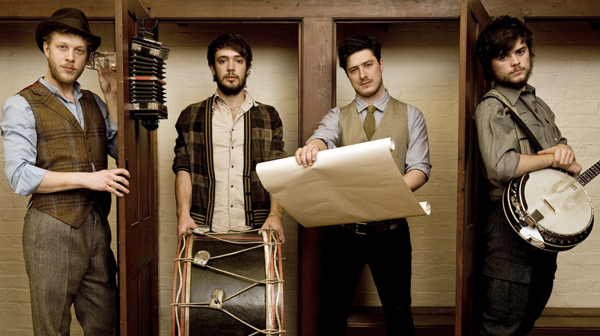
I think a lot about issues of race, gender and class. I read about it and talk it over with people every week. I am working my way through an expensive program in order to write my dissertation about it.  I care about matters of diversity and justice a great deal. mumford_and_sons

Ever since talking to my mentor, Randy Woodley at Wild Goose West last fall I have been thinking about this a little differently. Then with the happenings of the Emergent Christianity thing in Memphis … I thought I would bring out what I have been whittling away at in my workshop.
This is something I am working on and I would love your constructive feedback. 

The problem isn’t Brian McLaren speaking at a conference.
The problem is if everyone speaking at the conference looks like McLaren.

The problem isn’t reading a book by a white guy.
The problem is only reading books by white guys.*

The problem isn’t having a man speak up front at church.
The problem is if we only hear men speak from up front at church.


You don’t even listen to podcasts! 

Here is what I want to avoid. There was some grumbling on facebook when The Culture Cast was released and it turned out that both Jordan and Christian were white guys. Ironically, almost all the grumbling came from white guys – but that is a different issue.

One female friend said “where are the women podcasters?”

I suggested that since it was a concern of hers … why didn’t she tell us some recommendations.  Why is she asking a question?

She responded that she didn’t listen to podcasts.

I was stunned.

I asked “then why do you care? What difference would it make to you?”

It would be like me complaining their aren’t enough black NASCAR drivers. I don’t watch NASCAR. I don’t even know how many black drivers there are. That reality is irrelevant to my existence.

I think that we need to care deeply about things that we are invested in. There are too many issues that matter for too much for us to get tangled in controversies vicariously.


We don’t except tokens.

We need to be careful of tokenism. Let me be clear on this: if you are group of white people who have organized a conference, already have 10 white speakers lined up and then think ‘we need some color – let’s see if we can get Randy Woodley’ … that is token.  Randy got no say in the direction and organization nor had any power or influence. You just want to put a microphone in his face and have him do his schtick.

Token is an afterthought that serves primarily to help one feel good about being able to check off a box. If Randy was on the organizing committee – trust me the no conference would look the same.

In contrast to ‘token’ let me offer 3 examples:

  • Anthony Smith is an emergent voice and influence. He was in the movement before me and helped bring me in. That is not token. That is influence. Anthony Smith is influential.
  • When Tripp and I organized the Emergent Village Theological Conversation we said “Monica Coleman is our marquee speaker, our cornerstone, our prima donna.” And we did not do anything until she agreed to be our first round draft pick. She got session 1 to start the conference to set the tone and she got session 5 to end the conference so that she had the final word. We built the conference around that structure. We then invited others to come in around her.
  • When we inherited the Phoenix Big-Tent Christianity event many of the speakers were already in place. It was great to have Richard Rohr, Marcus Borg and Brian McLaren to boost ticket sales. But we wanted to highlight some voices that people had not heard a lot before. So, for instance, we structured the actual sessions that one of the ‘marquee’ voices was asking questions of one of the ‘emerging’ voices. For many people, that was the first time they had heard of Rachel Held-Evans. I will never forget watching her debate Marcus Borg about church folks understanding of creation!


I’m with the band. 

Here is my big point:
The problem isn’t that Mumford and Sons are all white guys. We have to look at the way that bands form. It makes sense that the guys of Mumford connect and play.

The problem is if every band on the radio is white guys.

The problem isn’t that Bono is a white guy or that U2 are all white guys.

The problem is if every band on a record label is a bunch of white guys.

We have to learn to distinguish between how a band come together and how the music industry functions.

We also need to do this for church … and for christian conferences.

No conference or podcast is or can be the full expression of the kingdom on earth. It is not nor can it be heaven. It is not supposed to be. Like no band can play every type of music …

I understand our desire for diversity – I just want us to manage our expectations. Our problem isn’t with Mumford and Sons, it’s with the music industry.

The answer isn’t “add a black guy”.  That is not how bands work.
Can you imagine somebody saying “why doesn’t Boys 2 Men have a women in it?” or “why doesn’t Destiny’s Child get Ricky Martin to join?”

The problem then isn’t with any church, podcast, organization, conference or person. Our concern is with how that all comes together in a less-diverse way than we would hope for and desperately need. 

The answer then is not to ‘add a women and stir’ or to ‘get some color’. That is what we call token – and it is insulting to everyone involved.

The need is to examine the bigger picture. This includes how things are planned, who makes decisions, and in what ways can people access resources.

Here is a timely example: Tripp and I are singers and songwriters. Our friends Callid Keefe-Perry and Steve Knight are as concerned about the impact of technology on the church as we are. We have talking about  it whenever we are together. We started this when we lived in 4 different parts of the country. Tomorrow, Steve Night is in town and we are going to record a podcast about the subject.

That is not a problem. We are Mumford, or U2, or The Stones, or the Beatles … we are just a band.
It is not a problem that we sing together – or in this case talk together. The problem comes if we are the only ones you hear.

Just to be clear: 1) I am using this an analogy. 2) I am using the music industry as a positive example.


___________________

*If you find yourself in this situation, here are some books suggestions

Quest for the Living God by Elizabeth Johnson

Christ the Key by Catherine Tanner

Teaching Community by bell hooks

Shalom and the Community of Creation by Randy Woodley

Many Colors or The Next Evangelicalism by Soong Chan-Rah

Triune Atonement: Christ’s Healing for Sinners, Victims, and the Whole Creation by Andrew Sung Park


Liberal Question part 2: Jesus Creed

I had the honor of guest blogging for Scot McKnight a couple of weeks ago. It was a good opportunity to try something out with a different crowd. It was  instigated by last weeks post in response to Roger Olsen and Scot McKnight.Facade of St. Vitus Cathedral

It was a fantastic conversation and I learned several things that I will take with me into future engagements. Here are some observations:

  • I learned to clarify the difference between people in the pew and theologians.

I go to a mainline school and work at a mainline church. I have an amalgamation in my mind of the ‘average liberal’.  But if you are in the conservative camp, your main engagement and concern is with Liberal theologians who have a high profile.

If was starting the post over, I would address this up front and make an early distinction. I think that would have helped.

  • I learned not to use the word ‘versus’ if you don’t mean adversarial.

Neither Scot nor I think liberal is necessarily  a bad thing. Roger Olsen does. But some of the readers at JesusCreed think in adversarial binaries. I was not trying to say that progressives are good and liberals are bad. I was simply trying to distinguish the two – not pit them against each other. The argument culture is so strong – especially in conservative circles – that I should have preempted that.

  •  I learned that those in systematic approaches struggle to recognize non-systematic approaches.

This is an obvious and inherent problem. If you value systematic approaches, of corse you will criticize something as ‘not systematic’ and think that stands alone are a critique. I was trying to point out that conservative, liberal, evangelical, emergent, and progressive are not 5 categories of the same thing. Some are positions. Some are loyalties. Some are approaches.

Here is what I ended up with: 

Since my Cobb quick-definition was not working for folks I thought I would ‘shift’ the emphasis and see if this language worked better:

Liberal – a constellation of loyalties inherited from the Enlightenment that is settled/assumed.

Progressive – an approach that integrates such influences as Feminist, Liberation and Post-Colonial critiques explicitly.

I’m open to help refining this – ESPECIALLY  if you are a self-proclaimed  liberal or progressive

My favorite response came from TJJ and it has me smiling ear to ear.

Qualities of a progressive ………as viewed by an evangelical……….

A. See more “grey” in their approach to scripture issues: inspiration, inerrancy, revelation.
B. Allow for more of a continuum on doctrinal/theological issues: hell, salvation, sin, depravity, exclusiveness of Gospel, etc.
C. More open ended on social issues : gay marriage, illegal immigration.
D. Trends more democratic/progressive politically
E. White, college degree and often more, affluent, alcohol, NPR, Toyota/Honda, MSNBC/CNN

Oh my. That is good.

At first read you may say “yeah – of course”.

But look at it again. It’s actually pretty helpful to see it all in one place.

I would love to hear your thoughts on any part of this whole episode. 

Liberal Question part 1: Rick Warren

A couple of weeks ago, Rick Warren provided some of us with a lot of fun on Twitter. He had sent out a message:

“New churches: Buy land as soon as you can but delay building for as long as you can. Cant explain all the reasons here.”

This set off one of the funniest followup memes I have seen called #RickWarrenTips.

Those, however, are not the Warren tweets that I want to discuss. Earlier Warren had fired two out of the blue shots at ‘liberals’. I had just finished my progressive and liberal post at Jesus Creed and so I was really interested.

Here are his two quotes:

Liberal theology cannot sustain a local congregation. It kills churches. In fact, It only survives due to tenured academics.

and

Liberal theology has never created any university. It just sucks the life our of those that were started by Bible believers.

Plenty of people had push-back on the last bit of revisionist history.  I’m not so concerned with the accuracy of his content …my question is what even spawned  or sparked it? 

What happens for somebody like Rick Warren that causes him to fire this out?
Was he reading something that has him thinking about liberals?  

Did he get in an argument with someone?
 Was he watch watching something on TV about liberals?
Was he watching Fox News or something?

I’m not so much asking for wild speculations about Warren in particular – I’m more thinking about the contentious and combative polarized atmosphere that shots like this are fired out of.

Evangelicals Really Dislike Lent

My friend Krista Dalton tweeted last week:

Was told Lent was “stupid” by a fellow Christian at school. Good reminder why I am not evangelical!

I had to fes’ up to her that I used to say crap like that and I repented.

So what is it about Lent that evangelicals hate so much? I have a two-tiered theory. 

The first involves a Theology of Glory. The second is not a cause – it is an effect – but it is born our of strangeness and suspicion.

Theology of Glory

Back in Christian history, back to the roots of evangelicalism in the Protestant Reformation, are two major approaches (if you will). The first is a Theology of the Cross held up by Luther. The second is a Theology of Glory brought forward by Calvin.

I don’t have time to get into all the sorted details, but suffice to say … that the American evangelical church has not just majored in a Theology of Glory but almost to the near neglect of a Theology of Cross.

Here is a really helpful article on the differences:

“Theologies of glory” are approaches to Christianity (and to life) that try in various ways to minimize difficult and painful things, or to move past them rather than looking them square in the face and accepting them. Theologies of glory acknowledge the cross, but view it primarily as a means to an end-an unpleasant but necessary step on the way to personal improvement, the transformation of human potential. As Luther puts it, the theologian of glory “does not know God hidden in suffering. Therefore he prefers works to suffering, glory to the cross, strength to weakness, wisdom to folly, and, in general, good to evil.” The theology of glory is the natural default setting for human beings addicted to control and measurement. This perspective puts us squarely in the driver’s seat, after all.

It’s not that we don’t like the cross – oh we love the Cross – we sing about it (the wonderful cross) and we wear them around our necks!

It’s so bad that Dallas Willard has coined the phrase “Vampire Christians” for us. He says that we love Jesus for his blood and little else. Ouch – that one stings.  Wooden Cross

It shows up in other ways too. We are almost completely ignorant of the apophatic tradition. We are so kataphatic (speaking of God in the positive) that we have no idea that there are other options! We have no negativa or posteri – it is all presence all time.

Look at our worship services. Just ask yourself: what would it take to lift your hands and sing “Shout to the Lord” at the top of your lungs … and then ask if that seems compatible with fasting or Lent.  They are just two different muscle groups. Unfortunately, those who use the one often neglect the other and vice-versa

Strangeness and Suspicion  

I’m not saying that this element causes the unfamiliarity – but once there is alienation this next element adds fuel to the fire. The suspicion is syncretism.

Think about it this way: Lent isn’t in the Bible. Historically evangelicals have been a sola scriptura bunch (don’t look into that too much) and Lent is a foreign concept. It doesn’t’ take long to dig up some dirt on Lent and find out that it has its roots in Egyptian-Pagan worship borrowed by the Roman cults. Isis lost a son for 40 days so we mourn for 40 days and then have Isis eggs that are colorfully decorated is the story that come to me.

So, I’m not saying that explains all of the animosity that evangelicals have toward Lent, but I just wanted to offer up my two-tiered theory.

It starts with neglect and ends with accusations.

It’s same reason that we kinda try on Good Friday … have NO idea what to do on Saturday … but LOVE Resurrection Sunday!


Critical Questions: part 3 “Is the Internet for Women & Gays?”

This is part 3 of a series of critical questions. You can find part 1 and part 2 here.

“Is the internet for women and gays?” may seem like at odd question at first – but there is a story behind it. I am coming at the question as a researcher.  I am doing research design at UCLA right now in preparation for my dissertation next year. One of the research questions is in relation to technology, the community of users interacts with the technology, and possible issues related to who conceived of and  designed the technology. recycle-resized-600

An interesting case study is found in the Grindr social network community.  Grindr is a widely popular mobile, GPS-enabled hook-up app for gays. The folks at Grindr  had the idea to launch a ‘straight’ version called Blendr, and it has been massive failure. [You can read about why it failed here and here and here ]

One of the theories is that Grindr was conceived of and designed by gays. A hypothesis we were testing is that embedded in the ‘DNA’ of the technology was something inherently ‘gay’ that resonated with its users but was lost in translation when the conversion to Blendr was attempted.

During this research I have also become aware of a growing problem of cyber-bullying, particularly of women and LBGT persons. It shows up on Facebook, Xbox chat rooms during multi-player games, and blogs.

One article about women bloggers contained two different women’s experience.

“The death threat was pretty scary,” says HollaBack! cofounder Emily May. “And there have been several rape threats. But it’s mostly ‘I want to rape you’ or ‘Somebody should rape you.’ Most are not physical threats–they’re more about how ugly I am, how nobody would bother raping me because I’m so fat and hideous. Once, after reading all these posts, I just sat in my living room and bawled like a 12-year-old.”

Jennifer Pozner agrees. “Very rarely have I gotten negative feedback that doesn’t include either a rape threat or calling me ugly and fat. Or sometimes they tell me I’m hot, but they hate what I’m saying– they’d rather watch me on TV with the mute on.” Pozner’s threats have not been limited to online: One man left a letter at her door saying he’d “find you and your mom and rape you both.”

Ponzer says “It’s about the policing of women … using threats to keep us silent.”

It is clear that many of the same oppressive behaviors, patriarchal attitudes and hurtful rhetoric that plague us in the ‘real world’ show up in cyberspace. Is a matter for concern? Is this a surprising reality? Does this need to be addressed?

The question “Is the internet for women and gays?” seems to have 3 initial answers that each expose some significant underlying assumptions.

  • The first possible answer is “Of course it is! In fact, it is a powerful leveler of the social hierarchies and power structures that dominate our inherited cultural history” . The internet is seen to be a democratic space that allows for harmful elements to be exposed and for the community to vocalize and govern in ways that are newly empowering. It allows us the possibility to combat bullies and shame those who are hurtful to others.
  • The second possible answer relates to the idea that embedded in the DNA of technology  are the values and priorities (as well a biases) of it’s designer. In this case, it would make sense that many of the same problems in Western culture are carried over into the technologies that are conceived of and designed by folks from the culture. It is the same shit by different means. Same prejudice – different medium.
  • A third possible answer is that technology is an empty vessel when it comes to values and we, as users, supply it with meaning and content. So a message board, Facebook page, blog and XBox chat room are just spaces that we utilize. They are neutral and can be used in socially positive (welcoming) or negative (aggressive or discriminatory) ways.

Why am I concerned about this? 

This issues concerns me in two ways:

1) I am deeply troubled to read of women bloggers being threatened and intimidated – even virtually. I am concerned about stories I hear from the girls in my youth group about their Facebook experiences. My wife has worked in both Domestic Violence and Rape Crisis Counseling while I have been in youth ministry. Issues related intimidation, violence and  oppression-suppression are serious and deeply impact the quality of someone’s life, their mental and emotional health and their capacity to participate in family, church and society.

2) Technology seems to be a good test case for a much larger concern that I have regarding leadership and community development in the next generation. This particular issue gives me great hesitation about getting too excited regarding this potential new era of open-mindedness, equality, acceptance and freedom.  The issue is simply this:
We who have been trained, groomed, shaped, and socialized into the old forms – bring with us into the new forms, our patterns, values, ideas, permissions and prejudices. 

It’s like whenever someone complains about a perceived shortcoming in the Emerging Church, I find myself saying

“yes … but part of that has to do with that which we are emerging from. These are inherited patterns because we are all embedded in systems that contain inherent values. It will take a while to entirely emerge out of that.”

To take this back to our initial question about technology. Technology isn’t the solution to the problems that haunt us. They may be helpful for bringing about the solution – but simply have an open room – Facebook, Xbox chat or blog – is not a fix in itself. The prejudices and issues of power that are ‘outside’ the room are brought in with the people who come in to use the space.

This seems to me to be an import issue to vocalize. My hope is that in simply naming it to raise awareness that technology is not inherently neutral, safe, or equal. There is more going on in our use of Facebook, Xbox chats and blogs than just our use of those technologies. They are not absent of the values, patterns, prejudices and social power dynamics of the world and culture that made them.

We need to be vigilant to address hurtful and harmful material in our technologies. Technology is not neutral – it is embedded with meaning and value.

Critical Questions: part 2

Originally published as ‘The Silent White Guy and Invisible Black Women’. beyonce-super-bowl1

I am glad that people liked the idea of Critical Theory (from part 1) and the structure of the questions that I put forward.

 I did notice 2 places where the conversation trickled to an drip. 

  • One is the issue of what white guys are allowed to talk about.
  • Two is the way to talk about the role of black women in our society without picking on Beyonce.

Let me give those some background:

My friend Hollie Baker-Lutz tweeted  a sentiment that I hear quite frequently

“Uh oh, overheard in the university cafe: “and I can’t say anything in that class cuz I’m a white male, which is the worst thing u can be.”

I get this all the time from guys young and old alike.  I think something may be missing from that equation however.
Here are two things it would be helpful to add to the mix:

  1. an acknowledgement that the world is changing.
  2. a familiarity of the word hegemony.

If you add those 2 things, it has been my experience that people are generally open to hear what you have to say. People are quite interested.

What they are not interested in is the hegemonic refrain.  See, here is the problem: because that is the dominant cultural narrative … they have already heard it. They know it well. They may know it better than you because they have had to deal with it –  whereas you have only assumed it and benefited uncritically from it.

The second issue came from my friend Janisha when she wrote in response to part 1 post:

I appreciate your article and your attempt to think deeply. I don’t think anyone except for black women can truly determine what are primary and secondary issues.
The place of black women in society as a primary issue has with it endless complications, including “taking back one’s physicality in the face of generations of oppression and marginalization.”
My place in this culture is directly linked to taking back my physicality, because my black womanhood is my physicality. They aren’t different. they cannot be separated. I will argue again, that this conversation is difficult to have unless you are a black woman, because who else can fully understand the implications of Beyonce?

MP responded: 

I get what you (Janisha) are saying about the black woman conversation and I don’t want to butt into it, white man that I am. But that conversation would be about actual black womanhood, whereas this one is about public spectacle, one created and much enjoyed by white men. So there’s a white man conversation to be had about why we (white men) have created a category of “black women” who occupy this particular place in our spectacle. 

… Bo, I wonder how to tackle the issue of “what place black women hold in our culture” without picking apart actual cases like Beyonce’s half-time show??

MP makes 2 excellent points!  

The first situation I would compare to ‘reader response’ approaches to text. We have the author-text-reader.
In this case we have Beyonce-Performance-Viewer.

So each of us viewers is related to the performance differently so ‘white men’ and ‘black women’ may be relating to the performance differently.

In the second I just think that we need to be VERY clear the difference between an example and an anecdote.  Focusing in one example can be illustrative or it can be problematic.

I would hesitate to use this performance by Beyonce as an example – she is not the only one who dances like this. Lots of performers do. Also white women (like Christina and Britney) do.   So it is not unprecedented.

NFL Cheerleading squads do many of the same moves in much the same outfits … the difference is that
A) they don’t have a microphone  and
B) we don’t know their name.

Which is a HUGE difference.
If we want to talk about male sexuality and football we should have the Cheerleader conversation. That is every team – every week.  Women walking

If we want to have the ‘place that black women hold in our society’ conversation, then we would ask a different set of questions. Like ‘where were the other black women during the 5 hour broadcast of America’s largest TV event of the year?’  Since it is a commercial event … maybe we would even take a look at the commercials and ask how black women were represented.

Either way – isolating the one performance by Beyonce is not our best starting point.

Critical Questions: part 1

Pepsi Super Bowl XLVII Halftime ShowOriginally published as ‘Beyoncé and the Bigger Question’.

Over the last 2 weeks I have watched  the blowback over the Beyoncé SuperBowl Half-Time Show with great interest. I have read several interesting articles – both in support and in criticism – of the spectacle.

This is a part of what is becoming a theme for me. I will link to part 2 and 3 as I post them today.

I get why people want to talk about her outfit, her moves, and her assembled cast of all females – about modesty, sexuality, and female empowerment. I get why those are conversation points.

What is becoming a trend, however, is that I have little interest in that conversation – not until we have a more significant conversation first.

I think that it is time I lay all my cards on the table.

While I was in seminary, my mentor Randy Woodley, showed me how to look at bigger systems and structures than I was used to. I have continued down that road and during my time at Claremont have been in dialogue with a school of thought called ‘Critical Theory’.

Critical Theory has taught me to ask 3 initial questions in order to examine an issue:

  1. Is there a pattern visible?
  2. Is there something behind the main thing?
  3. Is there any issue of power differential?

The Critical part is that we are going beyond the initial perceptions, the popular approach and the cultural conversation. The Theory part is that we are going to see if we might offer an explanation about the deeper issue.

SO let’s ask our 3 questions about the SuperBowl Half-Time hullaballoo.

  • Is there a pattern visible?  

I would argue that there is. I noticed it just before kickoff – during the Nation Anthem to be specific. Alecia Keys was introduced, Jennifer Hudson had just sang with the kids from Sandy Hook … and I knew that Beyoncé was the halftime show.

I thought to myself:

“It’s odd that the only 3 black women involved in this TV spectacular are all singers.” Pam oliver

I noticed that CBS didn’t even have a black female sideline reporter like Pam Oliver (on FOX) for its NFL broadcasts. I watched the rest of the festivities – including all the military stuff – and was struck by the noticeable lack of black women associated with the event. Walter Payton’s daughter presented Jason Witten with the NFL Man of the Year award … but that was about it.  None of the coaches or commentators … not even many of the commercials involved black women.  This seemed significant since so many of the on-screen TV personalities, coaches and players are black.

  • Is there something behind the main thing? 

It is easy to see the answer to this one. The answer is consumerism. While the game itself is ‘the main event’ the commercial aspect of the SuperBowl has become at-least or almost as big. Commercials this year sold for a reported 4 million dollars a piece. Like the controversy we covered earlier in the ‘So God Made a Farmer’, commercialism-capitalism-consumerism is the unspoken thing.

It might be hard to see in a short blog post like this but Beyoncé isn’t the telling controversy. The more telling one was the criticism of Alicia Keys’ soulful rendition of the national anthem. People criticized her not just for sitting at a piano (!) but for altering the tried and true version of the song.

In CT when something is assumed – even if unstated – as a dominant form, it is called hegemony. It is a type of power or influence that may or may not be overtly communicated. If one were to look at just the first half of the SuperBowl broadcast, it might be possible to say that the major narrative when it comes black women is twofold:

  • you can sing – we like that.
  • but make sure you do it our way. Don’t do anything too much or too … you know… that’s not why you are here.
  • Is there any issue of power differential?

This is the one that we never get around to talking about. Maybe it’s because we don’t know how to or don’t have frameworks for it.  There is a question that needs to be asked though: who decided that Jennifer Hudson, Alecia Keys and Beyoncé would sing? What did that committee look like?  Who are in those seats of power?

Did the group that decided who would sing look like Jennifer Hudson, Alecia Keys, and Beyoncé?

I don’t know, I’m asking an honest question. It’s the tough question that no one wants to ask. Who has the resources? Who has the influence? Who makes the decisions? Who sits in the seats of power?

Now you can see why I am not interested in talking about whether Beyoncé should have had more clothes on, should have gyrated less or is a model for taking back one’s physicality in the face of generations of oppression and marginalization. 

Those are all secondary conversations.

The primary conversation is about what place black women hold in our culture.

It is a much bigger conversation with much deeper consequences than if Beyonce’s hips and wardrobe were appropriate for a Half-Time show.

So God Made A Farmer – and other kinda true sentiments

Not feeling so well, I watched the Superbowl alone. When the commercial came on that featured Paul Harvey reading his ‘so God made a farmer’ piece, I thought “nice tribute” – and nothing more.paul-harvey-so-god-made-a-farmer

I woke up the next  morning to find a buzz surrounding the spot – both good and bad. Some are claiming it the winner of the prestigious ‘best SuperBowl add’ and others are decrying it as a rip off and an overly sentimentalized piece of blatantly romanticized platitude.

I am fascinated with the power of words and specifically how, in our culture, there seems to be no understanding OF language and examination of its use. We act like words are just what the appear to be – but don’t look at how the function to re-present (or signify) a greater reality to us.

Earlier that day at church we had a major conversation about masculine pronouns for god and use of the word Satan. We are going through the book StoryLine by Donald Miller and not only does Miller only refer to god as ‘He’, but god only has classically masculine attributes. I got taken to task for selecting the book as our new year reading.

My defense is that ‘it’s just language’. So while it may not be the best language, I never thought that we would swallow it whole – hook, line, and sinker.
When it comes to the ‘Satan’ thing, yes – I wish that Miller had used ‘the devil’ or ‘our enemy’ or ‘evil’ or ‘darkness’.  I assumed that we all knew it was a kind of personification. Maybe I am just secure in second naiveté for my own good. I didn’t know that we still had to clarify that we don’t believe in an actual ancient cosmic bad guy but that it was a way for us to talk about forces that hurt us and others and destroys the good that God has called us to.

Earlier in our gathering we sang the song “How can I keep for singing your praise” and it has the line “I am loved by the King, it makes my heart want to sing.”    It’s how language works! It is an analogy. It is comparison. It is not exacting or mathematical.  No – I don’t think that god is literally a King. The age of monarchs is over … it is just a classical way to conceptualize. It’s poetic.

Side Note: I have been clear that language about god is not univocal. It is not a 1:1 equation. I have also talked openly about female pronouns for god (in God never changes, or does She?So-God-Made-A-Farmer

Which brings us back to Paul Harvey’s “so God made a farmer”. Of course god didn’t make a farmer – it is being poetic.  Someone might say “well God did make Adam to care for the garden and to work the soil.” Which is a fair enough point … but in saying that, we are not saying that God made a modern farmer who uses double-axled combines and herbicides made in laboratories.

I am suspicious that the reason that we would either get so excited or so upset is if we were lacking a theory about how language works.  Then I have to remind myself, we are the same country where a lot of people try to read the book of Revelation as literal – a completely novel way to read the Bible that has sprung up in the just the past 200 years.

So maybe that explains both  the accolades and the criticism of the ‘So God Made a Farmer’ ad. If you don’t get imagery, poetry, analogy … and think that language represents exactly what it signifies … then I suppose this one would be worth getting all fired up about.

When we say that God created a farmer – we don’t mean that God literally created a farmer. It is a poetic tribute. Noting more. Not worth getting fired up by or upset about. It’s just nice language.

________________

I would be remiss if I didn’t point out that there is a huge racial component to the controversy that I didn’t even get to touch on! If you are interested in an examination of that aspect please see this article in The Atlantic about the WhiteWashing of farming 

Doug Pagitt Radio: what is going on IN religion

I had the honor to be on Doug Pagitt Radio yesterday  morning. It was a great conversation with Doug and Victoria that centered about what is happening in religion.Web_Logo_lrg_wTagBubble

You can read the initial blog about religion and postmodern thought here.

Doug has the video on his website and on Itunes.

Here the video of the first segment. Here is the video of the second.

Doug has been on Homebrewed several times. Once talking about his books in the Inventive Age, and once chatting with Tripp about politics (in a post-debate debrief).

Check out Doug’s book on Amazon.

Most the conversation centered around my proposal that there are at least 5 things happening in religion:

  • Experience
  • Formation
  • Event
  • Mystery
  • Potentially Something Real

I would love to get your feedback on the interview. Brew on!   -Bo   [you can keep up with all my past posts on this page]

Blog at WordPress.com.

Up ↑