Search

Bo Sanders: Public Theology

updating & innovating for today

Barna and the Burned Over Region

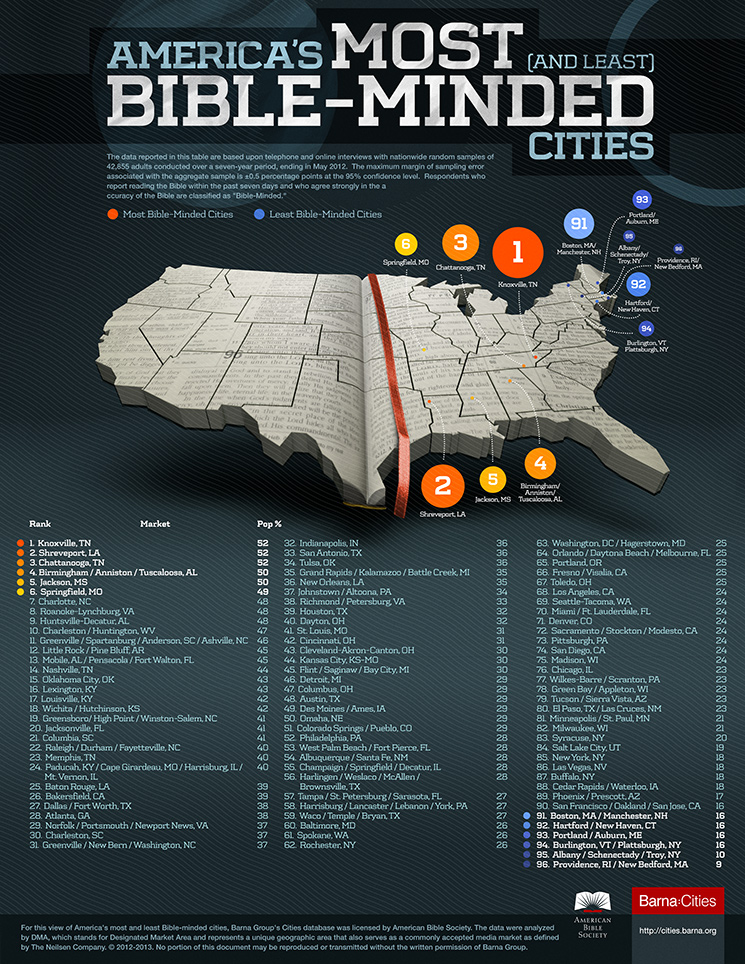
Barna Research put out a fascinating list of America’s Top 100 most ‘Bible-Minded Cities’.  Its not the top 10 Bible cities but the bottom 10 that are so telling! barna_biblemindedcities_preview1

The bottom 10 are:

  • Boston, Mass
  • Manchester, NH
  • Hartford/ New Haven, CT
  • Portland/Auburn, ME
  • Burlington,VT
  • Plattsburgh, NY
  • Albany/Schenectady/Troy, NY
  • Providence, RI
  • New Bedford, MA

It really caught my attention for 3 main reasons.

1. When I was in college I was an evangelist and Barna was our go-to source

2. During that time a common mantra in my circles was that ‘the Pacific-NorthWest is the most unchurched are in North America.’

3. After college I went to help plant a church in upstate NY (near the VT border) and grew suspicious about that Pacific NW thing.

I had spent time in the Pacific NW and while there were lots of unchurched people … there were also tons of churches – but specifically big churches aggressively engaged in the culture wars.

In the New England (or NorthEast) region, it was different. There was a cynicism is had not seen. Not a coffee shop atheism like the west. I deep suspicion unlike I had encountered.

 This came to a head for me when two roads converged. 

Ingredient 1: I was charismatic and had bought into a thing call “Re-digging the Wells of Revival” where you go to places where God has worked in the past and, through prayer, you try to unplug that ancient well of what God wants to do to release the anointing that once flowed.

I lived in area that had seen large revivals in the late 1800’s and early 1900’s. In fact, the denomination I was a part of was founded in the region and still had some of the revival tabernacles as properties! I would go to the  one closest to my house (Round Lake, NY) and pray for revival to sweep our area again.

I even started doing historical research. I stumbled into something. It was called ‘the Burned Over region’. It turns out that the much celebrated  revival had burned through so fast and so hot that when it was over … a cynicism had set into many people. Families that had given large amounts of time, sums of money and even family jewelry collections grew bitter.

A problem developed for me. The circles I was running in were celebrating the 2nd Great Awakening and other historical renewals of the church. I was growing suspicious and that altered my prayers.  I stopped praying for the same kind of revival we say 100 years ago and started praying for a different kind that didn’t leave generations of families bitter and broke.

 Ingredient 2: I went to a Barna Conference in western NY (Syracuse or Rochester area).  I sat there the whole time shaking my head as Mr. Barna presented to a packed massive auditorium. The finding that he was presenting were not exactly true of my area.

I had read a book by that point called “The Nine Nations of North America” and had begun to concoct a theory that merged (for churches) the New England of Nine Nations and my findings in Burned Over research. When you put those two together it really explained a lot.

 I kept saying to myself, “Even NY is different east of the Hudson river. From Albany east NY is more like New England than like Western NY and Pennsylvania”.

After Barna’s presentation I voiced my suspicion and that was not greeted well by my denominational cohort I was attending with.

I even brought up the Pacific NW thing and how out there you can hear 3 big christian radio stations and find a christian bookstore every couple of miles. We had neither.

The Pacific NW had mega-churches. We had one church over 1,000 and people in our area were suspicious that it was a cult, “because how else could you get that many people to all come and sing the same thing at the same time and then listen to one guy talk for a half-hour?”

 All of that is background for this past weekend. Barna put out a fascinating new list of the 100 most biblically minded cities. You can go read the article to see how they configured that.  The 2 most important things to me:

1 – the top 50 are East of the Mississippi River (except for Bakersfield, CA).

2 – the bottom 10 are all in NE or that NY Hudson River basin.

To me this says two things. First, the Bible Belt is a real thing and when combined with something like ‘Nine Nations’ is potent to think about.

Second, The bottom 10 are all in the burned over region and should give us concern about what 100 years from now will look like. I know that there are lots of factors over the last century and that someone will say “the past is not the future” and I get that.

But as one who a) studied this, b) while I lived there, and c) called it out in real time… I’m telling you –

The bottom 10 of this thing are far more relevant to our future than the top 10. 

What is going on IN religion when we talk about God

This weekend I will finish reading two books that we were given through the podcast (thank you publishers). The first is Peter Rollins new on The Idolatry of God and the second is Phil Snider’s Preaching After GodMP900405058

I have recently edited podcasts with both of these authors. [We put out the Phil Snider TNT last week ]

It is very clear to me that we have an emerging situation (trying not to say problem) on our hands. With the introduction of a new wave of postmodern or ‘radical’ theology [listen to the Caputo introduction here] – progressive and emergent christians are drinking in lots of innovative and challenging concepts about God that may not have a real God behind them.

This is fine IF the listener/reader knows what they are imbibing. What is increasingly concerning for Tripp and me is the consequence when people don’t know that the god of the 21st century philosophers is not exactly the god you hear about on Sunday morning.

Is there a danger in people reading a ‘how (not) to speak of god’ and then just quoting it from the pulpit like they would quote any other historical person?  Folks in the deconstruction camp are not real eager to answer this one.

I have some thoughts on the matter so I thought I would throw them out here for consideration.

 Intro: It is severely unhelpful to frame this in an either/or way. “Either God is X like the Bible/Creed/Tradition say OR Religion is the equivalent of Santa Clause &Tooth Fairy and we might as well all go home.”

That reductive approach is foolish and silly.  There is far too much going on in religion – and the Christian religion specifically – to say things like that.*

 I propose that there are – at least – 5 things happening IN the christian religion:

  • Experience
  • Formation
  • Event
  • Mystery
  • Potentially Something Real

Experience – People who were not raised in the faith convert and/or have crisis experiences that powerfully impact them.  People experience the presences of something they interpret as bigger than themselves.

We can talk about transcendence or phenomenology but what we can not deny is that people experience something in religion. As someone from a charismatic-evangelical background it is so clear to me that much of our talk about God and religion in progressive-emergent circles misses this very real component.

Is experience the whole story? NO! And those who reduce it down to that are equally as errant. It is not the main thing nor is it nothing. It does not account for everything but neither can it be dismissed outright.  People’s experience must factor into the equation.

At minimum do the Kantian thing and say that religious people’s experience is real but incomplete to understand the whole picture (noumenon) – like 6 blind people with their hands on different parts of the elephant – each thinking they are describing something unique: a tree (leg) a rope (tail) a wall (belly) and a giant leaf (ear) and an enormous snake (trunk).

Formation – I get in trouble for liking the post-liberal writing of George Lindbeck (Nature of Doctrine) but I think that this is exactly where it comes into play. The role that the christian tradition, sacred text and vocabulary plays is that forms us a people. It forms character within us as well as the way that we participate in community.

I am in dialogue with the work of Alasdair MacIntyre (After Virtue) for this very reason. While I disagree with his solution, I think that he is spot-on in his analysis and concern. Not only does our culture live in a chaotic time – but the very ethical assumption that would allow us to even HAVE the conversation have been eroded and now we can’t even debate! At least within the Christian church there is a common vocabulary. We may debate the definition of the terms but we have an arena in which to engage each other.

In this sense, the faith functions. As Elizabeth Johnson (She Who Is) is so good at pointing out: the words that we use function in our imagination, our communities and in the tradition.

Event – John Caputo (Weakness of God) and those who follow his Derridean ways prefer to speak of the name of God as an event. There is an event housed in the name of God the beckons us – we respond to this call … and are not that concerned wether there is a caller, or if we can know that there is one.

It is undeniable that something happens when God’s name is invoked. It triggers something in us. It calls for something from us. It makes some claim or demand to be dealt with differently than other words and concepts.

I like Caputo’s illumination of this shadow world. There is something deeply insightful about his explorations. Those who want to dismiss it because it isn’t enough on it’s own, are missing the point. Something happens if ‘God’ is invoked … and that would happen even if there were no ‘God’ per se because (as I said above) the concept functions. – it does something in us,

Voltaire said,”If God did not exist, it would be necessary to invent him.” That is because ‘god’ does something in us – demands something from us.  It maybe not ripping off our customers, it may get us through a tough time or help us to sleep at night – or even face the end of life with dignity. But in the name of God is an event that lays hold of us.

Mystery – I am fascinated with the apophatic tradition. I have no interest is appropriating it … but I am mesmerized by the fact that it even exists. Describing god by what she is not? Brilliant.

I also have been looking in historic understandings of analogy. Which works for me because I do not believe in univocal speech. When we call god ‘father’ we are using an analogy – god is like our best conception of father-liness … but it saying that is also included an understanding that God is not actually a father. Our use of the word is not a 1:1 equivalence.

Elizabeth Johnson challenged us over a year ago that every time we say ‘god’ that we must say it three times.  I do this every day now!

  • God beyond us.  This is that transcendent other or Kant’s noumenal real.
  • God within us. This is the experiential component.
  • God at work all around us. This could be the event.

When I say ‘god’ I always say God beyond me – within me – and at work all around me.

 Potentially Something Real – the final component in my 5 sided web is the possibility that there really is something to all of this – more than just phenomenon or imagination or tradition or vocabulary – and that the language of religion is at least getting some of it right.

If we don’t leave open the potential that something real is really happening – that a real god is actually acting – then we may be missing the biggest part of the puzzle and thus have an incomplete picture.

___________
Just because YOU haven’t thought of the multiplicity of layered meanings happening in the Christian expression doesn’t mean that it is an all or nothing game.Don’t be that person who says “If Santa Clause isn’t real, then Christmas isn’t worth celebrating”. Or “If Creation did not happened exactly like it is described in Genesis then the whole BIble is untrustworthy and unbelievable.”

Honoring Our Elders or If Aquinas was Around Today

Thomas Aquinas comes up a lot these days.*   Some of it is generated by a small community of passionate people who want to reclaim his project. Thomas_Aquinas_by_Fra_Bartolommeo

This, in turn, prompts some – such as John Caputo in an interview with us – to come up with a legendary one liner that accused this group of ‘retreating into the hills of Thomism’. 

The most insightful address I have encountered recently comes from Umberto Eco in the book Travels in Hyperreality. In a chapter entitled “In Praise of St. Thomas” he outlines how Thomas interacted with his world and how he navigated the difficulties of his inherited order (mendicants) , his Age, and his own limitations.  Three passages from the 1974 essay that inspired me were:

  – Thomas, was neither a heretic not a revolutionary. He has been called a “concordian”. For him it was a matter of reconciling the new science with the science of revelation, changing everything so that nothing would change. 

– Nobody ever said that Thomas was Galileo. Thomas simply gave the church a doctrinal system that put her in agreement with the natural world. 

–  So it is surely licit to ask what Thomas Aquinas would do if he were alive today; but we have to answer that, in any case, he would not write another Summa Theologica. He would come to terms with Marxism, with the physics of relativity, with formal logic, with existentialism and phenomenology. 

He would comment not on Aristotle, but on Marx and Freud. Then he would change his method of argumentation, which would become a bit less harmonious and conciliatory.

And finally he would realize that one cannot and must not work out a definitive, concluded system, like a piece of architecture, but a sort of mobile system, a loose-leaf Summa, because in his encyclopedia of the sciences the notion of historical temporariness would have entered.

I can’t say whether he would still be a Christian.

But let’s say he would be.

I know for sure that he would take part in the celebrations of his anniversary only to remind us that it is not a question of deciding how still  to use what he thought, but to think new things.

Or at least to learn from him how you can think cleanly, like a (person) of your own time.

After which I wouldn’t want to be in his shoes.

This actually is an approach to the past that has some general applicability. I have heard it said that best way to honor founders of any movement is not to simply repeat what they did but do the kind of thing they did in their time for our time. Aquinas

As a contextual theologian, I have said (over and over again) that honoring the apostles and the early church’s mothers and fathers is not in simple doing what they did in their culture – but in doing in our culture the types of things they did in theirs.

Rote repetition – regurgitation is not honoring. It is closer to idolatry. 

Repeating in the 21st century what they said in the 8th century isn’t as faithful as one might like it to imagine. This is due to the nature of our message. Our message is incarnational and thus our models and methods must match that!

The container must match the content. 

I’m not that into Aquinas. I think it’s because of the approach of those who are a little too into him.  But if they were to change to Eco’s approach and engage contemporary science and incorporate real scholarship, then I might get into Aquinas as well.

I just have no interest in reclaiming a romantically imagined version of the past. I am very interested in engaging the living now and emerging near future.

 _________
* Saint Thomas Aquinas, (1225 – 1274), also Thomas of Aquin or Aquino, was an Italian Dominican priest, and an immensely influential philosopher and theologian in the tradition of scholasticism, within which he is also known as the “Dumb Ox”.
Aquinas

Thank You For Your Prayers: a quick update

I just want to thank everyone who has been so supportive through a difficult period.   I appreciate the notes, emails, Facebook messages and voicemails. Knowing that I am prayed for is really encouraging.

Just a quick update:

– I made it through my final semester of course work. I was able to complete my big papers in Urban Education and Post-Modern Approach to Sociology (my self-designed directed study with Barry Taylor that gets me ready in one of my cognate fields).

– My wife’s health is better now. After the ruptured ovarian cyst and subsequent bladder infection – on top of continuing Lyme’s disease… it has been a doozy.

– It was good to go back East for Christmas and see my family. My mom’s health continues to deteriorate.

– The Loft has really taken off and my ‘partner pastor’ is back from his emergency paternity leave.

– My wife’s sister and brother-in-law (along with our nieces) have been living with us as they prepare to move to Thailand and the girls return to school (college here in LA). They all leave us this week.

– I am doing research design at UCLA one day a week. It is part of my PhD requirement to have a research language. I am studying qualitative and quantitative research design so that I can do my dissertation proposal next year.

I have said publicly that November and December 2012 were the worst two months of my life. I am glad to see them go.

Thanks again for the thoughts and prayers. They are more appreciated than you know!

-Bo

Blog Note: Now that course work is over, I plan to do some more personal reflections here along with the theological ones that initiate on HomeBrewed. I often have smaller thoughts that don’t need to be the big productions that I post over there.

Looking forward to it!

Maybe the Mayans were right!

In all of the hub-bub surrounding the Mayan apocalypse that came and went without incident, it was tough to resist the funny one-liner on Facebook and Twitter. We have become so calloused against the doomsday predictions that have fueled the religious airwaves, TV broadcasts and book sales of the last 30 years.

I get that. I came to faith during the cold-war in the heyday of characters like Hal Lidsay, Harold Camping and the Left-Behind phenomenon. Y2K was a bust and everyone was holding on for the December 2012 end of the Mayan calendar.  But I’m afraid that in our hurry to make funny quips we may have missed something important:

This actually could be the end of time.

It is similar the snark-fest regarding the Hostess bankruptcy and the end of Ding-Dongs and Twinkies.  Lost in all of the jokes was the reality of unjust labor practices by the cooperate execs of Hostess who, even at the end when massive layoffs could have been averted, continued to pay themselves ridiculous salaries and bonuses.

Hostess stole money from it’s workers pensions to use for things like operations – the whole while paying millions of dollars in bonuses to it’s 19 executives who were leading it into bankruptcy.

We didn’t address the illegal, and unjust practices of the mis-management, I suspect, because  there were just too many jokes to be made about Twinkies.

It appears that a similar scenario has blinded us to the reality of the Mayan calendar.

Never mind that the Mayans didn’t predict an end-of-the-world on the actual day – only that the calendar ended. 
Never mind how the ancient people may have conceived of the cyclical nature of time.
Never mind the odd fascination that descendants of European colonist have with indigenous artifacts from a genocidally exterminated people.

Jokes about the Mayans provided too many punchlines.

The Mayans were made a joke. 

But, like the Hostess bankruptcy, I wonder if a much bigger issue was ignored in the flurry of Facebook snark and apocalyptic themed parties.

What was lost in all the end-of-the-world banter was a sobering look at the realties that we face as humanity and that, if one had ears to hear, would sound an alarming warning signal that the world as we know is in real crisis.

I fear that like the proverbial frog in a kettle, that we have slowly adjusted and grown comfortable in rising temperature of the water and have failed to acknowledge that things might soon boil over.

Just take three areas

  • Economy
  • Environment
  • Military Tensions

Long ago, I left-behind the reading of Revelation that causes so many to live in fear of an impending catastrophe. But I’m not sure that people of faith can afford to grow comfortable thinking that the world we see is in it’s final form. Capitalism, Democracy and Nation-States are assumed to be the as-is realities on the planet.

 Zizek is oft-quoted as saying Christians are fascinated with the end of the world because it is easier to imagine life ceasing to exist on planet earth than it is for Christians to imagine an economy after capitalism.

 Global capitalism has bankrupted itself. The European Union (with countries like Greece and Spain) is in real trouble. The American economy is being exposed with its massive debts and downgraded dollar. China has mixed capitalism in with a form of communism – and a massive population – in a way that leaves most experts baffled.

 The environment is being degridated. It is conceivable that our ground water could be toxified, our warming oceans could cause extinction of the seafood we eat, and our thirst for easy energy (what the Frack are we doing?) could have repercussions that would make the planet uninhabitable for the human species.*

 That is all before nuclear fallout. Tensions is the middle east, America’s admittedly endless war on terror, and desperate global disparity are now more consequential than ever.**

It one takes the failing global economy, the toxification of the environment and the realities of perpetual war – maybe the Mayans weren’t wrong after all.

Maybe we have moved into the end of time.

_________________

* The practice of ‘mountian-top’ removal in places like West Virginia coal is instructive about environmental impacts.
** The Isreal-Palestine conflict and America’s role are especially illuminating.

America is like God – both can ask for your life

Charles Taylor, in his book Modern Social Imaginaries,  utilizes the term ‘social imaginary’ to refer to god-like capacity described by Benedict Anderson in Imagined Communities.  The term encompasses a threefold meaning:

  • First is the way that ordinary people “imagine” their surroundings in images, stories, and legends.
  • Second is the general acceptance and participation in the imaginary by a population and not simply the theories dominated by a small elite.
  • Third is empowerment provided from the imaginary for widely shared practices – and a sense of legitimization.[1]

One impact of this capacity to conceptualize national identity and belonging is in answer to the question “what would make someone be willing to die for their country?”

Anderson proposes a model of historic drift where sovereignty, which had previously been located in either religion or king (or both), has shifted decisively to the Nation in recent centuries. This is a dramatic innovation and recognizing nationality as a valid location for sovereignty has significantly altered matters related to loyalty, sacrifice and belonging.

Anderson proposes a definition of the nation as “an imagined political community – and imagined as both inherently limited and sovereign.” The distinction as imagined comes because “the members of even the smallest nation will never know most of their fellow-members, meet them, or even hear of them”.

Communities are limited because there must be some distinguishing demarcation outside of which are other communities (nations), which provide both competition and opportunities for cooperation. This distinction provides a vital function as classifications for the project of establishing communities.

Communities are imagined as sovereignbecause the concept was born in an age in which Enlightenment and Revolution were destroying the legitimacy of the divinely-ordained, hierarchical dynastic realm.” [2]
The dissolving social order of caste and class provided more level (if desperately unequal in reality) conception of both membership and participation for the mass of the population. This perceived leveling and opening gave rise to a new capacity for sacrifice on behalf of the imagined entity – an entity that was not solely and externally located in eternity or beyond, but in an ideal which one was associated (belonged) and participated and was thus responsible. To die for a religion (God) or a King was to reinforce that social order which established the hierarchical strata. Locating sovereignty within the conception of Nation – however dispersed and elusive – was a profound change.

In 1922 Carl Schmitt wrote his famous work Political Theology: Four Chapters on the Concept of Sovereignty and claims  that

“all significant concepts of the modern theory of the state are secularized theological concepts.”[3]

In 2011 Paul Kahn wrote an engagement of Schmitt’s work with four new chapters on the same subject where he says that the capacity for the state to ask for this kind of sacrifices, the power to pardon – which is a remnant of Kingly authority, and the symbolic notion of a flag that needed to be defended are all remnants of a religious notion. The very word sovereign is borrowed from religious vocabulary.  Kahn explains:

Political theology today is best thought of as an effort to describe the social imaginary … (arguing) that secularization, as the displacement of the sacred from the world of experience, never won, even though the church may have lost. The politics of the modern nation-state indeed rejected the church but simultaneously offered a new site of sacred experience.[4]

You can begin to see why the constitution is often thought of and talked about as an inspired document (sacred text) and why those who were responsible for it’s creation (founding fathers) are celebrated at patriarchs.[5]  If Schmitt is right – even partially – then all of these similarities are neither trivial nor inconsequential.

The power of the state to ask for death in order to preserve itself and the capacity of people to willingly offer their lives in defense of that conception is profound. The notion of the sovereign holding the power of exception goes all the way from the individual being pardoned (as referenced earlier) to modern realities impacting all of humanity. The President has the ability to launch nuclear weapons if the President was to view that the national interest was in jeopardy.

Kahn uses this to illustrate his point. What are we saying about the nation that we are willing to jeopardize human heath, the planet, and subsequent generations for its defense? What could possibly be above human health and planetary environmental conditions? The answer is ‘only something that is of ultimate concern’. 
The modern conception of the state is thus a result of religious conceptions and has replaced (in some sense) religion as the location of sovereignty one is willing to ultimately sacrifice and die for. Nation is a construct of transcendent meaning found in an imagined community.[6]

Now this is where it gets really interesting! 

Arjun Appadurai, in Modernity at Large interacts with Anderson and observes that:

Modern nationalisms involve communities of citizens in the territorially defined nation-state who share collective experience, not of face-to-face contact or common subordination to a royal person, but of reading texts together.[8]

Much of the rhetorical energies of the ruling powers are used in order to urge “their subjects to give up … primordial loyalties – to family, tribe, caste, and region” for the “fragile abstractions” called nations which are often “multiethnic … tenuous collective projects”.[9]

Only within the power of national imaginaries can one see the possibility of such a monument as a tomb left intentionally empty or holding the remains of an unidentified combatant. Anderson points out the absurdity of “a Tomb of the Unknown Marxist or a cenotaph for fallen Liberals.”[10]  There is no reserve of belonging that would justify such a display. It would hold little value outside the context of national identity.

And that is how the sausage called nationalism is made!


[1] Taylor, Modern Social Imaginaries, 23.

[2] Anderson, Imagined Communities, 8.

[3] Paul W. Kahn, Political Theology: Four New Chapters on the Concept of Sovereignty, location 37.

[4] Ibid., 360.

[5] CBC Ideas podcast  ‘The Myth of Secularism’ part 5

[6] It is not difficult within this framing to view contemporary movements such as the Tea Party as merely an extreme example of a group calling for a romanticized notion of an imagined past or legacy.

[7] Anderson, Imagined Communities, 8.

[8] Arjun Appadurai, Modernity At Large: Cultural Dimensions of Globalization, 161.

[9] Ibid., 162.

[10] Anderson, Imagined Communities, 10.

Moving Toward Multiplicity

Listening to Howard Zinn (author of the classic A People’s History of the United States) at a town hall meeting style presentation recorded in 2007 (you can get it on Itunes from WGBH Politics) I was struck by the need to recognize the sheer complexity of issues and multiplicity of perspectives. complexity

To state it as simply as possible: Not everything is the same. When we attempt to represent EVERYthing as if it were represented by ONE thing, we often neglect the complexity and multiplicity involved in the matter.

I will use two examples that Howard Zinn illustrated well at the community forum, then address the issues that it seemed relevant to connect to.

Zinn takes on the idea of “Family values”. Some conservative political interest say that they represent ‘family values’. But he asks “Which family?” I think it is a valid question. There are families with single moms and multiple kids, divorced dads raising a family, there are foster families, adoptive families, multi-generational families living in the same house. There are lesbian couples with no kids and gay couples with kids. My wife are were D.I.N.K.s (double income – no kids) hen she lost her job while were trying to adopt (which fell through recently) and every permeation you can imagine.

Which family is represented by Focus on the Family’s values? It is erroneous to act as if there is one kind of family and that you represent their values.

That is, unless you are saying that you value only one type of family.

That would be fair enough but you would have to stop using the phrase ‘family values’. Some families value making money or achieving success. Some value conformity. Some value religious adherence above all else. Some value military service while others value independent thinking or even civil disobedience.

Zinn says the same thing about the ‘National interest’. I am a big fan of Paul Kahn’s Political Theology and both he and Zinn talk about President’s ability to declare war or even launch the nuclear codes should the President deem it ‘in the national interest’.

But which of the many National interests? The Nation is not interested in only one thing. There are hundreds or thousands of interests. Unfortunately the reductive mono-speak is code. These buzz-words become code-words for an assume-unstated single issue that clouds the true complexity behind the language.

Zinn touched another example which has been showing up in a lot of my reading lately. The phrase ‘We the people’ is a magnificent ideal. I admire the phase and the idea behind it so much. But I think that it is worth noting that when it was written – we the people were not in the room. At the time of it’s writing, not every ‘we’ was represented.

There were no native americans in the room, no women, no blacks, no commoners. Just land-owning white males. But they had an idea – and it is that idea that we love!

I actually think that this is the exact type of trajectory mentality that we see in a progressive reading of the New Testament. When Paul says in Galatians 3:28 that “There is neither Jew nor Greek, slave nor free, male nor female, for you are all one in Christ Jesus.” He is doing this exact thing. He wrote in prophetic expectation using the 3 categories employed in his day were being broken with resurrection power. Barriers between nationality (or race), legal status and gender were being dissolved. My assertion is that it was not for the purpose of homogenization but for multiplicity! The former containers can not contain what it being poured out and welling up in Christ’s new life.

This is why I don’t sweat the fact that Paul appears to by anti-gay (though I argue that he was not anti-gay in the same way that those who quote him today are). You have to read Paul on a trajectory. Within the fruit of the Spirit of God is seed of liberation and transformation. So like ‘We the people’ – it looks forward to a greater reality than was present at it’s writing. Contained within the words is an ideal not yet realized. That is part of why I don’t want to conserve the reality of the time of it’s writing, but spring board off of it to be propelled to a greater one.

We can get caught up in reductive views that ignore the inherent complexity that we are dealing with. For instance, “Is the world essentially good or bad?” or “Are humans inherently evil or innately good?” That kind of simplicity is blind to the multiplicity of factors that we are dealing with in any conversation and allowing the conversation to be framed that way almost ensured that no progress will be made.

Good people still do bad things or even do good things with poor motivation. People who do bad things often love their own families.

We do ourselves a great disservice when we allow our media to talk about ‘the evangelical vote’ or even ‘the black perspective’ as if those parameters only mean one thing or as if everyone within designations voted the same way or believe all the same things, hold all the same values and act in unison. It is fictitious, deceptive and paralyzing.

You can’t even say ‘gun owners’ and mean one thing! Our language (and the dualism behind it) is crippling our culture.

There has been a great “De-centering” that has happened to humanity in the past 500 years. If you just look at the effect starting with Copernicus and continue to Darwin, the earth is not the center of the universe and neither are humans.

It would do us well to move from a reductive mentality (center/ order) to a dynamic interplay of emergent elements. When we recognize the complexity and multiplicity involved in the reality behind our ‘code words’, we will begin to access the real issues that face us.

The Church’s Task

In the next 24 hours I will be putting up 4 blogs – taken together, you will be able to tell what I have been thinking about the past month.  I would love your feedback on any of them.

Last month David Fitch tweeted this:

“The biggest task of today’s church is to undermine in its members the blase unexamined acceptance of secular assumptions for everyday life.”

I thought about it all day and just couldn’t be sure he was right on this one.

Now just to let you know where I am coming from:

Put that all together, I have doubts about Fitch’s assertion. Here is why:

I am increasingly suspicious that secularism is both a consequence and a side effect of Christendom. It is the West’s Frankenstein if you will. We made it. Then it took on a life of its own – a life we don’t like very much and which damages our efforts and injures our cause.  I think we have to start there.

I agree with Fitch that there is a ‘unexamined acceptance” and would go even further and say that it results in an assumption that what we see is the way it is. That our current mechanisms of organization are final forms and that the ‘as-is’ structures come with a large measure of ‘giveness’.  Tripp often applies this capitalism, nation-states and democracy. I would tack on both denominations for the church and militarism for US America.

I am just not so sure that our main task is to undermine. Maybe that is where my hangup comes. I am leery of this approach because it seems like we are defaulting the ground rules in the initial move and framing the task in a conceding first move.

I might be naive here but I am just not sure that the church needs to
A) give that much ground initially
B) frame her task in the negative.
I know it’s just so much one can do with a tweet but … there is something there that gives me caution.

So what is my constructive proposal?  I’m working on it.

I would want to frame it more like Stuart Murray does in the book Post-Christendom  and acknowledge that initial concession was early on with Constantinian Christianity. Then Christendom. Then Modernity.  With those three concessions we admit that the as-is nature of existing frameworks for both church and culture are thoroughly compromised and corrupted.

BECAUSE of that. We abandon the recuperation, rehabilitation, reclamation , and renovation projects (and mentality) all together! (all 4 faces of it).

It’s over man.  Let it go.

THEN we start new and in the positive. The 21st century provides fresh possibilities and opportunities IF ONLY we will let go the idea of getting back to something or getting something back. I know we never start from scratch – we never get back to square one. But …

I don’t want to be the undermining parasite ON the big organism. That is too small a task.  I want to partner with God in the healing of world (Tikkun Olum in Hebrew).  I want to participate in the development cosmic good – until then at least the common good. 


PostScript: now that I started down this “re” line I can’t stop coming up with words I want to flesh out further!
Restore: no
Re-imagine: yes
Represent: yes
Re-member: sure
Resurrect: ummmm not really
Reflect: probably

Pastors don’t have the same job as Jesus

There is no other way to say this – Jesus wasn’t a pastor and it is ridiculous to hold any contemporary pastor to that standard. 

 I should probably back up.  I was minding my own business last week reading Modernity at Large: Cultural Dimensions of Globalization by Arjun Appadurai  and I decided to take a break and check in on Twitter.

That is where I saw a tweet from the folks at Two Friars & a Fool (who I love love love) and smashed into an expectation that just seems objectionable to me.  [I have gathered their and my tweets in chunks for smoother reading]

Worrying that truth or justice will cause anxiety in your congregants isn’t “pastoral”.

More likely you are projecting your fear over job security, to excuse not speaking/living more boldly.

It is not a pastor’s job to protect their congregants from difficult truths, big ideas, or stark injustices.

I cannot think of one instance where Jesus withheld hard truths or talked around a subject out of “pastoral concern”.

My point is that if Jesus withheld them, you wouldn’t know about it. That’s an argument from silence. What we know about Jesus is what his disciples remember and re-presented to us. We don’t know what didn’t happen so we can’t cold contemporary pastors to a non-existent standard.

 They countered with: The Gospels could have had a story where Jesus was gentle with an interlocutor, then turned & told his disciples the truth.

Or we could have revelations in epistles etc… of “hard teachings” Jesus spared us from.

Or even instances where Jesus slowly led his disciples into a hard teaching with progressively less gentle versions.

I can also frame this argument positively: Jesus confronted people w/ hard truths often & is our model of what is “pastoral”.

I stated  that comparing what we have of Jesus in the Gospels to contemporary pastors in like comparing apples to oranges. You just are not looking at the same things. It’s nearly impossible to compare.

Their response:  Is comparing pastors to Jesus apples to oranges? Is imitation not implied in baptism?

I guess I would say that my job is fidelity. Do my best to see/speak/live the truth. Let the Spirit work out who can hear it.

And I’m more curious about what you think of the point that it isn’t “pastoral” to coddle congregants intellectually?

I often think pastors give their congregants too little credit & too much power.

Most can handle more than we allow, & it’s far from the end of the world if we piss a couple off.

Here is my condensed point:

If Jesus withheld teaching, you wouldn’t know about it. That’s argument from silence

You can’t be hard on contemporary pastors because of something Jesus DIDN’T say. It’s apples to oranges.

contemporary pastors are apples to Jesus’ Galilean orange 😉 Context, language, and expectations are different

Pentecost & Christendom alone would be enough. Add to it modern media, Copernicus, Darwin, Freud, WWII, 911 it’s just so different.

Pastors ARE beholden to what their congregants can hear. We know Jesus through disciples’ reports.

We know what the Disciples HEARD. We don’t know what they DIDN’T hear. Can’t be hard on contemporary pastors for that.

I just don’t want to tee-up modern pastors because of what their congregants can’t hear

You may say tough things from the pulpit – but you are situated in a location & context! What preceded you that allows you to say it?

I just can’t abide raking modern pastors w/ 401k & dental plans & seminary student debt or kids going to college for not saying things people won’t pay to hear! It is the system that we are in.

I guess what I’m saying is that Jesus wan’t even a real Rabbi in his day … let alone a post-christendom pastor with student debt, house payments, medical insurance, kids school payments … not to mention an ordination board, district superintendents, or a congregation with building – let alone tithing congregants with kids serving in the military.

It is contemporary apples and Galilean oranges at some point. 

How do I approach this? 
I have mashed together what I have learned from Cornell West, Slavo Zizek and Marc Ellis to say that all churches in North America fall into 3 primary categories: Prophetic, Therapeutic or Messianic.

  • Prophetic churches critique the as is structures to confront the system.
  • Therapeutic churches help folks exist within the system. ‘Chaplains to the Empire’ as we say.
  • Messianic churches focus on helping one survive until God delivers you from the system. This can be rapture, evacuation, eschatological, etc.

So, each of us in embedded in a unique modern social imaginary – a construct of meaning within a context, location, denomination and tradition that asks certain things of us and provides certain opportunities.

Our job is to be as faithful as possible within those parameters to the both the example and message of Jesus that we have.

We are not Jesus. No one is Jesus. Jesus didn’t do what we do for a living. We do the best we can within the frameworks that we have been given. Some are inherited, some need to be renovated, some are up for debate, some need to be challenged and maybe even discarded.

Without recognizing that located and situated reality we can not just take what we don’t see in Jesus and put it over a contemporary situation. It is just apples to oranges – an unfair comparison.

 Thoughts? 

Create a free website or blog at WordPress.com.

Up ↑