Mad Magazine is ceasing its publication of the print edition. This is going to be a huge loss.
Mad Magazine used parody, caricature, and satire to lampoon the ridiculous elements of our age.
This was the role of parables in Jesus’s age.
We have been taught to read parables poorly. They have been neutered, sanitized, and de-fanged.
Many of us were taught to read parables as:
Aesop’s Fables
Proverbs
Allegory
Parables are none of those things.
Parables are small stories about birds and farmers, widows and foreigners designed to come in underneath the listener’s radar to that their defenses are down … and then once in, to interrogate assumptions and undermine (subvert) the status quo.
Both Mad and Jesus’s parables utilized irony, skepticism, exaggeration, and satire to poke holes in the hypocritical and unjust elements of the establishment.
Mad’s legacy has now passed to TV shows like the Simpsons, South Park, the Daily Show, and even Saturday Night Live.
Here are two great articles about the end of Mad Magazine (one in the LA Times and one in the NY Times) .
Our orientation and posture toward a romanticized notion of the past is problematic. The impulse toward nostalgia is a real danger. I have written about the danger of ‘Re’ words and the pastbefore.
In this 10 minute video I talk about the importance of being fully present and looking for both better questions as well as different answers.
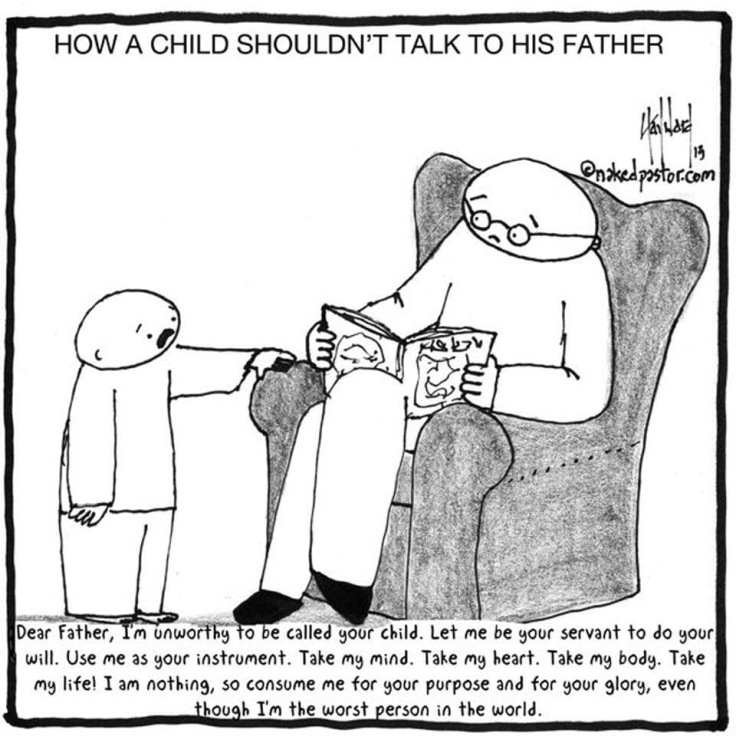
More than masculine imagery is needed for health and wholeness.
The divine – transcendent – eternal is so much more than the metaphors and analogies that we utilize is worship and prayer.
“The rule of prayer is the rule of faith” has migrated historically from prayer to sacrament to preaching and, now in our musical age, to worship. See also Worship Words Determine Faith [link]
Our language about God functions – Elizabeth Johnson
This is why we must both account for and attend to a more well-rounded and balanced approach to our imagery about God.
Some are just knick-knacks and mostly just ornamental or conversation starters.
Some are still useful and they come with a novelty factor.
Others need to be repurposed for some use other than their original one.
There even ‘reproductions’ that are designed take the best of the old model but which integrate new technology. These have been updated but in a way that still pays homage to the original purpose.
There are also antiques that don’t know that they are antiquated.
Denominations, like Methodism, are going through a challenging time. Their infrastructure and polity come from a European model leftover from State-Church models that prospered in Christendom. Even backlash movements (like early Methodism) become labored in legislation, politics, and governmental frameworks.
I am asking if they are ‘usable antiques’ or do they need to be repurposed. Are they able to be updated to include new innovation? Are they ornamental or can they be adapted in a way that still pays homage to the original design and vision.
What inflames change all the more in our exponential times of cultural conflict are:
Globalization – Transnational reality as a legacy of colonialism
Technology – Internet, Social Media, etc.
Finances – capitalism in the 21st century
People are concerned about what they see happening right now. There are geographic divisions that seem increasingly pronounced. There are generational, political, and racial division that are inflamed at troubling levels. The news cycle, social media, and institutional corruption (banks, schools, churches, government, hospitals, Hollywood, Washington, etc.) provide a constant string of crisis and controversy.
Things seem to have escalated quite a bit in the past couple of years. Some people will say ‘every generation thinks things are chaotic and out of control’ and there is some evidence of that. However, we live in a unique era when there are the some distinct factors causing an intensification that is notable.
Change is a constant, we know that. Change at this rate, is not. We live in a time of exponential (not just incremental) change. It is no wonder that this environment breeds so much conflict and chaos.
One of the things that I would like to explore is the way that following 3 factors come together in a troubling way:
Consumerism
Globalization
Pluralism
The connection between those three might not seem clear initially, but it is the way that they come together in the 21st century that is relevant for our conversation.
Consumerism is so assumed that it often goes unnamed. It is as if we are on automatic pilot. Buying things has become second nature. I know people who claim to be Christians who can go a whole day (or days) without praying but can’t go a day without making a purchase. Capitalism is the real religion of the West. [1]
Consumerism makes us individuals – or is it that individualism makes us consumers? … either way, we have exposed the root of the problem. Speaking a language, participating in an economy, procreating and raising the next generation, and nearly every other human activity is a communal enterprise that requires cooperation and mutuality. Individualism is a mental fiction we have been sold that fails us at nearly every turn.
Globalization has brought our communities into closer proximity than ever before. We have never had this much access to or contact with one-an-other. It almost doesn’t matter where you live anymore, you have access to goods from all over the world. In fact, you do business with, go to school with, and stand in line with people from all over the world. You may all have different religions, worldviews, or notions of community and belonging. We live in age of radical connection and proximity …. but maybe not overlap. And therein lies the problem for our concern this week.
Pluralism is then a relevant factor that completes our trio. As individuals whose communities are in great proximity to each other, we have to develop an approach to one-an-other.[2]Some of us feel like we have does this well. Which is why it is so baffling why it cause some of our fellow citizens so much agitation and even anger. ‘Difference doesn’t need to lead to division’ we say, and if attitude or acceptance was the only issue we might be right. The problem is that the first two ingredients to trio are the wood and gasoline that make our current environment so flammable. Attitude (or our approach) is just the spark that makes that situation combustible.
Here is the most important thing to understanding our current culture:
Our society is a set of fragments – leftover remainders – of previous expression that may not be compatible with other or newer expressions.
Again – our society is a set of fragments, leftover remainders, of previous expressions that may not be compatible with other or newer expressions. More on this tomorrow. The examples of this phenomenon are endless once you know what you are looking at. Think about religion, Christian denominations, theories of educations, economics, politics, nationality and race, pre-1975 military, for-profit prisons, policing strategies, parenting styles, marriage equality, even grammar and texting language.
Here is a picture that I want to utilize for this 4-part series. It is a piece by my neighbor Jeff and it really speaks to me.
Our circles (communities) have diversity and differentiation within them. Those circles are in close proximity to each other and are even connected … but without overlapping. They are not integrated. They do not bleed into each other. They are distinct from one-an-other.
What makes this proximity profound is that the newer circles are smaller and bolder but are foregrounded on other circles that are faded but still present. Those larger circles are older and not as pronounced but influential. They haunt the work. They are ghosts and shadows to the primary feature. They are echoes of the past who still exert their voice. Their influence has faded but their effect still remains. The current configuration and focus wouldn’t make sense without them.
Tomorrow we talk about the nature of these remaining fragments and how people who think about such things differ on the subject.

 Bo Sanders: Public Theology