Search

Bo Sanders: Public Theology

updating & innovating for today

Category

A B C’s

P is for Perichoresis

Perichoresis is the most beautiful and elegant picture of the Christian godhead that many Christians may be completly unaware of.P-Perichoresis

The easiest way to break down the word:

  • Peri – as in perimeter
  • Choresis – as in choreograph (from the Greek word to ‘give away’ or ‘make room’)

It is the dance of the godhead. The picture is of movement and inter-relatedness. It is the constant exchange of moving around the edge – always providing space in the center. The concept is also known as cicumincession or interpenetration.

Circumincession: The theological concept, also referred to as perichoresis, affirming that the divine *essence is shared by each of the three persons of the *Trinity in a manner that avoids blurring the distinctions among them. By extension, this idea suggests that any essential characteristic that belongs to one of the three is shared by the others. Circumincession also affirms that the action of one of the persons of the Trinity is also fully the action of the other two persons.

Pocket Dictionary of Theological Terms (Kindle Locations 254-256). Kindle Edition.

In the gospels God points to Jesus and says “this is son in whom I am well pleased”. Jesus says “I do only that which I see the father doing”. The spirit anoints Jesus and empowers him to point people to God. Jesus leaves and sends/is replaced by the presence of Holy Spirit. This Paraclete leads into all truth and reminds us of what Jesus said (John 14:26).

Admittedly, talk about the Trinity gets complicated quickly. This is why so my contention surrounded the early churches councils and creeds. The filioque clause caused a schism between Easter and Western branches of the church in the 11th century.

Modern arguments abound regarding the hierarchy of Father-Son-Spirit. contemporary conflicts multiply about the gendered language of trinitarian thought and moving toward formulations such as Creator-Redeemer-Comforter.

In fact, the list of early century heresies and modern attempts to revive or reformulate theories about the Trinity can make ones head spin. It takes upper level philosophy and vocabulary to explain how 3 can be 1 or how a monotheistic religion has 3 persons in the godhead. It gets even more complicated when one has to explain exactly what happened on the cross and where exactly ‘god’ was.
It can be done but it is sticky and messy to say the least.

Then there is the whole matter of the ‘economic’ trinity and the ‘ontological’ trinity. That is for another time. Suffice to say that examination and exploration of trinitarian theories are deep.

One sure thing that we have a beautiful legacy in this perichoretic picture of the inner-life and dance of god from the 3rd century.


Artwork for the series provided by Jesse Turri

* another complicated distinction many may not know is that when speaking of the Trinity use of the phrase ‘person’ does not – in fact, in no way – connateness the modern/contemporary understudying of personhood. God is not a person in that sense. Theologians use it as a ‘super-category’ – almost like a place holder that they know needs to be defined, clarified and expanded later. 

N is for Neoplatonism

In the same way that Empire influences and underlies nearly every thing in the Bible – and yet many do not know about it – Aristotelian thought, Platonism, and neo-Platonism saturate early church history and thus the inherited tradition.N-NeoPlatonism I had also suggested (in Liberation & Logos) that all theology has philosophical underpinnings – whether it admits it or not. It is no surprise then that much of the what would become Christianity had integrated/appropriated the philosophy of the world that it emerged from.

Neo-Platonism: The last stage of Greek philosophy (identified with Plotinus), which greatly influenced certain early church thinkers, particularly *Origen and *Augustine. Neo-Platonists taught that everything emanates (flows) from the transcendent principle of the One and is destined to return to the One through a process of purification.

Pocket Dictionary of Theological Terms (Kindle Locations 921-922). Kindle Edition.

Justo L. González. has some helpful additions:

In these emanations, the One moves toward multiplicity. Evil as such does not exist, but is rather the deprivation of the good, so that something is said to be “bad” or “corrupted” as it moves toward multiplicity and away from the One. True knowledge is attained through the contemplation of higher realities, and specifically of the One, and its goal is to culminate in *ecstasy, where the soul contemplates the One directly and loses itself into the One.

It is interesting to think about how influential these philosophies have been and to discover when they have most popular. Neoplatonism was initially rejected by christians.

Augustine (354-430) found Neoplatonism helpful in dealing with some of the difficulties he had with Christian doctrines such as the incorporeity of God and the *soul, and in dealing with the problem of how evil can exist in a world created by a good God (sec *Theodicy). He thus became one of the main channels through which Neoplatonism impacted Western Christian theology.

 Essential Theological Terms (Kindle Locations 2887-2896). Kindle Edition.

Neoplatonism was tweaked a bit (losing its objectionable elements) and was the dominant thought in Western Christianity until the 13th century when Aristotle was reintroduced – mainly through the work of Thomas Aquinas into what become known as Thomism.

I wanted to put this entry into the ABCs series because we live in a time when many are unaware of their religion’s philosophical past relationships. I will often hear concern from sincere and devout evangelical,charismatic or conservative believers who say “why do you mess around with all of that philosophical mumbo-jumbo? We already have the Bible and it should be enough. Just preach the Word.”

It isn’t that easy of course.

As I pointed about the Gospel of John with its use of the Logos, both scripture and church history draw deeply on philosophical underpinnings. I would actually argue that we owe it to out faith and to the contemporary culture to engage (not just combat) the contemporary philosophy of our day!

If you want to follow-up on this historic precedent and trajectory, I would recommend Philosophy and Theology by John D. Caputo. It is thin and written for a wide audience. His writing style is also wonderfully light-hearted.

Artwork for the series by Jesse Turri

M is for Metaphor

Today we explore two words that appear at opposite ends of the language/reality spectrum but in fact have a great deal to do with each other and inform each other mutually.M-Metaphore

Before we dive into metaphor, there are two words that are needed in our theological tool-belt.

Univocal and Equivocal are important 2nd tier vocabulary words that radically transform the conversation.

Folks who hold that language is univocal tend to think that language is representative and exacting – that a word represents that which it stands in for and is exact in its ability to execute that function.

Folks who hold that language is equivocal tend to think that language is expressive and thus any word or concept expresses that which it stands in for and is inexact in its ability to do so.

If you believe language is representative (univocal), then you will say that these symbols (words & pictures)  represent that which they reference. Getting this right is essential because otherwise you are talking about something different that what is intended.

If you believe that language is expressive (equivocal), then you will say that language is both inexact and it is malleable. We do the best we can with the language/concepts/word pictures that we have but in the end they are both perspectival and provisional (it depends on where you stand and the words always stand in/substitute for the concept).

Here is how our Pocket Dictionary defines it:

Metaphor, metaphorical theology: A metaphor is a figure of speech in which a word or phrase that has an accepted, literal meaning is used in place of another to suggest a likeness or similarity between them. Metaphorical theology holds that God can only be spoken about through metaphors. Thus we must use metaphors to name our experience of God (the “Transcendent”); consequently, God can be described only in relational terms (that is, through the relational language of metaphor). Furthermore, metaphorical theologians, such as Sallie McFague, generally claim that such metaphors are culturally conditioned representations created by the mind as we seek to make experience intelligible.

Pocket Dictionary of Theological Terms (Kindle Locations 856-860). Kindle Edition.

Obviously we use word pictures to talk about God and God’s work. There is no shortage of examples in the Bible from a rock to a King, from a mother-hen to a dove, from a lover to a judge… and lamb.  We use analogies to talk about God and God’s work.

The question arises (post-enlightenment) when we begin to expect language to be exacting and representative. We do the same thing with the narratives of scripture when we hold them to the standard of newspaper reports and instruction manuals.

I fall squarely in the equivocal camp and think that all of our god-talk is expressive and provisional. As we come to understand more about God and God’s work in the world, we will come greater understandings and bigger revelations.

We do the best we can with the tools that we have.

This only becomes an issue when someone latches onto one a word-picture and insists that God IS a father. They mean literally and ontologically… which is impossible.
God being a ‘father’ is not exact and representative – it is a metaphor, a word picture. Jesus is saying that he relates to God as one relates to an ‘Abba’ daddy figure.
Which brings us to our second topic: metaphysics

Metaphysics: The philosophical exploration into the ultimate nature of reality lying beyond the merely physical (meta = beyond). Metaphysics deals with *ontological concerns, that is, with questions about what constitutes something as “real” or as having “being.”

Pocket Dictionary of Theological Terms (Kindle Locations 860-861). Kindle Edition.

The important thing to understand about meta-physics is:

  • Unless you are a reductive-naturalist (that everything is physical) you have a metaphysic.
  • Metaphysics is how you explain the world (or universe) beyond what is seen and measurable.
  • A 21st century christian is not limited to the metaphysics of the ancient world that the Bible was written in.
  • The Copernican revolution (away from the Ptolemaic geo-centric world view) has seen cascading effects of de-centering both earth and thus humans from being central to everything.
  • This is why some have found a Process world-view a valuable alternative that incorporates scientific discoveries into views of the world and universe.

When one tackles metaphysical concerns, it is helpful to first have in place a notion of language (univocal v equivocal) and of metaphor when it comes to using word pictures and symbols to help us understand the world and human experience and existence.

Tell me how you are using language – then let’s talk about what is going on beyond the physical world.

Artwork for the series by Jessi Turri 

L is for Liberation (and Logos)

Two concepts that anybody doing theology in the 21st century must know are Liberation and Logos. They play into so much of what we do in the theological endeavor.L-Liberation

Liberation Theology: This term most often refers to a theological movement developed in the late 1960s in Latin America (where it continues to hold prominence). In attempting to unite theology and sociopolitical concerns, liberation theologians such as Gustavo Gutierrez emphasize the scriptural theme of liberation, understood as the overcoming of poverty and oppression. Liberation theologies have also found expression among representatives of seemingly marginalized groups in North American society, including women, African Americans, Hispanics, Native Americans and Asian Americans.

Pocket Dictionary of Theological Terms (Kindle Locations 797-800). Kindle Edition.

It might be helpful to understand how I came to liberation theologies. I was writing my Master’s Thesis at an evangelical seminary on ‘Contextual Theology’. I was doing so because I had been raised and ordained in a Missionary denomination. I wanted to encourage and advance the work of those who claimed the ‘missional’ and/or ‘missions’ moniker. It was in the midst of engagement with Bevans and Schreiter that I stumbled upon a form of contextual theology (an alternative perspective) that stood apart from the enlightenment/colonial models. It was called ‘Liberation’ and it was unlike any of the other models being examined.

Gonzalez adds a couple of important clarifications:

Some liberation theologies center their attention on international economic oppression, while others are particularly concerned with classism, racism, ageism, homophobia, and other foci. Besides acknowledging and claiming their contextuality, … liberation theologies insist on the need to promote and practice justice and love, not only at the personal level, but also in societal practices and structures.

Justo L. González. Essential Theological Terms (Kindle Locations 2442-2446). Kindle Edition.

The only thing that I will add as far a Logos theology goes is that one must account for they way in which the word (logos) became flesh. ?This is the case, not just because John 1 is so important in protestant-conservative-evangelical-charismatic circles, but because one must figure out in what way God was present in Christ. There is much to be said on this issue not just because the Incarnation sets the tone for contextual (liberation) models of ministry but because the entire christian gospel is based on (centered on) the reality that the Logos was made flesh and dwelt (camped-tabernacled) among us. In more philosophical circles, Logos theology takes on a much broader concern. As early as the 6th century B.C.E. Greek philosophers were addressing the Logos as “the divine reason implicit in the cosmos, ordering it and giving it form and meaning.” The Gospel of John borrows/appropriates/adopts this term to address the pre-existence of Christ and how that manifested in the person of Jesus. It is important to understand that the gospel writer integrated/adapted Greek philosophy. This move is significant for several reasons:

  1. Proclamations about Jesus were not made in a vacuum.
  2. Some early church writers drew from Hebrew narratives and themes.
  3. Others spliced in philosophical ideas and concepts from non-Jewish sources.
  4. Both in scripture and in church history we see a constant and elaborate mixing/integrating of external philosophies and concepts.

I bring this up because a major objection to Liberation theology is its use/appropriation of secular political theories (like Marxism) and critics will use this to discredit Liberation thought. We need to be careful with that kind of easy dismissal. ?Liberation theology does have its drawbacks and limitations* – but simply having philosophical partnership is not one of them. In fact, there has never been a theological or ‘biblical’ expression that did not have philosophical underpinnings or explicit frameworks. Theology does not happen in a vacuum. All theology is contextual theology. This is not a problem. The only problem is when certain theologies don’t recognize their contextual nature with time and place and purport to being both universal and timeless. Liberation theology is not for everyone and it does not happen everywhere. While true that it is thoroughly political and radically ideological at points, it is also highly contextual and local – as all theology should be.

Artwork for the series by Jesse Turri

  * some object to Liberation’s emphasis on God’s preferential option for the poor and oppressed. 

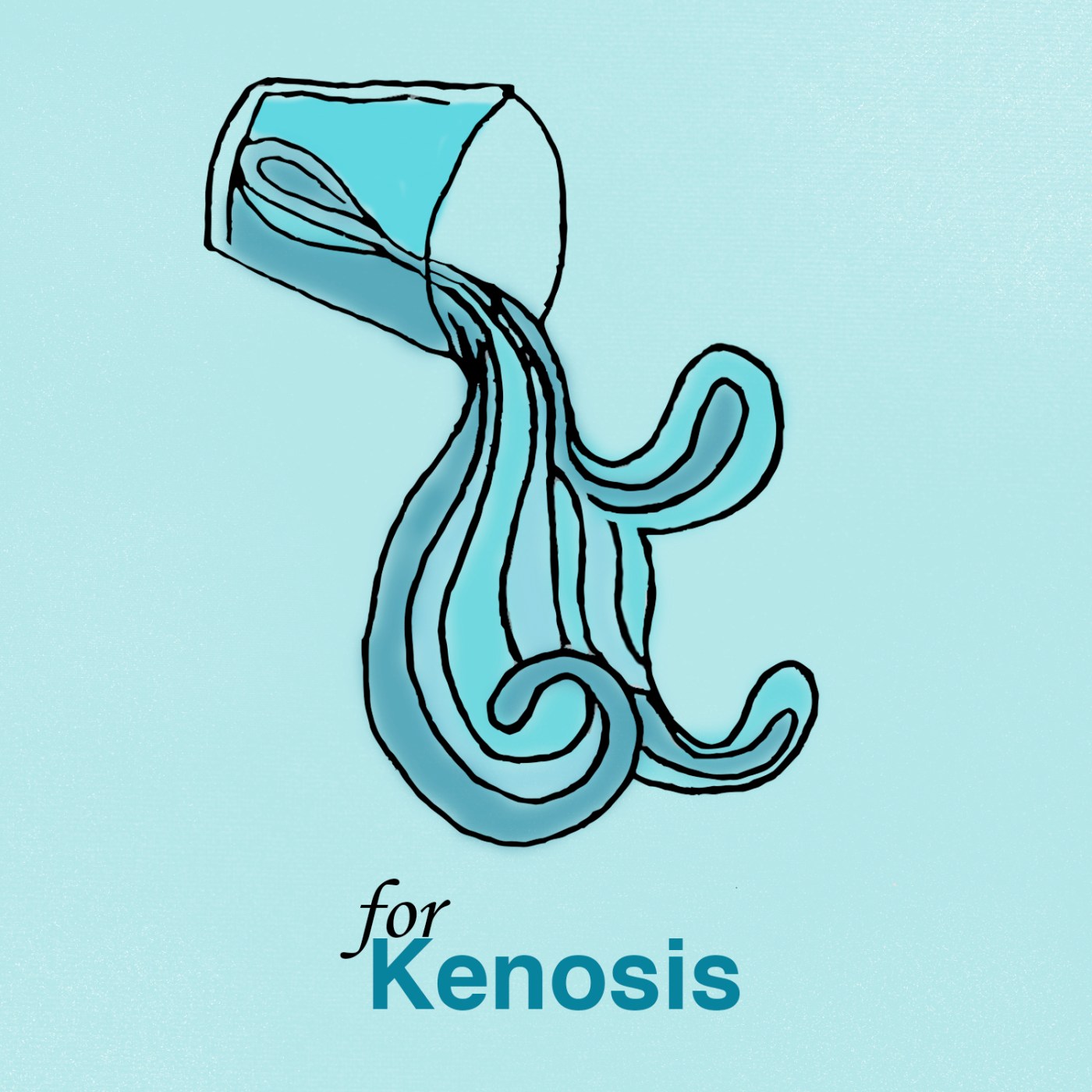
K is for Kenosis (and the Kingdom)

Kenosis is one of those Greek words in the New Testament that I wish went untranslated in English. It is a special and mysterious word that would be great just left as it was and put in italics by Bible translators.

I have a list of words that I wish remained in Greek. Words like agape, kiononia, kairos, and ecclesia. They are just great words that would carry some power/mystery if we did not offer an English translation.

I am a big fan of translating the Bible – in fact I think that the translatability of the christian scriptures is a major distinction from other religious traditions like Islam. We don’t have to learn the original language in order to read and interpret the Bible.

Lamin Sanneh in Whose Religion Is Christianity: the Gospel Beyond the West, says:

Being that the original scripture of the Christian movement, the New Testament Gospels are translated versions of the message of Jesus, and that means Christianity is a translated religion without a revealed language. The issue is not whether Christians translated their scriptures well or willingly, but that without translation there would be no Christianity or Christians. Translation is the church’s birthmark as well as its missionary benchmark: the church would be unrecognizable or unsustainable without it…  Since Jesus did not write or dictate the Gospels, his followers had little choice but to adopt a translated form of his message. (Sanneh p. 97)

You can read an older post about this issue here.

So while I love this translatability aspect of the christian testament, I also mourn for the loss of deep and mysterious words from the original language.K-Kenosis

Kenosis appears four times in the New Testament. Three times in is translated ‘made void’ or ‘to no effect’. The most famous appearance is in Philippians 2:7 when it talks about Christ Jesus and is translated ‘emptied himself’.
The self-emptying of God had become a big topic in the 18th and 19th century – then expanded in the theological work after the Second World War. Most people that I talk to are familiar with this concept in the work of thinkers like Motlmann and his ‘Crucified God’.

Our Pocket Dictionary defines it as:

Kenosis, kenoticism: Derived from the use of the Greek verb ekenosen (he emptied himself) in Philippians 2:7-11. Kenosis refers to the self-emptying of Christ in the incarnation, as well as his conscious acceptance of obedience to the divine will that led him to death by crucifixion. Many theologians see in the term a reference to Jesus’ choice not to exercise the prerogatives and powers that were his by virtue of his divine nature. In the nineteenth century certain thinkers built this idea into a kenotic *Christology,which spoke of the incarnation as the self-emptying of the preexistent, eternal Son to become the human Jesus. This self-emptying involved the setting aside of certain divine attributes, or at least the independent exercise of his divine powers.

Pocket Dictionary of Theological Terms (Kindle Locations 773-777). Kindle Edition.

While the concept is beautiful … it also gets really tricky really fast.
What exactly did he empty himself of? You have to be careful because almost any answer is either:

  1. a historical heresy
  2. based on a presupposition that he had that attribute in the first place

Most people go for the low hanging fruit of ‘3 omnis’ (as I call them) of omnipotence, omnipresence and omniscience. Obviously Jesus could not have been those 3 things and been human.
But once you start down this road you quickly run into your first barrier: if Jesus was lacking something that God has … how exactly was he still God? BUT if he had something that no other human had … then he wasn’t really all that like us and thus his being tempted or performing miracles is not really something that we can exactly imitate…

Many times this leads to a ‘Clark Kent’ version of Jesus where he wore a flesh suit and appeared to be human but underneath was a superman who could have done anything he wanted … it’s just that he chose not to!
This is part of why there is no end to the work of christology. Depending on your ontology (view of reality), metaphysics (beyond the physical), your view of the Trinity and your anthropology (view of humanity) … the danger of getting tied in knots is constricting.

What starts out as a beautiful word – Kenosis – hides a dangerous concept that can quickly become theological quicksand.

This is the opposite of a different ‘K’ word: kingdom.

What is often translated ‘the Kingdom of God’ in English is another phrase that I wish went untranslated: Basileia tou Theou.

From the age of Ceasars to the reign of Kings it made sense to translate it this way. It no longer does.
Not only does ‘kingdom’ not capture the nuance and possibility of expectation in Basileia tou Theou. It can actually be misleading because people think they know what a Kingdom is and are just waiting for God to take off this Clark Kent costume and take up the rightful claim to the throne!!

There are so many better translations of Basileia tou Theou. I have heard :

  • Kin-dom of God (family)
  • Reign of God (still too royal for me)
  • Common-wealth of God (my favorite)
  • Community of God (no hierarchy assumed)

I wish that we just left it untranslated as Basileia tou Theou.

You can see in these two ‘K’ words that translation is a tricky business and provides a constant supply of new material for the theological endeavor.

J is for Justification

The word Justification in English has the same convenient memory device as atonement did. Many use the Just-as-if to remember ‘it is just as if I never sinned’. J-Justification

Here is how our pocket dictionary defines it:

Justification, justification by faith: A forensic (legal) term related to the idea of acquittal, justification refers to the divine act whereby God makes humans, who are sinful and therefore worthy of condemnation, acceptable before a God who is holy and righteous. More appropriately described as “justification by grace through faith,” this key doctrine of the *Reformation asserts that a sinner is justified (pardoned from the punishment and condemnation of sin) and brought into relationship with God by faith in God’s grace alone.

 Pocket Dictionary of Theological Terms (Kindle Locations 764-767). Kindle Edition.

Our other resource for this series, Essential Theological Terms by Justo L. González, provides a helpful distinction about the heated debates between Protestant and Catholic thinkers during the Protestant Reformation.

The difference lay in that for Luther and the main Protestant theologians justification was God’s gracious act of declaring a sinner just, even in spite of the continued presence of sin, while Roman Catholics saw justification as God’s act of infusing *grace into the sinner, who can then perform acts of justice-good works-and thus become just.

(Kindle Locations 2246-2248). Kindle Edition.

Justification provides a telling snapshot about the task of contemporary theology.

  1. The concept is vital within the realm of theology.
  2. The underlying truth plays a central role with the christian tradition.
  3. There are many excellent theories and explanations regarding the concept.
  4. Consensus can be difficult to come by due to competing theories and explanations.
  5. Much of the work is subject to speculation.
  6. If one does not subscribe to the assumed presumption (in this case like ‘original sin’) then the solution seems arbitrary and unnecessary.

This is why I selected justification – as an illustration of the grand, elaborate, nuanced and speculative nature of much theology.

You might be surprised at how excited I get about the topic of justification and how committed I am to both proclaiming and explaining it to congregations that I pastor.
One of my favorite sermons is a high energy presentation of Romans 5 which begins:

Therefore, since we have been justified through faith, we have peace with God through our Lord Jesus Christ, 2 through whom we have gained access by faith into this grace in which we now stand. And we boast in the hope of the glory of God. 3 Not only so, but we also glory in our sufferings, because we know that suffering produces perseverance; 4 perseverance, character; and character, hope. 5 And hope does not put us to shame, because God’s love has been poured out into our hearts through the Holy Spirit, who has been given to us.

I then take v. 12-21 and convert the words into math formulas in order illustrate the fantastic work of God in Christ!

Keep that in mind when I say that justification is illustrative of the theological endeavor.

  • It is vital to the faith.
  • It is central to the tradition.
  • It is contentious as points.
  • It can be speculative.
  • It is rooted in suppositions that may be outdated or even antiquated.

This is a great snapshot of our task in contemporary theology: to take the tradition seriously, to account for the variety of perspectives and frameworks, and to adjust/adapt the ‘answers’ to the questions being posed by our present situation.

This is why simply parroting the answers of the past is often not sufficient. There are new considerations provided by sociology, biblical scholarship, history and science.
This is also what makes the theological endeavor A) exciting B) important C) difficult and D) complex.


Thanks to Jesse Turri for the artwork for this series.


I is for Infallible, Inerrant, Impassible and Immutable

Note: all relevant ‘I’ words will be placed in italics.I-Inerrant

It is an unfortunate quirk in the English language that leads negatives – or negations – to begin with the letter ‘I’.

The resulting effect is that some of the most problematic and even disturbing words in the theological tool-shed begin with ‘I’.

  • Infallible
  • Inerrant 
  • Impassible
  • Immutable 

These are just a sample, but are the 4 that we will focus on today.

These four ‘I’ words are just a sample of the kinds of words that lay-people can find both intimidating and infuriating about theology. Some have even lost their faith over these ‘I’ words.

Don’t even get me started on irresistible grace and infralapsarian – two concepts that hard-core Calvinists will bring up.

I say this in all seriousness. There is something about ‘I’ words which exhibit the most intense aspect of the difficulties when delving into theology. Many people point to words like these as an example of exactly why they are not interested in theology.

I have named 6 problematic ‘I’ words so far – but I will offer 2 more (inspiration and incarnation) as examples of ‘keeping it simple’ as an antidote to becoming disillusioned.

Let’s deal with the Bible first and then with God.

We live in a unique time of history where those who claim to believe the Bible the most attempt to place two words not found in scripture upon the Bible:

Inerrancy: The idea that Scripture is completely free from error. It is generally agreed by all theologians who use the term that inerrancy at least refers to the trustworthy and authoritative nature of Scripture as God’s Word, which informs humankind of the need for and the way to *salvation. Some theologians, however, affirm that the Bible is also completely accurate in whatever it teaches about other subjects, such as science and history.

This is admittedly a tough line to hold. The more that one learns about Biblical scholarship or historical criticism the tougher it gets. Inerrancy is an outside idea imposed upon the Bible that the Bible itself and thus has a tough time living up to its claim. It does not, however, mean that the Bible is not trustworthy!! This is my point! One can trust the Biblical narrative without having to elevate it to the level of inerrant.

Infallibility: The characteristic of being incapable of failing to accomplish a predetermined purpose. In Protestant theology infallibility is usually associated with Scripture. The Bible will not fail in its ultimate purpose of revealing God and the way of *salvation to humans. In Roman Catholic theology infallibility is also extended to the teaching of the church (“*magisterium” or “*dogma”) under the authority of the pope as the chief teacher and earthly head of the body of Christ.

Pocket Dictionary of Theological Terms (Kindle Locations 726-731). Kindle Edition.

Infallibility is better than inerrancy. Infallible can simply mean that the Bible will accomplish that which it is meant to accomplish. That seems fair enough on the surface.

Here is my contention: Why do we need to assert that it is guaranteed to accomplish the task? Where does that need for certainty come from?
Why isn’t it enough to say that the Bible is ‘inspired’ and leave it at that?

Inspiration: A term used by many theologians to designate the work of the Holy Spirit in enabling the human authors of the Bible to record what God desired to have written in the Scriptures. Theories explaining how God “superintended” the process of Scripture formation vary from dictation (the human authors wrote as secretaries, recording word for word what God said) to ecstatic writing (the human authors wrote at the peak of their human creativity). Most *evangelical theories of inspiration maintain that the Holy Spirit divinely guided the writing of Scripture, while at the same time allowing elements of the authors’ culture and historical context to come through, at least in matters of style, grammar and choice of words.

Pocket Dictionary of Theological Terms (Kindle Locations 731-736). Kindle Edition.

2 Timothy 3:16 talks about scripture being ‘god breathed’ . I think that should suffice and that attempts to impose external expectations upon the scriptures are futile (impotent?).  Whenever someone wants to talk about the ‘original’ texts, one only has to ask about them to see this folly.

It’s like calling the Bible ‘the Word of God’. The problem is that the New Testament refers to Jesus as the Word of God. Christians rightly refer to the testimony about Jesus as the scriptures. In this sense, they are words about the Word.
The problem starts when we want to upgrade the concept beyond its capability to sustain that we which we are attempting to assert upon it.
I would love if Christians would simply be satisfied with believing that the Bible is inspired by God’s Spirit and not attempt to make a claim on it that it can not sustain.

Now let’s talk about God.

The God that is revealed in Christ is, for the Christian, both informative and formative. It both sets a precedent and provides an interpretive lens.
As with the Bible (above) it is disastrous when we import foreign concepts of God (in this instance from Greek ideals) and impose them upon the revealed nature of Christ seen in the incarnation.

Immutability: The characteristic of not experiencing change or development. Certain understandings of God posit the divine reality as incapable of experiencing change in any way. Some theologians, however, assert that this concept owes more to Greek philosophical influence than to explicit biblical teaching. Many contemporary theologians distinguish between God’s eternally unchanging, faithful character and God’s ability to respond in different ways to changing human beings in their temporal, earthly situation.

Impassibility: The characteristic, usually associated with God, of being unaffected by earthly, temporal circumstances, particularly the experience of suffering and its effects. Many contemporary theologians reject the idea of divine impassibility, suggesting that it reflects Greek philosophical, rather than biblical, concerns. However, the Bible clearly teaches that God cannot be swayed in any way to be unfaithful to what God has promised. Still, it is seemingly impossible to associate pure impassibility with God in light of the fact that Jesus Christ, as the fullest manifestation of God, experienced suffering on the cross.

Pocket Dictionary of Theological Terms (Kindle Locations 704-709). Kindle Edition.

You can see why these concepts are contentious. They are imported from somewhere else and then imposed upon the narrative of Scripture. In my opinion they are incompatible and thus unsustainable.

Our great hope is found in the in-carnate god. We will return to this concept in two days with the letter ‘K’ for kenosis.

I would love to hear your thoughts, concerns, questions and comments.


BIG thanks to Jesse Turri for providing the artwork for each letter!

If you are interested you can see the early post about reading the Bible according to Genre or check out the art of Hermeneutics (interpretation).   You may also want to look into the temptation of Fideism.

H is for Hermeneutics

You may know that I hail from an evangelical-charismatic background.  What you may not know is that I am continually challenged in conversations about the need to interpret our experiences and texts.H-Hermeneutics

We don’t just have experiences – like we don’t just read (and believe) the Bible – we interpret. We do it as second nature because to be human – and thus social – is to be thoroughly saturated in language and symbols. We speak, and indeed think, in language. It permeates every thing we do and are. It is part of what being human means.

Our pocket dictionary defines hermeneutics as:

Hermeneutics: The discipline that studies the principles and theories of how texts ought to be interpreted, particularly sacred texts such as the Scriptures. Hermeneutics also concerns itself with understanding the unique roles and relationships between the author, the text and the original or subsequent readers.

Pocket Dictionary of Theological Terms (Kindle Locations 638-640). Kindle Edition.
Hermeneutics is a massive and complex field. Since this an ABC’s series, there are two things that you need to know :

  1. The word has been in use since the 17th century even though the idea is an ancient one that can be traced all the way back to the Greek philosophers.
  2. Everything changed in past 90 years. With the publication of Heidegger’s Being and Time in 1927, philosophy (and then subsequently the human sciences) took a hermeneutical turn.

One of Heidegger’s most famous students was Hans-Georg Gadamer. His 1975 book about the world of interpretation called Truth and Method expanded what is called the hermeneutical circle.
The five elements are characterized as:

  • pre-understanding
  • the experience of being brought up short
  • dialogical interplay
  • fusion of horizons
  • application.

I could not possibly do this topic justice in a single blog post – If you want more info there are links at the bottom of the page. ?

I just wanted to share an example of how the hermeneutical circle is employed in my field of Practical Theology. I tend toward utilizing the work of Paul Ricoeur and his ‘second naivety’ myself, but the example I want share is from Richard Osmer who utilizes Gadamer as his framework.

These elements allow Osmer to transition into analyzing the role of the congregational leader along these lines.

  1. He first examines the idea of guiding the congregation as a community of interpretation.
  2. Secondly, he addresses the need to guide interpretation evoked by the experience of being brought up short.
  3. Lastly, guiding the dialogue between theology and other fields of knowledge. Leadership of this kind is defined as “the exercise of influence.”

This influence engages in different forms of communication and is a collaborative effort. These three elements factor in significantly for the spirituality required to carry out the leadership that Osmer envisions.

  • The Descriptive–Empirical Task is called Priestley Listening and finds great importance in the power of presence.

The author illustrates the spirituality of presence by addressing several levels of what is called attending which is then integrated into concepts introduced earlier such as the congregation as a community of interpretation.

  • The second task is the Interpretive Task called Sagely Wisdom.

The interpretive task draws off of thoughtfulness, theory, and wise judgment. Osmer appeals to Israel’s wisdom tradition and to Jesus being the hidden wisdom of God revealed.

  • The third task is the Normative Task, which is called Prophetic Discernment.

The author utilizes a familiar pattern in this chapter similar to the previous two. Weaving together narrative, theory, and scriptural illustration.

  • The final task is the Pragmatic Task, classified as Servant Leadership.

Osmer identifies the three forms of leadership as task competence, transactional leadership, and transforming leadership.
The motif of “deep change” is introduced through the writing of Robert Quinn and is woven together with Old Testament imagery in order to illustrate the type of leadership that is required in this task. Quinn’s Four-stage model of organizational change (called the transformational cycle) involves: Initiation, Uncertainty, Transformation, and Routinization.

You will find that in almost all hermeneutical addresses, there is a common two common themes:

  1. They form a cycle, a circle or a spiral – signifying an ongoing (continual) process.
  2. The second stage or step is one of negativity, negation or something negative (like Uncertainty). This is important because it is only after was pass through the unknowing that we come to see-know-engage-understand-assimilate-fuse in a new way.

In conclusion:
We all interpret. We think, experience and speak through this lens.
The past century has seen a hermeneutical turn in almost every area related to human behavior, belief and social understanding.

For Further Reading:

A nice article on Heidegger and Gadamer

A massive and heady article on Hermeneutics from the Stanford Dictionary

A quick article on Paul Ricoeur and the Second Naïveté

G is for Genre or Billy Graham got one thing wrong

Genre is by far the most important thing about the Bible that many Bible believing people don’t know. Empire is a close second but nothing matters more than genre when it comes to reading the Bible.

Genre: A term that refers to different types or varieties of literature or media. In the interpretation of texts, particularly the Bible, most exegetes agree that identifying the genre of the text to be interpreted is crucial and that the text must be understood in light of the common conventions that typified that genre at the time of its writing. Thus, poetry is not to be interpreted in the same manner as historical narrative, nor is prophecy properly read in the same manner as an epistle (letter).

Pocket Dictionary of Theological Terms (Kindle Locations 593-595). Kindle Edition.

Simply stated, one must read a poem differently than history, prophecy differently than a gospel, an epistle differently than apocalyptic literature.

When people say “the Bible says …” it is a bit of a misnomer. The Bible is not one book per se but a collection of books. These 66 books were written at different times over several centuries by dozens of different men and women.G-Genre

This is why one can not say “The Bible says X” with any accuracy.

It would be better to say “In Romans Paul says” or, better yet, “The epistle the Romans says”.

Saying “the Bible says” is like saying “the Kindle says”.

If you said “according to the Kindle”, one would ask ‘in which book?’ and ‘who was the author?’

We need to do the same with the Bible.

This is where Billy Graham comes in. I was recently re-acquainted with the 1998 TED Talk delivered by the legendary evangelical preacher Billy Graham. You can hear the highlights here on the TED Radio Hour.

If you listen to those highlights, I expect 5 things will stick out to you.
1) The humble and sincere spirit of a man who impacted the world.
2) The quote about Thomas Edison.
3) The allusion to Pascal.
4) The ‘Liar, Lord, or Lunatic’ option

Now it is important to stop here are make a confession. Growing up Evangelical, I idolizing Billy Graham and was trained as an apologist in the Billy Graham School of Evangelism. I can not tell you how many times I quoted those same three lines (Franklin, Pascal, and Lewis).

I thank God for this man and have only one lingering concern:

5) The story about believing that the Bible was ‘God’s word’ because ‘God was a gentleman and does not lie’. That is an interesting cultural snapshot.

BUT what it leads to is viewing the Bible as a single-entity and being comfortable say “the Bible says …” as if the Bible did not have competing and contentious voices within its collection!

  • Many people love listening to Billy Graham.
  • Many of those same people love reading the Bible.
  • Many of those same people have never heard of J.E.D.P.

Which is the most basic entry-level of Biblical Scholarship that I know.

All of this is to say that ‘Genre’ is an important element of any Biblical examination and is essential to any discussion regarding faith and religion in the 21st Century.

I know that Billy Graham played a monumental role the American political and religious landscape in the second half of the 20th Century.
The phase “the Bible says”, however, is not one that we can carry into the 21st Century.

The books of the Bible need to be read according to the genre that they were written in.
That is how we hear the truth that is in them – and Christians, beyond anything else, should be lovers of  the truth.

_______________

You can read the rest of the series here:
A is for Atonement

B is for Baptism 

C is for Christology 

ABC Podcast (TNT)

D is for Deconstruction 

E is for Empire 

F is for Fideism 

Create a free website or blog at WordPress.com.

Up ↑