Search

Bo Sanders: Public Theology

updating & innovating for today

Category

Argument Culture

Bound In Conflict & UnBound In Love

We live in a time of division and conflict.

It is perfect timing then, that our topic this week comes from Galatians 3 and says, “In Christ, there is neither male nor female, slave nor free, Jew nor Gentile … all are one.”

Usually when this topic comes up people want to focus on how Christ’s love “bridges” the divides between us.

I want to take it a step further! I want to look at how:

A) we are bound up in those categories of sex, religion, and politics

B) Christ’s love ruptures those categories and un-binds us from them

The love of God doesn’t just bridge the divisions among us – it binds us together in love and undermines the very categories themselves.

God’s love calls into question the human categories of:

  • Gender
  • Sexual Orientation
  • Religion
  • Politics

Love UnBound doesn’t just help us bridge the difference between us – it unbinds us to see the other in such a different way that our categories themselves are called into question.

Here is a short video – let me know what you think …

Everyone For Themselves

I am big fan of Identity Politics.  People’s politics should be informed by, and come from, their social location. What is the alternative? Ideology? No, our identities are socially constructed and so that identity needs to inform our politics.

I am also aware that while identity politics (IP) are great for politics –they are not a totalizing approach for every area of life.  There has been quite a loud outcry recently by some over IP’s overreach into every arena and how it has come to dominate nearly everything in a media era where optics are everything.

Today I simply want to look at why it feels like it is ‘everyone for themselves’ in our culture. This is part 4 of “Why Things Seems So Bad Right Now”.  [You may want to read ‘No Neutral Anymore‘ and ‘Fragmented and Fractured’ first.]


Identity Politics rose in the 1960’s and came to prominence in the academy though various branches of what comes under the umbrella of ‘theory’. Concerns of feminists, civil rights leaders, the gay community and other minority groups brought radical critique of society and its norms in the 60’s challenging the status quo and the underlying assumption that sustained the oppressive systems of institutionalized systems.

Identity politics gave voice to many who had felt silenced or marginalized by a societal norm that instantiated by codes of conduct, conformity, and control (often through threats and actual violence). By banning together under small but vocal banners identifying the group as connected through some commonality and loyalty (race, gender, class, etc.) individuals were able to create a larger platform for their concerns and garner political leverage for change. Changes included legal protection, the removal of discrimination and practice of exclusion, as well prominence in representation whether in the workplace, government or media.


There are at least four considerable critiques of identity politics that cover a wide array of concerns from distinct perspective and commitments.  There are points of overlap between the critics, but for clarity I will group them in the following ways:

  • Atomism
  • Essentialist
  • Communitarian
  • Consumerism

Atomism: Marc Fisher is a vocal critic of identity politics (IP) as an extension of neo-liberalism and its resulting expression of autonomous individualism. Critiques like his focus on the shortcomings of the atomized conception of the individual that come out of the Enlightenment. The breakdown of social bonds (like the family and tribe), religious institutions (prevalent distrust of institutions and leaders) as well as prevalent mobility/transience has resulted in a society of individuals who often do not live in the village they grew up in, feel free to believe or not believe the things that their parents do, and have no generational supervision as they pursue their desires for promotion/status/relationship/satisfaction in isolation and without accountability.

IP then is the natural offspring of this atomized concept of self where one’s own self-interest and particular concern are central and elevated.  In this view, a black lesbian (for instance) takes her own interests and demands special consideration and a privileging of her situation to combat the privilege that has been inherited and enjoyed by those who has historically conformed to societal norms and thus their experience has been normalized.

Essentialist: Judith Butler has a very different concern about IP that it is danger of essentializing individual experience as a common and too concrete category. There is not one experience that can be called the ‘female experience’ or ‘the view of women’. The danger here is that a whole group can be lumped together and their varying experience and perspectives codified as something concrete or essential. Gender is the way (or sexuality, class expectations, etc) and its performative nature means that we have been socialized and conditioned into gender roles and expectations even as we freely act within the menu of options that we believe to be available to us.

In this sense, identity politics risks essentializing an individual or group’s experience in an attempt to gain solidarity within the identified group for the purpose of political leverage with those outside the group. Those working for ‘gay rights’ ban together to narrate a common experience in order to gain attention and allies that are required if the protections that are being sought are going to be agreed to by the majority. This, in Butler’s view, is a temporary measure that cannot be allowed to be essentialized as ‘the’ gay perspective or experience.

Communitarian: This group has a sustained critique of IP, prominently vocalized by thinkers like Michael Sandel. Communitarians view the individual within a larger matrix of social, ethical, and political structures that bind us as a networked or linked collective of groups and communities. The loyalties of IP are to the individual and promote the agenda of one group often to the neglect of or detriment to the collective whole.

IP looks to elevate the experience of a neglected or marginalized group without taking into account the possible reasons why that may have come to be the case historically. Both gays and women are addressed within the construct of procreation and the furtherance of our society and species. Communitarians are clever in the conservatism – contesting not on the grounds of some revealed or universal moral order, but on the grounds of utilitarian pragmatism before transitioning toward moralized principles of the greater good over specialty interests and minority perspectives. [1]

Consumerism: In his book “Consuming Religion”, Vincent Miller interacts with a number of Marxists critiques alongside postmodern approaches such as Jean Baudrillard to expose IP as a commodity fetish within the ‘logic of late capitalism’.  Within a consumer context such as Western culture has entered into, everything including religion experience and IP, is commodified. Consumption is ultimately unsatisfying but the totalizing nature of Capitalist society has the capacity to absorb even the most virulent dissent. The capacity of the market to absorb criticism and protest, then adopt and commodified the concern, and finally appropriate its agenda is all-consuming.

IP can easily be addressed then by the ‘logic of the market’ by taking every specialty interest group or minority and tailoring merchandise, products and ‘swag’ for their purpose and for their rallies. People want to broadcast an image to ‘appear’ that they are committed to a cause.

“The market does not distinguish between ‘Feel the Bern’ bumper stickers or ‘Make America Great Again’. It just wants you to buy bumper stickers.”

Nor does the market judge if a consumer wants to pay $2 more for a cup of coffee to ensure that it is organic – shade grown – fair trade – single region. In the same way, the interests of IP and its constituent groups are commodified and reified within the existing structure. Adjustment is made to supply personalized, modified, tailored, stylized and customized products and services for ready consumption. All resistence, dissent and protest is absorbed and appropriated into what Guy Deborg refers to as ‘the society of spectacle’.


In summary, critics of IP share in common a concern for its limitations even while those concerns manifest in disparate directions of critique.

  • First, there is no way that a few contributing markers can signify the totality of your experience.
  • Second, it is possible that identification within one minority group or special interest will suppress and minimize the full expression of your ‘self’ as an individual.
  • Third, by choosing to focus on one or a few personal markers of identity, groups create division and adversarial compartmentalization that may work against the ‘common good’ or which may end up limiting or injuring a different sub-group.
  • Lastly, by choosing to focus on one or a few personal markers of identity, there is a danger of essentializing one experience in order to promote a common voice or narrative but which may be inauthentic and intimately inaccurate committing a fallacy of misplaced concreteness in an attempt to promote solidarity or consolidate support.

I hope that this quick overview has been helpful – if nothing else, I just wanted to address why it may feel like there is such discord and animosity in our contemporary environment.


[1] This critique is very popular right now and is making big news on social media for being part of the backlash during the most recent election. Jordan Peterson is probably the most visible spokesperson for this sort of critique. The first 5 min of this video (content warning) will get you up to speed.

Being A Different Way In The World

What does it mean to be an Easter people?
In what way are we aliens and strangers (1 Peter 2:11)?
Is it possible to opt out of the current ‘Argument Culture’?

You can say “a different way to be in the world” … and that first step is a change in your personal orientation.

The next step is then to talk about being “a different way in the world”, which is a communal commitment and expression.

The emphasis of the first is the “be”.  A different way to be in the world asks us to consider how we approach the world, how we position ourselves, our posture toward the world, and our participation with the world.

  • How we approach the world
  • How we position ourselves in relation to the world
  • How we are postured toward the world
  • How we participate with the world

The emphasis of the second approach is the “way”.  This imagery rings familiar for Christians because Jesus proclaimed that “I am the way, the truth, and the life”. Following the teaching of Jesus is not just a different way to be in the world (though it certainly is), but the church is to be a different way in the world.

  • Forgiveness and reconciliation where there is division and animosity
  • Connection and community are prioritized
  • Peace and ‘shalom’ wholeness are desired
  • Unplugging from partisan politics and consumerism

Sadly, throughout history, the church has often followed the world’s way. It has utilized power, violence, personal gain, and many other worldly-ways to accomplish its work. People have used God’s name to get their way – but they have not always done it in God’s way.

The gospel is not just a different way of being in the world. It calls us to be a different way in the world.

If you don’t like the way that the world works, if you don’t want to be that way toward your neighbor, the stranger, and even your ‘enemy’, Christ offers you another way of being in the world. Then, when a number of us do this together, it provides a chance for others to find a different way – a path that leads to a different place.

Not understanding this has led to ‘the church’ participating in partisan politics. Christians have become a part of the problem and are actually making the situation worse. This happens in Liberal circles, in Conservative camps, and with folks who have opted out of the process altogether because they are disillusioned and don’t want to vote for ‘the lesser of two evils’.[1]

Aligning with the Republicans and the Democrats is failing us. Fox News and MSNBC (or NPR) are not the problem nor are they the solution. To paraphrase the Apostle Paul “neither voting or not voting brings in the kin-dom of God” but right-living, peace and joy in God’s Spirit.  (Romans 14:17) [2]

Cable news and social media are not the way. In fact, this is part of how we have been seduced by the ideologies of our day. Conservatives who want to legislate morality and Liberals who look to identity politics as an end in itself are practicing the way of the world. You can’t legislate morality and identity politics are great for liberal politics but not for sacred community.[3]

Jesus calls us to a different way of being in the world that does not use our race, gender, class, and sexuality as boundary markers. It includes and transcends the categories of identity and belonging (Galatians 3:28).

Likewise, the way is not found in military strength. It is not satisfied by consumerism or credit card debt. It is not found in reclaiming some idealized past or in returning to some romanticized notion from a previous era. It is not about becoming more orthodox in our beliefs or extravagant in our worship and sacrifice.

Once we discover a different way of being in the word (first step) and then collaborate with others to be a different way in the world (second step) then we may choose to partner with or support those elements of political parties that help bring about the greater good. These are the first two steps on a very long journey.

To be clear: I am not an idealist but I am a true believer. I am not after utopia. There is no pure or perfect to be had. Just writing this in English (or any language) is inherently compromised and corrupted. We have been formed and informed by the very words and ideas that we have been given. We are groomed and conditioned from birth in the way of the world.

Christ’s way will never be popular. It will always be a minority movement. It started that way and is perfectly suited to be that way. It does, however, provide a different way for an individual to be in the world and collectively we provide the world a different way than its round-and-round, dog-eat-dog, us versus them, march toward destruction.

Admittedly, I am being foolish here. I believe that there is a different way that isn’t measured in dollars, or troops, or ‘likes’, or members, or votes, or converts, or doctrinal purity, or visibility, or sales, or laws, or nearly anything that can be measured or quantified.[4]

The current way of being the world is being exposed as a rotten tree. We can smell its sour fruit. Its roots in division and deceit are coming to the surface. It can barely stand under the weight of its own burden. It provides no future or hope that the way forward will be satisfying or liberating.

Our hope is to follow the way of Christ, to live in the truth of God’s love, and to live life in the Spirit. If we did this, together, we would open up possibilities that are not even visible to us yet.


[1] If you are going to vote, I would certainly encourage you to vote for less evil. If nothing else we could use less evil.

[2] “for the kingdom of God is not eating and drinking, but righteousness and peace and joy in the Holy Spirit.” (NASV)

[3] Identity politics is great for politics. Of course someone’s politics should be informed by their social identity and location! What else would it be informed by – ideology?

[4] If you are looking for specifics, step one might focus on passages like the fruit of the spirit in Galatians 5:22-23 and step 2 might begin to look at passages like 2 Corinthians 5:19 in which God reconciled with the whole world through Christ and then gave Christ’s people the ministry of reconciliation. The first step is often personal and the second is always collective.


Different in Degree or Kind?

In an either/or world where things are so often presented to us as binary options, it is vital for the thoughtful christian to have maneuvers or techniques to counter the paralyzing confinements of the dominant framework.

The problem with these either/or options is not necessarily with the two options themselves. In fact, they both might be valid in and of themselves. The primary problem is that they are conceived of (or presented as)  A) non-overlapping and B) adversarial.

It is this dual-ism that results from the inherent divide of nearly every topic in modern American life: republican/democrat, creation/evolution, protestant/catholic, white/ person of color, lost/saved, married/single, male/female, gay/straight, conservative/liberal, etc. The list just goes on and on. Nearly everything is framed in this oppositional binary way, then turned inward toward  a ‘silo’ it becomes an echo chamber which then becomes a shouting contest and the volume goes up to 10. It is deafening.

In the past, I have used a simple technique of 3-4 to disrupt the either/or (1-2) stalemate. For instance, in the creation/evolution divide I look to a 3rd way (often a middle-way) of intelligent design to ‘split the middle’ and then look for an approach completely outside the bounded-set. Vine Deloria Jr. helps me there with his book Evolution, Creationism, and Other Modern Myths  to introduce the category of non-western origin epics.

I do the same with politics when the either/or mistakenly talks about ‘half of the country’. I point out that actually most of the country didn’t vote at all (3rd category) so while half of those who voted did so one way or another, the majority opted out of the system all together. Then as a dual-citizen with Canada I talk about the advantage of coalition governments (4th perspective) and the need for cooperation & compromise instead of ideology and ‘my team’ mentality which leads to a zero-sum winner/loser scenario.

Side note: earlier, I used the word ‘techniques’  and I just want to give a nod to the work of Michel de Certeau in The Practices of Everyday Life where he differentiates between the ‘strategies’ of the system and the ‘tactics’ of those who are trying to survive, subvert, and adapt to the established (dominant) order.  My use of ‘techniques’ is a homage to his ‘tactics’.

Recently, I have tried a new technique that seems to bear good fruit, even if it is different  than the 1-2-3-4 approach.

The question is: “Are these different only in degree or type?”

This started with christology when asking “is Jesus’s humanity different from ours in degree (more intense) or was he an entirely different kind of human than we are? The answer, of course, is that Jesus was fully human and thus differs from us in degree (faithfulness or openness to the divine). Jesus was the same kind or type of human as we are. This saves us from the popular modern misconception that has Jesus in some sort of Clark Kent  mud-suit which covered his divine super-man underneath.*

That conversation was so fruitful that I have begun to adapt it for other topics. My favorite one so far is in ecclesiology when asking about denominations. Are these two groups different in degree only or are they entirely different types of christianity? It is really helpful, at some level, to have permission to say ‘while these two groups both claim to be christian, they are so different that it may be difficult to find a common thread to link them’.

Degree & Type is especially helpful to correct the soft-cynic type who loves to quote that “there is nothing new under the sun”. When it comes to things like war, we need to ask if modern warfare differs in degree or type from the kind of military strategies that we see in the bible or in colonial history. The truth is that with the introduction of nuclear weapons, war needs to be thought of as a different type. It is not simply an escalation in degree but we have graduated to a different kind of military.

I have been in the classroom a lot lately and I have been finding the degree & type tool for analysis very helpful. It seems to open up new possibilities for people to look at classic sticking points and contemporary conundrums in ways that are not so limiting.

I wanted to introduce it here because I plan on employing in on some upcoming topics. It has added helpful richness and nuance to conversations about Jesus, church, the bible, denominations, politics, military, sexuality, and so many other relevant issues for 21st century expressions of faith.

Let me know what you think.


*  If I ask you “how did Jesus turn water into wine or do other miracles” and your answer is “he was god” then you have missed the full humanity of Jesus and we need to talk about the work of Holy Spirit.


May Update and 1234

Thank you for all the support and affirmation during my study break!

The request to do 5 min videos instead of 10 min videos has been heard I will be redoing the series from last summer as a 2.0 theme starting with God 2.0

A new mic has been purchased and the whiteboard has been upgraded.

Here is a quick summary of 4 things to look for when framing an issue.

A ‘Kind’ of Conservative

Three encounters in the past month have opened my eyes to a ‘kind’ of conservatism that I am suspicious I was not hip to previously. In the heated spectrum-thinking cultural climate that exists today, it is easy to get distracted by the exaggerated and inflammatory. What is more difficult to perceive is a kinder, gentler conservative mentality.

Here are 3 places it showed up recently:

  1. In fielding some criticism about our interview with the Cambridge Intelligent Design guest.
  2. In my tussle with the Aquinas crew (and their follow up blog posts)
  3. In conversations with two different pastors that I have known for decades – both inquiring as to my new progressive/emergent take on two thing quite ‘foundational’ to them (creation & evangelism).

The sentences are subtle – but once you pick up a pattern you begin to hear them more clearly.

“Since God is not a ‘he’ or a ‘she’, we gain nothing by using feminine pronouns for God … so let’s just stick with the tradition we have and the way it is in the Bible.”

That was the one that caught my attention. Then I started hearing that same formulation in other places.

“No one has ever provided iron-clad proof of macro-evolution … in the lack of definitive conclusion,Biblical creation is just as valid as any other ‘belief’ since we can’t prove it either way”

or

“You might be right about these cultural changes and the future of the church … but who is to say that your fancy new way will be any better than what we have now?  We might as well not tinker with anything since there is no guarantee it will fix the problem – and might possibly create different or bigger problems.”

This is a subtle type of conserving. It is not the blatant ideological animosity that gets all the press and dominates the airwaves. It is a more quiet concern that we not move too far too fast.

Here is my fear: it seems to me that this tactic is employed by – and born out of – a status quo that seeks to protect / preserve itself.  It is neither aggressive or egregious but is potentially just as harmful as it’s venomous counterpart. MP9004065481-196x300

“I get what you are saying Bo … but what’s not to say that 10 or 20 years from now your new-fangled ideas don’t look just as dated and flawed as those you are criticizing today?”

See how it works?  Since my innovation today might seemed cliché to the next generation … let’s not get too far ahead of ourselves and think that we have it all figured out. In fact, why change anything?

This ‘kind’ of conservatism doesn’t necessarily have a radical agenda. It doesn’t need one. It would be just fine if things stayed mostly as they are. It is perfectly suited to the current conditions. Stasis and a romantic reflection on the past is a perfect incubator for its ongoing preservation and, consequently, promulgation.

I would love to hear your thoughts on this. 

Liberal Question part 3: Music and Whiteness

I think a lot about issues of race, gender and class. I read about it and talk it over with people every week. I am working my way through an expensive program in order to write my dissertation about it.  I care about matters of diversity and justice a great deal. mumford_and_sons

Ever since talking to my mentor, Randy Woodley at Wild Goose West last fall I have been thinking about this a little differently. Then with the happenings of the Emergent Christianity thing in Memphis … I thought I would bring out what I have been whittling away at in my workshop.
This is something I am working on and I would love your constructive feedback. 

The problem isn’t Brian McLaren speaking at a conference.
The problem is if everyone speaking at the conference looks like McLaren.

The problem isn’t reading a book by a white guy.
The problem is only reading books by white guys.*

The problem isn’t having a man speak up front at church.
The problem is if we only hear men speak from up front at church.


You don’t even listen to podcasts! 

Here is what I want to avoid. There was some grumbling on facebook when The Culture Cast was released and it turned out that both Jordan and Christian were white guys. Ironically, almost all the grumbling came from white guys – but that is a different issue.

One female friend said “where are the women podcasters?”

I suggested that since it was a concern of hers … why didn’t she tell us some recommendations.  Why is she asking a question?

She responded that she didn’t listen to podcasts.

I was stunned.

I asked “then why do you care? What difference would it make to you?”

It would be like me complaining their aren’t enough black NASCAR drivers. I don’t watch NASCAR. I don’t even know how many black drivers there are. That reality is irrelevant to my existence.

I think that we need to care deeply about things that we are invested in. There are too many issues that matter for too much for us to get tangled in controversies vicariously.


We don’t except tokens.

We need to be careful of tokenism. Let me be clear on this: if you are group of white people who have organized a conference, already have 10 white speakers lined up and then think ‘we need some color – let’s see if we can get Randy Woodley’ … that is token.  Randy got no say in the direction and organization nor had any power or influence. You just want to put a microphone in his face and have him do his schtick.

Token is an afterthought that serves primarily to help one feel good about being able to check off a box. If Randy was on the organizing committee – trust me the no conference would look the same.

In contrast to ‘token’ let me offer 3 examples:

  • Anthony Smith is an emergent voice and influence. He was in the movement before me and helped bring me in. That is not token. That is influence. Anthony Smith is influential.
  • When Tripp and I organized the Emergent Village Theological Conversation we said “Monica Coleman is our marquee speaker, our cornerstone, our prima donna.” And we did not do anything until she agreed to be our first round draft pick. She got session 1 to start the conference to set the tone and she got session 5 to end the conference so that she had the final word. We built the conference around that structure. We then invited others to come in around her.
  • When we inherited the Phoenix Big-Tent Christianity event many of the speakers were already in place. It was great to have Richard Rohr, Marcus Borg and Brian McLaren to boost ticket sales. But we wanted to highlight some voices that people had not heard a lot before. So, for instance, we structured the actual sessions that one of the ‘marquee’ voices was asking questions of one of the ‘emerging’ voices. For many people, that was the first time they had heard of Rachel Held-Evans. I will never forget watching her debate Marcus Borg about church folks understanding of creation!


I’m with the band. 

Here is my big point:
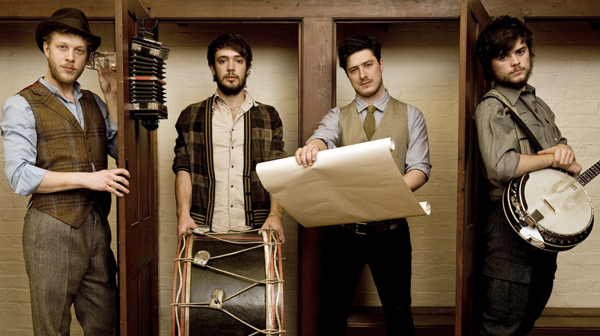
The problem isn’t that Mumford and Sons are all white guys. We have to look at the way that bands form. It makes sense that the guys of Mumford connect and play.

The problem is if every band on the radio is white guys.

The problem isn’t that Bono is a white guy or that U2 are all white guys.

The problem is if every band on a record label is a bunch of white guys.

We have to learn to distinguish between how a band come together and how the music industry functions.

We also need to do this for church … and for christian conferences.

No conference or podcast is or can be the full expression of the kingdom on earth. It is not nor can it be heaven. It is not supposed to be. Like no band can play every type of music …

I understand our desire for diversity – I just want us to manage our expectations. Our problem isn’t with Mumford and Sons, it’s with the music industry.

The answer isn’t “add a black guy”.  That is not how bands work.
Can you imagine somebody saying “why doesn’t Boys 2 Men have a women in it?” or “why doesn’t Destiny’s Child get Ricky Martin to join?”

The problem then isn’t with any church, podcast, organization, conference or person. Our concern is with how that all comes together in a less-diverse way than we would hope for and desperately need. 

The answer then is not to ‘add a women and stir’ or to ‘get some color’. That is what we call token – and it is insulting to everyone involved.

The need is to examine the bigger picture. This includes how things are planned, who makes decisions, and in what ways can people access resources.

Here is a timely example: Tripp and I are singers and songwriters. Our friends Callid Keefe-Perry and Steve Knight are as concerned about the impact of technology on the church as we are. We have talking about  it whenever we are together. We started this when we lived in 4 different parts of the country. Tomorrow, Steve Night is in town and we are going to record a podcast about the subject.

That is not a problem. We are Mumford, or U2, or The Stones, or the Beatles … we are just a band.
It is not a problem that we sing together – or in this case talk together. The problem comes if we are the only ones you hear.

Just to be clear: 1) I am using this an analogy. 2) I am using the music industry as a positive example.


___________________

*If you find yourself in this situation, here are some books suggestions

Quest for the Living God by Elizabeth Johnson

Christ the Key by Catherine Tanner

Teaching Community by bell hooks

Shalom and the Community of Creation by Randy Woodley

Many Colors or The Next Evangelicalism by Soong Chan-Rah

Triune Atonement: Christ’s Healing for Sinners, Victims, and the Whole Creation by Andrew Sung Park


Liberal Question part 2: Jesus Creed

I had the honor of guest blogging for Scot McKnight a couple of weeks ago. It was a good opportunity to try something out with a different crowd. It was  instigated by last weeks post in response to Roger Olsen and Scot McKnight.Facade of St. Vitus Cathedral

It was a fantastic conversation and I learned several things that I will take with me into future engagements. Here are some observations:

  • I learned to clarify the difference between people in the pew and theologians.

I go to a mainline school and work at a mainline church. I have an amalgamation in my mind of the ‘average liberal’.  But if you are in the conservative camp, your main engagement and concern is with Liberal theologians who have a high profile.

If was starting the post over, I would address this up front and make an early distinction. I think that would have helped.

  • I learned not to use the word ‘versus’ if you don’t mean adversarial.

Neither Scot nor I think liberal is necessarily  a bad thing. Roger Olsen does. But some of the readers at JesusCreed think in adversarial binaries. I was not trying to say that progressives are good and liberals are bad. I was simply trying to distinguish the two – not pit them against each other. The argument culture is so strong – especially in conservative circles – that I should have preempted that.

  •  I learned that those in systematic approaches struggle to recognize non-systematic approaches.

This is an obvious and inherent problem. If you value systematic approaches, of corse you will criticize something as ‘not systematic’ and think that stands alone are a critique. I was trying to point out that conservative, liberal, evangelical, emergent, and progressive are not 5 categories of the same thing. Some are positions. Some are loyalties. Some are approaches.

Here is what I ended up with: 

Since my Cobb quick-definition was not working for folks I thought I would ‘shift’ the emphasis and see if this language worked better:

Liberal – a constellation of loyalties inherited from the Enlightenment that is settled/assumed.

Progressive – an approach that integrates such influences as Feminist, Liberation and Post-Colonial critiques explicitly.

I’m open to help refining this – ESPECIALLY  if you are a self-proclaimed  liberal or progressive

My favorite response came from TJJ and it has me smiling ear to ear.

Qualities of a progressive ………as viewed by an evangelical……….

A. See more “grey” in their approach to scripture issues: inspiration, inerrancy, revelation.
B. Allow for more of a continuum on doctrinal/theological issues: hell, salvation, sin, depravity, exclusiveness of Gospel, etc.
C. More open ended on social issues : gay marriage, illegal immigration.
D. Trends more democratic/progressive politically
E. White, college degree and often more, affluent, alcohol, NPR, Toyota/Honda, MSNBC/CNN

Oh my. That is good.

At first read you may say “yeah – of course”.

But look at it again. It’s actually pretty helpful to see it all in one place.

I would love to hear your thoughts on any part of this whole episode. 

Liberal Question part 1: Rick Warren

A couple of weeks ago, Rick Warren provided some of us with a lot of fun on Twitter. He had sent out a message:

“New churches: Buy land as soon as you can but delay building for as long as you can. Cant explain all the reasons here.”

This set off one of the funniest followup memes I have seen called #RickWarrenTips.

Those, however, are not the Warren tweets that I want to discuss. Earlier Warren had fired two out of the blue shots at ‘liberals’. I had just finished my progressive and liberal post at Jesus Creed and so I was really interested.

Here are his two quotes:

Liberal theology cannot sustain a local congregation. It kills churches. In fact, It only survives due to tenured academics.

and

Liberal theology has never created any university. It just sucks the life our of those that were started by Bible believers.

Plenty of people had push-back on the last bit of revisionist history.  I’m not so concerned with the accuracy of his content …my question is what even spawned  or sparked it? 

What happens for somebody like Rick Warren that causes him to fire this out?
Was he reading something that has him thinking about liberals?  

Did he get in an argument with someone?
 Was he watch watching something on TV about liberals?
Was he watching Fox News or something?

I’m not so much asking for wild speculations about Warren in particular – I’m more thinking about the contentious and combative polarized atmosphere that shots like this are fired out of.

Create a free website or blog at WordPress.com.

Up ↑