Search

Bo Sanders: Public Theology

updating & innovating for today

Category

Bible

What if this isn’t even Christianity anymore?

One week ago  I caught wind of a cooky Southern preacher who preached about a plan to exterminate lesbians, queers and homosexuals. I hear a lot of chatter about this kind of thing so I hoped it would just go away.

By Tuesday night this North Carolina pastor was showing up all over Facebook and Twitter. By Wednesday morning he was the ‘most popular’ link on all of Yahoo! world homepage.

If you have not seen this video, be warned. It is in no way understated. Here is the link:  NC Pastor 

 I have 3 main thoughts about this:

  1. I know tons of people who are not for ‘same sex marriage’ who would not speak of electric fences. Anytime you are suggesting some tactic that the Germans used in WWII you may want to take note.
  2. This is a different TYPE of Christianity – one that is the concerned with governing morals. We going to have to address why the church is even doing State sanctioned marriage in the first place. So often we try to have the second conversation without the first – no wonder it doesn’t go anywhere.
  3. My church and 50 others that I know of and communicate with on a regular basis do kind things and say loving words all the time and no one press covers it. That is the nature of the modern media. Deal with it.

Nothing thus far is that surprising – save the actual sermon by the NC Pastor. Here is my concern:

  • At what point is some pastor so deep in the Constantinian compromise that he is more Roman than Christ-like? At some point do we say ‘that is not even Christian’ ?
  • OR is this just one branch of Christianity and it is our obligation to treat this man as a brother who has simply lost his way?
  • OR is this Preacher doing more harm than good and actually crippling the gospel message – and in that sense he is an enemy of our cause?  And at that point, what do we do with Jesus’ admonition to love our enemy?

Admission: I have been re-reading Stuart Murray’s Post-Christendom and … while that is admittedly probably not the best idea … I have to admit that this whole ‘legislating civil unions and marriages’ thing in North Carolina could not come at a worse time for me.

For what it is worth, here is my 2 cents.

  1. This is not Christianity. Well, it might be Christendom but it is not whatever Jesus was after.
  2. This guy is my brother (in humanity even if not christianity) and has simply lost his way.
  3. Whether he is my crazy cousin or my enemy – Christ compels me to love and respect him as a person even as I wholly (and holy) disagree with his inhuman and immoral speech.

I’m not really sure what other course of action I have in this situation. I spent last week in the woods with no technology and unless I want to perpetually retreat away from all this ugliness, I have got to address this kind of craziness at some level. What else is there in the face of hate except to love?

The Church of N. America will always be (mostly) like it is now

Before I headed out into the woods for a week, I had posted this over at HBC. It triggered a good discussion and today when I was reading a thing about Joel Osteen’s individualism I was reminded of it.  I would love to hear your thoughts.

 The church of N. America will always be (mostly) like it is today.  When those who think as individuals read a text that is communal, there is always going to be an issue. 

I know that there is a real danger in painting in broad stokes and speaking in generalities. I normally steer clear of such dangers but once in a while you find something that allows you to wade out onto the normally thin ice with a certain measure of confidence.

I recently finished a term paper on Alisdair MacIntrye’s opus After Virtue which is his attempt to reclaim the Aristotelian notion of character formation within community (to oversimplify a bit). In preparation for writing the paper I went back over some classics like John Rawls and Michael Sandel (the communitarian) and others.

It just so happens that I have also been reading a lot of post-colonial critique during this year and I have a growing suspicion that I wanted to throw out there:

We have individuals (products of the enlightenment) reading a text that was written in a communal framework (a product of a communal society).  That provides a fundamental discrepancy that will never be resolved. It will always provide a disjointed experience and thought process that lacks continuity.

Let’s not pretend that we can think another way. We are heirs of the enlightenment – this is our operating system. We can download a new program like ‘christianity’ but it is operating within the individualist code. Talking with my friends who are from non-European descent (Native American, Pacific Islands or certain Asian communities)  it is clear that there is no simple conversion that an individual can undergo and simply start thinking in communal terms. We are cultural creatures and this is our culture.

It shows up when we read the Bible. It shows up when we talk of government (democracy) economy (consumerism), status, value, worth, choice, success, identity, rights, laws,leadership and … well nearly every other aspect of Western society.

The famous example of Philippians 2:12 admonishing us to “work out your salvation with fear and trembling” is but a drop in the pond. It’s not just that the English language doesn’t have a plural ‘you’ (unless one counts the ya’all of the Southern US) but it is bigger than that. It is that we think in individual ‘you’s and there is no way around it.

This will always be an issue. So even when somebody talks about character formation, spiritual community, or some ideal of communitarian discipleship (be it Hauerwas, the Radical Orthodox, or any other innovative group) in the end, the church of N.America will always look mostly like it does now. The reason is that this individualism we think in is not all that compatible with the communal thrust of our very scriptures – and that is irreconcilable at some level. It can not be resolved because we can no more stop thinking as individuals than that Bible can stop encouraging community.

Limits in (religious) Language

I just finished my semester this past week and was going through my desktop cleaning up all the icons when I discovered this post and realized that I had put it up over here yet.
It was originally posted at HBC

I like reading Lindbeck.* I used to say that I love Lindbeck but I ran into two snags.

  1. I didn’t realize what people did with Lindbeck. I did not know that it often led to retreat into a neo-Catholic expression.
  2. There is some philosophical wrinkle that I don’t fully understand about why the language that creates our religious experience implies a one-way limitation of language -it is a bit technical for me but I wanted to acknowledge it because it eventually becomes a real sticking point.

Having said that …

What I am a big fan of is Lindbeck’s critique of Language. He has a riveting analysis of the way that religious language functions in our communities and personal experiences.  I was susceptible to liking Lindbeck because of my deep appreciation for Nancey Murphy’s book “Beyond Liberalism and Fundamentalism”. I was primed for what Lindbeck brings to the table.

To become religious–no less than to become culturally or linguistically competent–is to interiorize a set of skills by practice and training. One learns how to feel, act, and think in conformity with the religious tradition that is, in its inner structure, far richer and more subtle than can be explicitly articulated. The primary knowledge is not about the religion, nor is that the religion teaches such and such, but rather how to be religious in such and such ways. p. 35

Then I found out that saying you appreciate the Lindbeck’s (post-Liberal) approach is like saying you cheer for the New York Yankees in Boston. I understand the concern with the descendants of Lindbeck’s work … but I am still suspicious that he is right about how language works in our faith communities.

Fast Forward: I was reading some stuff to get ready for the 2012 Emergent Village Theological Conversation this past January and I stumbled onto a section of Whitehead’s thoughts on religious language.** I got to a section called “Doctrine and History”. After dealing with the fact that language does not have a one-to-one correlation and that all language thus requires interpretation, the author explains:

“The language of a tradition and the central doctrines that reflect and support that language are the prime turbulence of the particular mode of existence characterizing that tradition. Furthermore, as human existence is shaped in specialized ways during the course of history, experiences occur that are not possible to persons shaped by other traditions.”

I resonate with the idea that a person is shaped by the language one is groomed and conditioned by – and that would both empower and naturally shape the experiences that one has and the interpretation of those experiences … even (or especially) the religious experiences.

It just makes sense that because religious in a communal endeavor – one is always a part of a community that has a tradition and set of practices/beliefs – that it determines, at some level, both the types of experiences one has , can have and how one translates or interprets those experiences.

This is a vital assertion for the 21st century! We no longer live in the monopoly of Christendom or the frameworks of the Colonial Era where one tradition imported and imposed foreign expectations and alien interpretations on another.

With works like “The invention of world religions” by Tomoko Masuzawa and “God is not One” by Stephen Prothero (among many others) we are entering a time in world history (and thus church history) where we need to come to terms with two things that both Lindbeck and Whitehead are pointing out:

  • Language is both inherited and powerful in shaping our experiences and subsequent interpretations of those experiences.
  • Language used in doctrines like ‘the Church’ and ‘Eucharist’ actually facilitate the ability to have certain experiences that are simply not available to those outside the community or language game. Practices like Yoga or Ramadan would be the same for those in different traditions. That is why North American Christians who do yoga are not have the same experience as those in India.

We live in an era where the realities of inter-religious education, cross-denominational communication and trans-national citizenship are going to challenge all of our inherited traditions and conceptual frameworks.

If we are unwilling to do so and insist on simply repeating the same rote answers week after week under the misguided impression that we are being faithful to the tradition … we are in danger of an irrelevance that leads not only to extinction but ultimately failure to accomplish our great commission.

*George Lindbeck wrote “The Nature of Doctrine” and along with Hans Frei (author of “Eclipse of the Biblical Narrative”) is credited with starting the Yale School of thought. One of the most famous proponents of which is Stanley Hauerwas famous for his books like  “Peaceable Kingdom” as well as other things.

** Alfred North Whitehead was a 20th century philosopher who is credited for helping to come up with what became Process-Relational thought.

Jesus & (S)words part 3

reposting from last week.
Part 1 & Part 2 provide the lead in

Part 3:  Jesus tells his disciple to buy a sword?

We come to that famous passage in Luke 22 where Jesus tells his disciples to buy a sword.

 35 Then Jesus asked them, “When I sent you without purse, bag or sandals, did you lack anything?”

“Nothing,” they answered.

36 He said to them, “But now if you have a purse, take it, and also a bag; and if you don’t have a sword, sell your cloak and buy one. 37 It is written: ‘And he was numbered with the transgressors’[b]; and I tell you that this must be fulfilled in me. Yes, what is written about me is reaching its fulfillment.”

38 The disciples said, “See, Lord, here are two swords.”

“That’s enough!” he replied.

Here are two readings you may want to consider: 

Earlier this week I engaged a political reading of Moses and the waters of Meribah from Numbers 20. My question was “why, if Moses was going to ultimately speak to the rock, did the Lord even mention the staff?”  The answer was that it was a symbol of power to be carried – yes – but ultimately resisted in favor of a better present option that might be overshadowed by the most obvious option.

It takes strength to turn the other cheek. If you don’t have the ability to retaliate … it is just being a doormat or victim? That is how I have always thought about it.

In that perspective, I have read Jesus’ odd command with Peter in mind. I see that fateful night where Jesus tells him to ‘put away your sword’ and later tells the authorities ‘if my kingdom was of this world my followers would fight.’ The implication is that Jesus’ kingdom is not of this world and so his followers don’t fight.

The sword for the disciple, then, is what the staff was for Moses in Numbers  20: a powerful option to be resisted in favor of a preferable option that is less obvious because it is less forceful.

I used to reconcile ‘buying swords’ as a sort of object lesson or training excersise for the disciples. One lesson (trust and supply) is over – next lesson: You can’t resist temptation is one of the options is not even available.

 Then, in 2007, I discovered that Biblical Scholars have a different way of handling the passage. Here is Ben Witherington: 

Lk. 22.36-38. What is the meaning of this little story, taking into account the larger context of Jesus’ teaching? Vs. 37 is the key where Jesus quotes Is. 53.12—“he was numbered with the transgressors”. Jesus is saying to the disciples—you must fulfill your role as transgressors of what I have taught you!!! They must play the part of those who do exactly the opposite of what Jesus taught them in the Sermon on the Mount. The disciples become transgressors by seeking out weapons and then seeking to use them. This much is perfectly clear from the context for the disciples then go on to say “look Lord here is two swords”. They already have such weapons and Jesus responds in disgust to the fact that they are already transgressing his principles of non-violence by responding “that’s enough” (of this nonsense).

 So either Jesus was saying that two swords was enough for the revolution (not likely) or Witherington has this right.

Conclusion: We have looked at these four famous passages now and it seems clear that although Jesus talked about swords and the writers of scripture utilized sword analogies, none of these passages is a validation of the type of violence these verses are used to justify.


Jesus & (S)words part 2

I’m reposting last week’s HBC conversation in 3 parts
[part 1 is here]

Part 2:  

There are lots of swords in the New Testament.  The Word of God is compared to a double-edged sword and Jesus comes back wielding a sword. Maybe the Bible is more than ‘O.K.’ with swords and sword imagery?

Let me throw out two things:

  • In the context of the Roman Empire and its occupation of Jewish lands in the 1st century, swords would have been a common item that drawing imagery out of would have been appropriate.
  • A well-known pastor in Seattle, Washington is famously quoted as saying “Jesus is a cage fighter with a tattoo on his thigh and a sword in his hand, determined to make someone bleed”. He said this in reference to the fact that he “could not worship somebody that he could beat up.”

Some people dismiss statements like this and chalk it up to testosterone fueled, overly inflated, pumped up hyper-masculinity.  I worry that there is something much deeper and much more sinister involved. I think that it is a fundamental misunderstanding of the nature of God and the interpretation of Christian scripture.

 What is noteworthy in Revelation 19, is that the sword is not in Jesus’ hand but it comes out of Jesus’ mouth. That seems important in the poetic/prophetic  nature of Revelation. This sword is not your average sword. It is not in Jesus’ hand and that makes you wonder if the way in which this sword “strike down” the nations is not in bloody violence but in a kind of destruction that would happen as a result of a sword that proceeds from the mouth of God?  Let’s ask ourselves “is there something that comes from the mouth of God that radically impacts or consumes peoples and nations?”  Is there something sharp that comes from the mouth of God … something sharper than any two edged sword?

Oh, here we go: Hebrews 4

12 For the word of God is alive and active. Sharper than any double-edged sword, it penetrates even to dividing soul and spirit, joints and marrow; it judges the thoughts and attitudes of the heart.

So far so good! ‘It’ judges the thoughts and heart… but here comes the twist:

 13 Nothing in all creation is hidden from His sight. Everything is uncovered and laid bare before the eyes of him to whom we must give account.

Hold the phones! … the Word of God (it) is a person? Yes. Guess who?

 14 Therefore, since we have a great high priest who has ascended into heaven, Jesus the Son of God, let us hold firmly to the faith we profess.

Jesus is the Word of God?    (I’m being funny but you may want to check out John 1 for clarification).

 In conclusion: the use of sword imagery  in both Revelation and in the book of Hebrews needs to be taken with a poetic grain of salt. Yes, the Bible uses sword imagery. The thing is that if Jesus’ (S)word, from part 1,  is a non-sword or an un-sword and in Revelation is comes from Jesus’ mouth and in Hebrews it is a person … then none of these passages, thus far, can be utilized to justify what so many Christian (s)words are used for. 

I’ve obviously been having fun here, but the bottom line is that just because the Bible uses swords as analogies – it isn’t a wholesale validation of swords nor a justification for using them as the world does.

________

I would love to hear your thoughts – I just have one request: please don’t use the word ‘Pacifist’ when speaking of Jesus. That set of commitments belongs to a distinct school of thought  that did not exist in Jesus day so it is anachronistic to use in that way. He was certainly into non-violence and radical peace-making but Pacifism is a unique configuration of convictions.

Jesus & (S)words

This conversation went really well last week over at Homebrewed. I thought I would post it here in smaller chunks for anyone wanted to continue the conversation.

Jesus tells his disciples to sell their bags and buy swords. Why? And why then does he reprimand Peter for using a blade at the moment when it seemed to be most appropriate?  Was Jesus being inconsistent? Did he change his mind in the moment? Was it a test? Did he set Peter up to fail? Why did he say that ‘those who live by the sword, will die by the sword?’ and then tell his disciple to buy them?

I am asked about Jesus’ relationship to swords as much as anything I get asked about. Good hearted people are quite baffled by the whole subject.

  • Jesus did after all say that he came to bring a sword.
  • As the word of God, he is said to be sharper than any two-edged sword.
  • He is pictured with a sword coming from his mouth when he ‘returns’.
  • and there is this matter of him telling his followers to buy swords

As a former apologist, I have gotten pretty good at helping the baffled work through these passages. I even has a presentation I do called jesuSword that incorporates Jesus, his words, and these passages about swords.

 In order to facilitate a lively give and take, we will take this in 3 quick addresses over the next 24 hours.

 Part 1: Jesus says that he came to bring a sword.

 Matthew 10:34 “Do not suppose that I have come to bring peace to the earth. I did not come to bring peace, but a sword. 35 For I have come to turn “‘a man against his father, a daughter against her mother, a daughter-in-law against her mother-in-law—   37 Anyone who loves their father or mother more than me is not worthy of me; anyone who loves their son or daughter more than me is not worthy of me. 38 Whoever does not take up their cross and follow me is not worthy of me. 39 Whoever finds their life will lose it, and whoever loses their life for my sake will find it.

 Is it possible that Jesus was being ironic and that his sword is actually an un-sword. I say this because Jesus’ sword does the exact opposite thing that normal swords do. His sword divides family. Traditional swords are used their swords to defend their kin and kind.

Jesus was using a play on words.

Jesus was using hyperbole. In his day swords were actually for defending one’s family – for guarding me and mine. In this sense, Jesus’ “sword” is an un-sword… or an anti-sword. It does the opposite of what human swords are used for.  Jesus’ sword is not for defending family but for dividing family. Jesus did not come with a human sword but the opposite!!

John Caputo puts it this way:

The kingdom reigns wherever the least and most undesirable are favored while the best and most powerful are put on the defensive. The powerless power of the kingdom prevails whenever the one is preferred to the ninety-nine, whenever one loves one’s enemies and hates one’s father and mother while the world, which believes in power, counsels us to fend off our enemies and keep the circle of kin and kind, of family and friends, fortified and tightly drawn.”

If Jesus was being ironic or using hyperbole, it would make so much more sense than the way this passage gets used to justify violence and militarism.

I would love to hear your thoughts – I just have one request: please don’t use the word ‘Pacifist’ when speaking of Jesus. That set of commitments belongs to a distinct school of thought  that did not exist in Jesus day so it is anachronistic to use in that way. He was certainly into non-violence and radical peace-making but Pacifism is a unique configuration of convictions.   

Democracy, Pentecost, and the Old Testament?

  • Is it possible that democratic desires are present in the Old Testament and I have just never seen them before?
  • Is the de-centering of Pentecost and the empowerment of the people foreshadowed in the Old Testament?
  • Can we say  A) that Pentecost in the undoing of Babel and B) that God’s desire has always been for the voice of authority to reside in the people (multitude) and not in top-down leaders?

Here is why I am asking:

Recently I stumbled on what might be the most interesting reading of Moses at Mirebah I have seen. It comes from the book Emergency Politics by Bonnie Honig (also on Kindle). In it, she is engaging the theology of Franz Rosenzweig – a contemporary and rival to the German (later Nazi) Carl Schmitt who famously said “” Sovereign is he who decides on the exception.”

In Numbers chpt 20, Miriam passes away. She had been a prophetess for the people and had challenged Moses’ authority on occasion. Immediately after her passing (this will become important) the people realize that there is no water and press Moses and Aaron for solutions. Moses and Aaron step away from the people to seek God and receive instruction to “take the staff and speak to the rock – it will pour out water before their eyes”.

Moses, as you may remember, doesn’t follow instructions to the ‘T’. He ad libs a little bit.  He does indeed gather the people but then he veers from the plan. He chastises the people and then strikes the rock. Two things happen:

  • water does indeed come out
  • God is displeased with Moses and will not let him enter the land that is promised.

I have preached this passage many times and have read lots of treatments. I am intrigued by this passage and have always been unsettled by one detail in the story, which I have never been able to resolve:

why does the Lord tell Moses to take the staff if he is just going to speak to the rock? Why even mention the staff?

Here is where Honig and Rosenzweig bring a unique reading. The staff represent something magical like sorcery – or the miraculous for the early 20th century. This is a political theology and what is at stake in the suspension of law in emergency conditions. Can a sovereign power suspend law in the same way that  God suspends the laws of physics in order to preform miracles? Leaders, being empowered by God, the thinking goes, could suspend ‘normal’ activity if they determined an exceptional circumstance.

In Honig and Rosenzweig’s hermeneutic the dispersed empowerment of the people (multitude) is the location for God’s will and is intended to be home to the will/voice of the Lord. But, as we know, this responsibility had been too overwhelming and was resisted by the people in selecting Moses as a king type who would speak to God for/instead of them (Exodus 20:19). This was an abdication by the people of what the Lord had desired for them as a people – to be prophets all.

This resistance is reinforced when the voice of the people rises in the absence of water, and Moses (along with his brother Aaron) turn away from the ‘stiff necked people’ and receive instruction to speak to the rock. Moses then, probably importing the top-down authoritarianism of his Egyptian upbringing, disobeys the command to speak and instead, chastises the people and strikes the rock with his staff in an act of magical sorcery. God, though it produces water, reprimands this act, and Moses is disallowed from entering the promised-land with the people.

This event is placed within the historical context, earlier in the passage, where Miriam passed away and immediately the people realized that they had no water and held a council against Moses and Aaron. Miriam’s name alludes to water and she was the sister who placed Moses in the Nile’s water when he was an infant. She had been the only one to challenge Moses’ authoritarian ways and she provided, as a prophetess, a check to Moses’ power. Without her, this reading states, Moses proved he will give the people … “not authentic prophecy, but sorcery.” In not recognizing the predictive prophecy of the people (and Miriam), Moses loses his leadership of the people.

Honig utilizes Rosenzweig’s two types of prayer – one that spontaneously arises in a situational moment, and another that is used by the community and creates an openness or receptivity – to analyze the judicial deliberation surrounding the Bush v. Gore presidential ruling. By imagining that the people could have risen up in expectation of a serious effort to count valuable democratic votes instead of waiting for a Schmittian top-down rule from the authorities. The sovereign power might have been within the people prepared for and receptive to the sign instead of what came from above it – a rupture from beyond them. This expectation is foreshadowed within the Mosaic tradition that one day all of the people would be prophets (like Miriam).

Honig asks if this metaphorical reading (which it expressly is)  is a good model for democratic politics and a comparison of the  “state of legal exception to the divine rule of god”. The people, she says, when bound together can give to themselves the powers of state and can again decide to suspend them when, as a multitude, they are oriented and receptive (having been prepared) to the consequences of such action and what they point toward as a sign.

This, in the end, is the problem with magical thinking! We abdicate our power as the people – to be receptive to and bring forward the voice and will of God – in favor of looking to magically empowered leaders to suspend the rules that govern due to exceptional (or emergency) circumstances and hand down solution (metaphorically) through sorcery.

It makes sense then why the Lord even mentions the staff if Moses is ultimately to speak to the rock. It is a metaphor (symbol) of concentrated power that is present but to be resisted in lue of the prophetic possibility of speaking. In that speaking, which is to be located in the people (multitude) prepared by prayer, that a sign is revealed that points to a greater reality. We never hear that voice if a receptive people continually abdicate that potential to exceptional leaders who are expected to provide magical results.

God’s of use of authoritarian leaders would, in this line of thinking, always be either a temporary measure, a concession, or a deviation from the Lord’s will to have the voice housed in the God’s people.

I started with questions and I will close with one:

  • What kind of effect would a reading like this have the kenosis  of Philippians 2 and that weird conversation in 1 Samuel 8 where the people want a king and God says “trust me, you don’t – you only think you do” ?

Opting Out of the Argument Culture (follow up to 4 > 2)

Last week I put out a fun challenge for Good Friday: repent of either-or thinking. It got a great response and a reader asked how one might pursue a conversation differently.

After a decade of trial and error, these are the three things (appropriately) I have found most helpful in breaking down the inherited dualisms: diagrams, vocabulary, and intentional complexification.

Diagrams: I am a believer in the power of shapes. I heard Len Sweet talk one time about how the two scientists that finally solved the riddle of DNA actually had all the necessary proteins and elements figured out for quite a while … but could not break the code. It wasn’t until they had that now famous shape – the double helix – that they were able to put the puzzle together.
I tell people

“You can have all the right content and be forcing it into the wrong shape.”

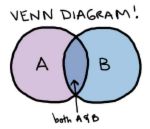
My use of the Venn last week to create 5 categories out of 2 would be an example of this. But it comes from a deep conviction that even when given 2 categories, there has to be more to the story – so look for a third. (The book Argument Culture by Deborah Tannen is excellent on this point).

Draw the person’s spectrum and then bend it (as I did here) for them. Take their two options and put it in a matrix (like the Urgent/Important matrix below). Just become convinced that there is too much data for it to be crammed into a pre-made little mold – it just won’t fit. You end up discarding too much data once your little tins are filled.

Vocabulary: When people are too familiar, too entrenched, and too comfortable, you may have to change the terms of the debate in order to unseat the status quo.

In the never ending Calvinist v Arminian debate that Calvinist love, I will teach them that Arminius was a Calvinist, but  just ‘not calvin enough’ and then, in reaction, the Synod of Dort went more calvin than Calvin to come up with T.U.L.I.P. So when Calvinist portray all free-will theologies as Arminian, that is like an American saying that all non-republicans are democrats: its just not true. They are basically just two sides of the same coin … but certainly not representative of the whole array of options. If they want to read an actual Arminian they should check out Roger Olson and his book Against Calvinism. Once you know what a real Arminian looks like, you will stop mistaking everyone who is not Calvinist for one!

Intentional Complexification:  Since dualism is destructive and deceptive, resolve to never let two contradictory-adversarial positions stand as the only options. Search far and wide, at all costs find a third option. Become inquisitive, Become imaginative. Who doesn’t see it this way?

In the abortion debate you must take away the entrenched or given labels that people assume are the only options. Pro-Life is usually just about one stage of life (unborn) and is less concerned about the life of the mother after her child’s birth, the education of the child 5 years after birth, our  country’s foreign policy and being pro-life in an age of perpetual war, and the ever increasing rates of incarceration, death penalty, etc. To be pro-life you also have to be pro-health care, for education, against militarism, anti-death penalty and should probably do something about hand guns and assault rifles ( I’m not talking about your deer rifle Mr. NRA, that is not what is being used to kill people in these shootings).

If you don’t care about the health of the mother, the education of the child, the life of soldiers, and the life of inmates then you are not pro-life: you are just anti-abortion.

When I see the conversation being set up in an us v. them scenario, I will just boycott by saying “until a women has control over her own womb and she can walk away from a pregnancy like the fella can, we can not even have this conversation. It’s impossible.” I just won’t concede the terms and allow the conversation to be set up like that. It is a false binary and it never leads anywhere except ‘both’ sides (as if there is only 2) feeling justified in their own self-virtue.

So those are my 3 suggestions. I would love to hear what things you have found help us get out of the either/or rut and change the parameters conversation!

Four is greater than Two: Good Friday repentance

So often when I hear two groups arguing, I think to myself  “the problem isn’t what we think about this subject, it is how we are thinking about it.”  If you have read posts here for any time at all you will know that I am not a big fan of dualism in general. I invest great amounts of energy examining binaries and pulling apart overly simplistic dichotomies.

In the past I have utilized a Venn diagram to illuminate the overlap between two groups that are ‘given’ as the options. Lately, I have focused more on the 4th and 5th area.
So in American politics, when ‘republican’ and ‘democrat’ are given to me as opposites, you simply illustrate the overlapping values of the two (3rd space) and then point out those who are ‘neither’ (4th space) like Green folks and anarchists. Then draw a circle around the whole system and point out folks outside the system (5th space) like Canadians.

This semester my two classes are ‘Political Liberalism and It’s Critics’ and ‘Globalization’. It has given me lots of practice in picking up on patterns and thinking in different shaped categories.

Example 1: when a subject like ‘Norms’ is discussed – in sexual identity or sexual practices for instance – often a basic “for & against” structure is presented for any isolated topic. But as the discussion develops you can actually see that this is not a linear ‘far left – far right’ spectrum configuration – even if it is presented as such!

You quickly see that there are least 4 positions even ON a spectrum: if the far left position is “there are no norms” and the far right position is that norms are “intrinsic / originate outside the system” and implement themselves, you can imagine that a center-left position would be an emergent perspective (norms arise from below in the population and then ascend) and a center-right position of top-down Hierarchy where norms are seen to be passed down from the authorities. Recognizing those four positions facilitates a radically different conversation than just outlining two.

Example 2: when the subject is ‘Law’ or court rulings, we need to rise above elementary ‘agree’ and ‘disagree’ binaries.  There are actually 4 positions in practice.

  • Agree & Obey
  • Agree & Disobey
  • Disagree but Obey
  • Disagree and Disobey

It is essential to admit that in any population there will be great variety, disparity, and diversity – so we do a terrible disservice to the matter when we reduce the matter down to basic dichotomies.

The reason I bring this up is because I am very concerned about the round-and-round cul-de-sac conversations that I hear over and over again in the church. I am growing convince that as contemporary Christians, the issue is increasingly not what we think but how we think about it.

The issues of abortion, homosexuality, biblical inerrancy, the creeds/ orthodoxy, environmentalism, and women in ministry are just 6 examples of matters where the dualisms are killing us.

One of the best things that could happen this Good Friday would be for those who take the Christian story seriously to die to – not what we think – but how we think about it. My dream would be for a heart of repentance: to decide in our hearts to swear off inherited dualisms and pledge to, as a community, look for and develop better ways of framing the issues that matter to us most.

Challenge: This Friday, repent of either/or thinking and die to the dualism of us/them for/against right/wrong in/out thinking.  Ask your small group to hold you accountable and maybe even join you in a new life (Easter) of the mind.

disclaimer: some of you will finish this post and think ‘it was so remedial it was barely worth reading’ and others will think ‘that is crazy talk – you are either right (on God’s side) or you are plain wrong – there is no middle ground.’ But we have to start somewhere, and this is the world we live in.


Blog at WordPress.com.

Up ↑