Search

Bo Sanders: Public Theology

updating & innovating for today

Category

Church History

Modern Theology’s Opportunity (3/3) : Neither Barth Nor Schleiermacher

Christian theology has an opportunity moving into the future. In part 1 I outlined modern Christianity’s problem. I could say more about Christendom, Colonialism and Consumerism (the 3 C’s of modern Christianity) and will later this week.

In part 2 I looked at modern Christianity’s temptation to concede, attack or retreat: concede to the private/personal realm, attack in the public realm or retreat into silos of privileged speech in the religious realm.

In order to understand how deep the problem really is, it might seem helpful to use modern Christianity’s binary way of thinking (as I alluded to in the title of this post). The either/or, mutually exclusive way of conceptualizing and framing issues is to tempting: conservative/liberal, literal/figurative, Catholic/Protestant, white/ethnic, male/female, gay/straight, etc.church-300x199

This is not our way forward.

When thinking about just Protestants in N. America you have to account for everyone from fundamentalist to charismatics, evangelicals to liberal mainliners, Pentecostals, Quakers and emergent types.

Ours is an age of diversity, multiplicity and plurality. Our theological approach needs to reflect that.

We are cresting into some form of late, high, hyper or post Modernity. This is evidenced in the fractured cultural arena and an unprecedented awareness of pluralism.


There will never be one great theologian again. The days of the great single voice are over. When Moltmann and Cobb pass, we will see the end of an era.

Now we refer to Feminist theologians, Liberationists, Process thinkers, the Yale School and Emergent voices. The closest we might get is referencing someone as Barthian or a Hauwerwasian.

This move toward the collective is significant. It pales, however, in comparison to the real shift.


The more significant shift is away from abstract, speculative and universalizing brands of thinking.
The future is found in:

  • concrete
  • interdisciplinary
  • qualitative analysis (observation)

These are but three of the reason that I love my discipline of Practical Theology. It is concerned not only with the ideas but with the practice of faith. It is inter-disciplinary because no one field is adequate to fully investigate or represent what is going on in an area of concern. It utilizes qualitative methods (interview, ethnography and case study) to flesh out the phenomenon under review and to represent the real and lived experience of those living faith out on the ground.


The models used in the past are inadequate then, they are harmful. Linell E. Cady’s chapter in Theology at the End of Modernity holds a powerful explanation of the problem and opportunity. [1]

The problem with a liberal approach’s emphasis on experience is obvious. The past century has exposed the fatal flaw of this opportunistic brand of Christianity. The ‘Christian Century’ ended somewhere between Hiroshima and 9/11. We can talk a more about this at a later time.

The answer, however, is not retreat into fideistic models that protect religious or god-talk from outside review by setting up religious speech as a privileged and incommensurable realm. I have been critical of both post-Liberal and Radical Orthodox approaches for this very reason. Neither the authoritarian modes of , say, Reformed thought nor confessional schools like these are sustainable in the 21st century.

“Moving toward this vision of theology means abandoning the systematic, ahistorical, textually driven mode of theology for one that is far more contextual in its attention to embodied religion.” [2]

Cady goes on:

“All too often theologians have pursued an ahistorical engagement with the great theologians of the past, regarding their positions as perennial Christian options rather than as strategies peculiar to a specific place and time.” [3]


In closing I want to make a subtle distinction. There is a deep resonance with the concerns about non-contextual, speculative, universalizing and systematizing approaches to theology. It just so happens that Practical Theology provides a different approach. Cady explains:

“(This) model of theology suggests the need for more careful attention to the historical and cultural context within which theological reflection is located. Moving in this direction would align theology closely with the history of religions … (becoming) more attentive to the analysis and evaluation of embodied religion.

The skills of the sociologist and ethnographer would begin to shape theological expertise, providing important supplements to the prevailing exegetical and philosophical orientations.” [4]


Our age asks us to move from abstraction, speculation and systematics to a collective and inter-disciplinary approach to lived religion. [5]


________________________


[1] It is not that I am fascinated with Gordon Kaufman – but with those who are attempting to answer the questions that he raised. I hope to address them from within a Practical Theology approach.

[2] p. 93

[3] p. 97

[4] p. 82

[5] Please read my previous post on The Body and Embodied Religion

Modern Christianity’s Temptation (2/3)

In light of the massive shifts in culture, understanding and expectation that the last 300 years has seen, there seem to be three great temptations for the devout.

Last post we talked about the problems that Modernity brought to Christianity’s doorstep in the West. Science had moved into the driver’s seat and was none too kind to those who would not get on board.

The problem, of course, is that we are simply not left the option to go back to primitive Christianity. For Lent this year I read books about post-Nuclear theology and listened to lectures on the first twelve centuries of Church history. It has never been more apparent that the world has changed in drastic ways.

  • Christendom
  • The Scientific Age
  • Globalization

Are just 3 catalysts and results of this epic (and epoch) shift.

Tomorrow I will present what I see as the amazing opportunity. Today I want to comment on what seem to be the 3 biggest temptations for modern Christianity:

  1. to concede
  2. to attack
  3. to retreat.


Concede

Faith as a public matter has never been more challenging. The easiest response is to both personalize ones faith and then make it private. This is a two-step dance but either is dangerous on its own.

Personalizing faith is a natural response for an Enlightenment Individual. We major in ‘self’. We have cultivated the ability to think in ‘me’. This is a novel development in religion and some argue that it is against the very nature of religion! The purpose of religion is to bind us together in practice (re-ligio) or reconnect us as a belief-community.

The second step is to internalize ones personal faith. In liberal democracy, no one cares if you believe something – just keep it to yourself. Don’t put it on someone else. Your personal practice in there or over there is one thing … just don’t make too big of a deal about out here. Out here we have a civil expectation of life, liberty and the pursuit of happiness. If your religion helps as a means to those ends, fine. If not, it might become an issue of you infringe on someone else right. Go ahead and practice your ‘tradition’ on your own time but just keep it down when you’re out here in public.

The modern expression of Christianity has responded to this two-step dance in many little ways – my favorite of which is consumeristic-accessorization. The bumper sticker on my interal-combustion automobile and the fashionable yet ironic message T that imitates a popular ad campaign are just two examples. It allows me to allude to a Bible verse (I am not of the world after all) while participating in a capitalist system that goes unquestioned.


Attack

To counter the personal-and-internal compromise noted above, an aggressive and external coup has been attempted. The memory of Christendom has fueled a political response to take back power and ‘return to our roots’. The rise of the Religious Right (and Moral Majority) of the past four decades is perhaps the most high-profile example. It is, however, just the latest incarnation of this impulse.Facade of St. Vitus Cathedral

The fond (and white-washed) memories of days gone by and yesteryear fuel an anger at what is seen as a disintegrating culture and a slouching toward Gomorrah. The resulting Culture Wars and political animosity have a fundamental problem however:

Ever since the Constantinian compromise in the 4th century is has been difficult (if not impossible) to get the Bible to say what one needs it to say in order to justify a claim to power.

A religion founded on the teaching of a marginalized prophet and incubated in persecuted minority communities does not lend itself to being in charge. An incredible amount of selective editing, creative hermeneutics and mental gymnastics are required to make it fit. At some point a voice like Yoder comes along and points out that ‘this is untenable’.


Retreat

The above two responses are both simpler and more obvious (and thus more popular) than our last response. The retreat is more subtle and sophisticated. I will return to Theology at the End of Modernity from the first post.

Those who seek to answer the questions raised by the work of Gordon Kaufman (primarily Sheila Greeve Davaney and Linell E. Cady) have deep concern about a school of thought that seeks to move the Christian tradition toward an “autonomous and protected location”.

A seductive temptation is found in an attempt to preserve former (historic) expressions of the faith behind linguistic fences (insulated language games) and communities that become isolated silos. These “are really retreats into forms of fideism or ‘protective strategies’ that seek ways of interpreting theological discourse so as to preserve its unique status.”

The Post-Liberal work of Lindbeck and the Radical Orthodoxy camp of Milbank and MacIntyre are in danger of this.[1]

Those who follow this line of reasoning:

“contend that theology is not properly about ascertaining indubitable truth claims about God or reality, nor about fathoming the depths of human subjectivity; rather, the task is to analyze and explicate the fundamental claims about reality and human life that have emerged within a specific tradition, so that believers might more fully appropriate and live out of their tradition’s vision of reality.”

It becomes a:

“self-enclosed historical community; its method is interpretive, not critical; and its goal is to aid in the internalization of central claim, not the critique or reconstruction of that which we have inherited.” p. 6

You can see the attraction of the retreat! By privileging “revelation” or the “given-ness” of the tradition, one is afforded the space to preserve and defend an inherited system which immune for outside critique and thus preserved in its ‘as is’ status.

This romantic preservation and reclamation mistakenly – and perhaps intentionally – defends and protects manifestations and consequences that we not only need to move on from but we to which we can not possible return to.


In part 3 we will conclude this series with a challenge to make the Christian faith “pluralistic, public, and critical”.


[1] “by emphasizing an ahistorical human subjectivity, (they seem) to find an autonomous sphere protected from the challenge of other forms of inquiry, then the cost of such independence was the removal of both theology and religion from the public sphere.” p.5

Modern Christianity’s Problem (1/3)

For Lent this year I did an interesting experiment. I did not give up anything but instead added an exercise as a discipline. My goal was to engage both the earliest days of the church’s past and stretch myself to imagine the church’s future. I did this by engaging two things:

  • I downloaded a lecture series on the History of Christianity from the 1st Century to the 12th. I listened to this as I biked to work and walked my dog everyday – instead of my normal diet of podcasts and news programs.
  • I bought and read a series of books from the most forward thinking theologian I have ever encountered. I read these in the morning over a french-press of coffee.

This has been a profoundly enriching experience and I am left with several observations as this season comes to an end.

1) I have never been more impressed or moved by the passion of the early centuries. What they were attempting to do was so formidable and expansive that a great deal of respect must be paid to them by anyone attempting to engage in a theological endeavor. From figuring out how a concept of Trinity could work with monotheism, to the incarnation within greek metaphysics – from eternal begotten-ness to the double procession of the Filioque clause controversy … one has to respectfully give a nod to what they were up against the overwhelming effort that was exerted. This is the first time that I have revisited either the patristic or the Middle Ages since I took on as conversation partners Process thought, Post-Colonial concerns or Critical Theory. This is the sixth time I have cycled around to the early church studies in the 20 years since I trained for ministry. It has been, by far, the most enlightening.

2) I have never been more convinced of both the situated and contextual nature of the church’s theology and practice. It is not just that those saints of the past lived in a different time, a different place and spoke a different language than we do – they were dealing with entirely different sets of concerns and with totally different sets of data. From Augustine, to Abelard – from Anselm to Aquinas, once you enter into the intricacies and nuanced argumentation of these doctrinal concerns, you can’t escape the fact that they were a product of their time. All theology is contextual and an honest examination of any doctrine or teaching reveals that their situated nature and specific location (time and place) played as much of a role in their development as any formulation that might have come out of them. The pre-Moderns were not only asking different questions than we are, they were working with different material than we are. Their philosophical assumptions, their metaphysical frameworks, their limitations of language and their pre-scientific world-views all have to be taken into account when evaluating their writing and thought.

3) I have never been more aware of our contemporary situation and how modernity has completely changed the game. To contrast the examination of the early centuries I have been reading the work of Gordon Kaufman, and more importantly, those who attempt to answer the questions that he raises. Kaufman is famous for his ‘Theology for a Nuclear Age’ but I am far more impressed with those who responded to him in ‘Theology at the End of Modernity’. Sheila Greeve Davaney, Sallie McFague, Linell E. Cady, Wayne Proudfoot, Francis Schussler Fiorenza, John Cobb and Mark C. Taylor have been rocking me.MP9004065481-196x300

Kaufman says that we live in an unprecedented time after a) the Holocaust b) Hiroshima and c) global environmental degradation. Human’s capacity to destroy life and wipe out humanity means that we are in a different epoch (era) that comes with unique concerns and an unequaled intensity. I agree with him.

We have to be concerned with things that Origen and Augustine simply never had to consider. We also have access to information that Aquinas and Calvin would have had no reference point for. We live in a new day. We have different concerns. We deal with levels of consequence they never had to consider. This is a new epoch – where the threat isn’t from the heavens or a realm beyond (super-natural). It is all too present and in the natural.

This admission leads to/calls for some significant adjustments to ones approach to life, thinking, theology and practice. We can’t go on just saying the same things (parroting / repetition) without variation. At some point it becomes unfaithful.

Take the foot-washing ceremony that often accompanies Maundy Thursday services. The unique element of the Biblical accounts is that Jesus shocked his followers by doing something that they would have been very familiar with. The novelty was who did the foot-washing. We live in an era where the novelty is the foot-washing itself. It has also changed from an everyday and practical occurrence to ceremonial and liturgical one.

“So even when we do the same thing that they did we are not doing the same thing they did.”

We live in a different time and in a different culture, which asks us a different set of questions, so that even when we give the same answers we are not saying the same thing.

4) It has never been more obvious that we can not go back. By looking at both the first 12 centuries and the last 30 years at the same time, it has deftly illustrated how extreme the gap is. What rests in the gap is modernity. It has become so clear why some want to go back to primitive or ancient expression of the Christian faith. I get the impulse to reclaim Augustine or Aquinas. I get the notion of converting to Greek Orthodox or Catholic. I feel the pull of retreating into insulated or isolated language games like the Post-Liberal or privileging an antiquated notion polis or habitus like the Radical Orthodoxy camp.

I get why that is desirable – It’s just that it is impossible. Like foot-washing on Maundy Thursday, even when you are doing the same thing you are not doing the same thing. It only appears that way.

This is Modern Christianity’s problem (the title of this post).

“ While science gained as the model for truth and the traditional arguments for God’s existence were eclipsed, theologians increasingly turned to the depths of human subjectivity as the source of religious experience and belief.”

Thus the attraction of reverting to former notions of tradition, revelation or isolation.

In “an autonomous and protected location in a modern world where science reigned and religious claims had lost their rational force … by positing that religious experience was a unique dimension of experience, differentiated by its unmediated and nonlinguistically interpreted character and hence not accountable to the canons of scientific inquiry and explanation. Thus religious and theological spheres, without legitimacy or security … appeared to have found a new and unassailable place in the modern world.”*

I am not saying there is only one way forward. I am saying that there are hundreds of ways forward – it’s just that there is no way back.

In part 2 I will address the new need.  In part 3 I will cover the two most obvious and wrong responses.


* Devaney in the introduction 


Blood: Easter, the Cross & that quote about Liberals

It is almost Easter – my most conflicted time of year as a pastor.

I am smitten with the empty grave. In fact, I am almost as excited about the Easter imagery as I am horrified by N. American Protestant’s fascination with the cross.
I have written and talked about this disturbing trend in the past so I won’t take the time to elaborate on it here.

This whole subject has been intensified for me this year. I have been leading a discussion at my church through Lent about historic atonement theories. The hope in doing so has been twofold.

  • We wanted to look at how the churches’ understand of the cross has changed over time.
  • I wanted to suggest a way to move past those previous and limited views.

We have been working through this in conversation with several resources: Saved From Sacrifice, The Non-Violent Atonement and the work of Michael Hardin.
It has been a powerful excersise and I have learned a great deal in the process. It is the week before Palm Sunday and I have two things in the back of my mind:lamb

  1. It bothers me that our most well attended services with the most visitors are our bloodiest (in imagery).
  2. That damn H. Richard Niehbuhr quote.

His famous jab at ‘liberal’ christianity:

“A God without wrath brought men without sin into a kingdom without judgment through the ministrations of a Christ without a cross.”

This quote gets under my skin so much. Here are 3 reasons why:
1) It is so true. I suspected it when I migrated out West and it is has only been confirmed as I have emerged from an charismatic/evangelical context to a more mainline one. I can not tell you how many people would be covered by Niehbuhr’s concern.

2) We live in a sanitized and sterilized culture (to paraphrase Cornell West) where most people have no connection to the meat on their table. They pick it up at the grocery store in plastic wrapped styrofoam containers. I say this as an avid hunter descended from farmers. We live in a horrifically violent culture (both domestic and military) but so few of us are familiar with blood. We outsource our violence.
This is why a penal substitutionary view of the cross is so attractive /acceptable for so many. The vicarious nature of god pouring out ‘his’ wrath on Jesus results in a pornographic delight that can be seen in depictions like that famous scene in The Passion and in many of our contemporary worship songs.

3) That Niehbuhr quote is thrown around too easily whenever someone wants to reexamine or revisit underlying assumptions about what happened (or how we understand) Easter.

Let me be clear about what I am saying and what I am not saying:
I am not saying that there was no cross and that there was no blood. I get both, I accept both and I proclaim both.
I am saying that something perverse has seeped into our understanding and our imagery.

  • What happened on that cross was real.
  • What happened on that cross mattered.
  • What happened on that cross was unjust.
  • What happened on that cross changed humanity’s relationship to God.

My concern is that we have misunderstood both how it changed and why it changed.
Let me end the critique there and wrap up with a constructive proposal.

When Jesus takes the bread and cup and forever changes their meaning he is saying “what they will do to me – don’t you, as my followers, do to anyone else”.
When Jesus says “forgive them, they know not what they do”, he is saying that they think they know what (and why) they are doing, but they are wrong.
When Jesus says “it is finished”, he is proclaiming the end of this type of scapegoating and violence by those who think they are doing it on God’s behalf.

2 Corinthians 5:18 All this is from God, who reconciled us to himself through Christ and gave us the ministry of reconciliation: 19 that God was reconciling the world to himself in Christ, not counting people’s sins against them. And he has committed to us the message of reconciliation. 20 We are therefore Christ’s ambassadors, as though God were making his appeal through us. We implore you on Christ’s behalf: Be reconciled to God. 21 [The one] who had no sin [was made] to be sin, so that in him we might become the righteousness of God.*

We are to be about peace. We are to be a people of reconciliation. In Christ, God absorbed the hatred and violence of the world. The one who knew no sin – an innocent man – was proclaimed guilty and God responds by proclaiming that we who are guilty of doing that are now innocent and our sins are forgiven.

This is the good news of gospel! This is the hope for human-kind. No one needs to be sacrificed any more. No one needs to die because God is angry – Christ’s unjust death is to be the last. In the empty grave we see the vindication of the victim. God took humanity’s wrong judgement of Jesus and now judges us right with God. We who are guilty are proclaimed innocent because the innocent one was found guilty.

Easter is the great reversal and the vindication of the victimized. It is finished. We can’t afford to keep missing this and repeating the mistake. We who follow Jesus must be about peace and reconciliation. Too many have been scapegoated, placed on crosses and victimized by violence … in Jesus’ name.

God forgive us – we know not what we are doing.
Let it be finished.
In Jesus’ name.


* If that final verse reads a little different than you are used to hearing it, you should listen to the podcast with Michael Hardin.

Drop ‘The’

Twice is a trend, three is a pattern.  The word ‘the’ has become a stumbling block.

The first incident occurred on TNT when I spoke up about my friendship with ‘Al’ – as in incarnational, etc. – and Tripp professed his love for the word ‘the’. Tripp wants to talk about the incarnation and the resurrection. I am more interested in a more generic, and I would add more fruitful, discussion about concepts like incarnation and resurrection.
You can read more about ‘Al’ here.

The second occasion was a little less contentious and I loved the feedback I got from the suggestion to Add An ‘S’ As A Test. It turns our that simple making something plural can be a great way to get away from the certitude or dogmatic cul de sac that conversation can get caught up in.
You can read more about Adding An ‘S’ here.

Last month a third incident emerged. At the Phyllis Tickle event to celebrate her new book and her life’s work, Barry Taylor (who I have studied with) offered a profound challenge. Phyllis’ new book is about Age of the Spirit. It became clear in the Q&R at Fuller Seminary that the Spirit was going to be a point of concern for people. You have questions about the modern pentecostal movement at one end and concern about early Trinitarian formulations at the other.
What Barry Taylor suggested at the Live3D event afterward was dropping the ‘the’ in Age of the Spirit. Why not just talk about the Age of Spirit?

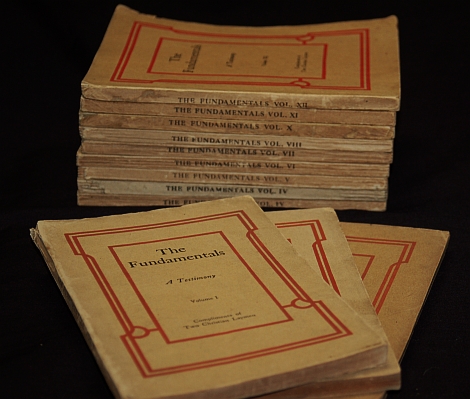
Dropping ‘the’ is sometimes necessary when adding an ‘s’.fundamentals

Please don’t misunderstand me. I am not saying that this is a cure-all formula for getting out of any theological pickle/quandary that you find yourself in. What I am saying is that dropping ‘the’ can sometimes open up greater possibilities AND provide much needed clarity to doctrinal or historical gridlock.

The bottom line: We are moving out of an era built around certainty and on propositional truth. Things are becoming more fractured, de-centered and relational (there is Al again). This can be a good thing – shifting from certainty.
(Now, in fairness, Phyllis had a great trinitarian answer to Barry’s concern that you will be able to hear later when the podcast comes out.)
There is a lager issue at hand, however, and that is the way in which we hold truth. I’m going to suggest in a post later this week that we revisit not just our conceptions of God and religious experiences – but that we hold our interpretations of them differently. Until then, I want to encourage you to do a little experiment and drop ‘the’.
Let me know how it goes.

Starter Suggestion: if you are someone who uses the phrase ‘the church’, try and replace that phrase with the word ‘churches’ and see if the sentence still makes sense. It probably won’t – which means that you will have to go back and look at the assumptions that underlie the sentence.

The Authority Question – Pentecostals & Methodists

Last month, at the Phyllis Tickle event, the ‘authority question’ came up, as it will/should whenever someone starts talking about ‘the Spirit’pentecost01

I was sitting out in the audience for the Fuller Seminary part of the evening. A little debate/concern arose about the issue of authority – especially as it relates to the rapidly growing Pentecostalism of the Southern Hemisphere.

I leaned over to the pastor sitting beside me and jokingly said “I pastored a charismatic church for a decade, and now I am at a Methodist church … this seems like the easiest thing in the world to navigate.”  The pastor requested that I blog about it.

Let’s get all the parts on the table and see how they come together:

Element 1: in the past we talked about seats or locations. Where does authority reside? Answers have included leaders, scripture, the collective, bylaws, reason, etc. Traditionally we have talked about authority in a static sense.

Element 2: in the Methodist tradition we have the Wesleyan Quadrilateral of Scripture, Tradition, Experience and Reason. (for an interesting side-read, John Cobb questions the sequence of those four elements)

Elements 3: I read a fascinating article a while ago about developments in neuroscience. Researches have long looked for which part of the brain memories reside in. It turns out that memories are not located in any one place but in the connection made between different parts of the brain.


Proposal: Authority, like memory, is not located in any one place. It is uniquely comprised of the connection between component parts. Depending on the collected aspects, the authority that emerges will be unique to that organization, congregation and movement.

Authority, therefor, doesn’t exist (per se) in that same sense that we used to conceptualize it … OR perhaps I should say it doesn’t reside somewhere – but in the connection and configuration of collected elements.


The reason that ‘the authority question’ is so elusive is because it is different in every place and is changing all the time

Authority will look different if you are Catholic charismatic in S. America than if you are a non-denominational megachurch in N. America. This is due to its emergent nature as an evolving concept.

Thoughts?

Add an ‘S’ as a test

I started doing this several years ago. It is surprising how often it reveals something that significantly alters the perception of the topic. When a complex topic is overly simplified it actually makes it more confusing and becomes less helpful. Topics that are appropriately complex and multifaceted are not served by being pressed down or made mono.

Two historic examples and then some contemporary ones:

The Industrial Revolution, according to historians like John Merriman, was actually three industrial revolutions.

  • The first was an agricultural revolution which allowed people to grow more, which encouraged a bigger population and thus all the surplus labor that would be needed.
  • The second was inventions that impacted small groups of workers, like the cotton gin.
  • Then came the big one that generally gets all the headlines with big industry and coal burning factories.

The name ‘the industrial revolution’ is a bit of a misnomer that lumps these three together. They actually happened progressively over quite a long period of time.

The same happens with the ‘Protestant Reformation’. Most people don’t know that Luther and Zwingli were kind of up to two different things and that later Calvin came in (initially as a Lutheran) and then there were at least three little reformations. Then there was England’s Anglican movement that was doing its own thing, and the Anabaptists. That is 5 reformation movements.

When it comes to religions, it is often appropriate to add an ‘s’.

When we lump together the Jewish religion or the Jewish perspective, we may be overlooking the fact that there are three huge branches within Judaism, as well as many other splinters. There is a Reformed Judaism, a Conservative, and an Orthodox. They are very different from each other. You also have secular expressions of Judaism (cultural or ethnic).

Islam is the same way – there are over 80 ‘denominations’ of Islam. So when we say “Muslims _____” we may want to be careful and be more specific by adding a plural mentality and saying “some types of Muslims ______”.

Even within Christianity there are God knows how many different kinds of Christianity. So to say that “Christians believe ______” is more than challenging. It may be misleading.

There are several Judaisms, several types of Islams, and multiple Christian perspectives.

Sometimes people say things like “the Biblical Worldview” as if there is only one. There are actually many worldviews that informed Scripture. Certainly the view of those who wandered in the desert in the Exodus story had a different view of the world than Paul the cosmopolitan Roman citizen of Jewish descent. And one can clearly see that what Paul wrote in Romans 13 to submit to governments because they do God’s work was a different worldview than the person who wrote Revelation and called Rome ‘Babylon’ and a ‘whore who is drunk on the blood of that nations’. There are many examples that I could use but the important thing to note is that there are many worldviews in the Bible.

You also see this misnomer in the phrase “the early church”. Books like The Emergence of the Early Church and The Churches the Apostles Left Behind help expose just how many competing/complimentary groups were in the mix. What most people mean by use of the phase ‘the early church’ is the proto-orthodox notion of those whose views eventually won out.

It also helps out pastorally. It is so tempting to be prescriptive and formulaic in ministry – whether it is the advice we give or the way that we conceptualize the world and its workings. Let me give just 3 examples from the past month:

  • People have kids for all sorts of reasons. Starting a family can be motivated by several different impulses. Some parents view is as ‘legacy’ issue, for others it is an obligation. For some it is duty, for some it is a ‘gift’. Some parents didn’t know that it was an option not to procreate. For some there is a fascination with making something from your own body (I am quoting here) or seeing what a being that was half-them and half-their spouse would look like.

Dealing with family dynamics and expectations, then, is not a one-size-fits-all matter.

  • The same can be said for abortion. Women terminate pregnancies for so many different reasons. I get upset when I hear opponents of abortion painting with a brush that is so broad that a supremely complex issue gets boiled down to a single point and then used as a battering ram.

Motivations and factors both need to be addressed in the plural.

  • Missions is another topic that requires complexity. It is inaccurate to talk about ‘missions’ and mean one thing. It is astounding how many different reasons people have for becoming missionaries. It is also significant to clarify the type or kind of missions one is engaged in. At minimum there are 3: compassion motivated missions, colonial type missions, and salvation (anti-hell) driven missions.

There is much more to said on this one (especially historically) but at minimum we need to be clear when we are talking about missionaries that both their drive and their tactics can vary widely.

SO many examples could be used: ‘black’ voters, the female perspective, sexuality/celibacy, American ____, etc. Once you start adding an ‘s’ you will see more and more areas where it is applicable.complexity

When you put this all together you see that just adding an ‘s’ as a test can help address the inherent complexity within an issue by more accurately reflecting its intrinsic multiplicity. We will also discover important themes where it is not appropriate and that will allow us to appreciate those unique topics even more.

I’m interested in your thoughts, questions, and concerns.

Doing Theology in the 21st Century. or why Aquinas is a footnote

We are going to have to agree to disagree about some things. One thing that I would ask (in my generous orthodoxy style) is that we both acknowledge those things that we agree on as well as those we don’t.

The reason that is important is because of something that Phyllis Tickle points out (paraphrase): it is not that former (and maybe dominant) expressions go away, it is that they no longer hold the prime spot and wield the kind of power that they once did. They are all still around however. MP900405058

The interesting terrain that we inhabit in the 21st century is littered with artifacts and occupied by pockets of groups – possible ones that were once in the ascendancy. This is, as I am often saying, the bricolage nature of our cultural/societal environment.

You have methodists who have no idea what the methods were. You have ‘Amish’ fireplace stoves being mass-produced and sold on TV (think about it). You have can still, more tellingly, find actual Amish folks if you know where to look.

Here are two things you need to know:

  1. I come to the theological endeavor as a contextual theologian.
  2. In my context, practical theology and its qualitative methods (interviews, case studies, ethnography) is my chosen approach.

There are several implications of these two things. Unlike Tripp, I don’t do systematic theology.* It is not that I don’t value other branches of theology. In fact, practical theology as a field is in a major renovation, at least in part, in order to join the other 4 primary branches of theology that do their own research and provide their own innovations:

  • Historical Theology
  • Biblical Theology
  • Systematic Theology
  • Philosophical Theology

As my professor Kathleen Greider says:

Practical theologians commonly assert that the primary text of our field is lived experience– diverse persons and communities that are contextually located, inextricably related, and experiencing each other through countless interconnections and interactions.

Almost invariably when I am enduring critique from a conversation partner who is more conservative than myself, it is only a matter of time before they bring up Aquinas. I don’t get the nuance of Aquinas. I didn’t distinguish between the early and late Aquinas. I wasn’t careful to appropriate this or that of Aquinas’ formulations. I didn’t read the right translation of Aquinas. (the same things with Barth and Scotus too) 

What I am saying is that we don’t need to understand Aquinas better or deeper. 

We are to do in our day what Aquinas did in his.

As a contextual theologian I don’t think that is accomplished by obsessing over Aquinas. I’m not saying that we aren’t generous or respectful … I’m saying that Aquinas lives neither where we do nor when we do. He lived in a different context and time.

Call this dismissive if you will but  The Church’s future is not to be found in Europe’s past. I say it all the time.

You may disagree with me about this. That is fine. I’m just telling you where I am coming from since our latest TNT has raised some eyebrows, questions (and hackles) both here and on twitter.

Historic thinkers like Aquinas never saw what I call the 5 C’s of our theological context:

  • post-Christendom
  • Colonialism
  • global Capitalism
  • Charismatic renewal (especially Pentecostalism in the Southern Hemisphere)
  • Cultural Revolutions (from Civil Rights in the 60’s to the ‘Arab Spring’)

Add to those 5 to pluralism, the internet and a growing environmental crisis and you have the 8 things we as theologians need to give great attention and care to. They are the context in which (and for which) we do theology in the 21st century. Go listen to our interview with Grace Ji-Sun Kim if you have questions about this. 

You may want to focus more on the christian tradition (like Augustine or Aquinas) and I would understand that – I view that impulse through a Lindbeckian tri-focal lens. I understand the work you want to do within that cultural-linguistic silo. [I’m having fun in this part for those unfamiliar with my style]

Disagree as we might about the importance of a writer in the 3rd or 13th century – I just wanted you to know where I was coming from and what my focus was.**

 I would love it if everyone would leave a comment and let me know how this sits with you. 

_________________

*One implication of that is that when I read systematic theologians I do so though mostly thought trusted secondary sources. Admittedly, I don’t major in primary sources – for reasons I hope are clear in this post. I find scholars who know their stuff like Elizabeth Johnson, John Caputo, Joseph Bracken and Stuart Murray and trust them.

** If you want to read more about my approach check out ‘After MacIntyre’ that I wrote a while ago but never put up on the blog. It will explain my concern about everything from consumerism to hipsters and the radical orthodoxy project.

Ancient-Future Faith: Invitation To Conversation

An ‘Ancient-Future’ faith is an idea that gripped me more than a decade ago and, even as I have emerged into a very different expression of my faith, I can not shake. As I have revisited and revised my participation and understanding of the Christian faith, this concept has haunted me in the best of ways.

On the TNT that will come out early this week, I talk about trying to hold onto this idea even as the author who popularized it seemed to go astray/ re-entrench from that original vision before his passing in 2007. I blame it on the post-911 Clash of Civilizations mentality that gripped many white men over a certain age. That is for another day. IMG_2907

I continue to be intrigued by the pairing of practices from previous centuries with communities and expressions fully embedded in the 21st century. There is something beautiful and powerful about matching these two. We are attempting to maintain a healthy continuity with the tradition that we have inherited with a vibrant incarnation in the world that we inhabit.

That is not an easy path to navigate. It is far easier (and more convenient) to either retreat into the romantic silo of the imagined past … or to adapt and adopt every cultural expression that comes into the mall or across the radio waves. Discernment is needed.

Discernment, however, happens after recognition.  Len Sweet*  was the first to introduce me to idea that we are moving from the Gutenberg era to the Google era. While there are many aspects of this cultural shift, the most striking is the shift from black & white words on a page to the multi-media world of image & message. The image and the message compliment (or reinforce) each other and sometimes serve to contrast or challenge each other.  This is something that us ‘digital-natives’ learn to negotiate early and easily. Some would call it second nature – which is an interesting phrase in more than one way.

Here is a video inviting people to our gathering at the Loft LA.  It is a little intro to some of the ideas that I’m talking about.

Ancient Future Faith from Bo Sanders on Vimeo.

I would love to chat with anyone who is interested in these topics. Here is just a quick list of ideas we might want to flesh out in an upcoming blog convo – just let me know below!

  • Sabbath
  • Centering Prayer
  • Ancient-Future Worship
  • Gutenberg to Google
  • The mosaic, collage nature of the 21st century
  • Community discernment
  • Collaboration & contribution
  • Continuity with the tradition & integrity with the moment
  • Post-christian apologetics

Mostly I just wanted to share some of what I am wrestling with in hopes of expanding the conversation.

I look forward to your thoughts.  in Christ -Bo

* another apparent victim of what we talked about earlier

Create a free website or blog at WordPress.com.

Up ↑