Search

Bo Sanders: Public Theology

updating & innovating for today

Category

Church History

’12 Years A Slave’ and the Cross of Christ

by Bo Sanders 

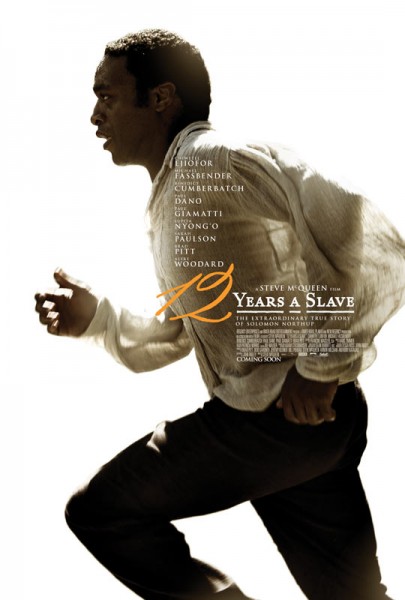
12 Years A Slave is one of the most powerful movies I have ever seen. The cinematic elements compliment the twisted and troubling plot to create a riveting experience for the viewer.  What follows is a theological reflection – for a more formal review of the movie check out Pop Theology by Ryan Parker.  Ryan and I also recorded a podcast that will be released this evening. 12-years-a-slave-poster-405x600

Based on a true story, the plight of Solomon Northup (played by Chiwetel Ejiofor) is a journey from the good life as a free black man in the North to the hellish existence of a slave in the deep South. Visual artist-turned-director Steve McQueen frames the narrative in stunning cinematography and a unique pacing that reflects the twists and turns in the story.

12 Years A Slave is one of those rare movies that impacts you emotionally and challenges the assumptions you carried into the theatre. The journey of the main character sticks with you and causes you to ask questions that you know deep down need to be examined.

I expect that this movie will be one of those rare films that trigger a much-needed cultural conversation. Issues of race and America’s haunting legacy of slavery and native reservation are never far from our national consciousness. Race is often front and center in the nightly news and on the margins of most national conversations.

While we know that something is amiss, we may not know how to approach the topic. We want to have a conversation but we may be unsure about how to proceed.

From the controversies surrounding the election of President Barack Obama to the George Zimmerman trial to the ongoing ‘stop and frisk’ policy debate in the New York City mayoral election, there is an awareness that race matters (to borrow a sentiment from Cornel West’s book title) but a perpetually unsatisfying confusion about how to access the underlying issues.

For Christians, perhaps the best way to address these issues is via the cross of Christ.  In his newest book, The Cross and the Lynching Tree, famed theologian James Cone equates the cross and the lynching tree: “though both are symbols of death, one represents a message of hope and salvation, while the other signifies the negation of that message by white supremacy.”

This is poignant because Solomon Northup first witnesses and then experiences the lynching tree in 12 Years a Slave. The lynching tree is the ultimate weapon of intimidation employed by the same slave owners who claimed the name of Christ, but who preached from the Christian Bible to their slaves in order to justify their cruelties.

For Cone,

“what is at stake is the credibility and promise of the Christian gospel and the hope that we may heal the wounds of racial violence that continue to divide our churches and our society.”

There are plenty of movies that are as fleeting and significant as the popcorn one eats during it. 12 Years A Slave is a different kind of movie. It has substance and is capable of being a touch-point for a significant cultural conversation.

“Until we can see the cross and the lynching tree together, until we can identify Christ with a ‘recrucified’ black body hanging from a lynching tree, there can be no genuine understanding of Christian identity in America, and no deliverance from the brutal legacy of slavery and white supremacy”.  – Cone

If we can talk about a movie like 12 Years A Slave in light of The Cross and the Lynching Tree, we may be able to begin to have a much-needed constructive and reconciling cultural conversation about race in America.

The election of President Obama was not the end of racism in America. As the 50th anniversary of ‘the March on Washington’ showed, we still live in a deeply divided country where race and the legacy of racist policies and attitudes have a lasting effect and are an ever-present reality.

America is also a deeply religious country and Christianity is the dominant religion. The irony, and the opportunity, resides in that fact that the symbol of the cross is so central to Christian imagery. There is great hope there, if only we would take it seriously and see what the Salvadoran martyr Ignacia Ellacurio called “the crucified peoples of history.”.

You can listen to my conversation with Ryan on the Homebrewed Christianity podcast here.

666 Is Not What You Think

A quirky and sad story has emerged out of Kentucky this week.

In one of the strangest cases of purported religious beliefs intersecting with athletic performance, a Kentucky junior cross country runner voluntarily walked away from a chance to qualify for the state meet to avoid running with the bib number “666”, which she said conflicted with her Christian beliefs.

As somebody who competed in state wide competitions back in the day, I can imagine how difficult this situation was for that young lady.  As somebody who learned how to read the Bible that same way, I understand her reluctance to associate with that number. Dark-Clouds

I am a big fan of the Book of Revelation. The last book in the Christian testament is a favorite of mine. I love it!  I love it almost as much as a I hate what the majority of N. Americans have been led to believe it is about.

I thought I would take this opportunity to point out three simple ways that this odd and sad story could have been avoided in Kentucky:

  1. We don’t have 13th floors in buildings and maybe we could just remove this number from rotations – since we know that it rubs the sensitivities of many people the wrong way. That seems like the easiest solution…
  2. The race official could have just given the young woman a new number offender her religious sensibilities. That seems like an easy solution …
  3. Someone could have just explained that the number 666 doesn’t have any actual power … and that even the Bible passage that it comes from tells you that. That seems like the best solution…

See, the actual passage says:

Revelation 13:17-18   New International Version (NIV)

17 so that they could not buy or sell unless they had the mark, which is the name of the beast or the number of its name.

18 This calls for wisdom. Let the person who has insight calculate the number of the beast, for it is the number of a man.[a] That number is 666.

Never-mind that the earliest manuscripts have the number as 616 (a whole other discussion about Roman emperor’s names and the genre called captivity literature within the apocalyptic tradition). What is important here is the world ‘calculate’.

The number – even if it is 666 – isn’t what it seems. It needs to be ‘calculated’, even according the actual verse. It’s right there in the Bible. The number has to be examined – or said another way – you have to do something with the number. It is not the actual number 666.

The clearest explanation is that it is a stand-in for a deeper meaning. Six is the number of humanity (created on the sixth day) and things that are represented in threes (holy, holy, holy Lord God Almighty who was and is and is to come) are complete. The number 666 simply means the completion, or culmination, of the human system.

The number itself is nothing to be afraid of. It is what that number represents that is of great concern. That is why the author of the Book of Revelation wrote in this poetic/symbolic language and imagery. This kind of apocalyptic literature was a political critique of its day – not a predictive work for our day. 

Pointing this out to Christian young people would accomplish at least two things:

  • It would relieve them of this superstitious ‘left-behind’ fear that is created by a misunderstanding of Biblical genres and interpretation.
  • It would serve as a challenge/inspiration to do in our day what the author of Revelation was doing in that day and use their creativity to critique the systems and structures of oppression that we are all caught up in.

The number 666 holds no special power – especially today. What it represents however is very much still in power and needs to be examined and engaged as ‘the Powers That Be’.

Apple Updates & the Church

I have been thinking about the church and technology a lot lately. Part of it comes from planning to update a sanctuary constructed in 1951. Some of it has to do with recruiting a team to handle all the tech stuff at ‘church plant’. A bit of it came from the odd analogy that was used repeatedly about the ‘glitches’ related to the initial launch of the Affordable Health Care Act website and all of the sigh-up problems. People, including the President, said “yeah but even Apple has glitches when it first launches a product”.

An inexact comparison to be sure.

One of the questions that we are asking at the Loft LA, as we enter into our second year, is:

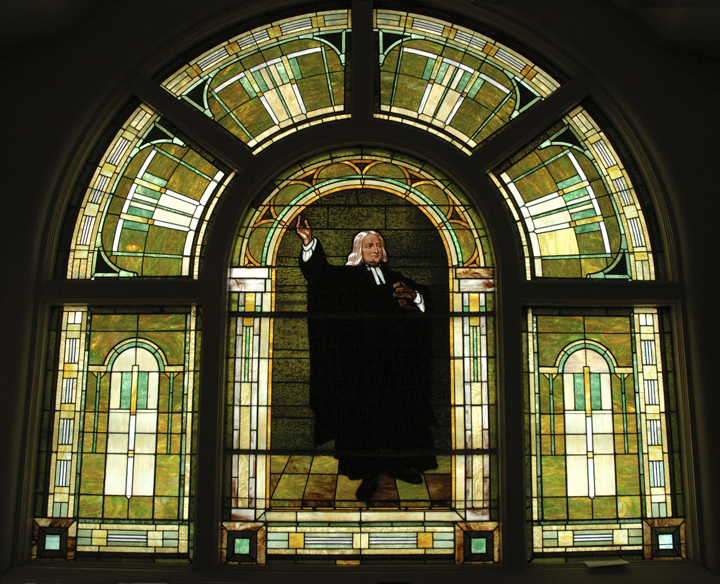
“What does it mean to use the Ancient-Future model of church in West LA?”17-85-BE3-134-08.0006-John Wesley

We come out of a United Methodist Church – which is a classic and beautiful expression of the Mainline tradition of Protestant Christianity.  The Loft is attempting to reclaim and hold onto the best of that inherited tradition … while at the same time engaging the culture around us in way that is contemporary and appropriate.
I’ll confess. It is a tricky section of water to navigate.

To use my favorite bowling analogy, there are gutters on each side that you want to avoid.
On the one side, you have a temptation to cater to the culture and concede so much of the Christian tradition that you have basically assimilated to the surrounding culture that you are nearly indistinguishable from it! This can happen in patterns of consumption, political views, sexuality, financial matters, or any other number of areas.

On the other side, you have the assumption that the inherited tradition, the given forms, are inherently relevant and effective in every place and in ever time since they were divinely delivered and historically proven. What this impulse to conserve leads to is reification of some previous era or expression of church that was culturally appropriate by which has since expired in its effectiveness in doing so. For a group whose gospel is, at its core, about incarnation … this is unacceptable.

This is why we think that the ‘Ancient-Future model’ of church is the best way forward for a young community.
Here is a short video about my recent experience with an old Apple TV that was given to me and why it triggered some thoughts about christian community for me.

Apple Updates and the Church from Bo Sanders on Vimeo.

In technology, when you fall enough behind on your updates, you can actually trap yourself with the inability to update. This is the definition of irrelevant. The christian spirituality that is employed in much of the North American church may be in this kind of danger. I am nervous that we are looking to get resources (updates) from sources (servers) that don’t exist anymore.

We are looking for solutions in things that don’t exist anymore.

The danger, for a religion that is at its core incarnation, is that the inability to be conversant with the surrounding culture in the epitome of irrelevance.

__________

Ancient-Future is a model that was popularized by Robert Webber before he changed his emphasis, focus and tone at the end of his life. His books on Faith, Worship, Evangelism and Time are supremely helpful and informative. 

My quoting him does not imply a wholesale endorsement of all of his works or thoughts. 

Religion and Consumerism’s Bricolage: in conversation with Philip Clayton

A couple of weeks ago I had a very interesting conversation with Philip Clayton. Several of us went out for lunch after the High Gravity session on Religion & Science. We were at a restaurant where the walls were decorated with a busy collection of reclaimed signs, old pictures and re-purposed trinkets.

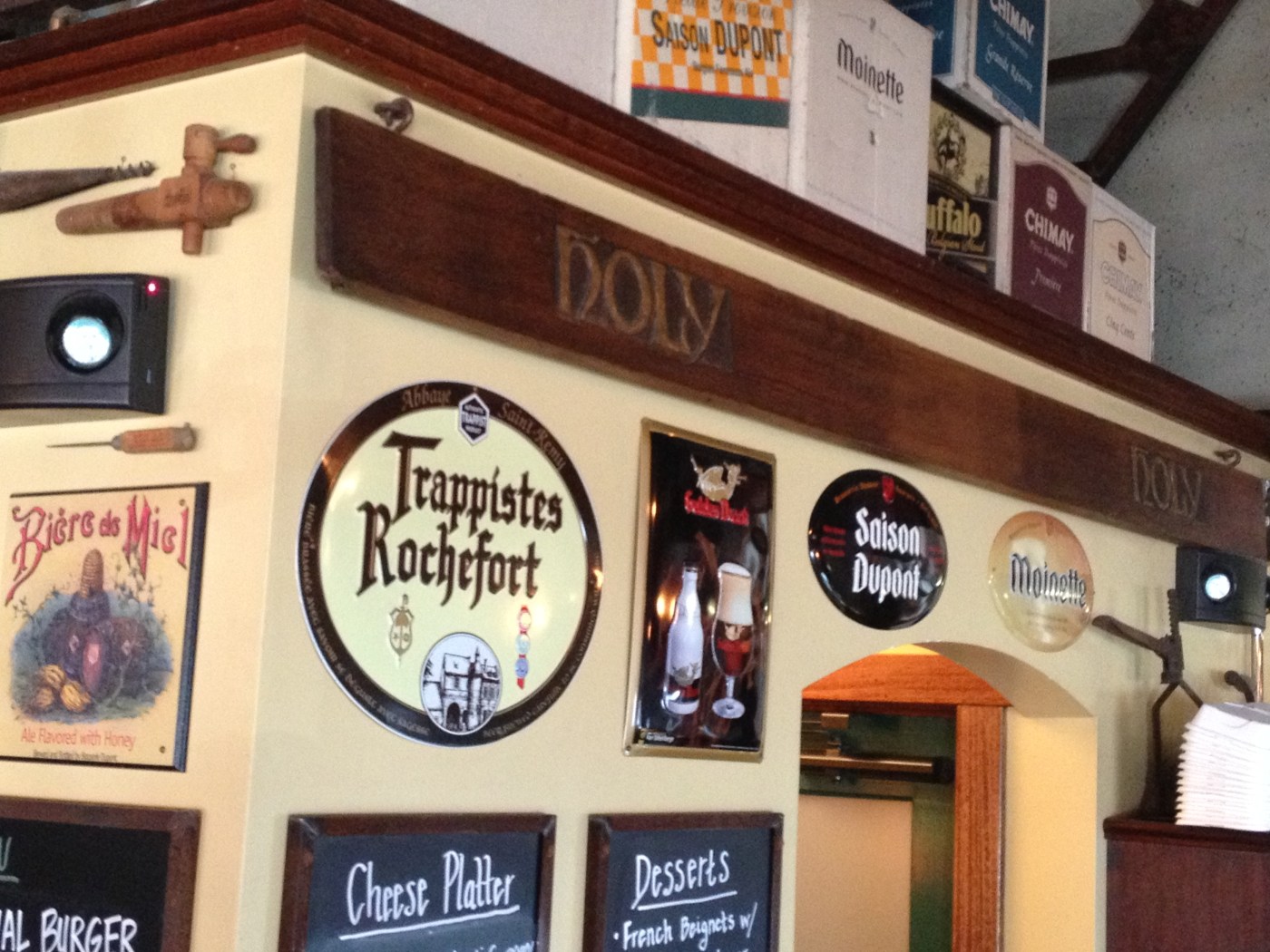
Dr. Clayton was across the table from me and at one point I look up to notice that above his head was a sign that read ‘Holy’ on one side and ‘Holy’ at the other end. The words ‘Holy – Holy’ were framing either side of his head. IMG_2884

I tried to come up with something clever to say, scouring my memory for some passage from the Hebrew Bible or the book of Revelation to tweak. The window of opportunity closed because the conversation was quite intense. That morning the topic had been ‘Science & Religion’ and now we had expanded it to ‘Religion & Society’ – or more specifically to ‘Church & Culture’.

The conversation intensified and it became clear that neither Dr. Clayton nor Tripp was too happy with my cynical take on consumer mentalities when it comes to consuming religious experiences within a capitalist framework.

At one point I said “it is like that sign behind you: it’s not like the holy is absent from the space and all the activity that happening here – it’s just that it blends in and goes unnoticed in the midst of all the bricolage that it melts into.”

Somebody had reclaimed that wooden sign. There is a story behind it – there might have even been more to it (I wondered if it used to have a 3rd ‘Holy’ further down the line that had been lost).

But that is my point! In any gathering there are going to be those (like us at that table) who think that what is happening is legitimate, sincere, authentic, important and worth organizing your life around. The congregation is also going to be largely made up of those who are consuming a religious experience – and it is financially worth about the same amount as a movie, a meal, a game or a show.*

I will go even further: this is my great hesitation with those who want to ‘go back’ or ‘conserve’ with their religious participation. This impulse was never more evident to me than when I began interacting with those were into Radical Orthodoxy or with evangelicals who had converted to Eastern Orthodoxy or Catholicism. The ‘zeal of the convert’ can be a telling element when it comes to the anti-modern or counter-modern impulse.

An incongruity is exposed in the counter-modern impulse of these conserving movements. Never mind for a moment that often what is being conserved is born out of a patriarchal model – set that aside for a second.

I will attempt to make this in 4 succinct points:

  1. You do not live in the 14th or 16th century.
  2. You do not think like someone in a previous century.
  3. You do not engage in the rest of your week as someone in a previous century.
  4. You chose, as a consumer within a capitalist framework, to participate.

Those four things signal to me that even the most sincere, authentic, devout, and thorough engagement – whether a Pentecostal, Evangelical, Orthodox, Anglican, RO, Catholic, Mainline or Congregational expression – must account for the ubiquitous consumerism within which we all are saturated.

Dr. Clayton rightly said that I while I had a good point I was proceeding in far too cynical a manner with it. He is correct of course.

My aggressiveness is born out of a deep concern. What we say the church is about – what we believe the very gospel to be – is so vital and so needed in the world today, that we can not afford to ‘play pretend’ about previous centuries and blindly participate in consumerism all the while trumpeting the virtue of our chosen ecclesiastic community.**

The danger, in my opinion, is that religious communities will become nothing more than decorations on the corner of a neighborhood or one more option at the mall food-court. 

For christian believers, the holy is all round us. We can not afford for it to disappear among the bricolage nature of our hyper-advertised media-saturated existence.

The gospel, at its core, is incarnational. Our central story as Christians is flesh and blood in a neighborhood. The whole project is contextual – it only happens in a time and a place. We can never escape that. That is why romantic notions of past centuries or early manifestations can be dangerous distractions and fantastical facades.

We can’t afford to fade into the bricolage. IMG_2886


* plus it usually comes with free babysitting. 

** Some might object that they have not chosen but rather have ‘stayed’. I would argue that they did within the consumer’s capacity to do so. 

Evangelicals Really Dislike Lent

My friend Krista Dalton tweeted last week:

Was told Lent was “stupid” by a fellow Christian at school. Good reminder why I am not evangelical!

I had to fes’ up to her that I used to say crap like that and I repented.

So what is it about Lent that evangelicals hate so much? I have a two-tiered theory. 

The first involves a Theology of Glory. The second is not a cause – it is an effect – but it is born our of strangeness and suspicion.

Theology of Glory

Back in Christian history, back to the roots of evangelicalism in the Protestant Reformation, are two major approaches (if you will). The first is a Theology of the Cross held up by Luther. The second is a Theology of Glory brought forward by Calvin.

I don’t have time to get into all the sorted details, but suffice to say … that the American evangelical church has not just majored in a Theology of Glory but almost to the near neglect of a Theology of Cross.

Here is a really helpful article on the differences:

“Theologies of glory” are approaches to Christianity (and to life) that try in various ways to minimize difficult and painful things, or to move past them rather than looking them square in the face and accepting them. Theologies of glory acknowledge the cross, but view it primarily as a means to an end-an unpleasant but necessary step on the way to personal improvement, the transformation of human potential. As Luther puts it, the theologian of glory “does not know God hidden in suffering. Therefore he prefers works to suffering, glory to the cross, strength to weakness, wisdom to folly, and, in general, good to evil.” The theology of glory is the natural default setting for human beings addicted to control and measurement. This perspective puts us squarely in the driver’s seat, after all.

It’s not that we don’t like the cross – oh we love the Cross – we sing about it (the wonderful cross) and we wear them around our necks!

It’s so bad that Dallas Willard has coined the phrase “Vampire Christians” for us. He says that we love Jesus for his blood and little else. Ouch – that one stings.  Wooden Cross

It shows up in other ways too. We are almost completely ignorant of the apophatic tradition. We are so kataphatic (speaking of God in the positive) that we have no idea that there are other options! We have no negativa or posteri – it is all presence all time.

Look at our worship services. Just ask yourself: what would it take to lift your hands and sing “Shout to the Lord” at the top of your lungs … and then ask if that seems compatible with fasting or Lent.  They are just two different muscle groups. Unfortunately, those who use the one often neglect the other and vice-versa

Strangeness and Suspicion  

I’m not saying that this element causes the unfamiliarity – but once there is alienation this next element adds fuel to the fire. The suspicion is syncretism.

Think about it this way: Lent isn’t in the Bible. Historically evangelicals have been a sola scriptura bunch (don’t look into that too much) and Lent is a foreign concept. It doesn’t’ take long to dig up some dirt on Lent and find out that it has its roots in Egyptian-Pagan worship borrowed by the Roman cults. Isis lost a son for 40 days so we mourn for 40 days and then have Isis eggs that are colorfully decorated is the story that come to me.

So, I’m not saying that explains all of the animosity that evangelicals have toward Lent, but I just wanted to offer up my two-tiered theory.

It starts with neglect and ends with accusations.

It’s same reason that we kinda try on Good Friday … have NO idea what to do on Saturday … but LOVE Resurrection Sunday!


Barna and the Burned Over Region

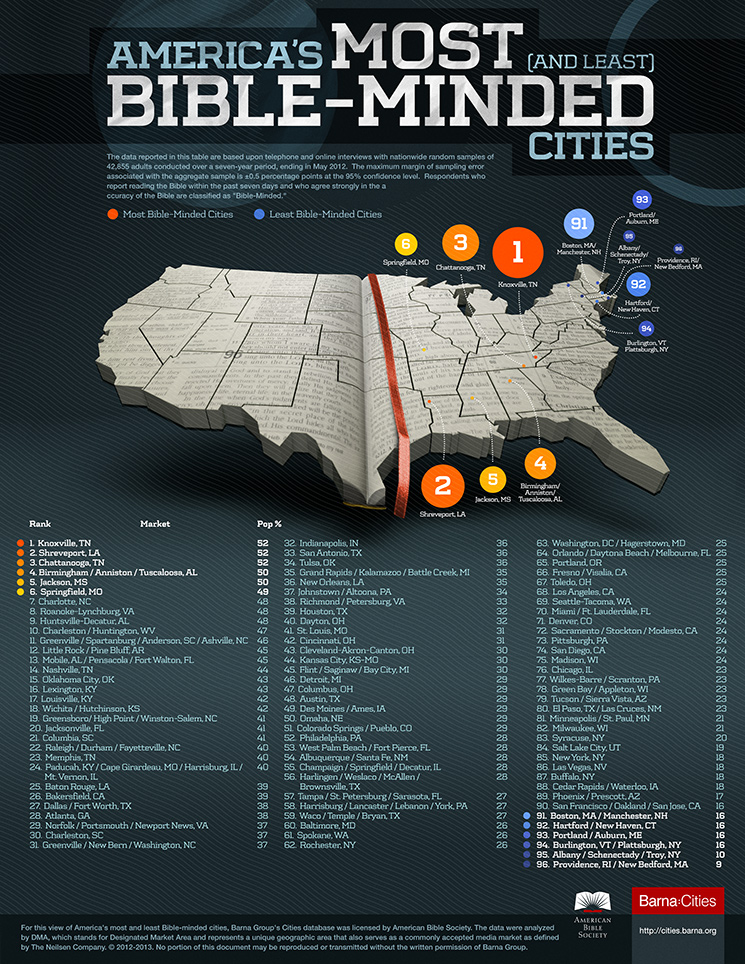
Barna Research put out a fascinating list of America’s Top 100 most ‘Bible-Minded Cities’.  Its not the top 10 Bible cities but the bottom 10 that are so telling! barna_biblemindedcities_preview1

The bottom 10 are:

  • Boston, Mass
  • Manchester, NH
  • Hartford/ New Haven, CT
  • Portland/Auburn, ME
  • Burlington,VT
  • Plattsburgh, NY
  • Albany/Schenectady/Troy, NY
  • Providence, RI
  • New Bedford, MA

It really caught my attention for 3 main reasons.

1. When I was in college I was an evangelist and Barna was our go-to source

2. During that time a common mantra in my circles was that ‘the Pacific-NorthWest is the most unchurched are in North America.’

3. After college I went to help plant a church in upstate NY (near the VT border) and grew suspicious about that Pacific NW thing.

I had spent time in the Pacific NW and while there were lots of unchurched people … there were also tons of churches – but specifically big churches aggressively engaged in the culture wars.

In the New England (or NorthEast) region, it was different. There was a cynicism is had not seen. Not a coffee shop atheism like the west. I deep suspicion unlike I had encountered.

 This came to a head for me when two roads converged. 

Ingredient 1: I was charismatic and had bought into a thing call “Re-digging the Wells of Revival” where you go to places where God has worked in the past and, through prayer, you try to unplug that ancient well of what God wants to do to release the anointing that once flowed.

I lived in area that had seen large revivals in the late 1800’s and early 1900’s. In fact, the denomination I was a part of was founded in the region and still had some of the revival tabernacles as properties! I would go to the  one closest to my house (Round Lake, NY) and pray for revival to sweep our area again.

I even started doing historical research. I stumbled into something. It was called ‘the Burned Over region’. It turns out that the much celebrated  revival had burned through so fast and so hot that when it was over … a cynicism had set into many people. Families that had given large amounts of time, sums of money and even family jewelry collections grew bitter.

A problem developed for me. The circles I was running in were celebrating the 2nd Great Awakening and other historical renewals of the church. I was growing suspicious and that altered my prayers.  I stopped praying for the same kind of revival we say 100 years ago and started praying for a different kind that didn’t leave generations of families bitter and broke.

 Ingredient 2: I went to a Barna Conference in western NY (Syracuse or Rochester area).  I sat there the whole time shaking my head as Mr. Barna presented to a packed massive auditorium. The finding that he was presenting were not exactly true of my area.

I had read a book by that point called “The Nine Nations of North America” and had begun to concoct a theory that merged (for churches) the New England of Nine Nations and my findings in Burned Over research. When you put those two together it really explained a lot.

 I kept saying to myself, “Even NY is different east of the Hudson river. From Albany east NY is more like New England than like Western NY and Pennsylvania”.

After Barna’s presentation I voiced my suspicion and that was not greeted well by my denominational cohort I was attending with.

I even brought up the Pacific NW thing and how out there you can hear 3 big christian radio stations and find a christian bookstore every couple of miles. We had neither.

The Pacific NW had mega-churches. We had one church over 1,000 and people in our area were suspicious that it was a cult, “because how else could you get that many people to all come and sing the same thing at the same time and then listen to one guy talk for a half-hour?”

 All of that is background for this past weekend. Barna put out a fascinating new list of the 100 most biblically minded cities. You can go read the article to see how they configured that.  The 2 most important things to me:

1 – the top 50 are East of the Mississippi River (except for Bakersfield, CA).

2 – the bottom 10 are all in NE or that NY Hudson River basin.

To me this says two things. First, the Bible Belt is a real thing and when combined with something like ‘Nine Nations’ is potent to think about.

Second, The bottom 10 are all in the burned over region and should give us concern about what 100 years from now will look like. I know that there are lots of factors over the last century and that someone will say “the past is not the future” and I get that.

But as one who a) studied this, b) while I lived there, and c) called it out in real time… I’m telling you –

The bottom 10 of this thing are far more relevant to our future than the top 10. 

What is going on IN religion when we talk about God

This weekend I will finish reading two books that we were given through the podcast (thank you publishers). The first is Peter Rollins new on The Idolatry of God and the second is Phil Snider’s Preaching After GodMP900405058

I have recently edited podcasts with both of these authors. [We put out the Phil Snider TNT last week ]

It is very clear to me that we have an emerging situation (trying not to say problem) on our hands. With the introduction of a new wave of postmodern or ‘radical’ theology [listen to the Caputo introduction here] – progressive and emergent christians are drinking in lots of innovative and challenging concepts about God that may not have a real God behind them.

This is fine IF the listener/reader knows what they are imbibing. What is increasingly concerning for Tripp and me is the consequence when people don’t know that the god of the 21st century philosophers is not exactly the god you hear about on Sunday morning.

Is there a danger in people reading a ‘how (not) to speak of god’ and then just quoting it from the pulpit like they would quote any other historical person?  Folks in the deconstruction camp are not real eager to answer this one.

I have some thoughts on the matter so I thought I would throw them out here for consideration.

 Intro: It is severely unhelpful to frame this in an either/or way. “Either God is X like the Bible/Creed/Tradition say OR Religion is the equivalent of Santa Clause &Tooth Fairy and we might as well all go home.”

That reductive approach is foolish and silly.  There is far too much going on in religion – and the Christian religion specifically – to say things like that.*

 I propose that there are – at least – 5 things happening IN the christian religion:

  • Experience
  • Formation
  • Event
  • Mystery
  • Potentially Something Real

Experience – People who were not raised in the faith convert and/or have crisis experiences that powerfully impact them.  People experience the presences of something they interpret as bigger than themselves.

We can talk about transcendence or phenomenology but what we can not deny is that people experience something in religion. As someone from a charismatic-evangelical background it is so clear to me that much of our talk about God and religion in progressive-emergent circles misses this very real component.

Is experience the whole story? NO! And those who reduce it down to that are equally as errant. It is not the main thing nor is it nothing. It does not account for everything but neither can it be dismissed outright.  People’s experience must factor into the equation.

At minimum do the Kantian thing and say that religious people’s experience is real but incomplete to understand the whole picture (noumenon) – like 6 blind people with their hands on different parts of the elephant – each thinking they are describing something unique: a tree (leg) a rope (tail) a wall (belly) and a giant leaf (ear) and an enormous snake (trunk).

Formation – I get in trouble for liking the post-liberal writing of George Lindbeck (Nature of Doctrine) but I think that this is exactly where it comes into play. The role that the christian tradition, sacred text and vocabulary plays is that forms us a people. It forms character within us as well as the way that we participate in community.

I am in dialogue with the work of Alasdair MacIntyre (After Virtue) for this very reason. While I disagree with his solution, I think that he is spot-on in his analysis and concern. Not only does our culture live in a chaotic time – but the very ethical assumption that would allow us to even HAVE the conversation have been eroded and now we can’t even debate! At least within the Christian church there is a common vocabulary. We may debate the definition of the terms but we have an arena in which to engage each other.

In this sense, the faith functions. As Elizabeth Johnson (She Who Is) is so good at pointing out: the words that we use function in our imagination, our communities and in the tradition.

Event – John Caputo (Weakness of God) and those who follow his Derridean ways prefer to speak of the name of God as an event. There is an event housed in the name of God the beckons us – we respond to this call … and are not that concerned wether there is a caller, or if we can know that there is one.

It is undeniable that something happens when God’s name is invoked. It triggers something in us. It calls for something from us. It makes some claim or demand to be dealt with differently than other words and concepts.

I like Caputo’s illumination of this shadow world. There is something deeply insightful about his explorations. Those who want to dismiss it because it isn’t enough on it’s own, are missing the point. Something happens if ‘God’ is invoked … and that would happen even if there were no ‘God’ per se because (as I said above) the concept functions. – it does something in us,

Voltaire said,”If God did not exist, it would be necessary to invent him.” That is because ‘god’ does something in us – demands something from us.  It maybe not ripping off our customers, it may get us through a tough time or help us to sleep at night – or even face the end of life with dignity. But in the name of God is an event that lays hold of us.

Mystery – I am fascinated with the apophatic tradition. I have no interest is appropriating it … but I am mesmerized by the fact that it even exists. Describing god by what she is not? Brilliant.

I also have been looking in historic understandings of analogy. Which works for me because I do not believe in univocal speech. When we call god ‘father’ we are using an analogy – god is like our best conception of father-liness … but it saying that is also included an understanding that God is not actually a father. Our use of the word is not a 1:1 equivalence.

Elizabeth Johnson challenged us over a year ago that every time we say ‘god’ that we must say it three times.  I do this every day now!

  • God beyond us.  This is that transcendent other or Kant’s noumenal real.
  • God within us. This is the experiential component.
  • God at work all around us. This could be the event.

When I say ‘god’ I always say God beyond me – within me – and at work all around me.

 Potentially Something Real – the final component in my 5 sided web is the possibility that there really is something to all of this – more than just phenomenon or imagination or tradition or vocabulary – and that the language of religion is at least getting some of it right.

If we don’t leave open the potential that something real is really happening – that a real god is actually acting – then we may be missing the biggest part of the puzzle and thus have an incomplete picture.

___________
Just because YOU haven’t thought of the multiplicity of layered meanings happening in the Christian expression doesn’t mean that it is an all or nothing game.Don’t be that person who says “If Santa Clause isn’t real, then Christmas isn’t worth celebrating”. Or “If Creation did not happened exactly like it is described in Genesis then the whole BIble is untrustworthy and unbelievable.”

Honoring Our Elders or If Aquinas was Around Today

Thomas Aquinas comes up a lot these days.*   Some of it is generated by a small community of passionate people who want to reclaim his project. Thomas_Aquinas_by_Fra_Bartolommeo

This, in turn, prompts some – such as John Caputo in an interview with us – to come up with a legendary one liner that accused this group of ‘retreating into the hills of Thomism’. 

The most insightful address I have encountered recently comes from Umberto Eco in the book Travels in Hyperreality. In a chapter entitled “In Praise of St. Thomas” he outlines how Thomas interacted with his world and how he navigated the difficulties of his inherited order (mendicants) , his Age, and his own limitations.  Three passages from the 1974 essay that inspired me were:

  – Thomas, was neither a heretic not a revolutionary. He has been called a “concordian”. For him it was a matter of reconciling the new science with the science of revelation, changing everything so that nothing would change. 

– Nobody ever said that Thomas was Galileo. Thomas simply gave the church a doctrinal system that put her in agreement with the natural world. 

–  So it is surely licit to ask what Thomas Aquinas would do if he were alive today; but we have to answer that, in any case, he would not write another Summa Theologica. He would come to terms with Marxism, with the physics of relativity, with formal logic, with existentialism and phenomenology. 

He would comment not on Aristotle, but on Marx and Freud. Then he would change his method of argumentation, which would become a bit less harmonious and conciliatory.

And finally he would realize that one cannot and must not work out a definitive, concluded system, like a piece of architecture, but a sort of mobile system, a loose-leaf Summa, because in his encyclopedia of the sciences the notion of historical temporariness would have entered.

I can’t say whether he would still be a Christian.

But let’s say he would be.

I know for sure that he would take part in the celebrations of his anniversary only to remind us that it is not a question of deciding how still  to use what he thought, but to think new things.

Or at least to learn from him how you can think cleanly, like a (person) of your own time.

After which I wouldn’t want to be in his shoes.

This actually is an approach to the past that has some general applicability. I have heard it said that best way to honor founders of any movement is not to simply repeat what they did but do the kind of thing they did in their time for our time. Aquinas

As a contextual theologian, I have said (over and over again) that honoring the apostles and the early church’s mothers and fathers is not in simple doing what they did in their culture – but in doing in our culture the types of things they did in theirs.

Rote repetition – regurgitation is not honoring. It is closer to idolatry. 

Repeating in the 21st century what they said in the 8th century isn’t as faithful as one might like it to imagine. This is due to the nature of our message. Our message is incarnational and thus our models and methods must match that!

The container must match the content. 

I’m not that into Aquinas. I think it’s because of the approach of those who are a little too into him.  But if they were to change to Eco’s approach and engage contemporary science and incorporate real scholarship, then I might get into Aquinas as well.

I just have no interest in reclaiming a romantically imagined version of the past. I am very interested in engaging the living now and emerging near future.

 _________
* Saint Thomas Aquinas, (1225 – 1274), also Thomas of Aquin or Aquino, was an Italian Dominican priest, and an immensely influential philosopher and theologian in the tradition of scholasticism, within which he is also known as the “Dumb Ox”.
Aquinas

The Church’s Task

In the next 24 hours I will be putting up 4 blogs – taken together, you will be able to tell what I have been thinking about the past month.  I would love your feedback on any of them.

Last month David Fitch tweeted this:

“The biggest task of today’s church is to undermine in its members the blase unexamined acceptance of secular assumptions for everyday life.”

I thought about it all day and just couldn’t be sure he was right on this one.

Now just to let you know where I am coming from:

Put that all together, I have doubts about Fitch’s assertion. Here is why:

I am increasingly suspicious that secularism is both a consequence and a side effect of Christendom. It is the West’s Frankenstein if you will. We made it. Then it took on a life of its own – a life we don’t like very much and which damages our efforts and injures our cause.  I think we have to start there.

I agree with Fitch that there is a ‘unexamined acceptance” and would go even further and say that it results in an assumption that what we see is the way it is. That our current mechanisms of organization are final forms and that the ‘as-is’ structures come with a large measure of ‘giveness’.  Tripp often applies this capitalism, nation-states and democracy. I would tack on both denominations for the church and militarism for US America.

I am just not so sure that our main task is to undermine. Maybe that is where my hangup comes. I am leery of this approach because it seems like we are defaulting the ground rules in the initial move and framing the task in a conceding first move.

I might be naive here but I am just not sure that the church needs to
A) give that much ground initially
B) frame her task in the negative.
I know it’s just so much one can do with a tweet but … there is something there that gives me caution.

So what is my constructive proposal?  I’m working on it.

I would want to frame it more like Stuart Murray does in the book Post-Christendom  and acknowledge that initial concession was early on with Constantinian Christianity. Then Christendom. Then Modernity.  With those three concessions we admit that the as-is nature of existing frameworks for both church and culture are thoroughly compromised and corrupted.

BECAUSE of that. We abandon the recuperation, rehabilitation, reclamation , and renovation projects (and mentality) all together! (all 4 faces of it).

It’s over man.  Let it go.

THEN we start new and in the positive. The 21st century provides fresh possibilities and opportunities IF ONLY we will let go the idea of getting back to something or getting something back. I know we never start from scratch – we never get back to square one. But …

I don’t want to be the undermining parasite ON the big organism. That is too small a task.  I want to partner with God in the healing of world (Tikkun Olum in Hebrew).  I want to participate in the development cosmic good – until then at least the common good. 


PostScript: now that I started down this “re” line I can’t stop coming up with words I want to flesh out further!
Restore: no
Re-imagine: yes
Represent: yes
Re-member: sure
Resurrect: ummmm not really
Reflect: probably

Create a free website or blog at WordPress.com.

Up ↑