Search

Bo Sanders: Public Theology

updating & innovating for today

Category

Church

‘Who am I to judge?’ is an honest question

It is no secret that  I am a fan of many of the things (not all)  that the new Pope has been up to. So I was very intrigued when it came out that on his cross-Atlantic flight he took the airplane microphone and addressed reporters. RNS-Pope-Francis-flight-home-Catholic-News-Service

I was also surprised by the reports of the following sentence:

“If someone is gay and he searches for the Lord and has good will, who am I to judge?” — Pope Francis, July 2013

The running joke is of course that if you are the Pope … it’s kinda your job description! You might be the only person who is allowed to judge in some of your followers estimations.

These things have landed Francis on the cover of this month’s Sojourners magazine. They are advertising it this way:

Francis—refreshingly candid and seemingly repelled by the perks of the papacy—offers new hope for the Catholic Church and beyond. From the symbolism of him stooping to wash a Muslim woman’s feet to his harsh lambasts against a culture of greed and consumerism, this Jesuit from Argentina has captured the collective imagination of the world.

This has me thinking over the past week about the topic of judging. When I was an evangelical preacher we were very clear to distinguish between judging – which is defined by its connection to wrath – and evaluating ‘a tree by its fruit’  which christians are also commanded by Jesus to do.

Yes Jesus said ‘Do not judge’ but Jesus also said you can tell a tree by its fruit. The question “who am I to judge” seems to be a rhetorical one.

Even Miley Cyrus knows that Only God Can Judge, as she proclaims in her new video (for which I am sure that she should be judged harshly).

Now I am a pastor at a Mainline church in LA and I can honestly say that it is the least judgmental place I have ever been… but is that a good thing?  Don’t we need to make some moral evaluations?

I was getting ready to ask the HBC crowd how they have learned to navigate this cultural conundrum when my new favorite persons to quote – Brene Brown – came out with this tweet:

“When you judge yourself for asking for help, you are always judging when you give help.” @BreneBrown

Judging is clearly on people’s minds these day. It is everywhere in our cultural conversation. As we transition out of post-Christendom and cultural revolutions of 1970’s into an information age where everything is available to everyone all of the time … and your mom is your friend of Facebook ….  here is an honest question:

How are your navigating the challenge of “Judge not lest you be judged” ?

one favor I ask: let me know if you are even trying to live up to Jesus’ commands or if you have left that behind. I have a feeling it might make a difference in this discussion.  

Photo: Pope Francis addresses journalists on his flight from Rio de Janeiro to Rome, July 29. (Paul Haring/Catholic News Service)

Religion in America Update: Spring 2013

Last week 3 interesting items came across my radar screen.

  1. A new CNN poll entitled “America losing its religion”
  2. A NYTimes op-ed called “Belief Is the Least Part of Faith” by an author who specializes on Evangelicals.
  3. A God Complex Radio interview with Cameron Trimble on the Future of Church Renewal.

Each of these three caught my attention for a different reason. I want to try to connect them here and then listen to what you have to say.

In the CNN poll, it turns out that:

“More than three in four of Americans say religion is losing its influence in the United States, according to a new survey, the highest such percentage in more than 40 years.”  One-Room Schoolhouse

There are two interesting parts to that opening sentence. The first is that it is only people ‘saying it’. It doesn’t meant that religion IS losing it’s influence – only that it feels that way to 3/4 of those surveyed. The second point is that 40 years ago it felt much that same way.

The article points out two other times in recent history that the percentage was very similar. Those periods were 1969-1970 and then again in 1991-1994.

In the NY Times op-ed piece, T. M. Luhrmann, attempts to clarify a common misconception by those who do not go to church about why people go to church. She is arguing that it is not because of belief – but rather that belief comes from action (going to church/living out your faith) for those who go to church.

As interesting as her stories and finding were, the part that really caught my attention (as one who comes from an Evangelical perspective) is that :

If you can sidestep the problem of belief — and the related politics, which can be so distracting — it is easier to see that the evangelical view of the world is full of joy. God is good. The world is good. Things will be good, even if they don’t seem good now. That’s what draws people to church. It is understandably hard for secular observers to sidestep the problem of belief. But it is worth appreciating that in belief is the reach for joy, and the reason many people go to church in the first place.

In the God Complex Radio interview with Rev. Cameron Trimble was great. She is the director of the center for progressive renewal and Derek asked her about the future of the church. She had fantastic answer that are best days are not behind us. This piqued my interest because of the CNN poll.

When I think about these three items together, I come to two conclusions:

A) IF the churches best days are not behind us, then WHAT the church is in the future will be very different – almost unrecognizable – from what we have been used to for the past couple of centuries.

B) The way that we engage media, use technology, train future leaders and use resources – especially buildings – is so important because of the reason that Luhrmann said in the NY Times piece that people are even going to church. Trimble also points out in the interview that the reason people even go to church at all has changed in the last 50 years.

I would love to hear your thoughts on these trends and ideas. 

Problem is that new Pope isn’t Protestant enough

It has been amazing to watch both the amount of reporting and the kind of reporting that  Pope Francis’ style has drawn. You can find stories about him in major magazines, on every news website … even the Daily Show gave some hilarious attention to the hype.

I was on an Australian radio show the day of his election – they liked the angle that I had taken on my blog focusing on the Southern hemisphere. [you can listen to the 4 minute clip at the bottom of this post at HBC] I was on after the Australian Ambassador from Argentina.

Some of my co-workers are Catholic and Pope Francis’ dealing provide us with every-other-day content for our coffee-pot conversations. Even my wife, who is generally not that interested in such things, is into it.

She asked me, on a recent road trip after several news stories, why I thought people were so into Francis.  I have three thoughts and would love to hear other’s thoughts.

  • There are still 1.6 Billion Catholics worldwide. That is 1/6 of everyone on the planet. Who is their leader matters a lot.

I know that not every Catholic listens to the Pope and that the Pope does not influence every thing … but it is still a big deal.

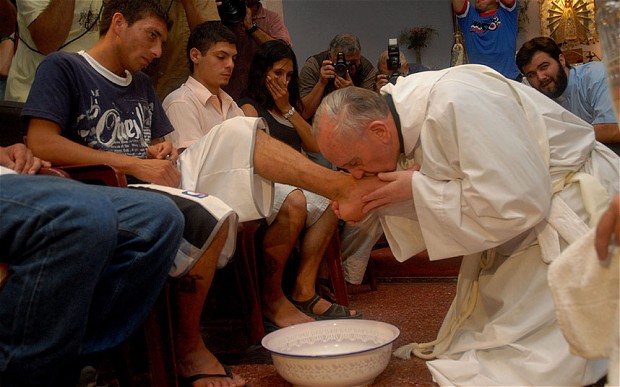
  • Between the elaborate displays of the Vatican and the global sex-abuse scandal – both of which are hard to figure out from reading the gospels – the Catholic church has been having a rough time of it in the court of public opinion.Pope-Holy-Thursday_2509139b

Francis’ style is not just a breath of fresh air – it is substantially different. What he did on Maundy Thursday was not just a ‘break with tradition’, as reports kept repeating, but was significant. Washing & kissing prisoner’s feet instead of priest’s is not window dressing

  •  Protestants seems to be fascinated with Pope-drama like Americans are fascinated with Royals. I don’t really get either.

It’s like we are enamored with the figure-head of the thing we left so long ago. I chalk it up to some sort of fetish thing for regal gowns, bejeweled crowns and antiquated (and sometimes secret) ceremonies.

There is one problem though. Protestants seem to want the Pope to be more protestant.

Almost all of the critique or concern I heard about him is something that would be more emblematic of protestant values or approaches. He is following the church’s traditional stance on (just to name 4):

  1. Contraception
  2. Celibacy
  3. Women in ministry
  4. Homosexuality

I want to holler at people when they are disappointed in this

“Of course he is – otherwise he wouldn’t have been elected Pope”.

It feels to me like somebody saying “I like the new Miss USA … I just wish she was built like a Linebacker in football.”   Well … I hate to break it to you but that’s not going to happen. In fact, people who are built to play linebackers don’t make it to the Miss USA pageant. That is just not what the judges are looking for.

What I wish we would instead focus on is his economic dealings, immigration issues (he is the son of immigrants) and out-reach to non-Europeans. I continue to claim that just those 3 will make this a game-changer.

I would love to hear your thoughts. 

Liberal Question part 2: Jesus Creed

I had the honor of guest blogging for Scot McKnight a couple of weeks ago. It was a good opportunity to try something out with a different crowd. It was  instigated by last weeks post in response to Roger Olsen and Scot McKnight.Facade of St. Vitus Cathedral

It was a fantastic conversation and I learned several things that I will take with me into future engagements. Here are some observations:

  • I learned to clarify the difference between people in the pew and theologians.

I go to a mainline school and work at a mainline church. I have an amalgamation in my mind of the ‘average liberal’.  But if you are in the conservative camp, your main engagement and concern is with Liberal theologians who have a high profile.

If was starting the post over, I would address this up front and make an early distinction. I think that would have helped.

  • I learned not to use the word ‘versus’ if you don’t mean adversarial.

Neither Scot nor I think liberal is necessarily  a bad thing. Roger Olsen does. But some of the readers at JesusCreed think in adversarial binaries. I was not trying to say that progressives are good and liberals are bad. I was simply trying to distinguish the two – not pit them against each other. The argument culture is so strong – especially in conservative circles – that I should have preempted that.

  •  I learned that those in systematic approaches struggle to recognize non-systematic approaches.

This is an obvious and inherent problem. If you value systematic approaches, of corse you will criticize something as ‘not systematic’ and think that stands alone are a critique. I was trying to point out that conservative, liberal, evangelical, emergent, and progressive are not 5 categories of the same thing. Some are positions. Some are loyalties. Some are approaches.

Here is what I ended up with: 

Since my Cobb quick-definition was not working for folks I thought I would ‘shift’ the emphasis and see if this language worked better:

Liberal – a constellation of loyalties inherited from the Enlightenment that is settled/assumed.

Progressive – an approach that integrates such influences as Feminist, Liberation and Post-Colonial critiques explicitly.

I’m open to help refining this – ESPECIALLY  if you are a self-proclaimed  liberal or progressive

My favorite response came from TJJ and it has me smiling ear to ear.

Qualities of a progressive ………as viewed by an evangelical……….

A. See more “grey” in their approach to scripture issues: inspiration, inerrancy, revelation.
B. Allow for more of a continuum on doctrinal/theological issues: hell, salvation, sin, depravity, exclusiveness of Gospel, etc.
C. More open ended on social issues : gay marriage, illegal immigration.
D. Trends more democratic/progressive politically
E. White, college degree and often more, affluent, alcohol, NPR, Toyota/Honda, MSNBC/CNN

Oh my. That is good.

At first read you may say “yeah – of course”.

But look at it again. It’s actually pretty helpful to see it all in one place.

I would love to hear your thoughts on any part of this whole episode. 

Barna and the Burned Over Region

Barna Research put out a fascinating list of America’s Top 100 most ‘Bible-Minded Cities’.  Its not the top 10 Bible cities but the bottom 10 that are so telling! barna_biblemindedcities_preview1

The bottom 10 are:

  • Boston, Mass
  • Manchester, NH
  • Hartford/ New Haven, CT
  • Portland/Auburn, ME
  • Burlington,VT
  • Plattsburgh, NY
  • Albany/Schenectady/Troy, NY
  • Providence, RI
  • New Bedford, MA

It really caught my attention for 3 main reasons.

1. When I was in college I was an evangelist and Barna was our go-to source

2. During that time a common mantra in my circles was that ‘the Pacific-NorthWest is the most unchurched are in North America.’

3. After college I went to help plant a church in upstate NY (near the VT border) and grew suspicious about that Pacific NW thing.

I had spent time in the Pacific NW and while there were lots of unchurched people … there were also tons of churches – but specifically big churches aggressively engaged in the culture wars.

In the New England (or NorthEast) region, it was different. There was a cynicism is had not seen. Not a coffee shop atheism like the west. I deep suspicion unlike I had encountered.

 This came to a head for me when two roads converged. 

Ingredient 1: I was charismatic and had bought into a thing call “Re-digging the Wells of Revival” where you go to places where God has worked in the past and, through prayer, you try to unplug that ancient well of what God wants to do to release the anointing that once flowed.

I lived in area that had seen large revivals in the late 1800’s and early 1900’s. In fact, the denomination I was a part of was founded in the region and still had some of the revival tabernacles as properties! I would go to the  one closest to my house (Round Lake, NY) and pray for revival to sweep our area again.

I even started doing historical research. I stumbled into something. It was called ‘the Burned Over region’. It turns out that the much celebrated  revival had burned through so fast and so hot that when it was over … a cynicism had set into many people. Families that had given large amounts of time, sums of money and even family jewelry collections grew bitter.

A problem developed for me. The circles I was running in were celebrating the 2nd Great Awakening and other historical renewals of the church. I was growing suspicious and that altered my prayers.  I stopped praying for the same kind of revival we say 100 years ago and started praying for a different kind that didn’t leave generations of families bitter and broke.

 Ingredient 2: I went to a Barna Conference in western NY (Syracuse or Rochester area).  I sat there the whole time shaking my head as Mr. Barna presented to a packed massive auditorium. The finding that he was presenting were not exactly true of my area.

I had read a book by that point called “The Nine Nations of North America” and had begun to concoct a theory that merged (for churches) the New England of Nine Nations and my findings in Burned Over research. When you put those two together it really explained a lot.

 I kept saying to myself, “Even NY is different east of the Hudson river. From Albany east NY is more like New England than like Western NY and Pennsylvania”.

After Barna’s presentation I voiced my suspicion and that was not greeted well by my denominational cohort I was attending with.

I even brought up the Pacific NW thing and how out there you can hear 3 big christian radio stations and find a christian bookstore every couple of miles. We had neither.

The Pacific NW had mega-churches. We had one church over 1,000 and people in our area were suspicious that it was a cult, “because how else could you get that many people to all come and sing the same thing at the same time and then listen to one guy talk for a half-hour?”

 All of that is background for this past weekend. Barna put out a fascinating new list of the 100 most biblically minded cities. You can go read the article to see how they configured that.  The 2 most important things to me:

1 – the top 50 are East of the Mississippi River (except for Bakersfield, CA).

2 – the bottom 10 are all in NE or that NY Hudson River basin.

To me this says two things. First, the Bible Belt is a real thing and when combined with something like ‘Nine Nations’ is potent to think about.

Second, The bottom 10 are all in the burned over region and should give us concern about what 100 years from now will look like. I know that there are lots of factors over the last century and that someone will say “the past is not the future” and I get that.

But as one who a) studied this, b) while I lived there, and c) called it out in real time… I’m telling you –

The bottom 10 of this thing are far more relevant to our future than the top 10. 

What is going on IN religion when we talk about God

This weekend I will finish reading two books that we were given through the podcast (thank you publishers). The first is Peter Rollins new on The Idolatry of God and the second is Phil Snider’s Preaching After GodMP900405058

I have recently edited podcasts with both of these authors. [We put out the Phil Snider TNT last week ]

It is very clear to me that we have an emerging situation (trying not to say problem) on our hands. With the introduction of a new wave of postmodern or ‘radical’ theology [listen to the Caputo introduction here] – progressive and emergent christians are drinking in lots of innovative and challenging concepts about God that may not have a real God behind them.

This is fine IF the listener/reader knows what they are imbibing. What is increasingly concerning for Tripp and me is the consequence when people don’t know that the god of the 21st century philosophers is not exactly the god you hear about on Sunday morning.

Is there a danger in people reading a ‘how (not) to speak of god’ and then just quoting it from the pulpit like they would quote any other historical person?  Folks in the deconstruction camp are not real eager to answer this one.

I have some thoughts on the matter so I thought I would throw them out here for consideration.

 Intro: It is severely unhelpful to frame this in an either/or way. “Either God is X like the Bible/Creed/Tradition say OR Religion is the equivalent of Santa Clause &Tooth Fairy and we might as well all go home.”

That reductive approach is foolish and silly.  There is far too much going on in religion – and the Christian religion specifically – to say things like that.*

 I propose that there are – at least – 5 things happening IN the christian religion:

  • Experience
  • Formation
  • Event
  • Mystery
  • Potentially Something Real

Experience – People who were not raised in the faith convert and/or have crisis experiences that powerfully impact them.  People experience the presences of something they interpret as bigger than themselves.

We can talk about transcendence or phenomenology but what we can not deny is that people experience something in religion. As someone from a charismatic-evangelical background it is so clear to me that much of our talk about God and religion in progressive-emergent circles misses this very real component.

Is experience the whole story? NO! And those who reduce it down to that are equally as errant. It is not the main thing nor is it nothing. It does not account for everything but neither can it be dismissed outright.  People’s experience must factor into the equation.

At minimum do the Kantian thing and say that religious people’s experience is real but incomplete to understand the whole picture (noumenon) – like 6 blind people with their hands on different parts of the elephant – each thinking they are describing something unique: a tree (leg) a rope (tail) a wall (belly) and a giant leaf (ear) and an enormous snake (trunk).

Formation – I get in trouble for liking the post-liberal writing of George Lindbeck (Nature of Doctrine) but I think that this is exactly where it comes into play. The role that the christian tradition, sacred text and vocabulary plays is that forms us a people. It forms character within us as well as the way that we participate in community.

I am in dialogue with the work of Alasdair MacIntyre (After Virtue) for this very reason. While I disagree with his solution, I think that he is spot-on in his analysis and concern. Not only does our culture live in a chaotic time – but the very ethical assumption that would allow us to even HAVE the conversation have been eroded and now we can’t even debate! At least within the Christian church there is a common vocabulary. We may debate the definition of the terms but we have an arena in which to engage each other.

In this sense, the faith functions. As Elizabeth Johnson (She Who Is) is so good at pointing out: the words that we use function in our imagination, our communities and in the tradition.

Event – John Caputo (Weakness of God) and those who follow his Derridean ways prefer to speak of the name of God as an event. There is an event housed in the name of God the beckons us – we respond to this call … and are not that concerned wether there is a caller, or if we can know that there is one.

It is undeniable that something happens when God’s name is invoked. It triggers something in us. It calls for something from us. It makes some claim or demand to be dealt with differently than other words and concepts.

I like Caputo’s illumination of this shadow world. There is something deeply insightful about his explorations. Those who want to dismiss it because it isn’t enough on it’s own, are missing the point. Something happens if ‘God’ is invoked … and that would happen even if there were no ‘God’ per se because (as I said above) the concept functions. – it does something in us,

Voltaire said,”If God did not exist, it would be necessary to invent him.” That is because ‘god’ does something in us – demands something from us.  It maybe not ripping off our customers, it may get us through a tough time or help us to sleep at night – or even face the end of life with dignity. But in the name of God is an event that lays hold of us.

Mystery – I am fascinated with the apophatic tradition. I have no interest is appropriating it … but I am mesmerized by the fact that it even exists. Describing god by what she is not? Brilliant.

I also have been looking in historic understandings of analogy. Which works for me because I do not believe in univocal speech. When we call god ‘father’ we are using an analogy – god is like our best conception of father-liness … but it saying that is also included an understanding that God is not actually a father. Our use of the word is not a 1:1 equivalence.

Elizabeth Johnson challenged us over a year ago that every time we say ‘god’ that we must say it three times.  I do this every day now!

  • God beyond us.  This is that transcendent other or Kant’s noumenal real.
  • God within us. This is the experiential component.
  • God at work all around us. This could be the event.

When I say ‘god’ I always say God beyond me – within me – and at work all around me.

 Potentially Something Real – the final component in my 5 sided web is the possibility that there really is something to all of this – more than just phenomenon or imagination or tradition or vocabulary – and that the language of religion is at least getting some of it right.

If we don’t leave open the potential that something real is really happening – that a real god is actually acting – then we may be missing the biggest part of the puzzle and thus have an incomplete picture.

___________
Just because YOU haven’t thought of the multiplicity of layered meanings happening in the Christian expression doesn’t mean that it is an all or nothing game.Don’t be that person who says “If Santa Clause isn’t real, then Christmas isn’t worth celebrating”. Or “If Creation did not happened exactly like it is described in Genesis then the whole BIble is untrustworthy and unbelievable.”

The Church’s Task

In the next 24 hours I will be putting up 4 blogs – taken together, you will be able to tell what I have been thinking about the past month.  I would love your feedback on any of them.

Last month David Fitch tweeted this:

“The biggest task of today’s church is to undermine in its members the blase unexamined acceptance of secular assumptions for everyday life.”

I thought about it all day and just couldn’t be sure he was right on this one.

Now just to let you know where I am coming from:

Put that all together, I have doubts about Fitch’s assertion. Here is why:

I am increasingly suspicious that secularism is both a consequence and a side effect of Christendom. It is the West’s Frankenstein if you will. We made it. Then it took on a life of its own – a life we don’t like very much and which damages our efforts and injures our cause.  I think we have to start there.

I agree with Fitch that there is a ‘unexamined acceptance” and would go even further and say that it results in an assumption that what we see is the way it is. That our current mechanisms of organization are final forms and that the ‘as-is’ structures come with a large measure of ‘giveness’.  Tripp often applies this capitalism, nation-states and democracy. I would tack on both denominations for the church and militarism for US America.

I am just not so sure that our main task is to undermine. Maybe that is where my hangup comes. I am leery of this approach because it seems like we are defaulting the ground rules in the initial move and framing the task in a conceding first move.

I might be naive here but I am just not sure that the church needs to
A) give that much ground initially
B) frame her task in the negative.
I know it’s just so much one can do with a tweet but … there is something there that gives me caution.

So what is my constructive proposal?  I’m working on it.

I would want to frame it more like Stuart Murray does in the book Post-Christendom  and acknowledge that initial concession was early on with Constantinian Christianity. Then Christendom. Then Modernity.  With those three concessions we admit that the as-is nature of existing frameworks for both church and culture are thoroughly compromised and corrupted.

BECAUSE of that. We abandon the recuperation, rehabilitation, reclamation , and renovation projects (and mentality) all together! (all 4 faces of it).

It’s over man.  Let it go.

THEN we start new and in the positive. The 21st century provides fresh possibilities and opportunities IF ONLY we will let go the idea of getting back to something or getting something back. I know we never start from scratch – we never get back to square one. But …

I don’t want to be the undermining parasite ON the big organism. That is too small a task.  I want to partner with God in the healing of world (Tikkun Olum in Hebrew).  I want to participate in the development cosmic good – until then at least the common good. 


PostScript: now that I started down this “re” line I can’t stop coming up with words I want to flesh out further!
Restore: no
Re-imagine: yes
Represent: yes
Re-member: sure
Resurrect: ummmm not really
Reflect: probably

The Pros and Cons of Advent

Last Monday John Stewart did a very funny bit on the Daily Show about how Christmas has gotten so big that it is starting to take over other Holidays – what we used to call Thanksgiving is now ‘Black Thursday’ … Watch out: you’re next Halloween!

And in one sense, it is true. Christmas has become, as many have articulated, a frenzied orgy of consumerism. My dean, Philip Clayton, in a piece entitled “ Reflections for a Time of Madness” points out:

In an irony of history, the time of spiritual preparation and silent waiting has become the busiest, most frenetic season of the year.

 Now admittedly I am new to Advent. This will only be my third time through it. I have embraced it with gusto though! Last year I even bought a box of these amazing Liturgical Calendars and led a series of lessons on it in the Adult Ed. classes at our church.

In fact, when Stuart explains that the 12 days of Christmas is actually the period from Christmas day to Epiphany (January 6) when the Magi (Wise Men) are celebrated as visiting the baby king. The sad part is that just 5 years ago, that would have been news to me! I probably thought that not only was it the 12 days that led up to Christmas – but that I was showing great restraint to limit the season to just 12 days.

I love reading, listening to and even chatting with Phyllis Tickle and Dianna Butler Bass [one of my conversations with her] about all of the rich tradition and deep meaning that are to be found in walking these ancient paths.

And while I am very excited about the spiritual season of waiting and reflection, I have a new wrinkle in my fledging appreciation for the liturgical season. We have started a new emergent gathering (the Loft LA) that employs an ‘ancient-future’ sort of engagement.

This coming Sunday we are introducing the group to the Advent Conspiracy and I am very pumped to enter into the that conversation.

 I am, however, a little less enthusiastic about introducing the topic of Advent itself. In fact, we have debated, prayed and really wrestled with how to approach this. Our liturgical service (10 am) does Advent that the 9s. We go all out. We even hold off singing the famous songs until Christmas day – even though we have this amazing (and overwhelming) pipe organ that would be a huge draw for those who like to sing the classics in preparation for the big day.

 But is it worth it to bring up the topic to a crowd of newbies? My conviction is wavering.

Look, I love Christmas. I love the month of December and the lights and the presents and everything that goes along it with. I love singing Christmas carols in December! Do I really want to get into this counter-cultural restraint motif with new folks? Is it really worth initiating folks to this old way?

 Part of me says no! The ship has sailed – that battle is lost. Christmas starts before December in our culture and we should capitalize on that as the Church! Stop being such sanctimonious nay-sayers and pious do-rights and join the party! Plan, strategize, and engage the people around you at the time the are most christianly-inclined!

They are singing things like: 

Long lay the world in sin and error pining,

‘Til He appear’d and the soul felt its worth.

A thrill of hope the weary world rejoices,

For yonder breaks a new and glorious morn.

Fall on your knees! O hear the angel voices!

O night divine, O night when Christ was born;


Truly He taught us to love one another;

His law is love and His gospel is peace.

Chains shall He break for the slave is our brother;

And in His name all oppression shall cease.

What the HELL is your problem?
Get with the program!
Shake off the dust Church Lady and roll with the times!
Carpe Mañana

Then another part of me says Advent makes so much more sense – is so much more meaningful – and aren’t we preaching an anti-mammon counter-cultural message anyway? Maybe we should cave in to culture. Maybe we should concede to the bloated, grotesque, shallow, hollow consumer and credit card carcass that christmas has become.’  Maybe Advent is still worth doing … even with new people.

Maybe, especially, with new people. Maybe giving them an alternative to the frenzied and hectic mess that December has become is exactly how we could minister to and with them.

Or maybe Advent is just one more of these sentimental oddities that the church likes to hold onto and even prides itself on hanging onto until it’s dying breath. It’s not like we own Christmas. Wait … we do kind of have an invested interest … one might even say a market share … and by God – we are going to love it to death.

As you can tell, I am quite unsettled on the issue.  Thoughts?

 [please let us know if you grew up with Advent in your response] 

5 Biggest Pastoral Changes in the Past 5 Decades

I’m preparing to facilitate a conversation with some colleagues in the new year about ministry and honoring tradition. I want to begin – and thus frame – the conversation with the changing culture that we are products of, interact with and attempt to minister to.

It is a different way to approach the topic of tradition, admittedly, but my thought is that we start where we are and then trace threads into the past to uncover their significance. I almost always find it unhelpful to start in the past – say at the Protest Reformation – and then slowly work our way up. It is simply too limiting (in scope) and cumbersome (in process) for the contemporary expectations of ministry.

I have been reading a little Gordon Kaufman. He has me thinking about the ‘nuclear age’ and how deeply that shift, from the end of WWII, has impacted us sociologically, psychologically, and spiritually. I take this as my launching off point.

 So here are my Big 5 – in no particular order. I wanted to throw them out here and see what others who are older, or wiser, or more insightful might add to the list or modify.

 Pervasive Pop Psychology  – My dad tells a story about interviewing retired pastors 30 years ago. He asked them when things seemed to change. All of them, without exception, pointed to the window from 1968-1970. They talked about Woodstock, Vietnam, and Nixon among other things.

Many of them also talked about people’s awareness and pop psychology. I will always remember the story of a son who came home from college to visit his folks on the farm. He tried to talk to his dad about his feelings, motivations, childhood memories, his subconscious, etc.  His dad responded, ‘Son, what the hell are going on about?’ He just had no frame of reference for it. Similar stories were repeated, in differing configurations, over and over by  the ministers.

Pop psychology has permeated every facet of society. From Oprah on daytime TV to Self-Help books – it impacts what people expect from a pastor and what they want from things like premarital counseling.
In my first 10 years of ministry, I often said that I would have more prepared for the actual way I spent my week if I had gotten a degree in psychology  rather than in Bible.

Biblical Scholarship – speaking of the Bible, I am shocked as to how much different those conversations go than they did 20 years ago when I was trained in Apologetics/Evangelism.  Between the Jesus Seminar, the Da Vinci Code and Bart Ehrman popularizing the stuff many pastors knew from seminary but were not allowed to say in the pulpit, it is a very different playing field.

It is an odd split: people often know little of the Bible – because they know so much stuff about the Bible. We can’t assume even a Sunday School understanding or a surface devotional reading. But at the same time, the culture wide awareness of critical Biblical scholarship is shocking. That was not true 50 years ago.

The Internet – The Internet changes everything. From the way people spend time to the way that they shop for a church. Facebook has changed how people connect to each other. Google has changed the way people access information. It is impossible to overstate how big of an impact the Internet has had on Western society. If you are still doing church the way you did 50 years ago – and think that it will have the same effect – you are fooling yourself. You may have the same seed, but the soil itself has changed. It will not grow the same crop or produce the same fruit.

Two little examples: When kids who grew up in your church come home from college and sit in on Sunday school (for example). They will assume that they get to share their opinion. They don’t sit quietly and honor the elders by talking last. They will raise their hands and talk first. Is it that they are over empowered? No. It is that they assume that they get to help shape the discussion and their opinion is valid. They don’t sit quietly and try to get up to speed or catch up on what they have missed.

  • This is the difference between Web 1.0 and Web 2.0.  A church website is 1.0 – the staff puts out the information that it wants people to see. You read it like a newspaper. It is not interactive. Facebook is 2.0 – it creates the environment but does not generate the content. Young people live in 2.0

Doug Paggitt talks of ‘the pastor as Google’. I love this. People don’t go to Google for Google. It is not a destination. It helps people get to their destination. If it does this well, people trust Google and go it often. Pastor used to be like encyclopedias. They were a resource, a destination for information. Now, the pastor’s office is not a destination, the art of pastoring is help people find theirs. If we do that well, they trust us and come back the next time they need direction.

Pastor as encyclopedia is a repository of information. Pastor as Google is a resource that knows how to find the information.

24 Hour News & Christian Media –  Cable news and Christian radio probably have a bigger impact on the people who fill the pews that any pastor can be expected to have in a 30 minute sermon once a week.  There is no other way to say it, the narrative that is being put out on media outlets like Fox News (Clash of Civilizations) or Christian Radio (the 6 Line Narrative) is so pervasive and so monolithic that it can feel as if your parishioners are being pastored far more by their TV and car radio that you will ever be able to.

This is also part of why our country and culture have become so:

  1. polarized
  2. adversarial

I am horrified by this trend more than all the others combined. I think that it hurts the heart of God and I know that it hurts our Christian witness.

Fractured Globalism  and PostModernity – People have great troubles conceptualizing and articulating how fractured, dislocated, overwhelmed and powerless they feel in the global marketplace. Things are not simple now. Things have never been more complex and overwhelming. Look at the food on your table? Do you know where it comes from? Think about your Thanksgiving dinner last week and imagine how many miles and from how many countries those ingredients were trucked to end up on your table. You might be shocked.

Think about your car. Was it all made and assembled at the same plant? Or even in the same country. The automotive industry was fairly straight forward 50 years ago. Now it is an example of inter-national, multi-corporation conglomerates. We have been de-centered, and people feel it. The way we conceptualize ourselves, our connection to family, the way we picture the world working, the universe and thus God. The best book I have read on the subject is “Identity, Culture, and the Postmodern World” by Madan Sarup.

The PostModern Turn – speaking of PostModern, this may be the biggest of the 5 changes. It is funny to me that some christians still want to debate if the category is real just because it can not be succinctly or universally defined (how very modern!)  Look, call it what you want: late-modernity, hyper-modernity, high-modernity, or some other thing – what can not be denied is that something big and deep has shifted. Blame it on the philosophers (Derrida, Lyotard, Foucault, etc) if you want. Make up a new name for it if you must. But please stop pretending that what we are looking at is nothing radical or unexpected. Even the ostrich thinks that it is time to pull your head out of the sand!

One interesting reaction, and this applies to denominations, is the counter-modern responses that want to go back to an imagined past and reclaim a romantic pre-shift relationship between the Christian religion and

  • society
  • the economy
  • science
  • other religions

You can see this in counter-modern responses like Radical Orthodoxy (retreating to the hills of Thomism), Post-Liberal thought, Hyper-Calvinism and the Tea-Party in politics. Even if you pastor with an established denomination (and many don’t) you have to contend with these fractious groups that will impact your congregation.

Those are my 5 Big changes for Pastors over the past 50 years. I would love your thoughts!  What would you take out and what would you add?

Create a free website or blog at WordPress.com.

Up ↑