Search

Bo Sanders: Public Theology

updating & innovating for today

Category

Church

3 things many Christians may not know (but should)

originally published as “I’m not sure most Christians know that

I was reading a fascinating article by Terry Eagelton where he was reviewing Dawkin’s book (the God Delusion) specifically and refuting the new atheist en mass. He took them to task for not knowing much about theology – which, in his mind, is a major problem if one is writing a book about God. He takes an interesting tone, nearly mocking at points, regarding their lack of sophistication and wherewithal in theological understanding and categorization.

Here is a sample (which, by the way, it reads MUCH better in a John Oliver delivery style):

Dawkins speaks scoffingly of a personal God, as though it were entirely obvious exactly what this might mean. He seems to imagine God, if not exactly with a white beard, then at least as some kind of chap, however supersized. He asks how this chap can speak to billions of people simultaneously, which is rather like wondering why, if Tony Blair is an octopus, he has only two arms. For Judeo-Christianity, God is not a person in the sense that Al Gore arguably is. Nor is he a principle, an entity, or ‘existent’: in one sense of that word it would be perfectly coherent for religious types to claim that God does not in fact exist. He is, rather, the condition of possibility of any entity whatsoever, including ourselves. He is the answer to why there is something rather than nothing. God and the universe do not add up to two, any more than my envy and my left foot constitute a pair of objects.

I was struck by his attitude and I caught myself thinking “I’m not sure that most Christians know that.” He kind of treats these antagonists with a dismissive “duh” but I am suspicious that the atheist aren’t the only one who aren’t aware of the categorical mistake of calling God a ‘person’ just because knowledge of God can be ‘personal’.

There are two significant implications of this:

  • the new atheists (Hitchens, Dawkins, Harris & Dennet) have a stinging criticism that continues to impact those on the margin of the faith and those wrestling with seasonal Christian commitment. Neither the Atheists nor those they seduce know that we don’t mean what they say we mean.
  • Many Christians continue to repeat the Creeds and Catechisms in rote repetition without comprehending the way in which language is being utilized. This concerns me as I continue to wrestle with (and against) the work of Lindbeck, Hauerwaus and MacIntyre.

Here are 3 things that I have learned over the past 5 years that I’m not sure most Christians know. In fact, as I have transitioned from an evangelist-apologist to a theologian, I’ve had the opportunity to converse with and introduce people to these ideas and ,for almost everyone, it is the first time they are hearing the distinction.

God is a Person: When we say that God is a ‘person’ we are not saying that God is like a big you (or me) in the sky. God is not a person in the way that we are a person. You almost have to think about it as a placeholder. It’s a verbal placeholder because whatever God is not exactly a person.
This is where accusations personification and anthropomorphism come in. Folk and Pop brands of christianity are very vulnerable to this charge.

God in 3 Persons: It gets really confusing when we say that there is ONE god but 3 Persons. Gregory of Nyssa, in the 4th century, said:

We can grasp this by reference to a single instance. From him, I say, who is the source of gifts, all things that share in this grace have obtained life. When, then, we inquire whence this good gift came to us, we find through the guidance of the Scriptures that it was through the Father, the Son, and the Holy Spirit. But though we take it for granted that there are three persons and names, we do not imagine that three different lives are granted us-one from each of them.

Most explanations I hear about how ‘God is One’ but can also be ‘3 persons’ reek of modalism. I was being too kind: they are modalism (one God in 3 modes). But who can blame them? Elizabeth Johnson is right when she says that it is nearly unavoidable when you start with One – then go to three (all of which are boys) … and claim that it is monotheism and not polytheism. It’s confusing as hell! She, instead, starts with a perichoretic reality and says we do the best we can to express it well.

Jesus is fully God and fully human: We don’t have space to get into  the ‘substance’ confusion about how Jesus could be fully two different things and how 98% of the explanations I have heard make it impossible that there actually was an incarnation. We still have to talk about the difference of God as a ‘being’ and God as being. Then we can deal with the nature of language and gender pronouns for God and all sorts of other stuff.

I also am not blaming people for the explanations they have been handed on these issues – they can be difficult to comprehend and even tougher to defend.I am suspicious that many of our former explanations are incomprehensible and so we simply say they are ‘mystery’ when in reality they are untenable.

What I am concerned about is that theologians not take on a ‘duh’ attitude toward those who are unfamiliar with the categorization employed within the theological endeavor. When our language is a) specific and b) different than the common use, it is we who are obligated to bridge the gap if we want others to understand what we are saying.

The Church of N. America will always be (mostly) like it is now

Before I headed out into the woods for a week, I had posted this over at HBC. It triggered a good discussion and today when I was reading a thing about Joel Osteen’s individualism I was reminded of it.  I would love to hear your thoughts.

 The church of N. America will always be (mostly) like it is today.  When those who think as individuals read a text that is communal, there is always going to be an issue. 

I know that there is a real danger in painting in broad stokes and speaking in generalities. I normally steer clear of such dangers but once in a while you find something that allows you to wade out onto the normally thin ice with a certain measure of confidence.

I recently finished a term paper on Alisdair MacIntrye’s opus After Virtue which is his attempt to reclaim the Aristotelian notion of character formation within community (to oversimplify a bit). In preparation for writing the paper I went back over some classics like John Rawls and Michael Sandel (the communitarian) and others.

It just so happens that I have also been reading a lot of post-colonial critique during this year and I have a growing suspicion that I wanted to throw out there:

We have individuals (products of the enlightenment) reading a text that was written in a communal framework (a product of a communal society).  That provides a fundamental discrepancy that will never be resolved. It will always provide a disjointed experience and thought process that lacks continuity.

Let’s not pretend that we can think another way. We are heirs of the enlightenment – this is our operating system. We can download a new program like ‘christianity’ but it is operating within the individualist code. Talking with my friends who are from non-European descent (Native American, Pacific Islands or certain Asian communities)  it is clear that there is no simple conversion that an individual can undergo and simply start thinking in communal terms. We are cultural creatures and this is our culture.

It shows up when we read the Bible. It shows up when we talk of government (democracy) economy (consumerism), status, value, worth, choice, success, identity, rights, laws,leadership and … well nearly every other aspect of Western society.

The famous example of Philippians 2:12 admonishing us to “work out your salvation with fear and trembling” is but a drop in the pond. It’s not just that the English language doesn’t have a plural ‘you’ (unless one counts the ya’all of the Southern US) but it is bigger than that. It is that we think in individual ‘you’s and there is no way around it.

This will always be an issue. So even when somebody talks about character formation, spiritual community, or some ideal of communitarian discipleship (be it Hauerwas, the Radical Orthodox, or any other innovative group) in the end, the church of N.America will always look mostly like it does now. The reason is that this individualism we think in is not all that compatible with the communal thrust of our very scriptures – and that is irreconcilable at some level. It can not be resolved because we can no more stop thinking as individuals than that Bible can stop encouraging community.

Limits in (religious) Language

I just finished my semester this past week and was going through my desktop cleaning up all the icons when I discovered this post and realized that I had put it up over here yet.
It was originally posted at HBC

I like reading Lindbeck.* I used to say that I love Lindbeck but I ran into two snags.

  1. I didn’t realize what people did with Lindbeck. I did not know that it often led to retreat into a neo-Catholic expression.
  2. There is some philosophical wrinkle that I don’t fully understand about why the language that creates our religious experience implies a one-way limitation of language -it is a bit technical for me but I wanted to acknowledge it because it eventually becomes a real sticking point.

Having said that …

What I am a big fan of is Lindbeck’s critique of Language. He has a riveting analysis of the way that religious language functions in our communities and personal experiences.  I was susceptible to liking Lindbeck because of my deep appreciation for Nancey Murphy’s book “Beyond Liberalism and Fundamentalism”. I was primed for what Lindbeck brings to the table.

To become religious–no less than to become culturally or linguistically competent–is to interiorize a set of skills by practice and training. One learns how to feel, act, and think in conformity with the religious tradition that is, in its inner structure, far richer and more subtle than can be explicitly articulated. The primary knowledge is not about the religion, nor is that the religion teaches such and such, but rather how to be religious in such and such ways. p. 35

Then I found out that saying you appreciate the Lindbeck’s (post-Liberal) approach is like saying you cheer for the New York Yankees in Boston. I understand the concern with the descendants of Lindbeck’s work … but I am still suspicious that he is right about how language works in our faith communities.

Fast Forward: I was reading some stuff to get ready for the 2012 Emergent Village Theological Conversation this past January and I stumbled onto a section of Whitehead’s thoughts on religious language.** I got to a section called “Doctrine and History”. After dealing with the fact that language does not have a one-to-one correlation and that all language thus requires interpretation, the author explains:

“The language of a tradition and the central doctrines that reflect and support that language are the prime turbulence of the particular mode of existence characterizing that tradition. Furthermore, as human existence is shaped in specialized ways during the course of history, experiences occur that are not possible to persons shaped by other traditions.”

I resonate with the idea that a person is shaped by the language one is groomed and conditioned by – and that would both empower and naturally shape the experiences that one has and the interpretation of those experiences … even (or especially) the religious experiences.

It just makes sense that because religious in a communal endeavor – one is always a part of a community that has a tradition and set of practices/beliefs – that it determines, at some level, both the types of experiences one has , can have and how one translates or interprets those experiences.

This is a vital assertion for the 21st century! We no longer live in the monopoly of Christendom or the frameworks of the Colonial Era where one tradition imported and imposed foreign expectations and alien interpretations on another.

With works like “The invention of world religions” by Tomoko Masuzawa and “God is not One” by Stephen Prothero (among many others) we are entering a time in world history (and thus church history) where we need to come to terms with two things that both Lindbeck and Whitehead are pointing out:

  • Language is both inherited and powerful in shaping our experiences and subsequent interpretations of those experiences.
  • Language used in doctrines like ‘the Church’ and ‘Eucharist’ actually facilitate the ability to have certain experiences that are simply not available to those outside the community or language game. Practices like Yoga or Ramadan would be the same for those in different traditions. That is why North American Christians who do yoga are not have the same experience as those in India.

We live in an era where the realities of inter-religious education, cross-denominational communication and trans-national citizenship are going to challenge all of our inherited traditions and conceptual frameworks.

If we are unwilling to do so and insist on simply repeating the same rote answers week after week under the misguided impression that we are being faithful to the tradition … we are in danger of an irrelevance that leads not only to extinction but ultimately failure to accomplish our great commission.

*George Lindbeck wrote “The Nature of Doctrine” and along with Hans Frei (author of “Eclipse of the Biblical Narrative”) is credited with starting the Yale School of thought. One of the most famous proponents of which is Stanley Hauerwas famous for his books like  “Peaceable Kingdom” as well as other things.

** Alfred North Whitehead was a 20th century philosopher who is credited for helping to come up with what became Process-Relational thought.

Jesus & (S)words part 3

reposting from last week.
Part 1 & Part 2 provide the lead in

Part 3:  Jesus tells his disciple to buy a sword?

We come to that famous passage in Luke 22 where Jesus tells his disciples to buy a sword.

 35 Then Jesus asked them, “When I sent you without purse, bag or sandals, did you lack anything?”

“Nothing,” they answered.

36 He said to them, “But now if you have a purse, take it, and also a bag; and if you don’t have a sword, sell your cloak and buy one. 37 It is written: ‘And he was numbered with the transgressors’[b]; and I tell you that this must be fulfilled in me. Yes, what is written about me is reaching its fulfillment.”

38 The disciples said, “See, Lord, here are two swords.”

“That’s enough!” he replied.

Here are two readings you may want to consider: 

Earlier this week I engaged a political reading of Moses and the waters of Meribah from Numbers 20. My question was “why, if Moses was going to ultimately speak to the rock, did the Lord even mention the staff?”  The answer was that it was a symbol of power to be carried – yes – but ultimately resisted in favor of a better present option that might be overshadowed by the most obvious option.

It takes strength to turn the other cheek. If you don’t have the ability to retaliate … it is just being a doormat or victim? That is how I have always thought about it.

In that perspective, I have read Jesus’ odd command with Peter in mind. I see that fateful night where Jesus tells him to ‘put away your sword’ and later tells the authorities ‘if my kingdom was of this world my followers would fight.’ The implication is that Jesus’ kingdom is not of this world and so his followers don’t fight.

The sword for the disciple, then, is what the staff was for Moses in Numbers  20: a powerful option to be resisted in favor of a preferable option that is less obvious because it is less forceful.

I used to reconcile ‘buying swords’ as a sort of object lesson or training excersise for the disciples. One lesson (trust and supply) is over – next lesson: You can’t resist temptation is one of the options is not even available.

 Then, in 2007, I discovered that Biblical Scholars have a different way of handling the passage. Here is Ben Witherington: 

Lk. 22.36-38. What is the meaning of this little story, taking into account the larger context of Jesus’ teaching? Vs. 37 is the key where Jesus quotes Is. 53.12—“he was numbered with the transgressors”. Jesus is saying to the disciples—you must fulfill your role as transgressors of what I have taught you!!! They must play the part of those who do exactly the opposite of what Jesus taught them in the Sermon on the Mount. The disciples become transgressors by seeking out weapons and then seeking to use them. This much is perfectly clear from the context for the disciples then go on to say “look Lord here is two swords”. They already have such weapons and Jesus responds in disgust to the fact that they are already transgressing his principles of non-violence by responding “that’s enough” (of this nonsense).

 So either Jesus was saying that two swords was enough for the revolution (not likely) or Witherington has this right.

Conclusion: We have looked at these four famous passages now and it seems clear that although Jesus talked about swords and the writers of scripture utilized sword analogies, none of these passages is a validation of the type of violence these verses are used to justify.


Jesus & (S)words part 2

I’m reposting last week’s HBC conversation in 3 parts
[part 1 is here]

Part 2:  

There are lots of swords in the New Testament.  The Word of God is compared to a double-edged sword and Jesus comes back wielding a sword. Maybe the Bible is more than ‘O.K.’ with swords and sword imagery?

Let me throw out two things:

  • In the context of the Roman Empire and its occupation of Jewish lands in the 1st century, swords would have been a common item that drawing imagery out of would have been appropriate.
  • A well-known pastor in Seattle, Washington is famously quoted as saying “Jesus is a cage fighter with a tattoo on his thigh and a sword in his hand, determined to make someone bleed”. He said this in reference to the fact that he “could not worship somebody that he could beat up.”

Some people dismiss statements like this and chalk it up to testosterone fueled, overly inflated, pumped up hyper-masculinity.  I worry that there is something much deeper and much more sinister involved. I think that it is a fundamental misunderstanding of the nature of God and the interpretation of Christian scripture.

 What is noteworthy in Revelation 19, is that the sword is not in Jesus’ hand but it comes out of Jesus’ mouth. That seems important in the poetic/prophetic  nature of Revelation. This sword is not your average sword. It is not in Jesus’ hand and that makes you wonder if the way in which this sword “strike down” the nations is not in bloody violence but in a kind of destruction that would happen as a result of a sword that proceeds from the mouth of God?  Let’s ask ourselves “is there something that comes from the mouth of God that radically impacts or consumes peoples and nations?”  Is there something sharp that comes from the mouth of God … something sharper than any two edged sword?

Oh, here we go: Hebrews 4

12 For the word of God is alive and active. Sharper than any double-edged sword, it penetrates even to dividing soul and spirit, joints and marrow; it judges the thoughts and attitudes of the heart.

So far so good! ‘It’ judges the thoughts and heart… but here comes the twist:

 13 Nothing in all creation is hidden from His sight. Everything is uncovered and laid bare before the eyes of him to whom we must give account.

Hold the phones! … the Word of God (it) is a person? Yes. Guess who?

 14 Therefore, since we have a great high priest who has ascended into heaven, Jesus the Son of God, let us hold firmly to the faith we profess.

Jesus is the Word of God?    (I’m being funny but you may want to check out John 1 for clarification).

 In conclusion: the use of sword imagery  in both Revelation and in the book of Hebrews needs to be taken with a poetic grain of salt. Yes, the Bible uses sword imagery. The thing is that if Jesus’ (S)word, from part 1,  is a non-sword or an un-sword and in Revelation is comes from Jesus’ mouth and in Hebrews it is a person … then none of these passages, thus far, can be utilized to justify what so many Christian (s)words are used for. 

I’ve obviously been having fun here, but the bottom line is that just because the Bible uses swords as analogies – it isn’t a wholesale validation of swords nor a justification for using them as the world does.

________

I would love to hear your thoughts – I just have one request: please don’t use the word ‘Pacifist’ when speaking of Jesus. That set of commitments belongs to a distinct school of thought  that did not exist in Jesus day so it is anachronistic to use in that way. He was certainly into non-violence and radical peace-making but Pacifism is a unique configuration of convictions.

Four is greater than Two: Good Friday repentance

So often when I hear two groups arguing, I think to myself  “the problem isn’t what we think about this subject, it is how we are thinking about it.”  If you have read posts here for any time at all you will know that I am not a big fan of dualism in general. I invest great amounts of energy examining binaries and pulling apart overly simplistic dichotomies.

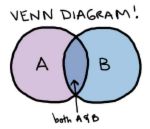
In the past I have utilized a Venn diagram to illuminate the overlap between two groups that are ‘given’ as the options. Lately, I have focused more on the 4th and 5th area.
So in American politics, when ‘republican’ and ‘democrat’ are given to me as opposites, you simply illustrate the overlapping values of the two (3rd space) and then point out those who are ‘neither’ (4th space) like Green folks and anarchists. Then draw a circle around the whole system and point out folks outside the system (5th space) like Canadians.

This semester my two classes are ‘Political Liberalism and It’s Critics’ and ‘Globalization’. It has given me lots of practice in picking up on patterns and thinking in different shaped categories.

Example 1: when a subject like ‘Norms’ is discussed – in sexual identity or sexual practices for instance – often a basic “for & against” structure is presented for any isolated topic. But as the discussion develops you can actually see that this is not a linear ‘far left – far right’ spectrum configuration – even if it is presented as such!

You quickly see that there are least 4 positions even ON a spectrum: if the far left position is “there are no norms” and the far right position is that norms are “intrinsic / originate outside the system” and implement themselves, you can imagine that a center-left position would be an emergent perspective (norms arise from below in the population and then ascend) and a center-right position of top-down Hierarchy where norms are seen to be passed down from the authorities. Recognizing those four positions facilitates a radically different conversation than just outlining two.

Example 2: when the subject is ‘Law’ or court rulings, we need to rise above elementary ‘agree’ and ‘disagree’ binaries.  There are actually 4 positions in practice.

  • Agree & Obey
  • Agree & Disobey
  • Disagree but Obey
  • Disagree and Disobey

It is essential to admit that in any population there will be great variety, disparity, and diversity – so we do a terrible disservice to the matter when we reduce the matter down to basic dichotomies.

The reason I bring this up is because I am very concerned about the round-and-round cul-de-sac conversations that I hear over and over again in the church. I am growing convince that as contemporary Christians, the issue is increasingly not what we think but how we think about it.

The issues of abortion, homosexuality, biblical inerrancy, the creeds/ orthodoxy, environmentalism, and women in ministry are just 6 examples of matters where the dualisms are killing us.

One of the best things that could happen this Good Friday would be for those who take the Christian story seriously to die to – not what we think – but how we think about it. My dream would be for a heart of repentance: to decide in our hearts to swear off inherited dualisms and pledge to, as a community, look for and develop better ways of framing the issues that matter to us most.

Challenge: This Friday, repent of either/or thinking and die to the dualism of us/them for/against right/wrong in/out thinking.  Ask your small group to hold you accountable and maybe even join you in a new life (Easter) of the mind.

disclaimer: some of you will finish this post and think ‘it was so remedial it was barely worth reading’ and others will think ‘that is crazy talk – you are either right (on God’s side) or you are plain wrong – there is no middle ground.’ But we have to start somewhere, and this is the world we live in.


a 3rd way to read the Bible?

In an ongoing search for a hermeneutical practice that is both healthy and accountable (meaning lifegiving without being merely devotional and scholarly without being dry) I have written quite a bit about the journey. I had a multi-part post a while back  Part 1    Part 3 as well Moving Mountains Signs that make you Wonde

This is last week’s addition (posted at HBC) and it was so well received (by some) that I wanted to A) post it here to continue that conversation and B) will be working on another series for late March.  This clearly is something that matters to people.

I love reading the Bible. I grew up reading it, I am passionate about studying it, and delight to preach from it whenever I get the chance.
I also recognize that it is getting harder to do in our contemporary context. I am a loud critic of simple dualism (constantly contending with my Evangelical associates)  – but even I must concede when there are two main schools of thought that have set themselves up in opposition to each other.  I buck the ‘spectrum’ thinking like Liberal v. Conservative (as if those were the only two options) in almost every circumstance. However, when it comes to reading the Bible, it is tough to avoid the set of major trenches that have been dug on either side of this narrow road.
The first group reads the Bible in what is called a ‘straight forward’ way and while they spend a lot of time with the text, there is little acknowledgement of what is going on behind the text. This group reads the Bible primarily devotionally, preaches exegetically and views it as not just instructive but binding for all times and places.
In my interactions with this group, there is little awareness of hermeneutics (in may cases they may have never heard the word before) and even less willingness to engage in scholarship that does anything behind the text.
The second group engages in Historical-Critical methods. They are willing to look at things like redaction (later editing). They don’t harmonize the Gospels into one Gospel. They are willing to acknowledge that Matthew and Luke’s conception, birth and subsequent details do not line up. They understand that while the story of Daniel happens in the 5th century BC – it was not written in the 5th century BC. They joke about Moses writing the 1st five books of Bible (how did he write about his own death?).
 Lately I have been engaging books like :

  • How to Read the Bible: A Guide to Scripture, Then and Now by James L. Kugel
  • To Each Its Own Meaning, Revised and Expanded: An Introduction to Biblical Criticisms and Their Application by Stephen R. Haynes
  • Whose Bible Is It? A History of the Scriptures Through the Ages by Jaroslav Pelikan
  • She Who Is: The Mystery of God in Feminist Theological Discourse by Elizabeth A. Johnson
  • Sexism and God Talk: Toward a Feminist Theology by Rosemary Radford Ruether

Over the last 4 years, it has become painfully clear to me that we have a problem when it comes to reading the Bible. Simply stated, those who spend the most time with the Bible know less about it but make greater claims for it than those who do more scholarship on it but may have little faith in it.
I was listening to a seminar on the Historical-Jesus and talking to several friends of mine who do Historical-Criticism, here are 3 sentences that no evangelical I know even have ears to hear:

  1. Paul didn’t even write that letter
  2. Jesus probably didn’t say that sentence
  3. The Bible is wrong about this

I get in trouble for saying much much milder things about the literary device of the virgin birth, the prophetic concern of Revelation which is limited to the first 2 centuries CE, and  Jesus being ironic about ‘bringing a sword’. Can you imagine what would happen if I thought that Paul didn’t write the letters that are attributed to him, that Jesus did not utter the red-letter words we have recorded in the gospels or that the Bible was wrong about something?  I can’t.
So how does a moderate engage Biblical scholarship without stumbling over Historical-Critical pitfalls and Historical Jesus land-mines?  The thing that I hear over and over is

“Just stick with N.T. Wright. He has navigated the gulf for you”

Now, I love N.T. Wright as much as the next emergent evangelical (especially his Everybody series) … but I am as unwilling, on one hand, to forego the best and most comprehensive stuff (like Dom Crossan’s work on Empire) as I am, on the other hand, to subscribe to the inane prerequisites of the Jesus Seminar.

What I would really like to see is a move within the emerging generation that is tenacious about engaging contemporary scholarship while fully embracing the kind of devotional passion that the innerant camp demonstrates  – all the while avoiding the fearful and intimidating chokehold that camp utilizes to squelch innovation & thought.
I want the next generation to both find life and direction in the scriptures and also to not have to read the tough parts with their fingers crossed behind their back.
a hopeful moderate – Rev. Bo C. Sanders

For those who do not want to scour the comments to find the links to other resources:
Daniel Kirk’s book  “Jesus have I loved but Paul?”
Ben Witherington’s  book list 

Loving Jesus – While Hating Religion

originally posted at HBC

Jeff Bethke has created quite a stir with his YouTube video that begins “Jesus came to abolish religion.”  Many video responses have followed (including a Muslim response) and  some bloggers have meticulously  attacked the logic behind his poem point-by-point.  Two  weeks ago  he was in Time magazine.

This whole controversy gets to me at two deep levels:

  •  I used to say those things. Just 4 short years ago I was an evangelical church-planter who regularly contrasted Jesus’ message to ‘religion’.


  •  I am shocked at how dismissive so many  folks are being to Bethke’s poem (especially educated and/or mainline).

I have heard many people just brush aside his use of ‘religion’ as ignorant, immature, stupid, uneducated, silly, shallow, un-historic, and false. The thing that I want to yell is

“YOU FOOLS – like it or not, that is how people use the word religion in our culture.”

If you asked A) people under 40 and B) evangelicals to define religion you would get a picture that is almost identical to Bethke’s .

I now hang out with mainline folks and people who read books on theology. They are  quick to say

  • that shows a poor understanding of religion
  • that is a silly/stupid/shallow definition of religion
  • that shows little historical perspective on the role that religion has played

Like it or not – this is the definition that many young people are using for religion. When they say (increasingly) that they are spiritual-but-not-religious , this is what they mean: empty ritual, mindless repitition, and meaningless ceremony.

I am pursuing a PhD in the field of Practical Theology for the very reason that I want to engage how people live out their faith – practice it – in particular communities. The two things that I am willing to concede up front are that

  • Many North American Christians and most Evangelicals utilize simple dualism (Physical v. Spiritual, Natural v. Supernatural, Temporal v. Eternal, Secular v. Sacred, Old v. New Testament, Law v. Grace). This is how they think.
  • Religion is conceptualized as the man-made structures that attempt to facilitate, replicate, and falsely imitate the real thing that God does/wants-to-do in the world.

It is popular to say in these circles “Religion is man’s attempt to connect with God. Jesus is God’s attempt to connect with man.” *

I know that there are many good attempts to connect with religious tradition. I have heard many addresses regarding the root of the word religion and how the ‘lig’ is the same as ligament or ‘binding’ and how it is an attempt to bind us together – not to have us bound up in rules!
My question is this: Are you willing to engage this dualistic and uniformed populist definition of religion that is in place OR would your rather hold to your enlightened and informed historical perspective and allow a conversation to happen without you because you are above it? **

I know that it can be frustrating to circle back and entertain naive perspectives. But if the alternative is to let the conversation happen without a historically informed perspective, then I think we have no choice but to concede the initial conditions of the dialogue in an attempt to express an informed/educated alternative.

*   there are alternatives like “Religion is our attempt to connect with God, Christianity is God’s connecting with us.”
**  I have intentionally provided two alternatives to honor the dualistic nature of this mentality.

Evangelical Orthodoxy? no such thing

Roger Olson posted an excellent article by Mike Clawson (hubby of Julie Clawson) on his blog last week. It was about the fundamentalist roots of evangelicalism and their contemporary implications. In the comments (and Roger always has tons of comments) Olson reminded everyone of an article he wrote 12 years ago for Christianity Today.  I subscribed to CT back then and remembered the article.  I went back and found it but what I did not remember was just how contentious things were.
In the article Olson is trying to fight off criticisms from the ultra-reformed, or rabid-Calvinist wing of the Evangelical camp. Folks like MacArthur, Piper, Driscoll, and Mohler – besides being continuously contentious – are always throwing around words like heresy and orthodoxy at folks like Olson, Rob Bell, and Brian McLaren (all former pod guests on HBC).
Here is the thing: there is no Evangelical Orthodoxy

I love reading books like Revisioning Evangelical Theology by Stanley Grenz, Discovering an Evangelical Heritage by Donald Dayton, History of Evangelical Theology by Roger Olson.  I was part of the the Lussane gathering of young leaders in Malaysia. I was very vocal last summer that Evangelical is not only a political term but has deep theological implications and is inherently and historically theological (I used Bebbington’s 4 indicators) .
 But there are two things I think need to be clear:
I got a book called the Evangelical Catechism. It is a compilation of consensus beliefs from 200 leaders, pastors, and thinkers that were surveyed. I like the book – but that is not the same as a catechism! We have no Pope, no ability to call a council, no catechism … so we need to knock it off with the “Orthodox” insistence and throwing around the word  “heresy”. LOOK: there actually is an ‘Orthodox’ church and they think that  the likes of Driscoll, MacArthur, and Piper (as well as the rest of us) has lost their way!  *
1) There is no evangelical catechism and there is no evangelical orthodoxy!  I proposed earlier this week that a dynamic conversation is the best we can hope for (I am partial to the Wesleyan quadrilateral). Can we have consensus? Ok. Can we have conversation? Absolutely. Is there a governing body to enforce your brand of ‘orthodoxy’? NO – so knock it off. Get some new words in your vocab. Think of some other ways to say what you want to say and stop pretending like you believe only what the early church believed. It fantasy at best and delusion at worst.

2) You can’t kick me out of the family. We all have siblings that think we are off and even wrong. Some brothers don’t talk to each other for years … but they are still family. That is not what determines if you are a part of a family! It is not how it works. So snuggle up sister! We are in this together, like it or not, we have the same parent, we were birthed through the same water, and we have the same blood. We don’t have to agree on everything – but stop trying to kick me out of the ‘fam’ bro! We are in this for eternity.
Now I know someone will come along and say “I told you its a meaningless term” … but I want to say

Hey Mr.  – if you don’t want to be evangelical that is fine. But some of us call this family and it means a lot to us. If you are done with the term, fine. But to us it has deep meaning we still use it as a family name. If you don’t count yourself as a member anymore – that is your call. But stop telling us who are inside the conversation that Evangelical doesn’t mean anything. It does to us.

We may not have a catechism or an actual orthodoxy, but that doesn’t mean we aren’t a  living branch on the family tree.

This was originally posted at Homebrewed Christianity as “There is no Evangelical Orthodoxy”

I also shared some thoughts about Christian unity and conformity on a TNT episode.

* I appreciate the real Orthodox and have learned much from them.

Create a free website or blog at WordPress.com.

Up ↑