Search

Bo Sanders: Public Theology

updating & innovating for today

Category

Culture

Seductive Statistics and Evangelical Persecution Complex

An intriguing aspect of cultural conceptions has to do with the importance of numbers. Empires have historically (and colonial projects more recently) have trusted in the power of quantification for both influence in shaping narrative and to fuel the imagination of the population. The ability to take a census, to generate maps with classifications of miles and acres (for example) has been utilized by those in a position to do so as mechanism of control and domination.[1] Colonial concerns of quantification, compartmentalization and subsequent mastery (control) of those established categories have been powerful and formative in the imaginaries available to it subjects (and former subjects).

“The vast ocean of numbers regarding land, field, crops, forests, castes, tribes, and so forth, gathered under colonial rule over the last four centuries, was not a utilitarian enterprise in a simple, referential manner. Its function was part of a complex including informational, justificatory, and pedagogical techniques … State-generated numbers were often put to important pragmatic uses, including setting agrarian tax levels, resolving land disputed, assessing various military options, and, later in the century, trying to adjudicate indigenous claims for political representation and policy change. Numbers were useful in all these ways.” [2]

The mechanism of devices such as census, map and agrarian register functioned in one way during colonial occupation – and in many places still functions as such – but has morphed in more recent thought for both minority communities within existing systems of power as well as de-colonial perspectives.

For an example we might look to the impact of projected demographic changes in the United States. It is widely speculated that, if present trends continue, by 2048 there will be no white majority in the country.

It is important to clarify that

  • A) this has not happened yet and
  • B) that whites will still be larger than every other ethnic group (or racial category) individually.

The turning of the tide is that as the racial categories have been constructed, there will be more non-whites than whites. This is deceptive at two levels:

  1. first it is based on statistical projections bases on demographic numbers from census results. It is simply a number at this point.
  2. Secondly, there is no inherent association or camaraderie amongst what will be the new majority except that they are non-white. Outside of that parameter, there is no assumed similarity, priority, or fixed fraternity.

Here is an example of the difficulties associated with this approach. When a young Native American man says to me with confidence that in his lifetime there will be no white majority, he draws confidence that his current lot, as a minority, will not always be the case. He is both encouraged by this projected reality and emboldened to be strong, take a stand, and let his voice be heard. He can feel the change that is in the air. His America will look very different than his father’s and great-grandfather’s America. But within his conception – his new cultural imaginary – there are (at least) three unstated difficulties.

  • The first barrier is that it is a projected number that is not his present reality. He draws strength and confidence for resistance to the perceived injustice and inequality of present reality. It is a number generated from his colonial oppressors’ census data. His growing sense of self and imagined community is a result of an empirical projection.
  • The second barrier is that he is feeling a sense of fraternity and camaraderie with a population that he will only ever meet a fraction of. He is envisioning himself as part of a dispersed community that is based on the categorization imposed by the powers that oppress him.
  • The third barrier is that of assuming an alliance with Blacks, Asians, Latinos, Islanders, and other immigrants who he may have little in common with outside their expressed non-whiteness. If he were to be empowered with legislative influence along side an LA Latina, a South Carolina descendant of slaves, and a NY Korean would they share many common cultural values?

Yet he has been given a number that allows him to imagine himself in a different cultural context – participating in a different social order. That number allows him to dream and plan now for something that is not his present reality and to behave/participate as if that number were the greater reality. Numbers, in this sense, are powerful within and for the social imaginary.[3]

I was raised and ordained in a denomination that I experienced as massive. It had a global magazine, publishing house, plus six universities and two seminaries around North America. When I attended national gathering the rented civic centers were filled to capacity. I later found that we were dwarfed in size by other denominations. This numeric awareness changed my feeling about what I belonged to and my experience of it. I am now serving with the United Methodist denomination. I have experienced this group as vibrant and massive. Within the ranks, however, is an awareness of a statistical decline that is sobering. The way that members conceive of their movement and conceptualize what is possible is impacted (hampered) by the presence of a shrinking number. It seasons their reality and ability to imagine the community to which they belong.

The power of numbers to shape experience is worth examining.  If I were a child with a skin disease that limited my physical and social options, would I feel it less un-fair if I were informed that 364 other children are inflicted with this disease yearly? Would it matter if I were to learn that I was one of only 3 people worldwide that has my condition? What if I was the victim of a violent crime: would it change the way I process what I had experienced if I learned that 50 such crimes happened daily in my city?

Would my feeling of isolation and loss be impacted by my awareness (numerically) of people that I have never met? Yes. In the western construct, numbers impact the way that we conceive of our experience and conceptualize of an imagined reality or community.

Which brings us to the ‘persecution complex’ that is framing story of many Evangelical communities. Within the ‘statistical’ approach that I have suggested above,  one can quickly zoom in on a phenomenon related to narrative that some evangelical leaders peddle with great success to ‘rally the troops’ and garner support.[4] Pastor Holding Bible

In the exact opposite way that the young Native American man (above) gained encouragement from the idea of statistical formulation, the evangelical may become angry at the perceived loss of what Bill Leonard (in episode 114) calls “Protestant cultural hegemony”. From the ‘Happy Holidays’ controversy to the Duck Dynasty fiasco what we are going through is somewhere between a slight societal shift and a seismic cultural upheaval.

The phenomenon itself is debatable. What is not debatable is the very real perception and subsequent feeling of loss by those who have bought into this narrative framing of their experience.

I recently had a conversation with someone who lives in a different region of the country. She expressed concern that Wednesday nights were no longer ‘sacred’ and that both little league Baseball games and High School practice times now encroached on what just a decade ago was set aside for Bible Study and kids programs at the area churches.

Now the reality is that she can buy Christian books and music at Walmart (!) or one of several Christian bookstores in her area while listening to her choice of Christian radio stations as she drives past the more-than-a-dozen  Protestant churches between her kids’ private Christian school and the ball fields.

The reality is that Christians are neither A) persecuted nor B) a minority in America but that statistical awareness of an incremental  loss of influence is perceived (or felt) as such. The underlying truth, however, is that it is a conceptual framework (narrative) attempting to grapple with a loss of cultural influence/domination (hegemony) that was so pervasive within the 20th century’s modern social imaginary.


[1] Arjun Appadurai, Modernity At Large, , 115.

[2] Ibid., 117.

[3] A similar case might be made for women who have been disgruntled based on the patriarchal remnants still influencing them and their sisters even though they are aware that they are 51% of the population as a whole. A great deal is made out of the number ‘51’ in juxtaposition to matters of access, equality and compensation. Much is made of that number. What if, one might ask, that number was changed. Would the case be harder to make? What if only 42% of the population were women? Or what if it turned out that an error had been made and actually 64% of the population were women. Would that make the current inequalities and unjust practices more grotesque? [See Imagined Communities by Benedict Anderson]

[4] Madan Sarup, Identity, Culture and the Postmodern World, 14. “Identity has a history. At one time it was taken for granted that a person had a ‘given’ identity. The debates round it today assume that identity is not an inherent quality of a person but that it arises in interaction with others and the focus is on the processes by which identity is constructed”

Podcasts for your travels

Last week was an audiological-extravaganza for me!  I was a part of 3 podcasts that I wanted to point out in case you are looking for something to listen to during your travels.

paul_jeffreyA Tour Around the World

Paul Jeffrey is a unique kind of missionary:  a photo-journalist.  He travels the world to chronicle the faces and stories of God’s family.  He is an engaging story-teller and (needless to say) an amazing photographer.

We go to:

  • Philippines
  • Serbia
  • Congo
  • Honduras
  • Nebraska
  • Egypt

Then we talk about the nature and complication of missions.

If you want to follow-up with Paul, visit his website/blog at http://www.kairosphotos.com/blog/ or his online gallery.

Culture-Cast

Callid and I talk about 5 movies coming out this holiday season:

  • American Hustle
  • Anchor Man 2
  • The Wolf of Wallstreet
  • The Secret Life of Walter Mitty
  • Saving Mr. Banks

Then Micky Jones and I tackle white-Santa and Duck Dynasty controversy.
The interview is Christian Piatt talking with Doug Pagitt from this Summer’s Wild Goose Festival.
Finally Christian and I wrap it up with some final thoughts.

TNT (Theology Nerd Throwdown)

This is not for the faith of heart (or head). Tripp and I try to stick up for Process theology by poking some holes in classical approaches. Imagine a mix between pro-wrestling/sports radio and a PhD seminar.
If you are into that type of thing … enjoy!

also …

Grace Ji-Sun Kim and the Transformative Spirit was the best thing that I listened to in 2013.

I hope you have a wonderful holiday season and I look forward to the New Year!!!

This Week in Whiteness

This is the first installment of what I fear will be an ongoing series.  At the end of the HBC review of the film 12 Years A Slave, I made a case that there is a deep and central ongoing problem related to race in this country – that we don’t quite know how to get at.

Now, some of you may be thinking ‘that is the simplest and most obvious thing I have ever read. Duh!’  and you would be right …

But here is the thing: that is not the problem.

The problem is that there are a near equal amount of people whose response is ‘What? No there is not. Stop making trouble and bringing this up all the time.’PuzzlePiece

The conversation is frustrating because of a complex little piece at the center of the cultural-historical puzzle. The mechanism is two-fold:

  • Many whites know-sense-feel-suspect-intuit that something is wrong but don’t know how to address it.
  • Race issues are supposed to be a thing of the past. You hear sentiments like ” I thought we fixed that whole problem,  I mean  MLK … and the election of Obama and I like Beyonce’s music and Michael Jordan was my favorite basketball player …”

Plus” , I hear this often, “if people wouldn’t make such a big deal about one celebrity who says something they shouldn’t have … if things were not so darn politically correct these days then it would just be one person sharing their opinion – right or wrong“.

If you have read my stuff before, you will know that I am often not that interested in talking about the thing itself (I usually sit back on these hot-button issues and let those closer to the issue handle it as a I read and learn – what I am looking for is patterns that develop).  My concern is usually the thing behind the thing.

Here then is my fear: the issues related to race in N. America are not isolated to a certain generation nor are they limited to celebrities (folks like Paula Deen or the Duck Dynasty crew).

The very nature of whiteness has a built-in mechanism (the privilege) that does not allow itself to see itself (or at least makes it extremely difficult to).

Jemar Tisby does a masterful job in breaking down the complexity of the situation when describes:

What Phil Robertson and others get wrong is how they diagnose the state of race relations in America.  They use external cues like the frequency of a smile, and their personal exposure to overt instances of racism to judge the climate of a culture.  But what some people fail to understand is that there are unwritten rules of conduct when Blacks interact with Whites.

“External cues” can be such a distracting data-set when diagnosing the culture around you.

But of course ‘external cues’ are not the only variable. The larger issue is related to ‘social construction’. Categories like race are constructed socially and all of us are acted-upon by them.

So when Megyn Kelley says that Santa and Jesus are white and that this is historically verifiable … while she is wrong (of course)  – it is not entirely her fault.  I have been reading a fascinating book called The Color of Christ: The Son of God and the Saga of Race in America. It turns out the images of Jesus have a long, complex and troubling history on this side of the Atlantic.  One is almost led to have mercy on Mrs. Kelly for her mistaken notion (joke or not) simply because the images that she would have had available to her formation are in-themselves skewed.

If you want to listen to a fascinating examination of race – and specifically why is can be so difficult to even address the underlying issues, track down a Canadian (CBC) ‘Ideas’ episode called Is Race A Fiction (video)  or download it on I-Tunes (audio).

I hear this sometimes:

“Since race is scientifically unverifiable and we are all part of the human race … why don’t we just stop with all of the talk about race and treat each other like human-beings?”

If only it were that easy. As you will hear in that CBC episode – The problem is that race is now a social and historical category that has been both acted upon and which has formed us (part of our social construction) and that makes it ‘real’ even if it doesn’t actually exist!

In the end, these flareups about the color of Santa or the opinions of guys who make duck calls are not just the death-flalings at the end of a post-racial era. Nor are they the isolated opinions of few backward folks in rural pockets of this continent.
These issues are not soon to disappear nor will they simply go away with time.

There is something deep in the heart of whiteness that is not going anywhere anytime soon. That is why we can not simply ‘let things run their course’ or be passive about the ongoing perpetuation of false categories and attitudes. In fact, the deeper I look into the issue, the deeper and scarier the issue of whiteness appears.

If you want to listen to my chat with Micky Jones about all of this you can find it here.

If you are going to comment- please do me a favor and remember that I am more concerned about the thing behind that thing than I am about the thing itself. 

_________________

For further reading:

Whiteness: a critical reader

The Heart of Whiteness: Confronting Race, Racism and White Privilege

After Whiteness: unmasking the american majority

I am going to cross-post this here and at Ethnic Space.

Apple Updates & the Church

I have been thinking about the church and technology a lot lately. Part of it comes from planning to update a sanctuary constructed in 1951. Some of it has to do with recruiting a team to handle all the tech stuff at ‘church plant’. A bit of it came from the odd analogy that was used repeatedly about the ‘glitches’ related to the initial launch of the Affordable Health Care Act website and all of the sigh-up problems. People, including the President, said “yeah but even Apple has glitches when it first launches a product”.

An inexact comparison to be sure.

One of the questions that we are asking at the Loft LA, as we enter into our second year, is:

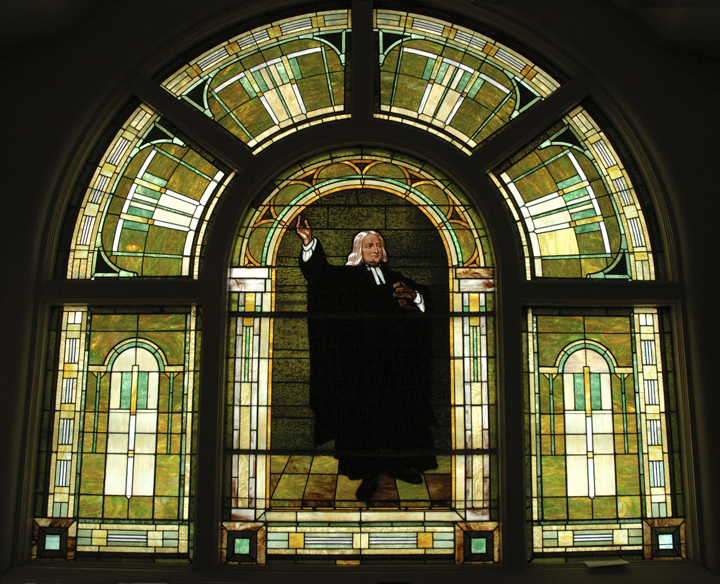
“What does it mean to use the Ancient-Future model of church in West LA?”17-85-BE3-134-08.0006-John Wesley

We come out of a United Methodist Church – which is a classic and beautiful expression of the Mainline tradition of Protestant Christianity.  The Loft is attempting to reclaim and hold onto the best of that inherited tradition … while at the same time engaging the culture around us in way that is contemporary and appropriate.
I’ll confess. It is a tricky section of water to navigate.

To use my favorite bowling analogy, there are gutters on each side that you want to avoid.
On the one side, you have a temptation to cater to the culture and concede so much of the Christian tradition that you have basically assimilated to the surrounding culture that you are nearly indistinguishable from it! This can happen in patterns of consumption, political views, sexuality, financial matters, or any other number of areas.

On the other side, you have the assumption that the inherited tradition, the given forms, are inherently relevant and effective in every place and in ever time since they were divinely delivered and historically proven. What this impulse to conserve leads to is reification of some previous era or expression of church that was culturally appropriate by which has since expired in its effectiveness in doing so. For a group whose gospel is, at its core, about incarnation … this is unacceptable.

This is why we think that the ‘Ancient-Future model’ of church is the best way forward for a young community.
Here is a short video about my recent experience with an old Apple TV that was given to me and why it triggered some thoughts about christian community for me.

Apple Updates and the Church from Bo Sanders on Vimeo.

In technology, when you fall enough behind on your updates, you can actually trap yourself with the inability to update. This is the definition of irrelevant. The christian spirituality that is employed in much of the North American church may be in this kind of danger. I am nervous that we are looking to get resources (updates) from sources (servers) that don’t exist anymore.

We are looking for solutions in things that don’t exist anymore.

The danger, for a religion that is at its core incarnation, is that the inability to be conversant with the surrounding culture in the epitome of irrelevance.

__________

Ancient-Future is a model that was popularized by Robert Webber before he changed his emphasis, focus and tone at the end of his life. His books on Faith, Worship, Evangelism and Time are supremely helpful and informative. 

My quoting him does not imply a wholesale endorsement of all of his works or thoughts. 

Religion and Consumerism’s Bricolage: in conversation with Philip Clayton

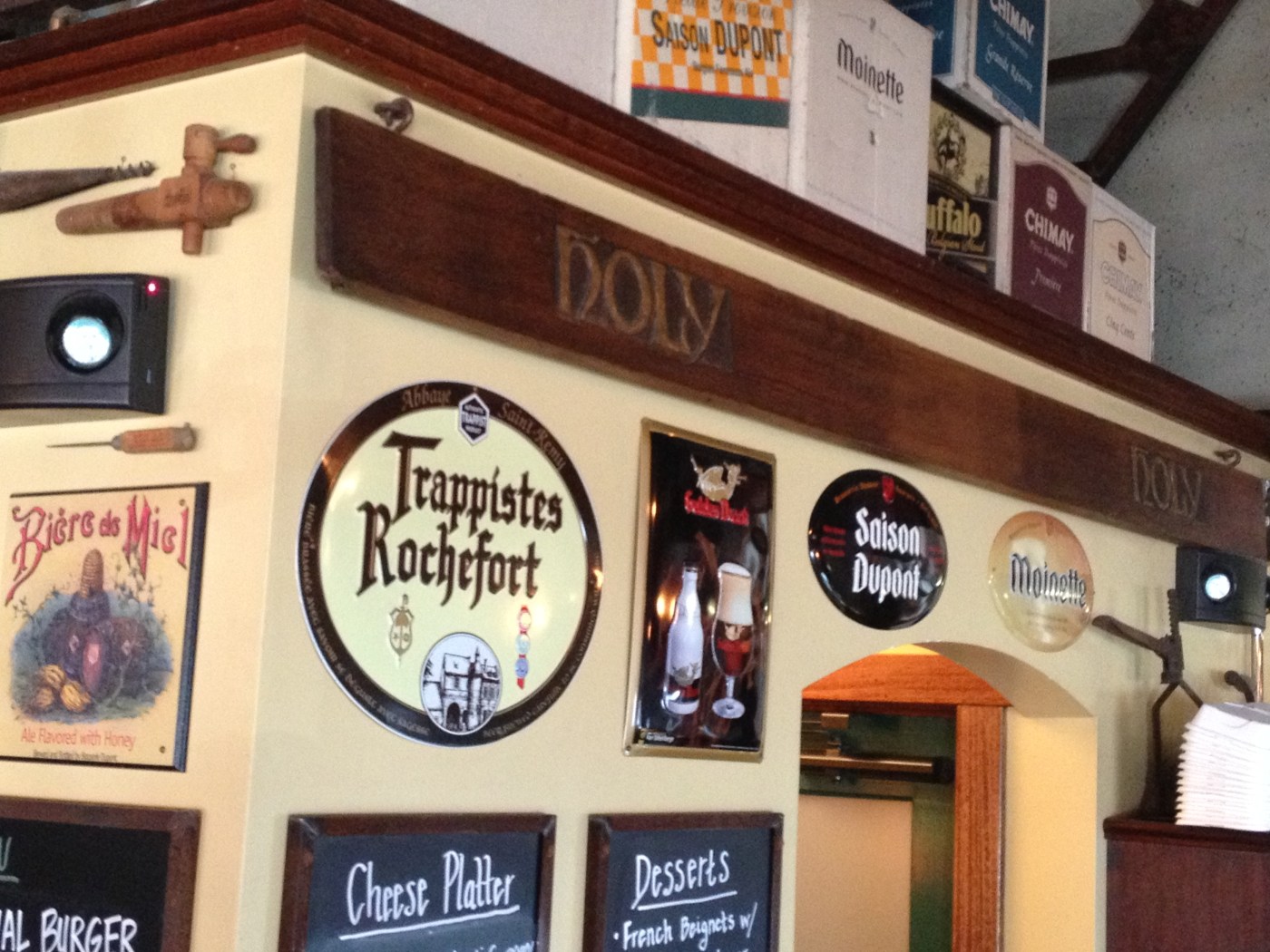
A couple of weeks ago I had a very interesting conversation with Philip Clayton. Several of us went out for lunch after the High Gravity session on Religion & Science. We were at a restaurant where the walls were decorated with a busy collection of reclaimed signs, old pictures and re-purposed trinkets.

Dr. Clayton was across the table from me and at one point I look up to notice that above his head was a sign that read ‘Holy’ on one side and ‘Holy’ at the other end. The words ‘Holy – Holy’ were framing either side of his head. IMG_2884

I tried to come up with something clever to say, scouring my memory for some passage from the Hebrew Bible or the book of Revelation to tweak. The window of opportunity closed because the conversation was quite intense. That morning the topic had been ‘Science & Religion’ and now we had expanded it to ‘Religion & Society’ – or more specifically to ‘Church & Culture’.

The conversation intensified and it became clear that neither Dr. Clayton nor Tripp was too happy with my cynical take on consumer mentalities when it comes to consuming religious experiences within a capitalist framework.

At one point I said “it is like that sign behind you: it’s not like the holy is absent from the space and all the activity that happening here – it’s just that it blends in and goes unnoticed in the midst of all the bricolage that it melts into.”

Somebody had reclaimed that wooden sign. There is a story behind it – there might have even been more to it (I wondered if it used to have a 3rd ‘Holy’ further down the line that had been lost).

But that is my point! In any gathering there are going to be those (like us at that table) who think that what is happening is legitimate, sincere, authentic, important and worth organizing your life around. The congregation is also going to be largely made up of those who are consuming a religious experience – and it is financially worth about the same amount as a movie, a meal, a game or a show.*

I will go even further: this is my great hesitation with those who want to ‘go back’ or ‘conserve’ with their religious participation. This impulse was never more evident to me than when I began interacting with those were into Radical Orthodoxy or with evangelicals who had converted to Eastern Orthodoxy or Catholicism. The ‘zeal of the convert’ can be a telling element when it comes to the anti-modern or counter-modern impulse.

An incongruity is exposed in the counter-modern impulse of these conserving movements. Never mind for a moment that often what is being conserved is born out of a patriarchal model – set that aside for a second.

I will attempt to make this in 4 succinct points:

  1. You do not live in the 14th or 16th century.
  2. You do not think like someone in a previous century.
  3. You do not engage in the rest of your week as someone in a previous century.
  4. You chose, as a consumer within a capitalist framework, to participate.

Those four things signal to me that even the most sincere, authentic, devout, and thorough engagement – whether a Pentecostal, Evangelical, Orthodox, Anglican, RO, Catholic, Mainline or Congregational expression – must account for the ubiquitous consumerism within which we all are saturated.

Dr. Clayton rightly said that I while I had a good point I was proceeding in far too cynical a manner with it. He is correct of course.

My aggressiveness is born out of a deep concern. What we say the church is about – what we believe the very gospel to be – is so vital and so needed in the world today, that we can not afford to ‘play pretend’ about previous centuries and blindly participate in consumerism all the while trumpeting the virtue of our chosen ecclesiastic community.**

The danger, in my opinion, is that religious communities will become nothing more than decorations on the corner of a neighborhood or one more option at the mall food-court. 

For christian believers, the holy is all round us. We can not afford for it to disappear among the bricolage nature of our hyper-advertised media-saturated existence.

The gospel, at its core, is incarnational. Our central story as Christians is flesh and blood in a neighborhood. The whole project is contextual – it only happens in a time and a place. We can never escape that. That is why romantic notions of past centuries or early manifestations can be dangerous distractions and fantastical facades.

We can’t afford to fade into the bricolage. IMG_2886


* plus it usually comes with free babysitting. 

** Some might object that they have not chosen but rather have ‘stayed’. I would argue that they did within the consumer’s capacity to do so. 

Religion in America Update: Spring 2013

Last week 3 interesting items came across my radar screen.

  1. A new CNN poll entitled “America losing its religion”
  2. A NYTimes op-ed called “Belief Is the Least Part of Faith” by an author who specializes on Evangelicals.
  3. A God Complex Radio interview with Cameron Trimble on the Future of Church Renewal.

Each of these three caught my attention for a different reason. I want to try to connect them here and then listen to what you have to say.

In the CNN poll, it turns out that:

“More than three in four of Americans say religion is losing its influence in the United States, according to a new survey, the highest such percentage in more than 40 years.”  One-Room Schoolhouse

There are two interesting parts to that opening sentence. The first is that it is only people ‘saying it’. It doesn’t meant that religion IS losing it’s influence – only that it feels that way to 3/4 of those surveyed. The second point is that 40 years ago it felt much that same way.

The article points out two other times in recent history that the percentage was very similar. Those periods were 1969-1970 and then again in 1991-1994.

In the NY Times op-ed piece, T. M. Luhrmann, attempts to clarify a common misconception by those who do not go to church about why people go to church. She is arguing that it is not because of belief – but rather that belief comes from action (going to church/living out your faith) for those who go to church.

As interesting as her stories and finding were, the part that really caught my attention (as one who comes from an Evangelical perspective) is that :

If you can sidestep the problem of belief — and the related politics, which can be so distracting — it is easier to see that the evangelical view of the world is full of joy. God is good. The world is good. Things will be good, even if they don’t seem good now. That’s what draws people to church. It is understandably hard for secular observers to sidestep the problem of belief. But it is worth appreciating that in belief is the reach for joy, and the reason many people go to church in the first place.

In the God Complex Radio interview with Rev. Cameron Trimble was great. She is the director of the center for progressive renewal and Derek asked her about the future of the church. She had fantastic answer that are best days are not behind us. This piqued my interest because of the CNN poll.

When I think about these three items together, I come to two conclusions:

A) IF the churches best days are not behind us, then WHAT the church is in the future will be very different – almost unrecognizable – from what we have been used to for the past couple of centuries.

B) The way that we engage media, use technology, train future leaders and use resources – especially buildings – is so important because of the reason that Luhrmann said in the NY Times piece that people are even going to church. Trimble also points out in the interview that the reason people even go to church at all has changed in the last 50 years.

I would love to hear your thoughts on these trends and ideas. 

Problem is that new Pope isn’t Protestant enough

It has been amazing to watch both the amount of reporting and the kind of reporting that  Pope Francis’ style has drawn. You can find stories about him in major magazines, on every news website … even the Daily Show gave some hilarious attention to the hype.

I was on an Australian radio show the day of his election – they liked the angle that I had taken on my blog focusing on the Southern hemisphere. [you can listen to the 4 minute clip at the bottom of this post at HBC] I was on after the Australian Ambassador from Argentina.

Some of my co-workers are Catholic and Pope Francis’ dealing provide us with every-other-day content for our coffee-pot conversations. Even my wife, who is generally not that interested in such things, is into it.

She asked me, on a recent road trip after several news stories, why I thought people were so into Francis.  I have three thoughts and would love to hear other’s thoughts.

  • There are still 1.6 Billion Catholics worldwide. That is 1/6 of everyone on the planet. Who is their leader matters a lot.

I know that not every Catholic listens to the Pope and that the Pope does not influence every thing … but it is still a big deal.

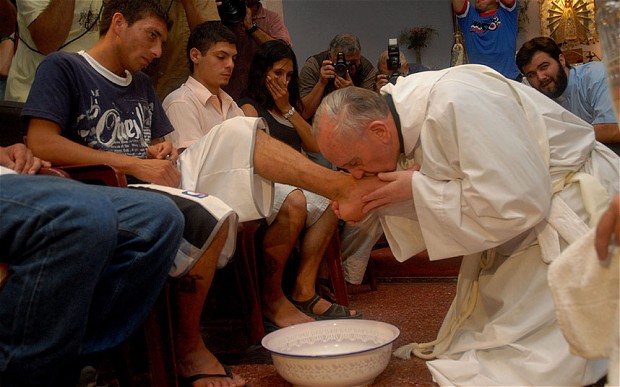
  • Between the elaborate displays of the Vatican and the global sex-abuse scandal – both of which are hard to figure out from reading the gospels – the Catholic church has been having a rough time of it in the court of public opinion.Pope-Holy-Thursday_2509139b

Francis’ style is not just a breath of fresh air – it is substantially different. What he did on Maundy Thursday was not just a ‘break with tradition’, as reports kept repeating, but was significant. Washing & kissing prisoner’s feet instead of priest’s is not window dressing

  •  Protestants seems to be fascinated with Pope-drama like Americans are fascinated with Royals. I don’t really get either.

It’s like we are enamored with the figure-head of the thing we left so long ago. I chalk it up to some sort of fetish thing for regal gowns, bejeweled crowns and antiquated (and sometimes secret) ceremonies.

There is one problem though. Protestants seem to want the Pope to be more protestant.

Almost all of the critique or concern I heard about him is something that would be more emblematic of protestant values or approaches. He is following the church’s traditional stance on (just to name 4):

  1. Contraception
  2. Celibacy
  3. Women in ministry
  4. Homosexuality

I want to holler at people when they are disappointed in this

“Of course he is – otherwise he wouldn’t have been elected Pope”.

It feels to me like somebody saying “I like the new Miss USA … I just wish she was built like a Linebacker in football.”   Well … I hate to break it to you but that’s not going to happen. In fact, people who are built to play linebackers don’t make it to the Miss USA pageant. That is just not what the judges are looking for.

What I wish we would instead focus on is his economic dealings, immigration issues (he is the son of immigrants) and out-reach to non-Europeans. I continue to claim that just those 3 will make this a game-changer.

I would love to hear your thoughts. 

Liberal Question part 3: Music and Whiteness

I think a lot about issues of race, gender and class. I read about it and talk it over with people every week. I am working my way through an expensive program in order to write my dissertation about it.  I care about matters of diversity and justice a great deal. mumford_and_sons

Ever since talking to my mentor, Randy Woodley at Wild Goose West last fall I have been thinking about this a little differently. Then with the happenings of the Emergent Christianity thing in Memphis … I thought I would bring out what I have been whittling away at in my workshop.
This is something I am working on and I would love your constructive feedback. 

The problem isn’t Brian McLaren speaking at a conference.
The problem is if everyone speaking at the conference looks like McLaren.

The problem isn’t reading a book by a white guy.
The problem is only reading books by white guys.*

The problem isn’t having a man speak up front at church.
The problem is if we only hear men speak from up front at church.


You don’t even listen to podcasts! 

Here is what I want to avoid. There was some grumbling on facebook when The Culture Cast was released and it turned out that both Jordan and Christian were white guys. Ironically, almost all the grumbling came from white guys – but that is a different issue.

One female friend said “where are the women podcasters?”

I suggested that since it was a concern of hers … why didn’t she tell us some recommendations.  Why is she asking a question?

She responded that she didn’t listen to podcasts.

I was stunned.

I asked “then why do you care? What difference would it make to you?”

It would be like me complaining their aren’t enough black NASCAR drivers. I don’t watch NASCAR. I don’t even know how many black drivers there are. That reality is irrelevant to my existence.

I think that we need to care deeply about things that we are invested in. There are too many issues that matter for too much for us to get tangled in controversies vicariously.


We don’t except tokens.

We need to be careful of tokenism. Let me be clear on this: if you are group of white people who have organized a conference, already have 10 white speakers lined up and then think ‘we need some color – let’s see if we can get Randy Woodley’ … that is token.  Randy got no say in the direction and organization nor had any power or influence. You just want to put a microphone in his face and have him do his schtick.

Token is an afterthought that serves primarily to help one feel good about being able to check off a box. If Randy was on the organizing committee – trust me the no conference would look the same.

In contrast to ‘token’ let me offer 3 examples:

  • Anthony Smith is an emergent voice and influence. He was in the movement before me and helped bring me in. That is not token. That is influence. Anthony Smith is influential.
  • When Tripp and I organized the Emergent Village Theological Conversation we said “Monica Coleman is our marquee speaker, our cornerstone, our prima donna.” And we did not do anything until she agreed to be our first round draft pick. She got session 1 to start the conference to set the tone and she got session 5 to end the conference so that she had the final word. We built the conference around that structure. We then invited others to come in around her.
  • When we inherited the Phoenix Big-Tent Christianity event many of the speakers were already in place. It was great to have Richard Rohr, Marcus Borg and Brian McLaren to boost ticket sales. But we wanted to highlight some voices that people had not heard a lot before. So, for instance, we structured the actual sessions that one of the ‘marquee’ voices was asking questions of one of the ‘emerging’ voices. For many people, that was the first time they had heard of Rachel Held-Evans. I will never forget watching her debate Marcus Borg about church folks understanding of creation!


I’m with the band. 

Here is my big point:
The problem isn’t that Mumford and Sons are all white guys. We have to look at the way that bands form. It makes sense that the guys of Mumford connect and play.

The problem is if every band on the radio is white guys.

The problem isn’t that Bono is a white guy or that U2 are all white guys.

The problem is if every band on a record label is a bunch of white guys.

We have to learn to distinguish between how a band come together and how the music industry functions.

We also need to do this for church … and for christian conferences.

No conference or podcast is or can be the full expression of the kingdom on earth. It is not nor can it be heaven. It is not supposed to be. Like no band can play every type of music …

I understand our desire for diversity – I just want us to manage our expectations. Our problem isn’t with Mumford and Sons, it’s with the music industry.

The answer isn’t “add a black guy”.  That is not how bands work.
Can you imagine somebody saying “why doesn’t Boys 2 Men have a women in it?” or “why doesn’t Destiny’s Child get Ricky Martin to join?”

The problem then isn’t with any church, podcast, organization, conference or person. Our concern is with how that all comes together in a less-diverse way than we would hope for and desperately need. 

The answer then is not to ‘add a women and stir’ or to ‘get some color’. That is what we call token – and it is insulting to everyone involved.

The need is to examine the bigger picture. This includes how things are planned, who makes decisions, and in what ways can people access resources.

Here is a timely example: Tripp and I are singers and songwriters. Our friends Callid Keefe-Perry and Steve Knight are as concerned about the impact of technology on the church as we are. We have talking about  it whenever we are together. We started this when we lived in 4 different parts of the country. Tomorrow, Steve Night is in town and we are going to record a podcast about the subject.

That is not a problem. We are Mumford, or U2, or The Stones, or the Beatles … we are just a band.
It is not a problem that we sing together – or in this case talk together. The problem comes if we are the only ones you hear.

Just to be clear: 1) I am using this an analogy. 2) I am using the music industry as a positive example.


___________________

*If you find yourself in this situation, here are some books suggestions

Quest for the Living God by Elizabeth Johnson

Christ the Key by Catherine Tanner

Teaching Community by bell hooks

Shalom and the Community of Creation by Randy Woodley

Many Colors or The Next Evangelicalism by Soong Chan-Rah

Triune Atonement: Christ’s Healing for Sinners, Victims, and the Whole Creation by Andrew Sung Park


Liberal Question part 2: Jesus Creed

I had the honor of guest blogging for Scot McKnight a couple of weeks ago. It was a good opportunity to try something out with a different crowd. It was  instigated by last weeks post in response to Roger Olsen and Scot McKnight.Facade of St. Vitus Cathedral

It was a fantastic conversation and I learned several things that I will take with me into future engagements. Here are some observations:

  • I learned to clarify the difference between people in the pew and theologians.

I go to a mainline school and work at a mainline church. I have an amalgamation in my mind of the ‘average liberal’.  But if you are in the conservative camp, your main engagement and concern is with Liberal theologians who have a high profile.

If was starting the post over, I would address this up front and make an early distinction. I think that would have helped.

  • I learned not to use the word ‘versus’ if you don’t mean adversarial.

Neither Scot nor I think liberal is necessarily  a bad thing. Roger Olsen does. But some of the readers at JesusCreed think in adversarial binaries. I was not trying to say that progressives are good and liberals are bad. I was simply trying to distinguish the two – not pit them against each other. The argument culture is so strong – especially in conservative circles – that I should have preempted that.

  •  I learned that those in systematic approaches struggle to recognize non-systematic approaches.

This is an obvious and inherent problem. If you value systematic approaches, of corse you will criticize something as ‘not systematic’ and think that stands alone are a critique. I was trying to point out that conservative, liberal, evangelical, emergent, and progressive are not 5 categories of the same thing. Some are positions. Some are loyalties. Some are approaches.

Here is what I ended up with: 

Since my Cobb quick-definition was not working for folks I thought I would ‘shift’ the emphasis and see if this language worked better:

Liberal – a constellation of loyalties inherited from the Enlightenment that is settled/assumed.

Progressive – an approach that integrates such influences as Feminist, Liberation and Post-Colonial critiques explicitly.

I’m open to help refining this – ESPECIALLY  if you are a self-proclaimed  liberal or progressive

My favorite response came from TJJ and it has me smiling ear to ear.

Qualities of a progressive ………as viewed by an evangelical……….

A. See more “grey” in their approach to scripture issues: inspiration, inerrancy, revelation.
B. Allow for more of a continuum on doctrinal/theological issues: hell, salvation, sin, depravity, exclusiveness of Gospel, etc.
C. More open ended on social issues : gay marriage, illegal immigration.
D. Trends more democratic/progressive politically
E. White, college degree and often more, affluent, alcohol, NPR, Toyota/Honda, MSNBC/CNN

Oh my. That is good.

At first read you may say “yeah – of course”.

But look at it again. It’s actually pretty helpful to see it all in one place.

I would love to hear your thoughts on any part of this whole episode. 

Blog at WordPress.com.

Up ↑