Search

Bo Sanders: Public Theology

updating & innovating for today

Category

Culture

Church & State are Married in a Civil Union

Originally published at HBC

A good questions can get to the heart of an issue – or expose the underlying assumptions that lie behind an issue.

I learned early on in ministry to ask a simple question about marriage: If I as an ordained minister perform a wedding ceremony for a couple, but they have not secured a license from the state, then when I say “Before God and all these witnesses – I pronounce that you are husband and wife. What God has joined together, let no one separate.” Are they married?

Overwhelmingly the answer is ‘no’. That they are not married until that paper is signed and it is legal.
So it is indeed that piece of paper that is marriage and not the Christian ceremony that we perform.

This actually happened to me one time. A young couple had secured the marriage license but in all the fun and frivolity of the reception and photos, they forgot to get the paper signed. They were just about to get on the Cruise ship when they realized the mistake!
No big deal, we got it taken care of. What was a big deal was the family’s reaction! What would have happened if they had consummated the union and they weren’t even married??? (legally).

If what we are doing is nothing more than a thin Christian veneer over a civil institution, then one has to wonder why we are also so concerned about who can get married – or even have civil unions – according to our biblical morality.

It seems that the Church wants it’s wedding cake and to eat it too.

But that is a second conversation. There is a different conversation that we need to have first. Like I said, I know hundreds of people who do not (because of what they claim is their christian conviction) support same-sex unions or homosexuality in general. I get that. But why does that then translate into legislating one’s religious belief into a legal morality imposed upon others?

My point is that there is a secondary mechanism involved. There is something else working behind the scenes.

We see this in legislating who can get married based on a reading of the Bible … but we also see it in the assumption of when someone is officially married: when the Christian minister declares it or when the State license is signed.

We try to have the second conversation without having the first and that is why we never get anywhere. Christians ask the question “should same sex unions be allowed” without first addressing “why are Christian ministers performing as agents of the State?

If the answer is what I suspect it is, then we may want to take the ‘separation of church & state’ verbiage down a notch and start thinking about how we are going to fund ministry if our tax-deductible status was not so convenient for people to ‘give’.

The same-sex union is a second conversation.
There is a conversation we should have first that no one seems too eager to entertain.

Limits in (religious) Language

I just finished my semester this past week and was going through my desktop cleaning up all the icons when I discovered this post and realized that I had put it up over here yet.
It was originally posted at HBC

I like reading Lindbeck.* I used to say that I love Lindbeck but I ran into two snags.

  1. I didn’t realize what people did with Lindbeck. I did not know that it often led to retreat into a neo-Catholic expression.
  2. There is some philosophical wrinkle that I don’t fully understand about why the language that creates our religious experience implies a one-way limitation of language -it is a bit technical for me but I wanted to acknowledge it because it eventually becomes a real sticking point.

Having said that …

What I am a big fan of is Lindbeck’s critique of Language. He has a riveting analysis of the way that religious language functions in our communities and personal experiences.  I was susceptible to liking Lindbeck because of my deep appreciation for Nancey Murphy’s book “Beyond Liberalism and Fundamentalism”. I was primed for what Lindbeck brings to the table.

To become religious–no less than to become culturally or linguistically competent–is to interiorize a set of skills by practice and training. One learns how to feel, act, and think in conformity with the religious tradition that is, in its inner structure, far richer and more subtle than can be explicitly articulated. The primary knowledge is not about the religion, nor is that the religion teaches such and such, but rather how to be religious in such and such ways. p. 35

Then I found out that saying you appreciate the Lindbeck’s (post-Liberal) approach is like saying you cheer for the New York Yankees in Boston. I understand the concern with the descendants of Lindbeck’s work … but I am still suspicious that he is right about how language works in our faith communities.

Fast Forward: I was reading some stuff to get ready for the 2012 Emergent Village Theological Conversation this past January and I stumbled onto a section of Whitehead’s thoughts on religious language.** I got to a section called “Doctrine and History”. After dealing with the fact that language does not have a one-to-one correlation and that all language thus requires interpretation, the author explains:

“The language of a tradition and the central doctrines that reflect and support that language are the prime turbulence of the particular mode of existence characterizing that tradition. Furthermore, as human existence is shaped in specialized ways during the course of history, experiences occur that are not possible to persons shaped by other traditions.”

I resonate with the idea that a person is shaped by the language one is groomed and conditioned by – and that would both empower and naturally shape the experiences that one has and the interpretation of those experiences … even (or especially) the religious experiences.

It just makes sense that because religious in a communal endeavor – one is always a part of a community that has a tradition and set of practices/beliefs – that it determines, at some level, both the types of experiences one has , can have and how one translates or interprets those experiences.

This is a vital assertion for the 21st century! We no longer live in the monopoly of Christendom or the frameworks of the Colonial Era where one tradition imported and imposed foreign expectations and alien interpretations on another.

With works like “The invention of world religions” by Tomoko Masuzawa and “God is not One” by Stephen Prothero (among many others) we are entering a time in world history (and thus church history) where we need to come to terms with two things that both Lindbeck and Whitehead are pointing out:

  • Language is both inherited and powerful in shaping our experiences and subsequent interpretations of those experiences.
  • Language used in doctrines like ‘the Church’ and ‘Eucharist’ actually facilitate the ability to have certain experiences that are simply not available to those outside the community or language game. Practices like Yoga or Ramadan would be the same for those in different traditions. That is why North American Christians who do yoga are not have the same experience as those in India.

We live in an era where the realities of inter-religious education, cross-denominational communication and trans-national citizenship are going to challenge all of our inherited traditions and conceptual frameworks.

If we are unwilling to do so and insist on simply repeating the same rote answers week after week under the misguided impression that we are being faithful to the tradition … we are in danger of an irrelevance that leads not only to extinction but ultimately failure to accomplish our great commission.

*George Lindbeck wrote “The Nature of Doctrine” and along with Hans Frei (author of “Eclipse of the Biblical Narrative”) is credited with starting the Yale School of thought. One of the most famous proponents of which is Stanley Hauerwas famous for his books like  “Peaceable Kingdom” as well as other things.

** Alfred North Whitehead was a 20th century philosopher who is credited for helping to come up with what became Process-Relational thought.

Four is greater than Two: Good Friday repentance

So often when I hear two groups arguing, I think to myself  “the problem isn’t what we think about this subject, it is how we are thinking about it.”  If you have read posts here for any time at all you will know that I am not a big fan of dualism in general. I invest great amounts of energy examining binaries and pulling apart overly simplistic dichotomies.

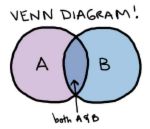
In the past I have utilized a Venn diagram to illuminate the overlap between two groups that are ‘given’ as the options. Lately, I have focused more on the 4th and 5th area.
So in American politics, when ‘republican’ and ‘democrat’ are given to me as opposites, you simply illustrate the overlapping values of the two (3rd space) and then point out those who are ‘neither’ (4th space) like Green folks and anarchists. Then draw a circle around the whole system and point out folks outside the system (5th space) like Canadians.

This semester my two classes are ‘Political Liberalism and It’s Critics’ and ‘Globalization’. It has given me lots of practice in picking up on patterns and thinking in different shaped categories.

Example 1: when a subject like ‘Norms’ is discussed – in sexual identity or sexual practices for instance – often a basic “for & against” structure is presented for any isolated topic. But as the discussion develops you can actually see that this is not a linear ‘far left – far right’ spectrum configuration – even if it is presented as such!

You quickly see that there are least 4 positions even ON a spectrum: if the far left position is “there are no norms” and the far right position is that norms are “intrinsic / originate outside the system” and implement themselves, you can imagine that a center-left position would be an emergent perspective (norms arise from below in the population and then ascend) and a center-right position of top-down Hierarchy where norms are seen to be passed down from the authorities. Recognizing those four positions facilitates a radically different conversation than just outlining two.

Example 2: when the subject is ‘Law’ or court rulings, we need to rise above elementary ‘agree’ and ‘disagree’ binaries.  There are actually 4 positions in practice.

  • Agree & Obey
  • Agree & Disobey
  • Disagree but Obey
  • Disagree and Disobey

It is essential to admit that in any population there will be great variety, disparity, and diversity – so we do a terrible disservice to the matter when we reduce the matter down to basic dichotomies.

The reason I bring this up is because I am very concerned about the round-and-round cul-de-sac conversations that I hear over and over again in the church. I am growing convince that as contemporary Christians, the issue is increasingly not what we think but how we think about it.

The issues of abortion, homosexuality, biblical inerrancy, the creeds/ orthodoxy, environmentalism, and women in ministry are just 6 examples of matters where the dualisms are killing us.

One of the best things that could happen this Good Friday would be for those who take the Christian story seriously to die to – not what we think – but how we think about it. My dream would be for a heart of repentance: to decide in our hearts to swear off inherited dualisms and pledge to, as a community, look for and develop better ways of framing the issues that matter to us most.

Challenge: This Friday, repent of either/or thinking and die to the dualism of us/them for/against right/wrong in/out thinking.  Ask your small group to hold you accountable and maybe even join you in a new life (Easter) of the mind.

disclaimer: some of you will finish this post and think ‘it was so remedial it was barely worth reading’ and others will think ‘that is crazy talk – you are either right (on God’s side) or you are plain wrong – there is no middle ground.’ But we have to start somewhere, and this is the world we live in.


Post-Contextuality : Evangelism and Missions must change

by Bo Sanders
posted at Ethnic Space

Contextual theology was the subject of my Master’s thesis.*  I was, and continue to be, enthralled with the possibility that the gospel could be uniquely expressed in every culture in a manner that was both authentic and indigenous to that group’s place and time. Lamin Sanneh goes so far as to say that it is the distinguishing characteristic of the Christian religion and that unlike Judaism, Islam, Hindu and Buddhist traditions there is no language, place, culture or time that is inherently superior for expressing the gospel.  In Whose Religion Is Christianity: the Gospel Beyond the West, he has it like this:

Being that the original scripture of the Christian movement, the New Testament Gospels are translated versions of the message of Jesus, and that means Christianity is a translated religion without a revealed language. The issue is not whether Christians translated their scriptures well or willingly, but that without translation there would be no Christianity or Christians. Translation is the church’s birthmark as well as its missionary benchmark: the church would be unrecognizable or unsustainable without it…  Since Jesus did not write or dictate the Gospels, his followers had little choice but to adopt a translated form of his message. (Sanneh p. 97)

When I wrote the thesis, I had yet to really encounter liberation or post-colonial thought in depth. My interest in contextualization arose from being a church-planter in a Missionary denomination. I did not realize at the outset of the project just how strong the critique contextual theology brought to classical (traditional) approaches. Since then I have engaged de-colonial, feminist, liberation, post-modern, and pluralistic voices that have even harsher critiques.

I keep circling back, however, to a much simpler concern: the practice of the church.

It is in this concern of practice that I have stumbled onto – and now stumble over – a haunting inconsistency between our thought and our practice.

The irony is thick. In my experience, those who are most excited about missions and evangelism are quite fond of the Bible. They often reference the Bible and even say things like “In the Bible” as a validation for doing something a certain way or “that’s unbiblical” as criticism of something.

Yet, never in the Bible do you see anyone intentionally learning another language in order to present the gospel. In the Bible, God repeatedly used dual-citizens and bi-lingual folks to get the message out. In the book of Acts we see three examples:

  • a miraculous bridging of the language barrier at Pentecost
  • the Ethiopian eunuch was a bi-lingual traveler who took something back to his ‘home’ in Africa
  • Saul/Paul was a dual-citizen who took the message to the Roman Empire

That, it seems to me, is the Biblical model for missions. (This is true whether or not one translates the Great Commission as the imperative “Go” or the more passive Greek rendering of “as you are going”. The precedent of Acts is the same.) The Biblical model is very different than the Colonial model we are so familiar with.

The past 5 centuries have had their effect – but now that the whole world is ‘mapped’ and ‘spoken for’, maybe its time to move away from the colonial obsession with conversion and trust the bilingual and dual-citizens among us to translate to and for their cultures. We would need to repent of our compulsion to import ourselves into foreign peoples or countries and then impose our cultural expectations on them.

In a global era it is time to stop importing and imposing our cultural entrapments into alien environments and presuming that we know what is best for them. There is enough migration, travel, immigration and cultural exchange that we can now trust God that this will happen in the right time and in the right way – without us taking matters into our own hands any longer and asking God to bless our efforts. The era of elaborate organizations for foreign missions needs to come to an end.** They are unbiblical – and I think they always have been – but now they are also inappropriate for our age.

 The move toward contextual theology helped me see that we have to move beyond contextualization in missions and evangelism. The Colonial era was an ugly one for the church and we need to move out its methods – not just for the word’s sake but because it undermines and  discredits the very message we are trying to convey through it.  

*different groups utilize different forms of contextualization – Catholics tend to call the process ‘inculturation’ for instance, others use a similar move called ‘indigenization’.

** I know dozens of missionaries and understand that they are passionate. I mean no harm to any one of these folks that I care so much about. I have delayed putting this out for more than a year out of my concern for their feelings.

God as She-He-They

Originally posted at Homebrewed Christianity as “She Who is Not”

Earlier this week I had a post about language and God talk that incorporated C.S. Lewis’ poem “A Footnote on All Prayers”.  Part of what came out of that was an exchange with J.W. about pronouns, the Bible, and Inspiration. I wanted to transfer some of that over here (I have edited it for clarity) in order to open up the conversation to more people.

J.W.: So, what does your god look like? And how is that look any different from Piper’s or Driscoll’s?

Me:
Thanks for asking! Actually there is quite a substantial difference. Let me point out just a couple of things to start:
A) I don’t believe that language about God is univocal (as I have said). SO we begin in humility understanding that all our words, metaphors and concepts are OUR best attempt.
B) I believe that langue (since it is not univocal) functions relationally. When Jesus uses ‘Father’ language, he is talking about the WAY in which relates to a father. Not that God’s ontological being is Father in an exacting and representative way. It is an expressive use of language. That is the nature of language.
C) The way that Scripture is expressed is historic. I believe that the Bible is Inspired by Holy Spirit. That means that Holy Spirit was at work in the authors and ultimately in those who collected and validated the canon. (I confess this by faith). Those authors were historically situated and particularly located. They expressed their thoughts in their best language in their best frameworks. We see that historical locatedness and account for it when we engage their writings.
D) Whether you call it ‘original sin’ (I don’t) or ‘human nature’ or (my favorite) relational brokeness and conflicting biological impulses … humans have a problem. We are not 100% whole. Something is wrong (we don’t even do the good we WANT to do). That means that in every epoch and era there are things in place that are not perfect. Those show up in scripture – since it is a snap shot of its environment. The Bible is fully human (and I believe fully divine in a Process sense) but it is not ABSENT of humanity. It is full of humanity.
So If you take just those 4 things in contrast to Piper and Driscoll, then my God talk is:

  • in Humility not certainty or pushy
  • Relational not static or exacting
  • Historical not trans-historic
  • Human not un-human

Does that help? SO that is my starting point. From there I diverge wildly from the other two.

J.W.
Well, first of all, thanks for a response.
Second, no offense, but you use an awful lot of words to not say too much. Or, to say the same thing over and over while denying that you are saying one thing, yet actually affirming another. Since I don’t have any real idea what you believe Piper and Driscoll believe, I still don’t know that you are painting a different god or not.
You start out saying that all expressions of God are only a best attempt, but then you claim to believe the inspiration of the Holy Spirit. So, which is it? Our best attempt, or Holy Spirit inspired? See the problem there. It’s either one or the other, can’t be both.
Certainly the Bible is written situationally. God could have inspired men to write it so it only made sense at one point in the entire course of time, or He could have inspired it so that it meant the same thing from beginning to end, from the beginning of time to the end of time. And written so that ordinary people could figure it out with a little help from His Holy Spirit. Which is what I believe. You seem to believe that only post-modern thought with a lot of help from certain philosophers can figure out this whole humility, relation, human thing. Sorry, way too many creeks have flowed over their banks throughout history for me to believe that only recently have we been smart enough to figure this whole mess out.
God (Holy Spirit) inspired the whole Bible. He could have very easily caused His writers to use words that wouldn’t mean anything to their (at the time, current) readers, but would only matter eons later. IF that is what He intended.
Again, you haven’t showed me anything but dichotomies, and nothing of substance that disproves anything Piper et al believe-which I still don’t know what you believe they believe.

Me:
1) I did use a lot of words, but it was to say quite a bit. Unfortunately it was not what you were looking for so you think I didn’t say much. I assure you that I say quite enough in my 300 words to get in a lot of trouble in many circles!
2) You are 100% wrong that “It’s either one or the other, can’t be both.” Inspiration is not the OVERriding of human intent – it is the filling UP and expanding of human intent. Inspiration does not make something inhuman. You are thinking of something else not inspiration. Then you accuse me of dichotomies? Weird. I am talking about a participatory-relational model that transcends either/or thinking. You must be confused.
3) Here is an example of the difference (which you apparently were not able to pick up on): It is equally a valid to call god She as it is to call god He. Because in the end, god is neither. Those are pronouns that stand in for their antecedent but which do not entirely explain god or contain god’s ontological reality. God did not give Christianity a masculine feel. We did. God is God that is beyond our biological categorizations and anatomical classification. God is not defined by those – we simply conceptualize God and these terms and portray those conceptions in our language.
This is the nature of language. It is symbolic – analogical – and metaphorical.  That does not mean that we are not saying anything when we talk about God. We are. It does not mean that there is no inspiration. There is. Those are not mutually exclusive.
To quote Elizabeth Johnson in She Who Is :

Words about God are cultural creatures, intwined with the mores and adventures of the faith community that uses them. As cultures shift, so too does the specificity of God-talk.

To call God She is just as accurate and as inaccurate as calling God ‘he’.


May your Kingdom Come … to an end

I might be done with kingdom language – not the dynamic of God’s power or God’s interaction with the world – just the word ‘kingdom’ and its imperial implications. It comes with too much baggage, it is so antiquated, and it is masculine in the way that is unhelpful.*
Here are three reasons that we have permission to move on if we were so inclined:

  • Jesus didn’t use the word.

It might seem simplistic but Jesus didn’t speak English and there is nothing magical about the English word ‘kingdom’. The New Testament uses the phrase Basileia Theou. Maybe we should just go back to that. We keep words like ‘koinonia’ and ‘selah’ in their original form so maybe we could just say when Jesus did and let it go untranslated. Then people would have to reconstruct what the concept means without importing all of their preconceived impressions.

  • The age of kings is over.

I can not believe the hysteria that occurred around the ‘royal wedding’ of Prince William to Kate Middleton – especially by Americans. Just the name the House of Commons makes me wince. I am so glad that the Age of Kings is over. Divine Right would be laughable to me … if I didn’t know how much sway it held for so long. Regardless, those days are over and maybe it is time to update our language about God’s ways as well.

  • The power of pronouns.

Even those who acknowledge that the nature of language is symbolic and metaphorical – even those who recognize that God language is not univocal – can get thrown off if one refers to God as ‘She’.  Even those who know that it is only a pronoun that functions as a place holder want to be careful about the antecedent to the pronoun.  This might be a limitation for a move toward a counter-Queendom, a more inclusive Kin-dom or a non-authoritarian Common/wealth.

There will be some obstacle to overcome.
Number one among them will that ‘it is in the Bible’. Let me say two things:
A) I love that it is in the Bible. It was powerful imagery for its day and it says something really important about God.
B) The authors of scripture conceptualized of God’s work in a way that was relevant to their time. Maybe we should as well.

Another problem I see is Christmas pageants. What will be do when we quote passages like Isaiah 9:7 which get translated into english as “His kingdom will have no end”. But I think it would be fine to have passages like this along side the shepherds and the manger (both are virtual artifacts of an agrarian society)  – as long as it was not our primary (or only) way of articulating and conceptualizing the work of God in the world.

One last thing to suggest: Jesus was in a context that was dominated by Empire. He positioned his vision and language in contrast/opposition to it. But is that our predominant contemporary element? I would suggest that in a venue of Global Capitalism  it may be more appropriate and powerful to speak of the Economy of God.

* I always have to clarify that as a man, I am not anti-masculine. I really like being a man – it’s just that only using masculine terms may have been helpful for clarity when Genesis 1-3 was written, it has become unclear and unhelpful. The hegemonic patriarchy of religious language is pitiful to hold onto and especially when it is done in a univocal way.

Language, God Talk, and Prayer

I never struggle to believe in God. I believe in the deep core of my being. I have faith in my bones. I breath this stuff. I am filled with Holy Spirit and that gives purpose to my day and direction to my life.  I never doubt the reality of the Christian faith … until I listen to a conservative like John Piper or Marc Driscoll talk. Then, it is all too apparent to me that we are (at least partially) projecting our greatest hopes and dreams onto the screen of the heavens. We are outsourcing our fears and evils onto a cosmic bad guy called the devil. We have created a galactic father figure in the sky (paging Dr. Freud).

It is so clear when Piper talks that it makes me want to retreat into the post-liberal work of George Lindbeck!  

Xenophanes is famed to have said:

“If oxen and horses and lions had hands and were able to draw with their hands and do the same things as men, horses would draw the shapes of gods to look like horses and oxen would draw them to look like oxen, and each would make the gods bodies have the same shape as they themselves had.”

It gets boiled down to “If horses had gods – they would look like horses.”

Most days I can stave that off. I can avoid the haunting suspicion and nagging doubt … but what Piper does is create a God in his own image – there is no other way to say it – it is idolatry.

So what? you may ask. Why even bother with it?  Because, I believe that there really is a God.

C.S. Lewis wrote a poem one time called “a footnote to all prayers” (it references Pheidias who was  a legendary statue maker in the ancient world)

Footnote to All Prayers
He whom I bow to only knows to whom I bow
When I attempt the ineffable Name, murmuring Thou,
And dream of Pheidian fancies and embrace in heart
Symbols (I know) which cannot be the thing Thou art.
Thus always, taken at their word, all prayers blaspheme
Worshipping with frail images a folk-lore dream,
And all men in their praying, self-deceived, address
The coinage of their own unquiet thoughts, unless
Thou in magnetic mercy to Thyself divert
Our arrows, aimed unskilfully, beyond desert;
And all men are idolators, crying unheard
To a deaf idol, if Thou take them at their word.
Take not, O Lord, our literal sense. Lord, in thy great
Unbroken speech our limping metaphor translate.

This is why we must acknowledge what it is we are doing when we pray, when we preach, and when we practice. We are doing the best we can with words, symbols, sounds and images. But if those images are solidified and codified past their point of original artistry, mysticism and metaphor – then it becomes something deadly to the soul and dangerous to the one seeking the real and living God revealed in Christ.

4 Locations for Theology in the 21st Century

originally posted at Homebrewed Christianity

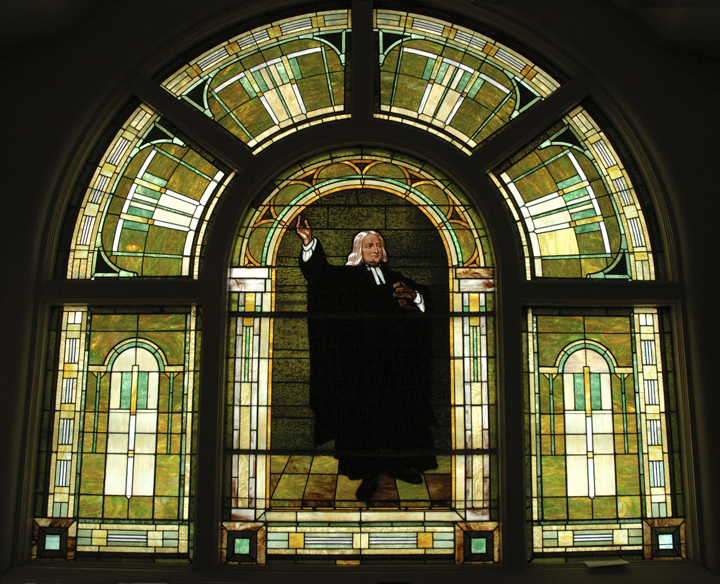
I come from a Methodist tradition that looks to John Wesley as its founder. Wesley utilized a famous quadrilateral to talk about how we do theology.
The four elements were Scripture, Tradition, Reason, and Experience.
I love the quad! I am a proud descendant of Wesley and I still find it quite helpful to utilize the same quad.  Here is why I find each element so valuable.

Scripture: No matter how fancy we want to get with our theology (I am looking at you Tillich) or whatever else we want to do (Griffin), it must account for the scriptural witness . I am not saying that we must always begin with scripture (like neo-Orthodox or Open folks) nor am I saying that we must only do scripture – but any 21st century theology must account for it. The Gutenberg and Missionary eras have reinforced a global importance and influence that must be acknowledged for any theology to carry weight. There is just no sense in having a theology that is not thoroughly scriptural if you want it to count widely.
Tradition: I grew up evangelical and developed a disdain for tradition. It was a bad word to me – like religion. It meant thoughtless, empty ritual done on autopilot in rote repetition. I see things a little differently now. Back then, I actually thought that we were free to do whatever we wanted as long as it was meaningful and effective for accomplishing the goal – which was to bring people into a deeper relationship with the living God. Now, I understand that we are all socially conditioned into elaborate human constructions. These constructs (like language or religion) are part and parcel of both the communal/social order and the religious tradition. Tradition and community must be recognized and honored since all theology is contextual theology.
Reason: I loved quoting Colossians 2:8 when I was an evangelist and someone would ask me a better question than I had an answer to
See to it that no one takes you captive through hollow and deceptive philosophy, which depends on human tradition and the elemental spiritual forces[a] of this world rather than on Christ.
It was the deceptive word play that depended on human thinking that was so dangerous to my Josh McDowell faith. I had evidence that demanded a verdict and you had tricky mental gymnastics and endless questions. I had never heard of Neoplatonism and why did I need to? I had Paul and the Epistle to the Hebrews! … Which is to say that I had never encountered the philosophical underpinnings of the New Testament writers nor of my Protestant declarations of faith.
Experience: I know that part of my fascination comes my charistmatic-evangelical roots. I know that part of it is my American protestant upbringing and that it is reinforced by my personality. But I find it on the pages of the New Testament, and I am simply uninterested a religion that is all in the head and not in the heart. I want a full body religious experience. Nice words are fine (and OH how I love nice words) but we have to walk the walk (as they say) and not just talk the talk. Theology must be validated by the community’s experience.  

I always attempt to frame things in the positive. In this case, I will also attempt to reinforce the need for all four by allowing myself to state them in the negative as well.
 Scripture: I am not interested in a Christianity that does not engage scripture or does not seek to be faithful to those initial witnesses.  We can update, renovate, adapt, evolve and reinterpret … but we must always interact with scripture. It is  scripture that we update and reinterpret.
Tradition: Let me say first that I  loath tradition for tradition’s sake. It makes be somewhere between vomitous and irate – which is not pretty. But in our global context you can’t just ‘do theology’ as if it were in a vacuum or you were starting from scratch. We are not starting with a blank slate!  I did not write the Bible, I am not the first to read the Bible – it was handed to me, was given to me and it is that ‘givenness’ that must be absorbed.
 Reason: who wants a faith the un-reasonable? Not me.  Plenty of other people do. In fact, this is really in vogue right now. Lots of conservative folks are retreating into their orthodoxy silo and playing their own isolated word games. That is a theological dead-end for the faith. It is a desperate remnant of Christendom monopoly and wholly counter to the very impetuous of the gospel they so proudly claim to defend.
 Experience: I am as uninterested in a theology that is not experienced as I am in a faith that is unreasonable.

I have been reading a lot of theology lately in preparation for the 2012 Emergent Theological Conversation. Much of it has been philosophical 20th century theology, some of it has been early century and reformation era. At the end of the day, I keep coming back to the Wesleyan quadrilateral as a framework that works for the inter-active, cross-cultural, multi-voiced engagement of the 21st century.

Cut it out with the whole ‘Curse’ business

My posts on Tim Tebow and Pat Robertson were so well received I thought I would  comment on one more incident this week.

You may have heard that another football player made non-sports headlines this week when he admitted that he now believes in curses.  You can read the story of Payton Hillis here.  You see, it is believed whichever player makes the cover of the Madden Football Video game each year can expect trouble in the season that follows and may see his career take a turn for the worse.
There is a similar curse for the magazine Sports Illustrated cover. I have seen that pattern happen over and over in past years.

I want to suggest here that we leave behind the idea of curses and all that associated hokus-pokus.

Before I do that – let me clarify two things:

  • You can curse somebody by saying hurtful things about them. Words effect both the speaker and the the hearer. Not guarding one’s tongue can be a curse.
  • You can curse someone by gossiping about them and crippling their chances with other people.

If we want to use ‘curse’ in a symbolic-poetic way … that would be one thing. But if we think that it has a literal correspondence to actual (ontological) reality then:
What I am saying is that this idea of somebody being cursed or being under a curse is so medieval, antiquated, and superstitious that it is somewhere between folk-religion and hogwash.

Now you may be asking yourself “Why does he get so upset about this stuff? Why does he even care? Why does he bother taking this on? Why not just let it go?”

It turns out that there is a really good explanation!

  1. I have been told that I had a curse.
  2. I regularly have to council people pastorally who have been told that they are under a curse.

It is hurtful and superstitious and I want to shout “How do you think that universe works? Really!”   Do you think that I could be plagued today because somebody who I may or may not know said something into the air that I may or may not be present for and it limits my life?” I have spent hours & hours late into the night praying to break curses – trying to discern in prayer who & where the curse came through in order to overturn its power at the origin.

Over the past 20 years I have been told so many times by people who are into Spiritual Warfare and Intercessory Prayer that “witches go through the phonebook and pray against pastors by name and put curses on churches” as an explanation for everything from pastoral adultery to drops in attendance.  Continue reading “Cut it out with the whole ‘Curse’ business”

Create a free website or blog at WordPress.com.

Up ↑