Search

Bo Sanders: Public Theology

updating & innovating for today

Category

Evangelical

What I Learned (Evangelicals)

A couple of weeks ago I shared what I had learned about Social Media and about Education in the past 2 years. I was scheduled to post this reflection about Evangelicals when a big story broke about a famous pastor and I decided to see what became of it before I waded in.

Yesterday there was a terrifying comic in the Sunday papers that compelled me to finally publish this reflection.


In 2016, I got an amazing opportunity to move back to Portland (from LA) and take an appointment as Visiting Professor of Theology at the seminary I had graduated from in 2010. I also taught a week-long intensive at the seminary in NY that is a part of my former denomination. I preached at Evangelical churches in 3 states and attended numerous churches. It was quite a year.

I was born and raised Evangelical. I was trained and ordained Evangelical. I love Evangelicals and I talk weekly to Evangelical pastors around the country. While my faith journey has emerged into quite a different expression, I am still conversant with and sympathetic to my former-tribe.

Here are some observations for your consideration:

  • They are really into the Bible.
  • They use coded language.
  • LGBTQ issues both terrify and annoy them.
  • Membership is a moving target.
  • They focus on the Supreme Court.
  • They can smell danger.
  • They don’t get Critical Theory.
  • They struggle with Identity Politics.


Evangelicals are really into the Bible. If you are not a part of this tribe then you may not realize just HOW into the Bible Evangelicals are. It’s not just that they like quoting the Bible, the actually think in the Bible. There is a joke that ‘versification is verification’ – which basically means that if you can put a Bible verse behind a point (Romans 12:1-2) that will validate it.

I’m not sure that non-evangelicals understand HOW big a deal the Bible is inside the Evangelical sub-culture. If you don’t give this point its proper weight, you might not understand much of what else follows.

[Side note: I prefer the Wesleyan Quad which has scripture first but not alone. Prima scriptura not Sola scriptura. That is followed by Tradition, Reason, and Experience in that order.]


Evangelicals use coded language. Due to its nature as a bounded set, evangelism can use words and phrases as a sort of short-hand or insider linguistic. I noticed it back when I was an insider but it became quite obvious that I had been out of it for 6 years.

It can be little things like “I just feel like God said …” to vouching for someone who “loves the Lord”.  It can also be big things that require a double-coding. It turns out that ‘liberal’ is really a code for not believing in ‘biblical authority’ which is actually code for being open and affirming of LGBTQ issues.


LGBTQ issues both terrify and annoy Evangelicals. I cannot overstate how many conversations I had about same-sex marriage and LGBTQ issues. It is a massive deal in every corner of Evangelicalism.

Homosexuality terrifies them because they want to be seen as loving but the way that they read the Bible makes them seem hateful (quoting here – not my words). I can’t tell you how many members and pastors of Evangelical churches I heard say either “we want to be open but not affirming” or “I just wish this wasn’t such a big issue – it comes up all time but I just want to preach the gospel and not talk about this. Sexuality is just one aspect of our life that has gotten blown out of proportion and is now the biggest or ONLY thing people want to talk about.”


[Side note: I too find it sad that this is such a big issue to my Evangelical friends. It is really not that hard to read the Bible in a way that is inclusive and open. I figured out how to be open and affirming even as an Evangelical. If anyone wants it, email AnEverydayTheology@gmail.com and I will send you the essay ‘An Evangelical Defense of Same-Sex Marriage’.]


Membership is a moving target. Very few people can tell me what it means to be an Evangelical. There is no sure litmus test or doctrinal statement. There is very little agreement. Evangelical academics try to utilize Bebbington’s (historic & British) definition but it does not fit the American context nor the 21st century. Somebody quipped that it basically means that you liked Billy Graham.

Here is the danger that most people are missing though! Evangelicalism is not a process – it is a conclusion. Unlike Presbyterians who can say ‘I am Presbyterian and I disagree about this XYZ’ … Evangelicalism IS the agreement.

It would be like saying, “I am a New Yorker who lives in Oregon” and New Yorkers saying, “then you are not a New Yorker”. You try to defend yourself by saying, “I was raised in NY, it is in my blood, I have the accent, I carry all the values … I just migrated to Oregon.” Nope. That is not how membership works. You can’t say “I am an Evangelical who just believes XYZ…” without being told, “then you are not Evangelical”. Membership is about territory and current residency.


Evangelicals focus on the Supreme Court. I was teaching during the election year. Thank God I was not on social media that year. One thing I constantly have to convince my non-evangelical friends is that most Evangelicals don’t actually support this man in the Oval Office and his terrible behavior … he is just a means to an end.

The Supreme Court is the end game. Many Evangelicals are nearly blind in their obsession with it. You have to understand: in their mind, they are just 1 judicial appointment from a 40-year plan to overturn Roe v. Wade. This is all about Supreme Court Justices. This is why when non-evangelicals pull their hair out and yell about his immoral behavior and hypocrisy of the Religious Right … they are screaming at the wind. That punch will never land – you are swinging at shadows. There is no there-there. You have missed the bigger end game.

You don’t have to agree with me but I hope that you believe me. It has nothing to do with the President. Politics are corrupt anyway. This is about something much deeper. I talk to my friends who voted for him and this is about the Supreme Court.

Evangelicals can smell danger. When I spoke of ‘coded language’ above, I noticed an interesting inverse as well. It is not just what you say .. but more what you don’t say. Look, I don’t listen to Christian radio or shop at Christian bookstores. I don’t go to churches where we sing Hillsong and Matt Redmond worship choruses … and it shows.

I am not exactly sure how it is so obvious that I am progressive but I might as well be a smoker who thinks that spraying cologne on will cover the smell. I stink. I was on my best behavior – I wanted a full-time position. I watched what I said at every encounter. I bit my lip when I needed to … but there was a glaring absence in the sort of things that were missing.

It’s not that I did anything wrong  per se …  If you have never been in an isolated community or closed environment then you may not know what I am talking about.

The phrase ‘guilty by association’ or ‘your reputation proceeding you’ comes to mind. The reason I include this point is that, of course, they were right. I just don’t know how they knew they were right. Like garlic leaking out of my pores … I smelled liberal.


Evangelicals don’t get Critical Theory. Systemic analysis is not built in to Evangelical thought. In fact, because they are so focused on personal piety and individual experience, systemic issues are often outside their scope of concern.

Admittedly, Critical Theory is rooted in some pretty secular and post-modern philosophies. Since Evangelicals think in the Bible (see earlier) they are grounded in a religious language-game and pre-modern worldview that seems incompatible (to them) with systemic analysis. Evangelicals prioritize personal sin and issues of the heart. They have not developed tools to explore the thing-behind-the-thing that Critical Theory is based on.

I only bring this up because …

Evangelicals struggle with Identity Politics. I did my PhD course-work at a school that has been addressing issues of race, gender, class, and sexuality for over 40 years. It is baked into the very essence of the place. It saturates every aspect of the institution.

For Evangelicals, it is a recent add-on that is causing some compatibility problems. For a group that is in the midst of figuring out women-in-ministry, colonial missions, capitalist prosperity and disparity, personal responsibility, and marriage roles … adding racial diversity to the mix can seem overwhelming (at worst) and clumsy (at best).  How do you add gender and racial diversity without it being tokenism and at the same time ensure that you come to the previous historical conclusions that determine membership and belonging?


Those are my reflections. I would to hear your thoughts, questions, and concerns. I know that this is a rough season for Evangelicalism but I am hoping for a fruitful conversation about a group of people I love very much but no longer camp with. I am like the brother who comes home from journeys abroad with trinkets and treasures.

Z is for Zebra (understanding our opponents)

There is a great danger – especially in 2018 – of not understanding the thought and convictions of those you disagree with.

I was taught to refute evolution. From 5th grade Sunday School, through youth group to Bible college and into my early years of ministry. It was a cornerstone to evangelical apologetics.

I did not understand evolution well, I only learned how to combat it.

Zebras and their stripes were a popular example used to refute evolution (along with the human eye and other things). If the stripes are for camouflaging a herd of zebras from

predators … then the first striped offspring would have actually stood out from the heard and thus been an easy target.

This is an example of getting ahead of oneself without fully entering into the school of thought one is trying to combat.
We saw this same problem with Ray Comfort and Kirk Cameron’s banana conversation [watch the video here: https://www.youtube.com/watch?v=YfucpGCm5hY].

You can’t simply start with where we are and extrapolate backwards from there.

You have to understand the primary concern:
• Science has a commitment to the process.
• Apologetics has a conviction of the conclusions.

We can’t pretend to honestly engage in asking questions if we begin with the assumption of the answers. That will always result in coming out with twisted conclusions.

Admittedly, scientists have been baffled over the zebra’s stripes for a long time. Recently some strong studies1 has have shown that the stripes are not about camouflaging herds from large predators but about flies. {Link here}

The region where zebras dwell has a breed of flies called tsetse that are legendary in their viciousness. Scientists have historically known that flies have an aversion to landing on striped surfaces. The zebra’s striped pattern acts then as a natural deterrent. This leads to greater health with less blood loss and therefore greater vitality which benefits reproduction – passing on those key genetics to offspring.

It turns out that zebras stripes are not about herds camouflaging from large predators but about individuals deterring small pests.


This means that the initial zebra ancestor to have that genetic variation would have benefited and thus that attribute would be more likely to be passed on to the next generation.

The apologetics argument I learned is flawed and would not refute the point it is intended to.

That is the first problem with not fully entering into an idea well enough to understand it – there has to be a commitment to the question not just a conviction about the conclusion.

The second problem is that much of the suspicion from creationists about evolutionary thought is based on the hard and cold version of survival of the fittest from a century ago. Many don’t know of newer strains of evolutionary thought that incorporate cooperation, mutuality, and emergence thought (see O is for Open & Relational).

Evolution has evolved in the past 30 years but many creation apologists prefer to takes pot-shots at the straw man caricature of Darwinian schools of the past. They have perfected taking swings at shadows of where the theory used to stand.

As we wrap up the ABC’s series, I wanted to acknowledge that not only has Christian belief evolved and adapted over the centuries but to encourage you to embrace these historic adjustments.

The gospel is itself incarnational and the universe is evolutionary. Those two things go together beautifully. The gospel is good news and is constantly in need to be contextualized to new times and new places. The scriptures are inherently translatable and come into every language and culture. This is one of the unique aspects of the christian religion (K is for Kenosis).

If evolution is true of the universe, Christians should have no need

to avoid or refute it. We can embrace evolutionary thought wholeheartedly.

Christians should, after all, be people who love truth.

If we want to contest certain aspects of the evolutionary theory, we should at least understand its claims thoroughly so that we can do that well.

____________

This is the final week of the ABC series for Sunday School. See preview here

Billy Graham: Case Study

Graham’s life show us so much about the changes in our society and the church: from newspapers, TV, civil rights, evangelicals, politics, media, and so much more.

I was moving into my new office and purging some old files. I found a magazine (Promise Keepers) from 1997 that had Graham on the cover.

Here are some of my thoughts in this short video.


I would love to hear your thoughts, questions, and concerns.

Where would energy go?

If same-sex marriage, evolution, end-times, and biblical inerrancy were settled issue – where would your energy go?

I have been thinking about this question for the past year as I returned to an evangelical context from 7 years away. For 7 years I attended a mainline (inter-religious) school and worked at a mainline (liberal) church.

I was struck upon my return to evangelicalism at the amount of energy that goes to LGBTQ discussions, defending creation and biblical authority, and end-times prophecy.

I kept thinking:

“imagine all the good that could be done if our energy didn’t go to this”.

So it has been eye-opening to be appointed to a church this summer where our energy doesn’t go to those issues – it turns out that my suspicion was right! An amazing amount of good does get done when your energy is not being sapped by those controversies.

Those controversies are exhausting and they occupy a disproportionate amount of mental and relational energy for evangelicals.

I sort of get why so many evangelical, charismatic, fundamentalist, and pentecostal  young people walk away from the church in their late teens and early 20’s. I get why so many people are now claiming to be ‘nones’ and ‘dones’. If you were raised conservative and then you settled those issues, your faith might seem spent.

I am in the midst of developing a thing for folks who are thinking about faith again as an adult but who want to begin again with those issues off the table. What would faith look like if those 4 variables were changed to givens? Where would your energy go?

I would love to hear from you:

Where would your energy go?
or if you have settled those issue, what has your energy gone to instead?

Evangelical and Liberal

I have stumbled into the most fascinating conversation.

Background: I work at an evangelical institution. I recently worked at a liberal mainline church while attending a liberal mainline school. I was raised evangelical and am ordained as an evangelical. It was interesting being in a mainline context for 7 years and it is equally as interesting to return to an evangelical context now.

I was talking about this with a colleague two weeks ago because a group that I am a part of is planning to simply its name but it will no longer contain with word ‘evangelical’. This decision was made before the recent US election in which 81% of white evangelicals voted for Trump. The group is afraid that this decision will now appear to be a reactive move.

I find three unspoken things going on in this discussion. Unspoken things are concerning because the assumed is unexamined and is often a source of operative power at a secondary register which hides behind the primary concerns.

Here are my 3 concerns:

  • ‘Evangelical’ has become a floating or migrating signifier. It does not mean what it used to mean and most people who use the term cannot tell you what it means. (Personally, I use an expanded version of Bebbington’s fourfold definition.)
  • The dominant boogeyman for evangelicals is being ‘liberal’ – another term which most cannot define, which has caused it to become a code-word and a boundary-marker. Liberal, to evangelicals, seems to be a place-holder and a sort of dog-whistle for being open and accepting. Using the label this way has resulted in the word operating as a master signifier.
  • Evangelicalism in the Pacific NW (where I recently returned to) is a unique type of evangelicalism which is highly visible and influential but which functions on a narrative whereby they are a minority who get the short end of the stick socially, politically, and culturally.

I find this stuff fascinating. As someone who has lived all over N. America, who has evangelical cred (I went to the Billy Graham school of evangelism for crying out loud), who has worked and studied with liberal mainline folks, and who is a committed social constructivist … I feel like I am in the vortex of a cultural and historic moment. I have friends in both camps and am comfortable in both conversations, but this is an eye-opening moment for both.


I was doing some research last week on a different issue and stumbled into a conversation from 2008 that is growing increasingly relevant. It centers around the work of University of Washington professor James K. Wellman in “Evangelical vs. Liberal: The Clash of Christian Cultures in the Pacific Northwest”.

A review in the Seattle Times by Bob Simmons starts this way:

“The “evangelicals” of James K. Wellman Jr.’s new book know there’s only one way to God, and it’s their way. The “liberals” know there’s more than one way and are still questioning theirs. By numerical and other earthly measures, the evangelicals are winning big in the Pacific Northwest. The only question is your definition of winning.”

The research is amazing. It shows that evangelical churches are larger by a 10-1 margin and are growing at an incredible rate. However … they often feel marginalized politically, oppressed culturally, and even victimized by public policy.

This is exactly what I had been telling my colleague! I have never lived in a place that felt more christian-y with so many Christian radio stations, Christian book stores, and large churches surrounded by asphalt lakes/moats (which I call a island/castle mentality) … all the while feeling that they are losing the culture war!

It is sad because the evangelicals are doing a tremendous job in so many ways. They really should be enjoying this kind of success. As Wellman writes:

“Evangelicals have an ideology that is centered on growth, and is in relation to the self, to God, to the family, the church, and the mission of the religion. Evangelicals have accommodated styles of group work that appeal to northwesterners because they activate a sense of belonging and moral accountability.”

A different article points out that, “while liberals sermonize about the importance of building a religious community, the evangelicals are living out community”, supporting financially, relationally, and spiritually.

What I am finding in these conversations has been complex and multi-layered. It turns out that when liberals talk about evangelicals, they are often commenting on two aspects: worship style (happy clappy) and politics (by which they mean women in ministry and LGBT support). Evangelicals in a similar way, use the moniker ‘liberal’ as a kind of a double-code. The first layer is supporting/accepting the LGBT community – and here is where it gets tricky – which is actually a metonym for “biblical authority”. In this sense, neither group is exactly representing the focus of the other group accurately.

I have so many thoughts that I am sure that this will be an ongoing theme for me in 2017.

One final note – you may be aware that I have developed an interpretive scheme for a potential book on the church that looks at how N. American churches relate to the ‘system’ or the ways things are. Churches fall into 3 primary categories: Prophetic, Therapeutic, or Messianic.

  • Prophetic churches critique the ‘as is’ structures to confront the system. Prophetic churches look toward the marginalized and those being run over by the machine.
  • Therapeutic churches help folks exist within the system. ‘Chaplains to the Empire’ as we say. Therapeutic churches work within the ‘ways things are’ to help make you a better version of yourself.
  • Messianic churches focus on helping one survive until God delivers us from the system. This can be rapture, evacuation, eschatological, etc.  Messianic churches often have animosity toward culture’s slippery slope ‘slouch toward Gomorrah’ and view change as resistance. Anything else is just ‘rearranging deck chairs on the Titanic’.

I reference that quickly (there is a whole book chapter that fleshes it out) in order to say that I found an amazing quote in another review.

For liberals and evangelicals, Jesus is the central focus, “but in the case of liberals, Jesus is the focus that offers compassion and hospitality to the world; in the case of evangelicals, Jesus is a source that saves them from the world by creating a new one to come” (p. 268).

I would love to hear your thoughts, concerns, or questions.

Barna and the Burned Over Region

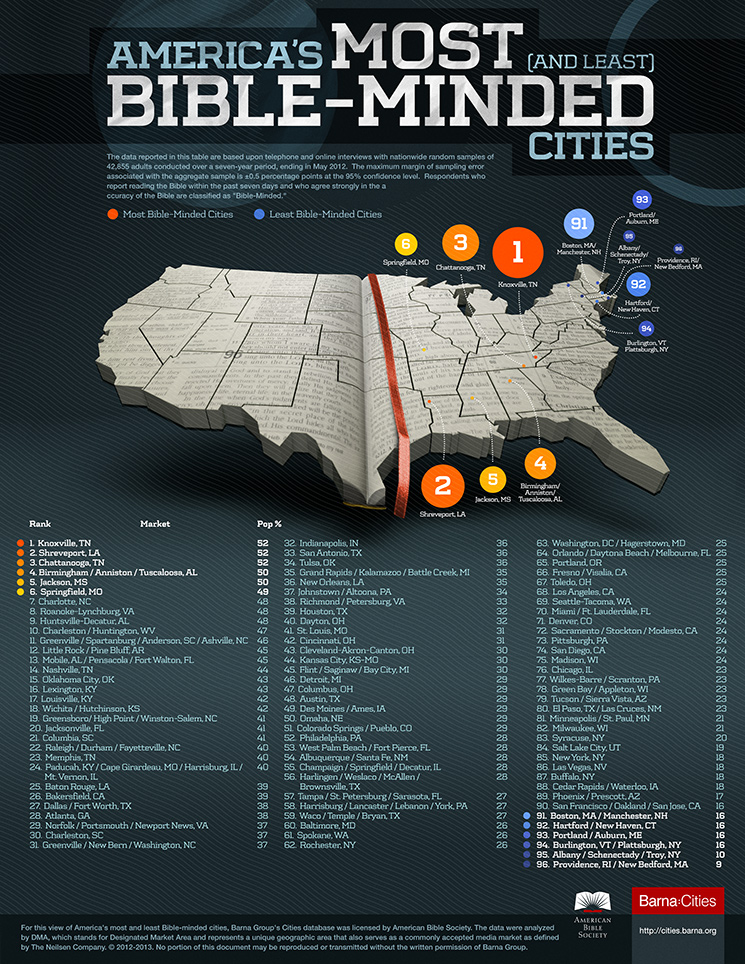
Barna Research put out a fascinating list of America’s Top 100 most ‘Bible-Minded Cities’.  Its not the top 10 Bible cities but the bottom 10 that are so telling! barna_biblemindedcities_preview1

The bottom 10 are:

  • Boston, Mass
  • Manchester, NH
  • Hartford/ New Haven, CT
  • Portland/Auburn, ME
  • Burlington,VT
  • Plattsburgh, NY
  • Albany/Schenectady/Troy, NY
  • Providence, RI
  • New Bedford, MA

It really caught my attention for 3 main reasons.

1. When I was in college I was an evangelist and Barna was our go-to source

2. During that time a common mantra in my circles was that ‘the Pacific-NorthWest is the most unchurched are in North America.’

3. After college I went to help plant a church in upstate NY (near the VT border) and grew suspicious about that Pacific NW thing.

I had spent time in the Pacific NW and while there were lots of unchurched people … there were also tons of churches – but specifically big churches aggressively engaged in the culture wars.

In the New England (or NorthEast) region, it was different. There was a cynicism is had not seen. Not a coffee shop atheism like the west. I deep suspicion unlike I had encountered.

 This came to a head for me when two roads converged. 

Ingredient 1: I was charismatic and had bought into a thing call “Re-digging the Wells of Revival” where you go to places where God has worked in the past and, through prayer, you try to unplug that ancient well of what God wants to do to release the anointing that once flowed.

I lived in area that had seen large revivals in the late 1800’s and early 1900’s. In fact, the denomination I was a part of was founded in the region and still had some of the revival tabernacles as properties! I would go to the  one closest to my house (Round Lake, NY) and pray for revival to sweep our area again.

I even started doing historical research. I stumbled into something. It was called ‘the Burned Over region’. It turns out that the much celebrated  revival had burned through so fast and so hot that when it was over … a cynicism had set into many people. Families that had given large amounts of time, sums of money and even family jewelry collections grew bitter.

A problem developed for me. The circles I was running in were celebrating the 2nd Great Awakening and other historical renewals of the church. I was growing suspicious and that altered my prayers.  I stopped praying for the same kind of revival we say 100 years ago and started praying for a different kind that didn’t leave generations of families bitter and broke.

 Ingredient 2: I went to a Barna Conference in western NY (Syracuse or Rochester area).  I sat there the whole time shaking my head as Mr. Barna presented to a packed massive auditorium. The finding that he was presenting were not exactly true of my area.

I had read a book by that point called “The Nine Nations of North America” and had begun to concoct a theory that merged (for churches) the New England of Nine Nations and my findings in Burned Over research. When you put those two together it really explained a lot.

 I kept saying to myself, “Even NY is different east of the Hudson river. From Albany east NY is more like New England than like Western NY and Pennsylvania”.

After Barna’s presentation I voiced my suspicion and that was not greeted well by my denominational cohort I was attending with.

I even brought up the Pacific NW thing and how out there you can hear 3 big christian radio stations and find a christian bookstore every couple of miles. We had neither.

The Pacific NW had mega-churches. We had one church over 1,000 and people in our area were suspicious that it was a cult, “because how else could you get that many people to all come and sing the same thing at the same time and then listen to one guy talk for a half-hour?”

 All of that is background for this past weekend. Barna put out a fascinating new list of the 100 most biblically minded cities. You can go read the article to see how they configured that.  The 2 most important things to me:

1 – the top 50 are East of the Mississippi River (except for Bakersfield, CA).

2 – the bottom 10 are all in NE or that NY Hudson River basin.

To me this says two things. First, the Bible Belt is a real thing and when combined with something like ‘Nine Nations’ is potent to think about.

Second, The bottom 10 are all in the burned over region and should give us concern about what 100 years from now will look like. I know that there are lots of factors over the last century and that someone will say “the past is not the future” and I get that.

But as one who a) studied this, b) while I lived there, and c) called it out in real time… I’m telling you –

The bottom 10 of this thing are far more relevant to our future than the top 10. 

People Do Change Their Minds

Recently I was reading an article by Richard A. Muller called “The Conversion of a Climate-Change Skeptic” in the NY Times. Muller is a professor of physics at the University of California, Berkeley, and is the author of “Energy for Future Presidents: The Science Behind the Headlines.” Muller begins by saying:

Three years ago I identified problems in previous climate studies that, in my mind, threw doubt on the very existence of global warming. Last year, following an intensive research effort involving a dozen scientists, I concluded that global warming was real and that the prior estimates of the rate of warming were correct. I’m now going a step further: Humans are almost entirely the cause.

Muller ends by saying:

 Science is that narrow realm of knowledge that, in principle, is universally accepted. I embarked on this analysis to answer questions that, to my mind, had not been answered. I hope that the Berkeley Earth analysis will help settle the scientific debate regarding global warming and its human causes. Then comes the difficult part: agreeing across the political and diplomatic spectrum about what can and should be done.

This made my think back to an article that I had read a month ago by Kevin DeYoung entitled “Why No Denomination Will Survive the Homosexuality Crisis”. DeYoung basically says that we are all talking past each other and that there is no way that conservatives, liberals and those want a compromise can ever get along or agree.

His conclusion is:

 “My plea is for these denominations to make a definitive stand. Make it right, left, or center, but make one and make it clearly. Insist that member churches and pastors hold to this position. And then graciously open a big door for any pastor or church who cannot live in this theological space to exit with their dignity, their time, and their property. Because sometimes the best way to preserve unity is to admit that we don’t have it.”

 I feel for DeYoung. He is in a tough ecclesiastic place. But … I have to respectfully disagree. After all, people do change their minds. 

Here is the odd part of this conversation: Things are not static. People are not givens, and views are not set in stone. Things change.

Now there is a caveat.

What I would want to bring to attention is that in both the issue of climate change and homosexuality (and I would add emergent evolution) the migration is not symmetrical. The movement is predominately one way traffic.

I don’t think that the issue of LGBT rights is as much of a forgone conclusion as some others. I do not think that it as inevitable as I often hear. I think that there is a lot of hard work ahead to educate, to protect and to actually legislate.

But here is why I am hopeful. Having a friend who is gay is how so many young people report changing their minds on the issue. It’s amazing – knowing someone who is gay, being a friend is a powerful influence. That element paired with advancements in science bringing greater explanation are major reasons for hope.

People who grow up in Bible believing churches, have a gay friend and figure out the need to read the Bible different on that issue. But rarely does the migration happen the other way. Somebody is ok with their gay friends, then reads the Bible and says “hey I think that this 3,000 year old understanding of sexuality is more accurate than what scientist, sociologist, and psychologist are telling us today.”

That is why I am hopeful. Not because it is inevitable. Not because ‘gay is the new black’. No – I am hopeful because the movement is almost exclusively one way traffic and because having a friend can be such a powerful influence.

In both climate change and evolution – people do change their minds. Mostly based on science. But in the realm of human relationship, there is nothing like a friend.*

So I would like speak against Mr. DeYoung’s proposal and put forward a counter-proposal:

I make a motion that we give it time. That was don’t initiate a parting of the ways. That we live in the uncomfortable tension and let God sort it out as God’s Spirit works within us, among us, and all around us. That we acknowledge the plurality of perspectives and we don’t make this a terminal issue to the relationship. 

Can I get a second? 

-Bo

*p.s. I know that somebody is going to come on and post that there is someone at their church who ‘wants out of the gay life style’ and that reinforced their previously held view.  The thing is that within the construct of a church culture where one is told to ‘pray away the gay’ (to use a common phrase) is it the same kind of friendship I am talking about. If you are the ‘healthy’ or normal one and you are wanting to change them … it’s not exactly a symmetrical mutuality.  When someone is under shame from the institutional frameworks of the church, they are not free to be the kind of friend who is most likely to change one’s mind.

Loving Jesus – While Hating Religion

originally posted at HBC

Jeff Bethke has created quite a stir with his YouTube video that begins “Jesus came to abolish religion.”  Many video responses have followed (including a Muslim response) and  some bloggers have meticulously  attacked the logic behind his poem point-by-point.  Two  weeks ago  he was in Time magazine.

This whole controversy gets to me at two deep levels:

  •  I used to say those things. Just 4 short years ago I was an evangelical church-planter who regularly contrasted Jesus’ message to ‘religion’.


  •  I am shocked at how dismissive so many  folks are being to Bethke’s poem (especially educated and/or mainline).

I have heard many people just brush aside his use of ‘religion’ as ignorant, immature, stupid, uneducated, silly, shallow, un-historic, and false. The thing that I want to yell is

“YOU FOOLS – like it or not, that is how people use the word religion in our culture.”

If you asked A) people under 40 and B) evangelicals to define religion you would get a picture that is almost identical to Bethke’s .

I now hang out with mainline folks and people who read books on theology. They are  quick to say

  • that shows a poor understanding of religion
  • that is a silly/stupid/shallow definition of religion
  • that shows little historical perspective on the role that religion has played

Like it or not – this is the definition that many young people are using for religion. When they say (increasingly) that they are spiritual-but-not-religious , this is what they mean: empty ritual, mindless repitition, and meaningless ceremony.

I am pursuing a PhD in the field of Practical Theology for the very reason that I want to engage how people live out their faith – practice it – in particular communities. The two things that I am willing to concede up front are that

  • Many North American Christians and most Evangelicals utilize simple dualism (Physical v. Spiritual, Natural v. Supernatural, Temporal v. Eternal, Secular v. Sacred, Old v. New Testament, Law v. Grace). This is how they think.
  • Religion is conceptualized as the man-made structures that attempt to facilitate, replicate, and falsely imitate the real thing that God does/wants-to-do in the world.

It is popular to say in these circles “Religion is man’s attempt to connect with God. Jesus is God’s attempt to connect with man.” *

I know that there are many good attempts to connect with religious tradition. I have heard many addresses regarding the root of the word religion and how the ‘lig’ is the same as ligament or ‘binding’ and how it is an attempt to bind us together – not to have us bound up in rules!
My question is this: Are you willing to engage this dualistic and uniformed populist definition of religion that is in place OR would your rather hold to your enlightened and informed historical perspective and allow a conversation to happen without you because you are above it? **

I know that it can be frustrating to circle back and entertain naive perspectives. But if the alternative is to let the conversation happen without a historically informed perspective, then I think we have no choice but to concede the initial conditions of the dialogue in an attempt to express an informed/educated alternative.

*   there are alternatives like “Religion is our attempt to connect with God, Christianity is God’s connecting with us.”
**  I have intentionally provided two alternatives to honor the dualistic nature of this mentality.

Apologetics or Apologizing? Progressing toward… the future?

originally written for Homebrewed

I have migrated – both theologically and geographically – from where I was raised. My move from east of the Mississippi to the west coast was mirrored by a similar (and more than symbolic) move in theology.

I grew up with Josh McDowell being the most reasonable (pun intended) voice of faith. I even went to the Billy Graham School of Evangelism and focused on apologetics. I bought Ravi Zacharias books on tape (and later CDs) and used my best stuff when I spoke to college groups or at outreaches. I loved it and it went pretty well most of the time.

At one point the questions changed and then the answers didn’t seem to work as well. Around this same time I read Brian McLaren and Len Sweet and, like a billiard ball struck by the cue ball, I was radically redirected into a different trajectory. Actually, truth be told, I didn’t know that at the time. I didn’t figure it out until I was cautioned about using N.T. Wright as my go-to scholar. One day it just hit me: if McLaren and Wright are the far edge before you are ‘out of bounds’ then I might be playing the wrong game… or least have been taught the wrong rules. Continue reading “Apologetics or Apologizing? Progressing toward… the future?”

Create a free website or blog at WordPress.com.

Up ↑