Search

Bo Sanders: Public Theology

updating & innovating for today

Category

God

Calling God Names

I wanted to share some thoughts coming out of our conversations at the Loft LA. You can listen to the podcast of our gatherings hereName of God Loft

As we near the end of the ‘New Gear for the New Year’ series we have two final topics to cover: the Name of God and the End of the World (or the hope of a future).

If you have listened to the series, you will know that we have covered a lot of controversial topics like prayer, sin and conflict.

You might be looking at this week’s topic about the Name of God and think ‘it doesn’t seem to be as contentious as the rest of the topics in the series’.

You would be wrong.

In a post- 9/11 world there are some profound issues related to Name of God. In a positive sense we are going to look at more that 80 Biblical names for God and attempt to flesh out the beauty and depth that has been largely lost in our English translations of the Bible – where everything gets mashed down to either ‘God’ or ‘Lord’. We lose so much when that happens.

We then want to turn from the rich Biblical tradition and look at how it might inform some very real issues in our modern world.

You may have seen on the news last week that in both Indonesia and Malaysia that the courts made decisions about whether Christians are allowed to use ‘Allah’ as a name for God. In many Muslim countries around the globe, Christians adopt the name for God used in the Koran.

The question has to be asked “Is the God of Abraham, Isaac and Jacob the same for Jews, Muslims and Christians?”

We call them the ‘Abrahamic faiths’ but are they all praying to the same God? I am going to argue that it is even simpler than that. By looking at the old German god named ‘Gud’ (which is still used in Danish and Scandinavian),  we can see how names for God work, evolve, adapt and migrate.

And while we are on the subject, we have to ask about using the masculine ‘He’ when referring to God. In what way are our words used to re-present an idea. Do our words simply stand in for the thing they are supposed to represent? curves_ahead

Are words like road signs? Think of the squiggly-line sign that lets us know that there are winding turns ahead. The sign is inexact in some ways – they don’t tell you the exact number or direction of the twists ahead. The sign is just a symbol that you learn to interpret as you proceed on the road ahead.

So I just wanted to let you know that this week’s topic will be no less complicated than the rest of the series – even if the title looks more docile or simple on the surface.

4 Attempts at Approaching ‘God’

Over Christmas my brother-in-law, who is a fellow pastor, wanted to have a conversation about approaches to God – specifically as it related to epistemology (how we know what we know).

Although we both went to the same Bible college more then 20 years ago, our paths have headed in different directions and our hope was to compare notes and see where some common ground might be found for future conversations about ministry and christian spirituality.

 I thought it would be fun to throw out my initial schematic here and ask for some help in refining / overhauling it. 

I started with 4 basic historic approaches and then added a layer where each of the 4 approaches had 2 directions. Each approach has the possibility of starting with the notion of ‘god’ and then working out to the concept or starting with the concept and working toward the notion of god.


 4 Approaches pic

  •  Ethics has been a popular approach in the past. It is not as popular after the events of the 20th century (WWII, global pluralism and post-modern theory being 3 reasons why).

The problem here seems to be that starting with ‘god’ does not inherently result in clear ethics. In fact, those who have attempted to take the ethics approach often run into the problem that the two don’t necessarily equate. It is obvious that those who believe in ‘god’ are not more ethical than those who don’t believe in that same god or any god for that matter.

To make matters worse, starting with ethics (the outside-in direction) has a tough time getting all the way to ‘god’ by trying to equate ethics with evidence that there is a god. While you can see that the ethics and belief in god may have some overlap, it is not the most efficient of effective approach and thus it has fallen out of favor.

  • Revelation is a tried-and-true approach historically. Protestants of almost every stripe love this approach. From fundamentalist to fans of Karl Barth feast on a steady diet of the revelation approach.

That God reveals god’s-self in creation, in history, in scripture and in experience is a staple of the christian religion. The problem is that there is often a gap. If you start with what is revealed you might not make it all the way to God… and likewise, if you start with God it can be tough to make it all the way out to what is revealed. The problems come in things like Biblical (historic) criticism, modern science and the pesky pluralism of the post-colonial era.

  • Reductive approaches are perhaps the post problematic. We are haunted in late modernity by this shadow of foundationalism. As we are all aware, the scientific reductionism of the New Atheists is just the flip-side of the coin from fundamentalists like Jerry Falwell. If you start out there, you never make it in to God. If you start with God, you never make it all the way out there.

This approach has left us with a nasty enlightenment hangover and many (if not most) people are weary of the contentious and often combative result of this attempt of making your way in the world.

  • Linguistic approaches (I include the hermeneutical crowd in this) seem to me the most promising in the 21st century. The problem, however, is that they can often be so different from classic or historic approaches that the uninitiated have a difficult time even recognizing them as the same christianity one is trying to engage.

Take for instance the much debated sentences of Jack Caputo. What does it even mean that God does not exist but that God insists? Is god just a concept of our highest good? And how does one fend off the Feuerbach critique that religion is nothing more than a human projection by talking about ‘language games’?

Does god ontologically exist or not? Is the linguistic approach just a fancy way of skirting the tricky questions about what we can know beyond the physical world? Most importantly, for the epistemology question that we were originally attempting to get setup, how do you even more forward if linguistics/hermeneutics are your preferred entry point?

So that is my “4 Approaches – 2 Directions” schematic. It lead to a fruitful conversation even while it clearly needed some adjustments.

I would welcome your thoughts, questions, concerns, revisions, suggestions and innovations. 

p.s. I’m going to start linking to the Kindle version of Pocket Dictionary of Theological Terms at the bottom of posts like this. It is only $5 and it is so helpful new readers of this blog.

When God Is Too Powerful

A dear friend of mine is in her final semester of a psychology degree. Somehow Martin Buber came up. The  famous work  of the Jewish thinker  – “I and Thou” –  is such a powerful idea from the early 20th century that is resonates in both psychology and theology.

Keith Ward explains in God: a guide for the perplexed:

“The word ‘thou’ in English has a rather peculiar history. In the sixteenth century, when the English Book of Common Prayer was first pieced together, it was the second-person singular personal pronoun. Just as in German and French, and many other languages today, it was used to signify an especially close and intimate relationship with the person to whom you were speaking. For formal occasions, or to people one did not know well, ‘you’ was appropriate. But for members of family and close friends, the correct word to use was ‘thou’.” *

Then something very odd happened to the English language. Everyone simply became ‘you’. No one used ‘Thou’ anymore and it became a very fancy and antiquated way to reference someone.
The problem is that is was still used to refer to God (in the books used by the church) and so:

“before long people thought that ‘thou’ was a special word only to be used for God – God being presumably very archaic – connoting very special reverence and respect. So, whereas the writers of the first Elizabethan prayer book had wanted people to address God in a very intimate, almost informal way, most people who love the prayer book now seem to think that it is important to address God as ‘thou’, because only that gives God appropriate respect. Ironically, those who insist on addressing God as ‘thou’ are doing the very opposite of what the compilers of the prayer book wanted.”

Do you see what happened?  Any words that get attached to our conception of God end up getting co-opted, absorbed and hijack by our conception of God.

We try to use words, phrases, pictures and metaphors to re-present the transcendent divine … but those words, phrases and metaphors end up getting codified then solidified then idolized.
In this way, our imagination becomes an image … and eventually becomes an idol.

I have argued this same sort of thing in “God never changes … or does She?” when it comes to masculine pronouns for god vs. thinking of god as a man.Hand_ofGod2

Instead of understanding Jesus’ language as relational – that Jesus calling God
‘Abba’ (some say “Father” but I like John Cobb’s use of “Pappa”) as saying “I relate to God as one relates to a loving Father/Parent” , we codified and solidified that language and now God is ONLY allowed to be called ‘He’ in some circles. Our imagination is then limited by the image which has become an idol.

Jesus and Unicorns

I run into this same thing when it comes to christology. People often confuse the two approaches of ‘from above’ and ‘from below’ with two results of ‘high christology’ and ‘low christology’. This is true of general theology and views of scripture as well.

Those who are convinced that God needs to be as big, as powerful and as all-mighty as possible are often caught in the slightly awkward position of having to stick up for, defend and police the opinions of other on behalf of this almighty being.

So often in these conversations I want to say “ Just because your god could beat up my god doesn’t mean that your conception in is correct.” Look, if we are just going make bigger and badder things up and then call that “High” … then I want a Jesus who rides a unicorn – cries magic teardrops that become diamonds and never lets anyone get sick or die. THAT would be a higher christology.

Why Are You Doing That?

Normally I wouldn’t go after this topic in such a way, but I have noticed that in our ‘culture wars’ there is a disturbing trend. Really good people with really sincere faith will give themselves permission to behave in really aggressive and judgmental ways and when confronted will respond with either “God …” or “The Bible …”.
That is just one way in which I know that we have a problem. Insisting on calling God ‘He’ (or ‘King’ or ‘Father”)  is the other.

The way that we imagine – or image – God is so powerful, that the words and phrases that we use to describe our conception get pulled into an orbit which threatens to change their very meaning. The gravitational pull of our language about God is so strong that it will actually warp the words themselves.

May god grant us the kindness and humility to recognize that all of our god-language, signs and symbols are provisional at best and to treat other people kindly and graciously as we walk together in common humanity as I and Thou.

Suggested Reading: 

* Keith Ward . God (2013 edition): A Guide for the Perplexed (Kindle edition). $9.99

Elizabeth Johnson. She Who Is.  Used for under $10

What is going on IN religion when we talk about God

This weekend I will finish reading two books that we were given through the podcast (thank you publishers). The first is Peter Rollins new on The Idolatry of God and the second is Phil Snider’s Preaching After GodMP900405058

I have recently edited podcasts with both of these authors. [We put out the Phil Snider TNT last week ]

It is very clear to me that we have an emerging situation (trying not to say problem) on our hands. With the introduction of a new wave of postmodern or ‘radical’ theology [listen to the Caputo introduction here] – progressive and emergent christians are drinking in lots of innovative and challenging concepts about God that may not have a real God behind them.

This is fine IF the listener/reader knows what they are imbibing. What is increasingly concerning for Tripp and me is the consequence when people don’t know that the god of the 21st century philosophers is not exactly the god you hear about on Sunday morning.

Is there a danger in people reading a ‘how (not) to speak of god’ and then just quoting it from the pulpit like they would quote any other historical person?  Folks in the deconstruction camp are not real eager to answer this one.

I have some thoughts on the matter so I thought I would throw them out here for consideration.

 Intro: It is severely unhelpful to frame this in an either/or way. “Either God is X like the Bible/Creed/Tradition say OR Religion is the equivalent of Santa Clause &Tooth Fairy and we might as well all go home.”

That reductive approach is foolish and silly.  There is far too much going on in religion – and the Christian religion specifically – to say things like that.*

 I propose that there are – at least – 5 things happening IN the christian religion:

  • Experience
  • Formation
  • Event
  • Mystery
  • Potentially Something Real

Experience – People who were not raised in the faith convert and/or have crisis experiences that powerfully impact them.  People experience the presences of something they interpret as bigger than themselves.

We can talk about transcendence or phenomenology but what we can not deny is that people experience something in religion. As someone from a charismatic-evangelical background it is so clear to me that much of our talk about God and religion in progressive-emergent circles misses this very real component.

Is experience the whole story? NO! And those who reduce it down to that are equally as errant. It is not the main thing nor is it nothing. It does not account for everything but neither can it be dismissed outright.  People’s experience must factor into the equation.

At minimum do the Kantian thing and say that religious people’s experience is real but incomplete to understand the whole picture (noumenon) – like 6 blind people with their hands on different parts of the elephant – each thinking they are describing something unique: a tree (leg) a rope (tail) a wall (belly) and a giant leaf (ear) and an enormous snake (trunk).

Formation – I get in trouble for liking the post-liberal writing of George Lindbeck (Nature of Doctrine) but I think that this is exactly where it comes into play. The role that the christian tradition, sacred text and vocabulary plays is that forms us a people. It forms character within us as well as the way that we participate in community.

I am in dialogue with the work of Alasdair MacIntyre (After Virtue) for this very reason. While I disagree with his solution, I think that he is spot-on in his analysis and concern. Not only does our culture live in a chaotic time – but the very ethical assumption that would allow us to even HAVE the conversation have been eroded and now we can’t even debate! At least within the Christian church there is a common vocabulary. We may debate the definition of the terms but we have an arena in which to engage each other.

In this sense, the faith functions. As Elizabeth Johnson (She Who Is) is so good at pointing out: the words that we use function in our imagination, our communities and in the tradition.

Event – John Caputo (Weakness of God) and those who follow his Derridean ways prefer to speak of the name of God as an event. There is an event housed in the name of God the beckons us – we respond to this call … and are not that concerned wether there is a caller, or if we can know that there is one.

It is undeniable that something happens when God’s name is invoked. It triggers something in us. It calls for something from us. It makes some claim or demand to be dealt with differently than other words and concepts.

I like Caputo’s illumination of this shadow world. There is something deeply insightful about his explorations. Those who want to dismiss it because it isn’t enough on it’s own, are missing the point. Something happens if ‘God’ is invoked … and that would happen even if there were no ‘God’ per se because (as I said above) the concept functions. – it does something in us,

Voltaire said,”If God did not exist, it would be necessary to invent him.” That is because ‘god’ does something in us – demands something from us.  It maybe not ripping off our customers, it may get us through a tough time or help us to sleep at night – or even face the end of life with dignity. But in the name of God is an event that lays hold of us.

Mystery – I am fascinated with the apophatic tradition. I have no interest is appropriating it … but I am mesmerized by the fact that it even exists. Describing god by what she is not? Brilliant.

I also have been looking in historic understandings of analogy. Which works for me because I do not believe in univocal speech. When we call god ‘father’ we are using an analogy – god is like our best conception of father-liness … but it saying that is also included an understanding that God is not actually a father. Our use of the word is not a 1:1 equivalence.

Elizabeth Johnson challenged us over a year ago that every time we say ‘god’ that we must say it three times.  I do this every day now!

  • God beyond us.  This is that transcendent other or Kant’s noumenal real.
  • God within us. This is the experiential component.
  • God at work all around us. This could be the event.

When I say ‘god’ I always say God beyond me – within me – and at work all around me.

 Potentially Something Real – the final component in my 5 sided web is the possibility that there really is something to all of this – more than just phenomenon or imagination or tradition or vocabulary – and that the language of religion is at least getting some of it right.

If we don’t leave open the potential that something real is really happening – that a real god is actually acting – then we may be missing the biggest part of the puzzle and thus have an incomplete picture.

___________
Just because YOU haven’t thought of the multiplicity of layered meanings happening in the Christian expression doesn’t mean that it is an all or nothing game.Don’t be that person who says “If Santa Clause isn’t real, then Christmas isn’t worth celebrating”. Or “If Creation did not happened exactly like it is described in Genesis then the whole BIble is untrustworthy and unbelievable.”
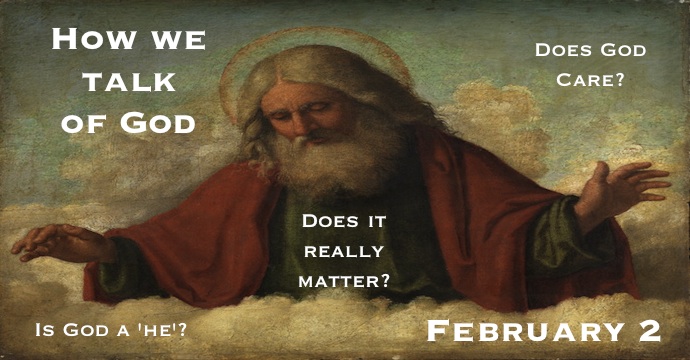
Its a Sign! God talk and stuff that matters

Two odd things have converged in my little pastoral office lately – both involve signs and they both impact how we think about God.

The first is that I was given a little daily calendar with actual church sign messages. They range from clever (rarely) to cheesy and all the way to painful.

 Sign #1 says “Twenty-four-hour lifeguard on duty – see John 3:16”

 Sign #2 says “God has not gone on vacation and left you in charge.” 

They are interesting, though different, but for similar reasons.

Sign #1 implies the God is always on the job – an all-the-time life guard. That is not the odd part (odd as it may be). The odd part is that it references John 3:16. Now, anyone who know that passage knows that it is about something very specific. “For God so loved the world that he gave his one and only Son, that whoever believes in him shall not perish but have eternal life.” So the ‘life guard’ is not watching over your actual life but an eternal life that you can have IF you believe in him.

That is an odd type of ‘life’ guard. It’s not really a promise to guard your life… it is a pledge to provide you another life after this life if you do certain things.

Sign #2 is sort of the opposite message. It says that God is not all the far away and you should not act like you are in charge of how things go. The implication is that God is very present and in some way directing or dictating how things go … even if it is loosely and absentee enough that you could be under the impression that you should take up action and do something.

 These Church signs kind of confuse me and I get turned around about what I am suppose to do and believe. 

 On a different note: we had a new visitor to our church a couple of weeks ago and they came back the next week.  On their third week they told us that on their first week they know that they had found the right church. They had gotten ‘a sign’ that they were in the right place for them.

This story is not the interesting part. The interesting part is the reaction that multiple people have had to that story. It turns out that not everyone believes in signs.

The two most common pieces of feedback that I got can be categorized as follows:

  • “There is no such thing as signs as if God were leaving us a trail of lucky charms as we walked trough the woods leading us to the end of the magical rainbow”.

As a person studying the discipline of Practical Theology in dialogue with process thought and a pastor of 18 years, this hurts my heart. I believe in the presence of God’s Spirit in the world. Just because we don’t want to be superstitious … do we leave no room for God to work?

  •  “Of course they did! If you loved a certain hymn and you visited a church who sang that hymn  – you would say “this place values what I value” and take it as a ‘sign’ that you were in the right place”.

As a person who dabbles with post-liberal ideas about the way that language works and  who has flirted with Caputo’s concept of Theo-poetics … this intrigues me.

I should mention:  This is actually part 3 in a loose series this week. Part 1 was “Waiting for Superman: the problem with Christopher Reeve”. Part 2 was “The Pornography of Fundamentalism”. 

 Why bring up the church signs and the person who thinks they got a sign that they were at the right church?   Why tie it into the problem with Superman and the pornography of fundamentalism?

The reason is quiet simple.

 What we believe about God really matters. Our conception of the divine reality actually influences ( but not determines) how we live and how we treat other people. It is not superfluous or superficial. It is consequential at the deepest levels. Our construction of that which is of ultimate concern impacts almost everything that we think, do and feel.

 As bad as church signs can fail – and as disparate as opinions on ‘getting a sign’ may be … this stuff matters. 

What we think about God, how we conceptualize the divine reality and how we converse with others who walk a different path than we do really does impact how we participate in the world.

That is why I am so passionate about Jesus and what that life reveals about the nature and person of God. This is why I try to come at this from so many angels and in so many different ways. I am under the impression that what we believe actually makes a difference in this life and matters for eternity.

You can see then why cheesy church signs and personal projections are worth addressing. They are not inconsequential nor are they insignificant. These things matter.  That is why the problem of waiting for Superman and pornography of fundamentalism are worth addressing.

-by Bo Sanders  

God Never Changes … or does She?

I got an email from a friend asking me:

“ … there’s just one thing that I’m still not sure about: the idea that God changes over time. And the reason this bugs me is because, to me, that means we can never know who/what God is. How do we know that God really is love? What if God really use to be as violent as He/She/It was back in the Old Testament?”

I thought it would be good to post part of my response here and compare notes (theology, after all, is dialogical).

 There are 3 things that we need to flesh out (pun intended) about this question:

1. While God may not change, how humans view and speak of that God evolves. There is little doubt that over the centuries how we conceptualize and even construct our language about God (or Gods) has changed, adapted, morphed, absorbed and modified.  There is no reason to shy away from that. It is a healthy response to growing awareness and – I will even say – progressing revelation.

God is at work in our midst and God has also given us Holy Spirit to lead us and guide us. We say that God is infinite, but as I have heard it said “then no matter how much we know about God – there is infinitely more to know.”

The only objection to this seem to be a ‘you think that your better than them?’ defense of the ancients. Seriously – that is the only real defense I hear of conserving antiquated notions of God. Don’t you dare going moving stuff and changing what they set down! 

That is silly. We must acknowledge as Merold Westphal told us in his visit to the podcast that all our knowledge is situated or what we call perspectival. This is where Elizabeth Johnson’s book “She Who Is” becomes so valuable. I wrote about this in ‘She Who Is Not’ and ‘Horse Gods’.

2. Many groups and thinkers would challenge the notion that God doesn’t change. As Keith Ward points out in God: a guide for the perplexed 

 “ it is important the see how different the classical view is from the popular view. Whatever the Trinity is, it cannot consist of three distinct ‘parts’ in God, who has no parts. Whatever is meant by ‘God becoming man’ is cannot mean that God changes by taking on human flesh. Whatever is meant by the Holy Spirit working to sanctify the hearts of man and women, it cannot mean that God is actually changing by acting like a finite being in history. All statements about God changing and acting, wether they are in the Bible of not, must be metaphors, All changes are in finite things, and not in God, who is changeless.”

Ya see – the old Platonic conception of changeless ideals means that there could not have really been an incarnation. The stories in the Old Testament about God ‘changing his mind’ must be anthropomorphism. You run into to real problems really quick if you say that God never changes.

Now, having said that – we can say, as a matter of faith, that the character and nature of God never changes. In fact, I would go as far as to say that when we say that God never changes, what we are commenting on is God’s loving nature. You want to know why I can say that so confidently as a Christian …. it’s because I believe that the highest  revelation that we have of God in this world is in Jesus.

 3. Process thinkers have an especially helpful take on this.  Built into a Process theology is a dipolar nature of God.  They distinguish between the Primordial nature or God and the Consequential Nature  (some get even more advanced and add a Superjective nature … but that is for another time.)   The Primordial nature sets out all the possibilities  – the Consequential nature is the perfection of the divine experience. Therefor the Primordial nature of God, what God desires, is preserved and can be said to ‘never change’ while God is fully participatory and even impacted by what happens.

 What are your thoughts?  Is there anything I could add to make this stronger? 

Savage Monkeys Won’t Save the Planet – why would they?

Two disclaimers up front:

  1. I originally posted this at HBC and it was not received so well. Which is fine, and I wrote a follow up that you can read [here] which is much more hopeful. 
  2. I do not expect anyone to like this or agree with this. I am simply put it out there for conversation.

The Summer philosophy group that I am a part of is reading The Faith of the Faithless by Simon Critchley. It is an wild, tour-de-force type of work that spans genres and categories. This past week it broached something that touched a nerve for me.

 The most extreme expression of human arrogance… is the idea that human beings can save the planet from environmental destruction. Because they are killer apes, that is, by virtue of a naturalized version of original sin that tends them towards wickedness and violence, human beings cannot redeem their environment.

Furthermore, the earth doesn’t need saving… The earth is suffering from disseminated primatemaia, a plague of people. Homo rapiens is ravaging the planet like a filthy pest that has infested a dilapidated but once beautiful mansion. In 1600 the human population was about half a billion. In the 1990’s it increased by the same amount.
This plague cannot be solved by the very species who are the efficient cause of the problem … When the earth is done with humans, it will recover and human civilization will be forgotten. Life will on on, but without us. Global warming is simply one of many fevers that the earth has suffered during its history. It will recover, but we won’t because we can’t.  – p. 110

This reminded me something that an old podcast interview with Michael Dowd first awakened me to. Dowd is the author of Thank God for Evolution and he has an incredible knack for articulating his unique perspective.

Dowd talks about the power of participating in a narrative. His assertion is that we are participating in the wrong narrative! If we think that humans are the crown achievement of a project that began about 10,000 years ago and was finished in a 6 day period … a project that humans were give dominion over – then we live one way. [often this dominion is mis-interpreted as domination and has resulted in everything from unchecked capitalism to environmental policies such as “drill baby drill” for instance

Dowd has this theory that humans who living under this narrative are participating in the earth as a cancer does in the body. Cancer is a biological part of the body. It is made up of the same matter that comprise the body that hosts it. But cancer is under the impression that the body that hosts it is a rival to be overcome and defeated. The cancer cells rally together to take over the body. They eventually multiply and expand to the point they endanger the very body that not only gave rise to it but that sustains it.

Ever since the Enlightenment and Descartes’ dualism, a certain set of the human population has believed that while humans are biologically mammals that they are not animals. Continuing on that while we originally were apart of the earth, we are above the earth. We are different than the rest of creation. While we came from the earth – from dust we came – we are not dependent on the earth for our very life. [I touched on this at my own blog in Nipples and Bellybuttons and the Imago dei ]

Because christian humans live by the wrong narrative, we behave as a cancer on the planet. In increasing size and exponential growth we consume at greater and greater levels, consuming the very body that gives host to our existence. At some point, the cancer ends up compromising the functions (organs) that give life to the organism in which it lives. Death ensues. We are not worried about because we think Jesus is coming back soon – it is the end times after all (a self-fulfilling prophecy if ever I saw one). *

Humans that are not willing to engage the ideas of emergence and evolution are living by a cancerous narrative that will extinguish the very host that gives it life. Humans that have a short view of history and a high view of their place in the created order behave in ways that are inherently cancerous to the ecosystems that support and sustain them.

 If we don’t wake up and acknowledge that we have been living by a false narrative we will eventually (sooner or later) overtake the host body’s capacity to renew itself and continue to survive and prosper. This 6 day – 10,000 year old narrative is resulting in a cancerous attitude that is killing the planet.

  • If Critchley is right, then we as killer apes can not save the planet – in fact we wouldn’t even care.
  • If Dowd is correct, we wouldn’t even try because we thought we didn’t need to. We would be living by a different narrative.

* The book of Revelation is a political commentary on Roman politics of the first three centuries written in the form of apocalyptic literature. 

Limits in (religious) Language

I just finished my semester this past week and was going through my desktop cleaning up all the icons when I discovered this post and realized that I had put it up over here yet.
It was originally posted at HBC

I like reading Lindbeck.* I used to say that I love Lindbeck but I ran into two snags.

  1. I didn’t realize what people did with Lindbeck. I did not know that it often led to retreat into a neo-Catholic expression.
  2. There is some philosophical wrinkle that I don’t fully understand about why the language that creates our religious experience implies a one-way limitation of language -it is a bit technical for me but I wanted to acknowledge it because it eventually becomes a real sticking point.

Having said that …

What I am a big fan of is Lindbeck’s critique of Language. He has a riveting analysis of the way that religious language functions in our communities and personal experiences.  I was susceptible to liking Lindbeck because of my deep appreciation for Nancey Murphy’s book “Beyond Liberalism and Fundamentalism”. I was primed for what Lindbeck brings to the table.

To become religious–no less than to become culturally or linguistically competent–is to interiorize a set of skills by practice and training. One learns how to feel, act, and think in conformity with the religious tradition that is, in its inner structure, far richer and more subtle than can be explicitly articulated. The primary knowledge is not about the religion, nor is that the religion teaches such and such, but rather how to be religious in such and such ways. p. 35

Then I found out that saying you appreciate the Lindbeck’s (post-Liberal) approach is like saying you cheer for the New York Yankees in Boston. I understand the concern with the descendants of Lindbeck’s work … but I am still suspicious that he is right about how language works in our faith communities.

Fast Forward: I was reading some stuff to get ready for the 2012 Emergent Village Theological Conversation this past January and I stumbled onto a section of Whitehead’s thoughts on religious language.** I got to a section called “Doctrine and History”. After dealing with the fact that language does not have a one-to-one correlation and that all language thus requires interpretation, the author explains:

“The language of a tradition and the central doctrines that reflect and support that language are the prime turbulence of the particular mode of existence characterizing that tradition. Furthermore, as human existence is shaped in specialized ways during the course of history, experiences occur that are not possible to persons shaped by other traditions.”

I resonate with the idea that a person is shaped by the language one is groomed and conditioned by – and that would both empower and naturally shape the experiences that one has and the interpretation of those experiences … even (or especially) the religious experiences.

It just makes sense that because religious in a communal endeavor – one is always a part of a community that has a tradition and set of practices/beliefs – that it determines, at some level, both the types of experiences one has , can have and how one translates or interprets those experiences.

This is a vital assertion for the 21st century! We no longer live in the monopoly of Christendom or the frameworks of the Colonial Era where one tradition imported and imposed foreign expectations and alien interpretations on another.

With works like “The invention of world religions” by Tomoko Masuzawa and “God is not One” by Stephen Prothero (among many others) we are entering a time in world history (and thus church history) where we need to come to terms with two things that both Lindbeck and Whitehead are pointing out:

  • Language is both inherited and powerful in shaping our experiences and subsequent interpretations of those experiences.
  • Language used in doctrines like ‘the Church’ and ‘Eucharist’ actually facilitate the ability to have certain experiences that are simply not available to those outside the community or language game. Practices like Yoga or Ramadan would be the same for those in different traditions. That is why North American Christians who do yoga are not have the same experience as those in India.

We live in an era where the realities of inter-religious education, cross-denominational communication and trans-national citizenship are going to challenge all of our inherited traditions and conceptual frameworks.

If we are unwilling to do so and insist on simply repeating the same rote answers week after week under the misguided impression that we are being faithful to the tradition … we are in danger of an irrelevance that leads not only to extinction but ultimately failure to accomplish our great commission.

*George Lindbeck wrote “The Nature of Doctrine” and along with Hans Frei (author of “Eclipse of the Biblical Narrative”) is credited with starting the Yale School of thought. One of the most famous proponents of which is Stanley Hauerwas famous for his books like  “Peaceable Kingdom” as well as other things.

** Alfred North Whitehead was a 20th century philosopher who is credited for helping to come up with what became Process-Relational thought.

God is great, Jesus is a good guy – now the other team…

It was a busy week over at Homebrewed Christianity as we get ready for the 2012 Emergent Village Theological Conversation. This is one of 3 blogs I am moving over from there to extend the conversation.

I was reading something that other day that really excited me. It was a comparison of the existential approach of someone like Rudolf Butlmann and the “powerful and illuminating analysis of post-christian existence” with the approach of someone like A.N. Whitehead in his book “Religion in the Making”.

It was particularly this sentence which caught my attention:

Bultmann’s belief that through Jesus’ death and resurrection a change was effected in the human situation at the most fundamental level can be examined as a historic hypothesis without introducing any ad hoc notions of a unique act of God.*

Fairly straight forward stuff, but it piqued my interest enough to go back and make sure that I understood the whole section leading up to it. What is interesting is that just before the above quote is this little nugget:

In such a context (exploring distinctive Western structures) the role of such historical figures such as Buddha, Socrates, and Jesus can been seen a bringing new structures of existence into being.

“Whoa! Hold it right there! I like it when you say wonderful things about how great Jesus is … by why do you have to include those other people?” I can hear my conservative and evangelical friends saying.

This is not the only time I have seen something like this and had the same reaction. (God is not One by Stephen Prothero springs to mind). It can almost be framed in this simply rubric

  • God is Great!
  • Jesus is super.
  • don’t elevate anyone else or Jesus won’t seem unique

Continue reading “God is great, Jesus is a good guy – now the other team…”

Blog at WordPress.com.

Up ↑