Search

Bo Sanders: Public Theology

updating & innovating for today

Category

Jesus

Jesus & (S)words part 2

I’m reposting last week’s HBC conversation in 3 parts
[part 1 is here]

Part 2:  

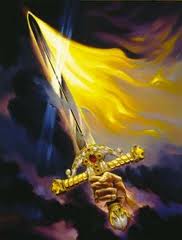
There are lots of swords in the New Testament.  The Word of God is compared to a double-edged sword and Jesus comes back wielding a sword. Maybe the Bible is more than ‘O.K.’ with swords and sword imagery?

Let me throw out two things:

  • In the context of the Roman Empire and its occupation of Jewish lands in the 1st century, swords would have been a common item that drawing imagery out of would have been appropriate.
  • A well-known pastor in Seattle, Washington is famously quoted as saying “Jesus is a cage fighter with a tattoo on his thigh and a sword in his hand, determined to make someone bleed”. He said this in reference to the fact that he “could not worship somebody that he could beat up.”

Some people dismiss statements like this and chalk it up to testosterone fueled, overly inflated, pumped up hyper-masculinity.  I worry that there is something much deeper and much more sinister involved. I think that it is a fundamental misunderstanding of the nature of God and the interpretation of Christian scripture.

 What is noteworthy in Revelation 19, is that the sword is not in Jesus’ hand but it comes out of Jesus’ mouth. That seems important in the poetic/prophetic  nature of Revelation. This sword is not your average sword. It is not in Jesus’ hand and that makes you wonder if the way in which this sword “strike down” the nations is not in bloody violence but in a kind of destruction that would happen as a result of a sword that proceeds from the mouth of God?  Let’s ask ourselves “is there something that comes from the mouth of God that radically impacts or consumes peoples and nations?”  Is there something sharp that comes from the mouth of God … something sharper than any two edged sword?

Oh, here we go: Hebrews 4

12 For the word of God is alive and active. Sharper than any double-edged sword, it penetrates even to dividing soul and spirit, joints and marrow; it judges the thoughts and attitudes of the heart.

So far so good! ‘It’ judges the thoughts and heart… but here comes the twist:

 13 Nothing in all creation is hidden from His sight. Everything is uncovered and laid bare before the eyes of him to whom we must give account.

Hold the phones! … the Word of God (it) is a person? Yes. Guess who?

 14 Therefore, since we have a great high priest who has ascended into heaven, Jesus the Son of God, let us hold firmly to the faith we profess.

Jesus is the Word of God?    (I’m being funny but you may want to check out John 1 for clarification).

 In conclusion: the use of sword imagery  in both Revelation and in the book of Hebrews needs to be taken with a poetic grain of salt. Yes, the Bible uses sword imagery. The thing is that if Jesus’ (S)word, from part 1,  is a non-sword or an un-sword and in Revelation is comes from Jesus’ mouth and in Hebrews it is a person … then none of these passages, thus far, can be utilized to justify what so many Christian (s)words are used for. 

I’ve obviously been having fun here, but the bottom line is that just because the Bible uses swords as analogies – it isn’t a wholesale validation of swords nor a justification for using them as the world does.

________

I would love to hear your thoughts – I just have one request: please don’t use the word ‘Pacifist’ when speaking of Jesus. That set of commitments belongs to a distinct school of thought  that did not exist in Jesus day so it is anachronistic to use in that way. He was certainly into non-violence and radical peace-making but Pacifism is a unique configuration of convictions.


Jesus & (S)words

This conversation went really well last week over at Homebrewed. I thought I would post it here in smaller chunks for anyone wanted to continue the conversation.

Jesus tells his disciples to sell their bags and buy swords. Why? And why then does he reprimand Peter for using a blade at the moment when it seemed to be most appropriate?  Was Jesus being inconsistent? Did he change his mind in the moment? Was it a test? Did he set Peter up to fail? Why did he say that ‘those who live by the sword, will die by the sword?’ and then tell his disciple to buy them?

I am asked about Jesus’ relationship to swords as much as anything I get asked about. Good hearted people are quite baffled by the whole subject.

  • Jesus did after all say that he came to bring a sword.
  • As the word of God, he is said to be sharper than any two-edged sword.
  • He is pictured with a sword coming from his mouth when he ‘returns’.
  • and there is this matter of him telling his followers to buy swords

As a former apologist, I have gotten pretty good at helping the baffled work through these passages. I even has a presentation I do called jesuSword that incorporates Jesus, his words, and these passages about swords.

 In order to facilitate a lively give and take, we will take this in 3 quick addresses over the next 24 hours.

 Part 1: Jesus says that he came to bring a sword.

 Matthew 10:34 “Do not suppose that I have come to bring peace to the earth. I did not come to bring peace, but a sword. 35 For I have come to turn “‘a man against his father, a daughter against her mother, a daughter-in-law against her mother-in-law—   37 Anyone who loves their father or mother more than me is not worthy of me; anyone who loves their son or daughter more than me is not worthy of me. 38 Whoever does not take up their cross and follow me is not worthy of me. 39 Whoever finds their life will lose it, and whoever loses their life for my sake will find it.

 Is it possible that Jesus was being ironic and that his sword is actually an un-sword. I say this because Jesus’ sword does the exact opposite thing that normal swords do. His sword divides family. Traditional swords are used their swords to defend their kin and kind.

Jesus was using a play on words.

Jesus was using hyperbole. In his day swords were actually for defending one’s family – for guarding me and mine. In this sense, Jesus’ “sword” is an un-sword… or an anti-sword. It does the opposite of what human swords are used for.  Jesus’ sword is not for defending family but for dividing family. Jesus did not come with a human sword but the opposite!!

John Caputo puts it this way:

The kingdom reigns wherever the least and most undesirable are favored while the best and most powerful are put on the defensive. The powerless power of the kingdom prevails whenever the one is preferred to the ninety-nine, whenever one loves one’s enemies and hates one’s father and mother while the world, which believes in power, counsels us to fend off our enemies and keep the circle of kin and kind, of family and friends, fortified and tightly drawn.”

If Jesus was being ironic or using hyperbole, it would make so much more sense than the way this passage gets used to justify violence and militarism.

I would love to hear your thoughts – I just have one request: please don’t use the word ‘Pacifist’ when speaking of Jesus. That set of commitments belongs to a distinct school of thought  that did not exist in Jesus day so it is anachronistic to use in that way. He was certainly into non-violence and radical peace-making but Pacifism is a unique configuration of convictions.   

The Status Quo has got to Go!

written for Homebrewed

A few weeks ago Joerg Rieger (on Homebrewed Christianity) cautioned about a type of Christianity that was a cheerleader for the system, that reinforced the status quo, and participated in society in way that strengthened Empire.

I have said before I come from a background where this type of thinking is not just disorienting but alienating. The focus is on individuals – with little mention of anything systemic. The goal is the salvation of souls for the afterlife – with no address of collective issues.

It was reading Walter Wink  “the Powers the Be” that radically impacted the way I could see this. I have since encountered other writings and teachers who have opened the subject even further.

Now, it is odd to look at the central figure of our faith and ask how did Jesus ever get portrayed as a guy who basically told people to be nice and obey the rules? Cornell West would talk about him be sanitized, deodorized, and neutralized. Someone else might call this being a chaplain to the empire.

My buddy Tripp and I have a theme that shows up in our personal conversations on a fairly regular basis. It revolves around the idea that variable X or Y may be changed or tweaked, but the outcome of the equation is never in doubt. A specific issue may be protested, but the machine itself in never in danger. Certain areas can be challenged or  even overhauled, but the system itself is never in jeopardy.

This is not limited to Empire. It goes beyond hegemony. It is not limited to Capitalism.

The powers that be, or the system, or the machine (as you prefer) is an omnibus. It can absorb – incorporate – and co-op any variation, deviation, or even challenge … and in the end the structure is nearly unchanged. The system is never in danger. The machine doesn’t even slow down. The Powers are never in jeopardy. It eats new ideas with barely a burp – let alone beginning to buckle.

We could talk about an anarchist musical band that signs a record contract, or a retail store that sells Buddhist trinkets from ‘the far east’, or a seminar on Native American spirituality that meets in a university classroom… but I don’t want to get sidelined. 

Benjamin Barber in his book Jihad vs. McWorld talks about the market in such a way that sketched a picture (for me) of a machine that needs to be fueled by new authentic-indigenous expressions, otherwise it runs dry and burns out on it’s own the boredom of its generic repetitions and knock-offs.

“McWorld cannot then do without Jihad: it needs cultural parochialism to feed its endless appetites. Yet neither can Jihad do without that world: for where would culture be without a commercial producers who market it and the information and communication systems that make it known?” Continue reading “The Status Quo has got to Go!”

Signs that make you Wonder

Let me just say how much I have enjoyed the conversation this week. One of the dynamic elements of a conversational blog is that sometimes that conversation takes longer or goes in a different direction than expected – this is the nature of dialogue (vs. a monologue). I was supposed to write on allegory today but that can wait till Friday – today we get talk about miracles, the supernatural and signs that make you wonder.

It seems to me that there are two main things to get on the table here.

The first is the phrase ‘super-natural’ comes from specific worldview that came to ascendancy in the seventeenth century. It is very mechanistic. It says that God set up the natural world to work a certain way (like a clock) and the debate was really between folks like the Deists who said the God stepped away after creation and is letting it run like clockwork. The other group believed in intervention and held that God did – from time to time – interfere with the normal mechanisms and do something … super-natural. The activities of angels and demons were outside the perceptibility and predictability of the ‘natural order’ and so on.

That is the supernatural and that is exactly what I do not believe in.

Now, I do believe in the miraculous. The miraculous in this sense is that which is extra-ordinary, outside the expected normality of human experience. Since I am a believer, I attribute that to the power of God who is at work in the world in Holy Spirit.

I want to say again that I do not believe in a solely transcendent God who in ‘his’ holiness can have nothing do with fallen matter and thus resides ‘up’ in the heavens and intermittently ‘breaks through’ the veil of reality in order to intervene in human affairs.

The second thing that we need to get on the table is Biblical language repeated so often in the Gospels of “signs”. What we calls miracles are often referred to as signs. I have even heard them called ‘signs that make you wonder’. This is sacramental language – which is why so many of us are not familiar with it.

A sign, by being fully itself, points to something that is beyond itself. Think of a road sign. A symbol, similarly, is something that participates in that which it signifies without being totally that thing. So in communion, we might say that the bread points to the body of Christ while remaining fully bread. Or that the church is not the Kingdom of God even though it participates in the it. It is a sign that points to a greater reality.

What we would call miracles, what the Gospels often refer to as signs, are activities of God’s presence that point to something beyond themselves while – or by – being fully themselves.

Once these two understandings are in place the conversation takes on a whole new set of possibilities. Once you say goodbye to predictable formulas (mechanistic) then you can move to a conception of a dynamic relationship with a living God. Once you move away from a super-natural mentality (which is often superstitious), you can move to a sacramental participation with the natural world.

God is at work in the world. As Christians we say this proudly and confidently. (I understand those in the Enlightenment who rejected the interventionist view of god and who explained away the miracles in the Bible by simply saying that ancient pre-modern people only interpreted things that way – but that is not where I am at).

If you are into Process Theology, there is a whole second conversation that takes you into all sorts of fun places!  But today I just want to point people to Chapter 7 in the Secret Message of Jesus by Brian McLaren called “the Demonstration of the Message”.  It is wonderful.  I will close here with the words he closes with there.

… this is in large part what I believe the signs and wonders of Jesus are secretly telling us: that God, the good King, is present – working from the inside. The King is in the kingdom, and the kingdom is among us here and now – for those who have eyes to see and ears to hear. The King is present in the mess and chaos of everyday life on earth, bringing healing, sight, perception, liberation… The incursion of the kingdom of God has begun. We are under a gentle, compassionate assault by a kingdom of peace and healing and forgiveness and life.

Relational Religion” src=”https://bosanders.com/wp-content/uploads/2010/11/citysoleilblueboat_4.jpg?w=150″ alt=”” width=”150″ height=”100″ />


a BIG difference between Christianity and Islam

I continue to be very excited about the Claremont Lincoln University Project to bring together Jewish, Muslim and Christian scholars and practitioners. It is essential for the future that each tradition initiate its young leaders and thinkers in at atmosphere of mutual exchange and understanding.

The reason this is so important is that these three religions are not the same. They are not simply three expressions of a common understanding. They are vastly and distinctly different from each other. Of course there is commonality and overlap – for instance all three are a covenantal people and point to a covenant they have with God. I am interested to hear how each of the three groups reflects on and lives into their particular understanding.

Many Christians seem to think that the big difference between Christianity and both Islam and Judaism is what they believe about Christ. I do not think that views on Jesus is the biggest difference between the three. In fact, I am suspicious that any Christian willingness to revisit a wooden-literal reading of passages like John 14:6 or reexamine the language and meta-physics of the creedal formulations would easily result in an understanding that did not violate the Quranic understanding that God has no children. Vocabularies of ‘how God was present in Christ’ are already being worked out by followers of the prophet Isa (Jesus) in Muslim countries. [Link: an article on c-6 contextualization]

In my mind, there is a much bigger difference between the three religions than an understanding of Jesus’ identity. It has to do with the earth.

Christianity is primarily time based. While the Christian gospel is one of incarnation, ironically, Christianity has become something that is not place-based and especially not land-based. This is easily illustrated by looking at some Muslim practices and noticing their absence or contrast in Christianity.

  • Prayer Direction: When Muslim pray, they face Mecca. This is a directional earth-relative orientation. Christianity lacks this orientation.
  • Pilgrimage: Once in their lives Muslims are expected to make a pilgrimage to Mecca. This is an intentional journey to a specific location on the surface of the earth that holds special meaning. Christianity has no such thing.
  • Sunset: Certain holy days are marked as beginning at “sundown” or when a specific phase of the moon first appears as observed in a set location. This shows an awareness of the seasons, the sun, and the moon. Christian holy days and holidays are based on a calendar and clock.
  • Language: If you want to read the Quran you need to learn Arabic. The Christian gospel is not only translatable into any language – Christians believe that it should be translated into every language. The Gospel is equally valid in any and every language.

In his book Whose Religion is Christianity?: the Gospel beyond the West, Lamin Sanneh puts it this way:

Being that the original scripture of the Christian movement, the New Testament Gospels are translated versions of the message of Jesus, and that means Christianity is a translated religion without a revealed language. The issue is not whether Christians translated their scriptures well or willingly, but that without translation there would be no Christianity or Christians. Translation is the church’s birthmark … Christianity  seems unique in being the only world religion that is transmitted without the language or originating culture of its founder (p. 97-98) Continue reading “a BIG difference between Christianity and Islam”

>After Easter

He is risen!   …  now what?


Last week I was a part of two vigorous online conversations regarding the resurrection. Then I had a wonderful opportunity to celebrate Easter Sunday in a glorious way. I thought it might be good to recap the implications of last week’s conversations and celebrations as we turn the corner toward Pentecost. 


The next question seems to be “what do we do with this?” – also known as the so what question. People want to know because there are 3 key passages in the New Testament that say Jesus’ resurrection has consequences for what we as believers can expect after our death. 


Here are the 4 layers of thought that seem to come out of the Resurrection conversation.  
Continue reading “>After Easter”

>Stirring the Water

I love reading the Bible. I am especially fond of the Gospels. One thing that I am increasingly aware of is the need for translation to the modern world. Yes, we need it to be translated from Greek to English well but we also need to translate it culturally. There is a significant gap between the world that the text was written in and the one that we live in. 

I get lots of feedback from people who think that world is exactly the same as it was 2,000 years ago (angels, demons, prophecy, etc.) and that the only difference is we that have cars and computers and alarm clocks.  But they think that gender roles and scientific assumptions are not really that different. 


I think that everything from physics to language to cosmology, gender, empire and culture has been effected in major and minor ways. I think that the text needs to be both translated and  interpreted. It is not a 1:1 equivalent with our contemporary understanding. 


I want to look at a story from the Bible to illustrate how I think we can navigate the gap, translate for our age and time, and interpret in ways that are authentic for our present reality. 


My goal is to be faithful to the text while being accountable to our contemporary world. I want to find continuity with the tradition while being credible to the modern understanding. 
Continue reading “>Stirring the Water”

>Walking on Water

>Last week I admitted to not believing in the supernatural [link]. For those that are still on the fence regarding this issue, the concern seems to be that there are some pretty crazy miracles in the Bible.

So let me just say that I believe in miracles. That is not in question. Miracles happen every day and they are amazing and divine and God at work. I am a big fan of miracles.


Let’s look at one of the most famous miracles: We read the story of Jesus walking on the water and he climbs into the boat and calms the storm which which in turn calms the disciples nerves. He says “fear not”
 (or ‘be not afraid‘) in the version of John 6 (he also walks on water in Mark 6 and Matthew 14).


Here is my question: What is the ‘take away’ from this story of Jesus walking on the water?  That God is lord even of the natural world and so we need not ‘be afraid’. That’s beautiful.


So what is the application of Jesus walking on the water?
Well … it is not for us to walk on water.


even if I believe that Jesus walked on water- I have never walked on water. I’ve never seen anyone walk on water. We don’t encourage or demand that people walk on water.


The application is to trust in God (or believe in Jesus) and “be not afraid”.


Here is what I am proposing: I want to move our application up a step and make it our interpretation.


There are three major benefits to doing so:

  1. People fight to defend that Jesus actually walked on the water – then don’t do anything with it. It becomes a stand alone fact. There is no application. There is no ‘and therefor you should walk on water too’.  It is a one-dimensional fight. 
  2. Since the application is the same wether you listen to a preacher who insists that it literally happen or one who thinks that it was figurative… this lets us skip all the rancoring.  Otherwise it is a lot of fighting over something that we are not going to do much with. 
  3. Since walking on water is not an issue, we can focus on the point of the text. If we get all caught up in the physics and metaphysics behind the text then we lose the focus OF the text. The point of the text – what we are suppose to take away from it – is not that Jesus defied the laws of physics. That is not the point and so we we should not make it the point . 


The end is not to do what Jesus did (walk on water) but to do what Jesus said “be not afraid”.


I can guess that the major objection to this reading will be. “If he didn’t really walk on water then how are we supposed to trust and not be afraid.” If he really did it , then we can really trust…


We need to be careful about something: The gospels are narrative works – they are works of literature. They are not newspaper reports, physics textbooks or modern biographies.


It is important to remember that the Gospel writers were telling us a story – and that the way they told that story matters.   We should not demand of them the kind of detail and accuracy that a post-Indusrtiral Revolution or scientific texts would have. We need to be careful of reading them through an exacting Enlightenment lens – back through Greek dualism of the physical & spiritual and then impose them on a Jewish story.


In the end, what I am suggesting is that we move our application – (which is the same for fundamentalists, conservatives, liberals, charismatics, and evangelicals) –  up one step and make it our interpretation.


The simple fact is that we no longer live is world where ‘supernatural’ is a sustainable or verifiable worldview. The phrase ‘supernatural’  A) is not Biblical and  B) is not believable in the world of electricity. There is no sense in doggedly sticking to something that is both foreign to the text and incompatible in our age.


This would mean that what we DO with the story, we would call the POINT of the story – that the response it is designed to elicit IS our interpretation. It is not that big of a jump – and it changes our reading of the Bible to be consistent with the world as we know it to be while being authentic to the tradition that we have inherited (by trusting in God).

>the Bible is not about the End of the World

>I wrote this for something else but wanted to post here for discussion.

The minute the earthquake in Japan happened, I told several friends that two things were coming: 1) talk of the end of the world  2) talk of God punishing Japan

But I was not prepared for was the quality of the sample that was to come. This article details the prophetic take of Cindy Jacobs.  She is an authoritative leader in Intercession Prayer circles and someone that I am very familiar with and had even quoted during my college years (the mid- 90s).

    “In the early nineties, the Lord gave me a prophecy for Japan that it was a “sickle in the hand of the Lord” that will be used for great harvest. The physical geography of the islands look like a curved sickle with the handle being the island of Hokkaido in the north. One could also say that it looks like a curved sword. Where Japan has historically been a sword of war across Asia.”

    “On the other hand, if you look at it another way, this island, Hokkaido, looks like the head of a dragon with the body being the rest of Japan. The people of Asia have worshipped the dragon for 5,000 years. If one looks at the place where the earthquake took place, it looks like the soft underbelly of most vulnerable part of the dragon.”

Can you believe it? The reasoning is that it ‘looks like a sword’?  Are you serious?
Does that mean as seen from space… or on a map… or… wait – I’m looking at a map right now and I am not seeing a sword,  or a dragon for that matter.

Not that it matters. When you are being this imaginative and fantastical, I am not sure that the facts would be all that helpful.

I was making fun of this on Facebook and I referenced the best selling book by Harold Camping’s 1994 or Edgar C. Whisenant “88 reasons the Rapture will be in 1988”.  How corny right?

A week later I get a text message from someone listening to NPR that Harold Camping is on the radio saying that the end of the world will be next May 26th. It will happen at 6pm. It will make it’s way around the world time-zone by time-zone.

Wasn’t that how Y2K was suppose to happen?  Not that it matters…

Here is what I wish would happen: that we could make a deal as Evangelical-Conservative-Fundamentalist and Charismatic Protestants that IF this happens next May or even in 2012 at all – then those of us who doubt them will volunteer to go to hell.

BUT if it doesn’t happen then we will realize that nothing is going to happens like this – and stop doing this every time a natural disaster occurs.

Here is what I wish we would realize:

   1. human civilizations (brick and mortar) who live on fault lines and shore lines are impacted when the world does what it has always done – shift, evolve, and create.
   2. every generation can not imagine things continuing to progress beyond a point that they would find unrecognizable and thus they think ‘this must be the end’
   3. when we talk about the ‘eschatological hope’ of the resurrection we need to be careful to distinguish it from cooky dispensational “Left-Behind” mumbo-jumbo. We must distinguish because most people can’t tell the difference. In fact, sometimes I can’t tell the difference.

Background:

  • Most of what Jesus said that gets chalked up to ‘end times’ stuff – like his story about two people in a field or on a road and one is taken, or  how women will not want to be pregnant – he is talking about the destruction of Jerusalem in 70 a.d.   All that ‘flight to the hills’ and sky/moon turning red and a loaf of bread costing a bag of gold is about something that happened “within that generation” (Matthew 24:33-35).  It is not about the end of the world.
  • The book of Revelation was a political commentary on Rome of the first centuries CE. It is written in apocalyptic language because of the Roman oppression of the first century. It is not about the end of the world.

Blog at WordPress.com.

Up ↑