Search

Bo Sanders: Public Theology

updating & innovating for today

Category

Religion

Problem is that new Pope isn’t Protestant enough

It has been amazing to watch both the amount of reporting and the kind of reporting that  Pope Francis’ style has drawn. You can find stories about him in major magazines, on every news website … even the Daily Show gave some hilarious attention to the hype.

I was on an Australian radio show the day of his election – they liked the angle that I had taken on my blog focusing on the Southern hemisphere. [you can listen to the 4 minute clip at the bottom of this post at HBC] I was on after the Australian Ambassador from Argentina.

Some of my co-workers are Catholic and Pope Francis’ dealing provide us with every-other-day content for our coffee-pot conversations. Even my wife, who is generally not that interested in such things, is into it.

She asked me, on a recent road trip after several news stories, why I thought people were so into Francis.  I have three thoughts and would love to hear other’s thoughts.

  • There are still 1.6 Billion Catholics worldwide. That is 1/6 of everyone on the planet. Who is their leader matters a lot.

I know that not every Catholic listens to the Pope and that the Pope does not influence every thing … but it is still a big deal.

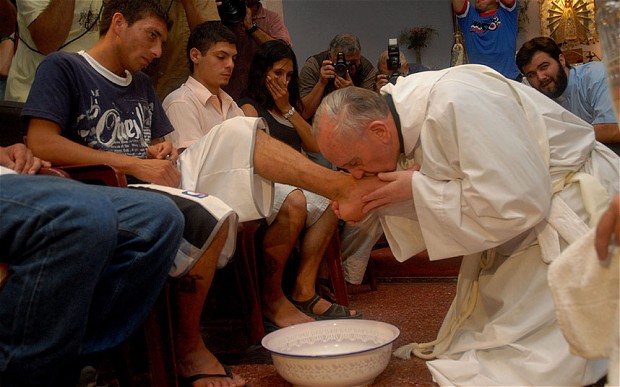
  • Between the elaborate displays of the Vatican and the global sex-abuse scandal – both of which are hard to figure out from reading the gospels – the Catholic church has been having a rough time of it in the court of public opinion.Pope-Holy-Thursday_2509139b

Francis’ style is not just a breath of fresh air – it is substantially different. What he did on Maundy Thursday was not just a ‘break with tradition’, as reports kept repeating, but was significant. Washing & kissing prisoner’s feet instead of priest’s is not window dressing

  •  Protestants seems to be fascinated with Pope-drama like Americans are fascinated with Royals. I don’t really get either.

It’s like we are enamored with the figure-head of the thing we left so long ago. I chalk it up to some sort of fetish thing for regal gowns, bejeweled crowns and antiquated (and sometimes secret) ceremonies.

There is one problem though. Protestants seem to want the Pope to be more protestant.

Almost all of the critique or concern I heard about him is something that would be more emblematic of protestant values or approaches. He is following the church’s traditional stance on (just to name 4):

  1. Contraception
  2. Celibacy
  3. Women in ministry
  4. Homosexuality

I want to holler at people when they are disappointed in this

“Of course he is – otherwise he wouldn’t have been elected Pope”.

It feels to me like somebody saying “I like the new Miss USA … I just wish she was built like a Linebacker in football.”   Well … I hate to break it to you but that’s not going to happen. In fact, people who are built to play linebackers don’t make it to the Miss USA pageant. That is just not what the judges are looking for.

What I wish we would instead focus on is his economic dealings, immigration issues (he is the son of immigrants) and out-reach to non-Europeans. I continue to claim that just those 3 will make this a game-changer.

I would love to hear your thoughts. 

Doug Pagitt Radio: what is going on IN religion

I had the honor to be on Doug Pagitt Radio yesterday  morning. It was a great conversation with Doug and Victoria that centered about what is happening in religion.Web_Logo_lrg_wTagBubble

You can read the initial blog about religion and postmodern thought here.

Doug has the video on his website and on Itunes.

Here the video of the first segment. Here is the video of the second.

Doug has been on Homebrewed several times. Once talking about his books in the Inventive Age, and once chatting with Tripp about politics (in a post-debate debrief).

Check out Doug’s book on Amazon.

Most the conversation centered around my proposal that there are at least 5 things happening in religion:

  • Experience
  • Formation
  • Event
  • Mystery
  • Potentially Something Real

I would love to get your feedback on the interview. Brew on!   -Bo   [you can keep up with all my past posts on this page]

What is going on IN religion when we talk about God

This weekend I will finish reading two books that we were given through the podcast (thank you publishers). The first is Peter Rollins new on The Idolatry of God and the second is Phil Snider’s Preaching After GodMP900405058

I have recently edited podcasts with both of these authors. [We put out the Phil Snider TNT last week ]

It is very clear to me that we have an emerging situation (trying not to say problem) on our hands. With the introduction of a new wave of postmodern or ‘radical’ theology [listen to the Caputo introduction here] – progressive and emergent christians are drinking in lots of innovative and challenging concepts about God that may not have a real God behind them.

This is fine IF the listener/reader knows what they are imbibing. What is increasingly concerning for Tripp and me is the consequence when people don’t know that the god of the 21st century philosophers is not exactly the god you hear about on Sunday morning.

Is there a danger in people reading a ‘how (not) to speak of god’ and then just quoting it from the pulpit like they would quote any other historical person?  Folks in the deconstruction camp are not real eager to answer this one.

I have some thoughts on the matter so I thought I would throw them out here for consideration.

 Intro: It is severely unhelpful to frame this in an either/or way. “Either God is X like the Bible/Creed/Tradition say OR Religion is the equivalent of Santa Clause &Tooth Fairy and we might as well all go home.”

That reductive approach is foolish and silly.  There is far too much going on in religion – and the Christian religion specifically – to say things like that.*

 I propose that there are – at least – 5 things happening IN the christian religion:

  • Experience
  • Formation
  • Event
  • Mystery
  • Potentially Something Real

Experience – People who were not raised in the faith convert and/or have crisis experiences that powerfully impact them.  People experience the presences of something they interpret as bigger than themselves.

We can talk about transcendence or phenomenology but what we can not deny is that people experience something in religion. As someone from a charismatic-evangelical background it is so clear to me that much of our talk about God and religion in progressive-emergent circles misses this very real component.

Is experience the whole story? NO! And those who reduce it down to that are equally as errant. It is not the main thing nor is it nothing. It does not account for everything but neither can it be dismissed outright.  People’s experience must factor into the equation.

At minimum do the Kantian thing and say that religious people’s experience is real but incomplete to understand the whole picture (noumenon) – like 6 blind people with their hands on different parts of the elephant – each thinking they are describing something unique: a tree (leg) a rope (tail) a wall (belly) and a giant leaf (ear) and an enormous snake (trunk).

Formation – I get in trouble for liking the post-liberal writing of George Lindbeck (Nature of Doctrine) but I think that this is exactly where it comes into play. The role that the christian tradition, sacred text and vocabulary plays is that forms us a people. It forms character within us as well as the way that we participate in community.

I am in dialogue with the work of Alasdair MacIntyre (After Virtue) for this very reason. While I disagree with his solution, I think that he is spot-on in his analysis and concern. Not only does our culture live in a chaotic time – but the very ethical assumption that would allow us to even HAVE the conversation have been eroded and now we can’t even debate! At least within the Christian church there is a common vocabulary. We may debate the definition of the terms but we have an arena in which to engage each other.

In this sense, the faith functions. As Elizabeth Johnson (She Who Is) is so good at pointing out: the words that we use function in our imagination, our communities and in the tradition.

Event – John Caputo (Weakness of God) and those who follow his Derridean ways prefer to speak of the name of God as an event. There is an event housed in the name of God the beckons us – we respond to this call … and are not that concerned wether there is a caller, or if we can know that there is one.

It is undeniable that something happens when God’s name is invoked. It triggers something in us. It calls for something from us. It makes some claim or demand to be dealt with differently than other words and concepts.

I like Caputo’s illumination of this shadow world. There is something deeply insightful about his explorations. Those who want to dismiss it because it isn’t enough on it’s own, are missing the point. Something happens if ‘God’ is invoked … and that would happen even if there were no ‘God’ per se because (as I said above) the concept functions. – it does something in us,

Voltaire said,”If God did not exist, it would be necessary to invent him.” That is because ‘god’ does something in us – demands something from us.  It maybe not ripping off our customers, it may get us through a tough time or help us to sleep at night – or even face the end of life with dignity. But in the name of God is an event that lays hold of us.

Mystery – I am fascinated with the apophatic tradition. I have no interest is appropriating it … but I am mesmerized by the fact that it even exists. Describing god by what she is not? Brilliant.

I also have been looking in historic understandings of analogy. Which works for me because I do not believe in univocal speech. When we call god ‘father’ we are using an analogy – god is like our best conception of father-liness … but it saying that is also included an understanding that God is not actually a father. Our use of the word is not a 1:1 equivalence.

Elizabeth Johnson challenged us over a year ago that every time we say ‘god’ that we must say it three times.  I do this every day now!

  • God beyond us.  This is that transcendent other or Kant’s noumenal real.
  • God within us. This is the experiential component.
  • God at work all around us. This could be the event.

When I say ‘god’ I always say God beyond me – within me – and at work all around me.

 Potentially Something Real – the final component in my 5 sided web is the possibility that there really is something to all of this – more than just phenomenon or imagination or tradition or vocabulary – and that the language of religion is at least getting some of it right.

If we don’t leave open the potential that something real is really happening – that a real god is actually acting – then we may be missing the biggest part of the puzzle and thus have an incomplete picture.

___________
Just because YOU haven’t thought of the multiplicity of layered meanings happening in the Christian expression doesn’t mean that it is an all or nothing game.Don’t be that person who says “If Santa Clause isn’t real, then Christmas isn’t worth celebrating”. Or “If Creation did not happened exactly like it is described in Genesis then the whole BIble is untrustworthy and unbelievable.”
Honoring Our Elders or If Aquinas was Around Today

Thomas Aquinas comes up a lot these days.*   Some of it is generated by a small community of passionate people who want to reclaim his project. Thomas_Aquinas_by_Fra_Bartolommeo

This, in turn, prompts some – such as John Caputo in an interview with us – to come up with a legendary one liner that accused this group of ‘retreating into the hills of Thomism’. 

The most insightful address I have encountered recently comes from Umberto Eco in the book Travels in Hyperreality. In a chapter entitled “In Praise of St. Thomas” he outlines how Thomas interacted with his world and how he navigated the difficulties of his inherited order (mendicants) , his Age, and his own limitations.  Three passages from the 1974 essay that inspired me were:

  – Thomas, was neither a heretic not a revolutionary. He has been called a “concordian”. For him it was a matter of reconciling the new science with the science of revelation, changing everything so that nothing would change. 

– Nobody ever said that Thomas was Galileo. Thomas simply gave the church a doctrinal system that put her in agreement with the natural world. 

–  So it is surely licit to ask what Thomas Aquinas would do if he were alive today; but we have to answer that, in any case, he would not write another Summa Theologica. He would come to terms with Marxism, with the physics of relativity, with formal logic, with existentialism and phenomenology. 

He would comment not on Aristotle, but on Marx and Freud. Then he would change his method of argumentation, which would become a bit less harmonious and conciliatory.

And finally he would realize that one cannot and must not work out a definitive, concluded system, like a piece of architecture, but a sort of mobile system, a loose-leaf Summa, because in his encyclopedia of the sciences the notion of historical temporariness would have entered.

I can’t say whether he would still be a Christian.

But let’s say he would be.

I know for sure that he would take part in the celebrations of his anniversary only to remind us that it is not a question of deciding how still  to use what he thought, but to think new things.

Or at least to learn from him how you can think cleanly, like a (person) of your own time.

After which I wouldn’t want to be in his shoes.

This actually is an approach to the past that has some general applicability. I have heard it said that best way to honor founders of any movement is not to simply repeat what they did but do the kind of thing they did in their time for our time. Aquinas

As a contextual theologian, I have said (over and over again) that honoring the apostles and the early church’s mothers and fathers is not in simple doing what they did in their culture – but in doing in our culture the types of things they did in theirs.

Rote repetition – regurgitation is not honoring. It is closer to idolatry. 

Repeating in the 21st century what they said in the 8th century isn’t as faithful as one might like it to imagine. This is due to the nature of our message. Our message is incarnational and thus our models and methods must match that!

The container must match the content. 

I’m not that into Aquinas. I think it’s because of the approach of those who are a little too into him.  But if they were to change to Eco’s approach and engage contemporary science and incorporate real scholarship, then I might get into Aquinas as well.

I just have no interest in reclaiming a romantically imagined version of the past. I am very interested in engaging the living now and emerging near future.

 _________
* Saint Thomas Aquinas, (1225 – 1274), also Thomas of Aquin or Aquino, was an Italian Dominican priest, and an immensely influential philosopher and theologian in the tradition of scholasticism, within which he is also known as the “Dumb Ox”.
Aquinas

John 14:6 may not even be about salvation

Over the past two months we have been having a lot of fun talking about John 14:6.  The release of Brian McLaren’s new book Why Did Jesus, Moses, the Buddha, and Mohammed Cross the Road?: Christian Identity in a Multi-Faith World  and our subsequent live event with him at Wild Goose West (audio here) got us started.

Then Jericho Books gave us some copies to give away so we put out the John 14:6 Challenge. People stepped up with posts and used the speakpipe to leave us messages.

I swung first with “Jesus wasn’t talking about Muslims in John 14:6” and followed it up with “an alternative to John 14:6” saying that one that famous passage is off the table for thinking about how to deal with other religions … where does one start? What are the alternatives?

Last week, Tripp and I recorded a TNT that will come out this afternoon where we listen to some of the calls and talk about some of the posts…  in that midst of that conversation, (beginning in minute 15)  we put out an idea that I thought should be in written form and not just audio.  Here it goes:

Not only is John 14:6 not about other religions – since it is a disciple’s invitation – but it is not even about salvation. It is about relationship and not salvation.

I blame it on lazy reading that results in conflating subjects. I think that Jesus is inviting those who follow him to relate to ‘the Father’ (Abba) as he relates to Abba by:

  • living the life he laid out,
  • walking the way he modeled and
  • embodying the truth we proclaim.

Tripp implies that is has something to do with Calvinism and it’s histroical impact of making salvation:
A) transactional instead of relational
B) individual instead of communal

So I want to ask the question (you may want to listen to the TNT episode to hear the whole context):

What if John 14:6 is not only not about other religions – but isn’t even about salvation? How would that impact your use of that passage and where else would you turn in the Bible for an alternative?

Personally, I would go to Acts 4:12 “God has given no other name under heaven by which we must be saved.”  Mainly because it has the word ‘saved’ in it AND sounds semi-exclusive … which is what people TRY to get John 14:6 to be – but simply isn’t.   That is the conflation that I am talking about.

Thoughts?  Responses?   

Hopefully the Politicizing of Rape is over

This is part of  a series over the next 2 days of posts that were written a month ago. It is interesting to read them now. I will tweak the intros to each, but I fear that they will be ongoing issues until we seriously revisit some of our flimsy thinking behind these subjects.

Yet again a Republican candidate came out with an outlandish comment about rape  that has drawn widespread criticism from those outside the ideological bubble.

  Indiana Congressman Richard Murdoch, during a debate, made the latest in what has become a consistent string of rhetoric for white conservative men – notably on the heels of Senate candidate Todd Akin’s introduction of ‘legitimate’ rape into our vernacular.

Apparently Akin, who is on the House Science Committee, thinks that a women’s body can sense if the conception was because of ‘legitimate’ rape and take of the matter on its own. Richard Murdoch took it a step further, beyond biology, and introduced theology into the mix. The resulting pregnancy would be ‘God’s will’.

 Let me be clear: I get why some people hate abortion. I do. I get it. I was raised watching movies like ‘Silent Scream’ and listening to Carmen rap/sing about our nation’s demise and invitation of God’s wrath.  I get it. That is not what I want to address here.

 My concern is with the consistent and frequent rhetoric that is coming from the conservative right on the issue of rape. 
There are 3 reasons that this hits so close to home for me:

  1. My wife ran the rape crisis hotline and prevention education for the county where we lived in NY. For a decade this was a major part of our life and focus.
  2. As a minister, I have sat with countless women and heard their stories. We have walked a really tough road of recovery and healing with many.
  3. I have traded my narrow/shallow theological adolescence for a more critical-aware- sophisticated-and progressive one.

These three things come together is a very painful way for me when I hear these continuing statements from non-women candidates.

 One starts to ask “What exactly is going on with these guys? What in the world are they thinking?”
If two is a trend and three is a pattern then this is a full-blown school of thought!

Are they just trying to fire-up their base? Are they trying to out religion each other? Are they so fixated on abortion that it blinds them to the absurdity of their other positions?

 Or is it worse than that?  Is it that there view of God is fundamentally determining this stuff?  I’m afraid that this might be true. I think that these might be really good hearted christian men who have bought into a view of God that is so limited and narrow that it necessarily dictates utterances like we have been hearing.

I am suspicious that one’s view of God is like an operating system on a computer and that given enough time, this N. American conservative/fundamentalist program that gets downloaded just inherently comes with some unavoidable glitches and bugs that eventually result in stances like we have been seeing.

Thomas Jay Oord posted the following on Facebook:

 Candidate Richard Mourdock’s statements about rape, pregnancy, and God’s intentions point out a major problem with most theologies. John Calvin summarized the problem well, “There can be no distinction between God’s will and God’s permission! Why say ‘permission’ unless it is because God so wills?” The Mourdock episode suggests that those who (rightfully) object to his statements implicitly support a view of divine power closer to process theology’s view, even though they may not realize it.

 I’m not trying to pick a fight.  I am not trying to be partisan. I am simply heartbroken about these hurtful things that have consistently come to the surface during this election cycle.

Maybe a new guideline should be put in place: as a candidate you are not allowed to talk about rape unless you have walked a mile in those shoes.

At a minimum, I would like to see the name of God disconnected from this subject in political arenas. 

Race and things like Politics

by Bo Sanders 

[I initially wrote this for Ethnic Space & Faith
but thought it would be fun to cross pollinate.]  

Despite what the caller said on this week’s ‘Take Them to Task’ segment from the Smiley & West show said, race is still an issue in North America – not everyone is color blind. In fact, here are four stories that caught my attention in the past couple of days in the areas of politics, music, TV, and sport:

 Politics:  Much analysis is being done – and will continue to be done – about the U.S. Presidential election.  I had heard leading up to November 6 that if Gov. Romney was to win, he would have to do it with the largest percentage of white voters in recent history.

While he did not win yesterday, the ethnic breakdown was stark and is causing much consternation in conservative circles. Whites, and especially Evangelicals, reports say, voted over 80% for Romney. It is almost exactly the opposite (some reports say as high as 93%) of Latino voters went for Obama.

My only point is that if you think that the election of a Black president makes this a post-racial country, you have another thing coming. Race is still an issue and will continue to be an issue as we move to 2048 when Whites will not be a majority in America.

How will we lead? How will we transition? How will we hear new voices? 

Music: You may have seen the uproar over the music group No Doubt’s new video “Looking Hot”. Rolling Stone describes it this way:

The clip for the second single off their long-awaited new album, Push and Shove, featured a Wild-West theme, replete with tee-pees, feather headdresses and smoke signals. After releasing the video on Friday, No Doubt quickly drew complaints for using the stereotypical imagery, with threads such as “Appropriating Native American culture” appearing

The band did apologize and did remove the video.  Continue reading “Race and things like Politics”

Not All Differences Are The Same – or simple God talk

There are two distinct kinds of differences (among many) that show up in my dealings across the religious landscape.

The first kind of difference is a seemingly superfluous, ‘icing on the cake’ kind of difference. This is when you share a large majority of opinion or agreement with someone but in the end you diverge and there is some significant application or implication that really provides a contrast.

For instance: you can have a great conversation with someone or a friendship where there is great connection and resonance, but there is something like … they think that communion elements are really sacred, or that a specific translation of the Bible is superior or that one kind of music makes God happier than another.  It’s not a deal breaker, it’s just a difference – not the end of the world.

Then there is another kind of difference – the kind that exposes the root of the problem, that provides a missing key that unlocks the rest of the mystery. Sometimes your hear someone say something and it stops you in your tracks.

You think “Wait! Is that what you’ve been doing this whole time? Is that what is driving these other things we disagree on?”

This kind of a difference is most often exposed when someone takes something you have encountered before – only they take it way too far. It is in the excess (or extreme) that the pattern is exposed and you are suddenly able to see it  in smaller or more subtle way where you have never been able to discern it clearly before.

This has happened to me in the areas of

  • PMS cramps – Maternity Leave (Eve ate the apple)
  • The war in Iraq (angels with flaming swords guarding Eden)
  • Africa’s poverty (Noah cursed his son who then went to Africa)
  • Racism (we have a black President)
  • Global Warming (God promised Noah never to destroy the earth with a natural disaster)

and far too many other examples to list here. I could talk about topics ranging from dinosaur bones planted by the Devil to ‘Manifest Destiny’, from open parking spots at the mall to Dr. Seuss’ Horton Hears a Who fulfilling the book of Ezekiel.

Sometimes it takes someone saying something so outrageous or outlandish that you are smacked out of your naive fantasy that we are all basically doing the same thing as Christians – or that Christianity is one thing, even if it is a diverse thing. 

A while ago I wrote a little blog about John Piper and his horse like faith. It got quite a good readership at first and then, as most posts tend to, faded into the shadows of the archive. Recently, however, this post has been getting tons of clicks and sometimes is getting more reads in a day than the new stuff!  So I went back to read ‘Horse Gods’ again to see what might be causing the comeback.

While I was there, I noticed in the comments section, someone had asked me to distinguish my view of God from someone like John Piper or Mark Driscoll. My original response seems more interesting with recent developments:

Actually there is quite a substantial difference. Let me point out just a couple of things to start:

1) I don’t believe that language about God is univocal (a 1:1 equation). SO we begin in humility understanding that all our words, metaphors, and concepts are OUR best attempt.

2) I believe that language (since it is not univocal) functions relationally. When Jesus uses ‘Father’ language, he is talking about the WAY in which relates to a father. Not that God’s ontological being is Father in an exacting and representative way. It is an expressive use of language. That is the nature of language.

3) The way that Scripture is expressed is historic. I believe that the Bible is Inspired by Holy Spirit. That means that Holy Spirit was at work in the authors and ultimately in those who collected and validated the canon. (I confess this by faith). Those authors were historically situated and particularly located. They expressed their thoughts in their best language in their best frameworks. We see that historical locatedness and account for it when we engage their writings.

4) Whether you call it ‘original sin’ (I don’t) or ‘human nature’ or (my favorite) relational brokeness and conflicting biological impulses … humans have a problem. We are not 100% whole. Something is wrong (we don’t even do the good we WANT to do). That means that in every epoch and era there are things in place that are not perfect. Those show up in scripture – since it is a snap shot of its environment. The Bible is fully human (and I believe fully divine in a Process sense) but it is not ABSENT of humanity. It is full of humanity.

So If you take just those 4 things in contrast to Piper and Driscoll, then my God talk is:
A) In humility not certainty or pushy
B) Relational not static or exacting
C) Historical not trans-historic
D) Human not un-human

That is my starting point. From there I diverge wildly from  those two.


Besides John 14:6

Since John 14:6 is not about other religions … in fact, it doesn’t mention ‘salvation’ either.  So if we can not use that verse either about other religions or salvation (since it is relational and a disciples invitation) then what other verse – or other place – would you start at?

Now I want to follow up on that and begin the different direction. In case you missed it, my argument is based on the fact that John 14:6 is in no way about other religions but is a disciples invitation to follow Jesus’ way and relate to God as Jesus related to God. 

It is predicated on the fact that:

  • He is not talking to a person of another religion
  • He is not answering a question about other religions
  • He is not addressing other religions

 John 14:6 is in no way about other religions.  Having said that, SINCE John 14:6 is off the table … where DO we start in thinking about the question of other religions?

I am interested where you would begin the response if you can’t go to John 14:6 as a trump card. How would you play the hand that you have been dealt?

—— please craft the rough outline of your response before you read mine ——

Here is where I begin : it is a 1-2 punch Scripture and Tradition!  First I go to acts  Acts 17 (in the positive) for the precedent and then I go downstream and find where things have gotten plugged up and dislodge the block that limiting the flow of God’s Spirit.

In Acts 17 Paul walks into the Areopagus (Mars Hill in Athens, Greece) and he says three interesting things to start:

  1. He honors their religious culture “I see that you are very religious”.
  2. He quotes their poets and philosophers.
  3. He includes them in the ‘We’ (both v. 28 & 29).

This should be our model for cross-cultural missions. We honor their religious tradition. We learn their artists and thinkers. We include them in the we.

Unfortunately what has been the predominant modus operandi is a Colonial version of missions that does none of the three.  It disparaged previous religious traditions as paganism, witchcraft, sorcery and superstition. It had no interest in indigenous voices and expressions. It was an us/them – in/out approach.

The second thing I would do is historical. I would revisit and reject the Filioque (Latin for “and (from) the Son”)  a phrase found in the form of Nicene Creed in use in most of the Western Christian churches. It is not present in the Greek text of the Nicene Creed as originally formulated at the First Council of Constantinople, which says only that the Holy Spirit proceeds “from the Father”.

This later change (about 1,000 years into church history) is a disaster for mission. The application has been that the Holy Spirit does not precede the Gospel (preparing the culture) but follows the preaching of the Gospel. Thus when you showed up in another culture, don’t look for where the Spirit has been at work and join in … until Jesus is proclaimed, God is not at work.

Reject the Filioque and recognize that Holy Spirit has proceeded from the Father – equal to the Gospel – and is not limited to only working in kind of a 3rd tier operation. Holy Spirit is a work in every place and with every people, when we show up there we can humbly look around (as in Acts 17) to find signs of the divine activity. Having recognized it we can learn from it, and participate with it.

That is where I would start.

Blog at WordPress.com.

Up ↑