After some time off and a house renovation, I am excited to return to the blog.
The past couple of months have renewed my commitment to ‘do theology in public’. The whole point of public theology (for me) is to engage 3 Publics:
Society and Cultural Concerns
Academy
Religious Communties
These 3 Publics allow me to engage in a from of inter-disciplinary dialogue that is mutually informing and constructive. We can not afford to allow these diverse engagements to become silos and in-house conversations.
Here is a quick video (5 min) as I prepare to return to the blog.
I just wrapped up a 3 week series on change with a sermon called “I would prefer not to”.
The first week we asked “Can the past save us?” The answer is ‘no’.
The next week talk about “the Life of the Ages” which is so much more than eternal life. We looked at how Jesus updated present religious practices in his time.
This past week was a 4-layered experiment with responding to change.
The videos are here – you can also listen to the podcast audio if you prefer (below)
We have set sail and are coasting in to uncharted waters.
Look at our institutions:
government is broken with congressional gridlock, banking crisis and scandal (too big to fail bail out of 2008), military spending is exponential but stuck in 2 endless wars because how do you win a war on terror, even religion … just look at our denomination [even the Quakers split last year] the UMC is about to, this is why some people are attracted to converting back to Orthodoxy, or Catholicism, or Anglicanism. It has a fetish appeal. Our seminaries are buckling.
Democracy, Capitalism, Nationalism, Religion.
We live in unprecedented times.
It is incredible and exhilarating and overwhelming to many. You can begin to see why some folks are attracted to going back to the way things were. It would make sense – it would be simpler and easier if we all just settled down and went back to the way things were.
Here is the problem – you can never go back. Because the past isn’t where you remember it was and even if you got there – it simply isn’t there anymore. It is gone. Time moved on
And the past won’t save us. Our future is not to be found in the past. Backward looking and past-oriented systems and mentalities will not prepare us for what is coming.
Things have changed. The landscape is changing. We live in fluid times and a liquid culture. It is time to sell the farm and becomes sailors. We won’t need bigger barns when the tide comes in – it is time to tear down the barns and use the wood to build some boats. We are floating in the new age.
The past will only sink us.
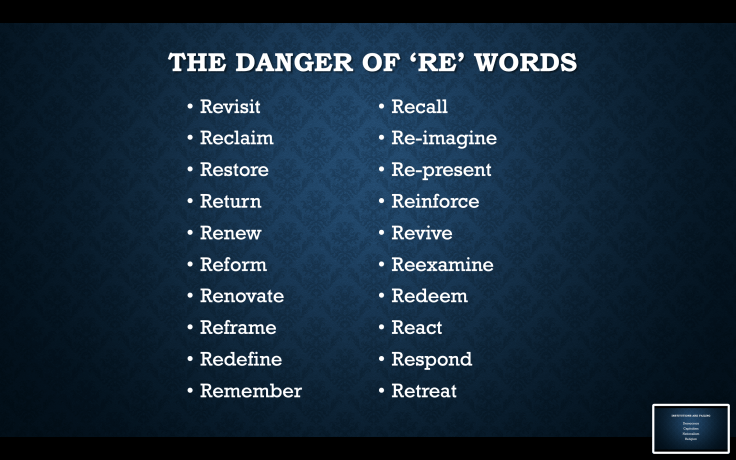
The Danger of ‘Re’ words.
But have no fear! God knows what (S)he is doing! God will get us through! Faith will get us through by God’s grace.
OK – so even if you are not as enthusiastic as I am about the future, which is fine (not many are) you need to be aware of dangers in romanticizing the imagined past.
SO what do we do?
Easy – Christianity is built for this! We have an incarnational gospel that is infinitely translatable to any language, culture, and time. God didn’t just work in the past. God is working in the present here and now.
We can bring about a preferable future by partnering with God’s spirit in the present moment. The infinite and timeless God is calling from the future into each moment providing us opportunities to say ‘yes’ and open up potentialities that were not always available in the past. This present moment is pregnant with possibilities for goodness and justice that don’t come embedded with the need to re-create, reinforce, and re-instantiate the layers of racism, sexism, and hierarchy inherent in past systems.
This is one of the unique aspects of Christianity that is different than other religions. We have a built in contextuality and translatability that gives us flexibility. All we have to do is repent and divorce ourselves from the marriage of religion and power – or to release the safety of empire and control.
That is what we are going to talk about next week: why things seem out of control.
For now let just say this: the past won’t save us. The future of faith is better than Europe’s past. We have nothing to fear but fear itself. God is at work in the world by Christ’s spirit. God is wanting and willing to work in and through us here and now. All we have to do is join God is the work that we were built for – and uniquely gifted and graced to do!
I am trying something new. Since everyone is reading the same chapter of the book each week, there is no sense in my just repeating that information or providing a slightly different take to supplement it. That is what I have historically done.
I am attempting ‘inverse preaching’ which is to take the idea and turn it inside out to see if it looks any different … or maybe it falls apart.
So for instance, at the start of the series I took the common thought (often attributed to Augustine) that ‘darkness doesn’t exist, it is simply the absence of light’ and inverted it to ask:
What if there is no such thing as light, but it is only the absence of darkness?
I take common wisdom like ” Jesus loves you” and says Jesus doesn’t love you as an individual – Jesus loves whole groups.
2019 is off to an frantic start so I wanted to give you an update about some fun I have been having.
At Vermont Hills I am enjoying a new sermon series. Two weeks ago was “God Loves Groups” about how the gospel has to be more than getting one small part of you (as an individual) to a good place after you die. That is too small a gospel.
This past week was about how the concept of ‘Hell’ functions in our psyche and how we need to take the sting out of this hellish idea. (Video below)
Progressive Bible Study (now called imBible Study) just finished the book of Ruth so Katie and recorded a Ruth Recap podcast that was a LOT of fun.
Sunday School (no called Brain Storming w/ Bo) is going through the alphabet. D is for Demythologize was a good podcast. E is for Emergence (and ecclesiology) comes out tomorrow. This Sunday is G is for Gay Christians where we are going to unClobber the Bible.
Let me know you thoughts. I would love to hear your comments, concerns, and questions.
Is the Christian religion inherently conservative? The answer is ‘no’ but you could be forgiven for thinking so. I am rarely discouraged. Yesterday I had a free hour so I googled ‘new books in theology’ and sank as I went from list to list.
Christianity, it appears at this moment, has no future.
98% percent of the books that I looked through were in some way related to the past – or worse – past oriented. We are a backward looking people as Christians.
This has been a terrible and ominous realization that I have come to over the past 15 years:
Christianity appears to be inherently conservative. It wants to conserve the previous structures and expressions.
We are in a period where the Christian religion is primarily past-oriented instead of present-centered and future-motivated.
I am always astounded at the number of spiritual/religious/theological projects that start with “Re-“
Revisit
Reclaim
Restore
Return
Renew
Reform
Renovate
Reframe
Redefine
Remember
Recall
Re-imagine
Re-present
Reinforce
Revive
Reexamine
Redeem
React
Respond
Retreat
It is as if we think that God worked better (or only) in the past and if we could only get BACK to that … then things would be better.
Make Christianity Great Again in a very real impulse.
I have also been looking at the phenomenon in our culture as a whole. Books such as:
So this impulse seems to be prevalent within our society but it is especially heightened within many churches and traditions. I get it. I used to really buy in to in. I wanted to have an “Acts 2” church, to get back to the Bible, and to do what Jesus did.
My change began when I bought into this idea of an ‘incarnational’ gospel that translates the gospel (good news of God’s love) into every language and in every place. Translatabilityis one of the unique aspects of Christianity that sets it apart from other religions.
The next step was looking at the radical changes throughout history and noticing that God seemed to work in every new era, in every new place, and with every new technology. Just start with the printing press and Luther’s protest(ant) reformation, the introduction of radio in the early 20th and the TV in the second half of the 20th century … up through today of people tweeting about how we need to ‘get back to’ and ‘reclaim’ the truth.
The third step was notice the irony of romanticizing the ‘Eden’ of the early church (as if there was only one) in an age of Christian radio stations, bookstores, schools, TV preachers, Study Bibles, megachurches, and the religious right. This romantization is somewhere between a mental imaginary and a commodity fetish.
The forth step was studying history and realizing that there was no ‘simple’ or ‘pure’ or ‘perfect’. It was always messy, complex, contested, and evolving. The creeds, the councils, the early canon, and even the Acts of the Apostles reveal this.
The final step is confessing that with the advent of capitalism, Christianity is being consumed. It is a product (or production) that is marketed and purchased by ‘church shoppers’. From the parents who pay extra to send their kids to Christian schools to disenchanted evangelicals who convert to Catholicism-Anglicanism or Orthodoxy, there is a component of consumerism that saturates the entire enterprise. [1] We are sold a distinct brand of religion.
As I travel, and as I get to talk to people from all over, I try to present a vision of the church or christian spirituality that is present-embracing and future-oriented. Some people are open to it but many people are really resistant. The resistance seems to be rooted in a different understanding of the past. A past that I do not want to return to and whose inconsistencies and injustices I do not want to repeat or reinforce. I want to learn from the past in the present, a
Is Christianity inherently conservative. Not exactly. It is for many folks right now. It might seem that we are in a conserving pendulum swing or at least that the brand of Christianity that is most visible (or loudest) is past-oriented. That is not the fully story however.
There is a kind (or type) of stream within Christianity that is socially engaged (present-oriented) and aware of the past enough to make corrections in the future. I hope to be a resource for people who are interested in a non-conservative approach to Christianity.
Next week I will talk about the dangers of reinforcing and repeating the past.
________________
[1] I get why people convert and I am not judging that. It is the absence of the capitalist component that concerns me. If there is no awareness of this facet of the ‘looking for a better brand’, then one might presume that it was only about ‘truth’ or ‘tradition’ or something more essential or substantial.
I was a worked with youth from 1996-2016 and saw a severe amount of change. I have also picked up some new tools as an academic that I hope will be helpful.
Millennial generation is burned out. We should believe them.
3 insights to help move the conversation along.
media culture and image
consumerism and branding
formed by our upbringing
Here is a short video. I would love to hear from you.
Normally I am allergic to modifiers. I find them deeply suspicious.
Why reference someone as female comedian or author? You don’t call Stephen King a male author or Jerry Seinfeld a male comedian.
Randy Woodley is often referenced as a Native American theologian. That is fine… but why am I not introduced as a white theologian?
The worst is ‘biblical’. Every time I hear it used I think to myself, “this is probably going to be inaccurate and untrue”.
People talk about biblical marriage but that is an imaginary. There are between 9-15 types of marriage in the Bible. It is the same with a ‘biblical’ worldview. There are 6 different worldviews in the Hebrew and Christian testaments. People want to say that scripture speaks with one voice … but have you read it ? I wish it did!! It just doesn’t.
All of that is to say that I DO have one modifier that I find helpful: Christian. Not like christian bookstores, or christian radio stations, or christian colleges.
I find the modifier ‘christian’ helpful when it comes to politics and the underlying motivation behind them.
Watch the short video and let me know what you think.





 Bo Sanders: Public Theology