Search

Bo Sanders: Public Theology

updating & innovating for today

Tag

ancient-future

Ancient-Future Faith: Invitation To Conversation

An ‘Ancient-Future’ faith is an idea that gripped me more than a decade ago and, even as I have emerged into a very different expression of my faith, I can not shake. As I have revisited and revised my participation and understanding of the Christian faith, this concept has haunted me in the best of ways.

On the TNT that will come out early this week, I talk about trying to hold onto this idea even as the author who popularized it seemed to go astray/ re-entrench from that original vision before his passing in 2007. I blame it on the post-911 Clash of Civilizations mentality that gripped many white men over a certain age. That is for another day. IMG_2907

I continue to be intrigued by the pairing of practices from previous centuries with communities and expressions fully embedded in the 21st century. There is something beautiful and powerful about matching these two. We are attempting to maintain a healthy continuity with the tradition that we have inherited with a vibrant incarnation in the world that we inhabit.

That is not an easy path to navigate. It is far easier (and more convenient) to either retreat into the romantic silo of the imagined past … or to adapt and adopt every cultural expression that comes into the mall or across the radio waves. Discernment is needed.

Discernment, however, happens after recognition.  Len Sweet*  was the first to introduce me to idea that we are moving from the Gutenberg era to the Google era. While there are many aspects of this cultural shift, the most striking is the shift from black & white words on a page to the multi-media world of image & message. The image and the message compliment (or reinforce) each other and sometimes serve to contrast or challenge each other.  This is something that us ‘digital-natives’ learn to negotiate early and easily. Some would call it second nature – which is an interesting phrase in more than one way.

Here is a video inviting people to our gathering at the Loft LA.  It is a little intro to some of the ideas that I’m talking about.

Ancient Future Faith from Bo Sanders on Vimeo.

I would love to chat with anyone who is interested in these topics. Here is just a quick list of ideas we might want to flesh out in an upcoming blog convo – just let me know below!

  • Sabbath
  • Centering Prayer
  • Ancient-Future Worship
  • Gutenberg to Google
  • The mosaic, collage nature of the 21st century
  • Community discernment
  • Collaboration & contribution
  • Continuity with the tradition & integrity with the moment
  • Post-christian apologetics

Mostly I just wanted to share some of what I am wrestling with in hopes of expanding the conversation.

I look forward to your thoughts.  in Christ -Bo

* another apparent victim of what we talked about earlier
Apple Updates & the Church

I have been thinking about the church and technology a lot lately. Part of it comes from planning to update a sanctuary constructed in 1951. Some of it has to do with recruiting a team to handle all the tech stuff at ‘church plant’. A bit of it came from the odd analogy that was used repeatedly about the ‘glitches’ related to the initial launch of the Affordable Health Care Act website and all of the sigh-up problems. People, including the President, said “yeah but even Apple has glitches when it first launches a product”.

An inexact comparison to be sure.

One of the questions that we are asking at the Loft LA, as we enter into our second year, is:

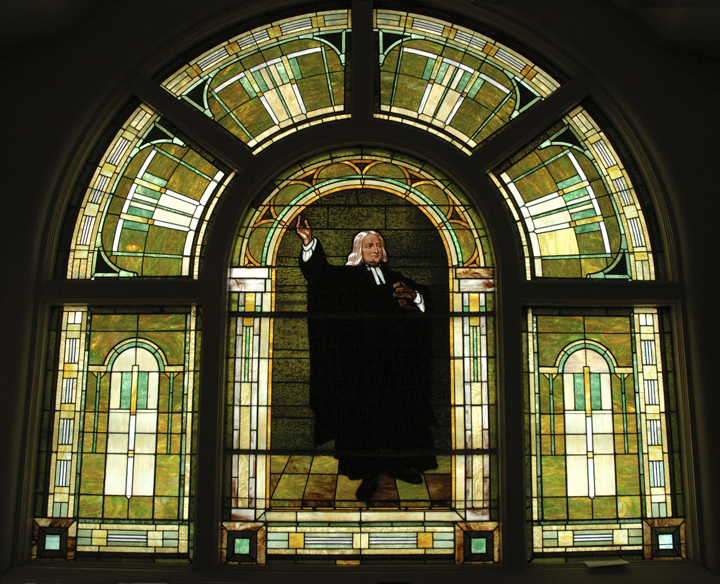
“What does it mean to use the Ancient-Future model of church in West LA?”17-85-BE3-134-08.0006-John Wesley

We come out of a United Methodist Church – which is a classic and beautiful expression of the Mainline tradition of Protestant Christianity.  The Loft is attempting to reclaim and hold onto the best of that inherited tradition … while at the same time engaging the culture around us in way that is contemporary and appropriate.
I’ll confess. It is a tricky section of water to navigate.

To use my favorite bowling analogy, there are gutters on each side that you want to avoid.
On the one side, you have a temptation to cater to the culture and concede so much of the Christian tradition that you have basically assimilated to the surrounding culture that you are nearly indistinguishable from it! This can happen in patterns of consumption, political views, sexuality, financial matters, or any other number of areas.

On the other side, you have the assumption that the inherited tradition, the given forms, are inherently relevant and effective in every place and in ever time since they were divinely delivered and historically proven. What this impulse to conserve leads to is reification of some previous era or expression of church that was culturally appropriate by which has since expired in its effectiveness in doing so. For a group whose gospel is, at its core, about incarnation … this is unacceptable.

This is why we think that the ‘Ancient-Future model’ of church is the best way forward for a young community.
Here is a short video about my recent experience with an old Apple TV that was given to me and why it triggered some thoughts about christian community for me.

Apple Updates and the Church from Bo Sanders on Vimeo.

In technology, when you fall enough behind on your updates, you can actually trap yourself with the inability to update. This is the definition of irrelevant. The christian spirituality that is employed in much of the North American church may be in this kind of danger. I am nervous that we are looking to get resources (updates) from sources (servers) that don’t exist anymore.

We are looking for solutions in things that don’t exist anymore.

The danger, for a religion that is at its core incarnation, is that the inability to be conversant with the surrounding culture in the epitome of irrelevance.

__________

Ancient-Future is a model that was popularized by Robert Webber before he changed his emphasis, focus and tone at the end of his life. His books on Faith, Worship, Evangelism and Time are supremely helpful and informative. 

My quoting him does not imply a wholesale endorsement of all of his works or thoughts. 

The Pros and Cons of Advent

Last Monday John Stewart did a very funny bit on the Daily Show about how Christmas has gotten so big that it is starting to take over other Holidays – what we used to call Thanksgiving is now ‘Black Thursday’ … Watch out: you’re next Halloween!

And in one sense, it is true. Christmas has become, as many have articulated, a frenzied orgy of consumerism. My dean, Philip Clayton, in a piece entitled “ Reflections for a Time of Madness” points out:

In an irony of history, the time of spiritual preparation and silent waiting has become the busiest, most frenetic season of the year.

 Now admittedly I am new to Advent. This will only be my third time through it. I have embraced it with gusto though! Last year I even bought a box of these amazing Liturgical Calendars and led a series of lessons on it in the Adult Ed. classes at our church.

In fact, when Stuart explains that the 12 days of Christmas is actually the period from Christmas day to Epiphany (January 6) when the Magi (Wise Men) are celebrated as visiting the baby king. The sad part is that just 5 years ago, that would have been news to me! I probably thought that not only was it the 12 days that led up to Christmas – but that I was showing great restraint to limit the season to just 12 days.

I love reading, listening to and even chatting with Phyllis Tickle and Dianna Butler Bass [one of my conversations with her] about all of the rich tradition and deep meaning that are to be found in walking these ancient paths.

And while I am very excited about the spiritual season of waiting and reflection, I have a new wrinkle in my fledging appreciation for the liturgical season. We have started a new emergent gathering (the Loft LA) that employs an ‘ancient-future’ sort of engagement.

This coming Sunday we are introducing the group to the Advent Conspiracy and I am very pumped to enter into the that conversation.

 I am, however, a little less enthusiastic about introducing the topic of Advent itself. In fact, we have debated, prayed and really wrestled with how to approach this. Our liturgical service (10 am) does Advent that the 9s. We go all out. We even hold off singing the famous songs until Christmas day – even though we have this amazing (and overwhelming) pipe organ that would be a huge draw for those who like to sing the classics in preparation for the big day.

 But is it worth it to bring up the topic to a crowd of newbies? My conviction is wavering.

Look, I love Christmas. I love the month of December and the lights and the presents and everything that goes along it with. I love singing Christmas carols in December! Do I really want to get into this counter-cultural restraint motif with new folks? Is it really worth initiating folks to this old way?

 Part of me says no! The ship has sailed – that battle is lost. Christmas starts before December in our culture and we should capitalize on that as the Church! Stop being such sanctimonious nay-sayers and pious do-rights and join the party! Plan, strategize, and engage the people around you at the time the are most christianly-inclined!

They are singing things like: 

Long lay the world in sin and error pining,

‘Til He appear’d and the soul felt its worth.

A thrill of hope the weary world rejoices,

For yonder breaks a new and glorious morn.

Fall on your knees! O hear the angel voices!

O night divine, O night when Christ was born;


Truly He taught us to love one another;

His law is love and His gospel is peace.

Chains shall He break for the slave is our brother;

And in His name all oppression shall cease.

What the HELL is your problem?
Get with the program!
Shake off the dust Church Lady and roll with the times!
Carpe Mañana

Then another part of me says Advent makes so much more sense – is so much more meaningful – and aren’t we preaching an anti-mammon counter-cultural message anyway? Maybe we should cave in to culture. Maybe we should concede to the bloated, grotesque, shallow, hollow consumer and credit card carcass that christmas has become.’  Maybe Advent is still worth doing … even with new people.

Maybe, especially, with new people. Maybe giving them an alternative to the frenzied and hectic mess that December has become is exactly how we could minister to and with them.

Or maybe Advent is just one more of these sentimental oddities that the church likes to hold onto and even prides itself on hanging onto until it’s dying breath. It’s not like we own Christmas. Wait … we do kind of have an invested interest … one might even say a market share … and by God – we are going to love it to death.

As you can tell, I am quite unsettled on the issue.  Thoughts?

 [please let us know if you grew up with Advent in your response] 

Blog at WordPress.com.

Up ↑