Search

Bo Sanders: Public Theology

updating & innovating for today

Tag

bible

Process, Cicadas and Time

Three things have been rattling around in by cranium while I was away this Spring.

1. The cicada’s came back. Every 17 years the Periodical Cicada Brood II emerges to rollick in the Eastern half of the U.S. for a brief but frenzied round of sex and gluttony. We will not see them again for 17 years. It is a phenomenon that always garners it’s fair share of bewilderment and awe.

cicadas

It is appropriate that this baffles most of us. We are set to think in perennial terms and oddities like this don’t fit that narrative. Underneath the soil right now is a massive swarm that we will not hear a peep from until 2030.

2. I was listening to an episode of Smiley and West’s weekly radio show while I was fixing up my parent’s house. The guests were Maceo Parker and Bill Ayers (interesting mix eh?). It was pointed out that sometimes, things just take time. Ayers’ example: Rosa Parks refused to give up her seat in 1955. It was not until 1963 that the march in Birmingham took place.

Ayers points out that not everything happens in quick succession. He said this in reference to the Occupy flare-up last year and why it appears that not much has come out of them.

3. Tony Jones had the response to Jack Caputo’s address at the Subverting the Norm conference. Point 2 of Tony’s 13 points was :

Process theology had its chance. If process theology couldn’t get traction in the American church under the auspices of John Cobb in the 1970s, I doubt that it will gain traction with his acolytes. Outside of Claremont (and Homebrewed Christianity), I hear little about process theology. I am not saying that popular theology = good theology; that would make Joel Osteen a theological genius. What I’m saying is that process theology did not capture the imagination of a critical mass of clergy and laypeople in its heyday, so I doubt that it will today. But maybe I’m wrong. Maybe Cobb was ahead of his time, and the church is only now ready for process.

I know that Process thought will always be on the periphery. It will never be mainstream… and I am o.k. with that. Some things just work better as ‘catchers’ on the outside of the whirlwind.

Here is the thing: many Mainline, progressive or emergent church expressions don’t make that many converts. Some may even think that evangelism is wrong/trite/passé/ or coercive.

You know who does make a lot of converts? The evangelical-charismatic branch of the family. They do.

But not all of their kids or converts find the theological answer persuasive or satisfying after a while. So there is always a large supply of folks cycling out of the evangelical spin-cycle looking for better frameworks and answers … and it just so happens that Process thought can provide that.

Process thought interacts with both Biblical Scholarship and Science with flying colors.

Process even has a built-in interface for engaging other religions. It’s perfect for the pluralism that our world and time are calling for.

Yes – you have to learn some new words and it is admittedly clumsy to transition into from a classical approach. We all acknowledge that. But … and I can not overstate this … if your unhappy with the frameworks that you inherited, what have you got to lose?   Your faith?

If the alternatives are to either:

A) close your eyes and choke-down the medicine

or

B) walk away from the faith altogether

Then what is the harm is picking up some new vocabulary and concepts that allows you to navigate the tricky waters of the 21st century?

I mean, what else are you going to do for the next 17 years while we wait for the cicada’s return?

___

I have been enjoying 2 big books while I was away:

Modern Christian Thought (the twentieth century) and Essentials of Christian Theology – both have significant sections of Process influence.

Cicada Picture: H. Scott Hoffman/News & Record, via Associated Press

Report Card For New Pope

This weekend I found two stories related to the first 100 days of Pope Francis’ tenure.

The first was a glowing review by an unlikely source. Esquire magazine had a blog that detailed some of the major  highlights.

It has now been a little over a hundred days since Francis took over the Vatican. He famously declared on his first day “The Carnival is over,” by which he meant that he wanted the Church to abandon its luxurious ways. But for Pope-watchers the carnival has just begun. There is serious upheaval in the Vatican, with outsiders brought into major positions of power, and Francis speaking openly of “a current of corruption” in the Curia, but, as an atheist, I don’t really care about any of that. I’m sure it takes guts and brains to try and reform the Church, but whether the Vatican is a strong or a weak institution is of the smallest possible concern to me. What is much more important is how he has used many small gestures to demonstrate the possibilities of compassion.

Read more: Pope Francis Awesome – Pope Francis Is Kind of Great – Esquire
Follow us: @Esquiremag on Twitter | Esquire on Facebook
Visit us at Esquire.com

The second story comes by way of the CBC news show the Current. You can listen to the fascinating segment about the attempt – and difficulties – related to changing the Vatican’s ‘bank’ system and some of the corruption that has recently been uncovered.esq-pope-xlg-14464425

These scandals are notable because the Institute for the Works of Religion (the so-called Vatican Bank) handles billions of dollars in trusts and holdings for the Catholic church. Pope Francis is attempting to change the culture of the hierarchy but scandals like this expose that corruption goes all the way to the highest offices.

Late last week, Italian police arrested Monsignor Nunzio Scarano, a high-ranking cleric in the department that manages the Church’s assets. Monsignor Scarano was already under investigation for allegedly laundering money, using the Institute for the Works of Religion — the so-called Vatican Bank.

Now, he is accused — along with two others — of trying to smuggle $20-million-euros out of Switzerland and into Italy, tax-free and undetected by Italian authorities. The arrests came just two days after Pope Francis launched a campaign to clean-up the Vatican Bank, which for decades has been accused of money laundering, corruption and links with the mafia.

While the famous foot-washing of Easter week was a wonderful symbolic act, and while he may be a fun and friendly character … it is matters like this bank scandal (and the billions behind it) that will determine not just the public perception of Pope Francis but ultimately the sustainability of the global Catholic structure.

As you may know, I went out on a limb the day he was elected by saying that this would be a game changer – so I like to keep an eye on his dealings. 

Your Spiritual Genius

I have been reading an inspiring book entitled Spiritual Genius by Winifred Gallagher. She looks at 10 ‘masters’ and the quest for meaning. One of the passages early on in the book has really stuck with me and yesterday I had the opportunity to present it as a ‘conversation starter’ (we don’t do sermons per se) at the Loft.

All of us use our spiritual genius some of the time. We might not recognize it as such, but we tap it whenever we “just know” that something is happening for a reason that, to paraphrase Blaise Pascal, “reason does not know.” Spiritual genius tells us that, despite the chaos and confusion around us, everything is all right, so we might as well be nice. It tells us that if we take on a worthwhile challenge, we’ll somehow find the necessary strength and help. It tells us that our true self is more that a bunch of personality traits and problems. Like a compass, spiritual genius always points us toward a reality larger than the ego and the status quo. Once we members of the meaning-seeking species find our place in the grand design, we’re able to gather up the pieces of our everyday lives, making a coherent picture out of what can seem like an impossible puzzle.

I tried something a little different by reading it like you would a passage of scripture and then circling back and going through it ‘verse by verse’. I thought I would post some of it here in the hopes of encouraging you today.

All of us use our spiritual genius some of the time. We might not recognize it as such, but we tap it whenever we “just know” that something is happening for a reason that, to paraphrase Blaise Pascal, “reason does not know.”

It is illuminating to recognize that you have spiritual genius inside of you. That is not to say that you are a spiritual genius or that you have a spiritual genius inside of you. What you have, however, is access to spiritual genius. Nov20sw1

There is a passage of scripture that talks about a “peace that surpasses understanding” and we can rest in that. By God’s spirit, we have access to a strength that transcends our ability to comprehend or master the information about the circumstances that surround us. We have stories in the gospels about a ‘power’ that is asleep in our boat in the midst of the storm. That old line ‘Hope was asleep at the back of the boat’ is a funny reminder that we are provided in the christian narrative a peace in the midst of the storm.

Spiritual genius tells us that, despite the chaos and confusion around us, everything is all right, so we might as well be nice.

I am the oldest of 4 siblings and developed a little bully streak when I was younger. I was a jock in high school (captain of the football and basketball team) and that fed my inner ‘jerk’. Pour on the gasoline of immaturity and I had a full-blown fire inside. I was prone to angry outburst and even into my early years of ministry, I would ‘vent’ in angry rants.

I repented of this whole fiery permission 7 or 8 years ago and have watched that fire crumble into a pile of little embers. Once in a while however, I am surprised that it will flare up out of nowhere. I have noticed a pattern: Every time I get angry it is a result of 1 of 2 things – either I am not getting my way or I don’t know how this chapter ends.

I have grown fond of talking about the ‘spirit of adoption’ from Romans 8:15 and Galatians 4: 4-7. This is part of your spiritual genius. When you receive the truth that you are accepted, approved and adored by God, there is peace and strength that surpasses your ability to understand your circumstance and allows you to be the full version of you … even though you don’t know how this chapter turns out.

It tells us that if we take on a worthwhile challenge, we’ll somehow find the necessary strength and help.

The walk of faith requires 2 things:

  1. That we participate in something bigger than ourself and are concerned about something other than yourself.
  2. That we step into that endeavor before we have secured all of the resources for it.

It is in that place that God meets us with that which we lack but so desperately need for the thing that we have been called to.

It tells us that our true self is more that a bunch of personality traits and problems. Like a compass, spiritual genius always points us toward a reality larger than the ego and the status quo.

Your spiritual genius begins with a confession that are more that the sum of things that can be measured. There is something about your life that is greater than what can be seen. The struggle is getting outside of the ego and not accepting the status quo. This means fighting for something that is both bigger than you and may not even profit you – it also means not accepting the ways things are as the way that will be or should be.

Once we members of the meaning-seeking species find our place in the grand design, we’re able to gather up the pieces of our everyday lives, making a coherent picture out of what can seem like an impossible puzzle.

Life is messy. It is mis-matched mixed-up collection of experiences, relationships, assumptions, attitudes and limitations.

Here is the possibility and the payoff however: IF you will bring your spiritual genius to the table, it makes us all better. When we all bring our spiritual genius to the table, each of us is better. 

You have spiritual genius in you. How do access it? On what worthy endeavor will you spend it? 

1st Chapters of Books: The New Materialism

I can not tell you how often I start a book and find myself thinking “This is going to be great!” ContentImage-63-220729-ContentImage63163974CrockettRobbins2

It doesn’t always turn out to be great… but there is almost always something in the 1st chapter that I would love to quote/riff on/incorporate.  The problem is that the rest of the book may not be very good OR it may turn into something that I am not sure I want to associate with/defend later.

I’m reading a book entitled “What Color Is Your God: Multicultural Education In The Church” right now. The subtitle is ‘examine Christ and culture in light of the changing face of the church”. The first chapter has some rockin’ quotes but I am nervous about the trajectory that the authors have set for the book.

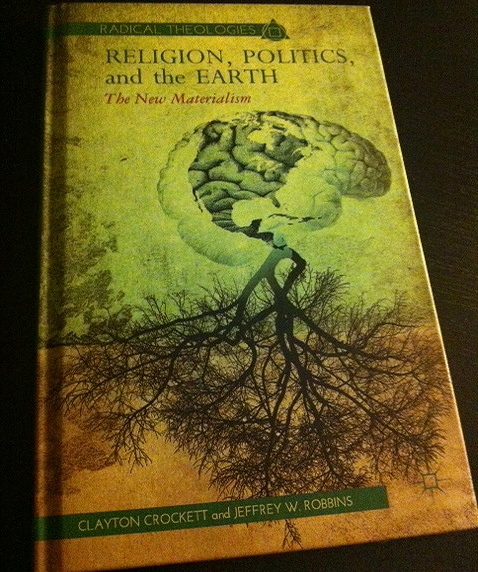
I have also started an in-depth reading of “Religion, Politics, and the Earth – The New Materialism” by Clayton Crockett & Jeffrey W. Robbins. I have skimmed the book in prep for a series of HomeBrewed Christianity podcasts on the subject but this time I am prepping for a reading group that starts next week.

I have been thinking for a while about sharing great quotes that I find here. My hesitation is that someone will get nit-picky about not having the whole context for the content … but I think that I am just going to do it anyway.

So without further ado, here is a challenging quote from the beginning of that Crockett and Robbins book:

We are witnessing the exhaustion of contemporary culture, a devolution to consumerism, greed, mindless entertainment, and the corrupt appeal of money and military power. We encounter numerous scenarios of apocalyptic crisis and collapse both in the popular imagination and in the real world. Globally—culturally and economically—our world has become tied together to an unbelievable extent, just to the point where it is fraying and fragmenting apart.
Witness the vapidity of most popular cultural modes: the saturation of consciousness by “reality” shows, recycled commercial jingles and right-wing talk radio, and the bleeding of news into cynical infotain-ment, the dumbing-down or corporatization of education and other phenomena.3 The most invigorating buzz is usually tied to a sporting event or an advertising campaign.

I’m going to try this over the next month as a fun experiment – sharing stuff I find intriguing.

I would love to hear your thoughts on the totally out-of-context introductory section.


Religion in America Update: Spring 2013

Last week 3 interesting items came across my radar screen.

  1. A new CNN poll entitled “America losing its religion”
  2. A NYTimes op-ed called “Belief Is the Least Part of Faith” by an author who specializes on Evangelicals.
  3. A God Complex Radio interview with Cameron Trimble on the Future of Church Renewal.

Each of these three caught my attention for a different reason. I want to try to connect them here and then listen to what you have to say.

In the CNN poll, it turns out that:

“More than three in four of Americans say religion is losing its influence in the United States, according to a new survey, the highest such percentage in more than 40 years.”  One-Room Schoolhouse

There are two interesting parts to that opening sentence. The first is that it is only people ‘saying it’. It doesn’t meant that religion IS losing it’s influence – only that it feels that way to 3/4 of those surveyed. The second point is that 40 years ago it felt much that same way.

The article points out two other times in recent history that the percentage was very similar. Those periods were 1969-1970 and then again in 1991-1994.

In the NY Times op-ed piece, T. M. Luhrmann, attempts to clarify a common misconception by those who do not go to church about why people go to church. She is arguing that it is not because of belief – but rather that belief comes from action (going to church/living out your faith) for those who go to church.

As interesting as her stories and finding were, the part that really caught my attention (as one who comes from an Evangelical perspective) is that :

If you can sidestep the problem of belief — and the related politics, which can be so distracting — it is easier to see that the evangelical view of the world is full of joy. God is good. The world is good. Things will be good, even if they don’t seem good now. That’s what draws people to church. It is understandably hard for secular observers to sidestep the problem of belief. But it is worth appreciating that in belief is the reach for joy, and the reason many people go to church in the first place.

In the God Complex Radio interview with Rev. Cameron Trimble was great. She is the director of the center for progressive renewal and Derek asked her about the future of the church. She had fantastic answer that are best days are not behind us. This piqued my interest because of the CNN poll.

When I think about these three items together, I come to two conclusions:

A) IF the churches best days are not behind us, then WHAT the church is in the future will be very different – almost unrecognizable – from what we have been used to for the past couple of centuries.

B) The way that we engage media, use technology, train future leaders and use resources – especially buildings – is so important because of the reason that Luhrmann said in the NY Times piece that people are even going to church. Trimble also points out in the interview that the reason people even go to church at all has changed in the last 50 years.

I would love to hear your thoughts on these trends and ideas. 

Be A Better White Male

Last week I was a part of conversation about privilege and racism/sexism/oppression. I was asked about some simple starting points and this is the list that I came up with.  I know that it is flawed and limited but it might be a good start.RoadPortraitSunsetD&B

I would love hear your additions.

I will venture to get this started – the suggestions are going to be provisional at best and will need to be supplemented (heavily) by others.

  1. Assume that you are definitely part of the problem and only possibly part of the solution.
  2. Put yourself under the leadership/care of someone or a group that is not like you in race-gender-sexuality. So … if you go to George Fox Evangelical Seminary in Portland and it is time for you write your Master’s thesis, ask Randy Woodley, Roger Nam or Mary Kate Morse to be your adviser.
  3. Listen to them. Just listen.
  4. Resist the temptation to ask questions that have numbers in them. Like don’t ask “how hot does a sweat-lodge get and how many rocks are used?” or “what percentage of people would be X ?”  White guys love numbers – it’s a european enlightenment thing I think.
  5. Listen some more and do not discredit any of it – don’t allow yourself to think ‘that seems over the top’ or ‘it couldn’t have been that bad / blatant’. Don’t do it. You will want to. Don’t.
  6. Buy books by people that are not like you in a greater percentage than ones by white males. Start with Randy Woodley’s Shalom and the Community of Creation and Mary Kate Morse’s Making Room for Leadership.  You will not be sorry.
  7. and most importantly! – do what they tell you. No… Do what they DO … if you can. If they say ‘Don’t go to that conference’ cancel your plans. Even if you like the topic and you will lose money. If they say ‘This group could use some volunteers’, ask them if that is something you could do. If they tell you that they are doing something next Saturday, ask if that is something you could come to. Cancel the other thing you were going to do. Someone else will probably do that other thing.
  8. Assume that you are definitely part of the problem and only possibly part of the solution. You will make mistakes. It’s ok – we all do. The problem is so large and so seemingly insurmountable that we can not afford to get dis-couraged or to entertain allusions of grandeur.
  9. This is gunna take a while. Pace yourself. Embrace your spirituality in a new way – you will need it for the long haul. Don’t chuck it like so many do when they figure out how shitty the world is.
  10. Listen to the Smiley & West podcast every week.
  11. Whenever you are in a group do not use your whole percentage of air-time. If you are in a discussion with 3 other people – don’t talk 25% of the time (let alone 50). Use less than your percentage. I’m not saying ‘don’t talk or ask questions’. We don’t need to be silent … just use less than your 25% allotment.

Please let me know any additions or adjustments that you would like to see.   -Bo

Emergent Preaching?

A good question can stimulate the brain to put together things that one had not previously connected. Stuart Harrell asked my a question about what a course on emergent “preaching” would look like. Here are some of my thought – I would love to hear yours.

GtMeadow

My cleaned up tweets are posted as bullet-points with a clarifying thought following. 

  • You would want to immediately address message and medium. It’s not just a repacking of the same old material.

What we are experiencing in a genuinely different expression of the good news. I watch lots of video clips of hip – fashionable – edgy young preachers who are still on an elevated stage using the exact same forms as the past 100 years … only they have added video clips and hair gel.

That is not what we are talking about. That is just lipstick on pig 🙂  not that I really believe that old-school preaching is a pig, I just love that phrase.

  •  #EmergentPreaching would involve scripture, culture, media, dialogue, experience & impartation to start.

The ‘problem’ with emergent thought is that it is neither reductive nor is it reproducible. It is environment specific (contextual) and organic. It interacts with its surroundings and emerges from its participants. It is a different animal from day 1.

  • I have given a LOT of thought to Emergent Preaching since my dad is a homiletics Prof. & I helped start The Loft LA recently.

One of our biggest glitches is that our ‘gatherings’ don’t translate to podcasts or video very well. We planned on being media savvy but the ‘sermon’ is broken up into conversation starters, dialogue, small groups, feedback and presentation. It’s kind of messy and we are still trying to figure out how to ‘capture’ it authentically. I think that we are going to start just throwing it out there unedited for members who missed that week in case they want to catch up.

  • the task of Emergent Preaching would deal with issues of power, voice, dialogue, participation, action, justice & cultural stuff.

This is where the medium must be addressed along with the message. HOW we do something is as important as WHAT we do.

Proclamation is a vital part of the Christian tradition. We don’t want to lose that! We address the form as well.

Why is there one person talking anyway? How is that person chosen? With what authority do they speak? These are essential questions to ask.

  • Assumptions of culture, the gospel, power, structures, and orthopraxy are vital to address in thinking about.

We are always attempting to do at least two things (this is true for every area of life). Side note: this is why saying that sex is only for procreation is ludicrous.  So it is incumbent upon us to concern ourself with present cultural realities as well as desired outcomes – because we preach an incarnational gospel that must be in-bodied (embodied) to survive.

  • One would have to pull back the curtain & examine the scaffolding (assumptions) that hold the entire project up.

This is the tough job of deconstructing a constructive theology. There is no easy way around it.

  • It would be part Liberation, Feminism, Walter Wink, masters of suspicion, biblical scholarship & philosophy.

There is just no sense in even attempting to do proclamation in the 21st century under the auspices of emergence without this. Emergent Preaching would need to be well-informed and undeniably self-aware at some level. This seems unavoidable.

  • But it would also have to be rooted in history, hermeneutics, scripture and praxis. Those are my thoughts on Emergence Preaching. 

In the end, we preach the christian gospel and not some form of god-ness or spirit-uality. We are the church after all. Accounting for history, hermeneutics, scripture and praxis is tall order. But what is the other option?

I would love to hear your thoughts on my little list and see if you had any additions. 

Problem is that new Pope isn’t Protestant enough

It has been amazing to watch both the amount of reporting and the kind of reporting that  Pope Francis’ style has drawn. You can find stories about him in major magazines, on every news website … even the Daily Show gave some hilarious attention to the hype.

I was on an Australian radio show the day of his election – they liked the angle that I had taken on my blog focusing on the Southern hemisphere. [you can listen to the 4 minute clip at the bottom of this post at HBC] I was on after the Australian Ambassador from Argentina.

Some of my co-workers are Catholic and Pope Francis’ dealing provide us with every-other-day content for our coffee-pot conversations. Even my wife, who is generally not that interested in such things, is into it.

She asked me, on a recent road trip after several news stories, why I thought people were so into Francis.  I have three thoughts and would love to hear other’s thoughts.

  • There are still 1.6 Billion Catholics worldwide. That is 1/6 of everyone on the planet. Who is their leader matters a lot.

I know that not every Catholic listens to the Pope and that the Pope does not influence every thing … but it is still a big deal.

  • Between the elaborate displays of the Vatican and the global sex-abuse scandal – both of which are hard to figure out from reading the gospels – the Catholic church has been having a rough time of it in the court of public opinion.Pope-Holy-Thursday_2509139b

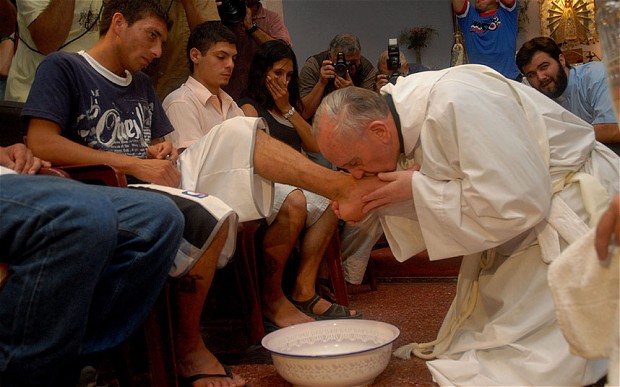
Francis’ style is not just a breath of fresh air – it is substantially different. What he did on Maundy Thursday was not just a ‘break with tradition’, as reports kept repeating, but was significant. Washing & kissing prisoner’s feet instead of priest’s is not window dressing

  •  Protestants seems to be fascinated with Pope-drama like Americans are fascinated with Royals. I don’t really get either.

It’s like we are enamored with the figure-head of the thing we left so long ago. I chalk it up to some sort of fetish thing for regal gowns, bejeweled crowns and antiquated (and sometimes secret) ceremonies.

There is one problem though. Protestants seem to want the Pope to be more protestant.

Almost all of the critique or concern I heard about him is something that would be more emblematic of protestant values or approaches. He is following the church’s traditional stance on (just to name 4):

  1. Contraception
  2. Celibacy
  3. Women in ministry
  4. Homosexuality

I want to holler at people when they are disappointed in this

“Of course he is – otherwise he wouldn’t have been elected Pope”.

It feels to me like somebody saying “I like the new Miss USA … I just wish she was built like a Linebacker in football.”   Well … I hate to break it to you but that’s not going to happen. In fact, people who are built to play linebackers don’t make it to the Miss USA pageant. That is just not what the judges are looking for.

What I wish we would instead focus on is his economic dealings, immigration issues (he is the son of immigrants) and out-reach to non-Europeans. I continue to claim that just those 3 will make this a game-changer.

I would love to hear your thoughts. 

God After Easter: Jesu Babushka

Easter turns everything upside down. The temple veil is torn in two. The sealed stone is rolled away. The dead are made alive. In darkness we have seen the light. The powers are defeated.
I have friends who are transitioning back to paycheck & mortgage N. America after 15 years of international missions. For some reason they were on my mind all day as I went through the Easter services, egg hunt, and Loft gathering.
There is something about Easter  that haunts me.

babushka_2-t

Our conceptions of God are so powerful and how they impact our life is so fascinating. I wrote a sermon about this several years ago while in the Ukraine: I call this aspect of God  ‘Jehovah Babushka’. I got it while watching an Ukrainian grandma (babushka) knead dough.
It’s like God is always punching into the dough our life – to break the crust of the outside and expose the raw stuff on the inside. Always turning us inside out to expose that which is  in need of the air in order to develop and mash that which is crusty into softness again.

The story of Jesus does this too. He welcomes in those who had been on the outside or stuck on the periphery.
He pushes out those who assumed they were center.
He brought low the arrogant and the prideful.
He lifted up the lowly and the downtrodden.

He said it’s not about sacrifice or even law anymore.
He broke the crust of the old system to expose the loving heart of god to the world.
He turned the raw goo of the disciples out to the world as his public representatives on earth.
The spirit of god crashed in at Pentecost to turn upside down the priesthood.
Now we are all ministers.
The priesthood has been turned inside out and upside down.

God calls us to season of loneliness to expose our need of people. God uses tough encounters with people to show us something about ourselves and hopefully smash our conception of God – exposing the immature and underdeveloped while breaking in through the stale and crusty images we have allowed to become cliché.

Our idolatry of God is pressed out so our true identity can be pressed in.With Jesus there is no longer a female-male divide. There is not slave – only free. Jews and Gentiles are both connected to God.
Jesus smashed those old crusty categories.
The faithfulness of Jesus (pistis christou) mashes our certainty that we are saved by having faith in Jesus and exposes the raw reality that we are called to participate in the faithfulness of Jesus and that is what brings salvation to the world.Jesu Babushka kneads all the gas out of the dough – presses all the air pockets so that the finished product is fine and consistent.
All of this, of course, is only in preparation for the chemistry (yeast and rising) transformation to kick in and the eventual baking (heat) of the oven.

Who said faith was going to be easy? Or did you think Easter was all jelly beans and pretty dresses?

Create a free website or blog at WordPress.com.

Up ↑