Search

Bo Sanders: Public Theology

updating & innovating for today

Tag

book

Liberal Question part 1: Rick Warren

A couple of weeks ago, Rick Warren provided some of us with a lot of fun on Twitter. He had sent out a message:

“New churches: Buy land as soon as you can but delay building for as long as you can. Cant explain all the reasons here.”

This set off one of the funniest followup memes I have seen called #RickWarrenTips.

Those, however, are not the Warren tweets that I want to discuss. Earlier Warren had fired two out of the blue shots at ‘liberals’. I had just finished my progressive and liberal post at Jesus Creed and so I was really interested.

Here are his two quotes:

Liberal theology cannot sustain a local congregation. It kills churches. In fact, It only survives due to tenured academics.

and

Liberal theology has never created any university. It just sucks the life our of those that were started by Bible believers.

Plenty of people had push-back on the last bit of revisionist history.  I’m not so concerned with the accuracy of his content …my question is what even spawned  or sparked it? 

What happens for somebody like Rick Warren that causes him to fire this out?
Was he reading something that has him thinking about liberals?  

Did he get in an argument with someone?
 Was he watch watching something on TV about liberals?
Was he watching Fox News or something?

I’m not so much asking for wild speculations about Warren in particular – I’m more thinking about the contentious and combative polarized atmosphere that shots like this are fired out of.

Evangelicals Really Dislike Lent

My friend Krista Dalton tweeted last week:

Was told Lent was “stupid” by a fellow Christian at school. Good reminder why I am not evangelical!

I had to fes’ up to her that I used to say crap like that and I repented.

So what is it about Lent that evangelicals hate so much? I have a two-tiered theory. 

The first involves a Theology of Glory. The second is not a cause – it is an effect – but it is born our of strangeness and suspicion.

Theology of Glory

Back in Christian history, back to the roots of evangelicalism in the Protestant Reformation, are two major approaches (if you will). The first is a Theology of the Cross held up by Luther. The second is a Theology of Glory brought forward by Calvin.

I don’t have time to get into all the sorted details, but suffice to say … that the American evangelical church has not just majored in a Theology of Glory but almost to the near neglect of a Theology of Cross.

Here is a really helpful article on the differences:

“Theologies of glory” are approaches to Christianity (and to life) that try in various ways to minimize difficult and painful things, or to move past them rather than looking them square in the face and accepting them. Theologies of glory acknowledge the cross, but view it primarily as a means to an end-an unpleasant but necessary step on the way to personal improvement, the transformation of human potential. As Luther puts it, the theologian of glory “does not know God hidden in suffering. Therefore he prefers works to suffering, glory to the cross, strength to weakness, wisdom to folly, and, in general, good to evil.” The theology of glory is the natural default setting for human beings addicted to control and measurement. This perspective puts us squarely in the driver’s seat, after all.

It’s not that we don’t like the cross – oh we love the Cross – we sing about it (the wonderful cross) and we wear them around our necks!

It’s so bad that Dallas Willard has coined the phrase “Vampire Christians” for us. He says that we love Jesus for his blood and little else. Ouch – that one stings.  Wooden Cross

It shows up in other ways too. We are almost completely ignorant of the apophatic tradition. We are so kataphatic (speaking of God in the positive) that we have no idea that there are other options! We have no negativa or posteri – it is all presence all time.

Look at our worship services. Just ask yourself: what would it take to lift your hands and sing “Shout to the Lord” at the top of your lungs … and then ask if that seems compatible with fasting or Lent.  They are just two different muscle groups. Unfortunately, those who use the one often neglect the other and vice-versa

Strangeness and Suspicion  

I’m not saying that this element causes the unfamiliarity – but once there is alienation this next element adds fuel to the fire. The suspicion is syncretism.

Think about it this way: Lent isn’t in the Bible. Historically evangelicals have been a sola scriptura bunch (don’t look into that too much) and Lent is a foreign concept. It doesn’t’ take long to dig up some dirt on Lent and find out that it has its roots in Egyptian-Pagan worship borrowed by the Roman cults. Isis lost a son for 40 days so we mourn for 40 days and then have Isis eggs that are colorfully decorated is the story that come to me.

So, I’m not saying that explains all of the animosity that evangelicals have toward Lent, but I just wanted to offer up my two-tiered theory.

It starts with neglect and ends with accusations.

It’s same reason that we kinda try on Good Friday … have NO idea what to do on Saturday … but LOVE Resurrection Sunday!


Critical Questions: part 1

Pepsi Super Bowl XLVII Halftime ShowOriginally published as ‘Beyoncé and the Bigger Question’.

Over the last 2 weeks I have watched  the blowback over the Beyoncé SuperBowl Half-Time Show with great interest. I have read several interesting articles – both in support and in criticism – of the spectacle.

This is a part of what is becoming a theme for me. I will link to part 2 and 3 as I post them today.

I get why people want to talk about her outfit, her moves, and her assembled cast of all females – about modesty, sexuality, and female empowerment. I get why those are conversation points.

What is becoming a trend, however, is that I have little interest in that conversation – not until we have a more significant conversation first.

I think that it is time I lay all my cards on the table.

While I was in seminary, my mentor Randy Woodley, showed me how to look at bigger systems and structures than I was used to. I have continued down that road and during my time at Claremont have been in dialogue with a school of thought called ‘Critical Theory’.

Critical Theory has taught me to ask 3 initial questions in order to examine an issue:

  1. Is there a pattern visible?
  2. Is there something behind the main thing?
  3. Is there any issue of power differential?

The Critical part is that we are going beyond the initial perceptions, the popular approach and the cultural conversation. The Theory part is that we are going to see if we might offer an explanation about the deeper issue.

SO let’s ask our 3 questions about the SuperBowl Half-Time hullaballoo.

  • Is there a pattern visible?  

I would argue that there is. I noticed it just before kickoff – during the Nation Anthem to be specific. Alecia Keys was introduced, Jennifer Hudson had just sang with the kids from Sandy Hook … and I knew that Beyoncé was the halftime show.

I thought to myself:

“It’s odd that the only 3 black women involved in this TV spectacular are all singers.” Pam oliver

I noticed that CBS didn’t even have a black female sideline reporter like Pam Oliver (on FOX) for its NFL broadcasts. I watched the rest of the festivities – including all the military stuff – and was struck by the noticeable lack of black women associated with the event. Walter Payton’s daughter presented Jason Witten with the NFL Man of the Year award … but that was about it.  None of the coaches or commentators … not even many of the commercials involved black women.  This seemed significant since so many of the on-screen TV personalities, coaches and players are black.

  • Is there something behind the main thing? 

It is easy to see the answer to this one. The answer is consumerism. While the game itself is ‘the main event’ the commercial aspect of the SuperBowl has become at-least or almost as big. Commercials this year sold for a reported 4 million dollars a piece. Like the controversy we covered earlier in the ‘So God Made a Farmer’, commercialism-capitalism-consumerism is the unspoken thing.

It might be hard to see in a short blog post like this but Beyoncé isn’t the telling controversy. The more telling one was the criticism of Alicia Keys’ soulful rendition of the national anthem. People criticized her not just for sitting at a piano (!) but for altering the tried and true version of the song.

In CT when something is assumed – even if unstated – as a dominant form, it is called hegemony. It is a type of power or influence that may or may not be overtly communicated. If one were to look at just the first half of the SuperBowl broadcast, it might be possible to say that the major narrative when it comes black women is twofold:

  • you can sing – we like that.
  • but make sure you do it our way. Don’t do anything too much or too … you know… that’s not why you are here.
  • Is there any issue of power differential?

This is the one that we never get around to talking about. Maybe it’s because we don’t know how to or don’t have frameworks for it.  There is a question that needs to be asked though: who decided that Jennifer Hudson, Alecia Keys and Beyoncé would sing? What did that committee look like?  Who are in those seats of power?

Did the group that decided who would sing look like Jennifer Hudson, Alecia Keys, and Beyoncé?

I don’t know, I’m asking an honest question. It’s the tough question that no one wants to ask. Who has the resources? Who has the influence? Who makes the decisions? Who sits in the seats of power?

Now you can see why I am not interested in talking about whether Beyoncé should have had more clothes on, should have gyrated less or is a model for taking back one’s physicality in the face of generations of oppression and marginalization. 

Those are all secondary conversations.

The primary conversation is about what place black women hold in our culture.

It is a much bigger conversation with much deeper consequences than if Beyonce’s hips and wardrobe were appropriate for a Half-Time show.

So God Made A Farmer – and other kinda true sentiments

Not feeling so well, I watched the Superbowl alone. When the commercial came on that featured Paul Harvey reading his ‘so God made a farmer’ piece, I thought “nice tribute” – and nothing more.paul-harvey-so-god-made-a-farmer

I woke up the next  morning to find a buzz surrounding the spot – both good and bad. Some are claiming it the winner of the prestigious ‘best SuperBowl add’ and others are decrying it as a rip off and an overly sentimentalized piece of blatantly romanticized platitude.

I am fascinated with the power of words and specifically how, in our culture, there seems to be no understanding OF language and examination of its use. We act like words are just what the appear to be – but don’t look at how the function to re-present (or signify) a greater reality to us.

Earlier that day at church we had a major conversation about masculine pronouns for god and use of the word Satan. We are going through the book StoryLine by Donald Miller and not only does Miller only refer to god as ‘He’, but god only has classically masculine attributes. I got taken to task for selecting the book as our new year reading.

My defense is that ‘it’s just language’. So while it may not be the best language, I never thought that we would swallow it whole – hook, line, and sinker.
When it comes to the ‘Satan’ thing, yes – I wish that Miller had used ‘the devil’ or ‘our enemy’ or ‘evil’ or ‘darkness’.  I assumed that we all knew it was a kind of personification. Maybe I am just secure in second naiveté for my own good. I didn’t know that we still had to clarify that we don’t believe in an actual ancient cosmic bad guy but that it was a way for us to talk about forces that hurt us and others and destroys the good that God has called us to.

Earlier in our gathering we sang the song “How can I keep for singing your praise” and it has the line “I am loved by the King, it makes my heart want to sing.”    It’s how language works! It is an analogy. It is comparison. It is not exacting or mathematical.  No – I don’t think that god is literally a King. The age of monarchs is over … it is just a classical way to conceptualize. It’s poetic.

Side Note: I have been clear that language about god is not univocal. It is not a 1:1 equation. I have also talked openly about female pronouns for god (in God never changes, or does She?So-God-Made-A-Farmer

Which brings us back to Paul Harvey’s “so God made a farmer”. Of course god didn’t make a farmer – it is being poetic.  Someone might say “well God did make Adam to care for the garden and to work the soil.” Which is a fair enough point … but in saying that, we are not saying that God made a modern farmer who uses double-axled combines and herbicides made in laboratories.

I am suspicious that the reason that we would either get so excited or so upset is if we were lacking a theory about how language works.  Then I have to remind myself, we are the same country where a lot of people try to read the book of Revelation as literal – a completely novel way to read the Bible that has sprung up in the just the past 200 years.

So maybe that explains both  the accolades and the criticism of the ‘So God Made a Farmer’ ad. If you don’t get imagery, poetry, analogy … and think that language represents exactly what it signifies … then I suppose this one would be worth getting all fired up about.

When we say that God created a farmer – we don’t mean that God literally created a farmer. It is a poetic tribute. Noting more. Not worth getting fired up by or upset about. It’s just nice language.

________________

I would be remiss if I didn’t point out that there is a huge racial component to the controversy that I didn’t even get to touch on! If you are interested in an examination of that aspect please see this article in The Atlantic about the WhiteWashing of farming 

Doug Pagitt Radio: what is going on IN religion

I had the honor to be on Doug Pagitt Radio yesterday  morning. It was a great conversation with Doug and Victoria that centered about what is happening in religion.Web_Logo_lrg_wTagBubble

You can read the initial blog about religion and postmodern thought here.

Doug has the video on his website and on Itunes.

Here the video of the first segment. Here is the video of the second.

Doug has been on Homebrewed several times. Once talking about his books in the Inventive Age, and once chatting with Tripp about politics (in a post-debate debrief).

Check out Doug’s book on Amazon.

Most the conversation centered around my proposal that there are at least 5 things happening in religion:

  • Experience
  • Formation
  • Event
  • Mystery
  • Potentially Something Real

I would love to get your feedback on the interview. Brew on!   -Bo   [you can keep up with all my past posts on this page]

Barna and the Burned Over Region

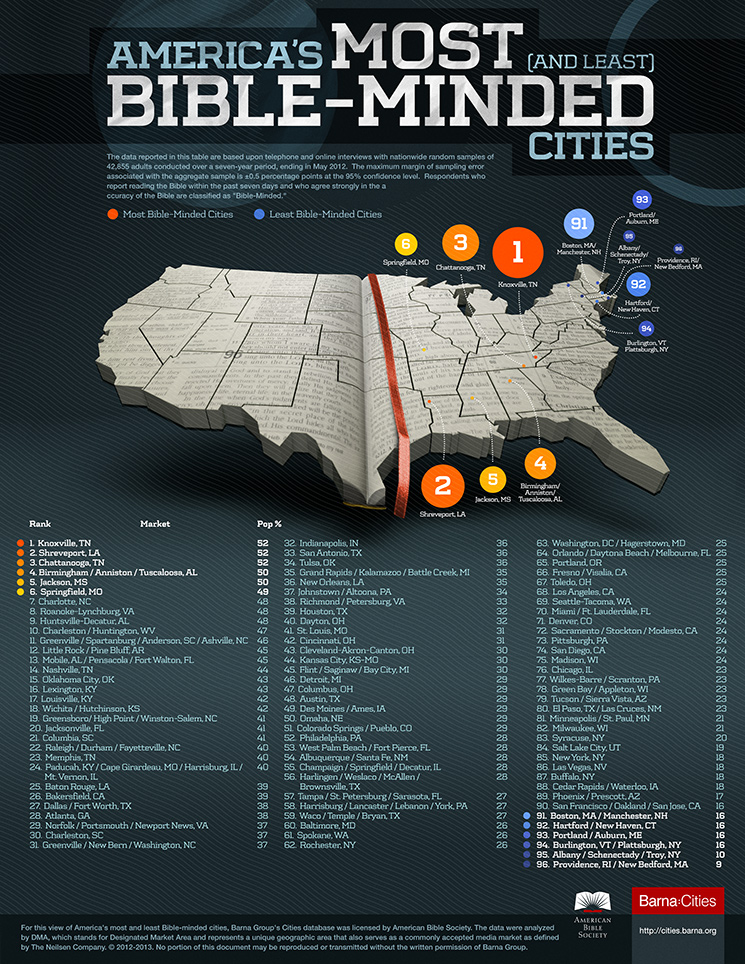
Barna Research put out a fascinating list of America’s Top 100 most ‘Bible-Minded Cities’.  Its not the top 10 Bible cities but the bottom 10 that are so telling! barna_biblemindedcities_preview1

The bottom 10 are:

  • Boston, Mass
  • Manchester, NH
  • Hartford/ New Haven, CT
  • Portland/Auburn, ME
  • Burlington,VT
  • Plattsburgh, NY
  • Albany/Schenectady/Troy, NY
  • Providence, RI
  • New Bedford, MA

It really caught my attention for 3 main reasons.

1. When I was in college I was an evangelist and Barna was our go-to source

2. During that time a common mantra in my circles was that ‘the Pacific-NorthWest is the most unchurched are in North America.’

3. After college I went to help plant a church in upstate NY (near the VT border) and grew suspicious about that Pacific NW thing.

I had spent time in the Pacific NW and while there were lots of unchurched people … there were also tons of churches – but specifically big churches aggressively engaged in the culture wars.

In the New England (or NorthEast) region, it was different. There was a cynicism is had not seen. Not a coffee shop atheism like the west. I deep suspicion unlike I had encountered.

 This came to a head for me when two roads converged. 

Ingredient 1: I was charismatic and had bought into a thing call “Re-digging the Wells of Revival” where you go to places where God has worked in the past and, through prayer, you try to unplug that ancient well of what God wants to do to release the anointing that once flowed.

I lived in area that had seen large revivals in the late 1800’s and early 1900’s. In fact, the denomination I was a part of was founded in the region and still had some of the revival tabernacles as properties! I would go to the  one closest to my house (Round Lake, NY) and pray for revival to sweep our area again.

I even started doing historical research. I stumbled into something. It was called ‘the Burned Over region’. It turns out that the much celebrated  revival had burned through so fast and so hot that when it was over … a cynicism had set into many people. Families that had given large amounts of time, sums of money and even family jewelry collections grew bitter.

A problem developed for me. The circles I was running in were celebrating the 2nd Great Awakening and other historical renewals of the church. I was growing suspicious and that altered my prayers.  I stopped praying for the same kind of revival we say 100 years ago and started praying for a different kind that didn’t leave generations of families bitter and broke.

 Ingredient 2: I went to a Barna Conference in western NY (Syracuse or Rochester area).  I sat there the whole time shaking my head as Mr. Barna presented to a packed massive auditorium. The finding that he was presenting were not exactly true of my area.

I had read a book by that point called “The Nine Nations of North America” and had begun to concoct a theory that merged (for churches) the New England of Nine Nations and my findings in Burned Over research. When you put those two together it really explained a lot.

 I kept saying to myself, “Even NY is different east of the Hudson river. From Albany east NY is more like New England than like Western NY and Pennsylvania”.

After Barna’s presentation I voiced my suspicion and that was not greeted well by my denominational cohort I was attending with.

I even brought up the Pacific NW thing and how out there you can hear 3 big christian radio stations and find a christian bookstore every couple of miles. We had neither.

The Pacific NW had mega-churches. We had one church over 1,000 and people in our area were suspicious that it was a cult, “because how else could you get that many people to all come and sing the same thing at the same time and then listen to one guy talk for a half-hour?”

 All of that is background for this past weekend. Barna put out a fascinating new list of the 100 most biblically minded cities. You can go read the article to see how they configured that.  The 2 most important things to me:

1 – the top 50 are East of the Mississippi River (except for Bakersfield, CA).

2 – the bottom 10 are all in NE or that NY Hudson River basin.

To me this says two things. First, the Bible Belt is a real thing and when combined with something like ‘Nine Nations’ is potent to think about.

Second, The bottom 10 are all in the burned over region and should give us concern about what 100 years from now will look like. I know that there are lots of factors over the last century and that someone will say “the past is not the future” and I get that.

But as one who a) studied this, b) while I lived there, and c) called it out in real time… I’m telling you –

The bottom 10 of this thing are far more relevant to our future than the top 10. 

What is going on IN religion when we talk about God

This weekend I will finish reading two books that we were given through the podcast (thank you publishers). The first is Peter Rollins new on The Idolatry of God and the second is Phil Snider’s Preaching After GodMP900405058

I have recently edited podcasts with both of these authors. [We put out the Phil Snider TNT last week ]

It is very clear to me that we have an emerging situation (trying not to say problem) on our hands. With the introduction of a new wave of postmodern or ‘radical’ theology [listen to the Caputo introduction here] – progressive and emergent christians are drinking in lots of innovative and challenging concepts about God that may not have a real God behind them.

This is fine IF the listener/reader knows what they are imbibing. What is increasingly concerning for Tripp and me is the consequence when people don’t know that the god of the 21st century philosophers is not exactly the god you hear about on Sunday morning.

Is there a danger in people reading a ‘how (not) to speak of god’ and then just quoting it from the pulpit like they would quote any other historical person?  Folks in the deconstruction camp are not real eager to answer this one.

I have some thoughts on the matter so I thought I would throw them out here for consideration.

 Intro: It is severely unhelpful to frame this in an either/or way. “Either God is X like the Bible/Creed/Tradition say OR Religion is the equivalent of Santa Clause &Tooth Fairy and we might as well all go home.”

That reductive approach is foolish and silly.  There is far too much going on in religion – and the Christian religion specifically – to say things like that.*

 I propose that there are – at least – 5 things happening IN the christian religion:

  • Experience
  • Formation
  • Event
  • Mystery
  • Potentially Something Real

Experience – People who were not raised in the faith convert and/or have crisis experiences that powerfully impact them.  People experience the presences of something they interpret as bigger than themselves.

We can talk about transcendence or phenomenology but what we can not deny is that people experience something in religion. As someone from a charismatic-evangelical background it is so clear to me that much of our talk about God and religion in progressive-emergent circles misses this very real component.

Is experience the whole story? NO! And those who reduce it down to that are equally as errant. It is not the main thing nor is it nothing. It does not account for everything but neither can it be dismissed outright.  People’s experience must factor into the equation.

At minimum do the Kantian thing and say that religious people’s experience is real but incomplete to understand the whole picture (noumenon) – like 6 blind people with their hands on different parts of the elephant – each thinking they are describing something unique: a tree (leg) a rope (tail) a wall (belly) and a giant leaf (ear) and an enormous snake (trunk).

Formation – I get in trouble for liking the post-liberal writing of George Lindbeck (Nature of Doctrine) but I think that this is exactly where it comes into play. The role that the christian tradition, sacred text and vocabulary plays is that forms us a people. It forms character within us as well as the way that we participate in community.

I am in dialogue with the work of Alasdair MacIntyre (After Virtue) for this very reason. While I disagree with his solution, I think that he is spot-on in his analysis and concern. Not only does our culture live in a chaotic time – but the very ethical assumption that would allow us to even HAVE the conversation have been eroded and now we can’t even debate! At least within the Christian church there is a common vocabulary. We may debate the definition of the terms but we have an arena in which to engage each other.

In this sense, the faith functions. As Elizabeth Johnson (She Who Is) is so good at pointing out: the words that we use function in our imagination, our communities and in the tradition.

Event – John Caputo (Weakness of God) and those who follow his Derridean ways prefer to speak of the name of God as an event. There is an event housed in the name of God the beckons us – we respond to this call … and are not that concerned wether there is a caller, or if we can know that there is one.

It is undeniable that something happens when God’s name is invoked. It triggers something in us. It calls for something from us. It makes some claim or demand to be dealt with differently than other words and concepts.

I like Caputo’s illumination of this shadow world. There is something deeply insightful about his explorations. Those who want to dismiss it because it isn’t enough on it’s own, are missing the point. Something happens if ‘God’ is invoked … and that would happen even if there were no ‘God’ per se because (as I said above) the concept functions. – it does something in us,

Voltaire said,”If God did not exist, it would be necessary to invent him.” That is because ‘god’ does something in us – demands something from us.  It maybe not ripping off our customers, it may get us through a tough time or help us to sleep at night – or even face the end of life with dignity. But in the name of God is an event that lays hold of us.

Mystery – I am fascinated with the apophatic tradition. I have no interest is appropriating it … but I am mesmerized by the fact that it even exists. Describing god by what she is not? Brilliant.

I also have been looking in historic understandings of analogy. Which works for me because I do not believe in univocal speech. When we call god ‘father’ we are using an analogy – god is like our best conception of father-liness … but it saying that is also included an understanding that God is not actually a father. Our use of the word is not a 1:1 equivalence.

Elizabeth Johnson challenged us over a year ago that every time we say ‘god’ that we must say it three times.  I do this every day now!

  • God beyond us.  This is that transcendent other or Kant’s noumenal real.
  • God within us. This is the experiential component.
  • God at work all around us. This could be the event.

When I say ‘god’ I always say God beyond me – within me – and at work all around me.

 Potentially Something Real – the final component in my 5 sided web is the possibility that there really is something to all of this – more than just phenomenon or imagination or tradition or vocabulary – and that the language of religion is at least getting some of it right.

If we don’t leave open the potential that something real is really happening – that a real god is actually acting – then we may be missing the biggest part of the puzzle and thus have an incomplete picture.

___________
Just because YOU haven’t thought of the multiplicity of layered meanings happening in the Christian expression doesn’t mean that it is an all or nothing game.Don’t be that person who says “If Santa Clause isn’t real, then Christmas isn’t worth celebrating”. Or “If Creation did not happened exactly like it is described in Genesis then the whole BIble is untrustworthy and unbelievable.”


Honoring Our Elders or If Aquinas was Around Today

Thomas Aquinas comes up a lot these days.*   Some of it is generated by a small community of passionate people who want to reclaim his project. Thomas_Aquinas_by_Fra_Bartolommeo

This, in turn, prompts some – such as John Caputo in an interview with us – to come up with a legendary one liner that accused this group of ‘retreating into the hills of Thomism’. 

The most insightful address I have encountered recently comes from Umberto Eco in the book Travels in Hyperreality. In a chapter entitled “In Praise of St. Thomas” he outlines how Thomas interacted with his world and how he navigated the difficulties of his inherited order (mendicants) , his Age, and his own limitations.  Three passages from the 1974 essay that inspired me were:

  – Thomas, was neither a heretic not a revolutionary. He has been called a “concordian”. For him it was a matter of reconciling the new science with the science of revelation, changing everything so that nothing would change. 

– Nobody ever said that Thomas was Galileo. Thomas simply gave the church a doctrinal system that put her in agreement with the natural world. 

–  So it is surely licit to ask what Thomas Aquinas would do if he were alive today; but we have to answer that, in any case, he would not write another Summa Theologica. He would come to terms with Marxism, with the physics of relativity, with formal logic, with existentialism and phenomenology. 

He would comment not on Aristotle, but on Marx and Freud. Then he would change his method of argumentation, which would become a bit less harmonious and conciliatory.

And finally he would realize that one cannot and must not work out a definitive, concluded system, like a piece of architecture, but a sort of mobile system, a loose-leaf Summa, because in his encyclopedia of the sciences the notion of historical temporariness would have entered.

I can’t say whether he would still be a Christian.

But let’s say he would be.

I know for sure that he would take part in the celebrations of his anniversary only to remind us that it is not a question of deciding how still  to use what he thought, but to think new things.

Or at least to learn from him how you can think cleanly, like a (person) of your own time.

After which I wouldn’t want to be in his shoes.

This actually is an approach to the past that has some general applicability. I have heard it said that best way to honor founders of any movement is not to simply repeat what they did but do the kind of thing they did in their time for our time. Aquinas

As a contextual theologian, I have said (over and over again) that honoring the apostles and the early church’s mothers and fathers is not in simple doing what they did in their culture – but in doing in our culture the types of things they did in theirs.

Rote repetition – regurgitation is not honoring. It is closer to idolatry. 

Repeating in the 21st century what they said in the 8th century isn’t as faithful as one might like it to imagine. This is due to the nature of our message. Our message is incarnational and thus our models and methods must match that!

The container must match the content. 

I’m not that into Aquinas. I think it’s because of the approach of those who are a little too into him.  But if they were to change to Eco’s approach and engage contemporary science and incorporate real scholarship, then I might get into Aquinas as well.

I just have no interest in reclaiming a romantically imagined version of the past. I am very interested in engaging the living now and emerging near future.

 _________
* Saint Thomas Aquinas, (1225 – 1274), also Thomas of Aquin or Aquino, was an Italian Dominican priest, and an immensely influential philosopher and theologian in the tradition of scholasticism, within which he is also known as the “Dumb Ox”.
Aquinas

Maybe the Mayans were right!

In all of the hub-bub surrounding the Mayan apocalypse that came and went without incident, it was tough to resist the funny one-liner on Facebook and Twitter. We have become so calloused against the doomsday predictions that have fueled the religious airwaves, TV broadcasts and book sales of the last 30 years.

I get that. I came to faith during the cold-war in the heyday of characters like Hal Lidsay, Harold Camping and the Left-Behind phenomenon. Y2K was a bust and everyone was holding on for the December 2012 end of the Mayan calendar.  But I’m afraid that in our hurry to make funny quips we may have missed something important:

This actually could be the end of time.

It is similar the snark-fest regarding the Hostess bankruptcy and the end of Ding-Dongs and Twinkies.  Lost in all of the jokes was the reality of unjust labor practices by the cooperate execs of Hostess who, even at the end when massive layoffs could have been averted, continued to pay themselves ridiculous salaries and bonuses.

Hostess stole money from it’s workers pensions to use for things like operations – the whole while paying millions of dollars in bonuses to it’s 19 executives who were leading it into bankruptcy.

We didn’t address the illegal, and unjust practices of the mis-management, I suspect, because  there were just too many jokes to be made about Twinkies.

It appears that a similar scenario has blinded us to the reality of the Mayan calendar.

Never mind that the Mayans didn’t predict an end-of-the-world on the actual day – only that the calendar ended. 
Never mind how the ancient people may have conceived of the cyclical nature of time.
Never mind the odd fascination that descendants of European colonist have with indigenous artifacts from a genocidally exterminated people.

Jokes about the Mayans provided too many punchlines.

The Mayans were made a joke. 

But, like the Hostess bankruptcy, I wonder if a much bigger issue was ignored in the flurry of Facebook snark and apocalyptic themed parties.

What was lost in all the end-of-the-world banter was a sobering look at the realties that we face as humanity and that, if one had ears to hear, would sound an alarming warning signal that the world as we know is in real crisis.

I fear that like the proverbial frog in a kettle, that we have slowly adjusted and grown comfortable in rising temperature of the water and have failed to acknowledge that things might soon boil over.

Just take three areas

  • Economy
  • Environment
  • Military Tensions

Long ago, I left-behind the reading of Revelation that causes so many to live in fear of an impending catastrophe. But I’m not sure that people of faith can afford to grow comfortable thinking that the world we see is in it’s final form. Capitalism, Democracy and Nation-States are assumed to be the as-is realities on the planet.

 Zizek is oft-quoted as saying Christians are fascinated with the end of the world because it is easier to imagine life ceasing to exist on planet earth than it is for Christians to imagine an economy after capitalism.

 Global capitalism has bankrupted itself. The European Union (with countries like Greece and Spain) is in real trouble. The American economy is being exposed with its massive debts and downgraded dollar. China has mixed capitalism in with a form of communism – and a massive population – in a way that leaves most experts baffled.

 The environment is being degridated. It is conceivable that our ground water could be toxified, our warming oceans could cause extinction of the seafood we eat, and our thirst for easy energy (what the Frack are we doing?) could have repercussions that would make the planet uninhabitable for the human species.*

 That is all before nuclear fallout. Tensions is the middle east, America’s admittedly endless war on terror, and desperate global disparity are now more consequential than ever.**

It one takes the failing global economy, the toxification of the environment and the realities of perpetual war – maybe the Mayans weren’t wrong after all.

Maybe we have moved into the end of time.

_________________

* The practice of ‘mountian-top’ removal in places like West Virginia coal is instructive about environmental impacts.
** The Isreal-Palestine conflict and America’s role are especially illuminating.

Blog at WordPress.com.

Up ↑