Search

Bo Sanders: Public Theology

updating & innovating for today

Tag

Certainty

Drop ‘The’

Twice is a trend, three is a pattern.  The word ‘the’ has become a stumbling block.

The first incident occurred on TNT when I spoke up about my friendship with ‘Al’ – as in incarnational, etc. – and Tripp professed his love for the word ‘the’. Tripp wants to talk about the incarnation and the resurrection. I am more interested in a more generic, and I would add more fruitful, discussion about concepts like incarnation and resurrection.
You can read more about ‘Al’ here.

The second occasion was a little less contentious and I loved the feedback I got from the suggestion to Add An ‘S’ As A Test. It turns our that simple making something plural can be a great way to get away from the certitude or dogmatic cul de sac that conversation can get caught up in.
You can read more about Adding An ‘S’ here.

Last month a third incident emerged. At the Phyllis Tickle event to celebrate her new book and her life’s work, Barry Taylor (who I have studied with) offered a profound challenge. Phyllis’ new book is about Age of the Spirit. It became clear in the Q&R at Fuller Seminary that the Spirit was going to be a point of concern for people. You have questions about the modern pentecostal movement at one end and concern about early Trinitarian formulations at the other.
What Barry Taylor suggested at the Live3D event afterward was dropping the ‘the’ in Age of the Spirit. Why not just talk about the Age of Spirit?

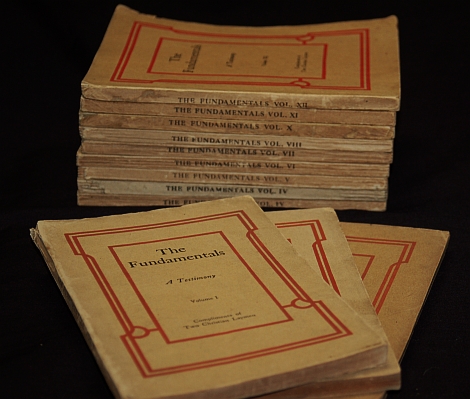
Dropping ‘the’ is sometimes necessary when adding an ‘s’.fundamentals

Please don’t misunderstand me. I am not saying that this is a cure-all formula for getting out of any theological pickle/quandary that you find yourself in. What I am saying is that dropping ‘the’ can sometimes open up greater possibilities AND provide much needed clarity to doctrinal or historical gridlock.

The bottom line: We are moving out of an era built around certainty and on propositional truth. Things are becoming more fractured, de-centered and relational (there is Al again). This can be a good thing – shifting from certainty.
(Now, in fairness, Phyllis had a great trinitarian answer to Barry’s concern that you will be able to hear later when the podcast comes out.)
There is a lager issue at hand, however, and that is the way in which we hold truth. I’m going to suggest in a post later this week that we revisit not just our conceptions of God and religious experiences – but that we hold our interpretations of them differently. Until then, I want to encourage you to do a little experiment and drop ‘the’.
Let me know how it goes.

Starter Suggestion: if you are someone who uses the phrase ‘the church’, try and replace that phrase with the word ‘churches’ and see if the sentence still makes sense. It probably won’t – which means that you will have to go back and look at the assumptions that underlie the sentence.

Certainty: the difference between emergents and fundamentalists

In chapter 7 of Predicament of Belief, Philip Clayton introduces a 6 tiered scale of epistemic certainty. Things that are nearly universally agreed upon (by the ‘community of experts’) are at a level 1. Issues like ‘Ultimate Reality’ that can not be verified but can deduced in relative certainty are at a level 2. Matters of specific religions might be a level 3. Issues particular to branches within a religion would be level 4.

Clayton has pointed out in his podcast appearances how important this type of scale is. In decades past, there seemed to be a collective ability to recognize nuance and to acknowledge differentiation between ‘core’ and ‘peripheral’ matters.

In the current climate of polarized animosity, we seem to have lost the ability to distinguish. Now everything is core.

The other way to say it is that instead of ranking issues in importance on a scale of 1-10 or holding to beliefs and theories at different levels of epistemic certainty, now everything is held at level 10.

Merold Westphal said the same type of thing in his podcast visit. Belief in the resurrection should not be held at the same level theories about the rapture (for instance).

The Reformers made an important distinction about matters of adiaphora and those essential to faith. Centuries later, I think we should at least start but reclaiming that distinction (at a minimum) and probably need to adopt something similar to Clayton’s scale to reflect the complexity of religious and inter-religious issues.

I was explaining this epistemic certainty thing to a friend a while ago. I said that I held Clayton’s real presence resurrection at like a 7 or 8 (out of 10). Process at a 8 or 9. Linbeck’s post-liberalism at a 5 or 6. Pannenberg’s eschatology at a 3 or 4. The virgin birth at like a 1. That the virgin birth provides a literary function in Matthew and Luke I hold at a 9 or 10.

My friend was shocked. He said “You are not a 10 on everything? I assumed that you held everything at a 10. When I knew you as an Evangelist, you sounded certain of everything. I just assumed that you were equally certain now.”

Now, he can be forgiven at several levels.

  1. We are both from a background where everything is a 10 and if you believe it, it is core. Nuance is not a part of the game.
  2. My voice is mostly the same as it was 10 years ago, so unless I specifically clarify or qualify the statement – it probably sounds identical.
  3. If you haven’t read Predicament of Belief or been exposed to a sliding scale of epistemic certainty or something similar … you may just assume matters of faith are held at a 10.

This, to me is the second biggest difference between say an emergent type and a fundamentalist. The first is willingness to engage scholarship and advancements in science.  The second is this ability to distinguish appropriate levels of certainty about things.

I think that it would be fun to add to all my future blogs an EC rating – “epistemic certainty” on a scale of 1-10. That way if I was talking about eschatology, folks would know to read it at a 2 (for instance). When we talk about Jesus walking on the water – a 4. The dipolar nature of the Process God – a 7.

This is a game-changer for many. As I get to talk to more and more people are migrating, emerging, adapting, and awakening to the multiplicity of possibilities within Christian theology,  just knowing that not everything needs to be held at a 10 is freeing and energizing.

 * I would go back and retrofit my recent posts with an EC rating – but my posts on pluralism and homosexuality have already caused such a stir, I would hate to mess with folk’s heads at this point.

Blog at WordPress.com.

Up ↑