Search

Bo Sanders: Public Theology

updating & innovating for today

Tag

charismatic

Believe Different Things Differently

A short video (5 min) about how  progressives and liberals not only believe different things than conservatives and evangelicals … but they believe them differently.

From Missions to Eschatology -they both believe different things and they hold those beliefs differently.

Let me know your thoughts.

Response to The (Non)Wesleyan (Non)Quadrilateral

Please read this is the “I’m having fun talking about something I love” voice.

A very good post was put up called: Once Again The Wesleyan Quad

I will now call it the “I Can’t Believe It’s Not Butter Should Not Be Allow To Use ‘Butter’ Blog”

The author and I have a lot in common: both United Methodist, both from Ohio, both academic.

The Butter Blog is right on so many points.

  • The Wesleyan Quad was not explicitly used by John Wesley in the 1700’s
  • Wesley looked to scripture first (Prima Scriptura) unlike other Reformed folks who claimed ‘Sola Scriptura
  • The Quad is not an symmetrical cube but a 4-part sequence which many of us have pointed out.

The Butter Blog is missing a couple of things:

  • Scripture, Tradition, Reason, and Experience are found in Wesley and easily retrofitted as ‘the Quad’
  • This is the same impulse that developed the canon of scripture because of it’s common use centuries after the founders.
  • The Quad was born out of the cultural need of the 1970’s and answered a question that was being asked in that context.

In my mind there are (at least) two vital reasons for the element of experience being added:

First, since 1906 the Pentecostal (and charismatic) movement has place primary importance on the experiential nature of Christian expression. I don’t think that we can afford to (or want to) poo-poo on the largest and fastest growing branch of Christianity globally.

Second, locating ‘experience’ as a site of theological reflection gives validity to the experience of those who have not had a chance to contribute to scripture, the tradition, or ‘reason’ (aka European philosophy) in the way that they may have wanted.

In this way: perspectives of women, people of color, and non-European contributions  are included and valued.


So when the Butter Blog argues that:

“Moreover, what too often happens in UM circles is that when the quadrilateral is employed, it is most of the time used for the purpose of pitting one of the four “principal factors” against the others (usually to pit experience against Scripture)”

Well, sort of … not against scripture … but to compliment the scripture and compensate for the lack in scripture …

I hate to be the white guy who has to point out that every person quoted in this Butter Blog seems to have something in common: Kevin Watson, Randy Maddox, Andrew Thompson, and N.T. (Tom) Wright.

As far as the quote:

“The problem, as Thompson rightly notes, is that we Methodists tend to be more American than Methodist.”

That is like saying that International Harvester tends to be more ‘harvester’ than international. Most Methodist (even in Ohio where the articles’ author is from) can’t even tell you what the ‘methods’ are.


I would like to point you in 3 other directions:


I have 50 other thoughts tonight but unfortunately it is late, and I have a 6am online session to teach for my East-coast seminary class.


BTW: I have an entire session in that seminary class about ‘the migration of meaning’ where we talk about everything from universities in Texas  – TCU (the ‘C’ being Christian) and SMU (the ‘M’ being Methodist) – to Emergent (from scientific thought to a ‘brand’ of post-evangelical hipsters).

More than welcome – wanted!

A fascinating part of my last 2 years is the amazing number of evangelical and charismatic pastors that I have been able to talk to who feel trapped by the whole ‘open & affirming’ conversation [or same-sex marriage issue for some].

I hear, on a fairly regular basis, that they wish they could be ‘open but not affirming’ or that the whole conversation would just go away and they could just get on with the business of preaching the gospel or making disciples without this cultural pressure to conform to something they are uncomfortable with or even see as wrong.

On the other hand, I have heard from so many gay and lesbian friends about the sheer frustration and agitation at churches saying that everyone is welcome (come as your are) but it really being code for ‘anyone can come and attend but to be fully accepted or empowered will require you to change and conform to be like us.’

The church that I am now pastoring is not just ‘open & affirming’ but it actually a reconciling congregation that advocates for LGBTQ inclusion at every level of church life, ministry, and ordination.  You can probably imagine how amazing it feels to be able to say with complete integrity that “everyone is welcome here” and know that it is totally true in this place !

This morning I wrote the following post in prep for the weekend:

You may have seen that Vermont Hills UMC’s tagline is ‘a spiritual oasis’.  It has been both fascinating and encouraging to find out how accurate of a description this tagline is.

I’ll be honest: we live in a cynical age and if you are not an accepting and welcoming church, people will grow skeptical of taglines and slogans. You have to be open and affirming of people’s journey and their uniqueness or it will not pass the ‘smell test‘.

It was with great joy that I discovered that VHUMC really is a safe and accepting place – that it lived up to the tagline of being ‘a spiritual oasis’.

Now, no one wants to define themselves by what they are not or what they are against – as tempting as it may be. So we don’t want to state this in the negative or only in contrast to others. We want to be as constructive and as hopeful as possible.

That is why it gives me great joy to be able to say that you are welcome here.

In fact, you are more than welcome – you are wanted!

Part of our transition toward being a conversational community is that we need people of:

  • different backgrounds
  • different journeys
  • different perspectives
  • different opinions
  • different races
  • different genders
  • different sexualities
  • different religious convictions
  • different income levels
  • different ages
  • different education levels and styles
  • different passions
  • different giftings
  • different phases of life

I am delighted to be able to say this about VHUMC and I look forward to exploring this topic together this coming Sunday.


IF you are a conversational pastor (as I am) THEN you actually want to hear from people of different genders, stages of life, races, religious backgrounds, and sexualities.  It is not something to be addressed or overcome … it IS the point and the joy of being in dialogue.

If people just repeat back to you what you already believe – that is called ‘an echo chamber’.

Perhaps the biggest challenge of being a conversational church is accepting that we are not all going to agree about everything … and that is not just ‘OK’ but is a good thing!

Tomorrow I will post part 2 of this idea and ask: ” what would our energy go to if this debate was settled?”

‘Atheist Churches’ are more traditional than Emergents

I am loving the conversations that have come out of the publicity tour of Sunday Assemblies. The feedback and pushback that is being generated by these ‘atheist churches’ is proving very informative. I am actually learning a lot about how people think of church, atheism, tradition, and community.

If nothing else comes out of their moment in the spotlight, it has been very enlightening. I do, however, think that some more will come out of this.

The most illuminating resource that I have found so far was an interview with co-founder of Sunday Assembly, Pippa Evans on the Nomad Podcast ep. 55. Nomad is based in Britain – as are the comedic co-founders of Sunday Assembly – and Nomad comes out of the ‘fresh expressions’ branch of the emergent movement.

The interview with Pippa (Sanderson Jones, the other co-founder, comes in at the end) is 100% worth your time. The two things that stood out the most to me were:

  1.  Pippa talks about and has adopted the ‘form’ of church.
  2. The Nomad hosts hated it – but for the opposite reason you would think.

1. The Form: Pippa was very clear in several spots about her background in church. The telling part for me, toward the end, was when she mentioned being in Soul Survivor. If you don’t know what that is, you may have missed the reference. Soul Survivor is a very charismatic movement that has developed worship leaders and a style that has been imported around the world – including by US American evangelicals & charismatics.

Pippa explains the formula – it is all about flow:

  • Start with two high energy songs – one of them needs to be familiar and singable
  • A short presentation of poetry or reading (this is like the opening prayer or scripture equivalent)
  • A slower song
  • The offering
  • The sermon (presenting an idea)
  • Response / Confession of thanks (stuff your are grateful for)
  • A big song so that it ends with a bang

Pretty standard stuff! What it reminded me of was the hilarious parody video from a couple of years ago (which started out an in-house joke for a worship conference) about the formula for contemporary evangelical/charismatic worship services.

2. Traditional. The fascinating point that made by the Nomad hosts was that walking into and sitting through a Sunday Assembly was painful because it was reclaiming and repurposing all of the things they disliked about going to traditional church! The whole reason they are into ‘fresh expressions’ is because they found so little in the forms of the church.

They were horrified to walk in and find:

  • people sitting in strait rows
  • everyone facing forward
  • huge screens at the front with song lyrics
  • one person doing all the talking
  • passive participation by the audience
  • it was Sunday morning

My favorite part was when they asked Pippa about the possibility of conversation at future Assemblies.  She was not hopeful or  excited about the idea. She said that some people have asked for a Q&A segment at the Assemblies and that is not likely either. Her point is that things like conversation and Q&A’s happen in other places. That is not what the Sunday Assembly is for.

It was at this point that the Nomad hosts made the observation that – at least in this sense – the ‘atheist churches’ are more traditional than their emergent (fresh expressions) gatherings which have de-centered meetings and deconstructed elements. That was an epiphany for me.

I am so glad that Sunday Assembly is doing this – and even more pleased that they are so approachable about what they are doing and why they are doing it. I have already had more than a dozen conversations about ‘why we do what we do‘ with people. IMG_2181

I can tell you this though – now that I have met in the round and been in conversational church … I don’t know if I could go back to  everybody facing the same direction and not have interactive sermons Sunday after Sunday. I’m pretty sure that the future of the church is de-centered and conversational/participatory.

Let me know what you think – as you can tell, I love hearing others thoughts and being in conversation.   -Bo 

Speaking in Tongues Isn’t What It Used To Be

On the latest episode of TNT I was asked to quickly define ‘Glossolalia’ a.k.a. speaking in tongues. I said some things in that opening segment that I want to clarify here.

Here are 4 thoughts:

Initial Design 

The original miracle that we read about in Acts 2 and the story of Pentecost is that people heard the gospel message in their own tongue. While the speakers, filled with Holy Spirit power, were unaware of the language they were speaking, the hearers were not.

This is a significant point because the original miracle of speaking in tongues was an outward-external boundary crossing event. It was missional. It would be one thing if the gift of tongues was that I could suddenly speak French and knew what I was saying. But that is not how it happened. The miracle is not on the part of the one speaking but on the side of the one hearing. Tongues wasn’t about the speaker … it was impactful for the hearer.

Change Is Not Bad 

Most contemporary pentecostal manifestations of glossolalia are no longer boundary-crossing missional expressions. Modern tongues speaking is almost exclusively within the context of ecstatic worship services and are meant to edify the person with the gift and the Lord who they are praising.

Now before anyone becomes defensive … keep in mind who is saying this. I am not a conservative at any level. I am always calling for the faith to be updated and modified. I am convinced that the church is called to adapt and evolve in order to accomplish in our culture what Jesus did in his and the early churches did in theirs.

I don’t think that change is a bad thing – quite the opposite. We are called to continual change.

The only reason that I bring this up is to clarify that what is called ‘speaking in tongues’ today is not exactly the same thing was happening in scripture. In scripture it was a missional move – an external focus – that crossed cultural and linguistic barriers.

This is what we call ‘historic drift’.

Master Signifier 

How we see speaking in tongues today often accomplishes the opposite of that original aim. Speaking in tongues is now an internal matter – not out on the streets but inside a house of worship.

Speaking in tongues is also no longer missional (external in focus) – for the hearer – but is actually an internal matter of both personal edification and (here is the important part) belonging to a community.pentecost01

When glossolalia is held up as a mark of validation it become a boundary marker (or master signifier) for who belongs to a given group. When the sign is a validation or litmus test for membership, it has ceased to be what it was originally designed for and has become something else.

That is all I am saying. Speaking in tongues today is almost never the same thing that we see in the Bible. It has largely become a master signifier for membership in pentecostal-charismatic communities.

One of the reasons I believe this to be the case is that our churches have not been boundary-crossing missional organizations. They have become internally edifying communities of belonging – which is not a bad thing! It’s just not exactly the same thing that we see in Acts 2.

The Opposite of Cessation 

I was asked by our guest on the podcast if I was a cessationist. I said that I am the opposite of that. I believe that the revival of tongues (most point to the Azusa Street Revivals of 1906 as key moment) in the 20th Century to be a genuine work of God’s Spirit. I know that in many parts of the world – especially areas in S. America, Africa, and Asia – that the pentecostal expression has been a wild-fire of renewal for the church and has been a primary force in its mission and zeal.

In saying that I also want to point out that glossolalia doesn’t only happen in Christian contexts. It also manifests with Hindu gurus, in the syncretistic Haitian religions, and in shamanistic spirituality around the world.  Why do I bring this up? Because I think it important to clarify two things:

  1. God’s Spirit is not only at work in Christians. So much of what we have inherited in Christendom and Colonial frameworks does not allow us to recognize this.
  2. Glossolalia is something that humans experience in ecstatic worship.  It is not super-natural. It is quite natural.

Being that glossolalia is neither exclusive to christians nor super-natural, I think it would be interesting to ask what role it might play in crossing boundaries for our multi-national, cross-cultural, inter-racial, bi-lingual, pluralistic world of the 21st century. What if we confessed that speaking in tongues had become a master signifier and returned it to it’s original missional design where the focus is not on the speaker but the effect it has on the hearer?

I have often been in meetings, cities and seminaries where over 100 languages are represented. It has stoked my imagination for what a new-type of glossolalia could mean for the church to come.

Barna and the Burned Over Region

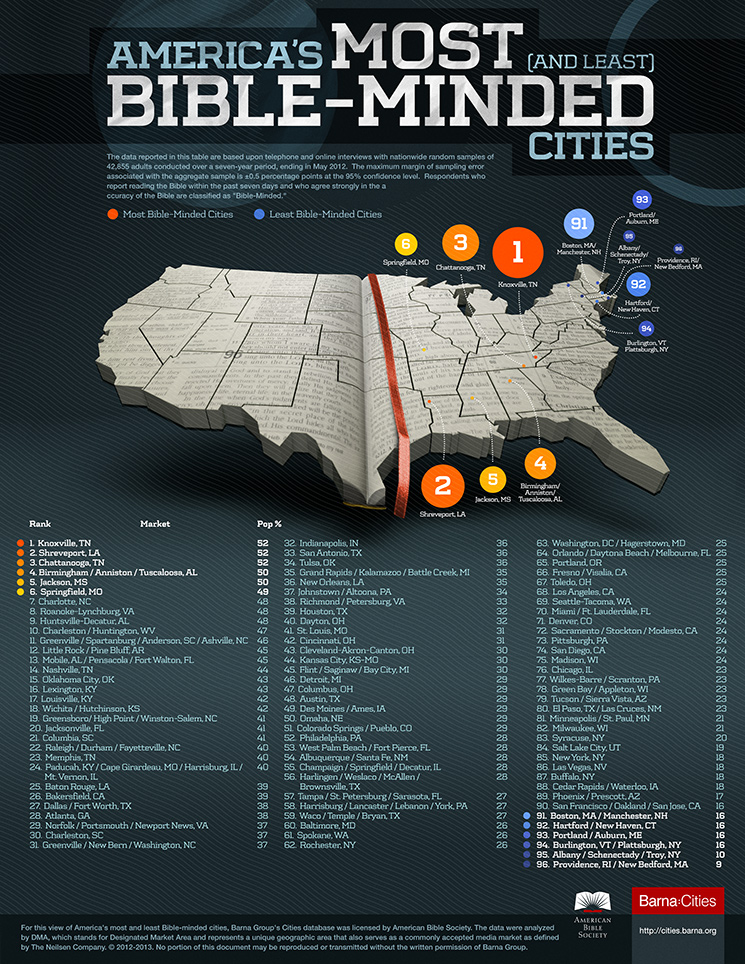
Barna Research put out a fascinating list of America’s Top 100 most ‘Bible-Minded Cities’.  Its not the top 10 Bible cities but the bottom 10 that are so telling! barna_biblemindedcities_preview1

The bottom 10 are:

  • Boston, Mass
  • Manchester, NH
  • Hartford/ New Haven, CT
  • Portland/Auburn, ME
  • Burlington,VT
  • Plattsburgh, NY
  • Albany/Schenectady/Troy, NY
  • Providence, RI
  • New Bedford, MA

It really caught my attention for 3 main reasons.

1. When I was in college I was an evangelist and Barna was our go-to source

2. During that time a common mantra in my circles was that ‘the Pacific-NorthWest is the most unchurched are in North America.’

3. After college I went to help plant a church in upstate NY (near the VT border) and grew suspicious about that Pacific NW thing.

I had spent time in the Pacific NW and while there were lots of unchurched people … there were also tons of churches – but specifically big churches aggressively engaged in the culture wars.

In the New England (or NorthEast) region, it was different. There was a cynicism is had not seen. Not a coffee shop atheism like the west. I deep suspicion unlike I had encountered.

 This came to a head for me when two roads converged. 

Ingredient 1: I was charismatic and had bought into a thing call “Re-digging the Wells of Revival” where you go to places where God has worked in the past and, through prayer, you try to unplug that ancient well of what God wants to do to release the anointing that once flowed.

I lived in area that had seen large revivals in the late 1800’s and early 1900’s. In fact, the denomination I was a part of was founded in the region and still had some of the revival tabernacles as properties! I would go to the  one closest to my house (Round Lake, NY) and pray for revival to sweep our area again.

I even started doing historical research. I stumbled into something. It was called ‘the Burned Over region’. It turns out that the much celebrated  revival had burned through so fast and so hot that when it was over … a cynicism had set into many people. Families that had given large amounts of time, sums of money and even family jewelry collections grew bitter.

A problem developed for me. The circles I was running in were celebrating the 2nd Great Awakening and other historical renewals of the church. I was growing suspicious and that altered my prayers.  I stopped praying for the same kind of revival we say 100 years ago and started praying for a different kind that didn’t leave generations of families bitter and broke.

 Ingredient 2: I went to a Barna Conference in western NY (Syracuse or Rochester area).  I sat there the whole time shaking my head as Mr. Barna presented to a packed massive auditorium. The finding that he was presenting were not exactly true of my area.

I had read a book by that point called “The Nine Nations of North America” and had begun to concoct a theory that merged (for churches) the New England of Nine Nations and my findings in Burned Over research. When you put those two together it really explained a lot.

 I kept saying to myself, “Even NY is different east of the Hudson river. From Albany east NY is more like New England than like Western NY and Pennsylvania”.

After Barna’s presentation I voiced my suspicion and that was not greeted well by my denominational cohort I was attending with.

I even brought up the Pacific NW thing and how out there you can hear 3 big christian radio stations and find a christian bookstore every couple of miles. We had neither.

The Pacific NW had mega-churches. We had one church over 1,000 and people in our area were suspicious that it was a cult, “because how else could you get that many people to all come and sing the same thing at the same time and then listen to one guy talk for a half-hour?”

 All of that is background for this past weekend. Barna put out a fascinating new list of the 100 most biblically minded cities. You can go read the article to see how they configured that.  The 2 most important things to me:

1 – the top 50 are East of the Mississippi River (except for Bakersfield, CA).

2 – the bottom 10 are all in NE or that NY Hudson River basin.

To me this says two things. First, the Bible Belt is a real thing and when combined with something like ‘Nine Nations’ is potent to think about.

Second, The bottom 10 are all in the burned over region and should give us concern about what 100 years from now will look like. I know that there are lots of factors over the last century and that someone will say “the past is not the future” and I get that.

But as one who a) studied this, b) while I lived there, and c) called it out in real time… I’m telling you –

The bottom 10 of this thing are far more relevant to our future than the top 10. 

Christians have to believe something about Hell, Election and Predestination

On last month’s TNT I said something that I have heard a lot of feedback on (some positive and some negative ). I thought it would be good to continue the conversation here on the blog.

 My assertion was that: If you are a Christian, you have to believe something about hell. It is just not an option to say “I don’t believe in hell”.  The word ‘hell’ is in the English version of the Bible and you can’t just say, as a Christian, that you don’t believe it. You can hold that it was a burning garbage dump in a valley outside Jerusalem that Jesus makes a poetic illusion to … but you have to believe something about hell. 

I would go on to broaden that assertion. I would say that you must believe in predestination, election, and the Book of Revelation.

All 4 of these are topics that l have personally heard people say “I don’t believe in __”

  • You have to believe something about hell.
  • You have to believe something about predestination.
  • You have to believe something about election.
  • You have to believe something about the Book of Revelation.

It is is just not an option to say “I don’t believe in hell”.  Jesus did.  If you are a Christian, you have to hold some belief about it.

Paul spoke of predestination. Election is a theme in scripture. You can’t just say ‘I don’t believe in Revelation’.  You can object to how some people interpret and preach the Book of Revelation … but you can’t ‘not believe’ it.

 Why It Matters: 

I come from an Evangelical-Charismatic background and am now employed at a Mainline church and attend a Mainline school.  I am passionate that thoughtful progressive Christians can not make the same mistake that Liberals made in the past century. By ‘de-mythologizing’ the Bible they undercut the very foundation that the tradition is built on.

It is like sawing the very branch that your a sitting on … on the tree side of the branch! What do you think is going to happen? You are left no place to perch.

I love Biblical Scholarship. I delight in post-modern and progressive theology. I take seriously the post-colonial critique and the perspective of feminists and queer theory. But it does us no good if we know what we don’t believe about something but do not have the ability to present in a constructive way what we do believe about those very subjects.

There is so little value in participating in a community based on a tradition where one does not believe in the very words of that faith’s sacred text.

Why even do it?  I think that is why so many ‘nones’ have just opted out. I actually greatly respect those who participate in the emergent conversation and who are valiantly attempting to update their denomination from within. It is far easier to just walk away from the entire project all together … and many have.

So How Do I Do It? 

Predestination:  Forget about the historical hyper-Calvinist understanding that you ‘don’t believe in”. Romans 8:29 says “For those God foreknew he also predestined to be conformed to the likeness of his Son, that he might be the firstborn among many brothers.”

Who did God foreknow? Everyone.  What are they predestined to? To be conformed to the image of the Son.  Does everyone arrive at their destination? No.

Predestination might be, what some Process thinkers would be called, an ‘initial aim’. It is God’s desire for all. God doesn’t always get what God wants ( see 1Timothy 2:4).

 Election: Karl Barth said it clearly. God elected Jesus. All humanity is involved in that election. All who are ‘in Christ’ are elect.

 The Book of Revelation: You may not like the ‘Left Behind’ / Hal Lidsey / Jack Van Impe interpretation of the Book of Revelation … but you can’t, as a Christian, say that you don’t believe in it.  It’s in the Bible. You have to believe something about it.

The Book of Revelation was a political critique of the Roman Empire of the first two centuries written in the genre of the ‘apocalyptic’. It is not predictive of the 21st century. But we don’t want to throw it away!  What we need, more than ever, is to imitate it and write an apocalyptic critique of our as-it structures, systems and institutions of injustice and our empire. We need a prophetic imagination.

You can’t say, as a Christian, that you don’t believe in this stuff. You have to believe something about this stuff. My suggestion is that we just believe more informed better stuff about these topics. The simple fact is that we are community of people centered about a sacred text and it is simply not acceptable to say ‘I don’t believe in something’. We are free to not believe in some people’s interpretation – but we have to believe something about it. 

Thoughts? Questions? Comments? 

Personal Prophecy: a minority report (part 1)

I’m passing this work on to you, my son Timothy. The prophetic word that was directed to you prepared us for this. All those prayers are coming together now so you will do this well, fearless in your struggle, keeping a firm grip on your faith and on yourself.  – 1 Timothy 1:18 (Message)

 Do not quench the Spirit.  Do not treat prophecies with contempt but test them all; hold on to what is good
– 1 Thessalonians 5: 19-21 

 I was writing a letter to a friend the other morning about a devastating development in her family. I didn’t get to finish the letter so I put it on hold. A couple of days later I was watching the film The Minority Report (2002 with Tom Cruise) and had an epiphany.

In the film, Cruise’s character kidnaps a women who has cognitive abilities (pre-cog) to anticipate and ‘see’ the future. At one point he is smuggling her through a mall and she says to him “The women in the brown sweater will recognize you” just seconds before it happens. Then she stops another women (a stranger) and warns her, “He knows – don’t go home.”

It was jarring to me because that is how many people wish that God worked. I come from a charismatic background and in the past I have participated ‘prophetic words’ where secrets were revealed and the hidden was brought out into the light. I always enjoyed those unique occasions where something like this occurred. An openness to God was my general posture … but I was never quite comfortable with forming lines at the alter after every service with people lining up every week to ‘hear from God’. That seemed too forced, or too rote or too presumptuous. 

I have talked before about my progressive take on pentecostal stuff (after the Leif Hetland interview) and getting my mind around miracles. But personal prophecy seems to be an even bigger issue. For those who run in charismatic circles, words of personal prophecy (or ‘reading someone’s mail’) are something that they come to lean on. That is what makes me so nervous.

Let me be clear: I take the passages in the Bible where Jesus talks about hearing the ‘voice’ of the Father very seriously. I have taught hundreds of folks how to ‘listen to God’ in the past. I am neither apologizing for that nor am I explaining it away.
What I am wanting to address is when people

  1. expect it
  2. come to rely on it
  3. abandon other ways of ‘knowing’ because of a dependance on it.

I’m not talking about folks who pray about trivial stuff like prime parking spots or who try to discern which color to paint their fingernails (both are common). I am talking about real people who have said  sentences like the following over the past decade of ministry:

  • Why didn’t God tell me it was cancer?
  • Why didn’t God warn us not to let her take the car?
  • Why didn’t God alert us our that child was being abused?
  • Why didn’t God direct us and help us find the body?
  • Why didn’t God tell me that my spouse was cheating?
  • Why didn’t God expose the treasurer’s embezzling?
  • Why didn’t God say the Doctor’s diagnosis was wrong?

I am not making these up. These are real sentences I have been asked. (and I have many more examples)

I want to say two things:

That is not how God works. It’s just not. Look, I get the power of personal prophecy! I have called out things that I wouldn’t know in my own capability. I am not a doubter. I am just saying that if we come to rely on this way of knowing we could really endanger ourselves and those around us. We need accountability with our church’s finances because we can’t trust that the Holy Spirit would tell us if something was up.

Process has given me a framework to explain how this kind of prophecy works. I don’t want to quench the Spirit, or hold prophecy with contempt, or lose what is good and explain away some of the miraculous stuff I have seen over the years. I know that some will dispute that personal prophecy is what is meant when the New Testament speaks of prophecy – and it is illustrative to my about the contemporary church that many have NO frame of reference for this activity (it seems like voodoo to them) and yet for others it is their MAIN connection to God and they know of no other type of definition for prophecy.

Tomorrow I will post ‘The Process of Prophecy’ – but for now I just wanted to say that The Minority Report is fiction. That is not how God works. Yes, I think it is cool that we can know stuff we normally don’t have access to. BUT we have to be really careful that we don’t turn off other systems of navigation because we like playing with this one. People are getting hurt (by others) and are discouraged with God because we are playing with a toy that was never meant to be a real steering wheel or compass.

Personal prophecy is not a guide to life. It can be a sign (like in the Gospel of John) that points to a greater level of trust and awareness and creates a desire. However, it can not be our main go-to mechanism for making our way in the world. Prophetic words need to be integrated into a web-of-meaning that incorporates scripture, community, and reason. 

Why didn’t God tell you? Because that is not how God designed it to work.

_______

if you have never encountered this type of thing before: check out this instructive blog about maximizing the impact your prophetic word.

Then you may want to check out my post “what has changed since I was your pastor”.

weaving my theological web

part of being Post-foundational is a move away from thinking in “foundation stones” – building blocks that become unmovable or unquestionable over time – and moving to more a “web” of meaning or interpretation. The advantage of the web-mentality  is that it is flexible and you can adjust one part of it without the entire project crumbling into ruins.

I like this switch a lot.   Of course, no system or structure comes without it’s complications, glitches, and obstacles.

A web is not a liquid existence. It still needs to be anchored somewhere. It has to be connected to something.

I am fond of saying that I want to be innovative, but in a way that honors the original idea and provides continuity with the tradition. This desire means that I am not floating from thing to thing as if I was un-anchored. We are all, at some level, tied to both the original vision and to the modern manifestation. The first asks for accountability and the second one calls for integrity.

navigating between the original vision and the historic progression is demanding. It takes time, a little bit of research, and a whole lot of grace. In fact, I see why some people don’t want to do it. It would be easier to either A) be conservative and just set the foundation stones in place and then never need to move them or ask the original questions again or B) be destructive and/or pragmatic and just do what works now without consideration for the road that brought us here.

I have noticed a pattern lately in my conversations. There seem to be four ideas or movements that I use to anchor my web of meaning / interpretation to.  I ran this by a couple of friends and it has led to some really interesting conversations.

I am a post-conservative, emergent, progressive with charismatic leanings. – this allows me to be in conversation with process thought as well as post-modern thinkers. Continue reading “weaving my theological web”

Blog at WordPress.com.

Up ↑