Search

Bo Sanders: Public Theology

updating & innovating for today

Tag

church

W is for the Word of God (and the Wesleyan Quad)

There is no phrase that is more misused, or more contentious, than The Word of God. We might need to take a vacation from throwing the phrase around as a tight summary until we pull it apart and clarify its multiple uses. W-WordofGod

The Word of God, when used properly, carries three layers of meaning:

  1. Divine Communication. The prophets used the phrase in the Hebrew Testament to convey weight and authority. They had a message for the people of God that could be encouragement, directive, corrective, or illuminating.
  2. Logos – divine wisdom. New Testament believers are treated to a syncretistic twist when the Gospel of John prologue draws off the greek notion of logos and then shockingly says what no greek thinker could fathom saying: “the word became flesh and dwelt among us”.
  3. Revelatory elements in the scriptures. When the Spirit who inspired the original works illuminates the message again for a contemporary audience, it is said to be ‘the word of God’. (Thanks be to God)

For clarity I will now refer to the first and third meanings as ‘the word of the Lord’ and the second as the ‘Logos made flesh’.

The pitfall that some fall into is that they take this last sense (revelatory elements within scripture) and attempt to make it concrete (or foundational). Doing so is to erroneously confuse the messenger and message, the vessel with the element, the sign for the object.

Calling the Bible the Word of God is as inaccurate as it is accurate. It is not exactly true … but it is true enough that it is tempting. The problem is that it confused the ‘curves ahead’ road sign on the mountain road for the road up the mountain. It is not that they are unrelated – it is that they are not equivalent. The map may be accurate, and trustworthy for the journey, but it is not the landscape itself.

Knowing the map well is not the same as going on the journey.

This is the important difference between a sign and symbol.

  • A sign points to a greater reality … even if it does so imperfectly. The yellow and black ‘curves ahead’ sign on the mountain road is not telling you the exact sequence of twists and turns ahead. It is not map. It is alerting you to something bigger than itself.
  • A symbol, when used theologically, is a sign that participate in the reality that it points to. In this sense, the Bible contains the potential for the word of the Lord, it records instances of the word of the Lord, and it tells us about the Logos made flesh. The Bible is thus not unrelated to the Word of God but is not exactly equivalent either. It records and points to a greater reality (like a sign) and under the influence of Holy Spirit inspiration participates in that reality to which it points (symbol).

One can see the problem in legal court and in Sunday school. It is ironic to place one’s hand on a Bible and swear ‘to tell the truth, the whole truth and nothing but the truth so help you God’. The irony, for those who have actually read the Bible, is that it says in two New Testament passages not to do such things. We are not to swear by things but to simply let our yes be ‘yes’ and our no, ‘no’. That should be enough. We don’t need to swear by heaven or earth or anything like God. It is an odd practice.
Similarly we see things like this in the songs we learn as children:

The B-I-B-L-E,
that’s the books for me,
I stand alone on the Word of God

The Bible is not a book. It is a collection of 66 books by different authors in different centuries representing different histories, perspectives and opinions utilizing diverse genres of writing. This is part of why you can not say ‘the Bible says’.
When we say that ‘the word of God is living and active’ or that ‘all scripture is God breathed and useful’ we are right … but we must avoid the temptation of too quickly boiling those three into down into one interchangeable phrase lest we miss the awesome power and invitation provided by the interplay between them.

Now, if we mean that because of what we learn in the Bible, we hear the word of the Lord and believe in the Logos made flesh … that would be fantastic. ?If, however, we mean that the Bible is equivalent to the Word of God, then we have set our children up to be confounded, frustrated and spiritually impotent.
We have given them a road sign and told them it was the adventure. ?The word of the Lord propels us on a journey! To walk the way of the Logos made flesh, to know the truth of that which was in the beginning – with God and was God – and to live the life of the ages (eternal life).
To paraphrase a famous line – we are like children making mud-pies out of dirt in the back alley while there are real pies waiting in the kitchen.

Part of the problem is that we have try to cram too much into the phrase ‘the word of God’ and asked more from it than can be expected from any sign or symbol.
The most helpful thing I have found to address this problem is called the Wesleyan Quad. The quadrilateral is composed of 4 elements:

  1. Scripture
  2. Tradition
  3. Experience
  4. Reason

Those 4 elements also work best in that sequence.
– We go to scripture first for it records examples of the word of the Lord and points us to the Logos made flesh.
-We next consult the tradition, for religion has a given-ness to it. We inherent a living tradition and participate in its practices, rituals, ceremonies, train of the thought and teaching.
– We also recognize that importance of our community-experiences. No one is spiritual or religious on their own like no one uses language alone. We learn a language from others and use a language to communicate with others. It is not enough to know of a religion – one participates and thus experiences. We learn from and incorporate our community-experiences.
– Finally comes reason. We are made in the image of God and that divine Logos (reason) was given to us to exercise responsibly. We are not called to be robots who mechanically parrot the inherited sentences in rote repetition. There is a deep need to think about things so that our tradition does not become a dead artifact, or worse, a false idol.

The danger of what has been called ‘Bibliolotry’ is not simply that it makes the Bible ‘a paper pope’ or ‘the 4th member of the trinity’ (as bad as those seem). The danger is in missing the way, the truth, and the life that is available to us by instead settling for a road-sign instead of an adventure.


I would love to hear your thoughts about my distinction between the Word of God as the word of the Lord, the Logos made flesh and the Bible. 

Artwork for the series by Jesse Turri

For more read my earlier posts about Inspiration and about Revelation.

U is for Universalism

I used to joke with people that you had to be careful attending churches that had a ‘U’ in them. United, Universal, Unitarian, Unity, etc. They seemed either to believe in almost everything or in not much of anything. U-Universalism

It was much funnier back then… but there is something to it.
Theological words are much the same. ‘U’ words tend to be big and sweeping in their scope. Much like the ‘I’ words seem to embody a certain period and concern, the ‘U’ words are large and consequential.

We will tackle Universalism first and then look at Ultimate Concern.

Grenz defines it this way – but pay attention to how he does so:

Universalism. Known historically as apokatastasis, the belief that all persons will be saved. Hence universalism involves the affirmation of universal *salvation and the denial of eternal punishment. Universalists believe that ultimately all humans are somehow in union with Christ and that in the fullness of time they will gain release from the penalty of sin and be restored to God. Twentieth-century universalism often rejects the deity of Jesus and explores the “universal” bases of all religions.

Pocket Dictionary of Theological Terms (Kindle Locations 1325-1327). Kindle Edition.

Did you see it? By presenting the concept as a historical concept with some biblical precedent, there is put forward some credibility. Then modern versions are handled in one sentence and in a way that rejects the deity of Jesus.
This is not a mistake, nor is it an accident.

Universalism is an old idea. The version that emerged in the 20th century is a different animal. In a globalized context where religions, traditions and world-views bump up against each other everyday,  the conversation changes immensely.

There are really 2 distinct universalisms:

  • Classic christian universalism relates to the belief that salvation is for everyone. A couple of years ago Rob Bell’s Love Wins was accused of being universalist. Karl Rahner’s notion of ‘anonymous christians’ is another expression of this impulse.

If you think that the christian God loves everyone and that ultimately (another U word) God’s work is for everyone and that basically everyone will end up with God, that would be a type of universalism.

  • Contemporary universalism is more about world religions. It is a type of pluralism. Contemporary universalism is concerned with the validity of any – or all – approaches to religion. Many look to figures like John Hick or use the ‘many paths up the same mountain’ analogy.

Contemporary universalism is as different from classic universalism as lighting is from a lighting bug.

Classic universalism is concerned with with work of Christ for every-one [thus Grenz’s concern for Jesus’ divinity]. Contemporary universalism is not about Christ’s effectiveness so much as the inherent validity of traditions and religions.
Both of these notions are beautiful attempts at something grand but are warped deeply by the legacy of colonialism.

I could write (and have written) massive papers on contemporary approaches to universalism – specifically within the context of inter-religious dialogue and postmodern approaches to pluralism.

The globalized world of the 21st century means that religious conversations and convictions are perhaps the most important conversation happening in our lifetime. Unless Jesus’ return is soon, we are going to have to learn to live on this planet together.

Which leads us to another important U word.

Ultimate Concern: The idea arising from Paul Tillich that everyone has something that is of highest importance to him or her. Tillich suggested that persons’ ultimate concern, or “what concerns ultimately,” is their God. In this sense, everyone is inherently religious.

Pocket Dictionary of Theological Terms (Kindle Locations 1318-1320). Kindle Edition.

Tillich presented several innovative concepts* that reframe the whole theological enterprise. This notion of Ultimate Concern is the perfect addition to the Classic/Contemporary address of Universalism and Pluralism.


Thoughts? Concerns? Questions?


Below is a short bibliography of resources I find helpful.
*If I were not in the field of Practical Theology, I would write on Tillich. His notion of correlation and his approach to ‘the ground of being’ fascinate me. If it were not for the linguist turn that happened in continental philosophy after his time, I think that he would have been the most significant theologian of the 20th century. Alas, the world changed.

McLaren’s christian take

Prothero’s innovative non-academic take

famous John Hick

Knitter’s Theologies of Religion

a christian take on multiple versions of ‘salvations’

Catherine Cornille on the impossibility of this whole thing

the best new work on the subject

classic work on Pluralism

the invention of world religions (a must read)

ABC Final Stretch

I was out of town this week and my friends Micky and Callid took care of S and T over at Homebrewed. You can read their articles linked below.A-Atonement

I wanted to take this opportunity to clarify a couple of things before we make the turn toward the final series of letters.

  • Respond to questions about the Book of Revelation
  • Flesh out my answer in Micky’s video about Salvation
  • Explain why I went with ‘theopoetics’ instead of other (more famous) T words

I will do this in reverse order. Callid (and a few FB friends) were questioning the selection of ‘theopoetics’ over words like trinity, theosis and theodicy. We covered trinitarian matters in P is for Perichoresis. While I love the Eastern notion of theosis (becoming like God), this series is really focused on concepts that we need to engage going forward in the 21st century.

I am a big fan of theosis and love those who embrace/reclaim this ancient notion. They are often paired with both mystic appreciation and a commitment to spiritual disciplines.

Theodicy (the problem of evil) is a big one. After the events of the 20th Century – specifically WWII – there can be no doubt about the centrality of evil and human nature to any theological consideration.

  • Where is god in all of this?
  • Why is our experience so different than the ancients?
  • Is it technology?
  • It is society?
  • Has the world changed?
  • Has God changed?
  • Has our understanding of God changed?
  • Is the world no longer enchanted?

I try to cover this when I talk about The World Come of Age (Bonhoeffer) or what others call The World Transformed (Hunt) or what Kaufman calls The Nuclear Age.

The simple fact is that the 20th Century – between technology and war – changed the world and radically altered what we call society. The reality of living in the 21st century are very different than they were in the 12th – let alone the 2nd. The questions of the 21st century are not answered by repeating inherited answers or by parroting ancient thought.

Farming, hygiene, reading, telephones, banks, travel (airplanes) …. there are thousands of examples of how different our existence is from those in previous centuries. Even the way was imagine our self (identity) and community (belonging) has changed.

So theodicy is a major issue, but I wanted to add something to our theological tool-belt that will help us going forward. Theopoetics is one of the most important ideas – and one of the most vibrant contemporary conversations – that we can engage in. It impacts everything from how we read Genesis and Revelation to how we approach the ancient creeds and how we conceptualize our god-thoughts and convey ourselves in god-talk. That was the thinking behind selecting theopoetics for T.


Salvation:  In her post, Micky shared her video. I provide the opening response and folks had several questions about it.

What we are talking about in salvation happens at 3 levels:

  1. The Life of the Ages. Jesus talked about it and unfortunately it gets translated into English as ‘eternal life’ which people think happens after death and then have to try and explains how it impacts life here. Some say it starts here and carries on and is intensified after you die. The whole thing is much clearer and more powerful if you call it ‘the life of the ages.’
  2. Reversal-Restoration-Reconcilation from Eden. The story of Eden shows us three fractures – from God, from each other and from the Earth. Salvation is a process of reconnection and participation in right relationship and the community of creation. Shalom is the word. 
  3. The Jewish notion of Tekkun Olam. This is the restoration of all things. NT Wright has a famous version of this bringing all things to right.

Salvation therefore impacts everyone and everything. It is not only about a tiny part of you (your soul) after it leaves your body. It is about your body and the earth that it comes from … and every other body on that earth.


Revelation: Folks liked my take on the book of Revelation … but then wanted to know what to do with it. Here are some suggestions:

  1. Enjoy it. Don’t be scared by it. Look into the 2nd century imagery and learn how apocalyptic works as a genre.
  2. Then take that knowledge and examine Jesus’ statements in the Gospels as well as the second half of Daniel.
  3. Mess with your friends who have been sold a Left Behind version of faith with historical perspective.
  4. Give our artists, poets, film-makers and dreamers permission to create political critiques of the 21st century like the author of Revelation did for first two.

Once you are relieved of the notion that Revelation is about the future, you can get down to the series task of examining, critiquing and challenging  the existing structures and systems of our day. Tripp and I chat about this stuff for the last 20 min of this week’s TNT.

I would love your thoughts about any or all of these subjects.

Q is for the Quest for the Historical Jesus

The Quest for the Historical Jesus is a topic that I am both annoyed and intrigued by. Chalk this reaction up to my evangelical upbringing but I am like a high-schooler in the midst of drama. Q-Quest

“They drive me nuts, I hate listening to them talk! … What did they say? Tell me everything.”
I am both attracted to and repelled by the work and findings of this movement.

Before we go any further, lets see how others Justo L. González introduces it:

Historical Jesus: Often contrasted with “the Christ of faith,” the phrase “historical Jesus” is somewhat ambiguous, for sometimes it refers to those things about Jesus that can be proved through rigorous historical research, and sometimes it simply means the historical figure of Jesus of Nazareth. The phrase itself, “historical Jesus,” was popularized by the title of the English translation of a hook by Albert Schweitzer, The Quest of the Historical Jesus (1910). In this book, Schweitzer reviewed a process, begun by Hermann S. Reimarus (1694-1768), which sought to discover the Jesus behind the Gospels by means of the newly developed tools of historical research. After reviewing this quest of almost two centuries, Schweitzer concluded that what each of the scholars involved had discovered was not in fact Jesus of Nazareth as he lived in the first century, but rather a modern image of Jesus, as much informed by modern bourgeois perspectives as by historical research itself.

Essential Theological Terms (Kindle Locations 1905-1916). Kindle Edition.

González goes on to explain that much of the quest was abandoned after Schweitzer’s findings but has recently reappeared in a minimalist expression (what are the bare facts that can be validated?).

Grenz is clear about this historical quest – that its proponents think Jesus:

  • never made any messianic claim
  • never predicted his death or resurrection
  • never instituted the *sacraments now followed by the church.

All of this was “projected onto him by his disciples, the Gospel writers and the early church. The true historical Jesus, in contrast, preached a simple, largely ethical message as capsulized in the dictum of the “fatherhood of God” and the “brotherhood of humankind.”

Pocket Dictionary of Theological Terms (Kindle Locations 1089-1093). Kindle Edition.

A modern manifestation of this quest is seen in the Jesus Seminar.
You can hear our podcast about with John Dominic Crossan from this past May.

I am deeply indebted to those in Historical Jesus research. I never knew any of this stuff (like Empire) as an evangelical pastor. It has been both eye-opening and disorienting (not to mention the theological whiplash).
I have problems with so many of the conclusions reached but am so grateful for the depth of engagement and sincerity of scholarship. My faith has been enriched and informed in ways I could never have imagined.

There is just something about the whole enterprise that gets under my skin and rubs me the wrong way. It is possible to be grateful for a pebble in your shoe as you journey?

Even as I write this I am thinking, “I don’t like where you take this… but I need to know what you know. I just want to draw different conclusions than you do.”

This, of course, is the danger of venturing outside your comfort zone.

Artwork for this series by Jesse Turri

O is for Open and Relational

One of the most vibrant developments in Christian theology has happened in the past 50 years. The conversation is diverse and includes everyone from Process friendly Mainliners to Vatican II Catholics, from Emergent types to progressive Evangelicals – and plenty of others.O-OpenRelational

These diverse perspectives come under a canopy called “Open and Relational Theologies”. The name itself is instructive and helpful in this case. Here is the easiest way to think about the name:

  • Open addresses the nature of the future.
  • Relational addresses the nature of power.

The Open crew often hale from more evangelical camps who question the common held belief (in their circles) that the future is determined. Questions of human free will, God’s intervention and nature of certainty when interpreting things like biblical prophecy, salvation, and world history.
The Relational crew is more concerned with assumptions of God’s character and power and thus question common held beliefs about things like omnipotence and intervention. This camp looks at world history and says, ‘We know how God’s activity has been framed and thought of in the past but is that really how the world works?’ Challenges to the other famous ‘O’ words are seriously undertaken: omnipotence, omniscience, omnipresence.

Both groups have many positive assertions even though they often grow out of a negative critique of established or institutional assumption regarding God’s character and work in the world.

There is much overlap between the two schools and thus they often work together and can be grouped at partners.
There are, however, three significant differences:

  1. Open thinkers often come from an evangelical background and thus are heavily Bible focused. They question the nature of the future and of God’s power but are unwilling to come all the way over to Process thoughts or to convert to a different metaphysic.
  2. Relational folks may be more likely to engage liberal brands of biblical scholarship and to shed antiquated our outdated notions by integrating scientific discoveries and new models (and better explanations) of reality.
  3. Open thinkers also hold that God could be coercive and interventionist, but willing holds back (or relinquished this) in love and for human free-will. Relational thinkers may be more willing to go all the way and say ‘no – this is just not the nature of God or God’s character. It is not that God could if God wanted to … it is simply not the way that things work.’

I came to O&R through Emergence thought. Emergent explanations of science and society make far more sense than former top-down and authoritarian (coercive) models of God and the world.
Emergence thought focus on the inter-related nature of existence and how higher forms of organization emerged from simpler and smaller  elements (or entities) within the organization or eco-system.

Many of the models we have inherited from church history are either based in hierarchy (like King-Caesar thought) or are mechanical (from the Industrial Revolution and Enlightenment on). Those mechanistic explanations of God’s power and God’s work become problematic and seem entirely outdated (and unprovable) in a world come of age.

Open & Relational schools of thought provide a much better model of reality (nature) and human experience than antiquated explanations based in the 3-tiered Universe and ancient metaphysics.

Here is a bullet point list of themes from a previous post by Tripp Fuller:

  • God’s primary characteristic is love.
  • Theology involves humble speculation about who God truly is and what God really does.
  • Creatures – at least humans – are genuinely free to make choices pertaining to their salvation.
  • God experiences others in some way analogous to how creatures experience others.
  • Both creatures and God are relational beings, which means that both God and creatures are affected by others in give-and-take relationships.
  • God’s experience changes, yet God’s nature or essence is unchanging.
  • God created all nondivine things.
  • God takes calculated risks, because God is not all-controlling.
  • Creatures are called to act in loving ways that please God and make the world a better place.
  • The future is open; it is not predetermined or fully known by God.
  • God’s expectations about the future are often partly dependent upon creaturely actions.
  • Although everlasting, God experiences time in a way analogous to how creatures experience time.

You can listen to HBC episode 107 with Thomas J. Oord for more.

Artwork for the series by Jesse Turri 


L is for Liberation (and Logos)

Two concepts that anybody doing theology in the 21st century must know are Liberation and Logos. They play into so much of what we do in the theological endeavor.L-Liberation

Liberation Theology: This term most often refers to a theological movement developed in the late 1960s in Latin America (where it continues to hold prominence). In attempting to unite theology and sociopolitical concerns, liberation theologians such as Gustavo Gutierrez emphasize the scriptural theme of liberation, understood as the overcoming of poverty and oppression. Liberation theologies have also found expression among representatives of seemingly marginalized groups in North American society, including women, African Americans, Hispanics, Native Americans and Asian Americans.

Pocket Dictionary of Theological Terms (Kindle Locations 797-800). Kindle Edition.

It might be helpful to understand how I came to liberation theologies. I was writing my Master’s Thesis at an evangelical seminary on ‘Contextual Theology’. I was doing so because I had been raised and ordained in a Missionary denomination. I wanted to encourage and advance the work of those who claimed the ‘missional’ and/or ‘missions’ moniker. It was in the midst of engagement with Bevans and Schreiter that I stumbled upon a form of contextual theology (an alternative perspective) that stood apart from the enlightenment/colonial models. It was called ‘Liberation’ and it was unlike any of the other models being examined.

Gonzalez adds a couple of important clarifications:

Some liberation theologies center their attention on international economic oppression, while others are particularly concerned with classism, racism, ageism, homophobia, and other foci. Besides acknowledging and claiming their contextuality, … liberation theologies insist on the need to promote and practice justice and love, not only at the personal level, but also in societal practices and structures.

Justo L. González. Essential Theological Terms (Kindle Locations 2442-2446). Kindle Edition.

The only thing that I will add as far a Logos theology goes is that one must account for they way in which the word (logos) became flesh. ?This is the case, not just because John 1 is so important in protestant-conservative-evangelical-charismatic circles, but because one must figure out in what way God was present in Christ. There is much to be said on this issue not just because the Incarnation sets the tone for contextual (liberation) models of ministry but because the entire christian gospel is based on (centered on) the reality that the Logos was made flesh and dwelt (camped-tabernacled) among us. In more philosophical circles, Logos theology takes on a much broader concern. As early as the 6th century B.C.E. Greek philosophers were addressing the Logos as “the divine reason implicit in the cosmos, ordering it and giving it form and meaning.” The Gospel of John borrows/appropriates/adopts this term to address the pre-existence of Christ and how that manifested in the person of Jesus. It is important to understand that the gospel writer integrated/adapted Greek philosophy. This move is significant for several reasons:

  1. Proclamations about Jesus were not made in a vacuum.
  2. Some early church writers drew from Hebrew narratives and themes.
  3. Others spliced in philosophical ideas and concepts from non-Jewish sources.
  4. Both in scripture and in church history we see a constant and elaborate mixing/integrating of external philosophies and concepts.

I bring this up because a major objection to Liberation theology is its use/appropriation of secular political theories (like Marxism) and critics will use this to discredit Liberation thought. We need to be careful with that kind of easy dismissal. ?Liberation theology does have its drawbacks and limitations* – but simply having philosophical partnership is not one of them. In fact, there has never been a theological or ‘biblical’ expression that did not have philosophical underpinnings or explicit frameworks. Theology does not happen in a vacuum. All theology is contextual theology. This is not a problem. The only problem is when certain theologies don’t recognize their contextual nature with time and place and purport to being both universal and timeless. Liberation theology is not for everyone and it does not happen everywhere. While true that it is thoroughly political and radically ideological at points, it is also highly contextual and local – as all theology should be.

Artwork for the series by Jesse Turri

  * some object to Liberation’s emphasis on God’s preferential option for the poor and oppressed. 

I is for Infallible, Inerrant, Impassible and Immutable

Note: all relevant ‘I’ words will be placed in italics.I-Inerrant

It is an unfortunate quirk in the English language that leads negatives – or negations – to begin with the letter ‘I’.

The resulting effect is that some of the most problematic and even disturbing words in the theological tool-shed begin with ‘I’.

  • Infallible
  • Inerrant 
  • Impassible
  • Immutable 

These are just a sample, but are the 4 that we will focus on today.

These four ‘I’ words are just a sample of the kinds of words that lay-people can find both intimidating and infuriating about theology. Some have even lost their faith over these ‘I’ words.

Don’t even get me started on irresistible grace and infralapsarian – two concepts that hard-core Calvinists will bring up.

I say this in all seriousness. There is something about ‘I’ words which exhibit the most intense aspect of the difficulties when delving into theology. Many people point to words like these as an example of exactly why they are not interested in theology.

I have named 6 problematic ‘I’ words so far – but I will offer 2 more (inspiration and incarnation) as examples of ‘keeping it simple’ as an antidote to becoming disillusioned.

Let’s deal with the Bible first and then with God.

We live in a unique time of history where those who claim to believe the Bible the most attempt to place two words not found in scripture upon the Bible:

Inerrancy: The idea that Scripture is completely free from error. It is generally agreed by all theologians who use the term that inerrancy at least refers to the trustworthy and authoritative nature of Scripture as God’s Word, which informs humankind of the need for and the way to *salvation. Some theologians, however, affirm that the Bible is also completely accurate in whatever it teaches about other subjects, such as science and history.

This is admittedly a tough line to hold. The more that one learns about Biblical scholarship or historical criticism the tougher it gets. Inerrancy is an outside idea imposed upon the Bible that the Bible itself and thus has a tough time living up to its claim. It does not, however, mean that the Bible is not trustworthy!! This is my point! One can trust the Biblical narrative without having to elevate it to the level of inerrant.

Infallibility: The characteristic of being incapable of failing to accomplish a predetermined purpose. In Protestant theology infallibility is usually associated with Scripture. The Bible will not fail in its ultimate purpose of revealing God and the way of *salvation to humans. In Roman Catholic theology infallibility is also extended to the teaching of the church (“*magisterium” or “*dogma”) under the authority of the pope as the chief teacher and earthly head of the body of Christ.

Pocket Dictionary of Theological Terms (Kindle Locations 726-731). Kindle Edition.

Infallibility is better than inerrancy. Infallible can simply mean that the Bible will accomplish that which it is meant to accomplish. That seems fair enough on the surface.

Here is my contention: Why do we need to assert that it is guaranteed to accomplish the task? Where does that need for certainty come from?
Why isn’t it enough to say that the Bible is ‘inspired’ and leave it at that?

Inspiration: A term used by many theologians to designate the work of the Holy Spirit in enabling the human authors of the Bible to record what God desired to have written in the Scriptures. Theories explaining how God “superintended” the process of Scripture formation vary from dictation (the human authors wrote as secretaries, recording word for word what God said) to ecstatic writing (the human authors wrote at the peak of their human creativity). Most *evangelical theories of inspiration maintain that the Holy Spirit divinely guided the writing of Scripture, while at the same time allowing elements of the authors’ culture and historical context to come through, at least in matters of style, grammar and choice of words.

Pocket Dictionary of Theological Terms (Kindle Locations 731-736). Kindle Edition.

2 Timothy 3:16 talks about scripture being ‘god breathed’ . I think that should suffice and that attempts to impose external expectations upon the scriptures are futile (impotent?).  Whenever someone wants to talk about the ‘original’ texts, one only has to ask about them to see this folly.

It’s like calling the Bible ‘the Word of God’. The problem is that the New Testament refers to Jesus as the Word of God. Christians rightly refer to the testimony about Jesus as the scriptures. In this sense, they are words about the Word.
The problem starts when we want to upgrade the concept beyond its capability to sustain that we which we are attempting to assert upon it.
I would love if Christians would simply be satisfied with believing that the Bible is inspired by God’s Spirit and not attempt to make a claim on it that it can not sustain.

Now let’s talk about God.

The God that is revealed in Christ is, for the Christian, both informative and formative. It both sets a precedent and provides an interpretive lens.
As with the Bible (above) it is disastrous when we import foreign concepts of God (in this instance from Greek ideals) and impose them upon the revealed nature of Christ seen in the incarnation.

Immutability: The characteristic of not experiencing change or development. Certain understandings of God posit the divine reality as incapable of experiencing change in any way. Some theologians, however, assert that this concept owes more to Greek philosophical influence than to explicit biblical teaching. Many contemporary theologians distinguish between God’s eternally unchanging, faithful character and God’s ability to respond in different ways to changing human beings in their temporal, earthly situation.

Impassibility: The characteristic, usually associated with God, of being unaffected by earthly, temporal circumstances, particularly the experience of suffering and its effects. Many contemporary theologians reject the idea of divine impassibility, suggesting that it reflects Greek philosophical, rather than biblical, concerns. However, the Bible clearly teaches that God cannot be swayed in any way to be unfaithful to what God has promised. Still, it is seemingly impossible to associate pure impassibility with God in light of the fact that Jesus Christ, as the fullest manifestation of God, experienced suffering on the cross.

Pocket Dictionary of Theological Terms (Kindle Locations 704-709). Kindle Edition.

You can see why these concepts are contentious. They are imported from somewhere else and then imposed upon the narrative of Scripture. In my opinion they are incompatible and thus unsustainable.

Our great hope is found in the in-carnate god. We will return to this concept in two days with the letter ‘K’ for kenosis.

I would love to hear your thoughts, concerns, questions and comments.


BIG thanks to Jesse Turri for providing the artwork for each letter!

If you are interested you can see the early post about reading the Bible according to Genre or check out the art of Hermeneutics (interpretation).   You may also want to look into the temptation of Fideism.

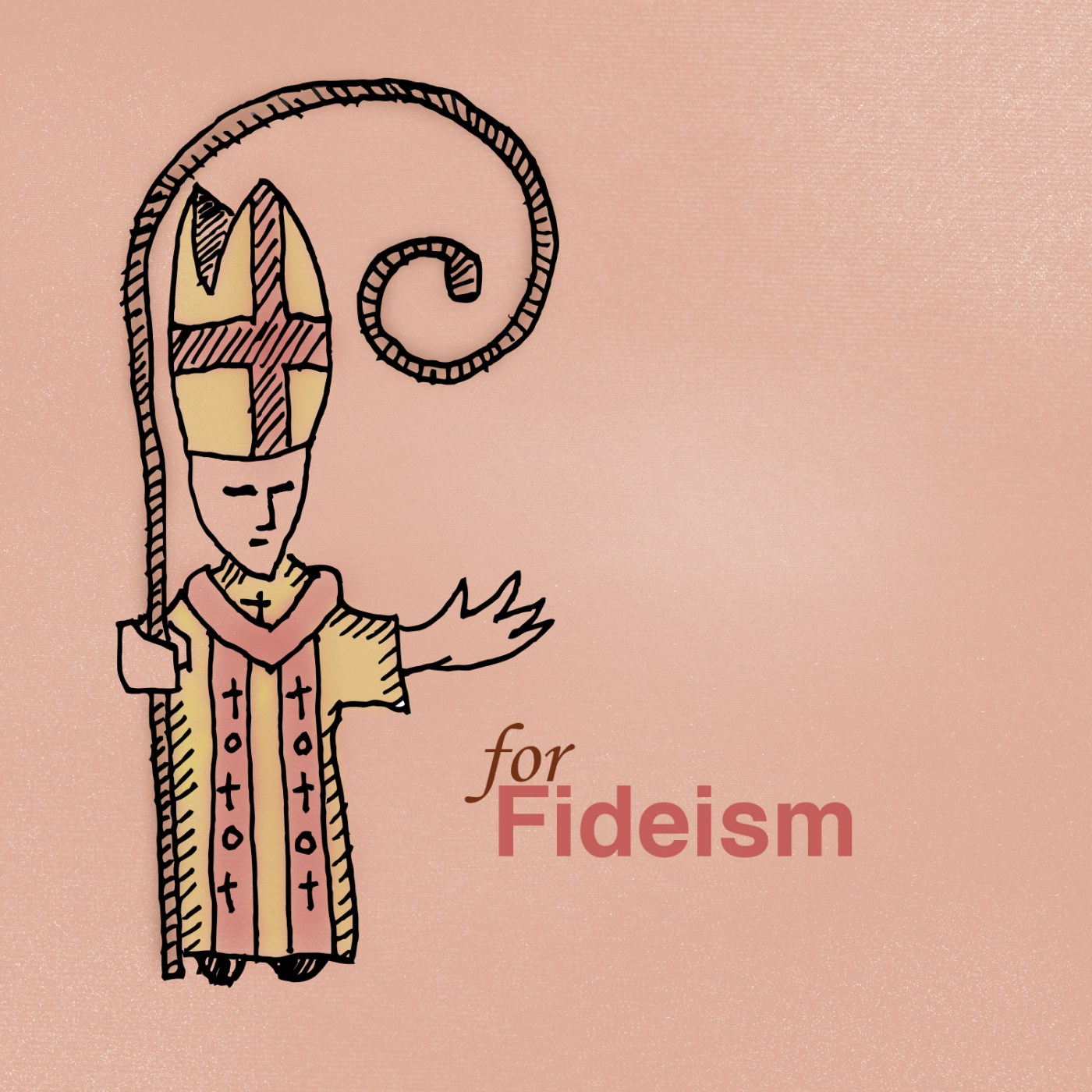
F is for Fideism or Why What We Believe Really Matters

Fideism is one of the most alluring, and thus, potentially dangerous developments on the theological landscape in our lifetime.

Fideism: The view that matters of religious and theological truth must be accepted by faith apart from the exercise of reason. In its extreme, fideism suggests that the use of reason is misleading. Less extreme fideists suggest that reason is not so much misleading as it is simply unable to lead to truths about the nature of God and *salvation.

Pocket Dictionary of Theological Terms (Kindle Locations 552-554). Kindle Edition.

Fideism has been around for a long time but it has taken on a new tenacity recently.F-Fideism

The 19th Century was a tough one for ‘reasoned faith’. Those bastions that survived into the 20th Century were not left unaltered. In fact, since WWII the effect of those descended from who Paul Ricoeur dubbed ‘The Master of Suspicion’ – Freud, Nietzsche, Marx … and some add Darwin – has grown and intensified.*

Part of ‘reasoned faith’ is that it had to adjust and modify. It had to account for new data (scientific and sociological) and, more importantly, it had to stop playing by its own rules.

The rules of engagement changed. Faith no longer got a free pass. The ‘church’ was no longer running the uni-versity. Fields like science had grown up since the Copernican revolution was no longer afraid of the church and began to act like the were running the show now.

Modern christianity had to choose whether to

  • Flee
  • Fight
  • or Adjust-Adapt-Evolve

I have written about this as modern christianity’s temptations.

A subtle form of this impulse toward fideism is simply to speak of ‘Non-Overlapping Magisterium”. Science and reason take care of their areas and faith takes care of its area.

Those who take this impulse further retreat into what Wittgenstein would call ‘private language games’. They take on a formal defense of the given-ness of faith say that faith doesn’t have to be reasonable. Those two things are just speaking different languages and that science of reason doesn’t even have the ability to understand what faith is doing. That is why neither can even provide a critique let alone a correction. Religion is thus except from an investigation-integration from outside.

I would argue that what we believe in private has massive implication for how we participate in the public arena.

We can see this battle line in the recent Hobby Lobby decision from the Supreme Court.

Let me give an example from history – courtesy of another ‘F’ word in our pocket dictionary: filioque. A Latin term literally meaning “and the Son,”

The addition of this phrase by the Western (Latin) branch of the church in the in the 6th to the 4th Century creeds – without the permission of the Eastern churches – would eventually lead to the schism of the two groups in the 11th Century.
This schism is notable enough but 500 years later, in what would become colonial missions by western europeans, the issue had real consequences. As both Catholic and Protestant missionaries sailed around the world to convert native populations, the filioque clause would answer a significant question.
Could the Spirit of God be at work ahead of the missionaries arrival? The answer was a resounding ‘no’. The Spirit proceeded not just from the Father (and thus potentially outside of the work of the Son) but ‘from the Son also’. It was believed then that the work of the Spirit followed (proceeded not preceded) the proclamation of the Christian gospel.

There were minority schools (some Jesuits) who disagreed – but they were subsequently reprimanded.

Some may hear about the filioque clause and think “how would we even know who proceeded when? And how exactly are three people ‘one God’ anyway? This is all just speculation and minutia – like angels dancing on the head of the needle!”

Speculation it might be. But both in history and in our present societal unrest what folks believe in private really does impact how that participate in public.

This is why we have to care about fideism. I understand the desire to preserve the past and stake out ones territory for the given-ness of the tradition. It is a way of protecting what is deeply valued and – let’s be honest – in grave danger.

Those who are attracted to fideism look at the evolution of their religion and the disappearance of treasured practices and think “I don’t even recognize this contemporary mutation as the same thing that we inherited from those who came before!”

… and that might be true. But , as I am arguing in the series, we live in a world come of age and The Faith both needs to and is bound to change.
* another way of saying this is to list the fields of psychology, philosophy, sociology, and science.

E is for Empire


“Christian theology suffers from an imperial condition”E-Empire

This is how Catherine Keller begins her chapter in PostColonial Theology.  [Keller podcast]

The people that I know who love, quote, and believe the Bible the most happen to be the least aware of the Bible’s concern with /critique of Empire.

What is fascinating to me is that those who are most unaware of the nature of the American Empire (Imperial reign) are also those who claim to take the Bible the most seriously.

Whenever I bring this up, some who will question ‘How can this be so?” While others will say “What are you making such a big deal about?”

Here is how it works: The biblical narrative details many empires – all of whom have a devastating effect on the people of God.
The Exodus narrative, the Babylonian captivity and the Roman occupation are all examples of Empire. The Bible is through-and-through saturated with imperialism and the disastrous effects that it has on those who are faithful to God.

This is where is gets tough: Moses, Daniel and Jesus all suffered (and subsequently overcame) Imperial regimes. The Bible is saturated with themes of ‘Empire’ and resistance.

The problem is that those who are most imbedded in the Empire (and believe the Bible) are the most unaware of this theme and may have no idea that the Bible that they believe so much has anything to say about the issue what so ever!

If you have never heard of ‘Empire / Imperialism’ then the Bible reads a certain way which allows you to be complicit in the current American imperial impulse and actually believe that you are serving the Kingdom of God by participating in that said structure.

The shocker is when you find out that Moses, Daniel and Jesus were on the underbelly of the beast and were figures of resistance seeking to undermine the established order – the systems, structures and institutions of repression and containment.

It can be eye-opening!~

There is not a single part of the New Testament that is not haunted by the shadow of Empire and Imperial domination.
One might as well not even read the Gospels or the Book of Revelation outside of this lens!!

As long as we are on the subject, it is impossible to talk about the Cross of Christ or Paul’s diatribe in Romans 1 without a thorough understanding of Empire. Take a minute and think about what a cross was – an instrument of intimidation and public terror reserved for those who threatened that stability of the Empire (like sedition).

I might go as far as to say that Empire and Imperial pressures dominate and dictate every facet of the Bible and especially the New Testament.

Here is the shocker: those who take the Bible the most seriously (or least read it the most) may know the least about this aspect of its original context …

… and may be those what are most blind to the current role that their nationalistic government plays in the world.


Think about this: if you do not see the role that Egypt, Babylon and Rome played in the Biblical narrative … by what lens would be able to see the role that post-Cold War America plays in the global War on Terror?

I don’t think that you could.

Here is the bottom line: The people of God have frequently been oppressed and dominated.
Scripture tells us of their resistance and deliverance.
If, then, the people who claim to be ‘with God’ are complicit in the oppression and marginalization of those who claim to be fellow believers ‘in Christ’ … let alone those who come from a different tradition…

… you can see the problem.

Empire dominates everything. Domination is actually the Modus Operandi of Imperial regimes. The methods are predictable:

  • Road blocks
  • Security checks
  • Boarders
  • Prisons
  • War
  • Control

The Bible testifies to this and to the resistance of it. The great irony of history is that so many Bible believing people both don’t know this – and subsequently participate (even complicetly) in the continuation of this oppressive system.
The Bible tells us that Moses, Daniel and Jesus all suffered under Imperial oppression. We need to make sure that we don’t use the Bible to defend or extend any Nationalistic/ Empire ambitions in the world that we live in via the systems that we participate in and support.
For further examination:

Beyond the Spirit of Empire – Rieger, Sung, Miguez [Rieger podcast]

Arrogance of Nations: Paul and Empire – Elliott  [Elliot podcast]

God and Empire – Crossan  [Crossan podcast]

Jesus and Empire – Horsley

New Testament and Empire – Carter  [Carter podcast]

If interested, here is a blog series I wrote about social imaginaries (nationalism)
In case one would think that I made too much out of the absence of this topic in certain circles, it is illustrative that neither Grenz nor Gonzalez – the two resources I am utilizing in the series –  have an entry for ‘Empire’ in their dictionaries. They do however both address ‘Empiricism’ (as in ‘empirical evidence’).

Blog at WordPress.com.

Up ↑