Search

Bo Sanders: Public Theology

updating & innovating for today

Tag

church

Getting Ready For Reza

I am getting very excited about Reza Aslan’s visit to Homebrewed Christianity this September 3rd. In anticipation of this conversation, I am reading his book Zealot and I recently attended a conversation between Reza and Rainn Wilson (who you probably know as Dwight from the Office) that was hosted at Barry Taylor’s church. IMG_2395

All of that aside, I am a little confused at some of the negative press that Reza has been getting in the past weeks. I get that some outlets and camps will be perpetually perturbed, and I don’t worry about them.

What has drawn my attention is the push-back from those I know and follow who have seemed to raise the ire about both Reza and his latest project. 

The complaints seem to come in 3 broad categories.

  • This has all been said before / Why do we need another book about Jesus? 

I am mystified by this line of reasoning. You think that because the Jesus Seminar or Borg or Crossan, Horsely or Karen Armstrong has covered this (at least some of it) in the work that there is nothing new or no new presentation that could be helpful for furthering the conversation?

Clearly – as you can see from the media response – hearing this from a new voice or from a different perspective has hit a nerve of some kind.

  • He is not even in Biblical Scholarship. 

This is an odd criticism. He is a historian and if you look at the courses in his department at the UC Riverside department you will see that it is not your normal creative writing program. Plus, discounting an author because of their field/title within the academy seems like a last-ditch effort at some level.

  • The Islamic thing. 

Don’t even get me started. If only people within a tradition are allowed … so Christians are not allowed to research-write about Jewish history or address anything Islamic? This just doesn’t hold up.

Enough of the negativity. Let me get to 3 things that I like about Reza’s project.

  • I love his approach. 

Instead of starting with the Bible, he starts with history. The Roman world was well documented and allows us to gain an elaborate picture of what life looked like during that period. We even know about their agricultural practices and prices – not to mention military, political, construction, trade, and religious matters.

Then what he does is come back to the Bible to if the details in the Gospel accounts stands up in relation to what we already know. The advantage to doing this is it helps illuminate what aspects of the Gospels were written for theological reasons. I find this a very helpful approach.

  • Not everyone knows about synoptic studies.

I come from an evangelical world where people spend lots of time reading the Bible but may not know that much about the Bible. In fact, every Christmas and Easter I felt like the bad guy for introducing them to the differences between the Synoptic accounts (not to mention the Gospel of John being its own thing).

This is why I love that Reza is getting so much attention and that we will get to chat with him on September 3 … and at my home church of all places!

I am a confessional christian and take great joy in integrating contemporary biblical scholarship as much as possible. The trick is always taking the often critical stance of that scholarship and utilizing it is a constructive confession!

One way I have found success in doing this is to embrace that the Gospel accounts are theological presentations – not newspaper reports – and that in those details that appear to be non-historical the authors/communities that wrote them are trying to tell us something. I want to hear and proclaim that something.

Am I worry that Reza’s work might not be intended for that purpose? No. That is why we are in dialogue with those in different disciples and traditions. We are translators at some level – all of us.

We engage, absorb, adapt, adopt, appropriate and integrate to the best of our ability.

  • Liberals should be even more upset than Conservatives and Evangelicals.

I get why folks from the conservative and evangelical branches of the family might not be too keen on Raza’s project. It gives them whiplash if they have never thought about this stuff before.

The most ridiculous response, however, is when those from the liberal side of the fences take the ‘we have heard all of this stuff before’ stance. Listen to what he is saying:

If the only thing that you knew about Jesus is that he was crucified, you would know everything that you need to. Crucifixion is reserved from state-criminals. Jesus was convicted of sedition.

From there it gets zesty. It turns out that the criminals on either side of Jesus that day were not ‘thieves’ they were bandits. That is how the original greek word should be translated according to Reza.

Jesus was not a good little Jewish boy who unfortunately and surprisingly got tacked up on a cross. He was a political threat with radical stances that were dangerous to the establishment. So when Liberals shrug their shoulders and go back to being ‘Chaplains to the Empire’ and participating in the establishment in ways that are complicit in unjust and oppressive institutions … they have missed what Reza is saying about their ‘savior’. It is an indictment on a brand of christianity is that is so compromised and complicit with the system that it is has lost its prophetic unction and revolutionary subversiveness.

I am excited to read the rest of this book and to continue to get ready for the September 3rd event. I don’t want to miss the opportunity to hear about Jesus from an angle I normally wouldn’t encounter. If people want to quibble about the title of the book as being fantastical and over-the-top in order to gains sales … OK.  But let’s not miss the point of the project over the title.

I would love to hear your thoughts or concerns. 

‘Who am I to judge?’ is an honest question

It is no secret that  I am a fan of many of the things (not all)  that the new Pope has been up to. So I was very intrigued when it came out that on his cross-Atlantic flight he took the airplane microphone and addressed reporters. RNS-Pope-Francis-flight-home-Catholic-News-Service

I was also surprised by the reports of the following sentence:

“If someone is gay and he searches for the Lord and has good will, who am I to judge?” — Pope Francis, July 2013

The running joke is of course that if you are the Pope … it’s kinda your job description! You might be the only person who is allowed to judge in some of your followers estimations.

These things have landed Francis on the cover of this month’s Sojourners magazine. They are advertising it this way:

Francis—refreshingly candid and seemingly repelled by the perks of the papacy—offers new hope for the Catholic Church and beyond. From the symbolism of him stooping to wash a Muslim woman’s feet to his harsh lambasts against a culture of greed and consumerism, this Jesuit from Argentina has captured the collective imagination of the world.

This has me thinking over the past week about the topic of judging. When I was an evangelical preacher we were very clear to distinguish between judging – which is defined by its connection to wrath – and evaluating ‘a tree by its fruit’  which christians are also commanded by Jesus to do.

Yes Jesus said ‘Do not judge’ but Jesus also said you can tell a tree by its fruit. The question “who am I to judge” seems to be a rhetorical one.

Even Miley Cyrus knows that Only God Can Judge, as she proclaims in her new video (for which I am sure that she should be judged harshly).

Now I am a pastor at a Mainline church in LA and I can honestly say that it is the least judgmental place I have ever been… but is that a good thing?  Don’t we need to make some moral evaluations?

I was getting ready to ask the HBC crowd how they have learned to navigate this cultural conundrum when my new favorite persons to quote – Brene Brown – came out with this tweet:

“When you judge yourself for asking for help, you are always judging when you give help.” @BreneBrown

Judging is clearly on people’s minds these day. It is everywhere in our cultural conversation. As we transition out of post-Christendom and cultural revolutions of 1970’s into an information age where everything is available to everyone all of the time … and your mom is your friend of Facebook ….  here is an honest question:

How are your navigating the challenge of “Judge not lest you be judged” ?

one favor I ask: let me know if you are even trying to live up to Jesus’ commands or if you have left that behind. I have a feeling it might make a difference in this discussion.  

Photo: Pope Francis addresses journalists on his flight from Rio de Janeiro to Rome, July 29. (Paul Haring/Catholic News Service)

That Liberal Label

It has been a while since I posted here and part of the reason for that is that I have embroiled in a bit of a kerfuffle. I didn’t go looking for it but it came and found me. Anyway, here is a part of my response to all of the hullabaloo.
Once is an incident. Twice is a trend. Three times is a pattern.

This the now the 3rd time this thing idea about shying away from the label ‘liberal’ has come up.

  1. I heard it for the first time almost 10 years ago: “Emergents are just cool liberals”. This came from conservative, evangelical and reformed folks who were squawking at the Blue Parakeets that were new to the yard.
  2. More recently Fitch & Holsclaw leveled the accusation in their new book Prodigal Christianity and Tony Jones took exception.
  3. Then last week the idea was suggested on a different blog that Tripp & I were really just closet liberals who where afraid of the label because of its intrinsic baggage.

I tend to bury my big point in the final quarter of every blog post. For the purpose of clarity I am going to begin putting them at the top of the post. Here is my main point:

There is nothing wrong with being liberal. It is one of many valid ways to participate in the christian tradition. If I were liberal I would be so proudly. I am not liberal. Liberal approaches do not go far enough to combat capitalism, address colonial consequences or repent of the Constantinian compromise that led to Christendom it’s subsequent horrors.

I am not liberal. While Tripp and I are left-leaning. We are progressive. We are postmodern in our approach. We are emergent in our expression. We are playfully heretical (in a good way) and we are innovative where appropriate given our christo-centric hyperTheism.

But I am not liberal. Liberalism doesn’t go far enough in addressing five of my biggest concerns:

  • Critique of Capitalism and Consumerism
  • Post-Colonial consequences
  • Continental Philosophy’s reflection on late modern thought
  • Criticism of Christendom (Western and Constantinian)
  • Our cultures’ dangerous cocktail of Nationalism and Militarism

I have written extensively about how Progressive is not Liberal and even got taken to task over at Scot McKnight’s blog for trying to make that distinction. I will say this again:

There is nothing wrong with being liberal. It is one of many valid ways to participate in the christian tradition.

If I were liberal I would be so proudly. But alas I am not.

One last thing in closing:  I understand the historic drift of the term ‘Liberal’. I know what it meant in the 1700’s (specifically as it relates to individualistic epistemology) and I understand what it has become in the late 20th century (a constellation of loyalties and identity markers). I also know about it’s demise as an impotent political approach and I get why some evangelicals are allergic to the term and thus why some would desire to shy away from it. I get all that. I even recognize the unique draw of its individualistic epistemology. 000_0008

What I am saying is that calling me a closet liberal who is afraid to be identified by the label is like saying that I don’t wear ‘medium’ sized T-shirts because I don’t like the letter M. It is to miss the point. I don’t wear medium sized T-shirts because they are not big enough and don’t cover some essential areas that I deeply care about.

i.e.  It just doesn’t fit.


Speaking in Tongues Isn’t What It Used To Be

On the latest episode of TNT I was asked to quickly define ‘Glossolalia’ a.k.a. speaking in tongues. I said some things in that opening segment that I want to clarify here.

Here are 4 thoughts:

Initial Design 

The original miracle that we read about in Acts 2 and the story of Pentecost is that people heard the gospel message in their own tongue. While the speakers, filled with Holy Spirit power, were unaware of the language they were speaking, the hearers were not.

This is a significant point because the original miracle of speaking in tongues was an outward-external boundary crossing event. It was missional. It would be one thing if the gift of tongues was that I could suddenly speak French and knew what I was saying. But that is not how it happened. The miracle is not on the part of the one speaking but on the side of the one hearing. Tongues wasn’t about the speaker … it was impactful for the hearer.

Change Is Not Bad 

Most contemporary pentecostal manifestations of glossolalia are no longer boundary-crossing missional expressions. Modern tongues speaking is almost exclusively within the context of ecstatic worship services and are meant to edify the person with the gift and the Lord who they are praising.

Now before anyone becomes defensive … keep in mind who is saying this. I am not a conservative at any level. I am always calling for the faith to be updated and modified. I am convinced that the church is called to adapt and evolve in order to accomplish in our culture what Jesus did in his and the early churches did in theirs.

I don’t think that change is a bad thing – quite the opposite. We are called to continual change.

The only reason that I bring this up is to clarify that what is called ‘speaking in tongues’ today is not exactly the same thing was happening in scripture. In scripture it was a missional move – an external focus – that crossed cultural and linguistic barriers.

This is what we call ‘historic drift’.

Master Signifier 

How we see speaking in tongues today often accomplishes the opposite of that original aim. Speaking in tongues is now an internal matter – not out on the streets but inside a house of worship.

Speaking in tongues is also no longer missional (external in focus) – for the hearer – but is actually an internal matter of both personal edification and (here is the important part) belonging to a community.pentecost01

When glossolalia is held up as a mark of validation it become a boundary marker (or master signifier) for who belongs to a given group. When the sign is a validation or litmus test for membership, it has ceased to be what it was originally designed for and has become something else.

That is all I am saying. Speaking in tongues today is almost never the same thing that we see in the Bible. It has largely become a master signifier for membership in pentecostal-charismatic communities.

One of the reasons I believe this to be the case is that our churches have not been boundary-crossing missional organizations. They have become internally edifying communities of belonging – which is not a bad thing! It’s just not exactly the same thing that we see in Acts 2.

The Opposite of Cessation 

I was asked by our guest on the podcast if I was a cessationist. I said that I am the opposite of that. I believe that the revival of tongues (most point to the Azusa Street Revivals of 1906 as key moment) in the 20th Century to be a genuine work of God’s Spirit. I know that in many parts of the world – especially areas in S. America, Africa, and Asia – that the pentecostal expression has been a wild-fire of renewal for the church and has been a primary force in its mission and zeal.

In saying that I also want to point out that glossolalia doesn’t only happen in Christian contexts. It also manifests with Hindu gurus, in the syncretistic Haitian religions, and in shamanistic spirituality around the world.  Why do I bring this up? Because I think it important to clarify two things:

  1. God’s Spirit is not only at work in Christians. So much of what we have inherited in Christendom and Colonial frameworks does not allow us to recognize this.
  2. Glossolalia is something that humans experience in ecstatic worship.  It is not super-natural. It is quite natural.

Being that glossolalia is neither exclusive to christians nor super-natural, I think it would be interesting to ask what role it might play in crossing boundaries for our multi-national, cross-cultural, inter-racial, bi-lingual, pluralistic world of the 21st century. What if we confessed that speaking in tongues had become a master signifier and returned it to it’s original missional design where the focus is not on the speaker but the effect it has on the hearer?

I have often been in meetings, cities and seminaries where over 100 languages are represented. It has stoked my imagination for what a new-type of glossolalia could mean for the church to come.

Prayer as Poetry of Spirit

As a pastor I get to talk with a lot of people. The issue of prayer comes up more often than any other topic. I think I understand why but when any pattern is this consistent it piques my attention and compels me to dig a little deeper.Dark-Clouds

The problem, of course, isn’t for those for whom prayer is an automatic and assumed activity–nor for those who see no point in it. The problem, and thus the need for conversation, resides in those who are thoughtfully attempting to address how exactly a real God really works in the world.

To use a bowling analogy, there seems to be an illusive sweet spot we want to aim at between two proverbial gutters on either side.

The gutter to the left  is a mechanistic view  that too easily degenerates into prescriptive and formulaic constructs. The universe is not a machine and is not fueled by an individual’s personal piety, sincerity of prayer, amount of prayer, particular words and phrases, or purity of beliefs/doctrine.

The problem with many popular approaches to prayer is exposed when prayer appears not to work because certain outcomes were not achieved or no tangible evidence was produced. The difficulty then is the amount of time and energy one needs to invest to explain why prayer doesn’t always work. The explanations always seem to fall into the same worn ruts  involving God’s sovereignty, will and power. In the end these will always fail because God, after all, is not a machine and faith is not the product of an assembly line or factory.

The gutter to the right  might be called ‘cosmic coincidence’. One of the difficulties to being a person of faith is that it can be impossible to convince someone who wants to be cynical with enough persuasion as to disavow them of their skepticism. Somehow the concept of belief itself is elusive enough and just abstract enough to not provide the traction it takes to overcome the unqualified need for proof.
It is the narrow ground between these two gutters that I am attempting to navigate. I want to throw out a theory and get your feedback on.

My theory is that both the beauty and the power of prayer–and subsequently God’s work in the world– resides in the fact that God’s power is a low-level signal  being broadcast in the world on a weak enough frequency that two things happen:

  1. the transmission is subtle enough that those who wish to tune it out are capable of doing so. God’s work is not so obvious or overpowering that one is accosted by its blatant effects and thus would have to be in denial not to see it. The work of God in his gentle,  subtle, hidden, elusive at times and, as Jack Caputo says ‘weak’.
  2. at the same time, however, the work of God in the world is just consistent enough as to allow some to codify it and become prescriptive as to the optimal way to pray. Prayer works just enough of the time for just enough of the population for people to come up with formulas as to its power and how to tap into that.

Prayer is like poetry in this sense. Neither is so predictable as to allow themselves to be reduced down to a formula that can be perfected with simple repetition.

but at the same time–both poetry and prayer carry enough consistency to allow for them to be thought of as persuasive.

This is the beauty of prayer for me. am not praying to an interventionist God behind some supernatural veil asking for that Almighty but temperamental  being to puncture the membrane of the natural world and act in a coercive way.  The ancient images of God as warrior, puppet master or unseen mover don’t stand up to any level of scrutiny after the 20th century.

We know then what prayer isn’t… So what is it?

Prayer is the partnering of an open heart to participate with a God who is broadcasting a weak signal in the world  and which provides to every moment positive possibilities for every living thing  to bring about a greater good and beautiful flourishing.  As we participate in those positive possibilities we open up greater and more abundant possibilities in subsequent moments. As we resist the potential opportunities provided in the weak signal, we close down and crush possibilities for more abundant flourishing and beauty down the road.

In this way we acknowledge that prayer has just enough going on within it that those who prefer the formulaic or even mechanistic approaches of the past will continue to have just enough data to remain insistent. We also acknowledge that prayer will continue to be just elusive enough that those who wish to tune out the signal that is being broadcast by the divine to feel justified in doing so.

Prayer is the poetry of Spirit. It is not a math formula, a building blueprint, an assembly-line product or a battle plan. Nor is prayer a Christian form of meditation simply useful for aligning one’s heart and mind to the current running in the stream of the universe.

Prayer is a participation in an invitation to partnership that is being broadcast on a weak frequency in the world.

-Bo

________

I would love to hear your thoughts on this … I just have two requests:

  • Be careful using personal (private) experiences like speaking in tongues or being slain in the spirit as irrefutable evidence of the former ways of understanding that I am attempting to move us on from.
  • Don’t talk to me about miracles in S. America, Africa or Asia unless you are from those regions please. I will explain why I make this request in a post next week. 


When God Is Too Powerful

A dear friend of mine is in her final semester of a psychology degree. Somehow Martin Buber came up. The  famous work  of the Jewish thinker  – “I and Thou” –  is such a powerful idea from the early 20th century that is resonates in both psychology and theology.

Keith Ward explains in God: a guide for the perplexed:

“The word ‘thou’ in English has a rather peculiar history. In the sixteenth century, when the English Book of Common Prayer was first pieced together, it was the second-person singular personal pronoun. Just as in German and French, and many other languages today, it was used to signify an especially close and intimate relationship with the person to whom you were speaking. For formal occasions, or to people one did not know well, ‘you’ was appropriate. But for members of family and close friends, the correct word to use was ‘thou’.” *

Then something very odd happened to the English language. Everyone simply became ‘you’. No one used ‘Thou’ anymore and it became a very fancy and antiquated way to reference someone.
The problem is that is was still used to refer to God (in the books used by the church) and so:

“before long people thought that ‘thou’ was a special word only to be used for God – God being presumably very archaic – connoting very special reverence and respect. So, whereas the writers of the first Elizabethan prayer book had wanted people to address God in a very intimate, almost informal way, most people who love the prayer book now seem to think that it is important to address God as ‘thou’, because only that gives God appropriate respect. Ironically, those who insist on addressing God as ‘thou’ are doing the very opposite of what the compilers of the prayer book wanted.”

Do you see what happened?  Any words that get attached to our conception of God end up getting co-opted, absorbed and hijack by our conception of God.

We try to use words, phrases, pictures and metaphors to re-present the transcendent divine … but those words, phrases and metaphors end up getting codified then solidified then idolized.
In this way, our imagination becomes an image … and eventually becomes an idol.

I have argued this same sort of thing in “God never changes … or does She?” when it comes to masculine pronouns for god vs. thinking of god as a man.Hand_ofGod2

Instead of understanding Jesus’ language as relational – that Jesus calling God
‘Abba’ (some say “Father” but I like John Cobb’s use of “Pappa”) as saying “I relate to God as one relates to a loving Father/Parent” , we codified and solidified that language and now God is ONLY allowed to be called ‘He’ in some circles. Our imagination is then limited by the image which has become an idol.

Jesus and Unicorns

I run into this same thing when it comes to christology. People often confuse the two approaches of ‘from above’ and ‘from below’ with two results of ‘high christology’ and ‘low christology’. This is true of general theology and views of scripture as well.

Those who are convinced that God needs to be as big, as powerful and as all-mighty as possible are often caught in the slightly awkward position of having to stick up for, defend and police the opinions of other on behalf of this almighty being.

So often in these conversations I want to say “ Just because your god could beat up my god doesn’t mean that your conception in is correct.” Look, if we are just going make bigger and badder things up and then call that “High” … then I want a Jesus who rides a unicorn – cries magic teardrops that become diamonds and never lets anyone get sick or die. THAT would be a higher christology.

Why Are You Doing That?

Normally I wouldn’t go after this topic in such a way, but I have noticed that in our ‘culture wars’ there is a disturbing trend. Really good people with really sincere faith will give themselves permission to behave in really aggressive and judgmental ways and when confronted will respond with either “God …” or “The Bible …”.
That is just one way in which I know that we have a problem. Insisting on calling God ‘He’ (or ‘King’ or ‘Father”)  is the other.

The way that we imagine – or image – God is so powerful, that the words and phrases that we use to describe our conception get pulled into an orbit which threatens to change their very meaning. The gravitational pull of our language about God is so strong that it will actually warp the words themselves.

May god grant us the kindness and humility to recognize that all of our god-language, signs and symbols are provisional at best and to treat other people kindly and graciously as we walk together in common humanity as I and Thou.

Suggested Reading: 

* Keith Ward . God (2013 edition): A Guide for the Perplexed (Kindle edition). $9.99

Elizabeth Johnson. She Who Is.  Used for under $10

Process, Cicadas and Time

Three things have been rattling around in by cranium while I was away this Spring.

1. The cicada’s came back. Every 17 years the Periodical Cicada Brood II emerges to rollick in the Eastern half of the U.S. for a brief but frenzied round of sex and gluttony. We will not see them again for 17 years. It is a phenomenon that always garners it’s fair share of bewilderment and awe.

cicadas

It is appropriate that this baffles most of us. We are set to think in perennial terms and oddities like this don’t fit that narrative. Underneath the soil right now is a massive swarm that we will not hear a peep from until 2030.

2. I was listening to an episode of Smiley and West’s weekly radio show while I was fixing up my parent’s house. The guests were Maceo Parker and Bill Ayers (interesting mix eh?). It was pointed out that sometimes, things just take time. Ayers’ example: Rosa Parks refused to give up her seat in 1955. It was not until 1963 that the march in Birmingham took place.

Ayers points out that not everything happens in quick succession. He said this in reference to the Occupy flare-up last year and why it appears that not much has come out of them.

3. Tony Jones had the response to Jack Caputo’s address at the Subverting the Norm conference. Point 2 of Tony’s 13 points was :

Process theology had its chance. If process theology couldn’t get traction in the American church under the auspices of John Cobb in the 1970s, I doubt that it will gain traction with his acolytes. Outside of Claremont (and Homebrewed Christianity), I hear little about process theology. I am not saying that popular theology = good theology; that would make Joel Osteen a theological genius. What I’m saying is that process theology did not capture the imagination of a critical mass of clergy and laypeople in its heyday, so I doubt that it will today. But maybe I’m wrong. Maybe Cobb was ahead of his time, and the church is only now ready for process.

I know that Process thought will always be on the periphery. It will never be mainstream… and I am o.k. with that. Some things just work better as ‘catchers’ on the outside of the whirlwind.

Here is the thing: many Mainline, progressive or emergent church expressions don’t make that many converts. Some may even think that evangelism is wrong/trite/passé/ or coercive.

You know who does make a lot of converts? The evangelical-charismatic branch of the family. They do.

But not all of their kids or converts find the theological answer persuasive or satisfying after a while. So there is always a large supply of folks cycling out of the evangelical spin-cycle looking for better frameworks and answers … and it just so happens that Process thought can provide that.

Process thought interacts with both Biblical Scholarship and Science with flying colors.

Process even has a built-in interface for engaging other religions. It’s perfect for the pluralism that our world and time are calling for.

Yes – you have to learn some new words and it is admittedly clumsy to transition into from a classical approach. We all acknowledge that. But … and I can not overstate this … if your unhappy with the frameworks that you inherited, what have you got to lose?   Your faith?

If the alternatives are to either:

A) close your eyes and choke-down the medicine

or

B) walk away from the faith altogether

Then what is the harm is picking up some new vocabulary and concepts that allows you to navigate the tricky waters of the 21st century?

I mean, what else are you going to do for the next 17 years while we wait for the cicada’s return?

___

I have been enjoying 2 big books while I was away:

Modern Christian Thought (the twentieth century) and Essentials of Christian Theology – both have significant sections of Process influence.

Cicada Picture: H. Scott Hoffman/News & Record, via Associated Press

Report Card For New Pope

This weekend I found two stories related to the first 100 days of Pope Francis’ tenure.

The first was a glowing review by an unlikely source. Esquire magazine had a blog that detailed some of the major  highlights.

It has now been a little over a hundred days since Francis took over the Vatican. He famously declared on his first day “The Carnival is over,” by which he meant that he wanted the Church to abandon its luxurious ways. But for Pope-watchers the carnival has just begun. There is serious upheaval in the Vatican, with outsiders brought into major positions of power, and Francis speaking openly of “a current of corruption” in the Curia, but, as an atheist, I don’t really care about any of that. I’m sure it takes guts and brains to try and reform the Church, but whether the Vatican is a strong or a weak institution is of the smallest possible concern to me. What is much more important is how he has used many small gestures to demonstrate the possibilities of compassion.

Read more: Pope Francis Awesome – Pope Francis Is Kind of Great – Esquire
Follow us: @Esquiremag on Twitter | Esquire on Facebook
Visit us at Esquire.com

The second story comes by way of the CBC news show the Current. You can listen to the fascinating segment about the attempt – and difficulties – related to changing the Vatican’s ‘bank’ system and some of the corruption that has recently been uncovered.esq-pope-xlg-14464425

These scandals are notable because the Institute for the Works of Religion (the so-called Vatican Bank) handles billions of dollars in trusts and holdings for the Catholic church. Pope Francis is attempting to change the culture of the hierarchy but scandals like this expose that corruption goes all the way to the highest offices.

Late last week, Italian police arrested Monsignor Nunzio Scarano, a high-ranking cleric in the department that manages the Church’s assets. Monsignor Scarano was already under investigation for allegedly laundering money, using the Institute for the Works of Religion — the so-called Vatican Bank.

Now, he is accused — along with two others — of trying to smuggle $20-million-euros out of Switzerland and into Italy, tax-free and undetected by Italian authorities. The arrests came just two days after Pope Francis launched a campaign to clean-up the Vatican Bank, which for decades has been accused of money laundering, corruption and links with the mafia.

While the famous foot-washing of Easter week was a wonderful symbolic act, and while he may be a fun and friendly character … it is matters like this bank scandal (and the billions behind it) that will determine not just the public perception of Pope Francis but ultimately the sustainability of the global Catholic structure.

As you may know, I went out on a limb the day he was elected by saying that this would be a game changer – so I like to keep an eye on his dealings. 

1st Chapters of Books: The New Materialism

I can not tell you how often I start a book and find myself thinking “This is going to be great!” ContentImage-63-220729-ContentImage63163974CrockettRobbins2

It doesn’t always turn out to be great… but there is almost always something in the 1st chapter that I would love to quote/riff on/incorporate.  The problem is that the rest of the book may not be very good OR it may turn into something that I am not sure I want to associate with/defend later.

I’m reading a book entitled “What Color Is Your God: Multicultural Education In The Church” right now. The subtitle is ‘examine Christ and culture in light of the changing face of the church”. The first chapter has some rockin’ quotes but I am nervous about the trajectory that the authors have set for the book.

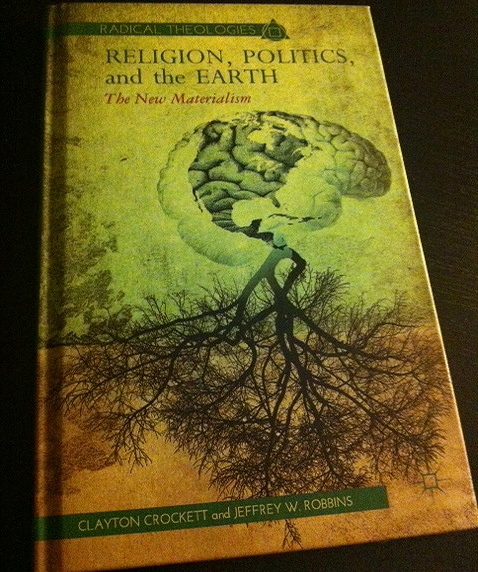
I have also started an in-depth reading of “Religion, Politics, and the Earth – The New Materialism” by Clayton Crockett & Jeffrey W. Robbins. I have skimmed the book in prep for a series of HomeBrewed Christianity podcasts on the subject but this time I am prepping for a reading group that starts next week.

I have been thinking for a while about sharing great quotes that I find here. My hesitation is that someone will get nit-picky about not having the whole context for the content … but I think that I am just going to do it anyway.

So without further ado, here is a challenging quote from the beginning of that Crockett and Robbins book:

We are witnessing the exhaustion of contemporary culture, a devolution to consumerism, greed, mindless entertainment, and the corrupt appeal of money and military power. We encounter numerous scenarios of apocalyptic crisis and collapse both in the popular imagination and in the real world. Globally—culturally and economically—our world has become tied together to an unbelievable extent, just to the point where it is fraying and fragmenting apart.
Witness the vapidity of most popular cultural modes: the saturation of consciousness by “reality” shows, recycled commercial jingles and right-wing talk radio, and the bleeding of news into cynical infotain-ment, the dumbing-down or corporatization of education and other phenomena.3 The most invigorating buzz is usually tied to a sporting event or an advertising campaign.

I’m going to try this over the next month as a fun experiment – sharing stuff I find intriguing.

I would love to hear your thoughts on the totally out-of-context introductory section.


Blog at WordPress.com.

Up ↑