Search

Bo Sanders: Public Theology

updating & innovating for today

Tag

church

Barna and the Burned Over Region

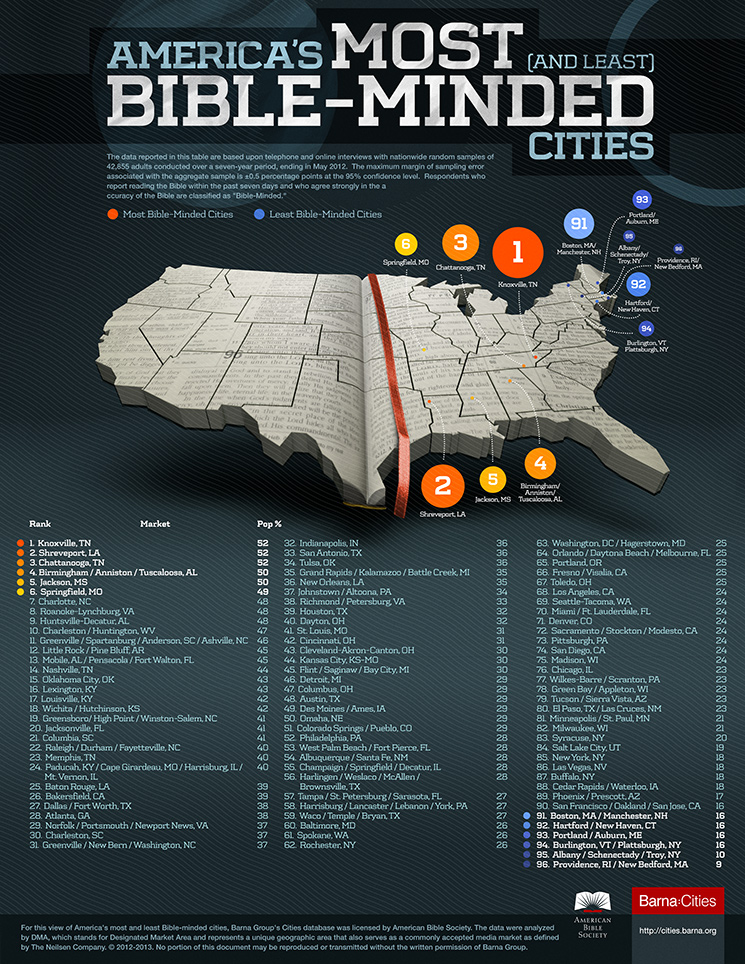
Barna Research put out a fascinating list of America’s Top 100 most ‘Bible-Minded Cities’.  Its not the top 10 Bible cities but the bottom 10 that are so telling! barna_biblemindedcities_preview1

The bottom 10 are:

  • Boston, Mass
  • Manchester, NH
  • Hartford/ New Haven, CT
  • Portland/Auburn, ME
  • Burlington,VT
  • Plattsburgh, NY
  • Albany/Schenectady/Troy, NY
  • Providence, RI
  • New Bedford, MA

It really caught my attention for 3 main reasons.

1. When I was in college I was an evangelist and Barna was our go-to source

2. During that time a common mantra in my circles was that ‘the Pacific-NorthWest is the most unchurched are in North America.’

3. After college I went to help plant a church in upstate NY (near the VT border) and grew suspicious about that Pacific NW thing.

I had spent time in the Pacific NW and while there were lots of unchurched people … there were also tons of churches – but specifically big churches aggressively engaged in the culture wars.

In the New England (or NorthEast) region, it was different. There was a cynicism is had not seen. Not a coffee shop atheism like the west. I deep suspicion unlike I had encountered.

 This came to a head for me when two roads converged. 

Ingredient 1: I was charismatic and had bought into a thing call “Re-digging the Wells of Revival” where you go to places where God has worked in the past and, through prayer, you try to unplug that ancient well of what God wants to do to release the anointing that once flowed.

I lived in area that had seen large revivals in the late 1800’s and early 1900’s. In fact, the denomination I was a part of was founded in the region and still had some of the revival tabernacles as properties! I would go to the  one closest to my house (Round Lake, NY) and pray for revival to sweep our area again.

I even started doing historical research. I stumbled into something. It was called ‘the Burned Over region’. It turns out that the much celebrated  revival had burned through so fast and so hot that when it was over … a cynicism had set into many people. Families that had given large amounts of time, sums of money and even family jewelry collections grew bitter.

A problem developed for me. The circles I was running in were celebrating the 2nd Great Awakening and other historical renewals of the church. I was growing suspicious and that altered my prayers.  I stopped praying for the same kind of revival we say 100 years ago and started praying for a different kind that didn’t leave generations of families bitter and broke.

 Ingredient 2: I went to a Barna Conference in western NY (Syracuse or Rochester area).  I sat there the whole time shaking my head as Mr. Barna presented to a packed massive auditorium. The finding that he was presenting were not exactly true of my area.

I had read a book by that point called “The Nine Nations of North America” and had begun to concoct a theory that merged (for churches) the New England of Nine Nations and my findings in Burned Over research. When you put those two together it really explained a lot.

 I kept saying to myself, “Even NY is different east of the Hudson river. From Albany east NY is more like New England than like Western NY and Pennsylvania”.

After Barna’s presentation I voiced my suspicion and that was not greeted well by my denominational cohort I was attending with.

I even brought up the Pacific NW thing and how out there you can hear 3 big christian radio stations and find a christian bookstore every couple of miles. We had neither.

The Pacific NW had mega-churches. We had one church over 1,000 and people in our area were suspicious that it was a cult, “because how else could you get that many people to all come and sing the same thing at the same time and then listen to one guy talk for a half-hour?”

 All of that is background for this past weekend. Barna put out a fascinating new list of the 100 most biblically minded cities. You can go read the article to see how they configured that.  The 2 most important things to me:

1 – the top 50 are East of the Mississippi River (except for Bakersfield, CA).

2 – the bottom 10 are all in NE or that NY Hudson River basin.

To me this says two things. First, the Bible Belt is a real thing and when combined with something like ‘Nine Nations’ is potent to think about.

Second, The bottom 10 are all in the burned over region and should give us concern about what 100 years from now will look like. I know that there are lots of factors over the last century and that someone will say “the past is not the future” and I get that.

But as one who a) studied this, b) while I lived there, and c) called it out in real time… I’m telling you –

The bottom 10 of this thing are far more relevant to our future than the top 10. 

Honoring Our Elders or If Aquinas was Around Today

Thomas Aquinas comes up a lot these days.*   Some of it is generated by a small community of passionate people who want to reclaim his project. Thomas_Aquinas_by_Fra_Bartolommeo

This, in turn, prompts some – such as John Caputo in an interview with us – to come up with a legendary one liner that accused this group of ‘retreating into the hills of Thomism’. 

The most insightful address I have encountered recently comes from Umberto Eco in the book Travels in Hyperreality. In a chapter entitled “In Praise of St. Thomas” he outlines how Thomas interacted with his world and how he navigated the difficulties of his inherited order (mendicants) , his Age, and his own limitations.  Three passages from the 1974 essay that inspired me were:

  – Thomas, was neither a heretic not a revolutionary. He has been called a “concordian”. For him it was a matter of reconciling the new science with the science of revelation, changing everything so that nothing would change. 

– Nobody ever said that Thomas was Galileo. Thomas simply gave the church a doctrinal system that put her in agreement with the natural world. 

–  So it is surely licit to ask what Thomas Aquinas would do if he were alive today; but we have to answer that, in any case, he would not write another Summa Theologica. He would come to terms with Marxism, with the physics of relativity, with formal logic, with existentialism and phenomenology. 

He would comment not on Aristotle, but on Marx and Freud. Then he would change his method of argumentation, which would become a bit less harmonious and conciliatory.

And finally he would realize that one cannot and must not work out a definitive, concluded system, like a piece of architecture, but a sort of mobile system, a loose-leaf Summa, because in his encyclopedia of the sciences the notion of historical temporariness would have entered.

I can’t say whether he would still be a Christian.

But let’s say he would be.

I know for sure that he would take part in the celebrations of his anniversary only to remind us that it is not a question of deciding how still  to use what he thought, but to think new things.

Or at least to learn from him how you can think cleanly, like a (person) of your own time.

After which I wouldn’t want to be in his shoes.

This actually is an approach to the past that has some general applicability. I have heard it said that best way to honor founders of any movement is not to simply repeat what they did but do the kind of thing they did in their time for our time. Aquinas

As a contextual theologian, I have said (over and over again) that honoring the apostles and the early church’s mothers and fathers is not in simple doing what they did in their culture – but in doing in our culture the types of things they did in theirs.

Rote repetition – regurgitation is not honoring. It is closer to idolatry. 

Repeating in the 21st century what they said in the 8th century isn’t as faithful as one might like it to imagine. This is due to the nature of our message. Our message is incarnational and thus our models and methods must match that!

The container must match the content. 

I’m not that into Aquinas. I think it’s because of the approach of those who are a little too into him.  But if they were to change to Eco’s approach and engage contemporary science and incorporate real scholarship, then I might get into Aquinas as well.

I just have no interest in reclaiming a romantically imagined version of the past. I am very interested in engaging the living now and emerging near future.

 _________
* Saint Thomas Aquinas, (1225 – 1274), also Thomas of Aquin or Aquino, was an Italian Dominican priest, and an immensely influential philosopher and theologian in the tradition of scholasticism, within which he is also known as the “Dumb Ox”.
Aquinas

America is like God – both can ask for your life

Charles Taylor, in his book Modern Social Imaginaries,  utilizes the term ‘social imaginary’ to refer to god-like capacity described by Benedict Anderson in Imagined Communities.  The term encompasses a threefold meaning:

  • First is the way that ordinary people “imagine” their surroundings in images, stories, and legends.
  • Second is the general acceptance and participation in the imaginary by a population and not simply the theories dominated by a small elite.
  • Third is empowerment provided from the imaginary for widely shared practices – and a sense of legitimization.[1]

One impact of this capacity to conceptualize national identity and belonging is in answer to the question “what would make someone be willing to die for their country?”

Anderson proposes a model of historic drift where sovereignty, which had previously been located in either religion or king (or both), has shifted decisively to the Nation in recent centuries. This is a dramatic innovation and recognizing nationality as a valid location for sovereignty has significantly altered matters related to loyalty, sacrifice and belonging.

Anderson proposes a definition of the nation as “an imagined political community – and imagined as both inherently limited and sovereign.” The distinction as imagined comes because “the members of even the smallest nation will never know most of their fellow-members, meet them, or even hear of them”.

Communities are limited because there must be some distinguishing demarcation outside of which are other communities (nations), which provide both competition and opportunities for cooperation. This distinction provides a vital function as classifications for the project of establishing communities.

Communities are imagined as sovereignbecause the concept was born in an age in which Enlightenment and Revolution were destroying the legitimacy of the divinely-ordained, hierarchical dynastic realm.” [2]
The dissolving social order of caste and class provided more level (if desperately unequal in reality) conception of both membership and participation for the mass of the population. This perceived leveling and opening gave rise to a new capacity for sacrifice on behalf of the imagined entity – an entity that was not solely and externally located in eternity or beyond, but in an ideal which one was associated (belonged) and participated and was thus responsible. To die for a religion (God) or a King was to reinforce that social order which established the hierarchical strata. Locating sovereignty within the conception of Nation – however dispersed and elusive – was a profound change.

In 1922 Carl Schmitt wrote his famous work Political Theology: Four Chapters on the Concept of Sovereignty and claims  that

“all significant concepts of the modern theory of the state are secularized theological concepts.”[3]

In 2011 Paul Kahn wrote an engagement of Schmitt’s work with four new chapters on the same subject where he says that the capacity for the state to ask for this kind of sacrifices, the power to pardon – which is a remnant of Kingly authority, and the symbolic notion of a flag that needed to be defended are all remnants of a religious notion. The very word sovereign is borrowed from religious vocabulary.  Kahn explains:

Political theology today is best thought of as an effort to describe the social imaginary … (arguing) that secularization, as the displacement of the sacred from the world of experience, never won, even though the church may have lost. The politics of the modern nation-state indeed rejected the church but simultaneously offered a new site of sacred experience.[4]

You can begin to see why the constitution is often thought of and talked about as an inspired document (sacred text) and why those who were responsible for it’s creation (founding fathers) are celebrated at patriarchs.[5]  If Schmitt is right – even partially – then all of these similarities are neither trivial nor inconsequential.

The power of the state to ask for death in order to preserve itself and the capacity of people to willingly offer their lives in defense of that conception is profound. The notion of the sovereign holding the power of exception goes all the way from the individual being pardoned (as referenced earlier) to modern realities impacting all of humanity. The President has the ability to launch nuclear weapons if the President was to view that the national interest was in jeopardy.

Kahn uses this to illustrate his point. What are we saying about the nation that we are willing to jeopardize human heath, the planet, and subsequent generations for its defense? What could possibly be above human health and planetary environmental conditions? The answer is ‘only something that is of ultimate concern’. 
The modern conception of the state is thus a result of religious conceptions and has replaced (in some sense) religion as the location of sovereignty one is willing to ultimately sacrifice and die for. Nation is a construct of transcendent meaning found in an imagined community.[6]

Now this is where it gets really interesting! 

Arjun Appadurai, in Modernity at Large interacts with Anderson and observes that:

Modern nationalisms involve communities of citizens in the territorially defined nation-state who share collective experience, not of face-to-face contact or common subordination to a royal person, but of reading texts together.[8]

Much of the rhetorical energies of the ruling powers are used in order to urge “their subjects to give up … primordial loyalties – to family, tribe, caste, and region” for the “fragile abstractions” called nations which are often “multiethnic … tenuous collective projects”.[9]

Only within the power of national imaginaries can one see the possibility of such a monument as a tomb left intentionally empty or holding the remains of an unidentified combatant. Anderson points out the absurdity of “a Tomb of the Unknown Marxist or a cenotaph for fallen Liberals.”[10]  There is no reserve of belonging that would justify such a display. It would hold little value outside the context of national identity.

And that is how the sausage called nationalism is made!


[1] Taylor, Modern Social Imaginaries, 23.

[2] Anderson, Imagined Communities, 8.

[3] Paul W. Kahn, Political Theology: Four New Chapters on the Concept of Sovereignty, location 37.

[4] Ibid., 360.

[5] CBC Ideas podcast  ‘The Myth of Secularism’ part 5

[6] It is not difficult within this framing to view contemporary movements such as the Tea Party as merely an extreme example of a group calling for a romanticized notion of an imagined past or legacy.

[7] Anderson, Imagined Communities, 8.

[8] Arjun Appadurai, Modernity At Large: Cultural Dimensions of Globalization, 161.

[9] Ibid., 162.

[10] Anderson, Imagined Communities, 10.

Moving Toward Multiplicity

Listening to Howard Zinn (author of the classic A People’s History of the United States) at a town hall meeting style presentation recorded in 2007 (you can get it on Itunes from WGBH Politics) I was struck by the need to recognize the sheer complexity of issues and multiplicity of perspectives. complexity

To state it as simply as possible: Not everything is the same. When we attempt to represent EVERYthing as if it were represented by ONE thing, we often neglect the complexity and multiplicity involved in the matter.

I will use two examples that Howard Zinn illustrated well at the community forum, then address the issues that it seemed relevant to connect to.

Zinn takes on the idea of “Family values”. Some conservative political interest say that they represent ‘family values’. But he asks “Which family?” I think it is a valid question. There are families with single moms and multiple kids, divorced dads raising a family, there are foster families, adoptive families, multi-generational families living in the same house. There are lesbian couples with no kids and gay couples with kids. My wife are were D.I.N.K.s (double income – no kids) hen she lost her job while were trying to adopt (which fell through recently) and every permeation you can imagine.

Which family is represented by Focus on the Family’s values? It is erroneous to act as if there is one kind of family and that you represent their values.

That is, unless you are saying that you value only one type of family.

That would be fair enough but you would have to stop using the phrase ‘family values’. Some families value making money or achieving success. Some value conformity. Some value religious adherence above all else. Some value military service while others value independent thinking or even civil disobedience.

Zinn says the same thing about the ‘National interest’. I am a big fan of Paul Kahn’s Political Theology and both he and Zinn talk about President’s ability to declare war or even launch the nuclear codes should the President deem it ‘in the national interest’.

But which of the many National interests? The Nation is not interested in only one thing. There are hundreds or thousands of interests. Unfortunately the reductive mono-speak is code. These buzz-words become code-words for an assume-unstated single issue that clouds the true complexity behind the language.

Zinn touched another example which has been showing up in a lot of my reading lately. The phrase ‘We the people’ is a magnificent ideal. I admire the phase and the idea behind it so much. But I think that it is worth noting that when it was written – we the people were not in the room. At the time of it’s writing, not every ‘we’ was represented.

There were no native americans in the room, no women, no blacks, no commoners. Just land-owning white males. But they had an idea – and it is that idea that we love!

I actually think that this is the exact type of trajectory mentality that we see in a progressive reading of the New Testament. When Paul says in Galatians 3:28 that “There is neither Jew nor Greek, slave nor free, male nor female, for you are all one in Christ Jesus.” He is doing this exact thing. He wrote in prophetic expectation using the 3 categories employed in his day were being broken with resurrection power. Barriers between nationality (or race), legal status and gender were being dissolved. My assertion is that it was not for the purpose of homogenization but for multiplicity! The former containers can not contain what it being poured out and welling up in Christ’s new life.

This is why I don’t sweat the fact that Paul appears to by anti-gay (though I argue that he was not anti-gay in the same way that those who quote him today are). You have to read Paul on a trajectory. Within the fruit of the Spirit of God is seed of liberation and transformation. So like ‘We the people’ – it looks forward to a greater reality than was present at it’s writing. Contained within the words is an ideal not yet realized. That is part of why I don’t want to conserve the reality of the time of it’s writing, but spring board off of it to be propelled to a greater one.

We can get caught up in reductive views that ignore the inherent complexity that we are dealing with. For instance, “Is the world essentially good or bad?” or “Are humans inherently evil or innately good?” That kind of simplicity is blind to the multiplicity of factors that we are dealing with in any conversation and allowing the conversation to be framed that way almost ensured that no progress will be made.

Good people still do bad things or even do good things with poor motivation. People who do bad things often love their own families.

We do ourselves a great disservice when we allow our media to talk about ‘the evangelical vote’ or even ‘the black perspective’ as if those parameters only mean one thing or as if everyone within designations voted the same way or believe all the same things, hold all the same values and act in unison. It is fictitious, deceptive and paralyzing.

You can’t even say ‘gun owners’ and mean one thing! Our language (and the dualism behind it) is crippling our culture.

There has been a great “De-centering” that has happened to humanity in the past 500 years. If you just look at the effect starting with Copernicus and continue to Darwin, the earth is not the center of the universe and neither are humans.

It would do us well to move from a reductive mentality (center/ order) to a dynamic interplay of emergent elements. When we recognize the complexity and multiplicity involved in the reality behind our ‘code words’, we will begin to access the real issues that face us.

The Church’s Task

In the next 24 hours I will be putting up 4 blogs – taken together, you will be able to tell what I have been thinking about the past month.  I would love your feedback on any of them.

Last month David Fitch tweeted this:

“The biggest task of today’s church is to undermine in its members the blase unexamined acceptance of secular assumptions for everyday life.”

I thought about it all day and just couldn’t be sure he was right on this one.

Now just to let you know where I am coming from:

Put that all together, I have doubts about Fitch’s assertion. Here is why:

I am increasingly suspicious that secularism is both a consequence and a side effect of Christendom. It is the West’s Frankenstein if you will. We made it. Then it took on a life of its own – a life we don’t like very much and which damages our efforts and injures our cause.  I think we have to start there.

I agree with Fitch that there is a ‘unexamined acceptance” and would go even further and say that it results in an assumption that what we see is the way it is. That our current mechanisms of organization are final forms and that the ‘as-is’ structures come with a large measure of ‘giveness’.  Tripp often applies this capitalism, nation-states and democracy. I would tack on both denominations for the church and militarism for US America.

I am just not so sure that our main task is to undermine. Maybe that is where my hangup comes. I am leery of this approach because it seems like we are defaulting the ground rules in the initial move and framing the task in a conceding first move.

I might be naive here but I am just not sure that the church needs to
A) give that much ground initially
B) frame her task in the negative.
I know it’s just so much one can do with a tweet but … there is something there that gives me caution.

So what is my constructive proposal?  I’m working on it.

I would want to frame it more like Stuart Murray does in the book Post-Christendom  and acknowledge that initial concession was early on with Constantinian Christianity. Then Christendom. Then Modernity.  With those three concessions we admit that the as-is nature of existing frameworks for both church and culture are thoroughly compromised and corrupted.

BECAUSE of that. We abandon the recuperation, rehabilitation, reclamation , and renovation projects (and mentality) all together! (all 4 faces of it).

It’s over man.  Let it go.

THEN we start new and in the positive. The 21st century provides fresh possibilities and opportunities IF ONLY we will let go the idea of getting back to something or getting something back. I know we never start from scratch – we never get back to square one. But …

I don’t want to be the undermining parasite ON the big organism. That is too small a task.  I want to partner with God in the healing of world (Tikkun Olum in Hebrew).  I want to participate in the development cosmic good – until then at least the common good. 


PostScript: now that I started down this “re” line I can’t stop coming up with words I want to flesh out further!
Restore: no
Re-imagine: yes
Represent: yes
Re-member: sure
Resurrect: ummmm not really
Reflect: probably

Christians have to believe something about Hell, Election and Predestination

On last month’s TNT I said something that I have heard a lot of feedback on (some positive and some negative ). I thought it would be good to continue the conversation here on the blog.

 My assertion was that: If you are a Christian, you have to believe something about hell. It is just not an option to say “I don’t believe in hell”.  The word ‘hell’ is in the English version of the Bible and you can’t just say, as a Christian, that you don’t believe it. You can hold that it was a burning garbage dump in a valley outside Jerusalem that Jesus makes a poetic illusion to … but you have to believe something about hell. 

I would go on to broaden that assertion. I would say that you must believe in predestination, election, and the Book of Revelation.

All 4 of these are topics that l have personally heard people say “I don’t believe in __”

  • You have to believe something about hell.
  • You have to believe something about predestination.
  • You have to believe something about election.
  • You have to believe something about the Book of Revelation.

It is is just not an option to say “I don’t believe in hell”.  Jesus did.  If you are a Christian, you have to hold some belief about it.

Paul spoke of predestination. Election is a theme in scripture. You can’t just say ‘I don’t believe in Revelation’.  You can object to how some people interpret and preach the Book of Revelation … but you can’t ‘not believe’ it.

 Why It Matters: 

I come from an Evangelical-Charismatic background and am now employed at a Mainline church and attend a Mainline school.  I am passionate that thoughtful progressive Christians can not make the same mistake that Liberals made in the past century. By ‘de-mythologizing’ the Bible they undercut the very foundation that the tradition is built on.

It is like sawing the very branch that your a sitting on … on the tree side of the branch! What do you think is going to happen? You are left no place to perch.

I love Biblical Scholarship. I delight in post-modern and progressive theology. I take seriously the post-colonial critique and the perspective of feminists and queer theory. But it does us no good if we know what we don’t believe about something but do not have the ability to present in a constructive way what we do believe about those very subjects.

There is so little value in participating in a community based on a tradition where one does not believe in the very words of that faith’s sacred text.

Why even do it?  I think that is why so many ‘nones’ have just opted out. I actually greatly respect those who participate in the emergent conversation and who are valiantly attempting to update their denomination from within. It is far easier to just walk away from the entire project all together … and many have.

So How Do I Do It? 

Predestination:  Forget about the historical hyper-Calvinist understanding that you ‘don’t believe in”. Romans 8:29 says “For those God foreknew he also predestined to be conformed to the likeness of his Son, that he might be the firstborn among many brothers.”

Who did God foreknow? Everyone.  What are they predestined to? To be conformed to the image of the Son.  Does everyone arrive at their destination? No.

Predestination might be, what some Process thinkers would be called, an ‘initial aim’. It is God’s desire for all. God doesn’t always get what God wants ( see 1Timothy 2:4).

 Election: Karl Barth said it clearly. God elected Jesus. All humanity is involved in that election. All who are ‘in Christ’ are elect.

 The Book of Revelation: You may not like the ‘Left Behind’ / Hal Lidsey / Jack Van Impe interpretation of the Book of Revelation … but you can’t, as a Christian, say that you don’t believe in it.  It’s in the Bible. You have to believe something about it.

The Book of Revelation was a political critique of the Roman Empire of the first two centuries written in the genre of the ‘apocalyptic’. It is not predictive of the 21st century. But we don’t want to throw it away!  What we need, more than ever, is to imitate it and write an apocalyptic critique of our as-it structures, systems and institutions of injustice and our empire. We need a prophetic imagination.

You can’t say, as a Christian, that you don’t believe in this stuff. You have to believe something about this stuff. My suggestion is that we just believe more informed better stuff about these topics. The simple fact is that we are community of people centered about a sacred text and it is simply not acceptable to say ‘I don’t believe in something’. We are free to not believe in some people’s interpretation – but we have to believe something about it. 

Thoughts? Questions? Comments? 

Praying Against Big Storms

This begins a series over the next 2 days that were written a month ago. It is interesting to read them now. I will tweak the intros to each, but I fear that they will be ongoing issues until we seriously revisit some of our flimsy thinking behind these subjects.

Hurricane Sandy was only one day in to its battering of the East and the religious weighed in.

The first thing that caught my attention was a fake picture of ‘the storm’ over NYC

I was introduced to this photo and I was immediately  suspicious of both the sunshine in the foreground and the speed boat that looks oddly mis-sized.

I thought it humorous until that afternoon when I logged onto Facebook and notices that it had already been shared by hundreds of  people. What really caught my attention, though, was a response in the form of a prayer.

My friend had stated in the captions to the photo: “This is an amazing shot of New York today with the Frankenstorm bearing down. Nature is so powerful, yet so beautiful.”   I thought “someone should tell him that it’s a fake”.  Before I could, someone else had offered this response:

Father, all the elements of nature obey your command. Calm the storms and hurricanes that threaten us and turn our fear of your power into praise of your goodness. Grant this through our Lord Jesus Christ, Your Son, who lives and reigns with you and the Holy Spirit, one God, forever and ever. Amen.

I was stunned. There are so many elements of this ‘prayer’ that concern me. I was filled with questions. Perhaps the biggest one was : Is there a god who hears these kind of prayers? 

This past Sunday at the Loft LA I had preached a sermon called ‘Why Pray?’ about this exact type of thing … so my attention was immediately piqued.

On a side note – I especially appreciated that just hours later this fake meme showed up in the twitter-verse.

I am deeply concerned about people who think that their prayers can command whole weather patterns. This concern is primarily at two levels.

  • The first is that I know so many of them.
  • The second is that a wooden reading of the Bible can lead one to think that this is acceptable and permissible.

This kind of stuff really pulls at me as an emerging evangelical-charismatic.  I was prepared to let the whole thing go when this showed up on the wire:

[I had written multiple times about John Piper’s stupid storm theology and simple Bible reading]

A Christian religious leader has already claimed that Hurricane Sandy is further proof that “God is systematically destroying America” as political judgment for the “homosexual agenda.” John McTernan previously made similar allusions about Hurricanes Katrina (2005) and Isaac (2012), which he reiterated in his urgent call to prayer posted Sunday evening (via Gay Star News):

Just last August, Hurricane Isaac hit New Orleans seven years later, on the exact day of Hurricane Katrina. Both hit during the week of the homosexual event called Southern Decadence in New Orleans!

McTernan believes that it is noteworthy that Hurricane Sandy is hitting 21 years after the “Perfect Storm,” because 3 is a “significant number with God”:

Twenty-one years breaks down to 7 x 3, which is a significant number with God. Three is perfection as the Godhead is three in one while seven is perfection.

It appears that God gave America 21 years to repent of interfering with His prophetic plan for Israel; however, it has gotten worse under all the presidents and especially Obama. Obama is 100 percent behind the Muslim Brotherhood which has vowed to destroy Israel and take Jerusalem. Both candidates are pro-homosexual and are behind the homosexual agenda. America is under political judgment and the church does not know it!

Religious spokespeople have frequently tried to draw bizarre connections between natural disasters and the LGBT community. Last year, the American Family Association’s Buster Wilson similarly claimed that Hurricane Isaac was punishment for the Southern Decadence LGBT festival. Rick Joyner had the same to say about Hurricane Katrina, claiming that “[God]‘s not gonna put up with perversion anymore.” Pat Robertson has long believed that acceptance of homosexuality could result in hurricanes, earthquakes, tornadoes, terrorist bombs, and “possibly a meteor.”

It’s likely that McTernan will not be the only religious figure to draw such allusions from this devastating storm.

One anti-gay (former lesbian) activist actually targeted  the state of Vermont as a litmus test of who her god was mad at. I loved the first comment on the post:

Considering that Lower Manhattan is troublingly at risk, I say there’s a good chance it’s Jesus cleaning up Wall Street – a modern-day version of when He cleared the moneychangers out of the Temple…

As funny as that last comment may be, I am not amused – because it concedes the rules of the game to the antiquated notions of centuries past and abdicates the metaphysical realities of 21st century life to the … let’s just say – the conceptions of bygone eras.

  • The picture was a fake.
  • It triggered real prayers.
  • I respect those intentions.
  • I questions the ‘god’ who they were offered to.
  • I am flustered that in the midst of suffering, those who claim Christ offer blame and not compassion.
  • They justify that stance by saying ‘if you only did what we said was right’.
  • It signals a pattern of christian response to tragedy.

I am concerned that the fake-ness of the pictures and posts we respond to correspond to our notion of reality and our conception of how the world works … and thus how our prayers are effective.


I Voted For the First Time Last Week

Seven days ago I voted for the very first time.  I wasn’t sure I wanted to puncture the seal – cross that threshold – and break my long string of abstaining.

 Here is the background on why I have never voted: 

  • In High-school my family moved from the Chicagoland area to Saskatchewan, Canada. After High-school I stayed in Canada to play football when my family moved to NY and I became a dual citizen.

When you come of age outside your culture of origin, you see some stuff within that culture a little differently. Voting (and politics in general) was one of them. I didn’t see its impact locally like I would have if I was a farmer or a school teacher, I saw it through the media circus. Loyalty and responsibility take on a different meaning when you have dual belonging.

  • When I got filled with Holy Spirit and called to ministry I was initiated in a very dualistic form of evangelical charismatic christianity. It was spiritual in contrast to physical. Church in contrast to world. Supernatural in contrast to natural.

I was a zealous young man and so I took it further than most. Many would quote the verse “we are in the world but not of the world”. I would take it further and quote 2 Timothy 2:4 “”No good soldier gets entangled in civilian affairs, but rather tries to please his commanding officer.”  I followed the Lutheran idea of ‘two kingdoms’ (kingdom of God and kingdom of this world) all the way down.

  • When I became Ordained I not only opted out of Social Security (which ministers are allowed to do in their first two years of filing taxes) but I registered with the Government as an objector.

I am a registered objector. I indicated that what remaining taxes I did pay, I did not want them going to pay for wars … and this was before W was in office (!). I would tell people “I am not political. I am focused on the spiritual realm not the physical. The government takes care of people in this way, I take care of people in a different way. Plus, I don’t want my loyalties in the natural realm to limit my ministry to people in the supernatural.”  It actually worked quite well for me for a time. I was very vocal about my opting out of the system and in my congregation was a eclectic mix of New England Democrats and pre- Fox News Republicans.

Here is why I was thinking about voting for the first time: 

  •  I no longer subscribe to the dualism of natural – supernatural, physical – spiritual, or church – world. I have shed my understanding of Luther’s two kingdoms.  I read Jesus’ admonition about “In the world but not of the world” differently now … and all it took was an introduction to Biblical scholarship and some Roman political history. 
  • Randy Woodley was my mentor in seminary and he would ask me to explain my politics to him and then challenge me that it was incoherent and inconsistent. I play my conversations with him over and over in my head. Once you study colonial history (or even 20th century history) you realize that to be silent in the face of systemic oppression and repressive legislation is to become complicit with the injustice and suffering that the God you claim to serve is so opposed to.
  • I read Martin Luther Kings “Letter from a Birmingham Jail”  and realized that I was one of those white ministers he was talking about being disappointed in and let down by.

“First, I must confess that over the past few years I have been gravely disappointed with the white moderate. I have almost reached the regrettable conclusion that the Negro’s great stumbling block in his stride toward freedom is not the White Citizen’s Counciler or the Ku Klux Klanner, but the white moderate, who is more devoted to “order” than to justice; who prefers a negative peace which is the absence of tension to a positive peace which is the presence of justice; …Shallow understanding from people of good will is more frustrating than absolute misunderstanding from people of ill will. Lukewarm acceptance is much more bewildering than outright rejection.”

  •  The attacks on September 11, 2001 and the Bush-Cheney-Rumsfeld (and Halliburton) parley into two wars under the false guise of ‘Weapons of Mass Destruction’ haunts me when I think of how a different administration might have proceeded differently.
  • As one getting their PhD in Religious Education I have become all too aware of the impact of economic and bureaucratic decisions on children’s education. I don’t see how you can know what I know now and not do something so little that can make such a big change for so many.
  • I live in California where we don’t just vote for candidates (which I was still leery about) but we also vote on propositions. Some of these propositions directly impact school budgets and it would be gross neglect to stay silent on them when our public schools are in such desperate shape.
  • The Paul Ryan budget was and is immoral and unimaginable. I was still siting on the fence about voting – even with the whole Tea Party and Occupy movement thing – until Romney’s selection for his Vice Presidential running mate. I have watched the union stuggles in Wisconsin and Chicago, I have listened to the disgusting rhetoric of this latest financial crisis and continueing bailouts of Wall Street and too-big-fail banks… but when Romney picked Ryan … and I had just recorded that interview with Randy Woodley … I was horrified.

 Why I was still hesitating: 

I read Chris Hedges ‘Death of the Liberal Class’ and can not shake the nauseating reality of just how broken our democratic system is. Both candidates are owned by big business and the election (thanks to the Citizens United decision) is a sham.

It seems to me that to participate in a process this corrupt is to somehow be complicit with the immorality and to sanction or validate these compromised actors.

I have gone this long and there is just something in my identity, something about the way that I imagine myself and tell my story that can not conceive of crossing that line – of breaking the seal and entering into this realm. It was the strangest thing to think about.

 In the end: 

Smiley and West is my second favorite podcast in the world (next to the one I am on). No, President Obama did not do so many things that he said he would do the first time (like close Guantanamo) but … he also did some stuff (like health care reform) that was much needed (although I question the for-profit nature of our insurance companies).

I’m still leery about endorsing professional politicians, but in the end I just didn’t know how I can have learned what I have learned about education in the country and not do something that would so greatly impact the young people – and disproportionately young people of color.

After all, I would hate to have the problem of Christopher Reeve that I spoke so harshly against.

 I am interested in any thoughts on my journey and process.  Comments? Questions?  

Not All Differences Are The Same – or simple God talk

There are two distinct kinds of differences (among many) that show up in my dealings across the religious landscape.

The first kind of difference is a seemingly superfluous, ‘icing on the cake’ kind of difference. This is when you share a large majority of opinion or agreement with someone but in the end you diverge and there is some significant application or implication that really provides a contrast.

For instance: you can have a great conversation with someone or a friendship where there is great connection and resonance, but there is something like … they think that communion elements are really sacred, or that a specific translation of the Bible is superior or that one kind of music makes God happier than another.  It’s not a deal breaker, it’s just a difference – not the end of the world.

Then there is another kind of difference – the kind that exposes the root of the problem, that provides a missing key that unlocks the rest of the mystery. Sometimes your hear someone say something and it stops you in your tracks.

You think “Wait! Is that what you’ve been doing this whole time? Is that what is driving these other things we disagree on?”

This kind of a difference is most often exposed when someone takes something you have encountered before – only they take it way too far. It is in the excess (or extreme) that the pattern is exposed and you are suddenly able to see it  in smaller or more subtle way where you have never been able to discern it clearly before.

This has happened to me in the areas of

  • PMS cramps – Maternity Leave (Eve ate the apple)
  • The war in Iraq (angels with flaming swords guarding Eden)
  • Africa’s poverty (Noah cursed his son who then went to Africa)
  • Racism (we have a black President)
  • Global Warming (God promised Noah never to destroy the earth with a natural disaster)

and far too many other examples to list here. I could talk about topics ranging from dinosaur bones planted by the Devil to ‘Manifest Destiny’, from open parking spots at the mall to Dr. Seuss’ Horton Hears a Who fulfilling the book of Ezekiel.

Sometimes it takes someone saying something so outrageous or outlandish that you are smacked out of your naive fantasy that we are all basically doing the same thing as Christians – or that Christianity is one thing, even if it is a diverse thing. 

A while ago I wrote a little blog about John Piper and his horse like faith. It got quite a good readership at first and then, as most posts tend to, faded into the shadows of the archive. Recently, however, this post has been getting tons of clicks and sometimes is getting more reads in a day than the new stuff!  So I went back to read ‘Horse Gods’ again to see what might be causing the comeback.

While I was there, I noticed in the comments section, someone had asked me to distinguish my view of God from someone like John Piper or Mark Driscoll. My original response seems more interesting with recent developments:

Actually there is quite a substantial difference. Let me point out just a couple of things to start:

1) I don’t believe that language about God is univocal (a 1:1 equation). SO we begin in humility understanding that all our words, metaphors, and concepts are OUR best attempt.

2) I believe that language (since it is not univocal) functions relationally. When Jesus uses ‘Father’ language, he is talking about the WAY in which relates to a father. Not that God’s ontological being is Father in an exacting and representative way. It is an expressive use of language. That is the nature of language.

3) The way that Scripture is expressed is historic. I believe that the Bible is Inspired by Holy Spirit. That means that Holy Spirit was at work in the authors and ultimately in those who collected and validated the canon. (I confess this by faith). Those authors were historically situated and particularly located. They expressed their thoughts in their best language in their best frameworks. We see that historical locatedness and account for it when we engage their writings.

4) Whether you call it ‘original sin’ (I don’t) or ‘human nature’ or (my favorite) relational brokeness and conflicting biological impulses … humans have a problem. We are not 100% whole. Something is wrong (we don’t even do the good we WANT to do). That means that in every epoch and era there are things in place that are not perfect. Those show up in scripture – since it is a snap shot of its environment. The Bible is fully human (and I believe fully divine in a Process sense) but it is not ABSENT of humanity. It is full of humanity.

So If you take just those 4 things in contrast to Piper and Driscoll, then my God talk is:
A) In humility not certainty or pushy
B) Relational not static or exacting
C) Historical not trans-historic
D) Human not un-human

That is my starting point. From there I diverge wildly from  those two.


Blog at WordPress.com.

Up ↑