Search

Bo Sanders: Public Theology

updating & innovating for today

Tag

conservative

Moving Toward Multiplicity

Listening to Howard Zinn (author of the classic A People’s History of the United States) at a town hall meeting style presentation recorded in 2007 (you can get it on Itunes from WGBH Politics) I was struck by the need to recognize the sheer complexity of issues and multiplicity of perspectives. complexity

To state it as simply as possible: Not everything is the same. When we attempt to represent EVERYthing as if it were represented by ONE thing, we often neglect the complexity and multiplicity involved in the matter.

I will use two examples that Howard Zinn illustrated well at the community forum, then address the issues that it seemed relevant to connect to.

Zinn takes on the idea of “Family values”. Some conservative political interest say that they represent ‘family values’. But he asks “Which family?” I think it is a valid question. There are families with single moms and multiple kids, divorced dads raising a family, there are foster families, adoptive families, multi-generational families living in the same house. There are lesbian couples with no kids and gay couples with kids. My wife are were D.I.N.K.s (double income – no kids) hen she lost her job while were trying to adopt (which fell through recently) and every permeation you can imagine.

Which family is represented by Focus on the Family’s values? It is erroneous to act as if there is one kind of family and that you represent their values.

That is, unless you are saying that you value only one type of family.

That would be fair enough but you would have to stop using the phrase ‘family values’. Some families value making money or achieving success. Some value conformity. Some value religious adherence above all else. Some value military service while others value independent thinking or even civil disobedience.

Zinn says the same thing about the ‘National interest’. I am a big fan of Paul Kahn’s Political Theology and both he and Zinn talk about President’s ability to declare war or even launch the nuclear codes should the President deem it ‘in the national interest’.

But which of the many National interests? The Nation is not interested in only one thing. There are hundreds or thousands of interests. Unfortunately the reductive mono-speak is code. These buzz-words become code-words for an assume-unstated single issue that clouds the true complexity behind the language.

Zinn touched another example which has been showing up in a lot of my reading lately. The phrase ‘We the people’ is a magnificent ideal. I admire the phase and the idea behind it so much. But I think that it is worth noting that when it was written – we the people were not in the room. At the time of it’s writing, not every ‘we’ was represented.

There were no native americans in the room, no women, no blacks, no commoners. Just land-owning white males. But they had an idea – and it is that idea that we love!

I actually think that this is the exact type of trajectory mentality that we see in a progressive reading of the New Testament. When Paul says in Galatians 3:28 that “There is neither Jew nor Greek, slave nor free, male nor female, for you are all one in Christ Jesus.” He is doing this exact thing. He wrote in prophetic expectation using the 3 categories employed in his day were being broken with resurrection power. Barriers between nationality (or race), legal status and gender were being dissolved. My assertion is that it was not for the purpose of homogenization but for multiplicity! The former containers can not contain what it being poured out and welling up in Christ’s new life.

This is why I don’t sweat the fact that Paul appears to by anti-gay (though I argue that he was not anti-gay in the same way that those who quote him today are). You have to read Paul on a trajectory. Within the fruit of the Spirit of God is seed of liberation and transformation. So like ‘We the people’ – it looks forward to a greater reality than was present at it’s writing. Contained within the words is an ideal not yet realized. That is part of why I don’t want to conserve the reality of the time of it’s writing, but spring board off of it to be propelled to a greater one.

We can get caught up in reductive views that ignore the inherent complexity that we are dealing with. For instance, “Is the world essentially good or bad?” or “Are humans inherently evil or innately good?” That kind of simplicity is blind to the multiplicity of factors that we are dealing with in any conversation and allowing the conversation to be framed that way almost ensured that no progress will be made.

Good people still do bad things or even do good things with poor motivation. People who do bad things often love their own families.

We do ourselves a great disservice when we allow our media to talk about ‘the evangelical vote’ or even ‘the black perspective’ as if those parameters only mean one thing or as if everyone within designations voted the same way or believe all the same things, hold all the same values and act in unison. It is fictitious, deceptive and paralyzing.

You can’t even say ‘gun owners’ and mean one thing! Our language (and the dualism behind it) is crippling our culture.

There has been a great “De-centering” that has happened to humanity in the past 500 years. If you just look at the effect starting with Copernicus and continue to Darwin, the earth is not the center of the universe and neither are humans.

It would do us well to move from a reductive mentality (center/ order) to a dynamic interplay of emergent elements. When we recognize the complexity and multiplicity involved in the reality behind our ‘code words’, we will begin to access the real issues that face us.

A Sentence about Seminary

Once in a while you run into a sentence that hits you like a ton of bricks.  You can read thousands of sentences in order to get to it.

Only rarely do you see it coming. Once in a while you are in a chapter that is so rich and nourishing that the sentence is just the Pièce de résistance.

Over the past 21 years, I have 5 sentences that have hit me like this. I can tell you exactly where I was when I first read them and why they hit me so hard. I say 21 years ago because that is essentially when I started reading. I was captain of the football and basketball teams in High School and didn’t so much … how do they say? … read.

It was after High School when I was no longer at my parents house – and I couldn’t make sense of my faith – that I picked up a copy of Josh McDowell’s apologetic classic: Evidence that Demands a Verdict.  On that first page was sentence that stabbed my in the heart. That was the first of the 5 sentences.

Yesterday in the spirited exchange of comments on my blog post “You have to believe in Hell, Predestination, Election and the Book of Revelation”  Nate Gilmore (you can hear his Georgia via Iowa drawl on last week’s TNT) was responding to a little bit of a fun rabbit trail we had going about seminaries and said:

 At least in online encounters, I’ve seen far more appeals to authority, citing “Biblical scholarship” as if it were a monolith, from liberals than from right-wingers.  In my own experience, the conservatives are much more interested in seeing the argument worked out than in “experts say that…” claims.

This is one of my favorite topics of discussion!  I love this topic! Not because I agree with the binary between Conservative and Liberal (I don’t – I can’t after reading The Argument Culture by Deborah Tannen, which contains 1 of my 5 sentences) but because I have a story about it  – a story that holds the last of my 5 sentences.

The Story:

I was writing my Master’s Thesis on Contextual Theology and I was utilizing a lot of material from a specific author – a real authority on the subject.  In the midst of completing the Thesis I was accepted into the PhD program at a large Evangelical shool where he teaches and I was even appointed to study with him!  It was an amazing honor.

After the Thesis was over, I was reading as much of his work as I could and I ran into a sentence from which I never recovered. He was talking about the need for innovation in the way we do Seminary – something that I am very passionate about – and he made a quick point about the difference between Liberal and more Evangelical seminaries in Africa.

He said that in Africa, Evangelical seminaries are much bigger, grow faster and produce more pastors because they are very method focused. They teach future pastors what to do.
Liberal seminaries, however, while being much smaller, are where almost all the innovation happens. His observation was that the difference came down to permission. His caution was that innovation can not become syncretism. 

Its not that his point was especially earth-shattering or unique. There was just something in the way he said it … or perhaps it was the gravity he carried as my future PhD Advisor … but I put down the book, went for a walk, and decided that I needed to go a different direction. I turned down my appointment to the school and enrolled in a totally different program at a Liberal institution (Claremont School of Theology). 

It was odd that someone I respected said something I agreed with, and the end result is that I knew I had to go a different direction than them.

This is the reason that I went into Practical Theology. It bridges the gap between these Liberal and Conservative approaches. It also attempts to bridge that gap between the Church and the Academy. It also addresses the false gap between theological theory and practice.

I’m so happy with my decision. Every time seminary education comes up, that sentence rushes to the front of my mind. My father (who was recently on the podcast) now runs the D.Min at his Evangelical seminary – so the topic of seminary education comes up a lot.

I don’t normally subscribe to the Conservative/Liberal binary, but in this case I concede the framing of the discussion because the institutions themselves identify this way and teach this way in a sort of self-reinforcing manner. 

You may not like the split, but if those on the inside are telling you that there is a significant difference … you may just have to go with it for a while and see where the road takes you.

 I just wanted to share my little story and see if anyone had any thoughts on the subject. 

Christians have to believe something about Hell, Election and Predestination

On last month’s TNT I said something that I have heard a lot of feedback on (some positive and some negative ). I thought it would be good to continue the conversation here on the blog.

 My assertion was that: If you are a Christian, you have to believe something about hell. It is just not an option to say “I don’t believe in hell”.  The word ‘hell’ is in the English version of the Bible and you can’t just say, as a Christian, that you don’t believe it. You can hold that it was a burning garbage dump in a valley outside Jerusalem that Jesus makes a poetic illusion to … but you have to believe something about hell. 

I would go on to broaden that assertion. I would say that you must believe in predestination, election, and the Book of Revelation.

All 4 of these are topics that l have personally heard people say “I don’t believe in __”

  • You have to believe something about hell.
  • You have to believe something about predestination.
  • You have to believe something about election.
  • You have to believe something about the Book of Revelation.

It is is just not an option to say “I don’t believe in hell”.  Jesus did.  If you are a Christian, you have to hold some belief about it.

Paul spoke of predestination. Election is a theme in scripture. You can’t just say ‘I don’t believe in Revelation’.  You can object to how some people interpret and preach the Book of Revelation … but you can’t ‘not believe’ it.

 Why It Matters: 

I come from an Evangelical-Charismatic background and am now employed at a Mainline church and attend a Mainline school.  I am passionate that thoughtful progressive Christians can not make the same mistake that Liberals made in the past century. By ‘de-mythologizing’ the Bible they undercut the very foundation that the tradition is built on.

It is like sawing the very branch that your a sitting on … on the tree side of the branch! What do you think is going to happen? You are left no place to perch.

I love Biblical Scholarship. I delight in post-modern and progressive theology. I take seriously the post-colonial critique and the perspective of feminists and queer theory. But it does us no good if we know what we don’t believe about something but do not have the ability to present in a constructive way what we do believe about those very subjects.

There is so little value in participating in a community based on a tradition where one does not believe in the very words of that faith’s sacred text.

Why even do it?  I think that is why so many ‘nones’ have just opted out. I actually greatly respect those who participate in the emergent conversation and who are valiantly attempting to update their denomination from within. It is far easier to just walk away from the entire project all together … and many have.

So How Do I Do It? 

Predestination:  Forget about the historical hyper-Calvinist understanding that you ‘don’t believe in”. Romans 8:29 says “For those God foreknew he also predestined to be conformed to the likeness of his Son, that he might be the firstborn among many brothers.”

Who did God foreknow? Everyone.  What are they predestined to? To be conformed to the image of the Son.  Does everyone arrive at their destination? No.

Predestination might be, what some Process thinkers would be called, an ‘initial aim’. It is God’s desire for all. God doesn’t always get what God wants ( see 1Timothy 2:4).

 Election: Karl Barth said it clearly. God elected Jesus. All humanity is involved in that election. All who are ‘in Christ’ are elect.

 The Book of Revelation: You may not like the ‘Left Behind’ / Hal Lidsey / Jack Van Impe interpretation of the Book of Revelation … but you can’t, as a Christian, say that you don’t believe in it.  It’s in the Bible. You have to believe something about it.

The Book of Revelation was a political critique of the Roman Empire of the first two centuries written in the genre of the ‘apocalyptic’. It is not predictive of the 21st century. But we don’t want to throw it away!  What we need, more than ever, is to imitate it and write an apocalyptic critique of our as-it structures, systems and institutions of injustice and our empire. We need a prophetic imagination.

You can’t say, as a Christian, that you don’t believe in this stuff. You have to believe something about this stuff. My suggestion is that we just believe more informed better stuff about these topics. The simple fact is that we are community of people centered about a sacred text and it is simply not acceptable to say ‘I don’t believe in something’. We are free to not believe in some people’s interpretation – but we have to believe something about it. 

Thoughts? Questions? Comments? 

Hopefully the Politicizing of Rape is over

This is part of  a series over the next 2 days of posts that were written a month ago. It is interesting to read them now. I will tweak the intros to each, but I fear that they will be ongoing issues until we seriously revisit some of our flimsy thinking behind these subjects.

Yet again a Republican candidate came out with an outlandish comment about rape  that has drawn widespread criticism from those outside the ideological bubble.

  Indiana Congressman Richard Murdoch, during a debate, made the latest in what has become a consistent string of rhetoric for white conservative men – notably on the heels of Senate candidate Todd Akin’s introduction of ‘legitimate’ rape into our vernacular.

Apparently Akin, who is on the House Science Committee, thinks that a women’s body can sense if the conception was because of ‘legitimate’ rape and take of the matter on its own. Richard Murdoch took it a step further, beyond biology, and introduced theology into the mix. The resulting pregnancy would be ‘God’s will’.

 Let me be clear: I get why some people hate abortion. I do. I get it. I was raised watching movies like ‘Silent Scream’ and listening to Carmen rap/sing about our nation’s demise and invitation of God’s wrath.  I get it. That is not what I want to address here.

 My concern is with the consistent and frequent rhetoric that is coming from the conservative right on the issue of rape. 
There are 3 reasons that this hits so close to home for me:

  1. My wife ran the rape crisis hotline and prevention education for the county where we lived in NY. For a decade this was a major part of our life and focus.
  2. As a minister, I have sat with countless women and heard their stories. We have walked a really tough road of recovery and healing with many.
  3. I have traded my narrow/shallow theological adolescence for a more critical-aware- sophisticated-and progressive one.

These three things come together is a very painful way for me when I hear these continuing statements from non-women candidates.

 One starts to ask “What exactly is going on with these guys? What in the world are they thinking?”
If two is a trend and three is a pattern then this is a full-blown school of thought!

Are they just trying to fire-up their base? Are they trying to out religion each other? Are they so fixated on abortion that it blinds them to the absurdity of their other positions?

 Or is it worse than that?  Is it that there view of God is fundamentally determining this stuff?  I’m afraid that this might be true. I think that these might be really good hearted christian men who have bought into a view of God that is so limited and narrow that it necessarily dictates utterances like we have been hearing.

I am suspicious that one’s view of God is like an operating system on a computer and that given enough time, this N. American conservative/fundamentalist program that gets downloaded just inherently comes with some unavoidable glitches and bugs that eventually result in stances like we have been seeing.

Thomas Jay Oord posted the following on Facebook:

 Candidate Richard Mourdock’s statements about rape, pregnancy, and God’s intentions point out a major problem with most theologies. John Calvin summarized the problem well, “There can be no distinction between God’s will and God’s permission! Why say ‘permission’ unless it is because God so wills?” The Mourdock episode suggests that those who (rightfully) object to his statements implicitly support a view of divine power closer to process theology’s view, even though they may not realize it.

 I’m not trying to pick a fight.  I am not trying to be partisan. I am simply heartbroken about these hurtful things that have consistently come to the surface during this election cycle.

Maybe a new guideline should be put in place: as a candidate you are not allowed to talk about rape unless you have walked a mile in those shoes.

At a minimum, I would like to see the name of God disconnected from this subject in political arenas. 

The Next Pat Robertson Gaff

With the election season over, the frequency, intensity and insanity of conservative white men making outlandish statements will hopefully die down …  I’m moving a bunch of blogs over there this week and found this cheeky little blog I wrote in the middle of the fire-storm.

 Pat Robertson topped even himself in the category of ‘insulting-inflammatory- stupid comments while the tape is running’ this morning. That may seem difficult with all of the previous entries that have earned him elite status in the gaff Olympics.

The most recent entry was in response to a question from a man who apparently wanted to know what to do with his non-submissive wife.  Robertson started with suggesting that the man could convert to Islam … and as tough as it might be to top that one, he did. After conceding that the Bible does not allow for him to divorce her, Robertson gave him the option to move to Saudi Arabia – thereby indicting not only an entire religion but an entire nation.

I know that many will want to jump on Robertson with disdain and scorn but … maybe we should not be so quick to jump to judgement. As often happens in cases like this, there is a good possibility that there is something we don’t know behind the scenes. There might be more to the story that at first meets the eye.

  • Robertson might have undiagnosed Tourette Syndrome.
  • He might have a serious drinking problem and been under the influence when he made those egregious comments.

Now, before you dismiss this outright – just keep in mind that many preachers and politicians who rail against homosexuality later turn out to have been involved in illicit same-sex affairs at the very time they were railing. This pattern can be seen in leaders of many self-righteous and sanctimonious movements.

With public figures, we just don’t know. So I am suggesting that we might want to hold off judgement. Sure, right now it looks like crazy Uncle Pat has come unglued and betrayed the very gospel that he is supposed to be a minister of and a spokesman for. But … let’s just give it time.

That is plan A.

If you can’t wait for that, there is a plan B. As I proposed a while ago, it is possible that words for fundamentalist christians are like dialogue in porn movies. They play an important role in allowing us to suspend our suspicion and get down to the real business at hand.

I said that the real activities were nationalism, capitalism and militarism. One of our deaconesses added patriarchy. This accusation would stick to Robertson’s many gaffs like a field of burrs on a cheap pair of cotton dockers.

 Here is the thing: I want to be a generous and gracious purveyor irenic ecumenism. But there are times when you hear something like this and realize how many people are genuinely injured by this stuff. Like it or not – he is a spokesman for our religion, my tradition and Jesus’ name. This is why I go so far out of my way to say that we need to stop waiting for Superman and start sticking up for causes that don’t directly impact us.

Here is a conversation that I have had repeatedly in the past 20 years.

 Me: I’m not against guns for hunting, but we have to do something about assault rifles and semi-automatic handguns.

Guy: It’s our God given right to bear arms.

Me: Wait! You probably still believe in things like depravity and original sin right?

Guy: It’s right there in the Word.

Me: Umm… those aren’t actually in the text of scripture but anyway … IF you believe in depravity, don’t you think we should account for that in our gun laws?

Guy: The second amendment protects our God given right to defend ourself.

Me: I get that, I’m just trying to say that we could revisit some things that were written in the era of muzzle-loaded muskets and flint lock rifles.

Guy: Liberal.

People don’t like when I am critical, negative, dismissive or adversarial. Neither do I.  All I am saying is that I am very nervous about what gets broadcast on christian radio and TV these days and the impact that it has on thousands and thousands of people.

So here is the question: If, and I am only asking ‘if’, there was a machine that was fueled by a different vision of the world and different priority structure than that fleeting Galilean vision – but it was covered with a thin veneer of Jesus talk as a mask for the true agenda … shouldn’t we say something at some point?

If the Jesus-paint was only a mask on a monster, or a series of brushstrokes on a Hollywood set facade … we should say something right?

That probably is why plan B in this case is not so popular.

THE most important thing in all of this is that we are very clear about people who have simply bought into a bad brand of christianity and those who are up to something with it.  It is one thing to have merely inherited a flawed-limited-unaware religious product and those who openly promote a product that injures people and harms those who need what Christ provides the most.  We have to be careful.  This stuff is wicked, acidic, and cancerous. We can’t paint with a broad brush or be dismissive of folks who are just walking the same road we are all walking together – trying to figure it out.

May God give us grace in the journey.  We need it.  Lots of it.

Diana Butler Bass and those non-human animals

Earlier this month I got to sit down with Diana Butler Bass and ask her about everything from her new book’s title Christianity After Religion to the Methodist tradition and why Evangelical young people are 30 years behind.

It was a blast! [you can hear the audio here]

At the end of the hour, the last question was put forward by Darcy who asked about something Diana had alluded to in the Methodist question. Butler Bass had said that the early Methodist had historically A) ministered to the fringes and B) gone to the frontiers.

It was the fringes and the frontiers that Darcy wanted to know about. Only, she was not asking about the past. She wanted to know about the present.

 Who are on the fringes today and where is the frontier for us?

This is possibly the best question I have heard asked at one of our live events. 

Diana didn’t flinch. She outlined three such scenarios that would qualify:

The first was in the realm of sexuality.
The second was in the realm of pluralism.
The third dealt with our environment.

  •  In sexuality she articulated issues related to the transgendered community. This did not surprise me. In the LGBT formulation, T (transgendered) is the the one the raises eyebrows. Now, because I am came to this conversation through a friend who was doing Queer theology, I had initially taken the LGBTQ as a 5-part alliance. I did not realize how difficult the T can be (not to mention the Q) until I starting asking question and listening to stories. I quickly became aware of the complexities and complications involved.

In the two weeks since Diana’s answer I have had several conversation about her take and I have realized how much conversation has yet to be had. May God give us grace as we learn from each other.

  •  In religion she mentioned learning from Hindu friends. As a student at Claremont School of Theology I am very invested in and more than on board with the idea of inter-religious learning. Yesterday was my day off and so I (as Christian) headed to a Jewish bakery to  sit and listen to an audio recording I had about diversity within Islam.

I am always shocked at how much I don’t know and how much beauty there is within each tradition. May God give us grace as we learn from each other.

  •  In issues of environment and ecology, I like to think of myself as up to speed. This is a subject I have really investigated and as someone mentored by Randy Woodley (his new book Shalom and the Kingdom of Creation was just released and he will be on the podcast next week) I was tracking with her when she talked about non-human animals [I often allude to Nipples & Belly Buttons in this regard].

It should not have been surprising to me that with the release of the video of our conversation that she came under some suspicion by a group called IRB  (Institute on Religion and Democracy) as well as others for  her views on non-human animals.

From the blog Juicy Ecumenism here is the end of Diana’s answer and their commentary:

“Non-human animals and their experience of our environment of the divine are a place that human animals need to listen in order to create more full understanding of God’s creation. […] They don’t have voices like humans do, but isn’t that part of my prejudice?”

I don’t like to bring up the slippery slope, but the mud’s looking pretty slick from here.

What IS surprising to me is that – of her three answers about the fringes and frontiers – that seemed to be the least inflammatory of the three answers!

In my humble opinion, her pluralism answer and her sexuality answer were FAR more daring – and challenging! The only thing that I can figure is that some Christians have so bought into the Cartesian dualism regarding humans that both Transgendered and Hindu folks are completely off their radar screen … but don’t you DARE say what you said about listening to non-human animals.

I was prepared to defend Diana Butler Bass after our show – she said some daring things –  I just didn’t think that it would be on the issue of creation-care over sexuality and pluralism.

This contemporary religious environment will never cease to surprise me.

God is in charge of the economy?

I have always been suspicious that what I am about to say was true. If you follow out the way that folks talk about an interventionist God who meddles, tinkers, intervenes and interacts with ‘His’ (always his) creation … then it has to follow that some within that stream will think that God actually runs the economy.

I have met people who think this. I have reported it and based some of my posts on it – only to have it be consistently rebuffed as a case a few superstitious, uniformed or immature people or groups. Then, last week this article by Paul Froese came out in Religion & Politics called “How Your View of God Shapes your View of the Economy”.  It turns out that it is worse than I even thought!

People who look at data and conduct surveys and polls are always looking for variables. One of the wrinkles that has gotten a lot of attention lately why some conservatives – mostly based on social concerns like abortion and gay marriage – vote against their own economic interest.  Why do those who are not benefiting from the current economic structure continue to put forward policies and candidates who reinforce the status quo and hierarchy?

It turns out that even though Jesus says you can’t serve both God and mammon (whatever that is) but what if you didn’t have to make that distinction? What if within the protestant work ethic there was a mechanism by which God was in charge of the economy?

 To put this more concretely, approximately 31 percent of Americans, many of whom are white evangelical men, believe that God is steering the United States economy, thus fusing their religious and economic interests. These individuals believe in what I call an “Authoritative God.” An Authoritative God is thought to be actively engaged in daily activities and historical outcomes. For those with an Authoritative God, value concerns are synonymous with economic concerns because God has a guiding hand in both. Around two-thirds of believers in an Authoritative God conjoin their theology with free-market economics, creating a new religious-economic idealism. Nearly one-fifth of American voters hold this viewpoint, signaling that it can be a major political force.

It is actually a fascinating set of findings in the study (I would encourage you to read the whole article). The search becomes twofold:

  1. Does the willingness of God to fix the economy become dependent on us to deal with our social ills? In other words: does prosperity result from faithfulness?
  2. Believing in this Authoritative God, depending on where you live in the world can lead one to a socialist conclusion or a non-capitalist structure. Why in the US does it mean a unquestioned allegiance to a laissez-faire ideology?

The article explains:

… the United States stands as a clear exception. Americans who feel that “God has a plan” for them and their country are much more likely to think that “success is achieved by ability rather than luck” and that “able-bodied people who are out of work should not receive unemployment checks.” And over half (54 percent) of Americans who think God controls the economy feel that “anything is possible for those who work hard”; in contrast, only one-quarter of Americans who rely on human resourcefulness, rather than God’s plan, feel this way.

Perhaps it is the fervent individualism of American Christianity which makes free market capitalism seem like a Divine mandate. Because evangelicals assert that you alone are responsible for your eternal salvation, it makes sense that the individual is also responsible for his or her economic salvation without government assistance, especially if God is the only assistance you really need.

I am fascinated by this. I have written (and talked on TNT) so often about the implication of this type of evangelical-charismatic-protestant mentality that believes in personal piety (small) and super-structure cosmic spiritual warfare (large) but has no framework for (linking middle)  ‘powers the be’ in systems, structures, and institutions.

If God magically made the world in 6 days, made the Sun stand still, can time earthquakes to get Apostles out of jail and one day will pull back the clouds and ride into to dole out justice and end the whole bloody thing… I guess it makes sense that God is guiding the economy.

This is why I am so passionate about a better way to read the Bible – we need a mature hermeneutic that see the text with its eyes wide open, aware of the world as it is not just the way we want it to be or we used to think it was. Last week I wrote about the effects of Globalization and how it impacts our theological thinking. Global capitalism is no minor issue – how we think about the economy and participate financially as consumers should matter to believers.

I might need to apologize for my sassy tone here – but I truly am interested in your thoughts.

Four is greater than Two: Good Friday repentance

So often when I hear two groups arguing, I think to myself  “the problem isn’t what we think about this subject, it is how we are thinking about it.”  If you have read posts here for any time at all you will know that I am not a big fan of dualism in general. I invest great amounts of energy examining binaries and pulling apart overly simplistic dichotomies.

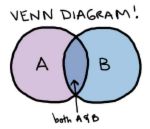
In the past I have utilized a Venn diagram to illuminate the overlap between two groups that are ‘given’ as the options. Lately, I have focused more on the 4th and 5th area.
So in American politics, when ‘republican’ and ‘democrat’ are given to me as opposites, you simply illustrate the overlapping values of the two (3rd space) and then point out those who are ‘neither’ (4th space) like Green folks and anarchists. Then draw a circle around the whole system and point out folks outside the system (5th space) like Canadians.

This semester my two classes are ‘Political Liberalism and It’s Critics’ and ‘Globalization’. It has given me lots of practice in picking up on patterns and thinking in different shaped categories.

Example 1: when a subject like ‘Norms’ is discussed – in sexual identity or sexual practices for instance – often a basic “for & against” structure is presented for any isolated topic. But as the discussion develops you can actually see that this is not a linear ‘far left – far right’ spectrum configuration – even if it is presented as such!

You quickly see that there are least 4 positions even ON a spectrum: if the far left position is “there are no norms” and the far right position is that norms are “intrinsic / originate outside the system” and implement themselves, you can imagine that a center-left position would be an emergent perspective (norms arise from below in the population and then ascend) and a center-right position of top-down Hierarchy where norms are seen to be passed down from the authorities. Recognizing those four positions facilitates a radically different conversation than just outlining two.

Example 2: when the subject is ‘Law’ or court rulings, we need to rise above elementary ‘agree’ and ‘disagree’ binaries.  There are actually 4 positions in practice.

  • Agree & Obey
  • Agree & Disobey
  • Disagree but Obey
  • Disagree and Disobey

It is essential to admit that in any population there will be great variety, disparity, and diversity – so we do a terrible disservice to the matter when we reduce the matter down to basic dichotomies.

The reason I bring this up is because I am very concerned about the round-and-round cul-de-sac conversations that I hear over and over again in the church. I am growing convince that as contemporary Christians, the issue is increasingly not what we think but how we think about it.

The issues of abortion, homosexuality, biblical inerrancy, the creeds/ orthodoxy, environmentalism, and women in ministry are just 6 examples of matters where the dualisms are killing us.

One of the best things that could happen this Good Friday would be for those who take the Christian story seriously to die to – not what we think – but how we think about it. My dream would be for a heart of repentance: to decide in our hearts to swear off inherited dualisms and pledge to, as a community, look for and develop better ways of framing the issues that matter to us most.

Challenge: This Friday, repent of either/or thinking and die to the dualism of us/them for/against right/wrong in/out thinking.  Ask your small group to hold you accountable and maybe even join you in a new life (Easter) of the mind.

disclaimer: some of you will finish this post and think ‘it was so remedial it was barely worth reading’ and others will think ‘that is crazy talk – you are either right (on God’s side) or you are plain wrong – there is no middle ground.’ But we have to start somewhere, and this is the world we live in.


Bending the Spectrum

I have never been a big fan of ‘spectrum’ thinking. The language of far left and far right  just rings hollow for me. It is insufficient for the most part and in the end, inaccurate.

I read the book The Argument Culture by Deborah Tannen more than a decade ago and said out loud “Oh! So THAT is why I bristle at the either/or, Republican/Democrat, Right/Left dichotomy! – now it makes sense.”

I reject the spectrum at every turn … but recently I have begun to make an exception in regards to the spectrum. The spectrum is only applicable for someone who thinks that there is a spectrum. I will only try to get them to see that not everyone exists on a spectrum nor are they accounted for by a right-left binary. I no longer try to dislodge them of the notion as a whole – I only try to introduce that a spectrum is incomplete and insufficient.

Lately I have been overwhelmed – probably because it is an election year – by binary language and dualistic thinking. In these conversations I have discovered that it can be quite effective to introduce a simple word play. Spectrums are not straight lines – like light, they bend.

You may think that this sounds overly simplistic but just think about the rise of the Tea-Party and the emergence of the Occupy movement coming in roughly the same window of time. Now those two groups would say that they stand for completely different things. To an outside observer, however, for all the minor distinctions they share a ‘Major’ concern: the system is broken and we can’t trust our leaders to fix it.

This week, I am starting a series working though the Death of the Liberal Class by Chris Hedges. He begins the book with a 25 year old former Marine walking along a highway in Upstate NY that I driven. He is disillusioned with the economic and political systems and is getting ready to do something about it. At one point the young vet says:

“I could see there was no difference between the two main political parties. There is a false left/right paradigm which diverts the working class from the real reasons for their hardships.”

I am looking forward to the series in the exact inverse proportion to how much I am dreading this election cycle.* I have lots of Tea Party types in my life and many Occupy sympathizers as friends. I hear them both saying that the system is not working and that those in charge are not capable of fixing it, that we the people need to be more hands on.

Chris Hedges analyzes the crisis and articulates the root causes better than anyone I have found. The slant of the series will revolve around one simple question “IF Hedges is right about the world – how then should we do theology?

The Tea Party, the Occupy Movement, the global economic crisis and the ongoing wars are telling us something … and it is not about the End of Days. Doing theology in this environment will inherently have some continuity with historical approaches but it will require some tools that may not be familiar to us as well as some necessary innovations.

 The left and right think that they are far apart, but in a bent system they are closer than they would believe. At some point on an arc the far right and the far left almost touch.

I end the way Hedges begins, with a quote from George Orwell:

At any given moment there is an orthodoxy, a body of ideas which it is assumed that all right-thinking people will accept without question. It is not exactly forbidden to say this, that or the other, but it is “not done” to say it, just as in mid-Victorian times it was “not done” to mention trousers in the presence of a lady. Anyone who challenges the prevailing orthodoxy finds himself silenced with surprising effectiveness. A genuinely unfashionable opinion is almost never given a fair hearing, either in the popular press or in the highbrow periodicals.  “Freedom of the Press”

* Tavis Smiley has been saying for quite a while that this will be the ugliest and most racist election in modern times.

I also posted this at Homebrewed

Blog at WordPress.com.

Up ↑