Search

Bo Sanders: Public Theology

updating & innovating for today

Tag

dualism

Different in Degree or Kind?

In an either/or world where things are so often presented to us as binary options, it is vital for the thoughtful christian to have maneuvers or techniques to counter the paralyzing confinements of the dominant framework.

The problem with these either/or options is not necessarily with the two options themselves. In fact, they both might be valid in and of themselves. The primary problem is that they are conceived of (or presented as)  A) non-overlapping and B) adversarial.

It is this dual-ism that results from the inherent divide of nearly every topic in modern American life: republican/democrat, creation/evolution, protestant/catholic, white/ person of color, lost/saved, married/single, male/female, gay/straight, conservative/liberal, etc. The list just goes on and on. Nearly everything is framed in this oppositional binary way, then turned inward toward  a ‘silo’ it becomes an echo chamber which then becomes a shouting contest and the volume goes up to 10. It is deafening.

In the past, I have used a simple technique of 3-4 to disrupt the either/or (1-2) stalemate. For instance, in the creation/evolution divide I look to a 3rd way (often a middle-way) of intelligent design to ‘split the middle’ and then look for an approach completely outside the bounded-set. Vine Deloria Jr. helps me there with his book Evolution, Creationism, and Other Modern Myths  to introduce the category of non-western origin epics.

I do the same with politics when the either/or mistakenly talks about ‘half of the country’. I point out that actually most of the country didn’t vote at all (3rd category) so while half of those who voted did so one way or another, the majority opted out of the system all together. Then as a dual-citizen with Canada I talk about the advantage of coalition governments (4th perspective) and the need for cooperation & compromise instead of ideology and ‘my team’ mentality which leads to a zero-sum winner/loser scenario.

Side note: earlier, I used the word ‘techniques’  and I just want to give a nod to the work of Michel de Certeau in The Practices of Everyday Life where he differentiates between the ‘strategies’ of the system and the ‘tactics’ of those who are trying to survive, subvert, and adapt to the established (dominant) order.  My use of ‘techniques’ is a homage to his ‘tactics’.

Recently, I have tried a new technique that seems to bear good fruit, even if it is different  than the 1-2-3-4 approach.

The question is: “Are these different only in degree or type?”

This started with christology when asking “is Jesus’s humanity different from ours in degree (more intense) or was he an entirely different kind of human than we are? The answer, of course, is that Jesus was fully human and thus differs from us in degree (faithfulness or openness to the divine). Jesus was the same kind or type of human as we are. This saves us from the popular modern misconception that has Jesus in some sort of Clark Kent  mud-suit which covered his divine super-man underneath.*

That conversation was so fruitful that I have begun to adapt it for other topics. My favorite one so far is in ecclesiology when asking about denominations. Are these two groups different in degree only or are they entirely different types of christianity? It is really helpful, at some level, to have permission to say ‘while these two groups both claim to be christian, they are so different that it may be difficult to find a common thread to link them’.

Degree & Type is especially helpful to correct the soft-cynic type who loves to quote that “there is nothing new under the sun”. When it comes to things like war, we need to ask if modern warfare differs in degree or type from the kind of military strategies that we see in the bible or in colonial history. The truth is that with the introduction of nuclear weapons, war needs to be thought of as a different type. It is not simply an escalation in degree but we have graduated to a different kind of military.

I have been in the classroom a lot lately and I have been finding the degree & type tool for analysis very helpful. It seems to open up new possibilities for people to look at classic sticking points and contemporary conundrums in ways that are not so limiting.

I wanted to introduce it here because I plan on employing in on some upcoming topics. It has added helpful richness and nuance to conversations about Jesus, church, the bible, denominations, politics, military, sexuality, and so many other relevant issues for 21st century expressions of faith.

Let me know what you think.


*  If I ask you “how did Jesus turn water into wine or do other miracles” and your answer is “he was god” then you have missed the full humanity of Jesus and we need to talk about the work of Holy Spirit.
 

May Update and 1234

Thank you for all the support and affirmation during my study break!

The request to do 5 min videos instead of 10 min videos has been heard I will be redoing the series from last summer as a 2.0 theme starting with God 2.0

A new mic has been purchased and the whiteboard has been upgraded.

Here is a quick summary of 4 things to look for when framing an issue.

3rd Way not Middle Way: bust the binary

Dualism offers us binary options that must be challenged. Evolution & Creation, Male & Female, Church & World, Jihad & McWorld, East & West, Think & Do etc.
This short video is in response to requests for alternatives to the either/or frame work that we have inherited.

Four is greater than Two: Good Friday repentance

So often when I hear two groups arguing, I think to myself  “the problem isn’t what we think about this subject, it is how we are thinking about it.”  If you have read posts here for any time at all you will know that I am not a big fan of dualism in general. I invest great amounts of energy examining binaries and pulling apart overly simplistic dichotomies.

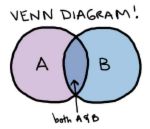
In the past I have utilized a Venn diagram to illuminate the overlap between two groups that are ‘given’ as the options. Lately, I have focused more on the 4th and 5th area.
So in American politics, when ‘republican’ and ‘democrat’ are given to me as opposites, you simply illustrate the overlapping values of the two (3rd space) and then point out those who are ‘neither’ (4th space) like Green folks and anarchists. Then draw a circle around the whole system and point out folks outside the system (5th space) like Canadians.

This semester my two classes are ‘Political Liberalism and It’s Critics’ and ‘Globalization’. It has given me lots of practice in picking up on patterns and thinking in different shaped categories.

Example 1: when a subject like ‘Norms’ is discussed – in sexual identity or sexual practices for instance – often a basic “for & against” structure is presented for any isolated topic. But as the discussion develops you can actually see that this is not a linear ‘far left – far right’ spectrum configuration – even if it is presented as such!

You quickly see that there are least 4 positions even ON a spectrum: if the far left position is “there are no norms” and the far right position is that norms are “intrinsic / originate outside the system” and implement themselves, you can imagine that a center-left position would be an emergent perspective (norms arise from below in the population and then ascend) and a center-right position of top-down Hierarchy where norms are seen to be passed down from the authorities. Recognizing those four positions facilitates a radically different conversation than just outlining two.

Example 2: when the subject is ‘Law’ or court rulings, we need to rise above elementary ‘agree’ and ‘disagree’ binaries.  There are actually 4 positions in practice.

  • Agree & Obey
  • Agree & Disobey
  • Disagree but Obey
  • Disagree and Disobey

It is essential to admit that in any population there will be great variety, disparity, and diversity – so we do a terrible disservice to the matter when we reduce the matter down to basic dichotomies.

The reason I bring this up is because I am very concerned about the round-and-round cul-de-sac conversations that I hear over and over again in the church. I am growing convince that as contemporary Christians, the issue is increasingly not what we think but how we think about it.

The issues of abortion, homosexuality, biblical inerrancy, the creeds/ orthodoxy, environmentalism, and women in ministry are just 6 examples of matters where the dualisms are killing us.

One of the best things that could happen this Good Friday would be for those who take the Christian story seriously to die to – not what we think – but how we think about it. My dream would be for a heart of repentance: to decide in our hearts to swear off inherited dualisms and pledge to, as a community, look for and develop better ways of framing the issues that matter to us most.

Challenge: This Friday, repent of either/or thinking and die to the dualism of us/them for/against right/wrong in/out thinking.  Ask your small group to hold you accountable and maybe even join you in a new life (Easter) of the mind.

disclaimer: some of you will finish this post and think ‘it was so remedial it was barely worth reading’ and others will think ‘that is crazy talk – you are either right (on God’s side) or you are plain wrong – there is no middle ground.’ But we have to start somewhere, and this is the world we live in.


Two Trolls and a Bridge (part 2 of 3)

In part one I mentioned that there are two trolls that guard the bridge to a new way. I named them as Colonial Christianity and Environmental Dualism. Of the many issues facing us, let me tell why I recognized those two.

In 1421 Chinese ships landed on the Pacific coast of what we know as North America. Last year in Postcolonial class, my prof asked us a series of questions that began with “Why didn’t they stay and colonize? What was different from what especially the Spanish would do a century later?

I spent the semester, as we read Said, de las Casas, and all those who follow them looking for a common theme that could provide a interpretive key. I kept noticing that there was secondary mechanism behind the machine of Colonial power.

Throughout history there have been Empires and that, by definition, comes with  a conquest narrative. Even in our own Bible we see that group like Assyria, the Babylonians Greeks, and Romans swept through Israel. Israel itself had the Canaanite conquest narrative. Not to mention that China was an empire that conquered and subjugated the areas and nations around them. There is nothing new about either empire or conquest.

But this is not that. There is something else going on in the Colonial era that led the British, French, Portuguese, Dutch and Spanish to expand and extend that impulse to an exponential degree. It is so inflamed and exaggerated that some explanation must be provided as to difference that we see in the 15th, 16th, and 17th centuries.

Technology is insufficient as an explanation. Guns and horses certainly explain some of atrocities we see with the Conquistadores but that is merely wood for the framework. There was a fuel that made it so flammable and destructive. What fueled the Colonial drive was a specific brand of Christianity.

I think that needs to be pointed out. It must be acknowledged for two reasons:

  1. It is still with us
  2. its unquestioned giveness allows it to remain in power but in a far more sinister way – in secret assumption.

Colonial Christianity remains – not just as a residue – but as an unquestioned operating system and that is both an ongoing danger to our planet’s existence (war, environment, economy, etc) but also to the very integrity of the Gospel message that it purports to contain.

Nipples and Bellybuttons

One of the most powerful things that the Western mind inherited comes from the thought of Renee Descartes – it is a Cartesian dualism between the mind and the physical body. On the surface it does not look so danderous – but it morphs and attches itself to other really valuable things. One mutant offspring begins to distinguish between humans and everything else. This fits great into Colonial Christianity. The result is that we think we are exceptional.

Humans are mammals – notice the presence of nipples and bellybuttons – while many Christians  recognize the similarities they refused to acknowledge that humans are mammals (and then are confused by our sexual desires and habits).

This exceptional dualism shows up in all sorts of places! In the study of religion, even if we acknowledge that other religions grew UP from communities and are expressions of their various locations … Christianity is held to be an exception to that. It came DOWN from Heaven and would be the same truth regardless of its historical embeddedness in the Ancient Near East.

Exceptionalism is an ongoing mentality today. It affects so many areas.  [by the way, Randy Woodley wrote a great piece on political exceptionalism here]

In my opinion – beside the possible exception of modern war – there is no area where exceptional thinking is more deadly than the environment. From dust we came – as humans we are made up and sustained by what comes from the soil, the water, and the air.

We must repent of of this exceptional dualism and confess that while we are unique on the earth – we are not exceptions to it and in fact we are integral parts of it and completely dependent upon it.

When you put these two monsters of Colonial Christianity and Environmental Dualism together, you may be able to see why I think that they are the Trolls blocking the bridge to a new way.

Tomorrow I will attempt to articulate what waits on the other side of the bridge. The simple fact is that we can’t go back. We can’t undo Colonization. We aren’t going back to family farms. We can’t refreeze the polar ice caps or re-create the Glaciers in Glacier National Park.  As they say ‘we shall not pass this way again’.  But I think that there is a different way of being in the world that holds hope for us.


originally posted at the Ethnic Space blog

Reading the Bible Better (part 3)

Dualism is deadly little disease.  The odd thing is that in our overexposed-undeveloped era of information saturation, terms often get thrown around without a working understanding necessarily being in place.  I’m not talking about full blown mastery of a subject. I’m just taking about clarity.

This can be especially limiting when it comes to reading the Bible. I’ve said before that I am a big fan of the Reformation impulse to put a Bible in everybody’s hands in their own language. I also recognize the danger or limitations if the reader is not discipled or empowered with good tools of interpretation (hermeneutics).

I thought it would be good to throw out two items for clarification that relate to our discussion last week about “A Better Way to Read the Bible”.  I posted in Moving Mountains and Signs that make you Wonder some of these issues, so this would be part 3.

Dualism is not simply the presence of two categories. Jesus and Paul had all sorts of pairings: body and spirit, law and grace, etc. That is not dualism. Dualism begins when those categories are excluding and non-overlapping.
Many of us have been groomed to think in mutually-exclusive oppositional pairs. Democrat-Republican, Creation-Evolution, Lost-Saved, Man-Women, etc.

When it comes to reading the Bible some of us have been told there are two categories: literal and allegorical. It is built on fiction or fact, real or fake, true or false.

This is not helpful. Continue reading “Reading the Bible Better (part 3)”

Blog at WordPress.com.

Up ↑