Search

Bo Sanders: Public Theology

updating & innovating for today

Tag

God

John 14:6 simply isn’t about other religions

I love John 14:6. I take so much encouragement from it and it challenges me deeply.

I love John 14:6 but I do not like what many today are doing with it: hiding behind it as a catch-all explanation for other religions...

Here is what I love about the passage and the three things I don’t like that people do with the passage:

What I love – this is a disciples invitation. It happens within a story, it is in dialogue that Jesus’ famous sentence “I am the way, the truth, and the life”. It comes in response to a very specific question. Here is the thing – the question is not “What about other religions?” The question was a disciples’ question about following.

Three things people do that scare me – My first concern is that people only quote John 14:6 and not John 14:1-5 or even 14:7. They have ripped this one sentence out of its narrative context and acted like it emerged in a vacuum. This is never a good sign. In fact, the only way this famous sentence of Jesus works as an answer to the question ‘What about other religions?’ is if you isolate it from the rest of the story and place it in a vacuum.

The second concern is that our inherited (non-Hebrew) concern with substance and our language’s (non-Hebrew) lack of relational emphasis really handicaps us when reading the scriptures. I have to explain to people all the time that when Jesus calls God ‘Father’ he is speaking relationally – he related to God as one relates to one’s pappa (or abba). He is not saying that god IS ontologically a Father. Language about God is not univocal, it is equivocal. Or, if you prefer, as Nancey Murphy points out, language is not representative of God, it is expressive. Language does not represent God is a 1:1 ratio – it is merely expressive of some aspect or nature of God.

The third concern is that in John 14:6 Jesus could not possibly have been talking about Muslims. He had never met a Muslim (as Islam didn’t exist yet) and therefore could not have been talking about them. In fact, once one comes to terms with this reality, one has to question whether Jesus would have even know about Buddhists or Hindus either. No, Jesus had probably never encountered them and certainly wasn’t referring to other religions in John 14:6.

(Unless of course you are retroactively ascribing attributes … at which point you are going to have to explain why you chose this one over other preferable ones.)

This sentence was uttered:

  • in conversation with his disciples
  • in response to a very specific question
  • as an invitation to his disciples
  • to relate to God as Jesus related to God

Where the problem seems to lie: When people miss the relational language (come to the Father as related to God), remove the sentence from its narrative context (as if it emerged in a vacuum) and assume that Jesus was referring to things he couldn’t possibly have known about … then irony sets in.

The ironic thing is that quoting John 14:6 as a stand alone explanation – without receiving it as a disciples invitation – one may actually be doing the exact opposite with that passage as Jesus was asking one to do: follow his way.

Having said all of that: Maybe Prophet Isa was talking about Muslims in John 14:6. Maybe he was saying that if they want to relate to God as he did – that they could only do so by walking his way and following his life.  In fact,  if you take away the univocal  calling God Father (ontologically) and see it as expressive (or equivocal) of relating to God as one relates to a loving father … you would remove the biggest obstacle Islam has to Jesus – namely that the Quran tells Muslims not to say that ‘God has children’.

You may think that I am way off here – but until we:

  1. stop quoting John 14:6 in a vacuum
  2. stop thinking that Jesus was talking about other religions
  3. stop thinking that Jesus’ Father language is univocal (instead of relational)

We won’t even be able to have the conversation and explore the possibility.
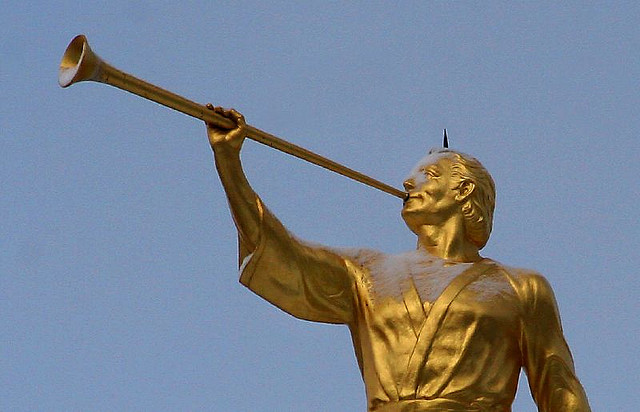
 

Mormons: Still Made In America

I’m taking the opportunity on this holiday Monday to take care of a whole bunch of stuff I have been neglecting. I was looking back over my HomeBrewed blogs from the past little while and was enjoying seeing this post-election.

No – we don’t have our first Mormon president yet … but it might just be a matter of time.  OR  it could never happen because of the eccentric nature of the religion and how it might never be that mainstream …

As a proud and dedicated ‘contextual theologian’, I have never been quite sure what to with Mormonism.  As in any field, questions will always come up from concerned listeners about ‘what if we take this too far’ or ‘where do we draw the line’.

In  contextual theology – since it started as a movement within missiology – the thrust has generally been about appropriate translation and inculturation between different nations, languages, and cultures. The move toward contextualization makes perfect sense within a typical framework whether it is inter-cultural or not.

In fact, in recent decades the conversation within contextual theology has moved from the old colonial missions idea of bringing a potted plant and putting it in native soil, to bringing the seed of gospel and planting it in native soil, to a more post-contextual idea of learning from the native people ‘what grows there’ and then partnering with them to integrate and advance a new crop. [for more on this listen to the podcast with Randy Woodley]

But that is a conversation about foreign missions. What do you with those who are not inter-cultural but which arise from within your very culture?

What got me thinking about all of this was a very strange little sentence in Stephen Prothero’s book God Is Not One.

In the middle of his chapter of Christianity he dedicates 3 pages to Mormonism. Among all the regular and expected material about their founder and their practices – which you can find almost anywhere – was this:

 Though long seen as dangerously un-American, Mormons are now widely viewed as quintessentially American.

He then goes on to detail the huge presence of mormons within pop culture (mostly TV).  This was, of course, before Mitt Romney becoming the presidential nominee.

The reason that comment caught my attention is that several years ago I had that exact conversation with a seminary professor. This professor was not a big fan of contextualization and said mormons were the most contextualized form of American christianity. I argued that no, they were actually a cult (as I had been taught this growing up) and he countered that this is what cults are – contextualization taken too far.

In the years since that encounter I have kept an eye on the ‘mormon thing’ and while I have evolved and adapted my views on so many things (including religious pluralism) I am still not quite sure what to do with the fact that Mormonism is truly the most American of religions.

I’m not talking about their unique beliefs or their novel practices – I am thinking more about their history and organization. It seems to me that whatever the conversation about missions and indigenous expressions that Mormonism remains that one group you have to hold out an exception for. They are exceptional in that sense. They don’t fit into neat categorization or wholly lie outside the issue either.

 Mormonism is an anomaly in this sense. They are just enough different than other groups that they can not be accounted for in predictable ways but they are similar enough that they can not be dismissed outright.

The Next Pat Robertson Gaff

With the election season over, the frequency, intensity and insanity of conservative white men making outlandish statements will hopefully die down …  I’m moving a bunch of blogs over there this week and found this cheeky little blog I wrote in the middle of the fire-storm.

 Pat Robertson topped even himself in the category of ‘insulting-inflammatory- stupid comments while the tape is running’ this morning. That may seem difficult with all of the previous entries that have earned him elite status in the gaff Olympics.

The most recent entry was in response to a question from a man who apparently wanted to know what to do with his non-submissive wife.  Robertson started with suggesting that the man could convert to Islam … and as tough as it might be to top that one, he did. After conceding that the Bible does not allow for him to divorce her, Robertson gave him the option to move to Saudi Arabia – thereby indicting not only an entire religion but an entire nation.

I know that many will want to jump on Robertson with disdain and scorn but … maybe we should not be so quick to jump to judgement. As often happens in cases like this, there is a good possibility that there is something we don’t know behind the scenes. There might be more to the story that at first meets the eye.

  • Robertson might have undiagnosed Tourette Syndrome.
  • He might have a serious drinking problem and been under the influence when he made those egregious comments.

Now, before you dismiss this outright – just keep in mind that many preachers and politicians who rail against homosexuality later turn out to have been involved in illicit same-sex affairs at the very time they were railing. This pattern can be seen in leaders of many self-righteous and sanctimonious movements.

With public figures, we just don’t know. So I am suggesting that we might want to hold off judgement. Sure, right now it looks like crazy Uncle Pat has come unglued and betrayed the very gospel that he is supposed to be a minister of and a spokesman for. But … let’s just give it time.

That is plan A.

If you can’t wait for that, there is a plan B. As I proposed a while ago, it is possible that words for fundamentalist christians are like dialogue in porn movies. They play an important role in allowing us to suspend our suspicion and get down to the real business at hand.

I said that the real activities were nationalism, capitalism and militarism. One of our deaconesses added patriarchy. This accusation would stick to Robertson’s many gaffs like a field of burrs on a cheap pair of cotton dockers.

 Here is the thing: I want to be a generous and gracious purveyor irenic ecumenism. But there are times when you hear something like this and realize how many people are genuinely injured by this stuff. Like it or not – he is a spokesman for our religion, my tradition and Jesus’ name. This is why I go so far out of my way to say that we need to stop waiting for Superman and start sticking up for causes that don’t directly impact us.

Here is a conversation that I have had repeatedly in the past 20 years.

 Me: I’m not against guns for hunting, but we have to do something about assault rifles and semi-automatic handguns.

Guy: It’s our God given right to bear arms.

Me: Wait! You probably still believe in things like depravity and original sin right?

Guy: It’s right there in the Word.

Me: Umm… those aren’t actually in the text of scripture but anyway … IF you believe in depravity, don’t you think we should account for that in our gun laws?

Guy: The second amendment protects our God given right to defend ourself.

Me: I get that, I’m just trying to say that we could revisit some things that were written in the era of muzzle-loaded muskets and flint lock rifles.

Guy: Liberal.

People don’t like when I am critical, negative, dismissive or adversarial. Neither do I.  All I am saying is that I am very nervous about what gets broadcast on christian radio and TV these days and the impact that it has on thousands and thousands of people.

So here is the question: If, and I am only asking ‘if’, there was a machine that was fueled by a different vision of the world and different priority structure than that fleeting Galilean vision – but it was covered with a thin veneer of Jesus talk as a mask for the true agenda … shouldn’t we say something at some point?

If the Jesus-paint was only a mask on a monster, or a series of brushstrokes on a Hollywood set facade … we should say something right?

That probably is why plan B in this case is not so popular.

THE most important thing in all of this is that we are very clear about people who have simply bought into a bad brand of christianity and those who are up to something with it.  It is one thing to have merely inherited a flawed-limited-unaware religious product and those who openly promote a product that injures people and harms those who need what Christ provides the most.  We have to be careful.  This stuff is wicked, acidic, and cancerous. We can’t paint with a broad brush or be dismissive of folks who are just walking the same road we are all walking together – trying to figure it out.

May God give us grace in the journey.  We need it.  Lots of it.

I could not be less reductive: love, sex and faith

It has become quite clear over the past several years that the source of many arguments in my life and in our culture originate with a desire to reduce things down to their simplest components or lowest common denominator. Over the past decade I have really embraced a complexity model of things. I can illustrate it with two examples:

  •  The foundational thinking of Josh McDowell and Ravi Zacharias – the apologetics school I had been groomed in – began to ring hollow in a number of areas. Through that process, I came to see the advantage of conceptualizing reality as a web, anchored in several locations, rather than a building resting on one key foundation.

The foundationalist approach is scary in a shifting culture. What used to seem rock solid is in danger of falling like a house of cards if even one element is moved or compromised.

  •  I moved from a magical ex nihilo understanding of 6 day creation (it was not the theologically sophisticated one you might be familiar with) but could not buy the cold darwinian evolution that had been so demonized in my camps.  Turns out that both a fairly reductive. It wasn’t until I discovered emergence thought and the interplay of elements that I was able to move beyond the simple either-or option of creation vs. evolution.

 This move away from the reductive becomes important in three key conversations: love, sex, and faith. 

 Love – when I talk with other youth pastors or teens from other youth groups, I am frequently surprised with just how often a reductive approach is taken on the topic love. “Is love an action or an emotion?” Sometime a third option will be given: “or a decision”. 

Its not that the answer to the question is that consequential. That is easy enough to deal with. It is the thinking behind the question that is so dangerous! Of course love is an action, it comes with feelings and creates more feelings and we make decisions about that at every step along the way. Its easy enough to side step the either/or trap … what concerns me is why something as grand and essential complex as love has to be reduced down to a single element? What is the driving influence there?  It is bigger than just getting christian teens to not ‘give into their emotions’ or to show their love for God and the world by putting it into ‘action’ whether they feel like it or not.  There is something else behind that reductive move.

Sex – I am truly shocked by how often a reductive maneuver is employed by those who are a little more conservative than me when the topic of sex comes up. “While sex may be pleasurable – in the end, it is primarily about procreation” my debate partner will say. “In fact, God probably made it pleasurable so that we would want to do it more.”

I object to this live of reasoning strenuously!  Sex is about a whole myriad of things.

Our sexuality is about pleasure, connection, expression, intimacy, power, procreation and drive.  It certainly is not about just one thing.

Look, I know a heterosexual couple that can’t procreate. They have a very healthy sex life. I know another couple who did procreate (twice) and are finding that it is significantly impeding their sex life.

Sex in the 21st century is not just or even primarily about procreation. Even heterosexual couples who can procreate have sex that does not result in pregnancy.

 Faith – I have heard voices as disparate as Slavo Zizek and Martin Luther pull a reductive move when it comes to faith. Zizek has said on more than one occasion that he would like to see good deeds done for no other reason than that they the right thing to do – good on their own merit – and not because the one who does it gets anything out (like an altruistic sense of satisfaction) or believes that she will be rewarded for it in the next life. This reminds of Luther’s early wrestling with loving God (If I only love God for saving me then I have loved God for the wrong reason and it is not love worthy of God … etc.)

 I don’t get this at all!  It seems to me that whether you believe in a God (I do) or whether you subscribe to a social construction theory of morality (that as social mammals it benefits us to benefit others in a series of non-zero and reciprocal relationships) that both are best understood as essentially complex webs of meaning and relationship.

Let’s take the God road for a minute. If there is a God who wants me to do good things, then it stands to reason that I may be made in such a way that I both enjoy doing that good and benefit from it. That does not take away from the goodness itself, it is just distributed to several factors of befit. Why is it only truly a good deed if I get nothing – not even satisfaction – out of it. Even if I do something anonymously for which there can be no reciprocal or social benefit, I’m not allowed that simple satisfaction of knowing I did something good?  So the only truly good deed is done with emotional distance and internal steel?  That is bogus! It seems to me that even without God in the equation, that reductive move is limiting and harmful, even self-defeating.

A far better approach would be embrace the social locatedness of human existence and to recognize the collective pot of goodness to which we both benefit from and contribute to. A pot of common-wealth that is both relational and substantial that has made us who we are – we have been molded, shaped and groomed by it – and to which we participate that can benefit others as well as be rewarding for us.

Doing good is complex and it is essentially complicated. We don’t need to break that down and diagnose it as much as we need to embrace it and pour ourselves into it.

In the end, I see this impulse toward the reductive to be not only limiting to thought but detrimental to joy. I think we are missing out by not embracing the multifaceted and layered complexity of love, sex and faith.

-Bo Sanders 

Its a Sign! God talk and stuff that matters

Two odd things have converged in my little pastoral office lately – both involve signs and they both impact how we think about God.

The first is that I was given a little daily calendar with actual church sign messages. They range from clever (rarely) to cheesy and all the way to painful.

 Sign #1 says “Twenty-four-hour lifeguard on duty – see John 3:16”

 Sign #2 says “God has not gone on vacation and left you in charge.” 

They are interesting, though different, but for similar reasons.

Sign #1 implies the God is always on the job – an all-the-time life guard. That is not the odd part (odd as it may be). The odd part is that it references John 3:16. Now, anyone who know that passage knows that it is about something very specific. “For God so loved the world that he gave his one and only Son, that whoever believes in him shall not perish but have eternal life.” So the ‘life guard’ is not watching over your actual life but an eternal life that you can have IF you believe in him.

That is an odd type of ‘life’ guard. It’s not really a promise to guard your life… it is a pledge to provide you another life after this life if you do certain things.

Sign #2 is sort of the opposite message. It says that God is not all the far away and you should not act like you are in charge of how things go. The implication is that God is very present and in some way directing or dictating how things go … even if it is loosely and absentee enough that you could be under the impression that you should take up action and do something.

 These Church signs kind of confuse me and I get turned around about what I am suppose to do and believe. 

 On a different note: we had a new visitor to our church a couple of weeks ago and they came back the next week.  On their third week they told us that on their first week they know that they had found the right church. They had gotten ‘a sign’ that they were in the right place for them.

This story is not the interesting part. The interesting part is the reaction that multiple people have had to that story. It turns out that not everyone believes in signs.

The two most common pieces of feedback that I got can be categorized as follows:

  • “There is no such thing as signs as if God were leaving us a trail of lucky charms as we walked trough the woods leading us to the end of the magical rainbow”.

As a person studying the discipline of Practical Theology in dialogue with process thought and a pastor of 18 years, this hurts my heart. I believe in the presence of God’s Spirit in the world. Just because we don’t want to be superstitious … do we leave no room for God to work?

  •  “Of course they did! If you loved a certain hymn and you visited a church who sang that hymn  – you would say “this place values what I value” and take it as a ‘sign’ that you were in the right place”.

As a person who dabbles with post-liberal ideas about the way that language works and  who has flirted with Caputo’s concept of Theo-poetics … this intrigues me.

I should mention:  This is actually part 3 in a loose series this week. Part 1 was “Waiting for Superman: the problem with Christopher Reeve”. Part 2 was “The Pornography of Fundamentalism”. 

 Why bring up the church signs and the person who thinks they got a sign that they were at the right church?   Why tie it into the problem with Superman and the pornography of fundamentalism?

The reason is quiet simple.

 What we believe about God really matters. Our conception of the divine reality actually influences ( but not determines) how we live and how we treat other people. It is not superfluous or superficial. It is consequential at the deepest levels. Our construction of that which is of ultimate concern impacts almost everything that we think, do and feel.

 As bad as church signs can fail – and as disparate as opinions on ‘getting a sign’ may be … this stuff matters. 

What we think about God, how we conceptualize the divine reality and how we converse with others who walk a different path than we do really does impact how we participate in the world.

That is why I am so passionate about Jesus and what that life reveals about the nature and person of God. This is why I try to come at this from so many angels and in so many different ways. I am under the impression that what we believe actually makes a difference in this life and matters for eternity.

You can see then why cheesy church signs and personal projections are worth addressing. They are not inconsequential nor are they insignificant. These things matter.  That is why the problem of waiting for Superman and pornography of fundamentalism are worth addressing.

-by Bo Sanders  

The Pornography of Fundamentalism

Normally I try to be as generous, welcoming and irenic as possible. One of my favorite slogans actually comes from my venerable partner Tripp Fuller at Big Tent 1 when he said that the ‘tent’ should be big enough for every former incarnation of our self … but I was never a fundamentalist. I flirted with being one in Bible College but never converted.

This past week I was flying back across the country after visiting my family and I was rummaging through my Ipod to see if anything caught my attention. I stumbled on an old Slavo Zizek lecture. As with all Zizek lectures he wandered through almost every topic under the sun – but two caught my attention: pornography and fundamentalism. I want to try and connect them here.

In a pornographic movie, the dialogue is secondary. It is merely window dressing. Think back to your younger years – before you were a christian. The dialogue is a thinly veiled, contrived scenario to get the actors into the same space. It is little more.

 A handyman comes over to a lonely women’s apartment to fix a hole in the wall. She says something about another hole that needs attention.

You get the idea. The dialogue is superfluous to the real intention. It is poorly written and even more poorly delivered. The dialogue is a facade, it is merely intended to set up the main activity. It allows for the suspension of suspicion so that one can enter into the fantasy. 

 Dialogue performs the same function for Christian Fundamentalists.

Don’t misunderstand me – I am not saying that the verbiage of fundamentalists is insincere or disingenuous. It is not. Fundamentalist believe it with all their heart. What I am saying is that the words in church perform the same function as dialogue in porn. The words that are spoken are secondary to the main activities: nationalism, militarism and capitalism (some would add patriarchy).

When I was in Bible College I used to set my VCR to record TV preachers while I was at school. I loved listening to preachers. I wanted to be one and I modeled myself on the famous ones. I even sent money to folks like Chuck Swindoll so I could get their tapes and listen to them over and over.

The more I read the Bible, however, the more I realized that something was wrong. At my evangelical college we studied the historical context of the Old Testament and the Ancient Near East. We even touched on some Roman legal stuff for the New Testament –  while avoiding things like Empire for the most part. [Jesus’ message was spiritual after all, not political.]

I started getting a pit in my stomach when pastors would shoe-horn modern issues between the lines of scripture. It made me nervous when they would draw a direct line from ancient Israel to modern America. My fallout actually came in two parts:

  • Step one was simply (but quietly) objecting to the lack of translation or conversion between Old Testament Israel  which was a theocracy and America which was democracy … and a pluralistic one at that.
  • Step two was the vehement (nearly venomous) push-back I got when broached the subject.

It was in the vicious rebuffs that something grotesque was exposed. The words that were spoken – while important and delivered with conviction – were secondary to the real driving influence and aim. The real engine is nationalism, militarism and capitalism. Those are the real gods of American fundamentalists. The christian verbiage is the fiberglass body. It is important, visible and gets most of the attention but it is not what is driving the machine.

Like dialogue in porn, it is only utilized to get the players into proximity with each other. It is only used to set up the main (real) activity.

Ask yourself these 3 questions:

  1. Why are voices raised, fists shaken, and teeth gritted when fundamentalists talk about God pouring out love for us in Christ and salvation being found in ‘the way, the truth, and the life’? Why doesn’t the medium match the message?
  2. Why is there unquestioned support for modern Israel regardless of their atrocities and unjust behaviors?
  3. Why is it permissible to be so aggressive with people who disagree with you on issues like who is allowed to be married (a civil union) by the state?

The reason that the medium doesn’t match the message is because the real message is not found in the words. Like dialogue in porn, it is only meant to set up the scenario for the real activity. Spend all the time you want on analyzing it or the logic behind it, but it is like capturing fog. It is a temporary holder for the main event. In fundamentalism’s case, that is nationalism, militarism and capitalism. Don’t get distracted by the christian verbiage or the message of Jesus – you will only be frustrated and baffled. No, there is something else driving this machine.  Just ask questions, even quietly, and you will hear where the real priorities are.

I know that normally I am not this critical,
but as you will see in the following posts,
we have a real problem on our hands.

Why this matters so much is covered in part 3: It’s a Sign.  

The Problem with Waiting for Superman

I had an interesting conversation with a friend of mine about Christopher Reeve. As you may remember the rich movie star, famous for his role as Superman, was tossed from his show horse and broke his neck resulting in paralysis. He soon began a campaign to bring awareness for the cause of such things as paralysis.

I was talking to this friend of mine who subscribes to the idea that everything is in God’s hands and everything happens for a reason (since God is in control). I was making the point that since Mr. Reeve did not care about such things as paralysis before he fell off a horse, it calls into question whether he is doing his now benevolent work for an ego-centric reason since he is campaigning for the very condition from which he suffers. ?
My point was that it would have been remarkable if some superstar or famous person cared about something before it impacted them personally. It intrigues me to see someone standing up for something that wasn’t just their back yard.
My friend thought that this was ridiculous. And said that there is a divine plan in such matters and that the proud will be humbled so that they can do this kind of work. I think that there is a great danger in the kind of thinking.

1. We are not only to care about things that directly impact us. One of the major points of Jesus‘ teaching was to care for those who couldn’t or didn’t return the favor. If we only love those who love us, what have we done? Everyone does that. If we invite to dinner only those who will reciprocate, what good is that? Even the pharisees do that. If we keep our energy and influence within a circle of economy that ultimately benefits us and ours, what value is there? Even the pagans do that.

We are supposed to be a people who look outside ourselves. Who reach out to those just beyond our natural reach. To work for those who don’t (and maybe can’t) pay us back. To folks who circles of economy don’t immediately overlap with our wealth of influence and credibility.

2. Unless we are going to adopt (or wholesale buy into) a form of divine ordination of things like the myth of progressive society, manifest destiny, social darwinism or historic inevitability – then we are on thin ice with this kind of thinking.

When I was a Sr. Pastor my wife was the director of Rape Crisis for the county which was a part of the Domestic Violence hotline. I have heard so many times over the past 20 years of being in ministry some configuration of ‘God allowed this to happen so that the victim can now help other victims/ work on the problem’. This both terrifies me (about our view of God) and infuriates me (double wounding the victim).

I get wanting to say that God was not absent from care in the situation. I do. But because we concede the omnipotence idea initially we run into that overly simple binary that if God is loving why didn’t then ‘he’ is not all-powerful and if God is all-powerful then ‘he’ is not loving. This will never get us anywhere.
We need to have a real theology of sin and a real anthropology. It is not enough to simply quote watered down clichés of something Europeans held to in the 17th and 18th centuries.

3. We are fools if we don’t think that things outside our backyard don’t effect us. There is no such thing as an individual. Every time we say ‘individual’ we must say ‘an individual in community’. There is no individual. It is an enlightenment fraud. You were born into a family, socialized into a society, you don’t speak a private language and you are intimately tied to those around you and the earth that upholds you.

So much of our short-sighted thinking acts as if we are not inter-connected in a web of relationships. Communities, cultures, economies, environments, and families are both related and in some way impacted by each other. To think otherwise is not simply foolish but sheer fantasy. What happens over there impacts us over here.

In fact, I would expand it one ring further: I need the other. I am missing something that they can supply and God has designed-called us into a mutuality and partnership that strengthens us all. I am in as much need of what they have as they are of what I bring. We need each other.

The old saying is lacking. Walking a mile in someone else’s shoes is impossible – it can’t be done. You can not have someone else’s experience. The best we can do is to build a friendship of trust, where someone tells me their story – shares with me the truth of their experience and I believe them.

When it comes to matters of race, gender and sexuality I think that we should admit that we all have something at stake in the conversation. Matters of race and color are not only important to non-whites. Gender isn’t something that only women should care about. Sexuality is not just a conversation about same-sex attraction. By not addressing issues of privilege and the fantasy of individualism we are stunting the conversation and the scope of our impact.

To summarize:

  • Jesus both modeled and taught that we are to care about more than just things that impact us directly.
  • Unless we think that this world is how God wants it to be, we need to revisit some really bad ideas we have inherited.
  • We are fooling ourselves if we think that what happens over there does not impact us over here. We are all in this together – and in fact, we need each other. God designed it that way.

Let me give you three examples:

  1. In the documentary ‘Waiting for Superman’, public education and problems with our school systems are detailed. It is a heartbreaking situation. If you don’t think that in our lifetime, that will not impact everyone of us …
  2. We have a problem in our prisons. What some call the Prison Industrial Complex and what Michelle Alexander calls the New Jim Crow is at epidemic proportions. We have a higher percentage of black men in prison in the US than South Africa had during apartheid. Half of all inmates are black. One-quarter of all African American males in their 20’s are in prison, on probation, on parole, or awaiting trial. You think that doesn’t affect us all?
  3. Domestic violence against women is the leading cause of injury – resulting in more emergency room visits than car crashes, muggings and rapes combined. What is said from our pulpits about this?

Here is why I bring this up:  if the christian gospel is supposed to be the solution – the antidote to the sin-sickness that ails us – but it continues to conceptualize the issues the way it does and participate in the culture wars the way it is … then we have a problem. The thing that is supposed to help make us well is actually contributing to the disease of ‘me and mine’. If that is the case, then what hope is there? At that point, we would no longer have the power of the gospel, we would have some odd mutation or amalgamation of some civil religion with vaguely christian veneer.

May it never be. What happens over there impacts us over here. We need each other. God designed us this way and Jesus both taught and modeled this way for us. If I only care about those things that impact me or only reach out to those who can profit me – what have I really done. Even the pharisees do that. We are to have an eye toward a kin-dom that doesn’t work the way this world does.

[tomorrow in part 2 I’ll explain why fundamentalism is pornography] 

Certainty: the difference between emergents and fundamentalists

In chapter 7 of Predicament of Belief, Philip Clayton introduces a 6 tiered scale of epistemic certainty. Things that are nearly universally agreed upon (by the ‘community of experts’) are at a level 1. Issues like ‘Ultimate Reality’ that can not be verified but can deduced in relative certainty are at a level 2. Matters of specific religions might be a level 3. Issues particular to branches within a religion would be level 4.

Clayton has pointed out in his podcast appearances how important this type of scale is. In decades past, there seemed to be a collective ability to recognize nuance and to acknowledge differentiation between ‘core’ and ‘peripheral’ matters.

In the current climate of polarized animosity, we seem to have lost the ability to distinguish. Now everything is core.

The other way to say it is that instead of ranking issues in importance on a scale of 1-10 or holding to beliefs and theories at different levels of epistemic certainty, now everything is held at level 10.

Merold Westphal said the same type of thing in his podcast visit. Belief in the resurrection should not be held at the same level theories about the rapture (for instance).

The Reformers made an important distinction about matters of adiaphora and those essential to faith. Centuries later, I think we should at least start but reclaiming that distinction (at a minimum) and probably need to adopt something similar to Clayton’s scale to reflect the complexity of religious and inter-religious issues.

I was explaining this epistemic certainty thing to a friend a while ago. I said that I held Clayton’s real presence resurrection at like a 7 or 8 (out of 10). Process at a 8 or 9. Linbeck’s post-liberalism at a 5 or 6. Pannenberg’s eschatology at a 3 or 4. The virgin birth at like a 1. That the virgin birth provides a literary function in Matthew and Luke I hold at a 9 or 10.

My friend was shocked. He said “You are not a 10 on everything? I assumed that you held everything at a 10. When I knew you as an Evangelist, you sounded certain of everything. I just assumed that you were equally certain now.”

Now, he can be forgiven at several levels.

  1. We are both from a background where everything is a 10 and if you believe it, it is core. Nuance is not a part of the game.
  2. My voice is mostly the same as it was 10 years ago, so unless I specifically clarify or qualify the statement – it probably sounds identical.
  3. If you haven’t read Predicament of Belief or been exposed to a sliding scale of epistemic certainty or something similar … you may just assume matters of faith are held at a 10.

This, to me is the second biggest difference between say an emergent type and a fundamentalist. The first is willingness to engage scholarship and advancements in science.  The second is this ability to distinguish appropriate levels of certainty about things.

I think that it would be fun to add to all my future blogs an EC rating – “epistemic certainty” on a scale of 1-10. That way if I was talking about eschatology, folks would know to read it at a 2 (for instance). When we talk about Jesus walking on the water – a 4. The dipolar nature of the Process God – a 7.

This is a game-changer for many. As I get to talk to more and more people are migrating, emerging, adapting, and awakening to the multiplicity of possibilities within Christian theology,  just knowing that not everything needs to be held at a 10 is freeing and energizing.

 * I would go back and retrofit my recent posts with an EC rating – but my posts on pluralism and homosexuality have already caused such a stir, I would hate to mess with folk’s heads at this point.

People Do Change Their Minds

Recently I was reading an article by Richard A. Muller called “The Conversion of a Climate-Change Skeptic” in the NY Times. Muller is a professor of physics at the University of California, Berkeley, and is the author of “Energy for Future Presidents: The Science Behind the Headlines.” Muller begins by saying:

Three years ago I identified problems in previous climate studies that, in my mind, threw doubt on the very existence of global warming. Last year, following an intensive research effort involving a dozen scientists, I concluded that global warming was real and that the prior estimates of the rate of warming were correct. I’m now going a step further: Humans are almost entirely the cause.

Muller ends by saying:

 Science is that narrow realm of knowledge that, in principle, is universally accepted. I embarked on this analysis to answer questions that, to my mind, had not been answered. I hope that the Berkeley Earth analysis will help settle the scientific debate regarding global warming and its human causes. Then comes the difficult part: agreeing across the political and diplomatic spectrum about what can and should be done.

This made my think back to an article that I had read a month ago by Kevin DeYoung entitled “Why No Denomination Will Survive the Homosexuality Crisis”. DeYoung basically says that we are all talking past each other and that there is no way that conservatives, liberals and those want a compromise can ever get along or agree.

His conclusion is:

 “My plea is for these denominations to make a definitive stand. Make it right, left, or center, but make one and make it clearly. Insist that member churches and pastors hold to this position. And then graciously open a big door for any pastor or church who cannot live in this theological space to exit with their dignity, their time, and their property. Because sometimes the best way to preserve unity is to admit that we don’t have it.”

 I feel for DeYoung. He is in a tough ecclesiastic place. But … I have to respectfully disagree. After all, people do change their minds. 

Here is the odd part of this conversation: Things are not static. People are not givens, and views are not set in stone. Things change.

Now there is a caveat.

What I would want to bring to attention is that in both the issue of climate change and homosexuality (and I would add emergent evolution) the migration is not symmetrical. The movement is predominately one way traffic.

I don’t think that the issue of LGBT rights is as much of a forgone conclusion as some others. I do not think that it as inevitable as I often hear. I think that there is a lot of hard work ahead to educate, to protect and to actually legislate.

But here is why I am hopeful. Having a friend who is gay is how so many young people report changing their minds on the issue. It’s amazing – knowing someone who is gay, being a friend is a powerful influence. That element paired with advancements in science bringing greater explanation are major reasons for hope.

People who grow up in Bible believing churches, have a gay friend and figure out the need to read the Bible different on that issue. But rarely does the migration happen the other way. Somebody is ok with their gay friends, then reads the Bible and says “hey I think that this 3,000 year old understanding of sexuality is more accurate than what scientist, sociologist, and psychologist are telling us today.”

That is why I am hopeful. Not because it is inevitable. Not because ‘gay is the new black’. No – I am hopeful because the movement is almost exclusively one way traffic and because having a friend can be such a powerful influence.

In both climate change and evolution – people do change their minds. Mostly based on science. But in the realm of human relationship, there is nothing like a friend.*

So I would like speak against Mr. DeYoung’s proposal and put forward a counter-proposal:

I make a motion that we give it time. That was don’t initiate a parting of the ways. That we live in the uncomfortable tension and let God sort it out as God’s Spirit works within us, among us, and all around us. That we acknowledge the plurality of perspectives and we don’t make this a terminal issue to the relationship. 

Can I get a second? 

-Bo

*p.s. I know that somebody is going to come on and post that there is someone at their church who ‘wants out of the gay life style’ and that reinforced their previously held view.  The thing is that within the construct of a church culture where one is told to ‘pray away the gay’ (to use a common phrase) is it the same kind of friendship I am talking about. If you are the ‘healthy’ or normal one and you are wanting to change them … it’s not exactly a symmetrical mutuality.  When someone is under shame from the institutional frameworks of the church, they are not free to be the kind of friend who is most likely to change one’s mind.

Blog at WordPress.com.

Up ↑