Search

Bo Sanders: Public Theology

updating & innovating for today

Tag

God

Can the past save us?

Here are my sermon notes from the past week – video below

Will the past save us ?

I weekly hear well-meaning people romanticize the ‘early church’ or simple primitive

I study this all the time: Books covers

We even have something like this happening in our country right now: red hatIMG_7802

This has been a major theme for me in the past decade

The future of the church is not Europe’s past

We have set sail and are coasting in to uncharted waters.

Look at our institutions:

government is broken with congressional gridlock, banking crisis and scandal (too big to fail bail out of 2008), military spending is exponential but stuck in 2 endless wars because how do you win a war on terror, even religion … just look at our denomination [even the Quakers split last year] the UMC is about to, this is why some people are attracted to converting back to Orthodoxy, or Catholicism, or Anglicanism. It has a fetish appeal. Our seminaries are buckling.

Democracy, Capitalism, Nationalism, Religion.

We live in unprecedented times.

It is incredible and exhilarating and overwhelming to many. You can begin to see why some folks are attracted to going back to the way things were. It would make sense – it would be simpler and easier if we all just settled down and went back to the way things were.

Here is the problem – you can never go back. Because the past isn’t where you remember it was and even if you got there – it simply isn’t there anymore. It is gone. Time moved on

And the past won’t save us. Our future is not to be found in the past. Backward looking and past-oriented systems and mentalities will not prepare us for what is coming.

Things have changed. The landscape is changing. We live in fluid times and a liquid culture. It is time to sell the farm and becomes sailors. We won’t need bigger barns when the tide comes in – it is time to tear down the barns and use the wood to build some boats. We are floating in the new age.

The past will only sink us.

The Danger of ‘Re’ words.Screen Shot 2019-03-10 at 4.54.46 PM
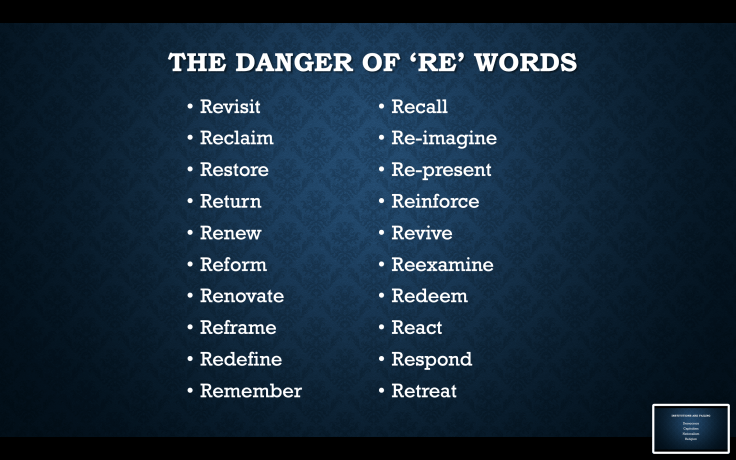
But have no fear!  God knows what (S)he is doing! God will get us through! Faith will get us through by God’s grace.

OK – so even if you are not as enthusiastic  as I am about the future, which is fine (not many are) you need to be aware of dangers in romanticizing the imagined past.

SO what do we do?

 Easy – Christianity is built for this! We have an incarnational gospel that is infinitely translatable to any language, culture, and time. God didn’t just work in the past. God is working in the present here and now.

We can bring about a preferable future by partnering with God’s spirit in the present moment. The infinite and timeless God is calling from the future into each moment providing us opportunities to say ‘yes’ and open up potentialities that were not always available in the past. This present moment is pregnant with possibilities for goodness and justice that don’t come embedded with the need to re-create, reinforce, and re-instantiate the layers of racism, sexism, and hierarchy inherent in past systems.

This is one of the unique aspects of Christianity that is different than other religions. We have a built in contextuality and translatability that gives us flexibility. All we have to do is repent and divorce ourselves from the marriage of religion and power – or to release the safety of empire and control.

That is what we are going to talk about next week: why things seem out of control.

For now let just say this: the past won’t save us. The future of faith is better than Europe’s past. We have nothing to fear but fear itself. God is at work in the world by Christ’s spirit. God is wanting and willing to work in and through us here and now. All we have to do is join God is the work that we were built for – and uniquely gifted and graced to do!

Inverse Preaching

The ‘We Make The Road By Walking’ series has been intense and interesting.

I am trying something new. Since everyone is reading the same chapter of the book each week, there is no sense in my just repeating that information or providing a slightly different take to supplement it. That is what I have historically done.

I am attempting ‘inverse preaching’ which is to take the idea and turn it inside out to see if it looks any different … or maybe it falls apart.

So for instance, at the start of the series I took the common thought (often attributed to Augustine) that ‘darkness doesn’t exist, it is simply the absence of light’ and inverted it to ask:

What if there is no such thing as light, but it is only the absence of darkness?

I take common wisdom like ” Jesus loves you” and says Jesus doesn’t love you as an individual – Jesus loves whole groups.

Here are the last 4 sermons (video) but you can always listen to the audio podcast as well [link]

Let me know what you think or if you have any questions.

Formula For Success?

Is this a formula for success?  Not everyone thinks so!
Focused Intensity – over Time – multiplied by the ‘God’ factor
I always pay attention when push-back does not follow a predictable bell-curve.
In this case, the concerns were equally divided into quarters.
Watch this 5 min video and let me know what you think.

Amazing Grace

Grace is by far my favorite topic of faith. It is so contrary to our normal ways of doing things.

Grace is a gift economy that is counter the way we think about things normally.

Grace is shocking. Grace is extravagant. Grace is scandalous.

SO I was very excited to wrap up our Summer Sermon Series in the book of Galatians at church yesterday. Here is a 12 min video of yesterday’s message.

The working thesis is that grace and forgiveness have lost their shocking greatness because we have grown too comfortable with them.

My hope is to remind everyone how scandalous grace is.

So in this short sermon you are going to hear that:

  1. grace is irrational
  2. grace is immoral
  3. grace is unethical

I hope that you will give it a listen with an open mind! You might be surprised by what you hear.


Updating CS Lewis

A Year with C.S. Lewis was my go-to devotional for about a 5 year window. I just loved his witty takes, his everyday language, and his optimistic outlook.

Once I decided to go to seminary and started reading heady theology, Lewis took a back seat. I tried to pick it up again a couple of years ago but it seemed too folksy and some of his logic seemed questionable.

Lately I have been doing an experiment: taking material that I used to get a lot out of and attempting to update-adapt-translate for my current context and our contemporary era.

Bringing Lewis into the 21st century is a fun experience. I actually think that his ideas hold up for the most part but that his language just needs a little updating.

Here is an example from Mere Christianity:

A live body is not one that never gets hurt, but one that can to some extent repair itself. In the same way, a Christian is not a woman who never goes wrong, but a woman who is enabled to repent and pick herself up and begin over again after each stumble – because the Christ-life is inside her, repairing her all the time, enabling her to repeat (in some degree) the kind of voluntary death which Christ carried out.

That is why the Christian is in a different position from other people who are trying to be good. They hope, by being good, to please God if there is one; or – if they think that there is not – at least they hope to deserve approval from good people. But the Christian thinks any good she does comes from the Christ-life within her.

She does not think God will love us because we are good, but that God will make us good because God loves us; just as the roof of a greenhouse does not attract the sun because it is bright, but becomes bright because the sun shines on it.

It is amazing how just a couple of pronoun changes and making God-language gender neutral (as God is) takes away all the distracting antiquated elements and allows the encouraging thought to come through with clarity and insight.

I am encouraged that I will be able to do this same process with some more material that has been so valuable to me over the years.

How about you? Anything that you would like to see updated-adapted-translated for our current context and contemporary era?


Getting Ready For God Week

The semester is off to a good start and my 3 classes are coming together in exciting ways.

Side-note: my 3 classes this semester are ecclesiology, culture & systems change, and essentials of christian theology. 

In ‘essentials’ the topic for next week is God. A really interesting cross-reference comes from Changing Signs of Truth by Crystal Downing, which is being read by the culture & systems change class this week.

She has a really innovative take on (re)signing our inherited symbols in order to clarify what those sign/symbols point to or signify. There is a part of me that wishes we could have the two classes meet at the same time and talk about what it would mean to (re)sign the symbol of that little three letter signifier ‘g-o-d’.

For those of you who are planning to follow along and participate in the essentials conversation, I just wanted to let you know how excited I am about how this is all coming together. In the book that we will be using as our primary focus, the list of authors is impressive:
Stanley J. Grenz; John B. Cobb, Jr.; Sallie McFague; Serene Jones; Robert W. Jenson; Hughes Oliphant Old; Ellen T. Charry; Paul F. Knitter; Richard J. Mouw; Noel Leo Erskine; David S. Cunningham; Kathryn Tanner; Clark M. Williamson; Leanne Van Dyk; Letty M. Russell; Michael Battle; J. A. DiNoia, O.P.; and Ted Peters.

What is going to make this exploration even more interesting is that we are putting each section of the essentials book in conversation with an author/thinker from a different tradition/perspective. Those authors include:

  • Emily Townes
  • James Cone
  • Rita Nakashima-Brock
  • Catherine Keller

I am also adding:

  • Randy Woodley
  • Elaine Graham
  • Sheila Greeve Davaney

It is going to be an epic 4 month journey and I hope that you will join us for it.

Let me know if you have any questions or if I can be helpful in any way.

God 2.0

The 3-letter word ‘god’ gets used to signify a number of different concepts. Here are 5 popular ideas that people are attempting to express when they talk about ‘god’.

I have ranked them from the highest level of commitment to the lowest for this 5 min video.

I would love your thoughts and feedback for an upcoming presentation/use of this model.

10 minutes on Afterlife

Life after death, the afterlife or the hereafter provide a major focus for some people’ interest in religion.

Here are some of my thoughts about the historical development and ongoing progress on our the way imagine eternity and the poetics involved. Nov20sw1

At the end is a constructive, innovative proposal of how we can address this major topic.

10 Minutes on Religion

Religion is a tricky subject. Many assume that they know what it means while others have decided to reduce religion to fantasy in order to dismiss it.

The hope is to move from an either-or model of ‘true’ or ‘false’ to a “web of meaning”.

My theory is that at least 5 elements contribute the web of meaning. This moves us away from an either/or model of ‘antiquated myth’ or ‘divine revelation’.

5 elements are:

  • Experience
  • Formation
  • Event
  • Mystery
  • potentially something RealRoadPortraitSunsetD&B

This last one is always the most difficult. Those who are sure (fundamentalist, foundational) dislike the ‘potential’ qualifier. Those who dismiss religion are suspicious of the potential of something ‘real’.

Once we get rid of the false either/or choices we are free to think about what is going on in religion.

I look forward to your comments, questions and concerns.

Create a free website or blog at WordPress.com.

Up ↑