Search

Bo Sanders: Public Theology

updating & innovating for today

Tag

history

P is for Perichoresis

Perichoresis is the most beautiful and elegant picture of the Christian godhead that many Christians may be completly unaware of.P-Perichoresis

The easiest way to break down the word:

  • Peri – as in perimeter
  • Choresis – as in choreograph (from the Greek word to ‘give away’ or ‘make room’)

It is the dance of the godhead. The picture is of movement and inter-relatedness. It is the constant exchange of moving around the edge – always providing space in the center. The concept is also known as cicumincession or interpenetration.

Circumincession: The theological concept, also referred to as perichoresis, affirming that the divine *essence is shared by each of the three persons of the *Trinity in a manner that avoids blurring the distinctions among them. By extension, this idea suggests that any essential characteristic that belongs to one of the three is shared by the others. Circumincession also affirms that the action of one of the persons of the Trinity is also fully the action of the other two persons.

Pocket Dictionary of Theological Terms (Kindle Locations 254-256). Kindle Edition.

In the gospels God points to Jesus and says “this is son in whom I am well pleased”. Jesus says “I do only that which I see the father doing”. The spirit anoints Jesus and empowers him to point people to God. Jesus leaves and sends/is replaced by the presence of Holy Spirit. This Paraclete leads into all truth and reminds us of what Jesus said (John 14:26).

Admittedly, talk about the Trinity gets complicated quickly. This is why so my contention surrounded the early churches councils and creeds. The filioque clause caused a schism between Easter and Western branches of the church in the 11th century.

Modern arguments abound regarding the hierarchy of Father-Son-Spirit. contemporary conflicts multiply about the gendered language of trinitarian thought and moving toward formulations such as Creator-Redeemer-Comforter.

In fact, the list of early century heresies and modern attempts to revive or reformulate theories about the Trinity can make ones head spin. It takes upper level philosophy and vocabulary to explain how 3 can be 1 or how a monotheistic religion has 3 persons in the godhead. It gets even more complicated when one has to explain exactly what happened on the cross and where exactly ‘god’ was.
It can be done but it is sticky and messy to say the least.

Then there is the whole matter of the ‘economic’ trinity and the ‘ontological’ trinity. That is for another time. Suffice to say that examination and exploration of trinitarian theories are deep.

One sure thing that we have a beautiful legacy in this perichoretic picture of the inner-life and dance of god from the 3rd century.


Artwork for the series provided by Jesse Turri

* another complicated distinction many may not know is that when speaking of the Trinity use of the phrase ‘person’ does not – in fact, in no way – connateness the modern/contemporary understudying of personhood. God is not a person in that sense. Theologians use it as a ‘super-category’ – almost like a place holder that they know needs to be defined, clarified and expanded later. 

I is for Infallible, Inerrant, Impassible and Immutable

Note: all relevant ‘I’ words will be placed in italics.I-Inerrant

It is an unfortunate quirk in the English language that leads negatives – or negations – to begin with the letter ‘I’.

The resulting effect is that some of the most problematic and even disturbing words in the theological tool-shed begin with ‘I’.

  • Infallible
  • Inerrant 
  • Impassible
  • Immutable 

These are just a sample, but are the 4 that we will focus on today.

These four ‘I’ words are just a sample of the kinds of words that lay-people can find both intimidating and infuriating about theology. Some have even lost their faith over these ‘I’ words.

Don’t even get me started on irresistible grace and infralapsarian – two concepts that hard-core Calvinists will bring up.

I say this in all seriousness. There is something about ‘I’ words which exhibit the most intense aspect of the difficulties when delving into theology. Many people point to words like these as an example of exactly why they are not interested in theology.

I have named 6 problematic ‘I’ words so far – but I will offer 2 more (inspiration and incarnation) as examples of ‘keeping it simple’ as an antidote to becoming disillusioned.

Let’s deal with the Bible first and then with God.

We live in a unique time of history where those who claim to believe the Bible the most attempt to place two words not found in scripture upon the Bible:

Inerrancy: The idea that Scripture is completely free from error. It is generally agreed by all theologians who use the term that inerrancy at least refers to the trustworthy and authoritative nature of Scripture as God’s Word, which informs humankind of the need for and the way to *salvation. Some theologians, however, affirm that the Bible is also completely accurate in whatever it teaches about other subjects, such as science and history.

This is admittedly a tough line to hold. The more that one learns about Biblical scholarship or historical criticism the tougher it gets. Inerrancy is an outside idea imposed upon the Bible that the Bible itself and thus has a tough time living up to its claim. It does not, however, mean that the Bible is not trustworthy!! This is my point! One can trust the Biblical narrative without having to elevate it to the level of inerrant.

Infallibility: The characteristic of being incapable of failing to accomplish a predetermined purpose. In Protestant theology infallibility is usually associated with Scripture. The Bible will not fail in its ultimate purpose of revealing God and the way of *salvation to humans. In Roman Catholic theology infallibility is also extended to the teaching of the church (“*magisterium” or “*dogma”) under the authority of the pope as the chief teacher and earthly head of the body of Christ.

Pocket Dictionary of Theological Terms (Kindle Locations 726-731). Kindle Edition.

Infallibility is better than inerrancy. Infallible can simply mean that the Bible will accomplish that which it is meant to accomplish. That seems fair enough on the surface.

Here is my contention: Why do we need to assert that it is guaranteed to accomplish the task? Where does that need for certainty come from?
Why isn’t it enough to say that the Bible is ‘inspired’ and leave it at that?

Inspiration: A term used by many theologians to designate the work of the Holy Spirit in enabling the human authors of the Bible to record what God desired to have written in the Scriptures. Theories explaining how God “superintended” the process of Scripture formation vary from dictation (the human authors wrote as secretaries, recording word for word what God said) to ecstatic writing (the human authors wrote at the peak of their human creativity). Most *evangelical theories of inspiration maintain that the Holy Spirit divinely guided the writing of Scripture, while at the same time allowing elements of the authors’ culture and historical context to come through, at least in matters of style, grammar and choice of words.

Pocket Dictionary of Theological Terms (Kindle Locations 731-736). Kindle Edition.

2 Timothy 3:16 talks about scripture being ‘god breathed’ . I think that should suffice and that attempts to impose external expectations upon the scriptures are futile (impotent?).  Whenever someone wants to talk about the ‘original’ texts, one only has to ask about them to see this folly.

It’s like calling the Bible ‘the Word of God’. The problem is that the New Testament refers to Jesus as the Word of God. Christians rightly refer to the testimony about Jesus as the scriptures. In this sense, they are words about the Word.
The problem starts when we want to upgrade the concept beyond its capability to sustain that we which we are attempting to assert upon it.
I would love if Christians would simply be satisfied with believing that the Bible is inspired by God’s Spirit and not attempt to make a claim on it that it can not sustain.

Now let’s talk about God.

The God that is revealed in Christ is, for the Christian, both informative and formative. It both sets a precedent and provides an interpretive lens.
As with the Bible (above) it is disastrous when we import foreign concepts of God (in this instance from Greek ideals) and impose them upon the revealed nature of Christ seen in the incarnation.

Immutability: The characteristic of not experiencing change or development. Certain understandings of God posit the divine reality as incapable of experiencing change in any way. Some theologians, however, assert that this concept owes more to Greek philosophical influence than to explicit biblical teaching. Many contemporary theologians distinguish between God’s eternally unchanging, faithful character and God’s ability to respond in different ways to changing human beings in their temporal, earthly situation.

Impassibility: The characteristic, usually associated with God, of being unaffected by earthly, temporal circumstances, particularly the experience of suffering and its effects. Many contemporary theologians reject the idea of divine impassibility, suggesting that it reflects Greek philosophical, rather than biblical, concerns. However, the Bible clearly teaches that God cannot be swayed in any way to be unfaithful to what God has promised. Still, it is seemingly impossible to associate pure impassibility with God in light of the fact that Jesus Christ, as the fullest manifestation of God, experienced suffering on the cross.

Pocket Dictionary of Theological Terms (Kindle Locations 704-709). Kindle Edition.

You can see why these concepts are contentious. They are imported from somewhere else and then imposed upon the narrative of Scripture. In my opinion they are incompatible and thus unsustainable.

Our great hope is found in the in-carnate god. We will return to this concept in two days with the letter ‘K’ for kenosis.

I would love to hear your thoughts, concerns, questions and comments.


BIG thanks to Jesse Turri for providing the artwork for each letter!

If you are interested you can see the early post about reading the Bible according to Genre or check out the art of Hermeneutics (interpretation).   You may also want to look into the temptation of Fideism.

F is for Fideism or Why What We Believe Really Matters

Fideism is one of the most alluring, and thus, potentially dangerous developments on the theological landscape in our lifetime.

Fideism: The view that matters of religious and theological truth must be accepted by faith apart from the exercise of reason. In its extreme, fideism suggests that the use of reason is misleading. Less extreme fideists suggest that reason is not so much misleading as it is simply unable to lead to truths about the nature of God and *salvation.

Pocket Dictionary of Theological Terms (Kindle Locations 552-554). Kindle Edition.

Fideism has been around for a long time but it has taken on a new tenacity recently.F-Fideism

The 19th Century was a tough one for ‘reasoned faith’. Those bastions that survived into the 20th Century were not left unaltered. In fact, since WWII the effect of those descended from who Paul Ricoeur dubbed ‘The Master of Suspicion’ – Freud, Nietzsche, Marx … and some add Darwin – has grown and intensified.*

Part of ‘reasoned faith’ is that it had to adjust and modify. It had to account for new data (scientific and sociological) and, more importantly, it had to stop playing by its own rules.

The rules of engagement changed. Faith no longer got a free pass. The ‘church’ was no longer running the uni-versity. Fields like science had grown up since the Copernican revolution was no longer afraid of the church and began to act like the were running the show now.

Modern christianity had to choose whether to

  • Flee
  • Fight
  • or Adjust-Adapt-Evolve

I have written about this as modern christianity’s temptations.

A subtle form of this impulse toward fideism is simply to speak of ‘Non-Overlapping Magisterium”. Science and reason take care of their areas and faith takes care of its area.

Those who take this impulse further retreat into what Wittgenstein would call ‘private language games’. They take on a formal defense of the given-ness of faith say that faith doesn’t have to be reasonable. Those two things are just speaking different languages and that science of reason doesn’t even have the ability to understand what faith is doing. That is why neither can even provide a critique let alone a correction. Religion is thus except from an investigation-integration from outside.

I would argue that what we believe in private has massive implication for how we participate in the public arena.

We can see this battle line in the recent Hobby Lobby decision from the Supreme Court.

Let me give an example from history – courtesy of another ‘F’ word in our pocket dictionary: filioque. A Latin term literally meaning “and the Son,”

The addition of this phrase by the Western (Latin) branch of the church in the in the 6th to the 4th Century creeds – without the permission of the Eastern churches – would eventually lead to the schism of the two groups in the 11th Century.
This schism is notable enough but 500 years later, in what would become colonial missions by western europeans, the issue had real consequences. As both Catholic and Protestant missionaries sailed around the world to convert native populations, the filioque clause would answer a significant question.
Could the Spirit of God be at work ahead of the missionaries arrival? The answer was a resounding ‘no’. The Spirit proceeded not just from the Father (and thus potentially outside of the work of the Son) but ‘from the Son also’. It was believed then that the work of the Spirit followed (proceeded not preceded) the proclamation of the Christian gospel.

There were minority schools (some Jesuits) who disagreed – but they were subsequently reprimanded.

Some may hear about the filioque clause and think “how would we even know who proceeded when? And how exactly are three people ‘one God’ anyway? This is all just speculation and minutia – like angels dancing on the head of the needle!”

Speculation it might be. But both in history and in our present societal unrest what folks believe in private really does impact how that participate in public.

This is why we have to care about fideism. I understand the desire to preserve the past and stake out ones territory for the given-ness of the tradition. It is a way of protecting what is deeply valued and – let’s be honest – in grave danger.

Those who are attracted to fideism look at the evolution of their religion and the disappearance of treasured practices and think “I don’t even recognize this contemporary mutation as the same thing that we inherited from those who came before!”

… and that might be true. But , as I am arguing in the series, we live in a world come of age and The Faith both needs to and is bound to change.
* another way of saying this is to list the fields of psychology, philosophy, sociology, and science.

C is for Christology

Christology, like our previous topics of Atonement and Baptism, is one prone to both diversity and contention.

This is a significant distinction because it is nearly impossible to say anything about any aspect of christology without drawing the ire of some group, camp or school of thought.

Having said that, it is vital to state that Christology is of central importance to any christian expression or practice. Maybe that is why it is so potentially contentious.


Let me introduce the basics – then we will dig deeper.

Christology attempts to navigate two paths which end up overlapping in a dynamic place.Jesus icon
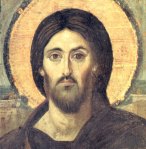
1) Jesus was a man. The way that we attempt to talk about his ‘divinity’ – or as I prefer – the way that he participated in the divine … is vital to any understanding of who and what Jesus (the man) was.
When we speak of ‘Christ’ we are speaking of the Logos or that aspect of Jesus which channeled, hosted, or was the Divine presence on Earth.

2) The two primary ways that thinkers approach this conundrum are classified as:

  • Christology from Below
  • Christology from Above

This is not to be confused with a ‘High Christology’ and a ‘Low Christology’.

‘From Below’ means that you begin with the baby in the manger and figure out in what way he embodied the divine presence of God. ‘From Above’ means that you begin in heaven with the pre-incarnate Christ and figure out how downsized/reduced/kenosis into the human form of a baby.

Technically you can start ‘from below’ and end up with a High Christology. It is just that there are a lot of steps one must undergo. That is for another time.


In this series I am using two resources. Here are the entries of each.

Christ, Christology. The Greek word translated in English as “Christ” is the equivalent of the Hebrew term Messiah and means “anointed one.” Although not intrinsic to its meaning, the NT use of the term Christ tends to point to the deity of Jesus. Christology is the theological study devoted to answering two main questions: Who is Jesus? (the question of his identity) and What is the nature and significance of what Jesus accomplished in the incarnation? (the question of his work).

Stanley J. Grenz;David Guretzki;Cherith Fee Nordling. Pocket Dictionary of Theological Terms (Kindle Locations 240-242). Kindle Edition.

Christology:  The branch of theology that deals with Christ. Traditionally, it has been concerned with two central issues: the person of Christ-who he is-and his work-how he saves us. (For the latter, Sec *Atonement; also *Soteriology.)

From very early times, Christians have puzzled over how to understand and to express who this Jesus is who means so much for them. In the New Testament, he is called Son of Man, Messiah, Lord, Word of God, True Shepherd, Lamb of God, for example. It is also clear that our earliest records of Christian worship place Jesus at its center. Early in the second century, pagan writer Pliny attests to this, saying that Christians gathered “to sing hymns to Christ as to God.”

Soon, however, what takes place in worship must also be expressed in theology and doctrine, and thus the question arises, Who is this Jesus? Is he divine? Is he human?

Some of the earliest answers were considered too simplistic, and were rejected by the church at large as denying an important aspect of the full truth. Thus, at one end of the spectrum there were those who believed that Jesus was a purely celestial being, an alien messenger from above who was human only in appearance. This view was called *Docetism, after a Greek word meaning “to seem.” It was held by many *gnostics as well as others. We see echoes of its rejection in 1 John 4:2, where the test of orthodoxy is the affirmation that Jesus “has come in the flesh.” The opposite extreme, often called *Ebionism, held that Jesus was a pure man, born like all men, whose purity was such that God gave him a special standing or role. This too was rejected by the church at large. Thus, from an early date it was clear that Christians wished to affirm that Jesus was both divine and human, but little thought seems to have been given to how to understand and to express this.

Very soon, partly on the basis of the Gospel of John, it became customary to declare that Jesus is the “Word of God made flesh-and it also became customary to refer to the Word as the Son. While this was helpful, it still left open a number of questions, particularly the question of how the Word, or Son, may be said to be divine. In the second century, Justin Martyr declared that the Word was a “second god”-an infelicitous expression that was soon abandoned. It was in the fourth century that this issue came to a head in ‘Arianism, and the process of refuting it and clarifying how the Word or Son is God led to the development and clarification of the doctrine of the ‘Trinity. Thus, by the second half of the fourth century, the general consensus was that Jesus is divine because he is the divine and eternal Word or Son of God made flesh.

It now remained to clarify how one is to speak of the relationship between that divine Word and the humanity of Jesus. Granted that Jesus, being God’s Word or Son, is fully divine, is he also fully human? How is one to conceive of the relationship between the divinity and the humanity in Jesus? On this subject, there were two theological tendencies that clashed repeatedly. One, the *Alexandrine, emphasized the unity of the divine and the human to such a point that it might seem that the humanity was dissolved or engulfed in the divinity. If need be, the Alexandrines were willing to deny some aspect of the humanity of Christ in order to affirm the union of the divine and the human in him. This led to positions such as *Apollinarianism, which denied that Jesus had a rational human *soul, and which was rejected by the Council of Constantinople in 381.

The opposite theological school, the *Antiochene, was concerned over safeguarding the full humanity of Jesus, sometimes at the expense of its full union with the divine. This was the position of *Nestorius, who declared that in Jesus there are two natures and two persons, and that the union of the two is one of will rather than of nature or of person. His position was rejected by the Council of Ephesus in 431. As part of that rejection, his Alexandrine adversaries underlined the importance of the *conrmunicatio idioniatum-the transferral of predicates from the human to the divine-in the person of Jesus Christ, so that whatever is said about him as human may also be said about him as divine.

In 451 the Council of Chalcedon finally arrived at the formula that eventually became generally accepted by most Christians, that in Christ there are “two natures in one person.” While this did not solve the issue, it was simply stating that one must affirm Christ’s full divinity, his full humanity, and the full union of the two.

Although most Christians eventually accepted the formula of Chalcedon, some rejected it. Those who followed the extreme Antiochene position, commonly known as *”Nestorians,” took refuge in Persia, and to this day there is a small church that traces its origins to that schism. Others, who followed the extreme Alexandrine position, became known as *Monophysites-that is, holding to the doctrine of a single nature in Jesus. This is still the position of the Coptic Church, the Church of Ethiopia, the Syrian Jacobite Church, and others.

Although the Council of Chalcedon is generally said to mark the end of these debates, the truth is that the controversy lasted for centuries, and that its fires were fanned repeatedly as various theologians -and sometimes emperors seeking political aims-suggested solutions or compromises that were found wanting by the rest of the church. (See also *Monergism; *Monotheletism; *Hypostasis; *Hypostatic Union; *Enhypostatic Union; *Dyophysism; *Dyotheletism.)

The Protestant Reformers in general accepted the christological formula of Chalcedon and the decisions of the early councils on these matters, but were more concerned over the saving work of Jesus than over the question of how he can be both divine and human and still only one person. Among the major Reformers, Calvin tended to emphasize the distinction between the divine and the human in Jesus, much as the Antiochenes had done earlier. Luther inclined in the opposite direction, emphasizing the union of the divine and human-although he differed radically from the ancient Alexandrines in that he emphasized the reality of the humanity of Jesus, and insisted that we can see the divinity of Jesus only as it is revealed in his humanity, his weakness, and his sufferings.

In more recent times, many theologians have sought to leave these debates aside by concentrating on the work of Christ rather than on the metaphysical issues surrounding his person. (See *Atonement.)

Justo L. González. Essential Theological Terms (Kindle Locations 953-988). Kindle Edition.


I hope that you can see both the difference in the 2 resources that I am drawing from AND the complexity of the issue being addressed.

At some point we will have to address the evolution from Jesus’ Religion to a Religion about Jesus … but that is later in the series.

I would love to hear your thoughts on this topic. 

Modern Christianity’s Temptation (2/3)

In light of the massive shifts in culture, understanding and expectation that the last 300 years has seen, there seem to be three great temptations for the devout.

Last post we talked about the problems that Modernity brought to Christianity’s doorstep in the West. Science had moved into the driver’s seat and was none too kind to those who would not get on board.

The problem, of course, is that we are simply not left the option to go back to primitive Christianity. For Lent this year I read books about post-Nuclear theology and listened to lectures on the first twelve centuries of Church history. It has never been more apparent that the world has changed in drastic ways.

  • Christendom
  • The Scientific Age
  • Globalization

Are just 3 catalysts and results of this epic (and epoch) shift.

Tomorrow I will present what I see as the amazing opportunity. Today I want to comment on what seem to be the 3 biggest temptations for modern Christianity:

  1. to concede
  2. to attack
  3. to retreat.


Concede

Faith as a public matter has never been more challenging. The easiest response is to both personalize ones faith and then make it private. This is a two-step dance but either is dangerous on its own.

Personalizing faith is a natural response for an Enlightenment Individual. We major in ‘self’. We have cultivated the ability to think in ‘me’. This is a novel development in religion and some argue that it is against the very nature of religion! The purpose of religion is to bind us together in practice (re-ligio) or reconnect us as a belief-community.

The second step is to internalize ones personal faith. In liberal democracy, no one cares if you believe something – just keep it to yourself. Don’t put it on someone else. Your personal practice in there or over there is one thing … just don’t make too big of a deal about out here. Out here we have a civil expectation of life, liberty and the pursuit of happiness. If your religion helps as a means to those ends, fine. If not, it might become an issue of you infringe on someone else right. Go ahead and practice your ‘tradition’ on your own time but just keep it down when you’re out here in public.

The modern expression of Christianity has responded to this two-step dance in many little ways – my favorite of which is consumeristic-accessorization. The bumper sticker on my interal-combustion automobile and the fashionable yet ironic message T that imitates a popular ad campaign are just two examples. It allows me to allude to a Bible verse (I am not of the world after all) while participating in a capitalist system that goes unquestioned.


Attack

To counter the personal-and-internal compromise noted above, an aggressive and external coup has been attempted. The memory of Christendom has fueled a political response to take back power and ‘return to our roots’. The rise of the Religious Right (and Moral Majority) of the past four decades is perhaps the most high-profile example. It is, however, just the latest incarnation of this impulse.Facade of St. Vitus Cathedral

The fond (and white-washed) memories of days gone by and yesteryear fuel an anger at what is seen as a disintegrating culture and a slouching toward Gomorrah. The resulting Culture Wars and political animosity have a fundamental problem however:

Ever since the Constantinian compromise in the 4th century is has been difficult (if not impossible) to get the Bible to say what one needs it to say in order to justify a claim to power.

A religion founded on the teaching of a marginalized prophet and incubated in persecuted minority communities does not lend itself to being in charge. An incredible amount of selective editing, creative hermeneutics and mental gymnastics are required to make it fit. At some point a voice like Yoder comes along and points out that ‘this is untenable’.


Retreat

The above two responses are both simpler and more obvious (and thus more popular) than our last response. The retreat is more subtle and sophisticated. I will return to Theology at the End of Modernity from the first post.

Those who seek to answer the questions raised by the work of Gordon Kaufman (primarily Sheila Greeve Davaney and Linell E. Cady) have deep concern about a school of thought that seeks to move the Christian tradition toward an “autonomous and protected location”.

A seductive temptation is found in an attempt to preserve former (historic) expressions of the faith behind linguistic fences (insulated language games) and communities that become isolated silos. These “are really retreats into forms of fideism or ‘protective strategies’ that seek ways of interpreting theological discourse so as to preserve its unique status.”

The Post-Liberal work of Lindbeck and the Radical Orthodoxy camp of Milbank and MacIntyre are in danger of this.[1]

Those who follow this line of reasoning:

“contend that theology is not properly about ascertaining indubitable truth claims about God or reality, nor about fathoming the depths of human subjectivity; rather, the task is to analyze and explicate the fundamental claims about reality and human life that have emerged within a specific tradition, so that believers might more fully appropriate and live out of their tradition’s vision of reality.”

It becomes a:

“self-enclosed historical community; its method is interpretive, not critical; and its goal is to aid in the internalization of central claim, not the critique or reconstruction of that which we have inherited.” p. 6

You can see the attraction of the retreat! By privileging “revelation” or the “given-ness” of the tradition, one is afforded the space to preserve and defend an inherited system which immune for outside critique and thus preserved in its ‘as is’ status.

This romantic preservation and reclamation mistakenly – and perhaps intentionally – defends and protects manifestations and consequences that we not only need to move on from but we to which we can not possible return to.


In part 3 we will conclude this series with a challenge to make the Christian faith “pluralistic, public, and critical”.


[1] “by emphasizing an ahistorical human subjectivity, (they seem) to find an autonomous sphere protected from the challenge of other forms of inquiry, then the cost of such independence was the removal of both theology and religion from the public sphere.” p.5

Modern Christianity’s Problem (1/3)

For Lent this year I did an interesting experiment. I did not give up anything but instead added an exercise as a discipline. My goal was to engage both the earliest days of the church’s past and stretch myself to imagine the church’s future. I did this by engaging two things:

  • I downloaded a lecture series on the History of Christianity from the 1st Century to the 12th. I listened to this as I biked to work and walked my dog everyday – instead of my normal diet of podcasts and news programs.
  • I bought and read a series of books from the most forward thinking theologian I have ever encountered. I read these in the morning over a french-press of coffee.

This has been a profoundly enriching experience and I am left with several observations as this season comes to an end.

1) I have never been more impressed or moved by the passion of the early centuries. What they were attempting to do was so formidable and expansive that a great deal of respect must be paid to them by anyone attempting to engage in a theological endeavor. From figuring out how a concept of Trinity could work with monotheism, to the incarnation within greek metaphysics – from eternal begotten-ness to the double procession of the Filioque clause controversy … one has to respectfully give a nod to what they were up against the overwhelming effort that was exerted. This is the first time that I have revisited either the patristic or the Middle Ages since I took on as conversation partners Process thought, Post-Colonial concerns or Critical Theory. This is the sixth time I have cycled around to the early church studies in the 20 years since I trained for ministry. It has been, by far, the most enlightening.

2) I have never been more convinced of both the situated and contextual nature of the church’s theology and practice. It is not just that those saints of the past lived in a different time, a different place and spoke a different language than we do – they were dealing with entirely different sets of concerns and with totally different sets of data. From Augustine, to Abelard – from Anselm to Aquinas, once you enter into the intricacies and nuanced argumentation of these doctrinal concerns, you can’t escape the fact that they were a product of their time. All theology is contextual and an honest examination of any doctrine or teaching reveals that their situated nature and specific location (time and place) played as much of a role in their development as any formulation that might have come out of them. The pre-Moderns were not only asking different questions than we are, they were working with different material than we are. Their philosophical assumptions, their metaphysical frameworks, their limitations of language and their pre-scientific world-views all have to be taken into account when evaluating their writing and thought.

3) I have never been more aware of our contemporary situation and how modernity has completely changed the game. To contrast the examination of the early centuries I have been reading the work of Gordon Kaufman, and more importantly, those who attempt to answer the questions that he raises. Kaufman is famous for his ‘Theology for a Nuclear Age’ but I am far more impressed with those who responded to him in ‘Theology at the End of Modernity’. Sheila Greeve Davaney, Sallie McFague, Linell E. Cady, Wayne Proudfoot, Francis Schussler Fiorenza, John Cobb and Mark C. Taylor have been rocking me.MP9004065481-196x300

Kaufman says that we live in an unprecedented time after a) the Holocaust b) Hiroshima and c) global environmental degradation. Human’s capacity to destroy life and wipe out humanity means that we are in a different epoch (era) that comes with unique concerns and an unequaled intensity. I agree with him.

We have to be concerned with things that Origen and Augustine simply never had to consider. We also have access to information that Aquinas and Calvin would have had no reference point for. We live in a new day. We have different concerns. We deal with levels of consequence they never had to consider. This is a new epoch – where the threat isn’t from the heavens or a realm beyond (super-natural). It is all too present and in the natural.

This admission leads to/calls for some significant adjustments to ones approach to life, thinking, theology and practice. We can’t go on just saying the same things (parroting / repetition) without variation. At some point it becomes unfaithful.

Take the foot-washing ceremony that often accompanies Maundy Thursday services. The unique element of the Biblical accounts is that Jesus shocked his followers by doing something that they would have been very familiar with. The novelty was who did the foot-washing. We live in an era where the novelty is the foot-washing itself. It has also changed from an everyday and practical occurrence to ceremonial and liturgical one.

“So even when we do the same thing that they did we are not doing the same thing they did.”

We live in a different time and in a different culture, which asks us a different set of questions, so that even when we give the same answers we are not saying the same thing.

4) It has never been more obvious that we can not go back. By looking at both the first 12 centuries and the last 30 years at the same time, it has deftly illustrated how extreme the gap is. What rests in the gap is modernity. It has become so clear why some want to go back to primitive or ancient expression of the Christian faith. I get the impulse to reclaim Augustine or Aquinas. I get the notion of converting to Greek Orthodox or Catholic. I feel the pull of retreating into insulated or isolated language games like the Post-Liberal or privileging an antiquated notion polis or habitus like the Radical Orthodoxy camp.

I get why that is desirable – It’s just that it is impossible. Like foot-washing on Maundy Thursday, even when you are doing the same thing you are not doing the same thing. It only appears that way.

This is Modern Christianity’s problem (the title of this post).

“ While science gained as the model for truth and the traditional arguments for God’s existence were eclipsed, theologians increasingly turned to the depths of human subjectivity as the source of religious experience and belief.”

Thus the attraction of reverting to former notions of tradition, revelation or isolation.

In “an autonomous and protected location in a modern world where science reigned and religious claims had lost their rational force … by positing that religious experience was a unique dimension of experience, differentiated by its unmediated and nonlinguistically interpreted character and hence not accountable to the canons of scientific inquiry and explanation. Thus religious and theological spheres, without legitimacy or security … appeared to have found a new and unassailable place in the modern world.”*

I am not saying there is only one way forward. I am saying that there are hundreds of ways forward – it’s just that there is no way back.

In part 2 I will address the new need.  In part 3 I will cover the two most obvious and wrong responses.


* Devaney in the introduction 


Drop ‘The’

Twice is a trend, three is a pattern.  The word ‘the’ has become a stumbling block.

The first incident occurred on TNT when I spoke up about my friendship with ‘Al’ – as in incarnational, etc. – and Tripp professed his love for the word ‘the’. Tripp wants to talk about the incarnation and the resurrection. I am more interested in a more generic, and I would add more fruitful, discussion about concepts like incarnation and resurrection.
You can read more about ‘Al’ here.

The second occasion was a little less contentious and I loved the feedback I got from the suggestion to Add An ‘S’ As A Test. It turns our that simple making something plural can be a great way to get away from the certitude or dogmatic cul de sac that conversation can get caught up in.
You can read more about Adding An ‘S’ here.

Last month a third incident emerged. At the Phyllis Tickle event to celebrate her new book and her life’s work, Barry Taylor (who I have studied with) offered a profound challenge. Phyllis’ new book is about Age of the Spirit. It became clear in the Q&R at Fuller Seminary that the Spirit was going to be a point of concern for people. You have questions about the modern pentecostal movement at one end and concern about early Trinitarian formulations at the other.
What Barry Taylor suggested at the Live3D event afterward was dropping the ‘the’ in Age of the Spirit. Why not just talk about the Age of Spirit?

Dropping ‘the’ is sometimes necessary when adding an ‘s’.fundamentals

Please don’t misunderstand me. I am not saying that this is a cure-all formula for getting out of any theological pickle/quandary that you find yourself in. What I am saying is that dropping ‘the’ can sometimes open up greater possibilities AND provide much needed clarity to doctrinal or historical gridlock.

The bottom line: We are moving out of an era built around certainty and on propositional truth. Things are becoming more fractured, de-centered and relational (there is Al again). This can be a good thing – shifting from certainty.
(Now, in fairness, Phyllis had a great trinitarian answer to Barry’s concern that you will be able to hear later when the podcast comes out.)
There is a lager issue at hand, however, and that is the way in which we hold truth. I’m going to suggest in a post later this week that we revisit not just our conceptions of God and religious experiences – but that we hold our interpretations of them differently. Until then, I want to encourage you to do a little experiment and drop ‘the’.
Let me know how it goes.

Starter Suggestion: if you are someone who uses the phrase ‘the church’, try and replace that phrase with the word ‘churches’ and see if the sentence still makes sense. It probably won’t – which means that you will have to go back and look at the assumptions that underlie the sentence.

Seductive Statistics and Evangelical Persecution Complex

An intriguing aspect of cultural conceptions has to do with the importance of numbers. Empires have historically (and colonial projects more recently) have trusted in the power of quantification for both influence in shaping narrative and to fuel the imagination of the population. The ability to take a census, to generate maps with classifications of miles and acres (for example) has been utilized by those in a position to do so as mechanism of control and domination.[1] Colonial concerns of quantification, compartmentalization and subsequent mastery (control) of those established categories have been powerful and formative in the imaginaries available to it subjects (and former subjects).

“The vast ocean of numbers regarding land, field, crops, forests, castes, tribes, and so forth, gathered under colonial rule over the last four centuries, was not a utilitarian enterprise in a simple, referential manner. Its function was part of a complex including informational, justificatory, and pedagogical techniques … State-generated numbers were often put to important pragmatic uses, including setting agrarian tax levels, resolving land disputed, assessing various military options, and, later in the century, trying to adjudicate indigenous claims for political representation and policy change. Numbers were useful in all these ways.” [2]

The mechanism of devices such as census, map and agrarian register functioned in one way during colonial occupation – and in many places still functions as such – but has morphed in more recent thought for both minority communities within existing systems of power as well as de-colonial perspectives.

For an example we might look to the impact of projected demographic changes in the United States. It is widely speculated that, if present trends continue, by 2048 there will be no white majority in the country.

It is important to clarify that

  • A) this has not happened yet and
  • B) that whites will still be larger than every other ethnic group (or racial category) individually.

The turning of the tide is that as the racial categories have been constructed, there will be more non-whites than whites. This is deceptive at two levels:

  1. first it is based on statistical projections bases on demographic numbers from census results. It is simply a number at this point.
  2. Secondly, there is no inherent association or camaraderie amongst what will be the new majority except that they are non-white. Outside of that parameter, there is no assumed similarity, priority, or fixed fraternity.

Here is an example of the difficulties associated with this approach. When a young Native American man says to me with confidence that in his lifetime there will be no white majority, he draws confidence that his current lot, as a minority, will not always be the case. He is both encouraged by this projected reality and emboldened to be strong, take a stand, and let his voice be heard. He can feel the change that is in the air. His America will look very different than his father’s and great-grandfather’s America. But within his conception – his new cultural imaginary – there are (at least) three unstated difficulties.

  • The first barrier is that it is a projected number that is not his present reality. He draws strength and confidence for resistance to the perceived injustice and inequality of present reality. It is a number generated from his colonial oppressors’ census data. His growing sense of self and imagined community is a result of an empirical projection.
  • The second barrier is that he is feeling a sense of fraternity and camaraderie with a population that he will only ever meet a fraction of. He is envisioning himself as part of a dispersed community that is based on the categorization imposed by the powers that oppress him.
  • The third barrier is that of assuming an alliance with Blacks, Asians, Latinos, Islanders, and other immigrants who he may have little in common with outside their expressed non-whiteness. If he were to be empowered with legislative influence along side an LA Latina, a South Carolina descendant of slaves, and a NY Korean would they share many common cultural values?

Yet he has been given a number that allows him to imagine himself in a different cultural context – participating in a different social order. That number allows him to dream and plan now for something that is not his present reality and to behave/participate as if that number were the greater reality. Numbers, in this sense, are powerful within and for the social imaginary.[3]

I was raised and ordained in a denomination that I experienced as massive. It had a global magazine, publishing house, plus six universities and two seminaries around North America. When I attended national gathering the rented civic centers were filled to capacity. I later found that we were dwarfed in size by other denominations. This numeric awareness changed my feeling about what I belonged to and my experience of it. I am now serving with the United Methodist denomination. I have experienced this group as vibrant and massive. Within the ranks, however, is an awareness of a statistical decline that is sobering. The way that members conceive of their movement and conceptualize what is possible is impacted (hampered) by the presence of a shrinking number. It seasons their reality and ability to imagine the community to which they belong.

The power of numbers to shape experience is worth examining.  If I were a child with a skin disease that limited my physical and social options, would I feel it less un-fair if I were informed that 364 other children are inflicted with this disease yearly? Would it matter if I were to learn that I was one of only 3 people worldwide that has my condition? What if I was the victim of a violent crime: would it change the way I process what I had experienced if I learned that 50 such crimes happened daily in my city?

Would my feeling of isolation and loss be impacted by my awareness (numerically) of people that I have never met? Yes. In the western construct, numbers impact the way that we conceive of our experience and conceptualize of an imagined reality or community.

Which brings us to the ‘persecution complex’ that is framing story of many Evangelical communities. Within the ‘statistical’ approach that I have suggested above,  one can quickly zoom in on a phenomenon related to narrative that some evangelical leaders peddle with great success to ‘rally the troops’ and garner support.[4] Pastor Holding Bible

In the exact opposite way that the young Native American man (above) gained encouragement from the idea of statistical formulation, the evangelical may become angry at the perceived loss of what Bill Leonard (in episode 114) calls “Protestant cultural hegemony”. From the ‘Happy Holidays’ controversy to the Duck Dynasty fiasco what we are going through is somewhere between a slight societal shift and a seismic cultural upheaval.

The phenomenon itself is debatable. What is not debatable is the very real perception and subsequent feeling of loss by those who have bought into this narrative framing of their experience.

I recently had a conversation with someone who lives in a different region of the country. She expressed concern that Wednesday nights were no longer ‘sacred’ and that both little league Baseball games and High School practice times now encroached on what just a decade ago was set aside for Bible Study and kids programs at the area churches.

Now the reality is that she can buy Christian books and music at Walmart (!) or one of several Christian bookstores in her area while listening to her choice of Christian radio stations as she drives past the more-than-a-dozen  Protestant churches between her kids’ private Christian school and the ball fields.

The reality is that Christians are neither A) persecuted nor B) a minority in America but that statistical awareness of an incremental  loss of influence is perceived (or felt) as such. The underlying truth, however, is that it is a conceptual framework (narrative) attempting to grapple with a loss of cultural influence/domination (hegemony) that was so pervasive within the 20th century’s modern social imaginary.


[1] Arjun Appadurai, Modernity At Large, , 115.

[2] Ibid., 117.

[3] A similar case might be made for women who have been disgruntled based on the patriarchal remnants still influencing them and their sisters even though they are aware that they are 51% of the population as a whole. A great deal is made out of the number ‘51’ in juxtaposition to matters of access, equality and compensation. Much is made of that number. What if, one might ask, that number was changed. Would the case be harder to make? What if only 42% of the population were women? Or what if it turned out that an error had been made and actually 64% of the population were women. Would that make the current inequalities and unjust practices more grotesque? [See Imagined Communities by Benedict Anderson]

[4] Madan Sarup, Identity, Culture and the Postmodern World, 14. “Identity has a history. At one time it was taken for granted that a person had a ‘given’ identity. The debates round it today assume that identity is not an inherent quality of a person but that it arises in interaction with others and the focus is on the processes by which identity is constructed”

4 Attempts at Approaching ‘God’

Over Christmas my brother-in-law, who is a fellow pastor, wanted to have a conversation about approaches to God – specifically as it related to epistemology (how we know what we know).

Although we both went to the same Bible college more then 20 years ago, our paths have headed in different directions and our hope was to compare notes and see where some common ground might be found for future conversations about ministry and christian spirituality.

 I thought it would be fun to throw out my initial schematic here and ask for some help in refining / overhauling it. 

I started with 4 basic historic approaches and then added a layer where each of the 4 approaches had 2 directions. Each approach has the possibility of starting with the notion of ‘god’ and then working out to the concept or starting with the concept and working toward the notion of god.


 4 Approaches pic

  •  Ethics has been a popular approach in the past. It is not as popular after the events of the 20th century (WWII, global pluralism and post-modern theory being 3 reasons why).

The problem here seems to be that starting with ‘god’ does not inherently result in clear ethics. In fact, those who have attempted to take the ethics approach often run into the problem that the two don’t necessarily equate. It is obvious that those who believe in ‘god’ are not more ethical than those who don’t believe in that same god or any god for that matter.

To make matters worse, starting with ethics (the outside-in direction) has a tough time getting all the way to ‘god’ by trying to equate ethics with evidence that there is a god. While you can see that the ethics and belief in god may have some overlap, it is not the most efficient of effective approach and thus it has fallen out of favor.

  • Revelation is a tried-and-true approach historically. Protestants of almost every stripe love this approach. From fundamentalist to fans of Karl Barth feast on a steady diet of the revelation approach.

That God reveals god’s-self in creation, in history, in scripture and in experience is a staple of the christian religion. The problem is that there is often a gap. If you start with what is revealed you might not make it all the way to God… and likewise, if you start with God it can be tough to make it all the way out to what is revealed. The problems come in things like Biblical (historic) criticism, modern science and the pesky pluralism of the post-colonial era.

  • Reductive approaches are perhaps the post problematic. We are haunted in late modernity by this shadow of foundationalism. As we are all aware, the scientific reductionism of the New Atheists is just the flip-side of the coin from fundamentalists like Jerry Falwell. If you start out there, you never make it in to God. If you start with God, you never make it all the way out there.

This approach has left us with a nasty enlightenment hangover and many (if not most) people are weary of the contentious and often combative result of this attempt of making your way in the world.

  • Linguistic approaches (I include the hermeneutical crowd in this) seem to me the most promising in the 21st century. The problem, however, is that they can often be so different from classic or historic approaches that the uninitiated have a difficult time even recognizing them as the same christianity one is trying to engage.

Take for instance the much debated sentences of Jack Caputo. What does it even mean that God does not exist but that God insists? Is god just a concept of our highest good? And how does one fend off the Feuerbach critique that religion is nothing more than a human projection by talking about ‘language games’?

Does god ontologically exist or not? Is the linguistic approach just a fancy way of skirting the tricky questions about what we can know beyond the physical world? Most importantly, for the epistemology question that we were originally attempting to get setup, how do you even more forward if linguistics/hermeneutics are your preferred entry point?

So that is my “4 Approaches – 2 Directions” schematic. It lead to a fruitful conversation even while it clearly needed some adjustments.

I would welcome your thoughts, questions, concerns, revisions, suggestions and innovations. 

p.s. I’m going to start linking to the Kindle version of Pocket Dictionary of Theological Terms at the bottom of posts like this. It is only $5 and it is so helpful new readers of this blog.

Create a free website or blog at WordPress.com.

Up ↑