More than masculine imagery is needed for health and wholeness.
The divine – transcendent – eternal is so much more than the metaphors and analogies that we utilize is worship and prayer.
“The rule of prayer is the rule of faith” has migrated historically from prayer to sacrament to preaching and, now in our musical age, to worship. See also Worship Words Determine Faith [link]
Our language about God functions – Elizabeth Johnson
This is why we must both account for and attend to a more well-rounded and balanced approach to our imagery about God.
We have set sail and are coasting in to uncharted waters.
Look at our institutions:
government is broken with congressional gridlock, banking crisis and scandal (too big to fail bail out of 2008), military spending is exponential but stuck in 2 endless wars because how do you win a war on terror, even religion … just look at our denomination [even the Quakers split last year] the UMC is about to, this is why some people are attracted to converting back to Orthodoxy, or Catholicism, or Anglicanism. It has a fetish appeal. Our seminaries are buckling.
Democracy, Capitalism, Nationalism, Religion.
We live in unprecedented times.
It is incredible and exhilarating and overwhelming to many. You can begin to see why some folks are attracted to going back to the way things were. It would make sense – it would be simpler and easier if we all just settled down and went back to the way things were.
Here is the problem – you can never go back. Because the past isn’t where you remember it was and even if you got there – it simply isn’t there anymore. It is gone. Time moved on
And the past won’t save us. Our future is not to be found in the past. Backward looking and past-oriented systems and mentalities will not prepare us for what is coming.
Things have changed. The landscape is changing. We live in fluid times and a liquid culture. It is time to sell the farm and becomes sailors. We won’t need bigger barns when the tide comes in – it is time to tear down the barns and use the wood to build some boats. We are floating in the new age.
The past will only sink us.
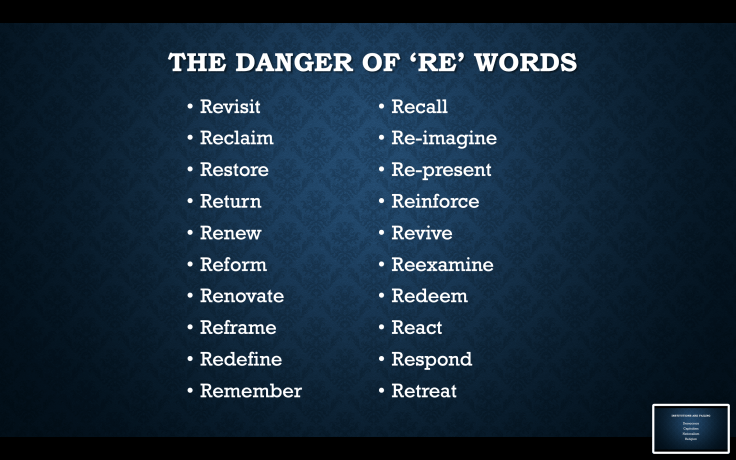
The Danger of ‘Re’ words.
But have no fear! God knows what (S)he is doing! God will get us through! Faith will get us through by God’s grace.
OK – so even if you are not as enthusiastic as I am about the future, which is fine (not many are) you need to be aware of dangers in romanticizing the imagined past.
SO what do we do?
Easy – Christianity is built for this! We have an incarnational gospel that is infinitely translatable to any language, culture, and time. God didn’t just work in the past. God is working in the present here and now.
We can bring about a preferable future by partnering with God’s spirit in the present moment. The infinite and timeless God is calling from the future into each moment providing us opportunities to say ‘yes’ and open up potentialities that were not always available in the past. This present moment is pregnant with possibilities for goodness and justice that don’t come embedded with the need to re-create, reinforce, and re-instantiate the layers of racism, sexism, and hierarchy inherent in past systems.
This is one of the unique aspects of Christianity that is different than other religions. We have a built in contextuality and translatability that gives us flexibility. All we have to do is repent and divorce ourselves from the marriage of religion and power – or to release the safety of empire and control.
That is what we are going to talk about next week: why things seem out of control.
For now let just say this: the past won’t save us. The future of faith is better than Europe’s past. We have nothing to fear but fear itself. God is at work in the world by Christ’s spirit. God is wanting and willing to work in and through us here and now. All we have to do is join God is the work that we were built for – and uniquely gifted and graced to do!
I am trying something new. Since everyone is reading the same chapter of the book each week, there is no sense in my just repeating that information or providing a slightly different take to supplement it. That is what I have historically done.
I am attempting ‘inverse preaching’ which is to take the idea and turn it inside out to see if it looks any different … or maybe it falls apart.
So for instance, at the start of the series I took the common thought (often attributed to Augustine) that ‘darkness doesn’t exist, it is simply the absence of light’ and inverted it to ask:
What if there is no such thing as light, but it is only the absence of darkness?
I take common wisdom like ” Jesus loves you” and says Jesus doesn’t love you as an individual – Jesus loves whole groups.
As we have moved through the centuries, things have changed. Our worship communities have moved from being centered on prayer, to sacrament, to preaching … and now many are centered on music.
I am proposing that now, the rule of worship is the rule of faith.
Watch this 5 minute video and let me know what you think.
When Sarah Palin said that water-boarding was how we baptized terrorist, it was a turning point for my understanding of faith and the role it plays in our culture. I don’t know if I was more offended because of my hatred of torture (or ‘enhanced-interrogation techniques’) or my love of baptism and what it represents as a central expression of the faith. Baptism is how we who believe demonstrate that we accept the death-to-self and enter into the life-of-Christ.
I had been asking this question ever since Rumsfeld/Cheney put Bible verses on the covers of their Iraq war briefings to President Bush. That is how I learned about things like ‘master signifiers’, which are symbols such as ‘Christianity’ that have become detached from the meaning that they were originally anchored to. They are un-tethered from the history that originally gave them meaning.
Christianism is disconnected from the faith and tradition that gave it birth. When you see or hear something under the banner of ‘Christian’ that does not seem to reflect the example of Jesus or the teaching of Christ … you may have wandered into the wilderness of Christianism. It uses all the same words that you know … but in foreign and contradictory ways.
Christianism is several degrees removed from the teaching and example of Jesus. It begins in the formation/formalizing of those things (one degree) – then it takes on an authoritarian/hierarchical structure (two degrees) – then, and this is the big one, it is married to power (government/military) so now we are three degrees from the origin. This new orientation becomes solidified/codified as a thing that has its own identity: “Christian” becomes a category by which you can know who is in and who is out – the saved and the lost (fourth degree). This is where bad things done by ‘good people’ can be justified as being beneficial to ‘the cause’ or ‘our side’.
The final stage is when ‘Christian’ is an identity that helps to distinguish us (in-group) from others, NOT depending on ones obedience to the central tenants, following the teachings of the founders, or even knowledge of the distinctions that signify identity to the group. At this point the signifier ‘Christian’ is no longer anchored to anything that it was originally grounded in and no longer connected to the very thing that gave it life and health. ‘Christian’ becomes a floating signifier and is un-tethered from its proverbial mooring (fifth degree).
We are watching a ‘historical drift’. This is how Sarah Palin can say that water-boarding is how we baptize terrorist. This one statement has it all! We are the in-group. We do this to people with unilateral/coercive power. It is then connected to sacred/holy acts. And finally, we assume that we are doing God’s work when we do things that are opposite/counter to the example of what we say is the incarnation/revelation of our very God.
When something is this far (5 degrees) away from its original intent, folks can start to ask, “how is this connected to that?” The generous/gracious response is ‘loosely’. The concerned response is ‘they are not connected’. The critical response is ‘it is counter to the origin’.
When you add an ‘ism’ to anything it is in danger of becoming a Frankenstein creature that takes on a monstrous life of its own. Examples of this in the U.S. context involve:
Democrat-ism: When it is no longer about the democracy but has become about beating the ‘other side’.
Republican-ism: When it is no longer about the republic but had been reduced to gun ownership and ‘states rights’.
Methodism: When members of Methodist churches can no longer tell you what the ‘methods’ are.
Evangelicalism: When those who identify as such cannot tell you what the evangelion is or cannot articulate the ‘good news’ of Jesus’ message. [more here]
Pentecostalism: When the gift of tongues is no longer about proclamation to those who speak in foreign languages but is about an ‘unknown’ prayer language that edifies the speaker.
These have all become master signifiers that identify an in/out boundary but which no longer re-present the original meaning they once stood for. Our world is full of markers/groups/identities/labels that are so far from what they originally meant that they are not longer tied (tethered) to the thing that used to anchor them.
My concern is that ‘Christian’ no longer signifies one who follows Christ and has instead become an ‘ism’ that designates an us/them distinction that has nothing to do with the teachings or model of Jesus. I get why people are being inventive and using ‘Christ-follower’ or attempting to follow ‘the way of Jesus’. Cynics will mock all they want, but if these innovative monikers are an attempt to protest or defy the ‘ism’ of the dominant expression … I say we ask more questions instead of making snarky and dismissive comments.
They might be onto something.
Interesting uses of Christianism started appearing between 2003-2005
That is what Katie asked the group last week. We had finished reading Galatians 1 where Paul seems pretty sure about it. He is sure that there is a gospel, and that he has the right one.
Katie asked the group “so what is the gospel?” She then asked “and what is grace?”
We talked about it a bit and then (as I mentioned on the Week 1 Debrief podcast) I offered my working definition:
“The Gospel is the good news that God loves the whole world and did something for us in Christ that we can not do for ourselves.”
I have worked on this a lot over the past 15 years and have grown quite comfortable with it. It includes:
good news (literally the definition of the word gospel)
the whole world (John 3:16)
grace (a gift of what we can not earn)
I would love it even if it just existed in a vacuum and I never talked with anyone about it.
The reality, however, is that everywhere it comes up, people REALLY want to talk about it!
The response follows a typical bell-curve. Most people like it or at least get it. But there is a tail on either side of a small minority who object at some level (but for completely different reasons).
For those who have a very particular understanding of the gospel, my working definition is not specific enough. It doesn’t say anything about asking Jesus into your heart, praying a specific prayer, believing certain things, believing them certainly, or going to heaven after you die.
On the opposite side, for those who hold that Jesus is one way (a path) to God, my working definition is too narrow. It sounds as if Jesus was unique in human history and in religious thought.
This is why the ‘gospel’ conversation is one of my favorites.
What do you think? How would you answer the question? What is your working definition?
[I originally wrote this for PBS but wanted to share it here as well]
Dualism offers us binary options that must be challenged. Evolution & Creation, Male & Female, Church & World, Jihad & McWorld, East & West, Think & Do etc.
This short video is in response to requests for alternatives to the either/or frame work that we have inherited.



 Bo Sanders: Public Theology