Search

Bo Sanders: Public Theology

updating & innovating for today

Tag

Jesus

X is for X-ray (technology)

Something a little different today. 

100 years ago was the beginning of what became known as World War I. X-Xray
I am fascinated by the changes that have come in that 100 year period.

The transition from the 19th to the 20th century houses a fascinating and rapid shift in both politics and technology (to name just two fields).

The build up to World War I is a study in what seems like not just a different time but wholly different world at points. Like learning the geography of Tolkien’s Middle-Earth or the kingdoms and families in The Game of Thrones, the world before the great war seems alien.
You have to get up to speed on such things as the Habsburg Dynasty and the Austro-Hungarian Empire.

Eschatology is an interesting entry point to this conversation. At the beginning of the 20th century, Post-Millenial views were the overwhelming position for protestant churches and denominations. The optimistic view of human progress and societal transformation brought an expectation of ushering in the Kingdom of God and a reign of peace and prosperity that would fill the whole earth. The horrors of the war brought that to an end. There was no ‘war to end all wars’ and by the end of the 20th century (the Christian Century) Post-Milleninial views were as a rare as telegraphs.

The beginning of the 20th century also saw seismic shifts in technology. The telephone, the airplane, vaccines and the radio mark the the era. The Xray illustrates the point as well as any other from this era.

The ability to see into the human body is remarkable. It transforms not just how we practice medicine but how we conceptualize the human body.
I read a passage a while ago, which I can now not find, where an author wondered how the apostle Paul’s writing would have changed if he had been able to take a trans-Atlantic flight or if he had seen that famous picture of the earth as a little blue marble as seen from the moon.

Which brings us to the question at hand as we begin to wrap up this series:

If technology and medicine, communication and psychology, economics and politics – and every other field – get to (and are encouraged to) advance, evolve, adapt and transform … why is religion so bound to the thinking of the pre-moderns and the ancients?

There is something peculiar about religious thought that needs to be examined. I understand those who want to conserve the tradition – I don’t agree but I understand the conservative impulse.
I prefer an approach that is incarnational and contextual. I see christianity as embodied (in-body) in a time and a place. All theology is contextual theology (as folks like Bevans and Schreiter say) and our faith must be re-callibrated, re-formed and re-membered within our cultural context.
Faith, like language, does not happen in a vacuum. It is (in)hereted. There is a given-ness to it. But faith is also in-acted and em-bodied.

This is a delicate dance to both honor the tradition and express in our time and place the truth of what was passed on to us.

The 1500’s had both Copernicus and William Harvey. The former told us that the earth revolved around the sun, the latter that the heart was responsible for blood circulation. In science the telescope and the microscope changed everything.

We live in the nuclear age. The Xray, the nuclear bomb and the microwave are just the tip of the iceberg. I have not even touched on TV, cell-phones, no-fault divorces, Christian-Mingle websites and credit-card giving machines in the pews.

Why, when every area of our lives from medicine to politics to economics to psychology is updating and evolving … why would religion insist on holding to the cosmology, metaphysics and epistemology of the pre-modern world?

When we get sick, even conservative/traditional folks will take an aspirin and get an x-ray.
The Christian faith, based on the story of incarnation, is designed to be embodied in a time and place. To hamper this process of adaptation and adjustment is to not only miss the point of the entire story but to worship an idolized moment in the development of its trajectory.

I would love to address the formerly enchanted world (without supernaturalism)  and the concept of second naiveté – but here is what I really want to leave you with:

The gospel is designed to be (in)carnate and (em)bodied. We have no fear of losing the gospel’s essential character by appropriating it to our time and our place. We live in a world come of age. It is time for a response to nuclear theology.

 Artwork for the series by Jesse Turri

W is for the Word of God (and the Wesleyan Quad)

There is no phrase that is more misused, or more contentious, than The Word of God. We might need to take a vacation from throwing the phrase around as a tight summary until we pull it apart and clarify its multiple uses. W-WordofGod

The Word of God, when used properly, carries three layers of meaning:

  1. Divine Communication. The prophets used the phrase in the Hebrew Testament to convey weight and authority. They had a message for the people of God that could be encouragement, directive, corrective, or illuminating.
  2. Logos – divine wisdom. New Testament believers are treated to a syncretistic twist when the Gospel of John prologue draws off the greek notion of logos and then shockingly says what no greek thinker could fathom saying: “the word became flesh and dwelt among us”.
  3. Revelatory elements in the scriptures. When the Spirit who inspired the original works illuminates the message again for a contemporary audience, it is said to be ‘the word of God’. (Thanks be to God)

For clarity I will now refer to the first and third meanings as ‘the word of the Lord’ and the second as the ‘Logos made flesh’.

The pitfall that some fall into is that they take this last sense (revelatory elements within scripture) and attempt to make it concrete (or foundational). Doing so is to erroneously confuse the messenger and message, the vessel with the element, the sign for the object.

Calling the Bible the Word of God is as inaccurate as it is accurate. It is not exactly true … but it is true enough that it is tempting. The problem is that it confused the ‘curves ahead’ road sign on the mountain road for the road up the mountain. It is not that they are unrelated – it is that they are not equivalent. The map may be accurate, and trustworthy for the journey, but it is not the landscape itself.

Knowing the map well is not the same as going on the journey.

This is the important difference between a sign and symbol.

  • A sign points to a greater reality … even if it does so imperfectly. The yellow and black ‘curves ahead’ sign on the mountain road is not telling you the exact sequence of twists and turns ahead. It is not map. It is alerting you to something bigger than itself.
  • A symbol, when used theologically, is a sign that participate in the reality that it points to. In this sense, the Bible contains the potential for the word of the Lord, it records instances of the word of the Lord, and it tells us about the Logos made flesh. The Bible is thus not unrelated to the Word of God but is not exactly equivalent either. It records and points to a greater reality (like a sign) and under the influence of Holy Spirit inspiration participates in that reality to which it points (symbol).

One can see the problem in legal court and in Sunday school. It is ironic to place one’s hand on a Bible and swear ‘to tell the truth, the whole truth and nothing but the truth so help you God’. The irony, for those who have actually read the Bible, is that it says in two New Testament passages not to do such things. We are not to swear by things but to simply let our yes be ‘yes’ and our no, ‘no’. That should be enough. We don’t need to swear by heaven or earth or anything like God. It is an odd practice.
Similarly we see things like this in the songs we learn as children:

The B-I-B-L-E,
that’s the books for me,
I stand alone on the Word of God

The Bible is not a book. It is a collection of 66 books by different authors in different centuries representing different histories, perspectives and opinions utilizing diverse genres of writing. This is part of why you can not say ‘the Bible says’.
When we say that ‘the word of God is living and active’ or that ‘all scripture is God breathed and useful’ we are right … but we must avoid the temptation of too quickly boiling those three into down into one interchangeable phrase lest we miss the awesome power and invitation provided by the interplay between them.

Now, if we mean that because of what we learn in the Bible, we hear the word of the Lord and believe in the Logos made flesh … that would be fantastic. ?If, however, we mean that the Bible is equivalent to the Word of God, then we have set our children up to be confounded, frustrated and spiritually impotent.
We have given them a road sign and told them it was the adventure. ?The word of the Lord propels us on a journey! To walk the way of the Logos made flesh, to know the truth of that which was in the beginning – with God and was God – and to live the life of the ages (eternal life).
To paraphrase a famous line – we are like children making mud-pies out of dirt in the back alley while there are real pies waiting in the kitchen.

Part of the problem is that we have try to cram too much into the phrase ‘the word of God’ and asked more from it than can be expected from any sign or symbol.
The most helpful thing I have found to address this problem is called the Wesleyan Quad. The quadrilateral is composed of 4 elements:

  1. Scripture
  2. Tradition
  3. Experience
  4. Reason

Those 4 elements also work best in that sequence.
– We go to scripture first for it records examples of the word of the Lord and points us to the Logos made flesh.
-We next consult the tradition, for religion has a given-ness to it. We inherent a living tradition and participate in its practices, rituals, ceremonies, train of the thought and teaching.
– We also recognize that importance of our community-experiences. No one is spiritual or religious on their own like no one uses language alone. We learn a language from others and use a language to communicate with others. It is not enough to know of a religion – one participates and thus experiences. We learn from and incorporate our community-experiences.
– Finally comes reason. We are made in the image of God and that divine Logos (reason) was given to us to exercise responsibly. We are not called to be robots who mechanically parrot the inherited sentences in rote repetition. There is a deep need to think about things so that our tradition does not become a dead artifact, or worse, a false idol.

The danger of what has been called ‘Bibliolotry’ is not simply that it makes the Bible ‘a paper pope’ or ‘the 4th member of the trinity’ (as bad as those seem). The danger is in missing the way, the truth, and the life that is available to us by instead settling for a road-sign instead of an adventure.


I would love to hear your thoughts about my distinction between the Word of God as the word of the Lord, the Logos made flesh and the Bible. 

Artwork for the series by Jesse Turri

For more read my earlier posts about Inspiration and about Revelation.

ABC Final Stretch

I was out of town this week and my friends Micky and Callid took care of S and T over at Homebrewed. You can read their articles linked below.A-Atonement

I wanted to take this opportunity to clarify a couple of things before we make the turn toward the final series of letters.

  • Respond to questions about the Book of Revelation
  • Flesh out my answer in Micky’s video about Salvation
  • Explain why I went with ‘theopoetics’ instead of other (more famous) T words

I will do this in reverse order. Callid (and a few FB friends) were questioning the selection of ‘theopoetics’ over words like trinity, theosis and theodicy. We covered trinitarian matters in P is for Perichoresis. While I love the Eastern notion of theosis (becoming like God), this series is really focused on concepts that we need to engage going forward in the 21st century.

I am a big fan of theosis and love those who embrace/reclaim this ancient notion. They are often paired with both mystic appreciation and a commitment to spiritual disciplines.

Theodicy (the problem of evil) is a big one. After the events of the 20th Century – specifically WWII – there can be no doubt about the centrality of evil and human nature to any theological consideration.

  • Where is god in all of this?
  • Why is our experience so different than the ancients?
  • Is it technology?
  • It is society?
  • Has the world changed?
  • Has God changed?
  • Has our understanding of God changed?
  • Is the world no longer enchanted?

I try to cover this when I talk about The World Come of Age (Bonhoeffer) or what others call The World Transformed (Hunt) or what Kaufman calls The Nuclear Age.

The simple fact is that the 20th Century – between technology and war – changed the world and radically altered what we call society. The reality of living in the 21st century are very different than they were in the 12th – let alone the 2nd. The questions of the 21st century are not answered by repeating inherited answers or by parroting ancient thought.

Farming, hygiene, reading, telephones, banks, travel (airplanes) …. there are thousands of examples of how different our existence is from those in previous centuries. Even the way was imagine our self (identity) and community (belonging) has changed.

So theodicy is a major issue, but I wanted to add something to our theological tool-belt that will help us going forward. Theopoetics is one of the most important ideas – and one of the most vibrant contemporary conversations – that we can engage in. It impacts everything from how we read Genesis and Revelation to how we approach the ancient creeds and how we conceptualize our god-thoughts and convey ourselves in god-talk. That was the thinking behind selecting theopoetics for T.


Salvation:  In her post, Micky shared her video. I provide the opening response and folks had several questions about it.

What we are talking about in salvation happens at 3 levels:

  1. The Life of the Ages. Jesus talked about it and unfortunately it gets translated into English as ‘eternal life’ which people think happens after death and then have to try and explains how it impacts life here. Some say it starts here and carries on and is intensified after you die. The whole thing is much clearer and more powerful if you call it ‘the life of the ages.’
  2. Reversal-Restoration-Reconcilation from Eden. The story of Eden shows us three fractures – from God, from each other and from the Earth. Salvation is a process of reconnection and participation in right relationship and the community of creation. Shalom is the word. 
  3. The Jewish notion of Tekkun Olam. This is the restoration of all things. NT Wright has a famous version of this bringing all things to right.

Salvation therefore impacts everyone and everything. It is not only about a tiny part of you (your soul) after it leaves your body. It is about your body and the earth that it comes from … and every other body on that earth.


Revelation: Folks liked my take on the book of Revelation … but then wanted to know what to do with it. Here are some suggestions:

  1. Enjoy it. Don’t be scared by it. Look into the 2nd century imagery and learn how apocalyptic works as a genre.
  2. Then take that knowledge and examine Jesus’ statements in the Gospels as well as the second half of Daniel.
  3. Mess with your friends who have been sold a Left Behind version of faith with historical perspective.
  4. Give our artists, poets, film-makers and dreamers permission to create political critiques of the 21st century like the author of Revelation did for first two.

Once you are relieved of the notion that Revelation is about the future, you can get down to the series task of examining, critiquing and challenging  the existing structures and systems of our day. Tripp and I chat about this stuff for the last 20 min of this week’s TNT.

I would love your thoughts about any or all of these subjects.

Q is for the Quest for the Historical Jesus

The Quest for the Historical Jesus is a topic that I am both annoyed and intrigued by. Chalk this reaction up to my evangelical upbringing but I am like a high-schooler in the midst of drama. Q-Quest

“They drive me nuts, I hate listening to them talk! … What did they say? Tell me everything.”
I am both attracted to and repelled by the work and findings of this movement.

Before we go any further, lets see how others Justo L. González introduces it:

Historical Jesus: Often contrasted with “the Christ of faith,” the phrase “historical Jesus” is somewhat ambiguous, for sometimes it refers to those things about Jesus that can be proved through rigorous historical research, and sometimes it simply means the historical figure of Jesus of Nazareth. The phrase itself, “historical Jesus,” was popularized by the title of the English translation of a hook by Albert Schweitzer, The Quest of the Historical Jesus (1910). In this book, Schweitzer reviewed a process, begun by Hermann S. Reimarus (1694-1768), which sought to discover the Jesus behind the Gospels by means of the newly developed tools of historical research. After reviewing this quest of almost two centuries, Schweitzer concluded that what each of the scholars involved had discovered was not in fact Jesus of Nazareth as he lived in the first century, but rather a modern image of Jesus, as much informed by modern bourgeois perspectives as by historical research itself.

Essential Theological Terms (Kindle Locations 1905-1916). Kindle Edition.

González goes on to explain that much of the quest was abandoned after Schweitzer’s findings but has recently reappeared in a minimalist expression (what are the bare facts that can be validated?).

Grenz is clear about this historical quest – that its proponents think Jesus:

  • never made any messianic claim
  • never predicted his death or resurrection
  • never instituted the *sacraments now followed by the church.

All of this was “projected onto him by his disciples, the Gospel writers and the early church. The true historical Jesus, in contrast, preached a simple, largely ethical message as capsulized in the dictum of the “fatherhood of God” and the “brotherhood of humankind.”

Pocket Dictionary of Theological Terms (Kindle Locations 1089-1093). Kindle Edition.

A modern manifestation of this quest is seen in the Jesus Seminar.
You can hear our podcast about with John Dominic Crossan from this past May.

I am deeply indebted to those in Historical Jesus research. I never knew any of this stuff (like Empire) as an evangelical pastor. It has been both eye-opening and disorienting (not to mention the theological whiplash).
I have problems with so many of the conclusions reached but am so grateful for the depth of engagement and sincerity of scholarship. My faith has been enriched and informed in ways I could never have imagined.

There is just something about the whole enterprise that gets under my skin and rubs me the wrong way. It is possible to be grateful for a pebble in your shoe as you journey?

Even as I write this I am thinking, “I don’t like where you take this… but I need to know what you know. I just want to draw different conclusions than you do.”

This, of course, is the danger of venturing outside your comfort zone.

Artwork for this series by Jesse Turri

P is for Perichoresis

Perichoresis is the most beautiful and elegant picture of the Christian godhead that many Christians may be completly unaware of.P-Perichoresis

The easiest way to break down the word:

  • Peri – as in perimeter
  • Choresis – as in choreograph (from the Greek word to ‘give away’ or ‘make room’)

It is the dance of the godhead. The picture is of movement and inter-relatedness. It is the constant exchange of moving around the edge – always providing space in the center. The concept is also known as cicumincession or interpenetration.

Circumincession: The theological concept, also referred to as perichoresis, affirming that the divine *essence is shared by each of the three persons of the *Trinity in a manner that avoids blurring the distinctions among them. By extension, this idea suggests that any essential characteristic that belongs to one of the three is shared by the others. Circumincession also affirms that the action of one of the persons of the Trinity is also fully the action of the other two persons.

Pocket Dictionary of Theological Terms (Kindle Locations 254-256). Kindle Edition.

In the gospels God points to Jesus and says “this is son in whom I am well pleased”. Jesus says “I do only that which I see the father doing”. The spirit anoints Jesus and empowers him to point people to God. Jesus leaves and sends/is replaced by the presence of Holy Spirit. This Paraclete leads into all truth and reminds us of what Jesus said (John 14:26).

Admittedly, talk about the Trinity gets complicated quickly. This is why so my contention surrounded the early churches councils and creeds. The filioque clause caused a schism between Easter and Western branches of the church in the 11th century.

Modern arguments abound regarding the hierarchy of Father-Son-Spirit. contemporary conflicts multiply about the gendered language of trinitarian thought and moving toward formulations such as Creator-Redeemer-Comforter.

In fact, the list of early century heresies and modern attempts to revive or reformulate theories about the Trinity can make ones head spin. It takes upper level philosophy and vocabulary to explain how 3 can be 1 or how a monotheistic religion has 3 persons in the godhead. It gets even more complicated when one has to explain exactly what happened on the cross and where exactly ‘god’ was.
It can be done but it is sticky and messy to say the least.

Then there is the whole matter of the ‘economic’ trinity and the ‘ontological’ trinity. That is for another time. Suffice to say that examination and exploration of trinitarian theories are deep.

One sure thing that we have a beautiful legacy in this perichoretic picture of the inner-life and dance of god from the 3rd century.


Artwork for the series provided by Jesse Turri

* another complicated distinction many may not know is that when speaking of the Trinity use of the phrase ‘person’ does not – in fact, in no way – connateness the modern/contemporary understudying of personhood. God is not a person in that sense. Theologians use it as a ‘super-category’ – almost like a place holder that they know needs to be defined, clarified and expanded later. 

I is for Infallible, Inerrant, Impassible and Immutable

Note: all relevant ‘I’ words will be placed in italics.I-Inerrant

It is an unfortunate quirk in the English language that leads negatives – or negations – to begin with the letter ‘I’.

The resulting effect is that some of the most problematic and even disturbing words in the theological tool-shed begin with ‘I’.

  • Infallible
  • Inerrant 
  • Impassible
  • Immutable 

These are just a sample, but are the 4 that we will focus on today.

These four ‘I’ words are just a sample of the kinds of words that lay-people can find both intimidating and infuriating about theology. Some have even lost their faith over these ‘I’ words.

Don’t even get me started on irresistible grace and infralapsarian – two concepts that hard-core Calvinists will bring up.

I say this in all seriousness. There is something about ‘I’ words which exhibit the most intense aspect of the difficulties when delving into theology. Many people point to words like these as an example of exactly why they are not interested in theology.

I have named 6 problematic ‘I’ words so far – but I will offer 2 more (inspiration and incarnation) as examples of ‘keeping it simple’ as an antidote to becoming disillusioned.

Let’s deal with the Bible first and then with God.

We live in a unique time of history where those who claim to believe the Bible the most attempt to place two words not found in scripture upon the Bible:

Inerrancy: The idea that Scripture is completely free from error. It is generally agreed by all theologians who use the term that inerrancy at least refers to the trustworthy and authoritative nature of Scripture as God’s Word, which informs humankind of the need for and the way to *salvation. Some theologians, however, affirm that the Bible is also completely accurate in whatever it teaches about other subjects, such as science and history.

This is admittedly a tough line to hold. The more that one learns about Biblical scholarship or historical criticism the tougher it gets. Inerrancy is an outside idea imposed upon the Bible that the Bible itself and thus has a tough time living up to its claim. It does not, however, mean that the Bible is not trustworthy!! This is my point! One can trust the Biblical narrative without having to elevate it to the level of inerrant.

Infallibility: The characteristic of being incapable of failing to accomplish a predetermined purpose. In Protestant theology infallibility is usually associated with Scripture. The Bible will not fail in its ultimate purpose of revealing God and the way of *salvation to humans. In Roman Catholic theology infallibility is also extended to the teaching of the church (“*magisterium” or “*dogma”) under the authority of the pope as the chief teacher and earthly head of the body of Christ.

Pocket Dictionary of Theological Terms (Kindle Locations 726-731). Kindle Edition.

Infallibility is better than inerrancy. Infallible can simply mean that the Bible will accomplish that which it is meant to accomplish. That seems fair enough on the surface.

Here is my contention: Why do we need to assert that it is guaranteed to accomplish the task? Where does that need for certainty come from?
Why isn’t it enough to say that the Bible is ‘inspired’ and leave it at that?

Inspiration: A term used by many theologians to designate the work of the Holy Spirit in enabling the human authors of the Bible to record what God desired to have written in the Scriptures. Theories explaining how God “superintended” the process of Scripture formation vary from dictation (the human authors wrote as secretaries, recording word for word what God said) to ecstatic writing (the human authors wrote at the peak of their human creativity). Most *evangelical theories of inspiration maintain that the Holy Spirit divinely guided the writing of Scripture, while at the same time allowing elements of the authors’ culture and historical context to come through, at least in matters of style, grammar and choice of words.

Pocket Dictionary of Theological Terms (Kindle Locations 731-736). Kindle Edition.

2 Timothy 3:16 talks about scripture being ‘god breathed’ . I think that should suffice and that attempts to impose external expectations upon the scriptures are futile (impotent?).  Whenever someone wants to talk about the ‘original’ texts, one only has to ask about them to see this folly.

It’s like calling the Bible ‘the Word of God’. The problem is that the New Testament refers to Jesus as the Word of God. Christians rightly refer to the testimony about Jesus as the scriptures. In this sense, they are words about the Word.
The problem starts when we want to upgrade the concept beyond its capability to sustain that we which we are attempting to assert upon it.
I would love if Christians would simply be satisfied with believing that the Bible is inspired by God’s Spirit and not attempt to make a claim on it that it can not sustain.

Now let’s talk about God.

The God that is revealed in Christ is, for the Christian, both informative and formative. It both sets a precedent and provides an interpretive lens.
As with the Bible (above) it is disastrous when we import foreign concepts of God (in this instance from Greek ideals) and impose them upon the revealed nature of Christ seen in the incarnation.

Immutability: The characteristic of not experiencing change or development. Certain understandings of God posit the divine reality as incapable of experiencing change in any way. Some theologians, however, assert that this concept owes more to Greek philosophical influence than to explicit biblical teaching. Many contemporary theologians distinguish between God’s eternally unchanging, faithful character and God’s ability to respond in different ways to changing human beings in their temporal, earthly situation.

Impassibility: The characteristic, usually associated with God, of being unaffected by earthly, temporal circumstances, particularly the experience of suffering and its effects. Many contemporary theologians reject the idea of divine impassibility, suggesting that it reflects Greek philosophical, rather than biblical, concerns. However, the Bible clearly teaches that God cannot be swayed in any way to be unfaithful to what God has promised. Still, it is seemingly impossible to associate pure impassibility with God in light of the fact that Jesus Christ, as the fullest manifestation of God, experienced suffering on the cross.

Pocket Dictionary of Theological Terms (Kindle Locations 704-709). Kindle Edition.

You can see why these concepts are contentious. They are imported from somewhere else and then imposed upon the narrative of Scripture. In my opinion they are incompatible and thus unsustainable.

Our great hope is found in the in-carnate god. We will return to this concept in two days with the letter ‘K’ for kenosis.

I would love to hear your thoughts, concerns, questions and comments.


BIG thanks to Jesse Turri for providing the artwork for each letter!

If you are interested you can see the early post about reading the Bible according to Genre or check out the art of Hermeneutics (interpretation).   You may also want to look into the temptation of Fideism.

E is for Empire


“Christian theology suffers from an imperial condition”E-Empire

This is how Catherine Keller begins her chapter in PostColonial Theology.  [Keller podcast]

The people that I know who love, quote, and believe the Bible the most happen to be the least aware of the Bible’s concern with /critique of Empire.

What is fascinating to me is that those who are most unaware of the nature of the American Empire (Imperial reign) are also those who claim to take the Bible the most seriously.

Whenever I bring this up, some who will question ‘How can this be so?” While others will say “What are you making such a big deal about?”

Here is how it works: The biblical narrative details many empires – all of whom have a devastating effect on the people of God.
The Exodus narrative, the Babylonian captivity and the Roman occupation are all examples of Empire. The Bible is through-and-through saturated with imperialism and the disastrous effects that it has on those who are faithful to God.

This is where is gets tough: Moses, Daniel and Jesus all suffered (and subsequently overcame) Imperial regimes. The Bible is saturated with themes of ‘Empire’ and resistance.

The problem is that those who are most imbedded in the Empire (and believe the Bible) are the most unaware of this theme and may have no idea that the Bible that they believe so much has anything to say about the issue what so ever!

If you have never heard of ‘Empire / Imperialism’ then the Bible reads a certain way which allows you to be complicit in the current American imperial impulse and actually believe that you are serving the Kingdom of God by participating in that said structure.

The shocker is when you find out that Moses, Daniel and Jesus were on the underbelly of the beast and were figures of resistance seeking to undermine the established order – the systems, structures and institutions of repression and containment.

It can be eye-opening!~

There is not a single part of the New Testament that is not haunted by the shadow of Empire and Imperial domination.
One might as well not even read the Gospels or the Book of Revelation outside of this lens!!

As long as we are on the subject, it is impossible to talk about the Cross of Christ or Paul’s diatribe in Romans 1 without a thorough understanding of Empire. Take a minute and think about what a cross was – an instrument of intimidation and public terror reserved for those who threatened that stability of the Empire (like sedition).

I might go as far as to say that Empire and Imperial pressures dominate and dictate every facet of the Bible and especially the New Testament.

Here is the shocker: those who take the Bible the most seriously (or least read it the most) may know the least about this aspect of its original context …

… and may be those what are most blind to the current role that their nationalistic government plays in the world.


Think about this: if you do not see the role that Egypt, Babylon and Rome played in the Biblical narrative … by what lens would be able to see the role that post-Cold War America plays in the global War on Terror?

I don’t think that you could.

Here is the bottom line: The people of God have frequently been oppressed and dominated.
Scripture tells us of their resistance and deliverance.
If, then, the people who claim to be ‘with God’ are complicit in the oppression and marginalization of those who claim to be fellow believers ‘in Christ’ … let alone those who come from a different tradition…

… you can see the problem.

Empire dominates everything. Domination is actually the Modus Operandi of Imperial regimes. The methods are predictable:

  • Road blocks
  • Security checks
  • Boarders
  • Prisons
  • War
  • Control

The Bible testifies to this and to the resistance of it. The great irony of history is that so many Bible believing people both don’t know this – and subsequently participate (even complicetly) in the continuation of this oppressive system.
The Bible tells us that Moses, Daniel and Jesus all suffered under Imperial oppression. We need to make sure that we don’t use the Bible to defend or extend any Nationalistic/ Empire ambitions in the world that we live in via the systems that we participate in and support.
For further examination:

Beyond the Spirit of Empire – Rieger, Sung, Miguez [Rieger podcast]

Arrogance of Nations: Paul and Empire – Elliott  [Elliot podcast]

God and Empire – Crossan  [Crossan podcast]

Jesus and Empire – Horsley

New Testament and Empire – Carter  [Carter podcast]

If interested, here is a blog series I wrote about social imaginaries (nationalism)
In case one would think that I made too much out of the absence of this topic in certain circles, it is illustrative that neither Grenz nor Gonzalez – the two resources I am utilizing in the series –  have an entry for ‘Empire’ in their dictionaries. They do however both address ‘Empiricism’ (as in ‘empirical evidence’).

C is for Christology

Christology, like our previous topics of Atonement and Baptism, is one prone to both diversity and contention.

This is a significant distinction because it is nearly impossible to say anything about any aspect of christology without drawing the ire of some group, camp or school of thought.

Having said that, it is vital to state that Christology is of central importance to any christian expression or practice. Maybe that is why it is so potentially contentious.


Let me introduce the basics – then we will dig deeper.

Christology attempts to navigate two paths which end up overlapping in a dynamic place.Jesus icon
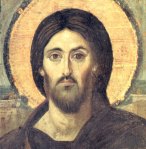
1) Jesus was a man. The way that we attempt to talk about his ‘divinity’ – or as I prefer – the way that he participated in the divine … is vital to any understanding of who and what Jesus (the man) was.
When we speak of ‘Christ’ we are speaking of the Logos or that aspect of Jesus which channeled, hosted, or was the Divine presence on Earth.

2) The two primary ways that thinkers approach this conundrum are classified as:

  • Christology from Below
  • Christology from Above

This is not to be confused with a ‘High Christology’ and a ‘Low Christology’.

‘From Below’ means that you begin with the baby in the manger and figure out in what way he embodied the divine presence of God. ‘From Above’ means that you begin in heaven with the pre-incarnate Christ and figure out how downsized/reduced/kenosis into the human form of a baby.

Technically you can start ‘from below’ and end up with a High Christology. It is just that there are a lot of steps one must undergo. That is for another time.


In this series I am using two resources. Here are the entries of each.

Christ, Christology. The Greek word translated in English as “Christ” is the equivalent of the Hebrew term Messiah and means “anointed one.” Although not intrinsic to its meaning, the NT use of the term Christ tends to point to the deity of Jesus. Christology is the theological study devoted to answering two main questions: Who is Jesus? (the question of his identity) and What is the nature and significance of what Jesus accomplished in the incarnation? (the question of his work).

Stanley J. Grenz;David Guretzki;Cherith Fee Nordling. Pocket Dictionary of Theological Terms (Kindle Locations 240-242). Kindle Edition.

Christology:  The branch of theology that deals with Christ. Traditionally, it has been concerned with two central issues: the person of Christ-who he is-and his work-how he saves us. (For the latter, Sec *Atonement; also *Soteriology.)

From very early times, Christians have puzzled over how to understand and to express who this Jesus is who means so much for them. In the New Testament, he is called Son of Man, Messiah, Lord, Word of God, True Shepherd, Lamb of God, for example. It is also clear that our earliest records of Christian worship place Jesus at its center. Early in the second century, pagan writer Pliny attests to this, saying that Christians gathered “to sing hymns to Christ as to God.”

Soon, however, what takes place in worship must also be expressed in theology and doctrine, and thus the question arises, Who is this Jesus? Is he divine? Is he human?

Some of the earliest answers were considered too simplistic, and were rejected by the church at large as denying an important aspect of the full truth. Thus, at one end of the spectrum there were those who believed that Jesus was a purely celestial being, an alien messenger from above who was human only in appearance. This view was called *Docetism, after a Greek word meaning “to seem.” It was held by many *gnostics as well as others. We see echoes of its rejection in 1 John 4:2, where the test of orthodoxy is the affirmation that Jesus “has come in the flesh.” The opposite extreme, often called *Ebionism, held that Jesus was a pure man, born like all men, whose purity was such that God gave him a special standing or role. This too was rejected by the church at large. Thus, from an early date it was clear that Christians wished to affirm that Jesus was both divine and human, but little thought seems to have been given to how to understand and to express this.

Very soon, partly on the basis of the Gospel of John, it became customary to declare that Jesus is the “Word of God made flesh-and it also became customary to refer to the Word as the Son. While this was helpful, it still left open a number of questions, particularly the question of how the Word, or Son, may be said to be divine. In the second century, Justin Martyr declared that the Word was a “second god”-an infelicitous expression that was soon abandoned. It was in the fourth century that this issue came to a head in ‘Arianism, and the process of refuting it and clarifying how the Word or Son is God led to the development and clarification of the doctrine of the ‘Trinity. Thus, by the second half of the fourth century, the general consensus was that Jesus is divine because he is the divine and eternal Word or Son of God made flesh.

It now remained to clarify how one is to speak of the relationship between that divine Word and the humanity of Jesus. Granted that Jesus, being God’s Word or Son, is fully divine, is he also fully human? How is one to conceive of the relationship between the divinity and the humanity in Jesus? On this subject, there were two theological tendencies that clashed repeatedly. One, the *Alexandrine, emphasized the unity of the divine and the human to such a point that it might seem that the humanity was dissolved or engulfed in the divinity. If need be, the Alexandrines were willing to deny some aspect of the humanity of Christ in order to affirm the union of the divine and the human in him. This led to positions such as *Apollinarianism, which denied that Jesus had a rational human *soul, and which was rejected by the Council of Constantinople in 381.

The opposite theological school, the *Antiochene, was concerned over safeguarding the full humanity of Jesus, sometimes at the expense of its full union with the divine. This was the position of *Nestorius, who declared that in Jesus there are two natures and two persons, and that the union of the two is one of will rather than of nature or of person. His position was rejected by the Council of Ephesus in 431. As part of that rejection, his Alexandrine adversaries underlined the importance of the *conrmunicatio idioniatum-the transferral of predicates from the human to the divine-in the person of Jesus Christ, so that whatever is said about him as human may also be said about him as divine.

In 451 the Council of Chalcedon finally arrived at the formula that eventually became generally accepted by most Christians, that in Christ there are “two natures in one person.” While this did not solve the issue, it was simply stating that one must affirm Christ’s full divinity, his full humanity, and the full union of the two.

Although most Christians eventually accepted the formula of Chalcedon, some rejected it. Those who followed the extreme Antiochene position, commonly known as *”Nestorians,” took refuge in Persia, and to this day there is a small church that traces its origins to that schism. Others, who followed the extreme Alexandrine position, became known as *Monophysites-that is, holding to the doctrine of a single nature in Jesus. This is still the position of the Coptic Church, the Church of Ethiopia, the Syrian Jacobite Church, and others.

Although the Council of Chalcedon is generally said to mark the end of these debates, the truth is that the controversy lasted for centuries, and that its fires were fanned repeatedly as various theologians -and sometimes emperors seeking political aims-suggested solutions or compromises that were found wanting by the rest of the church. (See also *Monergism; *Monotheletism; *Hypostasis; *Hypostatic Union; *Enhypostatic Union; *Dyophysism; *Dyotheletism.)

The Protestant Reformers in general accepted the christological formula of Chalcedon and the decisions of the early councils on these matters, but were more concerned over the saving work of Jesus than over the question of how he can be both divine and human and still only one person. Among the major Reformers, Calvin tended to emphasize the distinction between the divine and the human in Jesus, much as the Antiochenes had done earlier. Luther inclined in the opposite direction, emphasizing the union of the divine and human-although he differed radically from the ancient Alexandrines in that he emphasized the reality of the humanity of Jesus, and insisted that we can see the divinity of Jesus only as it is revealed in his humanity, his weakness, and his sufferings.

In more recent times, many theologians have sought to leave these debates aside by concentrating on the work of Christ rather than on the metaphysical issues surrounding his person. (See *Atonement.)

Justo L. González. Essential Theological Terms (Kindle Locations 953-988). Kindle Edition.


I hope that you can see both the difference in the 2 resources that I am drawing from AND the complexity of the issue being addressed.

At some point we will have to address the evolution from Jesus’ Religion to a Religion about Jesus … but that is later in the series.

I would love to hear your thoughts on this topic. 

Modern Christianity’s Temptation (2/3)

In light of the massive shifts in culture, understanding and expectation that the last 300 years has seen, there seem to be three great temptations for the devout.

Last post we talked about the problems that Modernity brought to Christianity’s doorstep in the West. Science had moved into the driver’s seat and was none too kind to those who would not get on board.

The problem, of course, is that we are simply not left the option to go back to primitive Christianity. For Lent this year I read books about post-Nuclear theology and listened to lectures on the first twelve centuries of Church history. It has never been more apparent that the world has changed in drastic ways.

  • Christendom
  • The Scientific Age
  • Globalization

Are just 3 catalysts and results of this epic (and epoch) shift.

Tomorrow I will present what I see as the amazing opportunity. Today I want to comment on what seem to be the 3 biggest temptations for modern Christianity:

  1. to concede
  2. to attack
  3. to retreat.


Concede

Faith as a public matter has never been more challenging. The easiest response is to both personalize ones faith and then make it private. This is a two-step dance but either is dangerous on its own.

Personalizing faith is a natural response for an Enlightenment Individual. We major in ‘self’. We have cultivated the ability to think in ‘me’. This is a novel development in religion and some argue that it is against the very nature of religion! The purpose of religion is to bind us together in practice (re-ligio) or reconnect us as a belief-community.

The second step is to internalize ones personal faith. In liberal democracy, no one cares if you believe something – just keep it to yourself. Don’t put it on someone else. Your personal practice in there or over there is one thing … just don’t make too big of a deal about out here. Out here we have a civil expectation of life, liberty and the pursuit of happiness. If your religion helps as a means to those ends, fine. If not, it might become an issue of you infringe on someone else right. Go ahead and practice your ‘tradition’ on your own time but just keep it down when you’re out here in public.

The modern expression of Christianity has responded to this two-step dance in many little ways – my favorite of which is consumeristic-accessorization. The bumper sticker on my interal-combustion automobile and the fashionable yet ironic message T that imitates a popular ad campaign are just two examples. It allows me to allude to a Bible verse (I am not of the world after all) while participating in a capitalist system that goes unquestioned.


Attack

To counter the personal-and-internal compromise noted above, an aggressive and external coup has been attempted. The memory of Christendom has fueled a political response to take back power and ‘return to our roots’. The rise of the Religious Right (and Moral Majority) of the past four decades is perhaps the most high-profile example. It is, however, just the latest incarnation of this impulse.Facade of St. Vitus Cathedral

The fond (and white-washed) memories of days gone by and yesteryear fuel an anger at what is seen as a disintegrating culture and a slouching toward Gomorrah. The resulting Culture Wars and political animosity have a fundamental problem however:

Ever since the Constantinian compromise in the 4th century is has been difficult (if not impossible) to get the Bible to say what one needs it to say in order to justify a claim to power.

A religion founded on the teaching of a marginalized prophet and incubated in persecuted minority communities does not lend itself to being in charge. An incredible amount of selective editing, creative hermeneutics and mental gymnastics are required to make it fit. At some point a voice like Yoder comes along and points out that ‘this is untenable’.


Retreat

The above two responses are both simpler and more obvious (and thus more popular) than our last response. The retreat is more subtle and sophisticated. I will return to Theology at the End of Modernity from the first post.

Those who seek to answer the questions raised by the work of Gordon Kaufman (primarily Sheila Greeve Davaney and Linell E. Cady) have deep concern about a school of thought that seeks to move the Christian tradition toward an “autonomous and protected location”.

A seductive temptation is found in an attempt to preserve former (historic) expressions of the faith behind linguistic fences (insulated language games) and communities that become isolated silos. These “are really retreats into forms of fideism or ‘protective strategies’ that seek ways of interpreting theological discourse so as to preserve its unique status.”

The Post-Liberal work of Lindbeck and the Radical Orthodoxy camp of Milbank and MacIntyre are in danger of this.[1]

Those who follow this line of reasoning:

“contend that theology is not properly about ascertaining indubitable truth claims about God or reality, nor about fathoming the depths of human subjectivity; rather, the task is to analyze and explicate the fundamental claims about reality and human life that have emerged within a specific tradition, so that believers might more fully appropriate and live out of their tradition’s vision of reality.”

It becomes a:

“self-enclosed historical community; its method is interpretive, not critical; and its goal is to aid in the internalization of central claim, not the critique or reconstruction of that which we have inherited.” p. 6

You can see the attraction of the retreat! By privileging “revelation” or the “given-ness” of the tradition, one is afforded the space to preserve and defend an inherited system which immune for outside critique and thus preserved in its ‘as is’ status.

This romantic preservation and reclamation mistakenly – and perhaps intentionally – defends and protects manifestations and consequences that we not only need to move on from but we to which we can not possible return to.


In part 3 we will conclude this series with a challenge to make the Christian faith “pluralistic, public, and critical”.


[1] “by emphasizing an ahistorical human subjectivity, (they seem) to find an autonomous sphere protected from the challenge of other forms of inquiry, then the cost of such independence was the removal of both theology and religion from the public sphere.” p.5

Create a free website or blog at WordPress.com.

Up ↑