Search

Bo Sanders: Public Theology

updating & innovating for today

Tag

kenosis

Jordan Peterson and the Past

I listened to a fascinating podcast yesterday where an older British intellectual (Philip Dodd) took Jordan Peterson to task on one subject after another. It was very argumentative and quite contentious – not to my irenic liking.

Jordan Peterson has risen to fame recently in a parallel way to “Make America Great Again” based on the same ‘things are out of control’ discomfort and backlash. This is a phenomenon that I am particularly intrigued by.

Peterson’s brand of ‘we have to get back to the preferable past’ reclamation project is the perfect blend of two things that I am very familiar with: The academic approach of Alasdair MacIntyre and the therapeutic manliness of John Eldredge’s “Wild at Heart” series.

Eldredge has a therapeutic approach to masculinity based loosely on Jungian archetypes (warrior, king, magician, lover) and thinkers like MacIntyre are trying reclaim Aristotle’s ancient Greek notions of virtue, ethics, and moral character.

When you combine “Wild at Heart” masculinity, with Aristotelian principles in ethics, and throw in a dash of ‘make culture great again’ … you get Jordan Peterson.

Peterson’s book is “12 Rules for Life: An Antidote to Chaos”. The first six rules are:

  1. Stand up straight with your shoulders back
  2. Treat yourself like someone you are responsible for helping
  3. Make friends with people who want the best for you
  4. Compare yourself to who you were yesterday, not to who someone else is today
  5. Do not let your children do anything that makes you dislike them
  6. Set your house in perfect order before you criticize the world

None of these rules seem intrinsically bad. Rule 1 is very ‘Wild at Heart’. Rule 6 is very MacIntyre.

Now I have written a lot about MacIntyre and the problems of Aristotelian reclamation projects. Susan Heckman[1] has convinced me that the solution is not simply to (re)claim/(re)cycle/(re)purpose ancient, antiquated, or Aristotelian concepts from the pre-modern world.

 “MacIntyre’s approach exemplifies a disturbing characteristic of much of the communitarian literature: the romanticization of premodern societies that ignores the oppression and hierarchy that was endemic to those societies. Even Sandel (1984), despite his modernist leanings, sometimes falls prey to the tendency to glorify traditional communities. The narrative selfhood that MacIntyre lauds can only be obtained at a high price: the ascription of traditional roles.”

She explains:

“When it comes to the highly charged issue of the sexism and racism of the traditions he praises so highly, MacIntyre seems to abandon his interrelationship thesis. With regard to the Aristotelian tradition, he tries to deny the claim that sexism and racism are an integral part of this system of virtues.

… throughout his writings MacIntyre unambiguously asserts it is this traditional community we must foster if we are to return to any semblance of a moral life:

“What matters at this stage are the construction of local forms of community within which civility and the intellectual and moral life can be sustained through the new dark ages which are already upon us (1984).”

To thinkers like MacIntyre and Hauerwas and Peterson, we are descending further into an age of darkness.[2] Their answer is to (re)claim or (re)turn to some former understanding or expression of virtue and order. Hekman is right though – we cannot even attempt to do so without acknowledging and addressing the inherent racism, sexism, and disparity built into every level of the structures from which those romantic notions come.

This is the problem with Jordan Peterson’s notion of the past.


Three thoughts that I want to leave you with:

Don’t read Peterson – it is too predictable. Read instead Teaching Community by bell hooks and Church In The Round by Letty Russel if you want to understand and do something in our historical moment.


The future is going to be slightly like the past but largely unlike it. The world is really changing in some ways and this cultural shift requires not just a new mental framework (thus my interest in ‘social imaginaries’) but a new skill-set. In a land based culture, farmers develop a certain set of skills. As we move to a more liquid and fluid culture, sailors need to develop a different set of skills and knowledges. Both require strength and intelligence … but they are very different.


Peterson came to prominence for contesting Canada’s language directives to use gender-neutral pronouns for trans people. Now, leaving out the argument about the government telling us how to talk (a whole other subject) I just want to say that using ‘they’ instead of ‘he’ or ‘she’ is not that difficult and doesn’t take anything away from your masculinity.

It is a really easy change to make once you realize that language (and especially English) is always adapting and evolving anyway. Referring to people by their preferred pronoun is a gracious thing to do (Peterson claims to be a Christian and bases much of his thought on Hebrew Bible stories) and it models Christlikeness through Kenosis (self-emptying) as seen in Philippians 2.


[1] Hekman, Susan. “The Embodiment of the Subject: Feminism and the Communitarian Critique of Liberalism.” The Journal of Politics 54, no. 04 (November 1992): 1098–1119.

[2] In the consumer society of the 21st century, it is not enough to want to ‘get back’ to a former era of romanticized notions which utilize previous formulations of order and social coherence. We must follow Jesus’ example of interrogating the ‘as is’ structure of our given systems. Jesus employed tactics which subverted the assumed nature of the status quo to inspire people’s imagination about the way that things can be. The way that things are is not the way that God wants them. Things can be different. The gospel calls us to imagine that the world can be a different way. This is good news (evangelion) in the original sense.
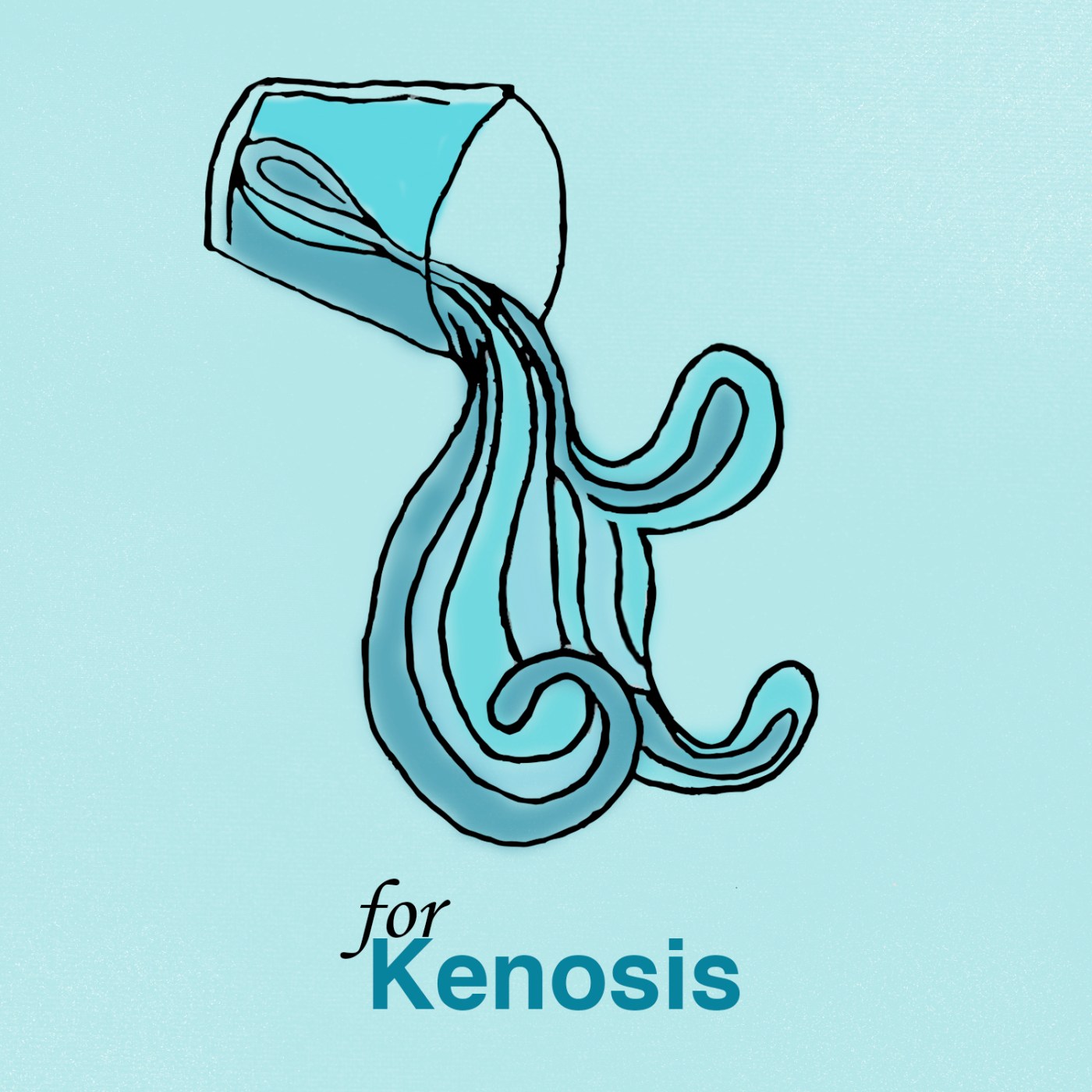
 

K is for Kenosis (and the Kingdom)

Kenosis is one of those Greek words in the New Testament that I wish went untranslated in English. It is a special and mysterious word that would be great just left as it was and put in italics by Bible translators.

I have a list of words that I wish remained in Greek. Words like agape, kiononia, kairos, and ecclesia. They are just great words that would carry some power/mystery if we did not offer an English translation.

I am a big fan of translating the Bible – in fact I think that the translatability of the christian scriptures is a major distinction from other religious traditions like Islam. We don’t have to learn the original language in order to read and interpret the Bible.

Lamin Sanneh in Whose Religion Is Christianity: the Gospel Beyond the West, says:

Being that the original scripture of the Christian movement, the New Testament Gospels are translated versions of the message of Jesus, and that means Christianity is a translated religion without a revealed language. The issue is not whether Christians translated their scriptures well or willingly, but that without translation there would be no Christianity or Christians. Translation is the church’s birthmark as well as its missionary benchmark: the church would be unrecognizable or unsustainable without it…  Since Jesus did not write or dictate the Gospels, his followers had little choice but to adopt a translated form of his message. (Sanneh p. 97)

You can read an older post about this issue here.

So while I love this translatability aspect of the christian testament, I also mourn for the loss of deep and mysterious words from the original language.K-Kenosis

Kenosis appears four times in the New Testament. Three times in is translated ‘made void’ or ‘to no effect’. The most famous appearance is in Philippians 2:7 when it talks about Christ Jesus and is translated ‘emptied himself’.
The self-emptying of God had become a big topic in the 18th and 19th century – then expanded in the theological work after the Second World War. Most people that I talk to are familiar with this concept in the work of thinkers like Motlmann and his ‘Crucified God’.

Our Pocket Dictionary defines it as:

Kenosis, kenoticism: Derived from the use of the Greek verb ekenosen (he emptied himself) in Philippians 2:7-11. Kenosis refers to the self-emptying of Christ in the incarnation, as well as his conscious acceptance of obedience to the divine will that led him to death by crucifixion. Many theologians see in the term a reference to Jesus’ choice not to exercise the prerogatives and powers that were his by virtue of his divine nature. In the nineteenth century certain thinkers built this idea into a kenotic *Christology,which spoke of the incarnation as the self-emptying of the preexistent, eternal Son to become the human Jesus. This self-emptying involved the setting aside of certain divine attributes, or at least the independent exercise of his divine powers.

Pocket Dictionary of Theological Terms (Kindle Locations 773-777). Kindle Edition.

While the concept is beautiful … it also gets really tricky really fast.
What exactly did he empty himself of? You have to be careful because almost any answer is either:

  1. a historical heresy
  2. based on a presupposition that he had that attribute in the first place

Most people go for the low hanging fruit of ‘3 omnis’ (as I call them) of omnipotence, omnipresence and omniscience. Obviously Jesus could not have been those 3 things and been human.
But once you start down this road you quickly run into your first barrier: if Jesus was lacking something that God has … how exactly was he still God? BUT if he had something that no other human had … then he wasn’t really all that like us and thus his being tempted or performing miracles is not really something that we can exactly imitate…

Many times this leads to a ‘Clark Kent’ version of Jesus where he wore a flesh suit and appeared to be human but underneath was a superman who could have done anything he wanted … it’s just that he chose not to!
This is part of why there is no end to the work of christology. Depending on your ontology (view of reality), metaphysics (beyond the physical), your view of the Trinity and your anthropology (view of humanity) … the danger of getting tied in knots is constricting.

What starts out as a beautiful word – Kenosis – hides a dangerous concept that can quickly become theological quicksand.

This is the opposite of a different ‘K’ word: kingdom.

What is often translated ‘the Kingdom of God’ in English is another phrase that I wish went untranslated: Basileia tou Theou.

From the age of Ceasars to the reign of Kings it made sense to translate it this way. It no longer does.
Not only does ‘kingdom’ not capture the nuance and possibility of expectation in Basileia tou Theou. It can actually be misleading because people think they know what a Kingdom is and are just waiting for God to take off this Clark Kent costume and take up the rightful claim to the throne!!

There are so many better translations of Basileia tou Theou. I have heard :

  • Kin-dom of God (family)
  • Reign of God (still too royal for me)
  • Common-wealth of God (my favorite)
  • Community of God (no hierarchy assumed)

I wish that we just left it untranslated as Basileia tou Theou.

You can see in these two ‘K’ words that translation is a tricky business and provides a constant supply of new material for the theological endeavor.

This is the best that God can do

It is fascinating what happens to conversations when you take away one word.  Words are like little suitcases – people put understandings or concepts in them and then carry them around as self contained units. Its so easy! They come with these convenient little handles and you can you pack so much meaning in and mean so much when you just use one little word.

This can be especially dangerous in theological conversations. That one word can take paragraphs and pages to unpack. Sometimes it can be a very liberating experience to take a word off the table. Just say ‘if you can’t use that word, how would you talk about this?’ It is an amazing exercise.

 A few weeks ago I had fun asking the question “what if you can’t use the word ‘demon’ – how would you talk about these same things?”  I am suspicious that we who read the Gospels and New Testament don’t mean the same thing when we say ‘demon’ or ‘devil’ as those in 1st century region of the Mediterranean did. 

 So it was with great interest that I had an amazing conversation this past weekend with a group of very intelligent, but non-theological folks. We were talking about God and the subject of evil came up. What was fascinating is that I did not place restrictions on the conversation, it happened organically – they just don’t use the usual words! Never once did I hear

  • Theodicy
  • Omnipotent
  • Kenosis

I started thinking “what if we had this conversation without those three words?” They are great words, and that is part of the problem! People assume that they know what is packed into the words and so they throw them around with ease (they come with convenient handles after all).

Here was my opening statement that sparked the debate:

God is doing all that God can do right now in the world. What you are looking at is the best that God can do. God is not holding back. God is doing God’s best to make the world a better place that more conforms to the divine will.

You can understand why that set off sparks. The questions, comments, and concerns started flowing.  Is God more powerful than God lets on? Has God restricted Godself? Has God willingly emptied Godself of some of God’s power?  Can God pick up that power anytime God will and God is just choosing not to? 

 There are specifically 3 groups that have shaped my thinking on this: 

  1. The Kenotic CrowdMultmaniacs mostly, but more generally people who think that God is who we have always said God to be but that some ‘emptying’ (see Philippians 2) or self-limitation has happened. God is ‘all powerful’ or ‘all mighty’ but has just chosen to act this way (free-will, etc.)
  2. The Process Perspective – Between Marjorie Suchocki, John Cobb, Catherine Keller, and Philip Clayton they have this thing covered. I thank God for Process as a conversation partner.
  3. The Caputo Contingent – with his book ‘The Weakness of God’ John Caputo shook some of us to our core and rocked our ‘foundation’.  What if God’s strength was shown in weakness?

 I have become very comfortable with the possibility that world as it exists is the best that God can do. I’m not saying that I believe that – just that I am open to that possibility.

What if God is doing all that God can do in the world right now?

What if God isn’t all-powerful but only very powerful?

Or that God’s power is a different kind of power?

What if God isn’t pretending or self-limiting?

What if God is giving all that God has to the moment?

So we don’t have to ask ‘why isn’t God stopping the genocide in Africa’. God can’t. It’s just not how it works. God is doing what God can but we are not cooperating.

Now, some will say “No, God could do more but has chosen to limit God’s self” or “God has emptied some of God’s power and given it to us as co-creators and free agents – we are misusing our power. It’s not on God.”

 I just want to throw out the question “What if this is the best that God can do?” I am comfortable with that.  

Looking forward to your thoughts!  All I ask is that you try not to use ‘theodicy’, ‘kenosis’, or ‘omnipotent’ without unpacking them.  

Blog at WordPress.com.

Up ↑