Search

Bo Sanders: Public Theology

updating & innovating for today

Tag

liberal

Why We Love

This is probably the most daring sermon I have tried.  Enjoy the video – my sermon notes are below.

We live in a very strange time. The old Chinese proverb” may you live in interesting times” was a curse originally and many of us feel like we live under that curse.

It is an interesting time of reversal. For instance, just a couple months ago grocery stores all over the country banned plastic bags and wanted you to bring your own reusable cloth bags. As with anything in modern consumerism, this became a form of both utility but also virtue signaling. It caught my attention in March when grocery stores no longer allowed reusable bags. This is an interesting reversal.

We are seeing so many reversals! From which workers are considered essential to our definition or restriction of who is in our inner circle.

Even love is being reevaluated. It is a unique type of love that says I care enough about you and your wellness that I will distance myself from you. Strange times indeed.

I thought it would be good for us to continue on our journey as Easter people with looking at hope two weeks ago, face last week, and love this week. This triad of terms comes to us from the famous wedding passage in 1 Corinthians 13:13 that says “faith, hope, and love but the greatest of these is love.”

In the Greek language that the New Testament in our Bible is written in, there are several vocabulary words that all gets translated into English as love. Agape, eros, philia, storge, mania, pragma and ludos are examples. They cover a wide array and variety of loves.

We live in a time where some in our society have felt emboldened with what can be viewed as un-love. This manifests in animosity, racism, and anti-immigrant sentiment. It is a sad development in what many of us had previously viewed as a time of progress and open-mindedness for acceptance and openness towards differences. (Some of our cultural opponents may, view this as permissiveness, pandering, political correctness and moral weakness.)

In contrast to that progressive churches like ours have become advocates for tolerance and justice issues. We view this as a type of love for the other.

I want to take this opportunity, as long as we are reevaluating things during this difficult time, to say that our notion of love for the other maybe flawed in a really dangerous way.

A common sentiment I hear from caring liberal kinds is the notion that “they are just like us except…”.

  • They are just like us except they were born in a different country.
  • They are just like us except that they have different skin color.
  • They are just like us except that they are attracted to people of a different sex.

This seems kind and caring on the surface, but there is a concerning misunderstanding underneath this seemingly open and accepting ideology.

We need to be careful that we don’t love other people because they are like us.

Do you see the danger? When we love people because we imagine that they are just like us except… this is certainly better than our opponent’s un-love (hatred) but as followers of Christ I want to be clear: that is not exactly love.

Love for others because they are like us concerns me because what if it turns out that they are not actually like us? Will we still love them despite the difference?

What if they value very different thing? What is they view the world very differently than we do? What is their goals and teams deliver them to a different destination then we had hoped for, what is they have different priorities or spend their money differently or raising children differently or have different sexual appetites?

Do we only love them because we are imagining that deep down inside they are exactly like us?

That is quite a dangerous fiction and ban become a very disappointing fantasy.

This is why as Christians we need to be careful and clear about who we love and why we love them.

1 John 4 says Dear friends, let us love one another, for love comes from God. Everyone who loves has been born of God and knows God. Whoever does not love does not know God, because God is love. This is how God showed his love among us: He sent his one and only Son into the world that we might live through him. 10 This is love: not that we loved God, but that he loved us and sent his Son as an atoning sacrifice for our sins. 11 Dear friends, since God so loved us, we also ought to love one another. 12 No one has ever seen God; but if we love one another, God lives in us and his love is made complete in us.”

You see it clearly here: God does not love us because we were like God–but for the very opposite reason! Because we were far from God, we were not like God, we did not prioritize what God did or value the things that God values.

This is love. Not because of similarity but exactly and precisely because of difference.

There is a sentiment in our culture that says, ‘an enemy is just somebody whose story you haven’t heard yet.’ As if to say that if you knew what made them tick or what they have been through in the past that they would no longer be your enemy.

Do you see the flaw here? As my favorite philosopher Slavoj Žižek points out that the problem with Hitler is not  that we didn’t know his story. Knowing someone’s story does not make them any less your enemy.

This is why Jesus calls us not only love our neighbor as ourselves, something that liberals pride themselves on, but Jesus calls us to love our enemy and pray for those who persecute us.

Enemy love is not based in similarity but indifference. This is where I like to quote GK Chesterton who said,

“It’s not that the gospel has been tried and found difficult, it’s that it has been found difficult and left untried.”

Now in contrast to the un-love of anti-immigration sentiment, anti-gay rhetoric and the legacy of racism in our country… we may view our liberal and open-minded acceptance and tolerance as a form of love. And it is a kind of love. But I want to be clear that it is not Christian love.

Christian love is not rooted in similarity because deep down somebody is just like us. The spirit of Christ calls us – no, compels us – and empowers us to love across difference and even to love those with whom we disagree. It calls us to love our enemy.

If we love people because they are like us we have done Little more than the average republican. Everyone loves people who are like themselves. Even lawyers do that. Sex-workers do that. Elementary school teachers do that. Nurses do that. Everyone does that.

No, what we are called to is a greater love. Not because deep down somebody is like us but in spite of the fact that they’re very different from us.

This is the love of God that we are called to. This is the higher calling and as long as we are in this time of global pause before we come out of social distancing and stay at home restrictions it is a great time for us to reflect and adjust our trajectory for how we want to emerge out of it this time. Let us be people of real love across difference in spite of disagreement even to those who may despise us into work against our values, undermine our convictions, and even those who seek to destroy the things we hold dear.

As progressive types and liberals, we may be disappointed in the ways of the world is going… but that is exactly why love is so deeply needed in our time.


Christian Politics

Normally I am allergic to modifiers. I find them deeply suspicious.

Why reference someone as female comedian or author? You don’t call Stephen King a male author or Jerry Seinfeld a male comedian.

Randy Woodley is often referenced as a Native American theologian. That is fine… but why am I not introduced as a white theologian?

The worst is ‘biblical’. Every time I hear it used I think to myself, “this is probably going to be inaccurate and untrue”.

People talk about biblical marriage but that is an imaginary. There are between 9-15 types of marriage in the Bible. It is the same with a ‘biblical’ worldview. There are 6 different worldviews in the Hebrew and Christian testaments. People want to say that scripture speaks with one voice … but have you read it ? I wish it did!!  It just doesn’t.

All of that is to say that I DO have one modifier that I find helpful: Christian.   Not like christian bookstores, or christian radio stations, or christian colleges.

I find the modifier ‘christian’ helpful when it comes to politics and the underlying motivation behind them.

Watch the short video and let me know what you think.

Believe Different Things Differently

A short video (5 min) about how  progressives and liberals not only believe different things than conservatives and evangelicals … but they believe them differently.

From Missions to Eschatology -they both believe different things and they hold those beliefs differently.

Let me know your thoughts.

How Good Was Friday? part 1

It is almost Easter – my most conflicted time of year as a pastor.
I am smitten with the empty grave and with Pentecost. In fact, I am equally as excited about the Easter imagery as I am horrified by North American protestant’s fascination with the cross.
Initially this was a gut reaction. Then I went looking for resources I found these two books : Saved From Sacrifice by Mark Heim , The Non-Violent Atonement by Michael Hardin.
Two things seem to provide the ditch on either side of the road:
1 – Our most well attended services with the most visitors are our bloodiest in imagery.
2 – H. Richard Niebuhr’s  famous jab at ‘liberal’ christianity:
“A God without wrath brought men without sin into a kingdom without
judgment through the ministrations of a Christ without a cross.”
This quote has bite for 3 reasons:
1) It is so true. My migration from a charismatic/evangelical context to a more mainline one revealed to me just how many people would be covered by Niehbuhr’s concern. If your don’t hang out with mainline liberal folks, you might not realize how pervasive this allergy to blood is.
2) We live in a sanitized and sterilized culture (to paraphrase Cornell West) where most people have no connection to the meat on their table. They pick it up at the grocery store in plastic wrapped styrofoam containers. Only a small percentage of the population are farmers or hunters.
Meanwhile, we live in a horrifically violent culture (both domestic and military) but so few of us are familiar with blood. We outsource our violence.
This is why a penal substitutionary view of the cross is so attractive /acceptable for so many. The vicarious nature of god pouring out ‘his’ wrath on Jesus results in a pornographic delight that can be seen in depictions like that famous scene in our movies [The Passion] and in many of our contemporary worship songs.
3) That Niehbuhr quote is thrown around too easily whenever someone wants to reexamine or revisit underlying assumptions about how we understand Easter.
Let me be clear about what I am saying and what I am not saying:
  • I am not saying that there was no cross and that there was no blood. I get both, I accept both and I proclaim both.
  • I am saying that something perverse has seeped into our understanding and our imagery.
  • What happened on that cross was real.
  • What happened on that cross mattered.
  • What happened on that cross was unjust.
  • What happened on that cross changed humanity’s relationship to God.

My concern is that we have misunderstood both how it changed and why it changed.
Let me wrap up with a constructive proposal.


When Jesus takes the bread and cup and forever changes their meaning he is saying “what they will do to me – don’t you, as my followers, do to anyone else”.

When Jesus says “forgive them, they know not what they do”, he is saying that they think they know what (and why) they are doing, but they are wrong.

When Jesus says “it is finished”, he is proclaiming the end of this type of scapegoating and violence by those who think they are doing it on God’s behalf.

2 Corinthians 5:18-21, “All this is from God, who reconciled us to himself through Christ and gave us the ministry of reconciliation: that God was reconciling the world to himself in Christ, not counting people’s sins against them. And he has committed to us the message of reconciliation. We are therefore Christ’s ambassadors, as though God were making his appeal through us. We implore you on Christ’s behalf: Be reconciled to God. [The one] who had no sin [was made] to be sin, so that in him we might become the righteousness of God.”
We are to be about peace. We are to be a people of reconciliation. In Christ, God absorbed the hatred and violence of the world. The one who knew no sin – an innocent man – was proclaimed guilty and God responds by proclaiming that we who are guilty of doing that are now innocent and our sins are forgiven.
This is the good news of gospel! This is the hope for human-kind. No one needs to be sacrificed any more. No one needs to die because God is angry – Christ’s unjust death is to be the last. In the empty grave we see the vindication of the victim. God took humanity’s wrong judgement of Jesus and now judges us right with God. We who are guilty are proclaimed innocent because the innocent one was found guilty.
Easter is the great reversal and the vindication of the victimized. It is finished. We can’t afford to keep missing this and repeating the mistake. We who follow Jesus must be about peace and reconciliation. Too many have been scapegoated, placed on crosses and victimized by violence … in Jesus’ name.
God forgive us – we know not what we are doing.
Let it be finished.
In Jesus’ name.
You can read part 2, part 3, and part 4 in this series.

Continue reading “How Good Was Friday? part 1”

Evangelical and Liberal

I have stumbled into the most fascinating conversation.

Background: I work at an evangelical institution. I recently worked at a liberal mainline church while attending a liberal mainline school. I was raised evangelical and am ordained as an evangelical. It was interesting being in a mainline context for 7 years and it is equally as interesting to return to an evangelical context now.

I was talking about this with a colleague two weeks ago because a group that I am a part of is planning to simply its name but it will no longer contain with word ‘evangelical’. This decision was made before the recent US election in which 81% of white evangelicals voted for Trump. The group is afraid that this decision will now appear to be a reactive move.

I find three unspoken things going on in this discussion. Unspoken things are concerning because the assumed is unexamined and is often a source of operative power at a secondary register which hides behind the primary concerns.

Here are my 3 concerns:

  • ‘Evangelical’ has become a floating or migrating signifier. It does not mean what it used to mean and most people who use the term cannot tell you what it means. (Personally, I use an expanded version of Bebbington’s fourfold definition.)
  • The dominant boogeyman for evangelicals is being ‘liberal’ – another term which most cannot define, which has caused it to become a code-word and a boundary-marker. Liberal, to evangelicals, seems to be a place-holder and a sort of dog-whistle for being open and accepting. Using the label this way has resulted in the word operating as a master signifier.
  • Evangelicalism in the Pacific NW (where I recently returned to) is a unique type of evangelicalism which is highly visible and influential but which functions on a narrative whereby they are a minority who get the short end of the stick socially, politically, and culturally.

I find this stuff fascinating. As someone who has lived all over N. America, who has evangelical cred (I went to the Billy Graham school of evangelism for crying out loud), who has worked and studied with liberal mainline folks, and who is a committed social constructivist … I feel like I am in the vortex of a cultural and historic moment. I have friends in both camps and am comfortable in both conversations, but this is an eye-opening moment for both.


I was doing some research last week on a different issue and stumbled into a conversation from 2008 that is growing increasingly relevant. It centers around the work of University of Washington professor James K. Wellman in “Evangelical vs. Liberal: The Clash of Christian Cultures in the Pacific Northwest”.

A review in the Seattle Times by Bob Simmons starts this way:

“The “evangelicals” of James K. Wellman Jr.’s new book know there’s only one way to God, and it’s their way. The “liberals” know there’s more than one way and are still questioning theirs. By numerical and other earthly measures, the evangelicals are winning big in the Pacific Northwest. The only question is your definition of winning.”

The research is amazing. It shows that evangelical churches are larger by a 10-1 margin and are growing at an incredible rate. However … they often feel marginalized politically, oppressed culturally, and even victimized by public policy.

This is exactly what I had been telling my colleague! I have never lived in a place that felt more christian-y with so many Christian radio stations, Christian book stores, and large churches surrounded by asphalt lakes/moats (which I call a island/castle mentality) … all the while feeling that they are losing the culture war!

It is sad because the evangelicals are doing a tremendous job in so many ways. They really should be enjoying this kind of success. As Wellman writes:

“Evangelicals have an ideology that is centered on growth, and is in relation to the self, to God, to the family, the church, and the mission of the religion. Evangelicals have accommodated styles of group work that appeal to northwesterners because they activate a sense of belonging and moral accountability.”

A different article points out that, “while liberals sermonize about the importance of building a religious community, the evangelicals are living out community”, supporting financially, relationally, and spiritually.

What I am finding in these conversations has been complex and multi-layered. It turns out that when liberals talk about evangelicals, they are often commenting on two aspects: worship style (happy clappy) and politics (by which they mean women in ministry and LGBT support). Evangelicals in a similar way, use the moniker ‘liberal’ as a kind of a double-code. The first layer is supporting/accepting the LGBT community – and here is where it gets tricky – which is actually a metonym for “biblical authority”. In this sense, neither group is exactly representing the focus of the other group accurately.

I have so many thoughts that I am sure that this will be an ongoing theme for me in 2017.

One final note – you may be aware that I have developed an interpretive scheme for a potential book on the church that looks at how N. American churches relate to the ‘system’ or the ways things are. Churches fall into 3 primary categories: Prophetic, Therapeutic, or Messianic.

  • Prophetic churches critique the ‘as is’ structures to confront the system. Prophetic churches look toward the marginalized and those being run over by the machine.
  • Therapeutic churches help folks exist within the system. ‘Chaplains to the Empire’ as we say. Therapeutic churches work within the ‘ways things are’ to help make you a better version of yourself.
  • Messianic churches focus on helping one survive until God delivers us from the system. This can be rapture, evacuation, eschatological, etc.  Messianic churches often have animosity toward culture’s slippery slope ‘slouch toward Gomorrah’ and view change as resistance. Anything else is just ‘rearranging deck chairs on the Titanic’.

I reference that quickly (there is a whole book chapter that fleshes it out) in order to say that I found an amazing quote in another review.

For liberals and evangelicals, Jesus is the central focus, “but in the case of liberals, Jesus is the focus that offers compassion and hospitality to the world; in the case of evangelicals, Jesus is a source that saves them from the world by creating a new one to come” (p. 268).

I would love to hear your thoughts, concerns, or questions.

Apple Updates & the Church

I have been thinking about the church and technology a lot lately. Part of it comes from planning to update a sanctuary constructed in 1951. Some of it has to do with recruiting a team to handle all the tech stuff at ‘church plant’. A bit of it came from the odd analogy that was used repeatedly about the ‘glitches’ related to the initial launch of the Affordable Health Care Act website and all of the sigh-up problems. People, including the President, said “yeah but even Apple has glitches when it first launches a product”.

An inexact comparison to be sure.

One of the questions that we are asking at the Loft LA, as we enter into our second year, is:

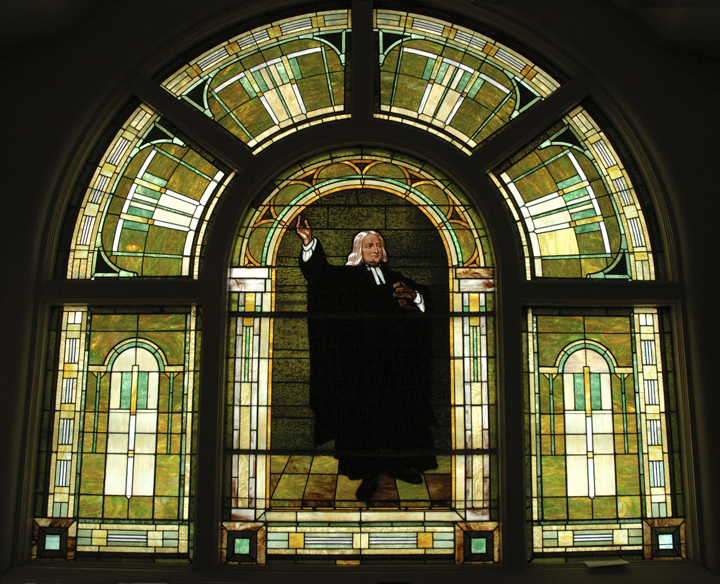
“What does it mean to use the Ancient-Future model of church in West LA?”17-85-BE3-134-08.0006-John Wesley

We come out of a United Methodist Church – which is a classic and beautiful expression of the Mainline tradition of Protestant Christianity.  The Loft is attempting to reclaim and hold onto the best of that inherited tradition … while at the same time engaging the culture around us in way that is contemporary and appropriate.
I’ll confess. It is a tricky section of water to navigate.

To use my favorite bowling analogy, there are gutters on each side that you want to avoid.
On the one side, you have a temptation to cater to the culture and concede so much of the Christian tradition that you have basically assimilated to the surrounding culture that you are nearly indistinguishable from it! This can happen in patterns of consumption, political views, sexuality, financial matters, or any other number of areas.

On the other side, you have the assumption that the inherited tradition, the given forms, are inherently relevant and effective in every place and in ever time since they were divinely delivered and historically proven. What this impulse to conserve leads to is reification of some previous era or expression of church that was culturally appropriate by which has since expired in its effectiveness in doing so. For a group whose gospel is, at its core, about incarnation … this is unacceptable.

This is why we think that the ‘Ancient-Future model’ of church is the best way forward for a young community.
Here is a short video about my recent experience with an old Apple TV that was given to me and why it triggered some thoughts about christian community for me.

Apple Updates and the Church from Bo Sanders on Vimeo.

In technology, when you fall enough behind on your updates, you can actually trap yourself with the inability to update. This is the definition of irrelevant. The christian spirituality that is employed in much of the North American church may be in this kind of danger. I am nervous that we are looking to get resources (updates) from sources (servers) that don’t exist anymore.

We are looking for solutions in things that don’t exist anymore.

The danger, for a religion that is at its core incarnation, is that the inability to be conversant with the surrounding culture in the epitome of irrelevance.

__________

Ancient-Future is a model that was popularized by Robert Webber before he changed his emphasis, focus and tone at the end of his life. His books on Faith, Worship, Evangelism and Time are supremely helpful and informative. 

My quoting him does not imply a wholesale endorsement of all of his works or thoughts. 

When Good Is Not Enough (3/3)

This week I have been writing a little about my interest in Practical Theology (PT) and  the subsequent philosophical orientation with which I will be engaging research: social constructivism. 

I had some very heady (and public) conversations with colleagues this Summer who desperately wanted to paint me as a ‘Liberal’ who is afraid of my own shadow (afraid to admit it/come out of the theological closet, etc.)

My assertion was that, as a social constructivist, I am more in a agreement with communitarian concerns than I am with liberal loyalties. Communitarians have a very harsh critique of liberalism where it:

considers classical liberalism to be ontologically and epistemologically incoherent, and opposes it on those grounds. Unlike classical liberalism, which construes communities as originating from the voluntary acts of pre-community individuals, it emphasizes the role of the community in defining and shaping individuals.

While I clearly hold some positions that overlap with liberal stances, and while I do presently serve at a classically Mainline church that exists within the liberal tradition of church expressions … I do not do so as a liberal. I grew evangelical, went very charismatic and then emerged into whatever kind of deconstructed christianity this is.

I jokingly said that I don’t identify as a liberal for the same reason that I don’t wear a medium-size Tshirt. It doesn’t fit and doesn’t cover some things I find important (ie. my belly).Facade of St. Vitus Cathedral

The problem with being progressive:

I have flirted with the idea of just being a progressive even while I bristle at the notion of societal evolution, inevitable progress or the consequences of a colonial notion of ‘civilization’.

I realize that some liberals have engaged in post-colonial, feminist or liberation approaches – so that those concerns are not mutually exclusive.

So what do I mean when I say that Liberal doesn’t go far enough?

 Take post-colonial concerns

Classic liberalism has had two responses to the colonial problem. I will call them:

assimilation and reservations.

They can either come to us, act like us, learn to think like us, speak like us and live among us … or they can go over there and do their own thing without bothering us.

In fact, is it self-congratulatory either way. If indigenous folks assimilate we feel validated as open and accepting – even multi-cultural or diverse! If we ‘give them their own space’ we pat ourselves on the back for being understanding and accepting of other cultures. Let’s be honest – at least it isn’t conquest and genocide after all.

Neither one of those approaches is satisfactory. The first is unacceptable because it still presumes the hegemonic power of the dominant culture and it is looking at the indigenous community as something that needs to be absorbed, adapted or modified. The second is unacceptable because it sees the two cultures as incommensurable without realizing the power differential to  conquest.

I am not looking for a nicer, more gentle version of colonialism or empire. As a researcher-advocate, I want to hear the voice and experience of impacted communities in their own words. If that leads to an opportunity for partnership, great. If not, I have to accept that I am not in control of the outcome nor am I referee to make sure that people play by my rules. In the post-colonial context, indigenous peoples are not to be adopted & adapted … nor are they to be ‘left to their own devices’. Neither of these approaches is acceptable.

Something else is needed. Practical Theology and its qualitative methods provide me a starting point to engaging in a different way – one that addresses larger issues of systemic and institutional concerns, one that hears the voice of the communities most affected, and one that provides the possibility of change in the real lived experiences of those involved.

Let me give you an example. James Cone writes near the end of ‘The Cross and The Lynching Tree’:

White theologians in the past century have written thousands of books about Jesus’ cross without remarking on the analogy between the crucifixion of Jesus and the lynching of black people. One must suppose that in order to feel comfortable in the Christian faith, whites needed theologians to interpret the gospel in a way that would not require them to acknowledge white supremacy as America’s greatest sin. 

Then Cone comments on perhaps the quintessential evolving- liberal theologian that America has ever had:

Reinhold Niebuhr could write and preach about the cross with profound theological imagination and say nothing of how the violence of white supremacy invalidated the faith of white churches. It takes a lot of theological blindness to do that, especially since the vigilantes were white Christians who claimed to worship the Jew lynched in Jerusalem.

I hope that these past three posts have helped to clarify why Practical Theology holds possibilities for me as a discipline and why I have chosen a social constructivist orientation within the research.

Thank you to everyone who has taken the time to read these 3 posts and to give me such high quality feedback and/or affirmation.

That Liberal Label

It has been a while since I posted here and part of the reason for that is that I have embroiled in a bit of a kerfuffle. I didn’t go looking for it but it came and found me. Anyway, here is a part of my response to all of the hullabaloo.
Once is an incident. Twice is a trend. Three times is a pattern.

This the now the 3rd time this thing idea about shying away from the label ‘liberal’ has come up.

  1. I heard it for the first time almost 10 years ago: “Emergents are just cool liberals”. This came from conservative, evangelical and reformed folks who were squawking at the Blue Parakeets that were new to the yard.
  2. More recently Fitch & Holsclaw leveled the accusation in their new book Prodigal Christianity and Tony Jones took exception.
  3. Then last week the idea was suggested on a different blog that Tripp & I were really just closet liberals who where afraid of the label because of its intrinsic baggage.

I tend to bury my big point in the final quarter of every blog post. For the purpose of clarity I am going to begin putting them at the top of the post. Here is my main point:

There is nothing wrong with being liberal. It is one of many valid ways to participate in the christian tradition. If I were liberal I would be so proudly. I am not liberal. Liberal approaches do not go far enough to combat capitalism, address colonial consequences or repent of the Constantinian compromise that led to Christendom it’s subsequent horrors.

I am not liberal. While Tripp and I are left-leaning. We are progressive. We are postmodern in our approach. We are emergent in our expression. We are playfully heretical (in a good way) and we are innovative where appropriate given our christo-centric hyperTheism.

But I am not liberal. Liberalism doesn’t go far enough in addressing five of my biggest concerns:

  • Critique of Capitalism and Consumerism
  • Post-Colonial consequences
  • Continental Philosophy’s reflection on late modern thought
  • Criticism of Christendom (Western and Constantinian)
  • Our cultures’ dangerous cocktail of Nationalism and Militarism

I have written extensively about how Progressive is not Liberal and even got taken to task over at Scot McKnight’s blog for trying to make that distinction. I will say this again:

There is nothing wrong with being liberal. It is one of many valid ways to participate in the christian tradition.

If I were liberal I would be so proudly. But alas I am not.

One last thing in closing:  I understand the historic drift of the term ‘Liberal’. I know what it meant in the 1700’s (specifically as it relates to individualistic epistemology) and I understand what it has become in the late 20th century (a constellation of loyalties and identity markers). I also know about it’s demise as an impotent political approach and I get why some evangelicals are allergic to the term and thus why some would desire to shy away from it. I get all that. I even recognize the unique draw of its individualistic epistemology. 000_0008

What I am saying is that calling me a closet liberal who is afraid to be identified by the label is like saying that I don’t wear ‘medium’ sized T-shirts because I don’t like the letter M. It is to miss the point. I don’t wear medium sized T-shirts because they are not big enough and don’t cover some essential areas that I deeply care about.

i.e.  It just doesn’t fit.


Liberal Question part 2: Jesus Creed

I had the honor of guest blogging for Scot McKnight a couple of weeks ago. It was a good opportunity to try something out with a different crowd. It was  instigated by last weeks post in response to Roger Olsen and Scot McKnight.Facade of St. Vitus Cathedral

It was a fantastic conversation and I learned several things that I will take with me into future engagements. Here are some observations:

  • I learned to clarify the difference between people in the pew and theologians.

I go to a mainline school and work at a mainline church. I have an amalgamation in my mind of the ‘average liberal’.  But if you are in the conservative camp, your main engagement and concern is with Liberal theologians who have a high profile.

If was starting the post over, I would address this up front and make an early distinction. I think that would have helped.

  • I learned not to use the word ‘versus’ if you don’t mean adversarial.

Neither Scot nor I think liberal is necessarily  a bad thing. Roger Olsen does. But some of the readers at JesusCreed think in adversarial binaries. I was not trying to say that progressives are good and liberals are bad. I was simply trying to distinguish the two – not pit them against each other. The argument culture is so strong – especially in conservative circles – that I should have preempted that.

  •  I learned that those in systematic approaches struggle to recognize non-systematic approaches.

This is an obvious and inherent problem. If you value systematic approaches, of corse you will criticize something as ‘not systematic’ and think that stands alone are a critique. I was trying to point out that conservative, liberal, evangelical, emergent, and progressive are not 5 categories of the same thing. Some are positions. Some are loyalties. Some are approaches.

Here is what I ended up with: 

Since my Cobb quick-definition was not working for folks I thought I would ‘shift’ the emphasis and see if this language worked better:

Liberal – a constellation of loyalties inherited from the Enlightenment that is settled/assumed.

Progressive – an approach that integrates such influences as Feminist, Liberation and Post-Colonial critiques explicitly.

I’m open to help refining this – ESPECIALLY  if you are a self-proclaimed  liberal or progressive

My favorite response came from TJJ and it has me smiling ear to ear.

Qualities of a progressive ………as viewed by an evangelical……….

A. See more “grey” in their approach to scripture issues: inspiration, inerrancy, revelation.
B. Allow for more of a continuum on doctrinal/theological issues: hell, salvation, sin, depravity, exclusiveness of Gospel, etc.
C. More open ended on social issues : gay marriage, illegal immigration.
D. Trends more democratic/progressive politically
E. White, college degree and often more, affluent, alcohol, NPR, Toyota/Honda, MSNBC/CNN

Oh my. That is good.

At first read you may say “yeah – of course”.

But look at it again. It’s actually pretty helpful to see it all in one place.

I would love to hear your thoughts on any part of this whole episode. 

Create a free website or blog at WordPress.com.

Up ↑