Search

Bo Sanders: Public Theology

updating & innovating for today

Tag

magic

Noah: Inhabiting A ReEnchanted World

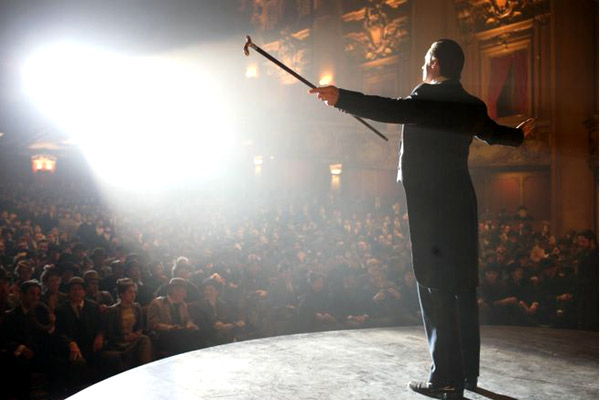
In Aronovsky’s movie, Noah inhabits an enchanted world. kinopoisk.ru

From the first rain drop that mystically/magically replaces a plucked flower, we know that Noah is walking in a world that is enchanted is way we are not used to seeing.

The rules are a little different. Things work in slightly different ways from the world that we inhabit.

From the suspension of certain laws of physics to the wondrous seed of Eden and on to the healing blessing of a barren womb, the world is undoubtedly enchanted.

It is about that enchanted world that I want to propose a problem and a promise.

Problem

In a post-enlightenment world, we no longer have access to that level of enchantment – except in cinema. That is the importance of movies. Most of us no longer sit around the fire and hear the stories and mythic tales of the ancient generations.

Movies open up a world to us that seems closed in the ancient past. Cinema releases us from the confines of our limited imagination and allows us to imagine the world (in) a different way.

Movies spark our creativity and open us up to the possibility that the world can, and maybe should, be a different way. Movies like Avatar or Star Wars are not meant to be exegeted or examined for their exacting possibilities. That would be to miss the point.

Noah should be enjoyed in the same way. A movie like this should not be measured and weighed in an attempt to map its realistic representation. That would be to close down the possibilities. Aronofsky’s vision is to open up our imaginative creativity and invite a greater possibility.

Promise 

David Ray Griffin has ambitiously tackled this problem in his massive (and heady) tome Reenchantment Without Supernaturalism. You can read Bevery Clack’s excellent review here.

Clack explains:

the naturalism that underpins this model is

  • prehensive (highlighting the conscious or unconscious grasp of something)
  • panentheistic (god’s presence is in all)
  • panexperientialist (meaning that experience is not limited only to the sensory)


I don’t want to get bogged down in big words but that tri-framing opens up an important insight that Griffin lays out.

 First, as long as the scientific and religious communities regard each other with suspicion and hostility, it will be difficult for them to cooperate wholeheartedly to overcome the problems threatening civilization today, such as the global ecological crisis.

Second, religion that has not taken account of the truths revealed by science can be very dangerous.

Third, the development of a “scientific worldview” that does not incorporate the truths revealed by religious experience has led … to the view that the universe provides no normative values to guide the future course of civilization.

It is passages like the above that bring me back to the enchanted world of Noah. We love the idea of that world. It is partly why the epic-mythical-primal storytelling of those early accounts capture us at so many levels.

The unfortunate thing is that we have no access to that world anymore. This is where cinema comes in. Movies like Noah release us from the confines of our disenchanted and mundane existence and open up our imaginations to the possibilities of an enchanted world. The unfortunate reality is, however, that cinema is the only access most of have to a world like that.

We can’t go back. We could try but we would never make it. The better option is to live wholly into this world that we actually inhabit in a way that recognizes what is already (re)enchanted and allows us to participate with integrity in the world as it is.
Noah: Eclipse of the Biblical Narrative

It has been a busy month for me but I have 4 things that I would love to hear your thoughts on in the next 24 hours.

I got a sneak peak of the new movie Noah and got to be a part of a roundtable with the director and screenwriter. You can listen to the HomeBrewed  review of the movie and interview here. 

Today I want to put up my two posts on Noah and see what y’all thought of it (if you got to see it this weekend).

______________________

The new Noah movie is a masterful work of biblical imagination and creativity. Noah

There are two aspects of the movie that audiences will notice up-front:

  1. one is related to epic-mythic-primal narrative
  2. the other addresses physics and logistics

The latter is significant for the former. Through a creative move to put the animals into hibernation, all of the questions about how you would feed that many animals, keep them from killing each other, and shoveling manure are instantly relieved. Those who are concerned about such logistical matter can then relax and settle into the narrative.

This is important because for many viewers, the story of Noah is either a) a children’s tale or b) a physics/apologetics problem.

What is missed in both the children’s story and the apologetics arguments is that we are dealing with an epic-mythic-primal narrative. It is not a newspaper account of the flood.

The danger of reducing epic-mythic-primal narrative down to newspaper reports is that too much is lost in the reductive move. The sad part is that often those who are the most series about the biblical account – and who may be upset about the creative flourishes in this movie – have often fallen victim to a debilitating loss of wonder and possibility.

 This is a ‘Failure of Imagination’.

When the Biblical Narrative is reduced down to a newspaper report,  the account lacks the appropriate level of animation.

Aronofsky illustrates how a story should inspire us. This is how we should entertain and engage a Biblical narrative – not by simplifying it down to a flannel board representation – but by breathing more life into it to see what emerges.

In the interview you will hear Aronofsky and Ari Handel say that they wanted to ‘humanize and dramatize’ this work of ‘primal story telling’. My mind went immediately to the work of Hans Frei – specifically The Eclipse of the Biblical Narrative. Frei was both concerned about and critical of the shifts that happened in recent centuries of biblical criticism. We had clearly moved out of the pre-modern (pre-critical) way of addressing a sacred text and into (via the enlightenment) a flood of critical thought and scholarly criticism.

Both the fundamentalist retreat to historical facts and the liberal abandonment of historical concerns are a failure to Frei. This is not about extracting universals or proving ‘facts.’ That is an exercise in missing the point.

Frie’s proposal related to fitting our world into the world of the Bible.  While I don’t subscribe to Frie’s system wholesale, I think that he would be very impressed by Aranofsky’s vision for the Noah story.

The director lets us inhabit the enchanted world of Noah and tries to find elements of our world within it. This is the beautiful opportunity provided for us through film. We breath creativity and imagination into the text and let it come alive.*

The next post will look at ReEnchanting the world the Noah inhabited. 

*It is important to note that Aronofsky and Handel took great pride in not contradicting a single detail in the biblical account. They admittedly added and embellished other aspects of the story.

That damned Second Sentence

I have always been suspicious of that second sentence. Usually it is the obvious second sentence that is preceded by the unstated first sentence.

“We hold these truth to be self-evident”  is a great second sentence.  The problem is that it is often put forward as a first sentence. People just start with “We hold these truths to be self-evident… that all men are created equal.”   It is a wonderful sentence. The problem is that there is something unstated that goes before it. The first sentence there is “After we killed the original inhabitants, stole their land and imported free labor from Africa …. We hold these truths to be self evident…”

 So often what appears to be a first sentence is really a second sentence and the first sentence goes unstated. 

Last week Peter Rollins showed up in LA and talked about why ‘Its not the size of the wand that matters … its the magic that is in it.’  In that talk he pointed out the danger of of a different kind: not understanding the (assumed) second sentence. This is particularly relevant to fundamentalist thinking.

The sentence is ‘We trust God’. The implied second sentence is ‘but we still lock up the church building when we leave and arm the security system.’

Or ‘I trust God’. The second implied sentence is ‘still lock your car doors’.

‘I pray for the headache to go away’ is followed by the implied ‘I take the aspirin to help’

Rollins says (around minute 26) that what is tragic is when somebody believes the first sentence too much and doesn’t pick up on the implied second sentence. Like when a child is sick and the community prays for them to be healed, the dad takes the kid home and doesn’t take them to the hospital or give them medicine and the kid dies.

People are always shocked and horrified that the parent took it too far. Yes, we pray for healing. Yes, we have faith. The implied second sentence is that we also partner with modern medicine – and I would add – even thanking God for the advances is technology and unlocking the potential (often of plants) for medicines.

 The tragedy is when someone doesn’t pick up on the implied second sentence and takes the first sentence way too seriously. It’s that damned second sentence that will get you in trouble.

Part of what I love about Rollins’ project is that he helps expose the invisible or unstated second sentence so that we, as communities of faith, are not assuming something that should not be assumed and then stating it appropriately so that everyone is on the same page and it is not invisible or hidden.

Admittedly, the danger is that it might take some of the magic out of it. I acknowledge that. The tradeoff, however,  is that we can be honest about what is really going on and move forward A) together and B) with integrity. I think that the tradeoff is worth the risk even if we do lose some  of the magic.

– Bo Sanders 

Democracy, Pentecost, and the Old Testament?

  • Is it possible that democratic desires are present in the Old Testament and I have just never seen them before?
  • Is the de-centering of Pentecost and the empowerment of the people foreshadowed in the Old Testament?
  • Can we say  A) that Pentecost in the undoing of Babel and B) that God’s desire has always been for the voice of authority to reside in the people (multitude) and not in top-down leaders?

Here is why I am asking:

Recently I stumbled on what might be the most interesting reading of Moses at Mirebah I have seen. It comes from the book Emergency Politics by Bonnie Honig (also on Kindle). In it, she is engaging the theology of Franz Rosenzweig – a contemporary and rival to the German (later Nazi) Carl Schmitt who famously said “” Sovereign is he who decides on the exception.”

In Numbers chpt 20, Miriam passes away. She had been a prophetess for the people and had challenged Moses’ authority on occasion. Immediately after her passing (this will become important) the people realize that there is no water and press Moses and Aaron for solutions. Moses and Aaron step away from the people to seek God and receive instruction to “take the staff and speak to the rock – it will pour out water before their eyes”.

Moses, as you may remember, doesn’t follow instructions to the ‘T’. He ad libs a little bit.  He does indeed gather the people but then he veers from the plan. He chastises the people and then strikes the rock. Two things happen:

  • water does indeed come out
  • God is displeased with Moses and will not let him enter the land that is promised.

I have preached this passage many times and have read lots of treatments. I am intrigued by this passage and have always been unsettled by one detail in the story, which I have never been able to resolve:

why does the Lord tell Moses to take the staff if he is just going to speak to the rock? Why even mention the staff?

Here is where Honig and Rosenzweig bring a unique reading. The staff represent something magical like sorcery – or the miraculous for the early 20th century. This is a political theology and what is at stake in the suspension of law in emergency conditions. Can a sovereign power suspend law in the same way that  God suspends the laws of physics in order to preform miracles? Leaders, being empowered by God, the thinking goes, could suspend ‘normal’ activity if they determined an exceptional circumstance.

In Honig and Rosenzweig’s hermeneutic the dispersed empowerment of the people (multitude) is the location for God’s will and is intended to be home to the will/voice of the Lord. But, as we know, this responsibility had been too overwhelming and was resisted by the people in selecting Moses as a king type who would speak to God for/instead of them (Exodus 20:19). This was an abdication by the people of what the Lord had desired for them as a people – to be prophets all.

This resistance is reinforced when the voice of the people rises in the absence of water, and Moses (along with his brother Aaron) turn away from the ‘stiff necked people’ and receive instruction to speak to the rock. Moses then, probably importing the top-down authoritarianism of his Egyptian upbringing, disobeys the command to speak and instead, chastises the people and strikes the rock with his staff in an act of magical sorcery. God, though it produces water, reprimands this act, and Moses is disallowed from entering the promised-land with the people.

This event is placed within the historical context, earlier in the passage, where Miriam passed away and immediately the people realized that they had no water and held a council against Moses and Aaron. Miriam’s name alludes to water and she was the sister who placed Moses in the Nile’s water when he was an infant. She had been the only one to challenge Moses’ authoritarian ways and she provided, as a prophetess, a check to Moses’ power. Without her, this reading states, Moses proved he will give the people … “not authentic prophecy, but sorcery.” In not recognizing the predictive prophecy of the people (and Miriam), Moses loses his leadership of the people.

Honig utilizes Rosenzweig’s two types of prayer – one that spontaneously arises in a situational moment, and another that is used by the community and creates an openness or receptivity – to analyze the judicial deliberation surrounding the Bush v. Gore presidential ruling. By imagining that the people could have risen up in expectation of a serious effort to count valuable democratic votes instead of waiting for a Schmittian top-down rule from the authorities. The sovereign power might have been within the people prepared for and receptive to the sign instead of what came from above it – a rupture from beyond them. This expectation is foreshadowed within the Mosaic tradition that one day all of the people would be prophets (like Miriam).

Honig asks if this metaphorical reading (which it expressly is)  is a good model for democratic politics and a comparison of the  “state of legal exception to the divine rule of god”. The people, she says, when bound together can give to themselves the powers of state and can again decide to suspend them when, as a multitude, they are oriented and receptive (having been prepared) to the consequences of such action and what they point toward as a sign.

This, in the end, is the problem with magical thinking! We abdicate our power as the people – to be receptive to and bring forward the voice and will of God – in favor of looking to magically empowered leaders to suspend the rules that govern due to exceptional (or emergency) circumstances and hand down solution (metaphorically) through sorcery.

It makes sense then why the Lord even mentions the staff if Moses is ultimately to speak to the rock. It is a metaphor (symbol) of concentrated power that is present but to be resisted in lue of the prophetic possibility of speaking. In that speaking, which is to be located in the people (multitude) prepared by prayer, that a sign is revealed that points to a greater reality. We never hear that voice if a receptive people continually abdicate that potential to exceptional leaders who are expected to provide magical results.

God’s of use of authoritarian leaders would, in this line of thinking, always be either a temporary measure, a concession, or a deviation from the Lord’s will to have the voice housed in the God’s people.

I started with questions and I will close with one:

  • What kind of effect would a reading like this have the kenosis  of Philippians 2 and that weird conversation in 1 Samuel 8 where the people want a king and God says “trust me, you don’t – you only think you do” ?

Blog at WordPress.com.

Up ↑