Search

Bo Sanders: Public Theology

updating & innovating for today

Tag

military

The Virus of War

We need to be careful about this language of a war against the virus. In the last 30 years war has migrated in meaning it has become too easily appropriated for anything we are concerned about.

We could talk about varieties that have global implications like the war on terror, to more seasonal and trivial instances like the so-called war on Christmas, and everything in between.  We could talk about the war on drugs, the war on poverty, the war on women, and so many other instances of war migrating in dangerous ways.

There are two primary reasons for concern:

  • First, whenever war is invoked emergency measures are implemented and we are in danger of losing our rights at citizens. I will talk about emergency politics below.
  • Second, because of global capitalism and our pervasive consumer society the victory in these wars is somehow always linked shopping.

You will remember the now famous exhortation by then President George W. Bush after the events of September 11 to not let the terrorists win by … going shopping.

A brilliant article came out this week about the impending call “return to normal”. We would be wise to pay attention to how that phrase is going to be used–not everyone means the same thing when they use the same words.

American politicians have become very comfortable invoking the war analogy but it really got my attention this past weekend when the Prime Minister of Canada used to the phrase. As a dual citizen between Canada and the US it always gets my attention when something that I had thought was unique to the American military mentality shows up north of the border.

Then yesterday during the extended media circus of a Covid 19 press conference, the current President of the United States repeatedly claimed that the powers of his office were total.

This is the danger of our exceptional times–exceptions get made that are nearly impossible to retract later. They get codified and instantiated, which sets the precedent, which then moves from being a fluid situation due to an emergency to a solidified expectation that is written in stone. 

The problem is that we now live in a permanent state of emergency.

I write about Emergency Politics every so often. It is far more ominous than its news coverage. Here is a snippet for those who are new:

Bonnie Honig, in Emergency Politics, says “The state of exception is that paradoxical situation in which the law is legally suspended by sovereign power.”

September 11, 2001 ushered in a state of perpetual exception. This applies to racial profiling, police brutality, State surveillance of its citizenry in the NSA – to name only a few.

When people are scared they willingly sacrifice their freedom and privacy in exchange for safety. The State benefits from a frightened population and people are more willing to accept the exceptional measures.

A population is more willing to view as exceptional the excessive tactics and escalation of violence precisely because we now live in a permanent state of exception (or emergency).

Gulli [in this article ] reports, “At the end of his critique of the state of exception, Giorgio Agamben addresses the question of contingency, which is very important in all of his work, when, with a reference to Benjamin, he speaks of “the urgency of the state of exception ‘in which we live’” (2005)

In his eighth thesis on the philosophy of history, Walter Benjamin says:

“The tradition of the oppressed teaches us that the ‘state of emergency’ in which we live is not the exception but the rule. We must attain to a conception of history that is in keeping with this insight. Then we shall clearly realize that it is our task to bring about a real state of emergency.” (1968)

I bring this up in the hopes that our current crisis might help to create a real sense of emergency that will call into question in the larger American conscience a question about the permanent state of exception that has crept in over the past decades.

We must question the exceptional State and its emergency politics that have become too normalized and quietly accepted in our society.

Degree and Kind

Different in degree or has it become a different kind of thing?

Spelling Bee, Military, Religion, Farming, etc.

This is a follow up to Meaning Migrates.

We live in a time when change is inflamed by globalism, technology, and money.

Meaning Migrates

Everything changes and meaning migrates. Below is a video about the migration of meaning.

Examples:
Military: from D-Day and the beaches of Normandy 75 years ago to the War on Terror and drones now.
Evangelicalism: from European and British examples over 100 years ago to Billy Graham and now 81% support for Trump.
Methodism: 300 years of historic drift
Farming: from Agrarian society to Agribusiness and Industrial Farming
Masculinity: in just the past 3 generations the meaning of ‘manhood’ has changed.
Politics: from ‘the party of Lincoln’ to the loss of conservatism. Also the ‘death of the Liberal class’.

Our access to truth is:

  1. Partial
  2. Provisional
  3. Perspectival

The result is that meaning is:

  • Contested
  • Mediated
  • Located

What inflames change all the more in our exponential times of cultural conflict are:
Globalization – Transnational reality as a legacy of colonialism
Technology – Internet, Social Media, etc.
Finances – capitalism in the 21st century

Just check out these stories in the news right now:
Climbing Mt. Everest has changed
China has changed global markets
The Mississippi River is being held by technology and money

America is like God – both can ask for your life

Charles Taylor, in his book Modern Social Imaginaries,  utilizes the term ‘social imaginary’ to refer to god-like capacity described by Benedict Anderson in Imagined Communities.  The term encompasses a threefold meaning:

  • First is the way that ordinary people “imagine” their surroundings in images, stories, and legends.
  • Second is the general acceptance and participation in the imaginary by a population and not simply the theories dominated by a small elite.
  • Third is empowerment provided from the imaginary for widely shared practices – and a sense of legitimization.[1]

One impact of this capacity to conceptualize national identity and belonging is in answer to the question “what would make someone be willing to die for their country?”

Anderson proposes a model of historic drift where sovereignty, which had previously been located in either religion or king (or both), has shifted decisively to the Nation in recent centuries. This is a dramatic innovation and recognizing nationality as a valid location for sovereignty has significantly altered matters related to loyalty, sacrifice and belonging.

Anderson proposes a definition of the nation as “an imagined political community – and imagined as both inherently limited and sovereign.” The distinction as imagined comes because “the members of even the smallest nation will never know most of their fellow-members, meet them, or even hear of them”.

Communities are limited because there must be some distinguishing demarcation outside of which are other communities (nations), which provide both competition and opportunities for cooperation. This distinction provides a vital function as classifications for the project of establishing communities.

Communities are imagined as sovereignbecause the concept was born in an age in which Enlightenment and Revolution were destroying the legitimacy of the divinely-ordained, hierarchical dynastic realm.” [2]
The dissolving social order of caste and class provided more level (if desperately unequal in reality) conception of both membership and participation for the mass of the population. This perceived leveling and opening gave rise to a new capacity for sacrifice on behalf of the imagined entity – an entity that was not solely and externally located in eternity or beyond, but in an ideal which one was associated (belonged) and participated and was thus responsible. To die for a religion (God) or a King was to reinforce that social order which established the hierarchical strata. Locating sovereignty within the conception of Nation – however dispersed and elusive – was a profound change.

In 1922 Carl Schmitt wrote his famous work Political Theology: Four Chapters on the Concept of Sovereignty and claims  that

“all significant concepts of the modern theory of the state are secularized theological concepts.”[3]

In 2011 Paul Kahn wrote an engagement of Schmitt’s work with four new chapters on the same subject where he says that the capacity for the state to ask for this kind of sacrifices, the power to pardon – which is a remnant of Kingly authority, and the symbolic notion of a flag that needed to be defended are all remnants of a religious notion. The very word sovereign is borrowed from religious vocabulary.  Kahn explains:

Political theology today is best thought of as an effort to describe the social imaginary … (arguing) that secularization, as the displacement of the sacred from the world of experience, never won, even though the church may have lost. The politics of the modern nation-state indeed rejected the church but simultaneously offered a new site of sacred experience.[4]

You can begin to see why the constitution is often thought of and talked about as an inspired document (sacred text) and why those who were responsible for it’s creation (founding fathers) are celebrated at patriarchs.[5]  If Schmitt is right – even partially – then all of these similarities are neither trivial nor inconsequential.

The power of the state to ask for death in order to preserve itself and the capacity of people to willingly offer their lives in defense of that conception is profound. The notion of the sovereign holding the power of exception goes all the way from the individual being pardoned (as referenced earlier) to modern realities impacting all of humanity. The President has the ability to launch nuclear weapons if the President was to view that the national interest was in jeopardy.

Kahn uses this to illustrate his point. What are we saying about the nation that we are willing to jeopardize human heath, the planet, and subsequent generations for its defense? What could possibly be above human health and planetary environmental conditions? The answer is ‘only something that is of ultimate concern’. 
The modern conception of the state is thus a result of religious conceptions and has replaced (in some sense) religion as the location of sovereignty one is willing to ultimately sacrifice and die for. Nation is a construct of transcendent meaning found in an imagined community.[6]

Now this is where it gets really interesting! 

Arjun Appadurai, in Modernity at Large interacts with Anderson and observes that:

Modern nationalisms involve communities of citizens in the territorially defined nation-state who share collective experience, not of face-to-face contact or common subordination to a royal person, but of reading texts together.[8]

Much of the rhetorical energies of the ruling powers are used in order to urge “their subjects to give up … primordial loyalties – to family, tribe, caste, and region” for the “fragile abstractions” called nations which are often “multiethnic … tenuous collective projects”.[9]

Only within the power of national imaginaries can one see the possibility of such a monument as a tomb left intentionally empty or holding the remains of an unidentified combatant. Anderson points out the absurdity of “a Tomb of the Unknown Marxist or a cenotaph for fallen Liberals.”[10]  There is no reserve of belonging that would justify such a display. It would hold little value outside the context of national identity.

And that is how the sausage called nationalism is made!


[1] Taylor, Modern Social Imaginaries, 23.

[2] Anderson, Imagined Communities, 8.

[3] Paul W. Kahn, Political Theology: Four New Chapters on the Concept of Sovereignty, location 37.

[4] Ibid., 360.

[5] CBC Ideas podcast  ‘The Myth of Secularism’ part 5

[6] It is not difficult within this framing to view contemporary movements such as the Tea Party as merely an extreme example of a group calling for a romanticized notion of an imagined past or legacy.

[7] Anderson, Imagined Communities, 8.

[8] Arjun Appadurai, Modernity At Large: Cultural Dimensions of Globalization, 161.

[9] Ibid., 162.

[10] Anderson, Imagined Communities, 10.

The Pornography of Fundamentalism

Normally I try to be as generous, welcoming and irenic as possible. One of my favorite slogans actually comes from my venerable partner Tripp Fuller at Big Tent 1 when he said that the ‘tent’ should be big enough for every former incarnation of our self … but I was never a fundamentalist. I flirted with being one in Bible College but never converted.

This past week I was flying back across the country after visiting my family and I was rummaging through my Ipod to see if anything caught my attention. I stumbled on an old Slavo Zizek lecture. As with all Zizek lectures he wandered through almost every topic under the sun – but two caught my attention: pornography and fundamentalism. I want to try and connect them here.

In a pornographic movie, the dialogue is secondary. It is merely window dressing. Think back to your younger years – before you were a christian. The dialogue is a thinly veiled, contrived scenario to get the actors into the same space. It is little more.

 A handyman comes over to a lonely women’s apartment to fix a hole in the wall. She says something about another hole that needs attention.

You get the idea. The dialogue is superfluous to the real intention. It is poorly written and even more poorly delivered. The dialogue is a facade, it is merely intended to set up the main activity. It allows for the suspension of suspicion so that one can enter into the fantasy. 

 Dialogue performs the same function for Christian Fundamentalists.

Don’t misunderstand me – I am not saying that the verbiage of fundamentalists is insincere or disingenuous. It is not. Fundamentalist believe it with all their heart. What I am saying is that the words in church perform the same function as dialogue in porn. The words that are spoken are secondary to the main activities: nationalism, militarism and capitalism (some would add patriarchy).

When I was in Bible College I used to set my VCR to record TV preachers while I was at school. I loved listening to preachers. I wanted to be one and I modeled myself on the famous ones. I even sent money to folks like Chuck Swindoll so I could get their tapes and listen to them over and over.

The more I read the Bible, however, the more I realized that something was wrong. At my evangelical college we studied the historical context of the Old Testament and the Ancient Near East. We even touched on some Roman legal stuff for the New Testament –  while avoiding things like Empire for the most part. [Jesus’ message was spiritual after all, not political.]

I started getting a pit in my stomach when pastors would shoe-horn modern issues between the lines of scripture. It made me nervous when they would draw a direct line from ancient Israel to modern America. My fallout actually came in two parts:

  • Step one was simply (but quietly) objecting to the lack of translation or conversion between Old Testament Israel  which was a theocracy and America which was democracy … and a pluralistic one at that.
  • Step two was the vehement (nearly venomous) push-back I got when broached the subject.

It was in the vicious rebuffs that something grotesque was exposed. The words that were spoken – while important and delivered with conviction – were secondary to the real driving influence and aim. The real engine is nationalism, militarism and capitalism. Those are the real gods of American fundamentalists. The christian verbiage is the fiberglass body. It is important, visible and gets most of the attention but it is not what is driving the machine.

Like dialogue in porn, it is only utilized to get the players into proximity with each other. It is only used to set up the main (real) activity.

Ask yourself these 3 questions:

  1. Why are voices raised, fists shaken, and teeth gritted when fundamentalists talk about God pouring out love for us in Christ and salvation being found in ‘the way, the truth, and the life’? Why doesn’t the medium match the message?
  2. Why is there unquestioned support for modern Israel regardless of their atrocities and unjust behaviors?
  3. Why is it permissible to be so aggressive with people who disagree with you on issues like who is allowed to be married (a civil union) by the state?

The reason that the medium doesn’t match the message is because the real message is not found in the words. Like dialogue in porn, it is only meant to set up the scenario for the real activity. Spend all the time you want on analyzing it or the logic behind it, but it is like capturing fog. It is a temporary holder for the main event. In fundamentalism’s case, that is nationalism, militarism and capitalism. Don’t get distracted by the christian verbiage or the message of Jesus – you will only be frustrated and baffled. No, there is something else driving this machine.  Just ask questions, even quietly, and you will hear where the real priorities are.

I know that normally I am not this critical,
but as you will see in the following posts,
we have a real problem on our hands.

Why this matters so much is covered in part 3: It’s a Sign.  

Starting in the middle never works: Romney, Israel & Palestine

Republican (presumptive) nominee  Mitt Romney got in some hot water recently in a visit to Israel. He  told Jewish donors Monday that their culture is part of what has allowed them to be more economically successful than the Palestinians, outraging Palestinian leaders who suggested his comments were racist and out of touch with the realities of the Middle East.

“And as I come here and I look out over this city and consider the accomplishments of the people of this nation, I recognize the power of at least culture and a few other things,” Romney said, citing an innovative business climate, the Jewish history of thriving in difficult circumstances and the “hand of providence.” He said similar disparity exists between neighboring countries, like Mexico and the United States.

There has been a lot of analysis about Palestinian ‘culture’ as well as economic, military, and other realities that have contributed to discrepancy that is so evident between Israel and Palestine.

I want to focus on a slightly different aspect of the story. Mitt Romney started in the middle and you just can’t do that. In a previous post entitled “Bullies, Bananas and the Bible” I stated:

You can’t verbalize the way things are – which is a result of the way things have been – as proof that this is how it should always be. 

Creation ‘expert’ Ray Comfort famously made a fool of himself by producing a video with Kirk Cameron where he praised the glories of the (modern) banana as evidence of God’s grand design and love for human beings. You can watch the video here – it is a hoot. There is only one problem. Comfort was highlighting many of the adaptations and ‘improvements’ that were results of human modification through deliberate cultivation.

This the problem starting in the middle. You can’t just walk into the way things are, assume the status quo and then make a case for it. *

This is not an isolated school of thought. I was camping in a national park with a long time friend who lives in and loves his ‘red’ state. We were hiking out and enjoying the beauty when he began to tell me about how ridiculous the environmentalists are and how stupid it is to put all these regulations on industry – we are handcuffing these innovators who create jobs for people. His evidence was to point to the trees around us and say “look at all of this amazing space – what are they so worried about? I don’t see why we need to have all these regulations and get so upset at industry.”

I pointed out that if somebody 100 years earlier had not had the foresight to preserve this land, the timber industry would own all this land and would have harvested all these trees. It would look nothing like it did and we would not be walking or hiking there. He had literally never thought about that.

It would be like walking into a grocery store, seeing a steak wrapped in saran wrap on a Styrofoam platter and beginning to articulate how perfectly the  steak was designed for your grill – how the saran wrap crumples in your hand for ease of disposal in the waste basket – how the steak is the same dimensions in thickness from side to side for consistent grilling. Clearly God designed this steak to go on your grill and for your enjoyment!!

This is the danger of starting in the middle.

John Piper’s conservative view of God is the same as Comforts view of the banana and my buddy’s view of the national park: completely ignorant and disconnected from the narrative & trajectory that lead to it.

Which leads us back to Romney: this is a consequence of privilege. I would love to ascribe it to some classicist view of god or an a-historical understanding of theology. It might be from those two things as well, but it is a consequence of privilege and the blind spot that results from it.

If you don’t account for socialization in things like gender – and instead argue for original design … if you don’t give validity to things like constructions and conditioning then you look at how society has been you will mis-attribute it to some other factor. We do it with everything from sexuality and gender  to culture and race.

If one ignores systemic oppression and historic injustice and starts in the middle, then one can conclude that it is this group’s culture or collective disposition that gives them the advantage resulting in the conditions that we see today.


Jesus & (S)words part 3

reposting from last week.
Part 1 & Part 2 provide the lead in

Part 3:  Jesus tells his disciple to buy a sword?

We come to that famous passage in Luke 22 where Jesus tells his disciples to buy a sword.

 35 Then Jesus asked them, “When I sent you without purse, bag or sandals, did you lack anything?”

“Nothing,” they answered.

36 He said to them, “But now if you have a purse, take it, and also a bag; and if you don’t have a sword, sell your cloak and buy one. 37 It is written: ‘And he was numbered with the transgressors’[b]; and I tell you that this must be fulfilled in me. Yes, what is written about me is reaching its fulfillment.”

38 The disciples said, “See, Lord, here are two swords.”

“That’s enough!” he replied.

Here are two readings you may want to consider: 

Earlier this week I engaged a political reading of Moses and the waters of Meribah from Numbers 20. My question was “why, if Moses was going to ultimately speak to the rock, did the Lord even mention the staff?”  The answer was that it was a symbol of power to be carried – yes – but ultimately resisted in favor of a better present option that might be overshadowed by the most obvious option.

It takes strength to turn the other cheek. If you don’t have the ability to retaliate … it is just being a doormat or victim? That is how I have always thought about it.

In that perspective, I have read Jesus’ odd command with Peter in mind. I see that fateful night where Jesus tells him to ‘put away your sword’ and later tells the authorities ‘if my kingdom was of this world my followers would fight.’ The implication is that Jesus’ kingdom is not of this world and so his followers don’t fight.

The sword for the disciple, then, is what the staff was for Moses in Numbers  20: a powerful option to be resisted in favor of a preferable option that is less obvious because it is less forceful.

I used to reconcile ‘buying swords’ as a sort of object lesson or training excersise for the disciples. One lesson (trust and supply) is over – next lesson: You can’t resist temptation is one of the options is not even available.

 Then, in 2007, I discovered that Biblical Scholars have a different way of handling the passage. Here is Ben Witherington: 

Lk. 22.36-38. What is the meaning of this little story, taking into account the larger context of Jesus’ teaching? Vs. 37 is the key where Jesus quotes Is. 53.12—“he was numbered with the transgressors”. Jesus is saying to the disciples—you must fulfill your role as transgressors of what I have taught you!!! They must play the part of those who do exactly the opposite of what Jesus taught them in the Sermon on the Mount. The disciples become transgressors by seeking out weapons and then seeking to use them. This much is perfectly clear from the context for the disciples then go on to say “look Lord here is two swords”. They already have such weapons and Jesus responds in disgust to the fact that they are already transgressing his principles of non-violence by responding “that’s enough” (of this nonsense).

 So either Jesus was saying that two swords was enough for the revolution (not likely) or Witherington has this right.

Conclusion: We have looked at these four famous passages now and it seems clear that although Jesus talked about swords and the writers of scripture utilized sword analogies, none of these passages is a validation of the type of violence these verses are used to justify.


Jesus & (S)words part 2

I’m reposting last week’s HBC conversation in 3 parts
[part 1 is here]

Part 2:  

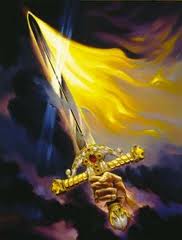
There are lots of swords in the New Testament.  The Word of God is compared to a double-edged sword and Jesus comes back wielding a sword. Maybe the Bible is more than ‘O.K.’ with swords and sword imagery?

Let me throw out two things:

  • In the context of the Roman Empire and its occupation of Jewish lands in the 1st century, swords would have been a common item that drawing imagery out of would have been appropriate.
  • A well-known pastor in Seattle, Washington is famously quoted as saying “Jesus is a cage fighter with a tattoo on his thigh and a sword in his hand, determined to make someone bleed”. He said this in reference to the fact that he “could not worship somebody that he could beat up.”

Some people dismiss statements like this and chalk it up to testosterone fueled, overly inflated, pumped up hyper-masculinity.  I worry that there is something much deeper and much more sinister involved. I think that it is a fundamental misunderstanding of the nature of God and the interpretation of Christian scripture.

 What is noteworthy in Revelation 19, is that the sword is not in Jesus’ hand but it comes out of Jesus’ mouth. That seems important in the poetic/prophetic  nature of Revelation. This sword is not your average sword. It is not in Jesus’ hand and that makes you wonder if the way in which this sword “strike down” the nations is not in bloody violence but in a kind of destruction that would happen as a result of a sword that proceeds from the mouth of God?  Let’s ask ourselves “is there something that comes from the mouth of God that radically impacts or consumes peoples and nations?”  Is there something sharp that comes from the mouth of God … something sharper than any two edged sword?

Oh, here we go: Hebrews 4

12 For the word of God is alive and active. Sharper than any double-edged sword, it penetrates even to dividing soul and spirit, joints and marrow; it judges the thoughts and attitudes of the heart.

So far so good! ‘It’ judges the thoughts and heart… but here comes the twist:

 13 Nothing in all creation is hidden from His sight. Everything is uncovered and laid bare before the eyes of him to whom we must give account.

Hold the phones! … the Word of God (it) is a person? Yes. Guess who?

 14 Therefore, since we have a great high priest who has ascended into heaven, Jesus the Son of God, let us hold firmly to the faith we profess.

Jesus is the Word of God?    (I’m being funny but you may want to check out John 1 for clarification).

 In conclusion: the use of sword imagery  in both Revelation and in the book of Hebrews needs to be taken with a poetic grain of salt. Yes, the Bible uses sword imagery. The thing is that if Jesus’ (S)word, from part 1,  is a non-sword or an un-sword and in Revelation is comes from Jesus’ mouth and in Hebrews it is a person … then none of these passages, thus far, can be utilized to justify what so many Christian (s)words are used for. 

I’ve obviously been having fun here, but the bottom line is that just because the Bible uses swords as analogies – it isn’t a wholesale validation of swords nor a justification for using them as the world does.

________

I would love to hear your thoughts – I just have one request: please don’t use the word ‘Pacifist’ when speaking of Jesus. That set of commitments belongs to a distinct school of thought  that did not exist in Jesus day so it is anachronistic to use in that way. He was certainly into non-violence and radical peace-making but Pacifism is a unique configuration of convictions.

Jesus & (S)words

This conversation went really well last week over at Homebrewed. I thought I would post it here in smaller chunks for anyone wanted to continue the conversation.

Jesus tells his disciples to sell their bags and buy swords. Why? And why then does he reprimand Peter for using a blade at the moment when it seemed to be most appropriate?  Was Jesus being inconsistent? Did he change his mind in the moment? Was it a test? Did he set Peter up to fail? Why did he say that ‘those who live by the sword, will die by the sword?’ and then tell his disciple to buy them?

I am asked about Jesus’ relationship to swords as much as anything I get asked about. Good hearted people are quite baffled by the whole subject.

  • Jesus did after all say that he came to bring a sword.
  • As the word of God, he is said to be sharper than any two-edged sword.
  • He is pictured with a sword coming from his mouth when he ‘returns’.
  • and there is this matter of him telling his followers to buy swords

As a former apologist, I have gotten pretty good at helping the baffled work through these passages. I even has a presentation I do called jesuSword that incorporates Jesus, his words, and these passages about swords.

 In order to facilitate a lively give and take, we will take this in 3 quick addresses over the next 24 hours.

 Part 1: Jesus says that he came to bring a sword.

 Matthew 10:34 “Do not suppose that I have come to bring peace to the earth. I did not come to bring peace, but a sword. 35 For I have come to turn “‘a man against his father, a daughter against her mother, a daughter-in-law against her mother-in-law—   37 Anyone who loves their father or mother more than me is not worthy of me; anyone who loves their son or daughter more than me is not worthy of me. 38 Whoever does not take up their cross and follow me is not worthy of me. 39 Whoever finds their life will lose it, and whoever loses their life for my sake will find it.

 Is it possible that Jesus was being ironic and that his sword is actually an un-sword. I say this because Jesus’ sword does the exact opposite thing that normal swords do. His sword divides family. Traditional swords are used their swords to defend their kin and kind.

Jesus was using a play on words.

Jesus was using hyperbole. In his day swords were actually for defending one’s family – for guarding me and mine. In this sense, Jesus’ “sword” is an un-sword… or an anti-sword. It does the opposite of what human swords are used for.  Jesus’ sword is not for defending family but for dividing family. Jesus did not come with a human sword but the opposite!!

John Caputo puts it this way:

The kingdom reigns wherever the least and most undesirable are favored while the best and most powerful are put on the defensive. The powerless power of the kingdom prevails whenever the one is preferred to the ninety-nine, whenever one loves one’s enemies and hates one’s father and mother while the world, which believes in power, counsels us to fend off our enemies and keep the circle of kin and kind, of family and friends, fortified and tightly drawn.”

If Jesus was being ironic or using hyperbole, it would make so much more sense than the way this passage gets used to justify violence and militarism.

I would love to hear your thoughts – I just have one request: please don’t use the word ‘Pacifist’ when speaking of Jesus. That set of commitments belongs to a distinct school of thought  that did not exist in Jesus day so it is anachronistic to use in that way. He was certainly into non-violence and radical peace-making but Pacifism is a unique configuration of convictions.   

Blog at WordPress.com.

Up ↑