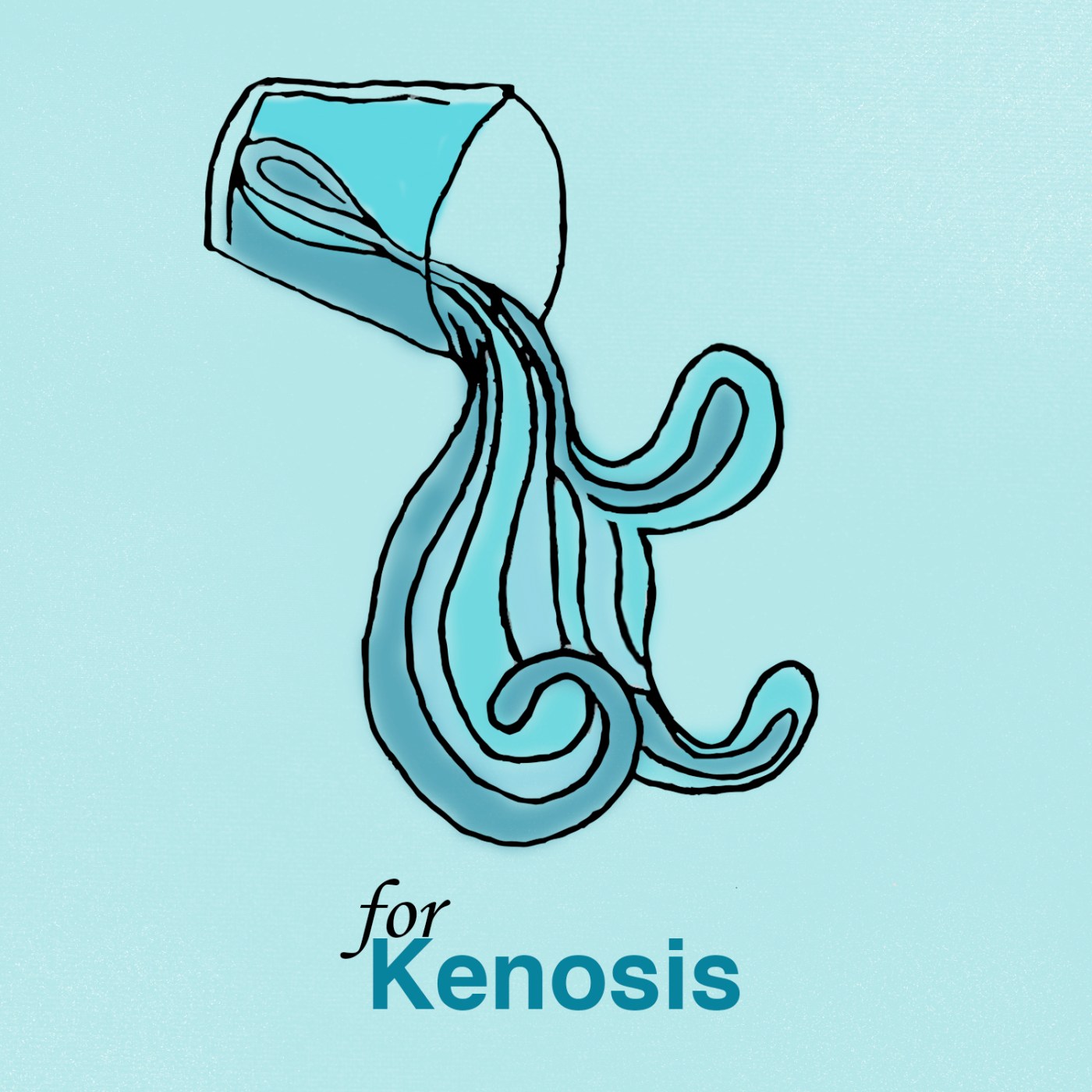
Kenosis is one of those Greek words in the New Testament that I wish went untranslated in English. It is a special and mysterious word that would be great just left as it was and put in italics by Bible translators.
I have a list of words that I wish remained in Greek. Words like agape, kiononia, kairos, and ecclesia. They are just great words that would carry some power/mystery if we did not offer an English translation.
I am a big fan of translating the Bible – in fact I think that the translatability of the christian scriptures is a major distinction from other religious traditions like Islam. We don’t have to learn the original language in order to read and interpret the Bible.
Lamin Sanneh in Whose Religion Is Christianity: the Gospel Beyond the West, says:
Being that the original scripture of the Christian movement, the New Testament Gospels are translated versions of the message of Jesus, and that means Christianity is a translated religion without a revealed language. The issue is not whether Christians translated their scriptures well or willingly, but that without translation there would be no Christianity or Christians. Translation is the church’s birthmark as well as its missionary benchmark: the church would be unrecognizable or unsustainable without it… Since Jesus did not write or dictate the Gospels, his followers had little choice but to adopt a translated form of his message. (Sanneh p. 97)
You can read an older post about this issue here.
So while I love this translatability aspect of the christian testament, I also mourn for the loss of deep and mysterious words from the original language.
Kenosis appears four times in the New Testament. Three times in is translated ‘made void’ or ‘to no effect’. The most famous appearance is in Philippians 2:7 when it talks about Christ Jesus and is translated ‘emptied himself’.
The self-emptying of God had become a big topic in the 18th and 19th century – then expanded in the theological work after the Second World War. Most people that I talk to are familiar with this concept in the work of thinkers like Motlmann and his ‘Crucified God’.
Our Pocket Dictionary defines it as:
Kenosis, kenoticism: Derived from the use of the Greek verb ekenosen (he emptied himself) in Philippians 2:7-11. Kenosis refers to the self-emptying of Christ in the incarnation, as well as his conscious acceptance of obedience to the divine will that led him to death by crucifixion. Many theologians see in the term a reference to Jesus’ choice not to exercise the prerogatives and powers that were his by virtue of his divine nature. In the nineteenth century certain thinkers built this idea into a kenotic *Christology,which spoke of the incarnation as the self-emptying of the preexistent, eternal Son to become the human Jesus. This self-emptying involved the setting aside of certain divine attributes, or at least the independent exercise of his divine powers.
Pocket Dictionary of Theological Terms (Kindle Locations 773-777). Kindle Edition.
While the concept is beautiful … it also gets really tricky really fast.
What exactly did he empty himself of? You have to be careful because almost any answer is either:
- a historical heresy
- based on a presupposition that he had that attribute in the first place
Most people go for the low hanging fruit of ‘3 omnis’ (as I call them) of omnipotence, omnipresence and omniscience. Obviously Jesus could not have been those 3 things and been human.
But once you start down this road you quickly run into your first barrier: if Jesus was lacking something that God has … how exactly was he still God? BUT if he had something that no other human had … then he wasn’t really all that like us and thus his being tempted or performing miracles is not really something that we can exactly imitate…
Many times this leads to a ‘Clark Kent’ version of Jesus where he wore a flesh suit and appeared to be human but underneath was a superman who could have done anything he wanted … it’s just that he chose not to!
This is part of why there is no end to the work of christology. Depending on your ontology (view of reality), metaphysics (beyond the physical), your view of the Trinity and your anthropology (view of humanity) … the danger of getting tied in knots is constricting.
What starts out as a beautiful word – Kenosis – hides a dangerous concept that can quickly become theological quicksand.
This is the opposite of a different ‘K’ word: kingdom.
What is often translated ‘the Kingdom of God’ in English is another phrase that I wish went untranslated: Basileia tou Theou.
From the age of Ceasars to the reign of Kings it made sense to translate it this way. It no longer does.
Not only does ‘kingdom’ not capture the nuance and possibility of expectation in Basileia tou Theou. It can actually be misleading because people think they know what a Kingdom is and are just waiting for God to take off this Clark Kent costume and take up the rightful claim to the throne!!
There are so many better translations of Basileia tou Theou. I have heard :
- Kin-dom of God (family)
- Reign of God (still too royal for me)
- Common-wealth of God (my favorite)
- Community of God (no hierarchy assumed)
I wish that we just left it untranslated as Basileia tou Theou.
You can see in these two ‘K’ words that translation is a tricky business and provides a constant supply of new material for the theological endeavor.


 Bo Sanders: Public Theology