Search

Bo Sanders: Public Theology

updating & innovating for today

Tag

politics

Moving Toward Multiplicity

Listening to Howard Zinn (author of the classic A People’s History of the United States) at a town hall meeting style presentation recorded in 2007 (you can get it on Itunes from WGBH Politics) I was struck by the need to recognize the sheer complexity of issues and multiplicity of perspectives. complexity

To state it as simply as possible: Not everything is the same. When we attempt to represent EVERYthing as if it were represented by ONE thing, we often neglect the complexity and multiplicity involved in the matter.

I will use two examples that Howard Zinn illustrated well at the community forum, then address the issues that it seemed relevant to connect to.

Zinn takes on the idea of “Family values”. Some conservative political interest say that they represent ‘family values’. But he asks “Which family?” I think it is a valid question. There are families with single moms and multiple kids, divorced dads raising a family, there are foster families, adoptive families, multi-generational families living in the same house. There are lesbian couples with no kids and gay couples with kids. My wife are were D.I.N.K.s (double income – no kids) hen she lost her job while were trying to adopt (which fell through recently) and every permeation you can imagine.

Which family is represented by Focus on the Family’s values? It is erroneous to act as if there is one kind of family and that you represent their values.

That is, unless you are saying that you value only one type of family.

That would be fair enough but you would have to stop using the phrase ‘family values’. Some families value making money or achieving success. Some value conformity. Some value religious adherence above all else. Some value military service while others value independent thinking or even civil disobedience.

Zinn says the same thing about the ‘National interest’. I am a big fan of Paul Kahn’s Political Theology and both he and Zinn talk about President’s ability to declare war or even launch the nuclear codes should the President deem it ‘in the national interest’.

But which of the many National interests? The Nation is not interested in only one thing. There are hundreds or thousands of interests. Unfortunately the reductive mono-speak is code. These buzz-words become code-words for an assume-unstated single issue that clouds the true complexity behind the language.

Zinn touched another example which has been showing up in a lot of my reading lately. The phrase ‘We the people’ is a magnificent ideal. I admire the phase and the idea behind it so much. But I think that it is worth noting that when it was written – we the people were not in the room. At the time of it’s writing, not every ‘we’ was represented.

There were no native americans in the room, no women, no blacks, no commoners. Just land-owning white males. But they had an idea – and it is that idea that we love!

I actually think that this is the exact type of trajectory mentality that we see in a progressive reading of the New Testament. When Paul says in Galatians 3:28 that “There is neither Jew nor Greek, slave nor free, male nor female, for you are all one in Christ Jesus.” He is doing this exact thing. He wrote in prophetic expectation using the 3 categories employed in his day were being broken with resurrection power. Barriers between nationality (or race), legal status and gender were being dissolved. My assertion is that it was not for the purpose of homogenization but for multiplicity! The former containers can not contain what it being poured out and welling up in Christ’s new life.

This is why I don’t sweat the fact that Paul appears to by anti-gay (though I argue that he was not anti-gay in the same way that those who quote him today are). You have to read Paul on a trajectory. Within the fruit of the Spirit of God is seed of liberation and transformation. So like ‘We the people’ – it looks forward to a greater reality than was present at it’s writing. Contained within the words is an ideal not yet realized. That is part of why I don’t want to conserve the reality of the time of it’s writing, but spring board off of it to be propelled to a greater one.

We can get caught up in reductive views that ignore the inherent complexity that we are dealing with. For instance, “Is the world essentially good or bad?” or “Are humans inherently evil or innately good?” That kind of simplicity is blind to the multiplicity of factors that we are dealing with in any conversation and allowing the conversation to be framed that way almost ensured that no progress will be made.

Good people still do bad things or even do good things with poor motivation. People who do bad things often love their own families.

We do ourselves a great disservice when we allow our media to talk about ‘the evangelical vote’ or even ‘the black perspective’ as if those parameters only mean one thing or as if everyone within designations voted the same way or believe all the same things, hold all the same values and act in unison. It is fictitious, deceptive and paralyzing.

You can’t even say ‘gun owners’ and mean one thing! Our language (and the dualism behind it) is crippling our culture.

There has been a great “De-centering” that has happened to humanity in the past 500 years. If you just look at the effect starting with Copernicus and continue to Darwin, the earth is not the center of the universe and neither are humans.

It would do us well to move from a reductive mentality (center/ order) to a dynamic interplay of emergent elements. When we recognize the complexity and multiplicity involved in the reality behind our ‘code words’, we will begin to access the real issues that face us.

Hopefully the Politicizing of Rape is over

This is part of  a series over the next 2 days of posts that were written a month ago. It is interesting to read them now. I will tweak the intros to each, but I fear that they will be ongoing issues until we seriously revisit some of our flimsy thinking behind these subjects.

Yet again a Republican candidate came out with an outlandish comment about rape  that has drawn widespread criticism from those outside the ideological bubble.

  Indiana Congressman Richard Murdoch, during a debate, made the latest in what has become a consistent string of rhetoric for white conservative men – notably on the heels of Senate candidate Todd Akin’s introduction of ‘legitimate’ rape into our vernacular.

Apparently Akin, who is on the House Science Committee, thinks that a women’s body can sense if the conception was because of ‘legitimate’ rape and take of the matter on its own. Richard Murdoch took it a step further, beyond biology, and introduced theology into the mix. The resulting pregnancy would be ‘God’s will’.

 Let me be clear: I get why some people hate abortion. I do. I get it. I was raised watching movies like ‘Silent Scream’ and listening to Carmen rap/sing about our nation’s demise and invitation of God’s wrath.  I get it. That is not what I want to address here.

 My concern is with the consistent and frequent rhetoric that is coming from the conservative right on the issue of rape. 
There are 3 reasons that this hits so close to home for me:

  1. My wife ran the rape crisis hotline and prevention education for the county where we lived in NY. For a decade this was a major part of our life and focus.
  2. As a minister, I have sat with countless women and heard their stories. We have walked a really tough road of recovery and healing with many.
  3. I have traded my narrow/shallow theological adolescence for a more critical-aware- sophisticated-and progressive one.

These three things come together is a very painful way for me when I hear these continuing statements from non-women candidates.

 One starts to ask “What exactly is going on with these guys? What in the world are they thinking?”
If two is a trend and three is a pattern then this is a full-blown school of thought!

Are they just trying to fire-up their base? Are they trying to out religion each other? Are they so fixated on abortion that it blinds them to the absurdity of their other positions?

 Or is it worse than that?  Is it that there view of God is fundamentally determining this stuff?  I’m afraid that this might be true. I think that these might be really good hearted christian men who have bought into a view of God that is so limited and narrow that it necessarily dictates utterances like we have been hearing.

I am suspicious that one’s view of God is like an operating system on a computer and that given enough time, this N. American conservative/fundamentalist program that gets downloaded just inherently comes with some unavoidable glitches and bugs that eventually result in stances like we have been seeing.

Thomas Jay Oord posted the following on Facebook:

 Candidate Richard Mourdock’s statements about rape, pregnancy, and God’s intentions point out a major problem with most theologies. John Calvin summarized the problem well, “There can be no distinction between God’s will and God’s permission! Why say ‘permission’ unless it is because God so wills?” The Mourdock episode suggests that those who (rightfully) object to his statements implicitly support a view of divine power closer to process theology’s view, even though they may not realize it.

 I’m not trying to pick a fight.  I am not trying to be partisan. I am simply heartbroken about these hurtful things that have consistently come to the surface during this election cycle.

Maybe a new guideline should be put in place: as a candidate you are not allowed to talk about rape unless you have walked a mile in those shoes.

At a minimum, I would like to see the name of God disconnected from this subject in political arenas. 

I Voted For the First Time Last Week

Seven days ago I voted for the very first time.  I wasn’t sure I wanted to puncture the seal – cross that threshold – and break my long string of abstaining.

 Here is the background on why I have never voted: 

  • In High-school my family moved from the Chicagoland area to Saskatchewan, Canada. After High-school I stayed in Canada to play football when my family moved to NY and I became a dual citizen.

When you come of age outside your culture of origin, you see some stuff within that culture a little differently. Voting (and politics in general) was one of them. I didn’t see its impact locally like I would have if I was a farmer or a school teacher, I saw it through the media circus. Loyalty and responsibility take on a different meaning when you have dual belonging.

  • When I got filled with Holy Spirit and called to ministry I was initiated in a very dualistic form of evangelical charismatic christianity. It was spiritual in contrast to physical. Church in contrast to world. Supernatural in contrast to natural.

I was a zealous young man and so I took it further than most. Many would quote the verse “we are in the world but not of the world”. I would take it further and quote 2 Timothy 2:4 “”No good soldier gets entangled in civilian affairs, but rather tries to please his commanding officer.”  I followed the Lutheran idea of ‘two kingdoms’ (kingdom of God and kingdom of this world) all the way down.

  • When I became Ordained I not only opted out of Social Security (which ministers are allowed to do in their first two years of filing taxes) but I registered with the Government as an objector.

I am a registered objector. I indicated that what remaining taxes I did pay, I did not want them going to pay for wars … and this was before W was in office (!). I would tell people “I am not political. I am focused on the spiritual realm not the physical. The government takes care of people in this way, I take care of people in a different way. Plus, I don’t want my loyalties in the natural realm to limit my ministry to people in the supernatural.”  It actually worked quite well for me for a time. I was very vocal about my opting out of the system and in my congregation was a eclectic mix of New England Democrats and pre- Fox News Republicans.

Here is why I was thinking about voting for the first time: 

  •  I no longer subscribe to the dualism of natural – supernatural, physical – spiritual, or church – world. I have shed my understanding of Luther’s two kingdoms.  I read Jesus’ admonition about “In the world but not of the world” differently now … and all it took was an introduction to Biblical scholarship and some Roman political history. 
  • Randy Woodley was my mentor in seminary and he would ask me to explain my politics to him and then challenge me that it was incoherent and inconsistent. I play my conversations with him over and over in my head. Once you study colonial history (or even 20th century history) you realize that to be silent in the face of systemic oppression and repressive legislation is to become complicit with the injustice and suffering that the God you claim to serve is so opposed to.
  • I read Martin Luther Kings “Letter from a Birmingham Jail”  and realized that I was one of those white ministers he was talking about being disappointed in and let down by.

“First, I must confess that over the past few years I have been gravely disappointed with the white moderate. I have almost reached the regrettable conclusion that the Negro’s great stumbling block in his stride toward freedom is not the White Citizen’s Counciler or the Ku Klux Klanner, but the white moderate, who is more devoted to “order” than to justice; who prefers a negative peace which is the absence of tension to a positive peace which is the presence of justice; …Shallow understanding from people of good will is more frustrating than absolute misunderstanding from people of ill will. Lukewarm acceptance is much more bewildering than outright rejection.”

  •  The attacks on September 11, 2001 and the Bush-Cheney-Rumsfeld (and Halliburton) parley into two wars under the false guise of ‘Weapons of Mass Destruction’ haunts me when I think of how a different administration might have proceeded differently.
  • As one getting their PhD in Religious Education I have become all too aware of the impact of economic and bureaucratic decisions on children’s education. I don’t see how you can know what I know now and not do something so little that can make such a big change for so many.
  • I live in California where we don’t just vote for candidates (which I was still leery about) but we also vote on propositions. Some of these propositions directly impact school budgets and it would be gross neglect to stay silent on them when our public schools are in such desperate shape.
  • The Paul Ryan budget was and is immoral and unimaginable. I was still siting on the fence about voting – even with the whole Tea Party and Occupy movement thing – until Romney’s selection for his Vice Presidential running mate. I have watched the union stuggles in Wisconsin and Chicago, I have listened to the disgusting rhetoric of this latest financial crisis and continueing bailouts of Wall Street and too-big-fail banks… but when Romney picked Ryan … and I had just recorded that interview with Randy Woodley … I was horrified.

 Why I was still hesitating: 

I read Chris Hedges ‘Death of the Liberal Class’ and can not shake the nauseating reality of just how broken our democratic system is. Both candidates are owned by big business and the election (thanks to the Citizens United decision) is a sham.

It seems to me that to participate in a process this corrupt is to somehow be complicit with the immorality and to sanction or validate these compromised actors.

I have gone this long and there is just something in my identity, something about the way that I imagine myself and tell my story that can not conceive of crossing that line – of breaking the seal and entering into this realm. It was the strangest thing to think about.

 In the end: 

Smiley and West is my second favorite podcast in the world (next to the one I am on). No, President Obama did not do so many things that he said he would do the first time (like close Guantanamo) but … he also did some stuff (like health care reform) that was much needed (although I question the for-profit nature of our insurance companies).

I’m still leery about endorsing professional politicians, but in the end I just didn’t know how I can have learned what I have learned about education in the country and not do something that would so greatly impact the young people – and disproportionately young people of color.

After all, I would hate to have the problem of Christopher Reeve that I spoke so harshly against.

 I am interested in any thoughts on my journey and process.  Comments? Questions?  

Democracy, Pentecost, and the Old Testament?

  • Is it possible that democratic desires are present in the Old Testament and I have just never seen them before?
  • Is the de-centering of Pentecost and the empowerment of the people foreshadowed in the Old Testament?
  • Can we say  A) that Pentecost in the undoing of Babel and B) that God’s desire has always been for the voice of authority to reside in the people (multitude) and not in top-down leaders?

Here is why I am asking:

Recently I stumbled on what might be the most interesting reading of Moses at Mirebah I have seen. It comes from the book Emergency Politics by Bonnie Honig (also on Kindle). In it, she is engaging the theology of Franz Rosenzweig – a contemporary and rival to the German (later Nazi) Carl Schmitt who famously said “” Sovereign is he who decides on the exception.”

In Numbers chpt 20, Miriam passes away. She had been a prophetess for the people and had challenged Moses’ authority on occasion. Immediately after her passing (this will become important) the people realize that there is no water and press Moses and Aaron for solutions. Moses and Aaron step away from the people to seek God and receive instruction to “take the staff and speak to the rock – it will pour out water before their eyes”.

Moses, as you may remember, doesn’t follow instructions to the ‘T’. He ad libs a little bit.  He does indeed gather the people but then he veers from the plan. He chastises the people and then strikes the rock. Two things happen:

  • water does indeed come out
  • God is displeased with Moses and will not let him enter the land that is promised.

I have preached this passage many times and have read lots of treatments. I am intrigued by this passage and have always been unsettled by one detail in the story, which I have never been able to resolve:

why does the Lord tell Moses to take the staff if he is just going to speak to the rock? Why even mention the staff?

Here is where Honig and Rosenzweig bring a unique reading. The staff represent something magical like sorcery – or the miraculous for the early 20th century. This is a political theology and what is at stake in the suspension of law in emergency conditions. Can a sovereign power suspend law in the same way that  God suspends the laws of physics in order to preform miracles? Leaders, being empowered by God, the thinking goes, could suspend ‘normal’ activity if they determined an exceptional circumstance.

In Honig and Rosenzweig’s hermeneutic the dispersed empowerment of the people (multitude) is the location for God’s will and is intended to be home to the will/voice of the Lord. But, as we know, this responsibility had been too overwhelming and was resisted by the people in selecting Moses as a king type who would speak to God for/instead of them (Exodus 20:19). This was an abdication by the people of what the Lord had desired for them as a people – to be prophets all.

This resistance is reinforced when the voice of the people rises in the absence of water, and Moses (along with his brother Aaron) turn away from the ‘stiff necked people’ and receive instruction to speak to the rock. Moses then, probably importing the top-down authoritarianism of his Egyptian upbringing, disobeys the command to speak and instead, chastises the people and strikes the rock with his staff in an act of magical sorcery. God, though it produces water, reprimands this act, and Moses is disallowed from entering the promised-land with the people.

This event is placed within the historical context, earlier in the passage, where Miriam passed away and immediately the people realized that they had no water and held a council against Moses and Aaron. Miriam’s name alludes to water and she was the sister who placed Moses in the Nile’s water when he was an infant. She had been the only one to challenge Moses’ authoritarian ways and she provided, as a prophetess, a check to Moses’ power. Without her, this reading states, Moses proved he will give the people … “not authentic prophecy, but sorcery.” In not recognizing the predictive prophecy of the people (and Miriam), Moses loses his leadership of the people.

Honig utilizes Rosenzweig’s two types of prayer – one that spontaneously arises in a situational moment, and another that is used by the community and creates an openness or receptivity – to analyze the judicial deliberation surrounding the Bush v. Gore presidential ruling. By imagining that the people could have risen up in expectation of a serious effort to count valuable democratic votes instead of waiting for a Schmittian top-down rule from the authorities. The sovereign power might have been within the people prepared for and receptive to the sign instead of what came from above it – a rupture from beyond them. This expectation is foreshadowed within the Mosaic tradition that one day all of the people would be prophets (like Miriam).

Honig asks if this metaphorical reading (which it expressly is)  is a good model for democratic politics and a comparison of the  “state of legal exception to the divine rule of god”. The people, she says, when bound together can give to themselves the powers of state and can again decide to suspend them when, as a multitude, they are oriented and receptive (having been prepared) to the consequences of such action and what they point toward as a sign.

This, in the end, is the problem with magical thinking! We abdicate our power as the people – to be receptive to and bring forward the voice and will of God – in favor of looking to magically empowered leaders to suspend the rules that govern due to exceptional (or emergency) circumstances and hand down solution (metaphorically) through sorcery.

It makes sense then why the Lord even mentions the staff if Moses is ultimately to speak to the rock. It is a metaphor (symbol) of concentrated power that is present but to be resisted in lue of the prophetic possibility of speaking. In that speaking, which is to be located in the people (multitude) prepared by prayer, that a sign is revealed that points to a greater reality. We never hear that voice if a receptive people continually abdicate that potential to exceptional leaders who are expected to provide magical results.

God’s of use of authoritarian leaders would, in this line of thinking, always be either a temporary measure, a concession, or a deviation from the Lord’s will to have the voice housed in the God’s people.

I started with questions and I will close with one:

  • What kind of effect would a reading like this have the kenosis  of Philippians 2 and that weird conversation in 1 Samuel 8 where the people want a king and God says “trust me, you don’t – you only think you do” ?

Four is greater than Two: Good Friday repentance

So often when I hear two groups arguing, I think to myself  “the problem isn’t what we think about this subject, it is how we are thinking about it.”  If you have read posts here for any time at all you will know that I am not a big fan of dualism in general. I invest great amounts of energy examining binaries and pulling apart overly simplistic dichotomies.

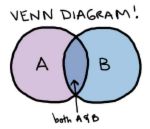
In the past I have utilized a Venn diagram to illuminate the overlap between two groups that are ‘given’ as the options. Lately, I have focused more on the 4th and 5th area.
So in American politics, when ‘republican’ and ‘democrat’ are given to me as opposites, you simply illustrate the overlapping values of the two (3rd space) and then point out those who are ‘neither’ (4th space) like Green folks and anarchists. Then draw a circle around the whole system and point out folks outside the system (5th space) like Canadians.

This semester my two classes are ‘Political Liberalism and It’s Critics’ and ‘Globalization’. It has given me lots of practice in picking up on patterns and thinking in different shaped categories.

Example 1: when a subject like ‘Norms’ is discussed – in sexual identity or sexual practices for instance – often a basic “for & against” structure is presented for any isolated topic. But as the discussion develops you can actually see that this is not a linear ‘far left – far right’ spectrum configuration – even if it is presented as such!

You quickly see that there are least 4 positions even ON a spectrum: if the far left position is “there are no norms” and the far right position is that norms are “intrinsic / originate outside the system” and implement themselves, you can imagine that a center-left position would be an emergent perspective (norms arise from below in the population and then ascend) and a center-right position of top-down Hierarchy where norms are seen to be passed down from the authorities. Recognizing those four positions facilitates a radically different conversation than just outlining two.

Example 2: when the subject is ‘Law’ or court rulings, we need to rise above elementary ‘agree’ and ‘disagree’ binaries.  There are actually 4 positions in practice.

  • Agree & Obey
  • Agree & Disobey
  • Disagree but Obey
  • Disagree and Disobey

It is essential to admit that in any population there will be great variety, disparity, and diversity – so we do a terrible disservice to the matter when we reduce the matter down to basic dichotomies.

The reason I bring this up is because I am very concerned about the round-and-round cul-de-sac conversations that I hear over and over again in the church. I am growing convince that as contemporary Christians, the issue is increasingly not what we think but how we think about it.

The issues of abortion, homosexuality, biblical inerrancy, the creeds/ orthodoxy, environmentalism, and women in ministry are just 6 examples of matters where the dualisms are killing us.

One of the best things that could happen this Good Friday would be for those who take the Christian story seriously to die to – not what we think – but how we think about it. My dream would be for a heart of repentance: to decide in our hearts to swear off inherited dualisms and pledge to, as a community, look for and develop better ways of framing the issues that matter to us most.

Challenge: This Friday, repent of either/or thinking and die to the dualism of us/them for/against right/wrong in/out thinking.  Ask your small group to hold you accountable and maybe even join you in a new life (Easter) of the mind.

disclaimer: some of you will finish this post and think ‘it was so remedial it was barely worth reading’ and others will think ‘that is crazy talk – you are either right (on God’s side) or you are plain wrong – there is no middle ground.’ But we have to start somewhere, and this is the world we live in.


Bending the Spectrum

I have never been a big fan of ‘spectrum’ thinking. The language of far left and far right  just rings hollow for me. It is insufficient for the most part and in the end, inaccurate.

I read the book The Argument Culture by Deborah Tannen more than a decade ago and said out loud “Oh! So THAT is why I bristle at the either/or, Republican/Democrat, Right/Left dichotomy! – now it makes sense.”

I reject the spectrum at every turn … but recently I have begun to make an exception in regards to the spectrum. The spectrum is only applicable for someone who thinks that there is a spectrum. I will only try to get them to see that not everyone exists on a spectrum nor are they accounted for by a right-left binary. I no longer try to dislodge them of the notion as a whole – I only try to introduce that a spectrum is incomplete and insufficient.

Lately I have been overwhelmed – probably because it is an election year – by binary language and dualistic thinking. In these conversations I have discovered that it can be quite effective to introduce a simple word play. Spectrums are not straight lines – like light, they bend.

You may think that this sounds overly simplistic but just think about the rise of the Tea-Party and the emergence of the Occupy movement coming in roughly the same window of time. Now those two groups would say that they stand for completely different things. To an outside observer, however, for all the minor distinctions they share a ‘Major’ concern: the system is broken and we can’t trust our leaders to fix it.

This week, I am starting a series working though the Death of the Liberal Class by Chris Hedges. He begins the book with a 25 year old former Marine walking along a highway in Upstate NY that I driven. He is disillusioned with the economic and political systems and is getting ready to do something about it. At one point the young vet says:

“I could see there was no difference between the two main political parties. There is a false left/right paradigm which diverts the working class from the real reasons for their hardships.”

I am looking forward to the series in the exact inverse proportion to how much I am dreading this election cycle.* I have lots of Tea Party types in my life and many Occupy sympathizers as friends. I hear them both saying that the system is not working and that those in charge are not capable of fixing it, that we the people need to be more hands on.

Chris Hedges analyzes the crisis and articulates the root causes better than anyone I have found. The slant of the series will revolve around one simple question “IF Hedges is right about the world – how then should we do theology?

The Tea Party, the Occupy Movement, the global economic crisis and the ongoing wars are telling us something … and it is not about the End of Days. Doing theology in this environment will inherently have some continuity with historical approaches but it will require some tools that may not be familiar to us as well as some necessary innovations.

 The left and right think that they are far apart, but in a bent system they are closer than they would believe. At some point on an arc the far right and the far left almost touch.

I end the way Hedges begins, with a quote from George Orwell:

At any given moment there is an orthodoxy, a body of ideas which it is assumed that all right-thinking people will accept without question. It is not exactly forbidden to say this, that or the other, but it is “not done” to say it, just as in mid-Victorian times it was “not done” to mention trousers in the presence of a lady. Anyone who challenges the prevailing orthodoxy finds himself silenced with surprising effectiveness. A genuinely unfashionable opinion is almost never given a fair hearing, either in the popular press or in the highbrow periodicals.  “Freedom of the Press”

* Tavis Smiley has been saying for quite a while that this will be the ugliest and most racist election in modern times.

I also posted this at Homebrewed

Blog at WordPress.com.

Up ↑