Search

Bo Sanders: Public Theology

updating & innovating for today

Tag

progressive

When Good Is Not Enough (3/3)

This week I have been writing a little about my interest in Practical Theology (PT) and  the subsequent philosophical orientation with which I will be engaging research: social constructivism. 

I had some very heady (and public) conversations with colleagues this Summer who desperately wanted to paint me as a ‘Liberal’ who is afraid of my own shadow (afraid to admit it/come out of the theological closet, etc.)

My assertion was that, as a social constructivist, I am more in a agreement with communitarian concerns than I am with liberal loyalties. Communitarians have a very harsh critique of liberalism where it:

considers classical liberalism to be ontologically and epistemologically incoherent, and opposes it on those grounds. Unlike classical liberalism, which construes communities as originating from the voluntary acts of pre-community individuals, it emphasizes the role of the community in defining and shaping individuals.

While I clearly hold some positions that overlap with liberal stances, and while I do presently serve at a classically Mainline church that exists within the liberal tradition of church expressions … I do not do so as a liberal. I grew evangelical, went very charismatic and then emerged into whatever kind of deconstructed christianity this is.

I jokingly said that I don’t identify as a liberal for the same reason that I don’t wear a medium-size Tshirt. It doesn’t fit and doesn’t cover some things I find important (ie. my belly).Facade of St. Vitus Cathedral

The problem with being progressive:

I have flirted with the idea of just being a progressive even while I bristle at the notion of societal evolution, inevitable progress or the consequences of a colonial notion of ‘civilization’.

I realize that some liberals have engaged in post-colonial, feminist or liberation approaches – so that those concerns are not mutually exclusive.

So what do I mean when I say that Liberal doesn’t go far enough?

 Take post-colonial concerns

Classic liberalism has had two responses to the colonial problem. I will call them:

assimilation and reservations.

They can either come to us, act like us, learn to think like us, speak like us and live among us … or they can go over there and do their own thing without bothering us.

In fact, is it self-congratulatory either way. If indigenous folks assimilate we feel validated as open and accepting – even multi-cultural or diverse! If we ‘give them their own space’ we pat ourselves on the back for being understanding and accepting of other cultures. Let’s be honest – at least it isn’t conquest and genocide after all.

Neither one of those approaches is satisfactory. The first is unacceptable because it still presumes the hegemonic power of the dominant culture and it is looking at the indigenous community as something that needs to be absorbed, adapted or modified. The second is unacceptable because it sees the two cultures as incommensurable without realizing the power differential to  conquest.

I am not looking for a nicer, more gentle version of colonialism or empire. As a researcher-advocate, I want to hear the voice and experience of impacted communities in their own words. If that leads to an opportunity for partnership, great. If not, I have to accept that I am not in control of the outcome nor am I referee to make sure that people play by my rules. In the post-colonial context, indigenous peoples are not to be adopted & adapted … nor are they to be ‘left to their own devices’. Neither of these approaches is acceptable.

Something else is needed. Practical Theology and its qualitative methods provide me a starting point to engaging in a different way – one that addresses larger issues of systemic and institutional concerns, one that hears the voice of the communities most affected, and one that provides the possibility of change in the real lived experiences of those involved.

Let me give you an example. James Cone writes near the end of ‘The Cross and The Lynching Tree’:

White theologians in the past century have written thousands of books about Jesus’ cross without remarking on the analogy between the crucifixion of Jesus and the lynching of black people. One must suppose that in order to feel comfortable in the Christian faith, whites needed theologians to interpret the gospel in a way that would not require them to acknowledge white supremacy as America’s greatest sin. 

Then Cone comments on perhaps the quintessential evolving- liberal theologian that America has ever had:

Reinhold Niebuhr could write and preach about the cross with profound theological imagination and say nothing of how the violence of white supremacy invalidated the faith of white churches. It takes a lot of theological blindness to do that, especially since the vigilantes were white Christians who claimed to worship the Jew lynched in Jerusalem.

I hope that these past three posts have helped to clarify why Practical Theology holds possibilities for me as a discipline and why I have chosen a social constructivist orientation within the research.

Thank you to everyone who has taken the time to read these 3 posts and to give me such high quality feedback and/or affirmation.
That Liberal Label

It has been a while since I posted here and part of the reason for that is that I have embroiled in a bit of a kerfuffle. I didn’t go looking for it but it came and found me. Anyway, here is a part of my response to all of the hullabaloo.
Once is an incident. Twice is a trend. Three times is a pattern.

This the now the 3rd time this thing idea about shying away from the label ‘liberal’ has come up.

  1. I heard it for the first time almost 10 years ago: “Emergents are just cool liberals”. This came from conservative, evangelical and reformed folks who were squawking at the Blue Parakeets that were new to the yard.
  2. More recently Fitch & Holsclaw leveled the accusation in their new book Prodigal Christianity and Tony Jones took exception.
  3. Then last week the idea was suggested on a different blog that Tripp & I were really just closet liberals who where afraid of the label because of its intrinsic baggage.

I tend to bury my big point in the final quarter of every blog post. For the purpose of clarity I am going to begin putting them at the top of the post. Here is my main point:

There is nothing wrong with being liberal. It is one of many valid ways to participate in the christian tradition. If I were liberal I would be so proudly. I am not liberal. Liberal approaches do not go far enough to combat capitalism, address colonial consequences or repent of the Constantinian compromise that led to Christendom it’s subsequent horrors.

I am not liberal. While Tripp and I are left-leaning. We are progressive. We are postmodern in our approach. We are emergent in our expression. We are playfully heretical (in a good way) and we are innovative where appropriate given our christo-centric hyperTheism.

But I am not liberal. Liberalism doesn’t go far enough in addressing five of my biggest concerns:

  • Critique of Capitalism and Consumerism
  • Post-Colonial consequences
  • Continental Philosophy’s reflection on late modern thought
  • Criticism of Christendom (Western and Constantinian)
  • Our cultures’ dangerous cocktail of Nationalism and Militarism

I have written extensively about how Progressive is not Liberal and even got taken to task over at Scot McKnight’s blog for trying to make that distinction. I will say this again:

There is nothing wrong with being liberal. It is one of many valid ways to participate in the christian tradition.

If I were liberal I would be so proudly. But alas I am not.

One last thing in closing:  I understand the historic drift of the term ‘Liberal’. I know what it meant in the 1700’s (specifically as it relates to individualistic epistemology) and I understand what it has become in the late 20th century (a constellation of loyalties and identity markers). I also know about it’s demise as an impotent political approach and I get why some evangelicals are allergic to the term and thus why some would desire to shy away from it. I get all that. I even recognize the unique draw of its individualistic epistemology. 000_0008

What I am saying is that calling me a closet liberal who is afraid to be identified by the label is like saying that I don’t wear ‘medium’ sized T-shirts because I don’t like the letter M. It is to miss the point. I don’t wear medium sized T-shirts because they are not big enough and don’t cover some essential areas that I deeply care about.

i.e.  It just doesn’t fit.


Liberal Question part 2: Jesus Creed

I had the honor of guest blogging for Scot McKnight a couple of weeks ago. It was a good opportunity to try something out with a different crowd. It was  instigated by last weeks post in response to Roger Olsen and Scot McKnight.Facade of St. Vitus Cathedral

It was a fantastic conversation and I learned several things that I will take with me into future engagements. Here are some observations:

  • I learned to clarify the difference between people in the pew and theologians.

I go to a mainline school and work at a mainline church. I have an amalgamation in my mind of the ‘average liberal’.  But if you are in the conservative camp, your main engagement and concern is with Liberal theologians who have a high profile.

If was starting the post over, I would address this up front and make an early distinction. I think that would have helped.

  • I learned not to use the word ‘versus’ if you don’t mean adversarial.

Neither Scot nor I think liberal is necessarily  a bad thing. Roger Olsen does. But some of the readers at JesusCreed think in adversarial binaries. I was not trying to say that progressives are good and liberals are bad. I was simply trying to distinguish the two – not pit them against each other. The argument culture is so strong – especially in conservative circles – that I should have preempted that.

  •  I learned that those in systematic approaches struggle to recognize non-systematic approaches.

This is an obvious and inherent problem. If you value systematic approaches, of corse you will criticize something as ‘not systematic’ and think that stands alone are a critique. I was trying to point out that conservative, liberal, evangelical, emergent, and progressive are not 5 categories of the same thing. Some are positions. Some are loyalties. Some are approaches.

Here is what I ended up with: 

Since my Cobb quick-definition was not working for folks I thought I would ‘shift’ the emphasis and see if this language worked better:

Liberal – a constellation of loyalties inherited from the Enlightenment that is settled/assumed.

Progressive – an approach that integrates such influences as Feminist, Liberation and Post-Colonial critiques explicitly.

I’m open to help refining this – ESPECIALLY  if you are a self-proclaimed  liberal or progressive

My favorite response came from TJJ and it has me smiling ear to ear.

Qualities of a progressive ………as viewed by an evangelical……….

A. See more “grey” in their approach to scripture issues: inspiration, inerrancy, revelation.
B. Allow for more of a continuum on doctrinal/theological issues: hell, salvation, sin, depravity, exclusiveness of Gospel, etc.
C. More open ended on social issues : gay marriage, illegal immigration.
D. Trends more democratic/progressive politically
E. White, college degree and often more, affluent, alcohol, NPR, Toyota/Honda, MSNBC/CNN

Oh my. That is good.

At first read you may say “yeah – of course”.

But look at it again. It’s actually pretty helpful to see it all in one place.

I would love to hear your thoughts on any part of this whole episode. 

Moving Toward Multiplicity

Listening to Howard Zinn (author of the classic A People’s History of the United States) at a town hall meeting style presentation recorded in 2007 (you can get it on Itunes from WGBH Politics) I was struck by the need to recognize the sheer complexity of issues and multiplicity of perspectives. complexity

To state it as simply as possible: Not everything is the same. When we attempt to represent EVERYthing as if it were represented by ONE thing, we often neglect the complexity and multiplicity involved in the matter.

I will use two examples that Howard Zinn illustrated well at the community forum, then address the issues that it seemed relevant to connect to.

Zinn takes on the idea of “Family values”. Some conservative political interest say that they represent ‘family values’. But he asks “Which family?” I think it is a valid question. There are families with single moms and multiple kids, divorced dads raising a family, there are foster families, adoptive families, multi-generational families living in the same house. There are lesbian couples with no kids and gay couples with kids. My wife are were D.I.N.K.s (double income – no kids) hen she lost her job while were trying to adopt (which fell through recently) and every permeation you can imagine.

Which family is represented by Focus on the Family’s values? It is erroneous to act as if there is one kind of family and that you represent their values.

That is, unless you are saying that you value only one type of family.

That would be fair enough but you would have to stop using the phrase ‘family values’. Some families value making money or achieving success. Some value conformity. Some value religious adherence above all else. Some value military service while others value independent thinking or even civil disobedience.

Zinn says the same thing about the ‘National interest’. I am a big fan of Paul Kahn’s Political Theology and both he and Zinn talk about President’s ability to declare war or even launch the nuclear codes should the President deem it ‘in the national interest’.

But which of the many National interests? The Nation is not interested in only one thing. There are hundreds or thousands of interests. Unfortunately the reductive mono-speak is code. These buzz-words become code-words for an assume-unstated single issue that clouds the true complexity behind the language.

Zinn touched another example which has been showing up in a lot of my reading lately. The phrase ‘We the people’ is a magnificent ideal. I admire the phase and the idea behind it so much. But I think that it is worth noting that when it was written – we the people were not in the room. At the time of it’s writing, not every ‘we’ was represented.

There were no native americans in the room, no women, no blacks, no commoners. Just land-owning white males. But they had an idea – and it is that idea that we love!

I actually think that this is the exact type of trajectory mentality that we see in a progressive reading of the New Testament. When Paul says in Galatians 3:28 that “There is neither Jew nor Greek, slave nor free, male nor female, for you are all one in Christ Jesus.” He is doing this exact thing. He wrote in prophetic expectation using the 3 categories employed in his day were being broken with resurrection power. Barriers between nationality (or race), legal status and gender were being dissolved. My assertion is that it was not for the purpose of homogenization but for multiplicity! The former containers can not contain what it being poured out and welling up in Christ’s new life.

This is why I don’t sweat the fact that Paul appears to by anti-gay (though I argue that he was not anti-gay in the same way that those who quote him today are). You have to read Paul on a trajectory. Within the fruit of the Spirit of God is seed of liberation and transformation. So like ‘We the people’ – it looks forward to a greater reality than was present at it’s writing. Contained within the words is an ideal not yet realized. That is part of why I don’t want to conserve the reality of the time of it’s writing, but spring board off of it to be propelled to a greater one.

We can get caught up in reductive views that ignore the inherent complexity that we are dealing with. For instance, “Is the world essentially good or bad?” or “Are humans inherently evil or innately good?” That kind of simplicity is blind to the multiplicity of factors that we are dealing with in any conversation and allowing the conversation to be framed that way almost ensured that no progress will be made.

Good people still do bad things or even do good things with poor motivation. People who do bad things often love their own families.

We do ourselves a great disservice when we allow our media to talk about ‘the evangelical vote’ or even ‘the black perspective’ as if those parameters only mean one thing or as if everyone within designations voted the same way or believe all the same things, hold all the same values and act in unison. It is fictitious, deceptive and paralyzing.

You can’t even say ‘gun owners’ and mean one thing! Our language (and the dualism behind it) is crippling our culture.

There has been a great “De-centering” that has happened to humanity in the past 500 years. If you just look at the effect starting with Copernicus and continue to Darwin, the earth is not the center of the universe and neither are humans.

It would do us well to move from a reductive mentality (center/ order) to a dynamic interplay of emergent elements. When we recognize the complexity and multiplicity involved in the reality behind our ‘code words’, we will begin to access the real issues that face us.

Christians have to believe something about Hell, Election and Predestination

On last month’s TNT I said something that I have heard a lot of feedback on (some positive and some negative ). I thought it would be good to continue the conversation here on the blog.

 My assertion was that: If you are a Christian, you have to believe something about hell. It is just not an option to say “I don’t believe in hell”.  The word ‘hell’ is in the English version of the Bible and you can’t just say, as a Christian, that you don’t believe it. You can hold that it was a burning garbage dump in a valley outside Jerusalem that Jesus makes a poetic illusion to … but you have to believe something about hell. 

I would go on to broaden that assertion. I would say that you must believe in predestination, election, and the Book of Revelation.

All 4 of these are topics that l have personally heard people say “I don’t believe in __”

  • You have to believe something about hell.
  • You have to believe something about predestination.
  • You have to believe something about election.
  • You have to believe something about the Book of Revelation.

It is is just not an option to say “I don’t believe in hell”.  Jesus did.  If you are a Christian, you have to hold some belief about it.

Paul spoke of predestination. Election is a theme in scripture. You can’t just say ‘I don’t believe in Revelation’.  You can object to how some people interpret and preach the Book of Revelation … but you can’t ‘not believe’ it.

 Why It Matters: 

I come from an Evangelical-Charismatic background and am now employed at a Mainline church and attend a Mainline school.  I am passionate that thoughtful progressive Christians can not make the same mistake that Liberals made in the past century. By ‘de-mythologizing’ the Bible they undercut the very foundation that the tradition is built on.

It is like sawing the very branch that your a sitting on … on the tree side of the branch! What do you think is going to happen? You are left no place to perch.

I love Biblical Scholarship. I delight in post-modern and progressive theology. I take seriously the post-colonial critique and the perspective of feminists and queer theory. But it does us no good if we know what we don’t believe about something but do not have the ability to present in a constructive way what we do believe about those very subjects.

There is so little value in participating in a community based on a tradition where one does not believe in the very words of that faith’s sacred text.

Why even do it?  I think that is why so many ‘nones’ have just opted out. I actually greatly respect those who participate in the emergent conversation and who are valiantly attempting to update their denomination from within. It is far easier to just walk away from the entire project all together … and many have.

So How Do I Do It? 

Predestination:  Forget about the historical hyper-Calvinist understanding that you ‘don’t believe in”. Romans 8:29 says “For those God foreknew he also predestined to be conformed to the likeness of his Son, that he might be the firstborn among many brothers.”

Who did God foreknow? Everyone.  What are they predestined to? To be conformed to the image of the Son.  Does everyone arrive at their destination? No.

Predestination might be, what some Process thinkers would be called, an ‘initial aim’. It is God’s desire for all. God doesn’t always get what God wants ( see 1Timothy 2:4).

 Election: Karl Barth said it clearly. God elected Jesus. All humanity is involved in that election. All who are ‘in Christ’ are elect.

 The Book of Revelation: You may not like the ‘Left Behind’ / Hal Lidsey / Jack Van Impe interpretation of the Book of Revelation … but you can’t, as a Christian, say that you don’t believe in it.  It’s in the Bible. You have to believe something about it.

The Book of Revelation was a political critique of the Roman Empire of the first two centuries written in the genre of the ‘apocalyptic’. It is not predictive of the 21st century. But we don’t want to throw it away!  What we need, more than ever, is to imitate it and write an apocalyptic critique of our as-it structures, systems and institutions of injustice and our empire. We need a prophetic imagination.

You can’t say, as a Christian, that you don’t believe in this stuff. You have to believe something about this stuff. My suggestion is that we just believe more informed better stuff about these topics. The simple fact is that we are community of people centered about a sacred text and it is simply not acceptable to say ‘I don’t believe in something’. We are free to not believe in some people’s interpretation – but we have to believe something about it. 

Thoughts? Questions? Comments? 

Dealing with Demons (a progressive take)

In the weeks since Pentecost I have posted 2 blogs about the Bible (A Funny Thing Happened and Poetics)  and then 2 about personal prophecy (Why didn’t God tell me? and Process). I love the conversations that have ensued and am amazed at the number of questions that have been generated.

Recently I was asked about ‘casting out demons’ in the past and how I reconcile that now. This is one of my favorite things to talk about, but it does require a little set-up so I will be a concise as possible and then get to it.

In ‘What had changed since I was your Pastor” I explained ‘why the natural is super’:

I am convinced that the church has made a major mistake in adopting the language of the super-natural. Since the epic flub with Galileo and Copernicus the church has allowed science to have the natural (things that make sense) and has been relegated to watching over things that increasingly don’t make sense and retreating into words like ‘mystery’ and ‘faith’ as cover for that which is just not reasonable.

I do not believe in a realm (the natural) that is without God. As a Christian, I believe that God’s work is the most natural thing in the world. I am unwilling to concede the natural-spiritual split and then leave less and less room for God as science is able to explain more and more. The church is foolish to accept the dualism (natural-supernatural) and then superintend only the spiritual part.

I would prefer to reclaim the language of the ‘miraculous’ (surprising to us or unexpected) and ‘signs’ from the Gospel of John (that point to a greater reality).

SO inside that expectation, what do you do with demons and the devil?

I no longer believe that demons are ancient fallen creatures that work for some cosmic bad army in unseen realms and attached themselves to people’s souls… or something.

I believe that demons are the ‘shadows’ that result from injury, brokeness, and scar tissue in a fractured psyche (or spirit or soul). Those ‘dark’ elements or places can manifest in the exact ways that we used to describe ‘spiritual oppression’.

The Devil is a poetic-literary device for when corporate evil is so big and bad that we outsource it (personify it) to an anthropomorphic bad guy envisioned as some overlord type.

[now, I have done this enough to know that two pushbacks are coming, so let me just say: A) Don’t quote Job. The ‘hasatan’ or the satan is not the New Testament ‘Devil’. Plus you have to read Job as the ancient play that it was (it is more like a manuscript than a newspaper report). B) The temptation of Jesus plays an important role in the gospels. stick with me, it will make a lot more sense if you don’t read the devil as ‘an ancient fallen being now terrorizing the earth’. The temptation of Christ was about identity. Not if he was Messiah, but what kind he would be. ]

When we kick demons out of people (through deliverance, exorcism, or guided prayer) we use something called “Open Doors & Broken Windows”.  We invite God’s Spirit to walk them through their ‘house’ – every area of their life – and look for places that the ‘enemy’ could have gained access. Doors are opened from the inside (you have the lock & key to your own heart). Windows are broken from the outside. That is our imagery.

  • Open Doors are decisions that you make (sin, weakness, participation, etc.) that leave you vulnerable and susceptible.
  • Broken Windows are injuries from others (abuse, neglect, violence, etc.).

Sometimes we do this topically (verbally go from room to room) sometimes we do it chronologically (starting from when you were young). Once we have find something, we take back the authority that has been given away (renounce sin) or we invite the Spirit into that place of injury to repair what has been broken and fractured.

Within Deliverance circles that are two primary schools: Authority (or power) and Truth. I am a Truth guy. I simply speak truth into that place of hurt or brokeness. The words of Christ are very powerful for healing and release. Within the Authority school there are two groups: a group who talks to (interviews) the demons; one that doesn’t but simply ‘takes authority’ over them. The theory is that you have to figure out how they got in in order to take away that root of their power. I never liked that, demons lie – they work for ‘the Liar and Father of Lies’.  I even thought that back then …

 How do I process this now? I still do deliverances but much prefer ‘guided prayer times’ without the deliverance element. The only time I will do it is if the person is convinced that there is a demon present. If this person grew up in an environment where this was taught, or has bought into a place where this is the religious teaching – I never introduce the idea, but if that is what they are being tormented by, then I help them out and meet them where they are at.

I believe that demons are the ‘shadows’ that result from injury, brokeness, and scar tissue in a fractured psyche (or spirit or soul). Those ‘dark’ elements or places can manifest in the exact ways that we used to describe ‘spiritual oppression’.

This can affect every thing from internal dialogue, to relationship, to social behavior. Gone far enough, it can even look like possession. Two important things:

  1. As Christians, we believe in the presence of God’s Holy Spirit in the world.
  2. The deliverance style prayer works just as well on shadows in fractured souls.

When someone walks into my office and they are convinced that they are being a tormented by a demon, I’m not sure that is the best time to explain to them how the ancients viewed the 3-tiered universe and the metaphysics behind it that allowed for demons. It is a time to care for that person and just translate for them.*  What they have been taught to call a demon is a personification with anthropomorphic characteristics. When we have injuries, there can emerge shadows from the fractures and scar tissue. Pastors do all sorts of counseling and this can be a way of caring for a hurting person who is really struggling inside.
I can still do 80% of what I used to do and operate in integrity. I can:

  • invite the Holy Spirit’s presence
  • walk with the person through their life
  • speak the words of Christ into that place of hurt
  • help them renounce the origin, impact and collateral damage
  • take authority over that situation and for themselves
  • confess trust in God and the power to live differently in the future
  • celebrate the freedom that is in Christ and in Christ’s work

I would love to hear your thoughts, concerns, comments and questions. This has been  long journey for me and though I no longer believe in ‘the boogie man’, I understand that this language of demons is powerful in some traditions so I work with people where they are at – I don’t need to first convince them of my perspective.

* I have at times said to the person “What if I told you that there is no such thing as a demon and that what you are experiencing is something else?” Just to test the waters. About 50% of the time the person is open and was simply told by someone else (usually the person who referred them to me) that it was a demon – which terrified them. Some times they insist, so I just go with it.

originally published at HBC

Four is greater than Two: Good Friday repentance

So often when I hear two groups arguing, I think to myself  “the problem isn’t what we think about this subject, it is how we are thinking about it.”  If you have read posts here for any time at all you will know that I am not a big fan of dualism in general. I invest great amounts of energy examining binaries and pulling apart overly simplistic dichotomies.

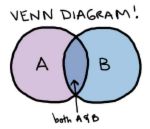
In the past I have utilized a Venn diagram to illuminate the overlap between two groups that are ‘given’ as the options. Lately, I have focused more on the 4th and 5th area.
So in American politics, when ‘republican’ and ‘democrat’ are given to me as opposites, you simply illustrate the overlapping values of the two (3rd space) and then point out those who are ‘neither’ (4th space) like Green folks and anarchists. Then draw a circle around the whole system and point out folks outside the system (5th space) like Canadians.

This semester my two classes are ‘Political Liberalism and It’s Critics’ and ‘Globalization’. It has given me lots of practice in picking up on patterns and thinking in different shaped categories.

Example 1: when a subject like ‘Norms’ is discussed – in sexual identity or sexual practices for instance – often a basic “for & against” structure is presented for any isolated topic. But as the discussion develops you can actually see that this is not a linear ‘far left – far right’ spectrum configuration – even if it is presented as such!

You quickly see that there are least 4 positions even ON a spectrum: if the far left position is “there are no norms” and the far right position is that norms are “intrinsic / originate outside the system” and implement themselves, you can imagine that a center-left position would be an emergent perspective (norms arise from below in the population and then ascend) and a center-right position of top-down Hierarchy where norms are seen to be passed down from the authorities. Recognizing those four positions facilitates a radically different conversation than just outlining two.

Example 2: when the subject is ‘Law’ or court rulings, we need to rise above elementary ‘agree’ and ‘disagree’ binaries.  There are actually 4 positions in practice.

  • Agree & Obey
  • Agree & Disobey
  • Disagree but Obey
  • Disagree and Disobey

It is essential to admit that in any population there will be great variety, disparity, and diversity – so we do a terrible disservice to the matter when we reduce the matter down to basic dichotomies.

The reason I bring this up is because I am very concerned about the round-and-round cul-de-sac conversations that I hear over and over again in the church. I am growing convince that as contemporary Christians, the issue is increasingly not what we think but how we think about it.

The issues of abortion, homosexuality, biblical inerrancy, the creeds/ orthodoxy, environmentalism, and women in ministry are just 6 examples of matters where the dualisms are killing us.

One of the best things that could happen this Good Friday would be for those who take the Christian story seriously to die to – not what we think – but how we think about it. My dream would be for a heart of repentance: to decide in our hearts to swear off inherited dualisms and pledge to, as a community, look for and develop better ways of framing the issues that matter to us most.

Challenge: This Friday, repent of either/or thinking and die to the dualism of us/them for/against right/wrong in/out thinking.  Ask your small group to hold you accountable and maybe even join you in a new life (Easter) of the mind.

disclaimer: some of you will finish this post and think ‘it was so remedial it was barely worth reading’ and others will think ‘that is crazy talk – you are either right (on God’s side) or you are plain wrong – there is no middle ground.’ But we have to start somewhere, and this is the world we live in.


Bo’s Blogs in November

Between a trip to San Fran for a conference and Thanksgiving in the mountains, I have not been blogging much this month. There are two things that I have been doing over at HomeBrewed Christianity that I am quite proud of.

The first is a conversation about the Cross.  It started with this blog post and then led to an hour long conversation with Tripp Fuller for a Theology Nerd Throwdown.  My basic take was that we have over-focused on the Cross and neglected both the empty tomb and Pentecost as Christian symbols and events.

Last week my friend A.J Swaboda said “Discipleship is photo-shopping the cross into every picture and angle of my life.”  I asked him if the empty tomb  wouldn’t be more appropriate. He said (wisely) that you can’t have one without the other.
So is that what we are doing? Is ‘the Cross’ shorthand for the whole story? Is it assumed that when we say ‘Cross’ we mean also Resurrection and Pentecost?
That would make me nervous.
Here is my concern: in the resurrection God spoke a new word over the world. I would like to live into that new word and participate with God’s Spirit who was given as a gift and a seal of the promise.
To obsess on the cross and related atonement theories is to live perpetually in the old word and to camp in the final thing that God said about the old situation.

The second is a conversation about being Charismatic/Pentecostal Continue reading “Bo’s Blogs in November”

weaving my theological web

part of being Post-foundational is a move away from thinking in “foundation stones” – building blocks that become unmovable or unquestionable over time – and moving to more a “web” of meaning or interpretation. The advantage of the web-mentality  is that it is flexible and you can adjust one part of it without the entire project crumbling into ruins.

I like this switch a lot.   Of course, no system or structure comes without it’s complications, glitches, and obstacles.

A web is not a liquid existence. It still needs to be anchored somewhere. It has to be connected to something.

I am fond of saying that I want to be innovative, but in a way that honors the original idea and provides continuity with the tradition. This desire means that I am not floating from thing to thing as if I was un-anchored. We are all, at some level, tied to both the original vision and to the modern manifestation. The first asks for accountability and the second one calls for integrity.

navigating between the original vision and the historic progression is demanding. It takes time, a little bit of research, and a whole lot of grace. In fact, I see why some people don’t want to do it. It would be easier to either A) be conservative and just set the foundation stones in place and then never need to move them or ask the original questions again or B) be destructive and/or pragmatic and just do what works now without consideration for the road that brought us here.

I have noticed a pattern lately in my conversations. There seem to be four ideas or movements that I use to anchor my web of meaning / interpretation to.  I ran this by a couple of friends and it has led to some really interesting conversations.

I am a post-conservative, emergent, progressive with charismatic leanings. – this allows me to be in conversation with process thought as well as post-modern thinkers. Continue reading “weaving my theological web”

Create a free website or blog at WordPress.com.

Up ↑