Search

Bo Sanders: Public Theology

updating & innovating for today

Tag

Prothero

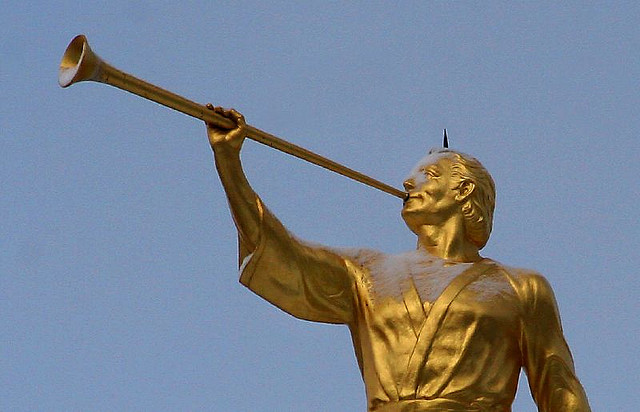
Mormons: Still Made In America

I’m taking the opportunity on this holiday Monday to take care of a whole bunch of stuff I have been neglecting. I was looking back over my HomeBrewed blogs from the past little while and was enjoying seeing this post-election.

No – we don’t have our first Mormon president yet … but it might just be a matter of time.  OR  it could never happen because of the eccentric nature of the religion and how it might never be that mainstream …

As a proud and dedicated ‘contextual theologian’, I have never been quite sure what to with Mormonism.  As in any field, questions will always come up from concerned listeners about ‘what if we take this too far’ or ‘where do we draw the line’.

In  contextual theology – since it started as a movement within missiology – the thrust has generally been about appropriate translation and inculturation between different nations, languages, and cultures. The move toward contextualization makes perfect sense within a typical framework whether it is inter-cultural or not.

In fact, in recent decades the conversation within contextual theology has moved from the old colonial missions idea of bringing a potted plant and putting it in native soil, to bringing the seed of gospel and planting it in native soil, to a more post-contextual idea of learning from the native people ‘what grows there’ and then partnering with them to integrate and advance a new crop. [for more on this listen to the podcast with Randy Woodley]

But that is a conversation about foreign missions. What do you with those who are not inter-cultural but which arise from within your very culture?

What got me thinking about all of this was a very strange little sentence in Stephen Prothero’s book God Is Not One.

In the middle of his chapter of Christianity he dedicates 3 pages to Mormonism. Among all the regular and expected material about their founder and their practices – which you can find almost anywhere – was this:

 Though long seen as dangerously un-American, Mormons are now widely viewed as quintessentially American.

He then goes on to detail the huge presence of mormons within pop culture (mostly TV).  This was, of course, before Mitt Romney becoming the presidential nominee.

The reason that comment caught my attention is that several years ago I had that exact conversation with a seminary professor. This professor was not a big fan of contextualization and said mormons were the most contextualized form of American christianity. I argued that no, they were actually a cult (as I had been taught this growing up) and he countered that this is what cults are – contextualization taken too far.

In the years since that encounter I have kept an eye on the ‘mormon thing’ and while I have evolved and adapted my views on so many things (including religious pluralism) I am still not quite sure what to do with the fact that Mormonism is truly the most American of religions.

I’m not talking about their unique beliefs or their novel practices – I am thinking more about their history and organization. It seems to me that whatever the conversation about missions and indigenous expressions that Mormonism remains that one group you have to hold out an exception for. They are exceptional in that sense. They don’t fit into neat categorization or wholly lie outside the issue either.

 Mormonism is an anomaly in this sense. They are just enough different than other groups that they can not be accounted for in predictable ways but they are similar enough that they can not be dismissed outright.

Stop Comparing Religions

I had the chance to teach adult Sunday School this past weekend as we worked our way through Brian McLaren’s A New Kind of Christianity. We are up to Question 9 “the Pluralism Question”. I had looked forward to this all Summer.

Now unfortunately I did not have the time to cover some classics on the subject like:

What I was able to do is to build on the thought of folks like  John Hick. In his famous works ,such as An Interpretation of Religions, Hick provides tour-de-force in the realm of comparative religion. He is not, however, simply reporting on religions – he is putting forward a theory about religions.

Many of Hick’s fans and critics alike end up saying the same two things when talking about him. The first is about the analogy of the mountain.  The metaphor about many paths leading up the same mountain is a pluralistic classic. The second is about the blind men and the elephant. This is of course based on a Kantian dualism between the numenal and the phenomenological.

Religions are like blind men, each with their hand on a different part of the elephant and thus describing different aspects of the same reality. One has the trunk, one the ear and one the leg. They each talk as if they have grasped the whole but in reality, they have not. Though it may appear as if they are talking about very different things (a Christian from a Muslim or Hindu) they are actually all touching the same entity.

Then there a critics of Hick.  Both Mark Heim in Salvations and Stephen Prothero in God Is Not One are post-Hickian.

Critics of Hick seem to have two main critiques (I am being very general here):

The first is that analogy of ‘paths up the mountain’ is flawed. Religions are like different paths up different mountains. The mountains may all be in a range together – in that they have some similarities and are in proximity to each other – but essentially they are not all leading to the same place. Being a good Hindu, which may have some ethic overlap with say the Christian sermon on the mount, is still not the ultimately after the same thing. Religions do not all lead to the same place and so just walking on road for long enough does not guarantee arriving at the same destination.

The second concern is about the Kantian blind men and elephant. When one takes on this enlightened view, one is placed in an elevated position above the religious traditions. They think that have a grasp on the whole but in reality it is only a part (ear, trunk, leg). The Katian-Hickian at that point is in the real seat of truth. The question then, is why would anyone ever participate in any particular religion?  Why even be a Christian – for example – and only grasp the part? Why not be a generic ‘God-ian’ and recognize the whole? In this way, studying religion is a way to not actually participate in any actual religion! Ironic isn’t it?

 Here was my main point on Sunday: the problem is comparative religion itself. The very discipline that we end up being unsatisfied with contains within it (from the very beginning) the inherent problem that we end up being frustrated with.

The problem is this – comparative religion is a product of a Western approach (with its intrinsic dualism) that first imports and them imposes it categorization upon other traditions and then looks within that compartmentalization for points of similarity and contrast. This will never work.

What I ended up doing was pointing folks toward an innovative concept called ‘Comparative Theology: deep learning across religions borders’ developed by Clooney in the book “Comparative Theology”.

His point is that each tradition tells its own story – in its own words. The art then is not in compartmentalization but in humble listening. Each learning to hear each tradition-religion bring forward its own stories, teachings, practices and values we remove ourselves from being ‘over’ the religion as a judge/reporter and humbly place ourselves at the feet as a learner/listener or at the table as friend/partner.

 I love Clooney’s approach. I find the epistemology and posture refreshing. I also think that in the inter-connected, trans-national, multi-religious 21st century it is going to be ever more critical to distance our selves from approaches of centuries past.

I have written before that I don’t want to apologize for being a Christian (I truly love it) but the time for apologetics is passing into the night of history. It’s a new day and a new approach is needed for the plurality and multiplicity that we increasingly live in. Many conservative christians hide behind exclusivism to guard against the threat of relativism.  What I love about Clooney’s approach is that they are not asked to give up their internal belief as christians but are challenged to adjust their external posture toward those of other traditions.

Create a free website or blog at WordPress.com.

Up ↑