Search

Bo Sanders: Public Theology

updating & innovating for today

Tag

quadrilateral

May Update and 1234

Thank you for all the support and affirmation during my study break!

The request to do 5 min videos instead of 10 min videos has been heard I will be redoing the series from last summer as a 2.0 theme starting with God 2.0

A new mic has been purchased and the whiteboard has been upgraded.

Here is a quick summary of 4 things to look for when framing an issue.

The Authority Question – Pentecostals & Methodists

Last month, at the Phyllis Tickle event, the ‘authority question’ came up, as it will/should whenever someone starts talking about ‘the Spirit’pentecost01

I was sitting out in the audience for the Fuller Seminary part of the evening. A little debate/concern arose about the issue of authority – especially as it relates to the rapidly growing Pentecostalism of the Southern Hemisphere.

I leaned over to the pastor sitting beside me and jokingly said “I pastored a charismatic church for a decade, and now I am at a Methodist church … this seems like the easiest thing in the world to navigate.”  The pastor requested that I blog about it.

Let’s get all the parts on the table and see how they come together:

Element 1: in the past we talked about seats or locations. Where does authority reside? Answers have included leaders, scripture, the collective, bylaws, reason, etc. Traditionally we have talked about authority in a static sense.

Element 2: in the Methodist tradition we have the Wesleyan Quadrilateral of Scripture, Tradition, Experience and Reason. (for an interesting side-read, John Cobb questions the sequence of those four elements)

Elements 3: I read a fascinating article a while ago about developments in neuroscience. Researches have long looked for which part of the brain memories reside in. It turns out that memories are not located in any one place but in the connection made between different parts of the brain.


Proposal: Authority, like memory, is not located in any one place. It is uniquely comprised of the connection between component parts. Depending on the collected aspects, the authority that emerges will be unique to that organization, congregation and movement.

Authority, therefor, doesn’t exist (per se) in that same sense that we used to conceptualize it … OR perhaps I should say it doesn’t reside somewhere – but in the connection and configuration of collected elements.


The reason that ‘the authority question’ is so elusive is because it is different in every place and is changing all the time

Authority will look different if you are Catholic charismatic in S. America than if you are a non-denominational megachurch in N. America. This is due to its emergent nature as an evolving concept.

Thoughts?

Clarifying the Quad

a quick follow up to the post from last week
– both of which were also posted at Homebrewed

 I wanted to thank everyone who gave feedback on the Four Locations of Theology in the 21st century post from earlier this week. I appreciate the comments here, on facebook, and the emails.  It has given me a lot to think about and I wanted to clarify three themes that have emerged.

Three clarifications:

  • Reason seems to be the suspicious quadrant. Every time I bring up quadrilateral, more than half of the conversation will be centered on reason. This week was no exception. Reason draws the most concern – which is funny to me because tradition is the one that I find most suspect.

Here is the thing I would want to clarify: the other 3 themes of Scripture, Tradition and Experience all have reason woven into them. Those who wrote the scriptures, those who established the tradition and even our won experience are all saturated with reason. It is inescapable. The scriptures did not fall from the sky! They passed through the author’s minds and were processed with reason. Same with tradition. The creeds were not divined in some sort of supernatural ceremony. The were constructed and reasoned. Our experiences are interpreted utilizing our filters, frameworks and lenses.

 It seems important then to clarify that those three are not independent of reason but are dynamically intertwined with it. It would be useless to take out reason (as some have suggested) because it interlinked and inescapable.

  •  It may be that the quad needs something else. Some suggested replacing one of the 4 elements with an alternative. My favorite idea came from my friend Raphael who said

 “I suggest we add a fifth source for the practice of theology in the 21st century: Imagination!”

Admittedly, it would no longer be a quad! but I think that the tradeoff is that you would get adventure and zest incorporated and not just a static, conserving, or historical product.

  • There are no guarantees. Even if we could all agree to utilize the quad for the theological endeavor, there is no guarantee that we would all come up with some thing or come out with the same conclusions. This seems to be a major concern – that we can not ensure the outcome of such an endeavor.

I am surprised at the conserving nature of such mentalities! People are ok to ‘go on the journey’ as long as we predictably end up basically where we started.
Think all you want. Explore new thoughts and incorporate science … just don’t stray too far from the foundations of antiquity!  Integrate new realities and account for ongoing historical developments … just make sure that you end up with the same thing we started with.

I have not overstated this hesitancy and resistance. But the reality is that there are no guarantees. You may start out an Evangelical and end up being an Emergent type working in a Mainline church with Process theology as your main conversation partner!  (for instance)

 In summary:

  1. You can’t get rid of reason, it is already present in the other three. Scripture, Tradition and Experience are inextricably laced with it.
  2. The quad may need a little something extra. The 21st century may require some zest, adventure and imagination
  3. There are no guarantees. While we want to honor the historical expression and provide continuity with the trajectory … it might look a little different and think a little different than it did in the 3rd or 17th century.

Thanks for all your feedback, thoughts, and concerns. I appreciate the conversation.

4 Locations for Theology in the 21st Century

originally posted at Homebrewed Christianity

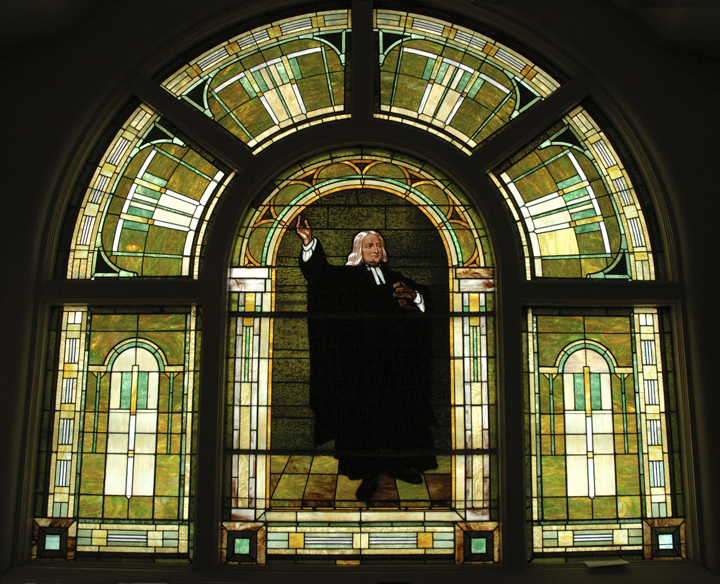
I come from a Methodist tradition that looks to John Wesley as its founder. Wesley utilized a famous quadrilateral to talk about how we do theology.
The four elements were Scripture, Tradition, Reason, and Experience.
I love the quad! I am a proud descendant of Wesley and I still find it quite helpful to utilize the same quad.  Here is why I find each element so valuable.

Scripture: No matter how fancy we want to get with our theology (I am looking at you Tillich) or whatever else we want to do (Griffin), it must account for the scriptural witness . I am not saying that we must always begin with scripture (like neo-Orthodox or Open folks) nor am I saying that we must only do scripture – but any 21st century theology must account for it. The Gutenberg and Missionary eras have reinforced a global importance and influence that must be acknowledged for any theology to carry weight. There is just no sense in having a theology that is not thoroughly scriptural if you want it to count widely.
Tradition: I grew up evangelical and developed a disdain for tradition. It was a bad word to me – like religion. It meant thoughtless, empty ritual done on autopilot in rote repetition. I see things a little differently now. Back then, I actually thought that we were free to do whatever we wanted as long as it was meaningful and effective for accomplishing the goal – which was to bring people into a deeper relationship with the living God. Now, I understand that we are all socially conditioned into elaborate human constructions. These constructs (like language or religion) are part and parcel of both the communal/social order and the religious tradition. Tradition and community must be recognized and honored since all theology is contextual theology.
Reason: I loved quoting Colossians 2:8 when I was an evangelist and someone would ask me a better question than I had an answer to
See to it that no one takes you captive through hollow and deceptive philosophy, which depends on human tradition and the elemental spiritual forces[a] of this world rather than on Christ.
It was the deceptive word play that depended on human thinking that was so dangerous to my Josh McDowell faith. I had evidence that demanded a verdict and you had tricky mental gymnastics and endless questions. I had never heard of Neoplatonism and why did I need to? I had Paul and the Epistle to the Hebrews! … Which is to say that I had never encountered the philosophical underpinnings of the New Testament writers nor of my Protestant declarations of faith.
Experience: I know that part of my fascination comes my charistmatic-evangelical roots. I know that part of it is my American protestant upbringing and that it is reinforced by my personality. But I find it on the pages of the New Testament, and I am simply uninterested a religion that is all in the head and not in the heart. I want a full body religious experience. Nice words are fine (and OH how I love nice words) but we have to walk the walk (as they say) and not just talk the talk. Theology must be validated by the community’s experience.  

I always attempt to frame things in the positive. In this case, I will also attempt to reinforce the need for all four by allowing myself to state them in the negative as well.
 Scripture: I am not interested in a Christianity that does not engage scripture or does not seek to be faithful to those initial witnesses.  We can update, renovate, adapt, evolve and reinterpret … but we must always interact with scripture. It is  scripture that we update and reinterpret.
Tradition: Let me say first that I  loath tradition for tradition’s sake. It makes be somewhere between vomitous and irate – which is not pretty. But in our global context you can’t just ‘do theology’ as if it were in a vacuum or you were starting from scratch. We are not starting with a blank slate!  I did not write the Bible, I am not the first to read the Bible – it was handed to me, was given to me and it is that ‘givenness’ that must be absorbed.
 Reason: who wants a faith the un-reasonable? Not me.  Plenty of other people do. In fact, this is really in vogue right now. Lots of conservative folks are retreating into their orthodoxy silo and playing their own isolated word games. That is a theological dead-end for the faith. It is a desperate remnant of Christendom monopoly and wholly counter to the very impetuous of the gospel they so proudly claim to defend.
 Experience: I am as uninterested in a theology that is not experienced as I am in a faith that is unreasonable.

I have been reading a lot of theology lately in preparation for the 2012 Emergent Theological Conversation. Much of it has been philosophical 20th century theology, some of it has been early century and reformation era. At the end of the day, I keep coming back to the Wesleyan quadrilateral as a framework that works for the inter-active, cross-cultural, multi-voiced engagement of the 21st century.

Create a free website or blog at WordPress.com.

Up ↑