Search

Bo Sanders: Public Theology

updating & innovating for today

Tag

reason

Wisdom of the Wesleyan Quad

The Wesleyan Quad is my 2nd favorite theological concept.

  • Scripture
  • Tradition
  • Experience
  • Reason

In this video we look at those 4 configured as a living web of interpretation. I hold that it is far better for community discernment than a foundationalist approach (the classic sequence).

Let me know if you have questions or concerns – especially about the little game of 3 minus 1.

W is for the Word of God (and the Wesleyan Quad)

There is no phrase that is more misused, or more contentious, than The Word of God. We might need to take a vacation from throwing the phrase around as a tight summary until we pull it apart and clarify its multiple uses. W-WordofGod

The Word of God, when used properly, carries three layers of meaning:

  1. Divine Communication. The prophets used the phrase in the Hebrew Testament to convey weight and authority. They had a message for the people of God that could be encouragement, directive, corrective, or illuminating.
  2. Logos – divine wisdom. New Testament believers are treated to a syncretistic twist when the Gospel of John prologue draws off the greek notion of logos and then shockingly says what no greek thinker could fathom saying: “the word became flesh and dwelt among us”.
  3. Revelatory elements in the scriptures. When the Spirit who inspired the original works illuminates the message again for a contemporary audience, it is said to be ‘the word of God’. (Thanks be to God)

For clarity I will now refer to the first and third meanings as ‘the word of the Lord’ and the second as the ‘Logos made flesh’.

The pitfall that some fall into is that they take this last sense (revelatory elements within scripture) and attempt to make it concrete (or foundational). Doing so is to erroneously confuse the messenger and message, the vessel with the element, the sign for the object.

Calling the Bible the Word of God is as inaccurate as it is accurate. It is not exactly true … but it is true enough that it is tempting. The problem is that it confused the ‘curves ahead’ road sign on the mountain road for the road up the mountain. It is not that they are unrelated – it is that they are not equivalent. The map may be accurate, and trustworthy for the journey, but it is not the landscape itself.

Knowing the map well is not the same as going on the journey.

This is the important difference between a sign and symbol.

  • A sign points to a greater reality … even if it does so imperfectly. The yellow and black ‘curves ahead’ sign on the mountain road is not telling you the exact sequence of twists and turns ahead. It is not map. It is alerting you to something bigger than itself.
  • A symbol, when used theologically, is a sign that participate in the reality that it points to. In this sense, the Bible contains the potential for the word of the Lord, it records instances of the word of the Lord, and it tells us about the Logos made flesh. The Bible is thus not unrelated to the Word of God but is not exactly equivalent either. It records and points to a greater reality (like a sign) and under the influence of Holy Spirit inspiration participates in that reality to which it points (symbol).

One can see the problem in legal court and in Sunday school. It is ironic to place one’s hand on a Bible and swear ‘to tell the truth, the whole truth and nothing but the truth so help you God’. The irony, for those who have actually read the Bible, is that it says in two New Testament passages not to do such things. We are not to swear by things but to simply let our yes be ‘yes’ and our no, ‘no’. That should be enough. We don’t need to swear by heaven or earth or anything like God. It is an odd practice.
Similarly we see things like this in the songs we learn as children:

The B-I-B-L-E,
that’s the books for me,
I stand alone on the Word of God

The Bible is not a book. It is a collection of 66 books by different authors in different centuries representing different histories, perspectives and opinions utilizing diverse genres of writing. This is part of why you can not say ‘the Bible says’.
When we say that ‘the word of God is living and active’ or that ‘all scripture is God breathed and useful’ we are right … but we must avoid the temptation of too quickly boiling those three into down into one interchangeable phrase lest we miss the awesome power and invitation provided by the interplay between them.

Now, if we mean that because of what we learn in the Bible, we hear the word of the Lord and believe in the Logos made flesh … that would be fantastic. ?If, however, we mean that the Bible is equivalent to the Word of God, then we have set our children up to be confounded, frustrated and spiritually impotent.
We have given them a road sign and told them it was the adventure. ?The word of the Lord propels us on a journey! To walk the way of the Logos made flesh, to know the truth of that which was in the beginning – with God and was God – and to live the life of the ages (eternal life).
To paraphrase a famous line – we are like children making mud-pies out of dirt in the back alley while there are real pies waiting in the kitchen.

Part of the problem is that we have try to cram too much into the phrase ‘the word of God’ and asked more from it than can be expected from any sign or symbol.
The most helpful thing I have found to address this problem is called the Wesleyan Quad. The quadrilateral is composed of 4 elements:

  1. Scripture
  2. Tradition
  3. Experience
  4. Reason

Those 4 elements also work best in that sequence.
– We go to scripture first for it records examples of the word of the Lord and points us to the Logos made flesh.
-We next consult the tradition, for religion has a given-ness to it. We inherent a living tradition and participate in its practices, rituals, ceremonies, train of the thought and teaching.
– We also recognize that importance of our community-experiences. No one is spiritual or religious on their own like no one uses language alone. We learn a language from others and use a language to communicate with others. It is not enough to know of a religion – one participates and thus experiences. We learn from and incorporate our community-experiences.
– Finally comes reason. We are made in the image of God and that divine Logos (reason) was given to us to exercise responsibly. We are not called to be robots who mechanically parrot the inherited sentences in rote repetition. There is a deep need to think about things so that our tradition does not become a dead artifact, or worse, a false idol.

The danger of what has been called ‘Bibliolotry’ is not simply that it makes the Bible ‘a paper pope’ or ‘the 4th member of the trinity’ (as bad as those seem). The danger is in missing the way, the truth, and the life that is available to us by instead settling for a road-sign instead of an adventure.


I would love to hear your thoughts about my distinction between the Word of God as the word of the Lord, the Logos made flesh and the Bible. 

Artwork for the series by Jesse Turri

For more read my earlier posts about Inspiration and about Revelation.

Clarifying the Quad

a quick follow up to the post from last week
– both of which were also posted at Homebrewed

 I wanted to thank everyone who gave feedback on the Four Locations of Theology in the 21st century post from earlier this week. I appreciate the comments here, on facebook, and the emails.  It has given me a lot to think about and I wanted to clarify three themes that have emerged.

Three clarifications:

  • Reason seems to be the suspicious quadrant. Every time I bring up quadrilateral, more than half of the conversation will be centered on reason. This week was no exception. Reason draws the most concern – which is funny to me because tradition is the one that I find most suspect.

Here is the thing I would want to clarify: the other 3 themes of Scripture, Tradition and Experience all have reason woven into them. Those who wrote the scriptures, those who established the tradition and even our won experience are all saturated with reason. It is inescapable. The scriptures did not fall from the sky! They passed through the author’s minds and were processed with reason. Same with tradition. The creeds were not divined in some sort of supernatural ceremony. The were constructed and reasoned. Our experiences are interpreted utilizing our filters, frameworks and lenses.

 It seems important then to clarify that those three are not independent of reason but are dynamically intertwined with it. It would be useless to take out reason (as some have suggested) because it interlinked and inescapable.

  •  It may be that the quad needs something else. Some suggested replacing one of the 4 elements with an alternative. My favorite idea came from my friend Raphael who said

 “I suggest we add a fifth source for the practice of theology in the 21st century: Imagination!”

Admittedly, it would no longer be a quad! but I think that the tradeoff is that you would get adventure and zest incorporated and not just a static, conserving, or historical product.

  • There are no guarantees. Even if we could all agree to utilize the quad for the theological endeavor, there is no guarantee that we would all come up with some thing or come out with the same conclusions. This seems to be a major concern – that we can not ensure the outcome of such an endeavor.

I am surprised at the conserving nature of such mentalities! People are ok to ‘go on the journey’ as long as we predictably end up basically where we started.
Think all you want. Explore new thoughts and incorporate science … just don’t stray too far from the foundations of antiquity!  Integrate new realities and account for ongoing historical developments … just make sure that you end up with the same thing we started with.

I have not overstated this hesitancy and resistance. But the reality is that there are no guarantees. You may start out an Evangelical and end up being an Emergent type working in a Mainline church with Process theology as your main conversation partner!  (for instance)

 In summary:

  1. You can’t get rid of reason, it is already present in the other three. Scripture, Tradition and Experience are inextricably laced with it.
  2. The quad may need a little something extra. The 21st century may require some zest, adventure and imagination
  3. There are no guarantees. While we want to honor the historical expression and provide continuity with the trajectory … it might look a little different and think a little different than it did in the 3rd or 17th century.

Thanks for all your feedback, thoughts, and concerns. I appreciate the conversation.

4 Locations for Theology in the 21st Century

originally posted at Homebrewed Christianity

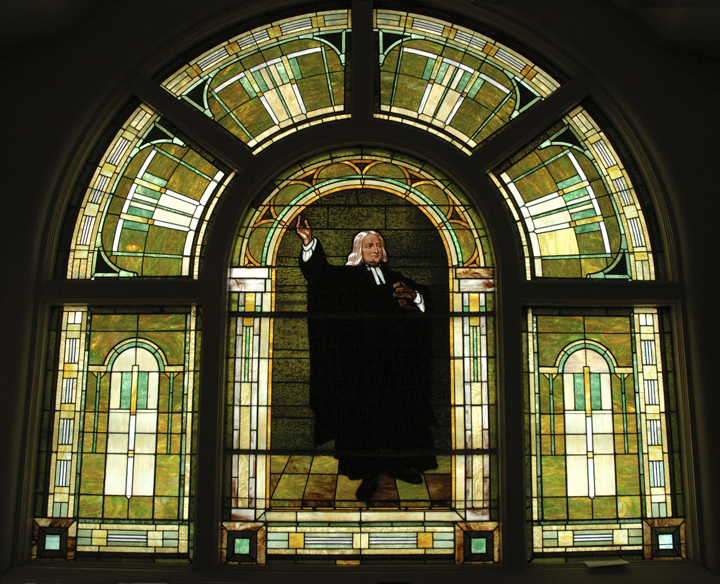
I come from a Methodist tradition that looks to John Wesley as its founder. Wesley utilized a famous quadrilateral to talk about how we do theology.
The four elements were Scripture, Tradition, Reason, and Experience.
I love the quad! I am a proud descendant of Wesley and I still find it quite helpful to utilize the same quad.  Here is why I find each element so valuable.

Scripture: No matter how fancy we want to get with our theology (I am looking at you Tillich) or whatever else we want to do (Griffin), it must account for the scriptural witness . I am not saying that we must always begin with scripture (like neo-Orthodox or Open folks) nor am I saying that we must only do scripture – but any 21st century theology must account for it. The Gutenberg and Missionary eras have reinforced a global importance and influence that must be acknowledged for any theology to carry weight. There is just no sense in having a theology that is not thoroughly scriptural if you want it to count widely.
Tradition: I grew up evangelical and developed a disdain for tradition. It was a bad word to me – like religion. It meant thoughtless, empty ritual done on autopilot in rote repetition. I see things a little differently now. Back then, I actually thought that we were free to do whatever we wanted as long as it was meaningful and effective for accomplishing the goal – which was to bring people into a deeper relationship with the living God. Now, I understand that we are all socially conditioned into elaborate human constructions. These constructs (like language or religion) are part and parcel of both the communal/social order and the religious tradition. Tradition and community must be recognized and honored since all theology is contextual theology.
Reason: I loved quoting Colossians 2:8 when I was an evangelist and someone would ask me a better question than I had an answer to
See to it that no one takes you captive through hollow and deceptive philosophy, which depends on human tradition and the elemental spiritual forces[a] of this world rather than on Christ.
It was the deceptive word play that depended on human thinking that was so dangerous to my Josh McDowell faith. I had evidence that demanded a verdict and you had tricky mental gymnastics and endless questions. I had never heard of Neoplatonism and why did I need to? I had Paul and the Epistle to the Hebrews! … Which is to say that I had never encountered the philosophical underpinnings of the New Testament writers nor of my Protestant declarations of faith.
Experience: I know that part of my fascination comes my charistmatic-evangelical roots. I know that part of it is my American protestant upbringing and that it is reinforced by my personality. But I find it on the pages of the New Testament, and I am simply uninterested a religion that is all in the head and not in the heart. I want a full body religious experience. Nice words are fine (and OH how I love nice words) but we have to walk the walk (as they say) and not just talk the talk. Theology must be validated by the community’s experience.  

I always attempt to frame things in the positive. In this case, I will also attempt to reinforce the need for all four by allowing myself to state them in the negative as well.
 Scripture: I am not interested in a Christianity that does not engage scripture or does not seek to be faithful to those initial witnesses.  We can update, renovate, adapt, evolve and reinterpret … but we must always interact with scripture. It is  scripture that we update and reinterpret.
Tradition: Let me say first that I  loath tradition for tradition’s sake. It makes be somewhere between vomitous and irate – which is not pretty. But in our global context you can’t just ‘do theology’ as if it were in a vacuum or you were starting from scratch. We are not starting with a blank slate!  I did not write the Bible, I am not the first to read the Bible – it was handed to me, was given to me and it is that ‘givenness’ that must be absorbed.
 Reason: who wants a faith the un-reasonable? Not me.  Plenty of other people do. In fact, this is really in vogue right now. Lots of conservative folks are retreating into their orthodoxy silo and playing their own isolated word games. That is a theological dead-end for the faith. It is a desperate remnant of Christendom monopoly and wholly counter to the very impetuous of the gospel they so proudly claim to defend.
 Experience: I am as uninterested in a theology that is not experienced as I am in a faith that is unreasonable.

I have been reading a lot of theology lately in preparation for the 2012 Emergent Theological Conversation. Much of it has been philosophical 20th century theology, some of it has been early century and reformation era. At the end of the day, I keep coming back to the Wesleyan quadrilateral as a framework that works for the inter-active, cross-cultural, multi-voiced engagement of the 21st century.

I am no Ignatius

Ignatius of Loyola, who founded the Society of Jesus (Jesuit order of the Catholic Church) said “What I see as white, I will believe to be black if the hierarchical Church thus determines it.”   This was #13 of his rules for thinking [link].

I have to admit that I am not Ignatius. I have no interest in this type of insistent loyalty. I know that may seem obvious, since I am a Protestant, but it has been troubling me quite a bit lately.

There are actually two parts of this that get to me. The first challenges me to question how I define authority. Where does authority come from and who decides that? It is clear that I am unwilling to live in the kind of authoritarian system that Christendom operated in. But where does that leave me? Continue reading “I am no Ignatius”

Blog at WordPress.com.

Up ↑