Search

Bo Sanders: Public Theology

updating & innovating for today

Tag

Religion

John 14:6 simply isn’t about other religions

I love John 14:6. I take so much encouragement from it and it challenges me deeply.

I love John 14:6 but I do not like what many today are doing with it: hiding behind it as a catch-all explanation for other religions...

Here is what I love about the passage and the three things I don’t like that people do with the passage:

What I love – this is a disciples invitation. It happens within a story, it is in dialogue that Jesus’ famous sentence “I am the way, the truth, and the life”. It comes in response to a very specific question. Here is the thing – the question is not “What about other religions?” The question was a disciples’ question about following.

Three things people do that scare me – My first concern is that people only quote John 14:6 and not John 14:1-5 or even 14:7. They have ripped this one sentence out of its narrative context and acted like it emerged in a vacuum. This is never a good sign. In fact, the only way this famous sentence of Jesus works as an answer to the question ‘What about other religions?’ is if you isolate it from the rest of the story and place it in a vacuum.

The second concern is that our inherited (non-Hebrew) concern with substance and our language’s (non-Hebrew) lack of relational emphasis really handicaps us when reading the scriptures. I have to explain to people all the time that when Jesus calls God ‘Father’ he is speaking relationally – he related to God as one relates to one’s pappa (or abba). He is not saying that god IS ontologically a Father. Language about God is not univocal, it is equivocal. Or, if you prefer, as Nancey Murphy points out, language is not representative of God, it is expressive. Language does not represent God is a 1:1 ratio – it is merely expressive of some aspect or nature of God.

The third concern is that in John 14:6 Jesus could not possibly have been talking about Muslims. He had never met a Muslim (as Islam didn’t exist yet) and therefore could not have been talking about them. In fact, once one comes to terms with this reality, one has to question whether Jesus would have even know about Buddhists or Hindus either. No, Jesus had probably never encountered them and certainly wasn’t referring to other religions in John 14:6.

(Unless of course you are retroactively ascribing attributes … at which point you are going to have to explain why you chose this one over other preferable ones.)

This sentence was uttered:

  • in conversation with his disciples
  • in response to a very specific question
  • as an invitation to his disciples
  • to relate to God as Jesus related to God

Where the problem seems to lie: When people miss the relational language (come to the Father as related to God), remove the sentence from its narrative context (as if it emerged in a vacuum) and assume that Jesus was referring to things he couldn’t possibly have known about … then irony sets in.

The ironic thing is that quoting John 14:6 as a stand alone explanation – without receiving it as a disciples invitation – one may actually be doing the exact opposite with that passage as Jesus was asking one to do: follow his way.

Having said all of that: Maybe Prophet Isa was talking about Muslims in John 14:6. Maybe he was saying that if they want to relate to God as he did – that they could only do so by walking his way and following his life.  In fact,  if you take away the univocal  calling God Father (ontologically) and see it as expressive (or equivocal) of relating to God as one relates to a loving father … you would remove the biggest obstacle Islam has to Jesus – namely that the Quran tells Muslims not to say that ‘God has children’.

You may think that I am way off here – but until we:

  1. stop quoting John 14:6 in a vacuum
  2. stop thinking that Jesus was talking about other religions
  3. stop thinking that Jesus’ Father language is univocal (instead of relational)

We won’t even be able to have the conversation and explore the possibility.

 

Mormons: Still Made In America

I’m taking the opportunity on this holiday Monday to take care of a whole bunch of stuff I have been neglecting. I was looking back over my HomeBrewed blogs from the past little while and was enjoying seeing this post-election.

No – we don’t have our first Mormon president yet … but it might just be a matter of time.  OR  it could never happen because of the eccentric nature of the religion and how it might never be that mainstream …

As a proud and dedicated ‘contextual theologian’, I have never been quite sure what to with Mormonism.  As in any field, questions will always come up from concerned listeners about ‘what if we take this too far’ or ‘where do we draw the line’.

In  contextual theology – since it started as a movement within missiology – the thrust has generally been about appropriate translation and inculturation between different nations, languages, and cultures. The move toward contextualization makes perfect sense within a typical framework whether it is inter-cultural or not.

In fact, in recent decades the conversation within contextual theology has moved from the old colonial missions idea of bringing a potted plant and putting it in native soil, to bringing the seed of gospel and planting it in native soil, to a more post-contextual idea of learning from the native people ‘what grows there’ and then partnering with them to integrate and advance a new crop. [for more on this listen to the podcast with Randy Woodley]

But that is a conversation about foreign missions. What do you with those who are not inter-cultural but which arise from within your very culture?

What got me thinking about all of this was a very strange little sentence in Stephen Prothero’s book God Is Not One.

In the middle of his chapter of Christianity he dedicates 3 pages to Mormonism. Among all the regular and expected material about their founder and their practices – which you can find almost anywhere – was this:

 Though long seen as dangerously un-American, Mormons are now widely viewed as quintessentially American.

He then goes on to detail the huge presence of mormons within pop culture (mostly TV).  This was, of course, before Mitt Romney becoming the presidential nominee.

The reason that comment caught my attention is that several years ago I had that exact conversation with a seminary professor. This professor was not a big fan of contextualization and said mormons were the most contextualized form of American christianity. I argued that no, they were actually a cult (as I had been taught this growing up) and he countered that this is what cults are – contextualization taken too far.

In the years since that encounter I have kept an eye on the ‘mormon thing’ and while I have evolved and adapted my views on so many things (including religious pluralism) I am still not quite sure what to do with the fact that Mormonism is truly the most American of religions.

I’m not talking about their unique beliefs or their novel practices – I am thinking more about their history and organization. It seems to me that whatever the conversation about missions and indigenous expressions that Mormonism remains that one group you have to hold out an exception for. They are exceptional in that sense. They don’t fit into neat categorization or wholly lie outside the issue either.

 Mormonism is an anomaly in this sense. They are just enough different than other groups that they can not be accounted for in predictable ways but they are similar enough that they can not be dismissed outright.

The Next Pat Robertson Gaff

With the election season over, the frequency, intensity and insanity of conservative white men making outlandish statements will hopefully die down …  I’m moving a bunch of blogs over there this week and found this cheeky little blog I wrote in the middle of the fire-storm.

 Pat Robertson topped even himself in the category of ‘insulting-inflammatory- stupid comments while the tape is running’ this morning. That may seem difficult with all of the previous entries that have earned him elite status in the gaff Olympics.

The most recent entry was in response to a question from a man who apparently wanted to know what to do with his non-submissive wife.  Robertson started with suggesting that the man could convert to Islam … and as tough as it might be to top that one, he did. After conceding that the Bible does not allow for him to divorce her, Robertson gave him the option to move to Saudi Arabia – thereby indicting not only an entire religion but an entire nation.

I know that many will want to jump on Robertson with disdain and scorn but … maybe we should not be so quick to jump to judgement. As often happens in cases like this, there is a good possibility that there is something we don’t know behind the scenes. There might be more to the story that at first meets the eye.

  • Robertson might have undiagnosed Tourette Syndrome.
  • He might have a serious drinking problem and been under the influence when he made those egregious comments.

Now, before you dismiss this outright – just keep in mind that many preachers and politicians who rail against homosexuality later turn out to have been involved in illicit same-sex affairs at the very time they were railing. This pattern can be seen in leaders of many self-righteous and sanctimonious movements.

With public figures, we just don’t know. So I am suggesting that we might want to hold off judgement. Sure, right now it looks like crazy Uncle Pat has come unglued and betrayed the very gospel that he is supposed to be a minister of and a spokesman for. But … let’s just give it time.

That is plan A.

If you can’t wait for that, there is a plan B. As I proposed a while ago, it is possible that words for fundamentalist christians are like dialogue in porn movies. They play an important role in allowing us to suspend our suspicion and get down to the real business at hand.

I said that the real activities were nationalism, capitalism and militarism. One of our deaconesses added patriarchy. This accusation would stick to Robertson’s many gaffs like a field of burrs on a cheap pair of cotton dockers.

 Here is the thing: I want to be a generous and gracious purveyor irenic ecumenism. But there are times when you hear something like this and realize how many people are genuinely injured by this stuff. Like it or not – he is a spokesman for our religion, my tradition and Jesus’ name. This is why I go so far out of my way to say that we need to stop waiting for Superman and start sticking up for causes that don’t directly impact us.

Here is a conversation that I have had repeatedly in the past 20 years.

 Me: I’m not against guns for hunting, but we have to do something about assault rifles and semi-automatic handguns.

Guy: It’s our God given right to bear arms.

Me: Wait! You probably still believe in things like depravity and original sin right?

Guy: It’s right there in the Word.

Me: Umm… those aren’t actually in the text of scripture but anyway … IF you believe in depravity, don’t you think we should account for that in our gun laws?

Guy: The second amendment protects our God given right to defend ourself.

Me: I get that, I’m just trying to say that we could revisit some things that were written in the era of muzzle-loaded muskets and flint lock rifles.

Guy: Liberal.

People don’t like when I am critical, negative, dismissive or adversarial. Neither do I.  All I am saying is that I am very nervous about what gets broadcast on christian radio and TV these days and the impact that it has on thousands and thousands of people.

So here is the question: If, and I am only asking ‘if’, there was a machine that was fueled by a different vision of the world and different priority structure than that fleeting Galilean vision – but it was covered with a thin veneer of Jesus talk as a mask for the true agenda … shouldn’t we say something at some point?

If the Jesus-paint was only a mask on a monster, or a series of brushstrokes on a Hollywood set facade … we should say something right?

That probably is why plan B in this case is not so popular.

THE most important thing in all of this is that we are very clear about people who have simply bought into a bad brand of christianity and those who are up to something with it.  It is one thing to have merely inherited a flawed-limited-unaware religious product and those who openly promote a product that injures people and harms those who need what Christ provides the most.  We have to be careful.  This stuff is wicked, acidic, and cancerous. We can’t paint with a broad brush or be dismissive of folks who are just walking the same road we are all walking together – trying to figure it out.

May God give us grace in the journey.  We need it.  Lots of it.

Certainty: the difference between emergents and fundamentalists

In chapter 7 of Predicament of Belief, Philip Clayton introduces a 6 tiered scale of epistemic certainty. Things that are nearly universally agreed upon (by the ‘community of experts’) are at a level 1. Issues like ‘Ultimate Reality’ that can not be verified but can deduced in relative certainty are at a level 2. Matters of specific religions might be a level 3. Issues particular to branches within a religion would be level 4.

Clayton has pointed out in his podcast appearances how important this type of scale is. In decades past, there seemed to be a collective ability to recognize nuance and to acknowledge differentiation between ‘core’ and ‘peripheral’ matters.

In the current climate of polarized animosity, we seem to have lost the ability to distinguish. Now everything is core.

The other way to say it is that instead of ranking issues in importance on a scale of 1-10 or holding to beliefs and theories at different levels of epistemic certainty, now everything is held at level 10.

Merold Westphal said the same type of thing in his podcast visit. Belief in the resurrection should not be held at the same level theories about the rapture (for instance).

The Reformers made an important distinction about matters of adiaphora and those essential to faith. Centuries later, I think we should at least start but reclaiming that distinction (at a minimum) and probably need to adopt something similar to Clayton’s scale to reflect the complexity of religious and inter-religious issues.

I was explaining this epistemic certainty thing to a friend a while ago. I said that I held Clayton’s real presence resurrection at like a 7 or 8 (out of 10). Process at a 8 or 9. Linbeck’s post-liberalism at a 5 or 6. Pannenberg’s eschatology at a 3 or 4. The virgin birth at like a 1. That the virgin birth provides a literary function in Matthew and Luke I hold at a 9 or 10.

My friend was shocked. He said “You are not a 10 on everything? I assumed that you held everything at a 10. When I knew you as an Evangelist, you sounded certain of everything. I just assumed that you were equally certain now.”

Now, he can be forgiven at several levels.

  1. We are both from a background where everything is a 10 and if you believe it, it is core. Nuance is not a part of the game.
  2. My voice is mostly the same as it was 10 years ago, so unless I specifically clarify or qualify the statement – it probably sounds identical.
  3. If you haven’t read Predicament of Belief or been exposed to a sliding scale of epistemic certainty or something similar … you may just assume matters of faith are held at a 10.

This, to me is the second biggest difference between say an emergent type and a fundamentalist. The first is willingness to engage scholarship and advancements in science.  The second is this ability to distinguish appropriate levels of certainty about things.

I think that it would be fun to add to all my future blogs an EC rating – “epistemic certainty” on a scale of 1-10. That way if I was talking about eschatology, folks would know to read it at a 2 (for instance). When we talk about Jesus walking on the water – a 4. The dipolar nature of the Process God – a 7.

This is a game-changer for many. As I get to talk to more and more people are migrating, emerging, adapting, and awakening to the multiplicity of possibilities within Christian theology,  just knowing that not everything needs to be held at a 10 is freeing and energizing.

 * I would go back and retrofit my recent posts with an EC rating – but my posts on pluralism and homosexuality have already caused such a stir, I would hate to mess with folk’s heads at this point.

Stop Comparing Religions

I had the chance to teach adult Sunday School this past weekend as we worked our way through Brian McLaren’s A New Kind of Christianity. We are up to Question 9 “the Pluralism Question”. I had looked forward to this all Summer.

Now unfortunately I did not have the time to cover some classics on the subject like:

What I was able to do is to build on the thought of folks like  John Hick. In his famous works ,such as An Interpretation of Religions, Hick provides tour-de-force in the realm of comparative religion. He is not, however, simply reporting on religions – he is putting forward a theory about religions.

Many of Hick’s fans and critics alike end up saying the same two things when talking about him. The first is about the analogy of the mountain.  The metaphor about many paths leading up the same mountain is a pluralistic classic. The second is about the blind men and the elephant. This is of course based on a Kantian dualism between the numenal and the phenomenological.

Religions are like blind men, each with their hand on a different part of the elephant and thus describing different aspects of the same reality. One has the trunk, one the ear and one the leg. They each talk as if they have grasped the whole but in reality, they have not. Though it may appear as if they are talking about very different things (a Christian from a Muslim or Hindu) they are actually all touching the same entity.

Then there a critics of Hick.  Both Mark Heim in Salvations and Stephen Prothero in God Is Not One are post-Hickian.

Critics of Hick seem to have two main critiques (I am being very general here):

The first is that analogy of ‘paths up the mountain’ is flawed. Religions are like different paths up different mountains. The mountains may all be in a range together – in that they have some similarities and are in proximity to each other – but essentially they are not all leading to the same place. Being a good Hindu, which may have some ethic overlap with say the Christian sermon on the mount, is still not the ultimately after the same thing. Religions do not all lead to the same place and so just walking on road for long enough does not guarantee arriving at the same destination.

The second concern is about the Kantian blind men and elephant. When one takes on this enlightened view, one is placed in an elevated position above the religious traditions. They think that have a grasp on the whole but in reality it is only a part (ear, trunk, leg). The Katian-Hickian at that point is in the real seat of truth. The question then, is why would anyone ever participate in any particular religion?  Why even be a Christian – for example – and only grasp the part? Why not be a generic ‘God-ian’ and recognize the whole? In this way, studying religion is a way to not actually participate in any actual religion! Ironic isn’t it?

 Here was my main point on Sunday: the problem is comparative religion itself. The very discipline that we end up being unsatisfied with contains within it (from the very beginning) the inherent problem that we end up being frustrated with.

The problem is this – comparative religion is a product of a Western approach (with its intrinsic dualism) that first imports and them imposes it categorization upon other traditions and then looks within that compartmentalization for points of similarity and contrast. This will never work.

What I ended up doing was pointing folks toward an innovative concept called ‘Comparative Theology: deep learning across religions borders’ developed by Clooney in the book “Comparative Theology”.

His point is that each tradition tells its own story – in its own words. The art then is not in compartmentalization but in humble listening. Each learning to hear each tradition-religion bring forward its own stories, teachings, practices and values we remove ourselves from being ‘over’ the religion as a judge/reporter and humbly place ourselves at the feet as a learner/listener or at the table as friend/partner.

 I love Clooney’s approach. I find the epistemology and posture refreshing. I also think that in the inter-connected, trans-national, multi-religious 21st century it is going to be ever more critical to distance our selves from approaches of centuries past.

I have written before that I don’t want to apologize for being a Christian (I truly love it) but the time for apologetics is passing into the night of history. It’s a new day and a new approach is needed for the plurality and multiplicity that we increasingly live in. Many conservative christians hide behind exclusivism to guard against the threat of relativism.  What I love about Clooney’s approach is that they are not asked to give up their internal belief as christians but are challenged to adjust their external posture toward those of other traditions.

Starting in the middle never works: Romney, Israel & Palestine

Republican (presumptive) nominee  Mitt Romney got in some hot water recently in a visit to Israel. He  told Jewish donors Monday that their culture is part of what has allowed them to be more economically successful than the Palestinians, outraging Palestinian leaders who suggested his comments were racist and out of touch with the realities of the Middle East.

“And as I come here and I look out over this city and consider the accomplishments of the people of this nation, I recognize the power of at least culture and a few other things,” Romney said, citing an innovative business climate, the Jewish history of thriving in difficult circumstances and the “hand of providence.” He said similar disparity exists between neighboring countries, like Mexico and the United States.

There has been a lot of analysis about Palestinian ‘culture’ as well as economic, military, and other realities that have contributed to discrepancy that is so evident between Israel and Palestine.

I want to focus on a slightly different aspect of the story. Mitt Romney started in the middle and you just can’t do that. In a previous post entitled “Bullies, Bananas and the Bible” I stated:

You can’t verbalize the way things are – which is a result of the way things have been – as proof that this is how it should always be. 

Creation ‘expert’ Ray Comfort famously made a fool of himself by producing a video with Kirk Cameron where he praised the glories of the (modern) banana as evidence of God’s grand design and love for human beings. You can watch the video here – it is a hoot. There is only one problem. Comfort was highlighting many of the adaptations and ‘improvements’ that were results of human modification through deliberate cultivation.

This the problem starting in the middle. You can’t just walk into the way things are, assume the status quo and then make a case for it. *

This is not an isolated school of thought. I was camping in a national park with a long time friend who lives in and loves his ‘red’ state. We were hiking out and enjoying the beauty when he began to tell me about how ridiculous the environmentalists are and how stupid it is to put all these regulations on industry – we are handcuffing these innovators who create jobs for people. His evidence was to point to the trees around us and say “look at all of this amazing space – what are they so worried about? I don’t see why we need to have all these regulations and get so upset at industry.”

I pointed out that if somebody 100 years earlier had not had the foresight to preserve this land, the timber industry would own all this land and would have harvested all these trees. It would look nothing like it did and we would not be walking or hiking there. He had literally never thought about that.

It would be like walking into a grocery store, seeing a steak wrapped in saran wrap on a Styrofoam platter and beginning to articulate how perfectly the  steak was designed for your grill – how the saran wrap crumples in your hand for ease of disposal in the waste basket – how the steak is the same dimensions in thickness from side to side for consistent grilling. Clearly God designed this steak to go on your grill and for your enjoyment!!

This is the danger of starting in the middle.

John Piper’s conservative view of God is the same as Comforts view of the banana and my buddy’s view of the national park: completely ignorant and disconnected from the narrative & trajectory that lead to it.

Which leads us back to Romney: this is a consequence of privilege. I would love to ascribe it to some classicist view of god or an a-historical understanding of theology. It might be from those two things as well, but it is a consequence of privilege and the blind spot that results from it.

If you don’t account for socialization in things like gender – and instead argue for original design … if you don’t give validity to things like constructions and conditioning then you look at how society has been you will mis-attribute it to some other factor. We do it with everything from sexuality and gender  to culture and race.

If one ignores systemic oppression and historic injustice and starts in the middle, then one can conclude that it is this group’s culture or collective disposition that gives them the advantage resulting in the conditions that we see today.


Violence in the Short Story

This was part of a post two weeks ago on HBC.
It had been a contentious week for God on the internet.

  • This week the parents of Trayvon Martin rejected the apology from George Zimmerman. According to CBS News:

The parents of Trayvon Martin say they have a hard time accepting George Zimmerman’s nationally televised apology.
Last night, in his first interview since killing the unarmed 17-year-old, the former neighborhood watch volunteer said the shooting death must have been part of “God’s plan” and that he prays for the Martin family daily.
“I simply really don’t know what God George Zimmerman is worshipping because there’s no way that the God that I serve had in his plans for George Zimmerman to murder my son,” Tracy Martin, the teen’s dad told CBS News.

What God is George Zimmerman talking about? It is a fair question.

  • This week Rachel Held Evans duked it out with the Gospel Coalition.

Two guys, Jared Wilson and Doug Wilson, said some nearly unbelievable things about sex within the complementarian theology that women complement men (or is it compliment?)  vs. the view that they are equal to men. Rachel takes them on:

The two have insisted that they advocate mutuality in the bedroom, and yet, according to Doug, “the sexual act cannot be made into an egalitarian pleasuring party,” but instead “a man penetrates, conquers, colonizes, plants” while a woman “receives, surrenders, accepts.”  What does he mean by that? What’s wrong with an “egalitarian pleasure party”? (Sounds like fun to me!)
In other words:  How is complementarian sex supposed to be different than egalitarian sex? Does preserving male authority mean that a man must always initiate sex? Does it mean that the missionary position is the only acceptable one for Christians? Is it too “egalitarian” for both a man and woman to be pleasured? Does “submission” mean that a woman must perform sex acts she doesn’t like in order to please her husband?

What is an eggalitarian pleasure party? Why can’t that be honoring to God?

There seems to be a recurring problem that is inherent to the traditional view – it is tough to get around the fact that the short story is a violent one.
What I call the “Short Story” goes like this: A short time ago (say 10,000 years) God created the world in a short period of time (6 days) and He (always ‘he’) will come back shortly (any day now) and set things right.

The short story comes from an elementary reading of both the first book and last book of the Bible that is unaware of the two different genres they were written in. It is a violent reading because (in English) it makes it look like God does what ever God wants – or shall we say – whatever God wills. God acts both unilaterally and coercively to bring about what God desires.
As one of my favorite thinkers explains

“We now know that our world, rather than being created in six days, was created in something like 16 billion years.  This quantitative difference is so great that is suggests a qualitative difference in the nature of God’s creative activity.  The idea that God spent some 16 billion years creating our world suggests that God’s creative power must be persuasive, not coercive, power.  This is the natural inference, that is, if we continue to think of the world as God’s creation.  …

Rather than a return to a premodern or early modern view: We can understand God’s activity at the beginning of our universe as of the same type as God’s activity in history. No supernatural origin must be assumed. We still have, however, the question of God’s activity at the end.  Can God as consummator be understood in the same terms?  Classical theologians certainly did not think so. For example, a book entitled Armageddon says: The second coming of Jesus Christ to earth will be no quiet manger scene. . . . Cities will literally collapse, islands sink, and mountains disappear.  Huge hailstones, each weighing a hundred pounds, will fall from heaven, the rulers and their armies who resist Christ’s return will be killed in a mass carnage. No more Mister Nice Guy!

According to this theology, in other words, God’s past mode of activity in Jesus would not suffice to bring about the eventual victory of divine over demonic power.  God would have to resort to a degree of violence that would outdo the violence of the forces of evil.  The revelation of God’s love in Jesus was not, accordingly, a revelation of the divine modus operandi: The true nature of divine power, which is supernatural, has been, for the most part, held in reserve, and will be fully manifested only at the end.”

This is not a consistent God. God acts unilaterally in the beginning, has violent periods in the Old Testament – even while being loving, is mostly super nice in Jesus, and then turns mean again at the end- which allows it to end abruptly and violently. The God of the short story is a violent and inconsistently inconsistent god.
This what we were going after on the most recent TNT. That god is a false god and an idol. It must be repented of and renounced.
I will add something here that I did not say there: people who hold that view of God are most nice people who always hold in reserve the possibility and potential right to be violent in order to bring about the will of God. It is how their God acts and they might need to imitate ‘him’ in order to bring about ‘his’ will.

  • It explains how George Zimmerman’s actions could have been a part of ‘God’s plan’.
  • It explains how the guys at the Gospel Coalition could say that “a man penetrates, conquers, colonizes, plants” while a woman “receives, surrenders, accepts.”
  • It explains how people can say that while what happened to the American Indians was ‘unfortunate’ it may have been ‘for the best’ or ‘necessary’.
  • It explains how Jesus flipping over tables at church translates into carrying concealed firearms and using drones to drop bombs.

People who object always use the same 3 defenses:

  1. (S)words – Jesus told his disciples to buy swords and said that he came to bring a sword – but those are all misunderstandings we dealt with here. 
  2. Tables & Whips – snapping a whip and turning over tables isn’t the same as packing heat or using drones to bomb enemy combatants. We dealt with that here. 
  3. Spiritual Warfare – it is of no value if we deal with personal piety and the spiritual realm but skip the systems, structures  and institutions that comprise the ‘Powers the Be’ as Walter Wink called them.

Here is the simple fact: Neither Jesus’ sayings about swords, his flipping over tables or Paul’s allusions to the spiritual realm justify this permission toward violence. It is not OK to justify aggression toward minorities, women, or other religions. Our God is not behind it and does not support it. Quote all the Bible verses you want but this is not the real and living God. It is an idol and a graven image.
We need to repent of this line of reasoning and own up to the fact that we have created a God in our own image who loves all the things we love and supports all the things that benefit us.

 – Bo Sanders 

Limits in (religious) Language

I just finished my semester this past week and was going through my desktop cleaning up all the icons when I discovered this post and realized that I had put it up over here yet.
It was originally posted at HBC

I like reading Lindbeck.* I used to say that I love Lindbeck but I ran into two snags.

  1. I didn’t realize what people did with Lindbeck. I did not know that it often led to retreat into a neo-Catholic expression.
  2. There is some philosophical wrinkle that I don’t fully understand about why the language that creates our religious experience implies a one-way limitation of language -it is a bit technical for me but I wanted to acknowledge it because it eventually becomes a real sticking point.

Having said that …

What I am a big fan of is Lindbeck’s critique of Language. He has a riveting analysis of the way that religious language functions in our communities and personal experiences.  I was susceptible to liking Lindbeck because of my deep appreciation for Nancey Murphy’s book “Beyond Liberalism and Fundamentalism”. I was primed for what Lindbeck brings to the table.

To become religious–no less than to become culturally or linguistically competent–is to interiorize a set of skills by practice and training. One learns how to feel, act, and think in conformity with the religious tradition that is, in its inner structure, far richer and more subtle than can be explicitly articulated. The primary knowledge is not about the religion, nor is that the religion teaches such and such, but rather how to be religious in such and such ways. p. 35

Then I found out that saying you appreciate the Lindbeck’s (post-Liberal) approach is like saying you cheer for the New York Yankees in Boston. I understand the concern with the descendants of Lindbeck’s work … but I am still suspicious that he is right about how language works in our faith communities.

Fast Forward: I was reading some stuff to get ready for the 2012 Emergent Village Theological Conversation this past January and I stumbled onto a section of Whitehead’s thoughts on religious language.** I got to a section called “Doctrine and History”. After dealing with the fact that language does not have a one-to-one correlation and that all language thus requires interpretation, the author explains:

“The language of a tradition and the central doctrines that reflect and support that language are the prime turbulence of the particular mode of existence characterizing that tradition. Furthermore, as human existence is shaped in specialized ways during the course of history, experiences occur that are not possible to persons shaped by other traditions.”

I resonate with the idea that a person is shaped by the language one is groomed and conditioned by – and that would both empower and naturally shape the experiences that one has and the interpretation of those experiences … even (or especially) the religious experiences.

It just makes sense that because religious in a communal endeavor – one is always a part of a community that has a tradition and set of practices/beliefs – that it determines, at some level, both the types of experiences one has , can have and how one translates or interprets those experiences.

This is a vital assertion for the 21st century! We no longer live in the monopoly of Christendom or the frameworks of the Colonial Era where one tradition imported and imposed foreign expectations and alien interpretations on another.

With works like “The invention of world religions” by Tomoko Masuzawa and “God is not One” by Stephen Prothero (among many others) we are entering a time in world history (and thus church history) where we need to come to terms with two things that both Lindbeck and Whitehead are pointing out:

  • Language is both inherited and powerful in shaping our experiences and subsequent interpretations of those experiences.
  • Language used in doctrines like ‘the Church’ and ‘Eucharist’ actually facilitate the ability to have certain experiences that are simply not available to those outside the community or language game. Practices like Yoga or Ramadan would be the same for those in different traditions. That is why North American Christians who do yoga are not have the same experience as those in India.

We live in an era where the realities of inter-religious education, cross-denominational communication and trans-national citizenship are going to challenge all of our inherited traditions and conceptual frameworks.

If we are unwilling to do so and insist on simply repeating the same rote answers week after week under the misguided impression that we are being faithful to the tradition … we are in danger of an irrelevance that leads not only to extinction but ultimately failure to accomplish our great commission.

*George Lindbeck wrote “The Nature of Doctrine” and along with Hans Frei (author of “Eclipse of the Biblical Narrative”) is credited with starting the Yale School of thought. One of the most famous proponents of which is Stanley Hauerwas famous for his books like  “Peaceable Kingdom” as well as other things.

** Alfred North Whitehead was a 20th century philosopher who is credited for helping to come up with what became Process-Relational thought.

Four is greater than Two: Good Friday repentance

So often when I hear two groups arguing, I think to myself  “the problem isn’t what we think about this subject, it is how we are thinking about it.”  If you have read posts here for any time at all you will know that I am not a big fan of dualism in general. I invest great amounts of energy examining binaries and pulling apart overly simplistic dichotomies.

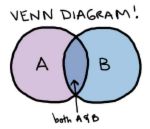
In the past I have utilized a Venn diagram to illuminate the overlap between two groups that are ‘given’ as the options. Lately, I have focused more on the 4th and 5th area.
So in American politics, when ‘republican’ and ‘democrat’ are given to me as opposites, you simply illustrate the overlapping values of the two (3rd space) and then point out those who are ‘neither’ (4th space) like Green folks and anarchists. Then draw a circle around the whole system and point out folks outside the system (5th space) like Canadians.

This semester my two classes are ‘Political Liberalism and It’s Critics’ and ‘Globalization’. It has given me lots of practice in picking up on patterns and thinking in different shaped categories.

Example 1: when a subject like ‘Norms’ is discussed – in sexual identity or sexual practices for instance – often a basic “for & against” structure is presented for any isolated topic. But as the discussion develops you can actually see that this is not a linear ‘far left – far right’ spectrum configuration – even if it is presented as such!

You quickly see that there are least 4 positions even ON a spectrum: if the far left position is “there are no norms” and the far right position is that norms are “intrinsic / originate outside the system” and implement themselves, you can imagine that a center-left position would be an emergent perspective (norms arise from below in the population and then ascend) and a center-right position of top-down Hierarchy where norms are seen to be passed down from the authorities. Recognizing those four positions facilitates a radically different conversation than just outlining two.

Example 2: when the subject is ‘Law’ or court rulings, we need to rise above elementary ‘agree’ and ‘disagree’ binaries.  There are actually 4 positions in practice.

  • Agree & Obey
  • Agree & Disobey
  • Disagree but Obey
  • Disagree and Disobey

It is essential to admit that in any population there will be great variety, disparity, and diversity – so we do a terrible disservice to the matter when we reduce the matter down to basic dichotomies.

The reason I bring this up is because I am very concerned about the round-and-round cul-de-sac conversations that I hear over and over again in the church. I am growing convince that as contemporary Christians, the issue is increasingly not what we think but how we think about it.

The issues of abortion, homosexuality, biblical inerrancy, the creeds/ orthodoxy, environmentalism, and women in ministry are just 6 examples of matters where the dualisms are killing us.

One of the best things that could happen this Good Friday would be for those who take the Christian story seriously to die to – not what we think – but how we think about it. My dream would be for a heart of repentance: to decide in our hearts to swear off inherited dualisms and pledge to, as a community, look for and develop better ways of framing the issues that matter to us most.

Challenge: This Friday, repent of either/or thinking and die to the dualism of us/them for/against right/wrong in/out thinking.  Ask your small group to hold you accountable and maybe even join you in a new life (Easter) of the mind.

disclaimer: some of you will finish this post and think ‘it was so remedial it was barely worth reading’ and others will think ‘that is crazy talk – you are either right (on God’s side) or you are plain wrong – there is no middle ground.’ But we have to start somewhere, and this is the world we live in.


Create a free website or blog at WordPress.com.

Up ↑