Search

Bo Sanders: Public Theology

updating & innovating for today

Tag

time

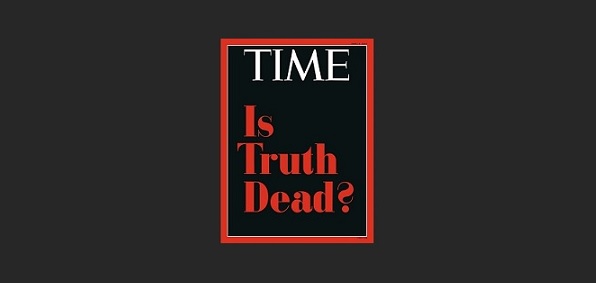
Is Truth Dead?

You have probably seen the attention-grabbing cover of this week’s Time magazine. It is a very real issue in our culture and it has serious implications for how we approach faith and church.

Truth has been an urgent topic this semester in the seminary classroom as some students have been asking what it means to think about religion and faith in a “post-truth” society.

I know that some status quo cynics and kind conservatives will smirk and try to dismiss these developments as just the latest assault on ‘what the church has always believed’. They will point to Herod asking “what is truth” in John 18:38 or quote Jude 1:3 and attempt to hide behind “the faith which was once for all handed down to the saints”.

Both of those attempts at dismissive evasion miss the point that something has shifted in our culture.

My hope is to seize this moment and to have an honest-to-God reality check that engages in an open-eyed assessment of the actual situation that we find ourselves in.

Here is the approach that I am taking with my students: 

We are exiting a time when truth has been purported to be both universal and timeless. IF that were ever true, and that is debatable, then it is certainly less true today than it ever has been.

First, nothing is timeless. Even if one wants to assert that something is not time-bound, it at least has to be time-ly. 2nd Temple Judaism, Pentecost, the Council of Constantinople, the Nicene Creed, Augustine’s confessions, Thomism, the Protestant Reformation, the birth of Methodism, the 2nd Great Awakening, and the Azusa Street revival were not timeless. They were all timely.

Second, things are not universal – they a situated, located, and particular. Things can not be presumed to be the same everywhere and simply applied anywhere. When and where (not to mention how and why) matter deeply.

Having said that, we have an opportunity (here and now) to evaluate our approach to truth and assess how we want to address this crisis in our culture.

Side-note: perhaps the worst thing that we could do at this kairos moment is to double-down on our truth claims of past centuries and continue to ignore the fact that things may not work as well, as smoothly, as predictably, or as justly as we had been told.

A great start begins with this realization:

Any claim to truth is:

  1. Partial
  2. Provisional
  3. Perspectival

It is partial because I never have all of the information – if there is a ‘god’s eye view’ I do not have access to it. Reality check: if there is a God, you are not God. This doesn’t mean that you have no access to truth – only that you have limited access to truth.

It is provisional because it will need to be amended as new data becomes available. I am free to say ‘at this point, here is what I understand’. If you are under the impression that something is ‘set in stone’, you need to come to terms with the fluid nature of our understanding and the perpetual/liquid nature of our access to all that is going on both in what we can see and the stuff behind the scenes.

It is perspectival because you can only see things from where you stand. Get rid of any notion of being ‘objective’ – you are subjective (thank God) and any access we have to truth is subject to review.

Is truth dead? Not exactly. 

Is our understanding of truth in need of adjustment for our liquid era of perpetual motion and exponential change? Yes. 

Do we still get to believe that things are true? Yes! 

Does that require a little bit of humility and even repentance from our addiction to certainty? Absolutely. 

666 Is Not What You Think

A quirky and sad story has emerged out of Kentucky this week.

In one of the strangest cases of purported religious beliefs intersecting with athletic performance, a Kentucky junior cross country runner voluntarily walked away from a chance to qualify for the state meet to avoid running with the bib number “666”, which she said conflicted with her Christian beliefs.

As somebody who competed in state wide competitions back in the day, I can imagine how difficult this situation was for that young lady.  As somebody who learned how to read the Bible that same way, I understand her reluctance to associate with that number. Dark-Clouds

I am a big fan of the Book of Revelation. The last book in the Christian testament is a favorite of mine. I love it!  I love it almost as much as a I hate what the majority of N. Americans have been led to believe it is about.

I thought I would take this opportunity to point out three simple ways that this odd and sad story could have been avoided in Kentucky:

  1. We don’t have 13th floors in buildings and maybe we could just remove this number from rotations – since we know that it rubs the sensitivities of many people the wrong way. That seems like the easiest solution…
  2. The race official could have just given the young woman a new number offender her religious sensibilities. That seems like an easy solution …
  3. Someone could have just explained that the number 666 doesn’t have any actual power … and that even the Bible passage that it comes from tells you that. That seems like the best solution…

See, the actual passage says:

Revelation 13:17-18   New International Version (NIV)

17 so that they could not buy or sell unless they had the mark, which is the name of the beast or the number of its name.

18 This calls for wisdom. Let the person who has insight calculate the number of the beast, for it is the number of a man.[a] That number is 666.

Never-mind that the earliest manuscripts have the number as 616 (a whole other discussion about Roman emperor’s names and the genre called captivity literature within the apocalyptic tradition). What is important here is the world ‘calculate’.

The number – even if it is 666 – isn’t what it seems. It needs to be ‘calculated’, even according the actual verse. It’s right there in the Bible. The number has to be examined – or said another way – you have to do something with the number. It is not the actual number 666.

The clearest explanation is that it is a stand-in for a deeper meaning. Six is the number of humanity (created on the sixth day) and things that are represented in threes (holy, holy, holy Lord God Almighty who was and is and is to come) are complete. The number 666 simply means the completion, or culmination, of the human system.

The number itself is nothing to be afraid of. It is what that number represents that is of great concern. That is why the author of the Book of Revelation wrote in this poetic/symbolic language and imagery. This kind of apocalyptic literature was a political critique of its day – not a predictive work for our day. 

Pointing this out to Christian young people would accomplish at least two things:

  • It would relieve them of this superstitious ‘left-behind’ fear that is created by a misunderstanding of Biblical genres and interpretation.
  • It would serve as a challenge/inspiration to do in our day what the author of Revelation was doing in that day and use their creativity to critique the systems and structures of oppression that we are all caught up in.

The number 666 holds no special power – especially today. What it represents however is very much still in power and needs to be examined and engaged as ‘the Powers That Be’.

Why change is challenging

I am fascinated with human behavior and the psychology behind it. I love reading books that examine sociology and help to explain why we, as a culture, do what we do. This is partly why I am in the field of Practical Theology and not Philosophical, Biblical, Systematic, Historic or any other branch of theology.

I am interested in how faith is lived out in actual locations.

I am also interested in why I do what I do. Why do I make the decisions that I do? Why do I value what I value? Why do I spend my time the way that I do?

Two quick stories:

I used to be a big fan of ‘time’ theory and practice. I based much of my philosophy on books like “Unwinding the Clock” by Bodil Johnsson and “Margin” by Richard Swenson. When I was a Lead Pastor this was a major emphasis of my thought and practice. Then I went back to school for graduate work and became an Associate Pastor and almost all of this has either gone out the window or deteriorated to the point of being unsustainable.

This past week I had the opportunity to go up to the mountains where there was no TV, Internet or reliable cell coverage. It was a wonderful Thanksgiving break. It dawned on me after two days “maybe I am not spending time during the week in a way that brings out the best of me.” I decided to revisit some of my routines and renovate some of my ruts.

Saturday went well as I change the way I prep for Sunday.
Sunday went well as I tweaked the way I get ready for a full day of activities.
Monday went well as I disciplined myself to change the way I spend time in the office.
Then came this morning…

I was doing so well that I thought I would return to an old pattern I had gone away from: morning devotional reading.  I pulled out an old daily reader that I have read and re-read so many times over the last 20 years but have not touched for the past 4.  I was excited to sit down with an old friend and meditate again to some classic ideas. There was just one little problem – it stunk.  The reading was stale and the thoughts were antiquated.

I had a good laugh after I got over my initial disappointment. This is why it is so hard to make changes! If your first run doesn’t meet immediate success, it can be really hard to muster enough energy to try again. This is especially true if you are making the change because of a perceived lack or deficit.

I feel like the person who does situps one day and then is disappointed when they look in the mirror and they are no thinner.

Anyway – I almost done with the semester and have great plans to get ready for the new year and some new patterns. I just thought I would throw out this reflection and share it with people I love exchanging ideas with.    seasons greetings to one and all  –Bo

Blog at WordPress.com.

Up ↑