Here is a follow up video for the blog post (2 weeks ago)
You can read the full blog at [this link] and either comment here or there. I look forward to continuing the conversation.
Next up: There is no neutral anymore
Here is a follow up video for the blog post (2 weeks ago)
You can read the full blog at [this link] and either comment here or there. I look forward to continuing the conversation.
Next up: There is no neutral anymore

The Wesleyan Quad is my 2nd favorite theological concept.
In this video we look at those 4 configured as a living web of interpretation. I hold that it is far better for community discernment than a foundationalist approach (the classic sequence).
Let me know if you have questions or concerns – especially about the little game of 3 minus 1.

There is no phrase that is more misused, or more contentious, than The Word of God. We might need to take a vacation from throwing the phrase around as a tight summary until we pull it apart and clarify its multiple uses. 
The Word of God, when used properly, carries three layers of meaning:
For clarity I will now refer to the first and third meanings as ‘the word of the Lord’ and the second as the ‘Logos made flesh’.
The pitfall that some fall into is that they take this last sense (revelatory elements within scripture) and attempt to make it concrete (or foundational). Doing so is to erroneously confuse the messenger and message, the vessel with the element, the sign for the object.
Calling the Bible the Word of God is as inaccurate as it is accurate. It is not exactly true … but it is true enough that it is tempting. The problem is that it confused the ‘curves ahead’ road sign on the mountain road for the road up the mountain. It is not that they are unrelated – it is that they are not equivalent. The map may be accurate, and trustworthy for the journey, but it is not the landscape itself.
Knowing the map well is not the same as going on the journey.
This is the important difference between a sign and symbol.
One can see the problem in legal court and in Sunday school. It is ironic to place one’s hand on a Bible and swear ‘to tell the truth, the whole truth and nothing but the truth so help you God’. The irony, for those who have actually read the Bible, is that it says in two New Testament passages not to do such things. We are not to swear by things but to simply let our yes be ‘yes’ and our no, ‘no’. That should be enough. We don’t need to swear by heaven or earth or anything like God. It is an odd practice.
Similarly we see things like this in the songs we learn as children:
The B-I-B-L-E,
that’s the books for me,
I stand alone on the Word of God
The Bible is not a book. It is a collection of 66 books by different authors in different centuries representing different histories, perspectives and opinions utilizing diverse genres of writing. This is part of why you can not say ‘the Bible says’.
When we say that ‘the word of God is living and active’ or that ‘all scripture is God breathed and useful’ we are right … but we must avoid the temptation of too quickly boiling those three into down into one interchangeable phrase lest we miss the awesome power and invitation provided by the interplay between them.
Now, if we mean that because of what we learn in the Bible, we hear the word of the Lord and believe in the Logos made flesh … that would be fantastic. ?If, however, we mean that the Bible is equivalent to the Word of God, then we have set our children up to be confounded, frustrated and spiritually impotent.
We have given them a road sign and told them it was the adventure. ?The word of the Lord propels us on a journey! To walk the way of the Logos made flesh, to know the truth of that which was in the beginning – with God and was God – and to live the life of the ages (eternal life).
To paraphrase a famous line – we are like children making mud-pies out of dirt in the back alley while there are real pies waiting in the kitchen.
Part of the problem is that we have try to cram too much into the phrase ‘the word of God’ and asked more from it than can be expected from any sign or symbol.
The most helpful thing I have found to address this problem is called the Wesleyan Quad. The quadrilateral is composed of 4 elements:
Those 4 elements also work best in that sequence.
– We go to scripture first for it records examples of the word of the Lord and points us to the Logos made flesh.
-We next consult the tradition, for religion has a given-ness to it. We inherent a living tradition and participate in its practices, rituals, ceremonies, train of the thought and teaching.
– We also recognize that importance of our community-experiences. No one is spiritual or religious on their own like no one uses language alone. We learn a language from others and use a language to communicate with others. It is not enough to know of a religion – one participates and thus experiences. We learn from and incorporate our community-experiences.
– Finally comes reason. We are made in the image of God and that divine Logos (reason) was given to us to exercise responsibly. We are not called to be robots who mechanically parrot the inherited sentences in rote repetition. There is a deep need to think about things so that our tradition does not become a dead artifact, or worse, a false idol.
The danger of what has been called ‘Bibliolotry’ is not simply that it makes the Bible ‘a paper pope’ or ‘the 4th member of the trinity’ (as bad as those seem). The danger is in missing the way, the truth, and the life that is available to us by instead settling for a road-sign instead of an adventure.
I would love to hear your thoughts about my distinction between the Word of God as the word of the Lord, the Logos made flesh and the Bible.
Artwork for the series by Jesse Turri
For more read my earlier posts about Inspiration and about Revelation.

Three encounters in the past month have opened my eyes to a ‘kind’ of conservatism that I am suspicious I was not hip to previously. In the heated spectrum-thinking cultural climate that exists today, it is easy to get distracted by the exaggerated and inflammatory. What is more difficult to perceive is a kinder, gentler conservative mentality.
Here are 3 places it showed up recently:
The sentences are subtle – but once you pick up a pattern you begin to hear them more clearly.
“Since God is not a ‘he’ or a ‘she’, we gain nothing by using feminine pronouns for God … so let’s just stick with the tradition we have and the way it is in the Bible.”
That was the one that caught my attention. Then I started hearing that same formulation in other places.
“No one has ever provided iron-clad proof of macro-evolution … in the lack of definitive conclusion,Biblical creation is just as valid as any other ‘belief’ since we can’t prove it either way”
or
“You might be right about these cultural changes and the future of the church … but who is to say that your fancy new way will be any better than what we have now? We might as well not tinker with anything since there is no guarantee it will fix the problem – and might possibly create different or bigger problems.”
This is a subtle type of conserving. It is not the blatant ideological animosity that gets all the press and dominates the airwaves. It is a more quiet concern that we not move too far too fast.
Here is my fear: it seems to me that this tactic is employed by – and born out of – a status quo that seeks to protect / preserve itself. It is neither aggressive or egregious but is potentially just as harmful as it’s venomous counterpart. 
“I get what you are saying Bo … but what’s not to say that 10 or 20 years from now your new-fangled ideas don’t look just as dated and flawed as those you are criticizing today?”
See how it works? Since my innovation today might seemed cliché to the next generation … let’s not get too far ahead of ourselves and think that we have it all figured out. In fact, why change anything?
This ‘kind’ of conservatism doesn’t necessarily have a radical agenda. It doesn’t need one. It would be just fine if things stayed mostly as they are. It is perfectly suited to the current conditions. Stasis and a romantic reflection on the past is a perfect incubator for its ongoing preservation and, consequently, promulgation.
I would love to hear your thoughts on this.

We are going to have to agree to disagree about some things. One thing that I would ask (in my generous orthodoxy style) is that we both acknowledge those things that we agree on as well as those we don’t.
The reason that is important is because of something that Phyllis Tickle points out (paraphrase): it is not that former (and maybe dominant) expressions go away, it is that they no longer hold the prime spot and wield the kind of power that they once did. They are all still around however. 
The interesting terrain that we inhabit in the 21st century is littered with artifacts and occupied by pockets of groups – possible ones that were once in the ascendancy. This is, as I am often saying, the bricolage nature of our cultural/societal environment.
You have methodists who have no idea what the methods were. You have ‘Amish’ fireplace stoves being mass-produced and sold on TV (think about it). You have can still, more tellingly, find actual Amish folks if you know where to look.
Here are two things you need to know:
There are several implications of these two things. Unlike Tripp, I don’t do systematic theology.* It is not that I don’t value other branches of theology. In fact, practical theology as a field is in a major renovation, at least in part, in order to join the other 4 primary branches of theology that do their own research and provide their own innovations:
As my professor Kathleen Greider says:
Practical theologians commonly assert that the primary text of our field is lived experience– diverse persons and communities that are contextually located, inextricably related, and experiencing each other through countless interconnections and interactions.
Almost invariably when I am enduring critique from a conversation partner who is more conservative than myself, it is only a matter of time before they bring up Aquinas. I don’t get the nuance of Aquinas. I didn’t distinguish between the early and late Aquinas. I wasn’t careful to appropriate this or that of Aquinas’ formulations. I didn’t read the right translation of Aquinas. (the same things with Barth and Scotus too)
What I am saying is that we don’t need to understand Aquinas better or deeper.
We are to do in our day what Aquinas did in his.
As a contextual theologian I don’t think that is accomplished by obsessing over Aquinas. I’m not saying that we aren’t generous or respectful … I’m saying that Aquinas lives neither where we do nor when we do. He lived in a different context and time.
Call this dismissive if you will but The Church’s future is not to be found in Europe’s past. I say it all the time.
You may disagree with me about this. That is fine. I’m just telling you where I am coming from since our latest TNT has raised some eyebrows, questions (and hackles) both here and on twitter.
Historic thinkers like Aquinas never saw what I call the 5 C’s of our theological context:
Add to those 5 to pluralism, the internet and a growing environmental crisis and you have the 8 things we as theologians need to give great attention and care to. They are the context in which (and for which) we do theology in the 21st century. Go listen to our interview with Grace Ji-Sun Kim if you have questions about this.
You may want to focus more on the christian tradition (like Augustine or Aquinas) and I would understand that – I view that impulse through a Lindbeckian tri-focal lens. I understand the work you want to do within that cultural-linguistic silo. [I’m having fun in this part for those unfamiliar with my style]
Disagree as we might about the importance of a writer in the 3rd or 13th century – I just wanted you to know where I was coming from and what my focus was.**
I would love it if everyone would leave a comment and let me know how this sits with you.
_________________
*One implication of that is that when I read systematic theologians I do so though mostly thought trusted secondary sources. Admittedly, I don’t major in primary sources – for reasons I hope are clear in this post. I find scholars who know their stuff like Elizabeth Johnson, John Caputo, Joseph Bracken and Stuart Murray and trust them.
** If you want to read more about my approach check out ‘After MacIntyre’ that I wrote a while ago but never put up on the blog. It will explain my concern about everything from consumerism to hipsters and the radical orthodoxy project.

An ‘Ancient-Future’ faith is an idea that gripped me more than a decade ago and, even as I have emerged into a very different expression of my faith, I can not shake. As I have revisited and revised my participation and understanding of the Christian faith, this concept has haunted me in the best of ways.
On the TNT that will come out early this week, I talk about trying to hold onto this idea even as the author who popularized it seemed to go astray/ re-entrench from that original vision before his passing in 2007. I blame it on the post-911 Clash of Civilizations mentality that gripped many white men over a certain age. That is for another day. 
I continue to be intrigued by the pairing of practices from previous centuries with communities and expressions fully embedded in the 21st century. There is something beautiful and powerful about matching these two. We are attempting to maintain a healthy continuity with the tradition that we have inherited with a vibrant incarnation in the world that we inhabit.
That is not an easy path to navigate. It is far easier (and more convenient) to either retreat into the romantic silo of the imagined past … or to adapt and adopt every cultural expression that comes into the mall or across the radio waves. Discernment is needed.
Discernment, however, happens after recognition. Len Sweet* was the first to introduce me to idea that we are moving from the Gutenberg era to the Google era. While there are many aspects of this cultural shift, the most striking is the shift from black & white words on a page to the multi-media world of image & message. The image and the message compliment (or reinforce) each other and sometimes serve to contrast or challenge each other. This is something that us ‘digital-natives’ learn to negotiate early and easily. Some would call it second nature – which is an interesting phrase in more than one way.
Here is a video inviting people to our gathering at the Loft LA. It is a little intro to some of the ideas that I’m talking about.
Ancient Future Faith from Bo Sanders on Vimeo.
I would love to chat with anyone who is interested in these topics. Here is just a quick list of ideas we might want to flesh out in an upcoming blog convo – just let me know below!
Mostly I just wanted to share some of what I am wrestling with in hopes of expanding the conversation.
I look forward to your thoughts. in Christ -Bo
* another apparent victim of what we talked about earlier
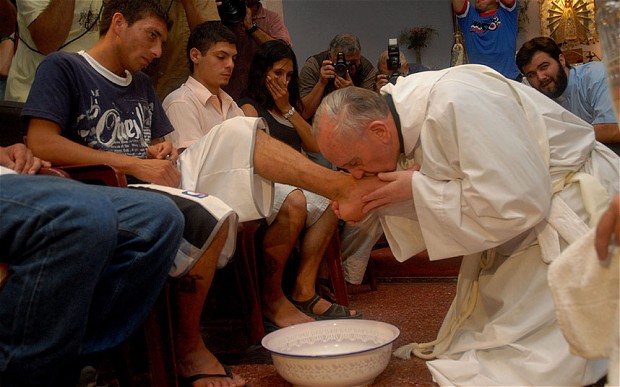
It has been amazing to watch both the amount of reporting and the kind of reporting that Pope Francis’ style has drawn. You can find stories about him in major magazines, on every news website … even the Daily Show gave some hilarious attention to the hype.
I was on an Australian radio show the day of his election – they liked the angle that I had taken on my blog focusing on the Southern hemisphere. [you can listen to the 4 minute clip at the bottom of this post at HBC] I was on after the Australian Ambassador from Argentina.
Some of my co-workers are Catholic and Pope Francis’ dealing provide us with every-other-day content for our coffee-pot conversations. Even my wife, who is generally not that interested in such things, is into it.
She asked me, on a recent road trip after several news stories, why I thought people were so into Francis. I have three thoughts and would love to hear other’s thoughts.
I know that not every Catholic listens to the Pope and that the Pope does not influence every thing … but it is still a big deal.

Francis’ style is not just a breath of fresh air – it is substantially different. What he did on Maundy Thursday was not just a ‘break with tradition’, as reports kept repeating, but was significant. Washing & kissing prisoner’s feet instead of priest’s is not window dressing
It’s like we are enamored with the figure-head of the thing we left so long ago. I chalk it up to some sort of fetish thing for regal gowns, bejeweled crowns and antiquated (and sometimes secret) ceremonies.
There is one problem though. Protestants seem to want the Pope to be more protestant.
Almost all of the critique or concern I heard about him is something that would be more emblematic of protestant values or approaches. He is following the church’s traditional stance on (just to name 4):
I want to holler at people when they are disappointed in this
“Of course he is – otherwise he wouldn’t have been elected Pope”.
It feels to me like somebody saying “I like the new Miss USA … I just wish she was built like a Linebacker in football.” Well … I hate to break it to you but that’s not going to happen. In fact, people who are built to play linebackers don’t make it to the Miss USA pageant. That is just not what the judges are looking for.
What I wish we would instead focus on is his economic dealings, immigration issues (he is the son of immigrants) and out-reach to non-Europeans. I continue to claim that just those 3 will make this a game-changer.
I would love to hear your thoughts.
This weekend I will finish reading two books that we were given through the podcast (thank you publishers). The first is Peter Rollins new on The Idolatry of God and the second is Phil Snider’s Preaching After God. 
I have recently edited podcasts with both of these authors. [We put out the Phil Snider TNT last week ]
It is very clear to me that we have an emerging situation (trying not to say problem) on our hands. With the introduction of a new wave of postmodern or ‘radical’ theology [listen to the Caputo introduction here] – progressive and emergent christians are drinking in lots of innovative and challenging concepts about God that may not have a real God behind them.
This is fine IF the listener/reader knows what they are imbibing. What is increasingly concerning for Tripp and me is the consequence when people don’t know that the god of the 21st century philosophers is not exactly the god you hear about on Sunday morning.
Is there a danger in people reading a ‘how (not) to speak of god’ and then just quoting it from the pulpit like they would quote any other historical person? Folks in the deconstruction camp are not real eager to answer this one.
I have some thoughts on the matter so I thought I would throw them out here for consideration.
Intro: It is severely unhelpful to frame this in an either/or way. “Either God is X like the Bible/Creed/Tradition say OR Religion is the equivalent of Santa Clause &Tooth Fairy and we might as well all go home.”
That reductive approach is foolish and silly. There is far too much going on in religion – and the Christian religion specifically – to say things like that.*
I propose that there are – at least – 5 things happening IN the christian religion:
Experience – People who were not raised in the faith convert and/or have crisis experiences that powerfully impact them. People experience the presences of something they interpret as bigger than themselves.
We can talk about transcendence or phenomenology but what we can not deny is that people experience something in religion. As someone from a charismatic-evangelical background it is so clear to me that much of our talk about God and religion in progressive-emergent circles misses this very real component.
Is experience the whole story? NO! And those who reduce it down to that are equally as errant. It is not the main thing nor is it nothing. It does not account for everything but neither can it be dismissed outright. People’s experience must factor into the equation.
At minimum do the Kantian thing and say that religious people’s experience is real but incomplete to understand the whole picture (noumenon) – like 6 blind people with their hands on different parts of the elephant – each thinking they are describing something unique: a tree (leg) a rope (tail) a wall (belly) and a giant leaf (ear) and an enormous snake (trunk).
Formation – I get in trouble for liking the post-liberal writing of George Lindbeck (Nature of Doctrine) but I think that this is exactly where it comes into play. The role that the christian tradition, sacred text and vocabulary plays is that forms us a people. It forms character within us as well as the way that we participate in community.
I am in dialogue with the work of Alasdair MacIntyre (After Virtue) for this very reason. While I disagree with his solution, I think that he is spot-on in his analysis and concern. Not only does our culture live in a chaotic time – but the very ethical assumption that would allow us to even HAVE the conversation have been eroded and now we can’t even debate! At least within the Christian church there is a common vocabulary. We may debate the definition of the terms but we have an arena in which to engage each other.
In this sense, the faith functions. As Elizabeth Johnson (She Who Is) is so good at pointing out: the words that we use function in our imagination, our communities and in the tradition.
Event – John Caputo (Weakness of God) and those who follow his Derridean ways prefer to speak of the name of God as an event. There is an event housed in the name of God the beckons us – we respond to this call … and are not that concerned wether there is a caller, or if we can know that there is one.
It is undeniable that something happens when God’s name is invoked. It triggers something in us. It calls for something from us. It makes some claim or demand to be dealt with differently than other words and concepts.
I like Caputo’s illumination of this shadow world. There is something deeply insightful about his explorations. Those who want to dismiss it because it isn’t enough on it’s own, are missing the point. Something happens if ‘God’ is invoked … and that would happen even if there were no ‘God’ per se because (as I said above) the concept functions. – it does something in us,
Voltaire said,”If God did not exist, it would be necessary to invent him.” That is because ‘god’ does something in us – demands something from us. It maybe not ripping off our customers, it may get us through a tough time or help us to sleep at night – or even face the end of life with dignity. But in the name of God is an event that lays hold of us.
Mystery – I am fascinated with the apophatic tradition. I have no interest is appropriating it … but I am mesmerized by the fact that it even exists. Describing god by what she is not? Brilliant.
I also have been looking in historic understandings of analogy. Which works for me because I do not believe in univocal speech. When we call god ‘father’ we are using an analogy – god is like our best conception of father-liness … but it saying that is also included an understanding that God is not actually a father. Our use of the word is not a 1:1 equivalence.
Elizabeth Johnson challenged us over a year ago that every time we say ‘god’ that we must say it three times. I do this every day now!
When I say ‘god’ I always say God beyond me – within me – and at work all around me.
Potentially Something Real – the final component in my 5 sided web is the possibility that there really is something to all of this – more than just phenomenon or imagination or tradition or vocabulary – and that the language of religion is at least getting some of it right.
If we don’t leave open the potential that something real is really happening – that a real god is actually acting – then we may be missing the biggest part of the puzzle and thus have an incomplete picture.
On last month’s TNT I said something that I have heard a lot of feedback on (some positive and some negative ). I thought it would be good to continue the conversation here on the blog.
My assertion was that: If you are a Christian, you have to believe something about hell. It is just not an option to say “I don’t believe in hell”. The word ‘hell’ is in the English version of the Bible and you can’t just say, as a Christian, that you don’t believe it. You can hold that it was a burning garbage dump in a valley outside Jerusalem that Jesus makes a poetic illusion to … but you have to believe something about hell.
I would go on to broaden that assertion. I would say that you must believe in predestination, election, and the Book of Revelation.
All 4 of these are topics that l have personally heard people say “I don’t believe in __”
It is is just not an option to say “I don’t believe in hell”. Jesus did. If you are a Christian, you have to hold some belief about it.
Paul spoke of predestination. Election is a theme in scripture. You can’t just say ‘I don’t believe in Revelation’. You can object to how some people interpret and preach the Book of Revelation … but you can’t ‘not believe’ it.
Why It Matters:
I come from an Evangelical-Charismatic background and am now employed at a Mainline church and attend a Mainline school. I am passionate that thoughtful progressive Christians can not make the same mistake that Liberals made in the past century. By ‘de-mythologizing’ the Bible they undercut the very foundation that the tradition is built on.
It is like sawing the very branch that your a sitting on … on the tree side of the branch! What do you think is going to happen? You are left no place to perch.
I love Biblical Scholarship. I delight in post-modern and progressive theology. I take seriously the post-colonial critique and the perspective of feminists and queer theory. But it does us no good if we know what we don’t believe about something but do not have the ability to present in a constructive way what we do believe about those very subjects.
There is so little value in participating in a community based on a tradition where one does not believe in the very words of that faith’s sacred text.
Why even do it? I think that is why so many ‘nones’ have just opted out. I actually greatly respect those who participate in the emergent conversation and who are valiantly attempting to update their denomination from within. It is far easier to just walk away from the entire project all together … and many have.
So How Do I Do It?
Predestination: Forget about the historical hyper-Calvinist understanding that you ‘don’t believe in”. Romans 8:29 says “For those God foreknew he also predestined to be conformed to the likeness of his Son, that he might be the firstborn among many brothers.”
Who did God foreknow? Everyone. What are they predestined to? To be conformed to the image of the Son. Does everyone arrive at their destination? No.
Predestination might be, what some Process thinkers would be called, an ‘initial aim’. It is God’s desire for all. God doesn’t always get what God wants ( see 1Timothy 2:4).
Election: Karl Barth said it clearly. God elected Jesus. All humanity is involved in that election. All who are ‘in Christ’ are elect.
The Book of Revelation: You may not like the ‘Left Behind’ / Hal Lidsey / Jack Van Impe interpretation of the Book of Revelation … but you can’t, as a Christian, say that you don’t believe in it. It’s in the Bible. You have to believe something about it.
The Book of Revelation was a political critique of the Roman Empire of the first two centuries written in the genre of the ‘apocalyptic’. It is not predictive of the 21st century. But we don’t want to throw it away! What we need, more than ever, is to imitate it and write an apocalyptic critique of our as-it structures, systems and institutions of injustice and our empire. We need a prophetic imagination.
You can’t say, as a Christian, that you don’t believe in this stuff. You have to believe something about this stuff. My suggestion is that we just believe more informed better stuff about these topics. The simple fact is that we are community of people centered about a sacred text and it is simply not acceptable to say ‘I don’t believe in something’. We are free to not believe in some people’s interpretation – but we have to believe something about it.
Thoughts? Questions? Comments?
 Bo Sanders: Public Theology