Search

Bo Sanders: Public Theology

updating & innovating for today

Tag

TV

Apple Updates & the Church

I have been thinking about the church and technology a lot lately. Part of it comes from planning to update a sanctuary constructed in 1951. Some of it has to do with recruiting a team to handle all the tech stuff at ‘church plant’. A bit of it came from the odd analogy that was used repeatedly about the ‘glitches’ related to the initial launch of the Affordable Health Care Act website and all of the sigh-up problems. People, including the President, said “yeah but even Apple has glitches when it first launches a product”.

An inexact comparison to be sure.

One of the questions that we are asking at the Loft LA, as we enter into our second year, is:

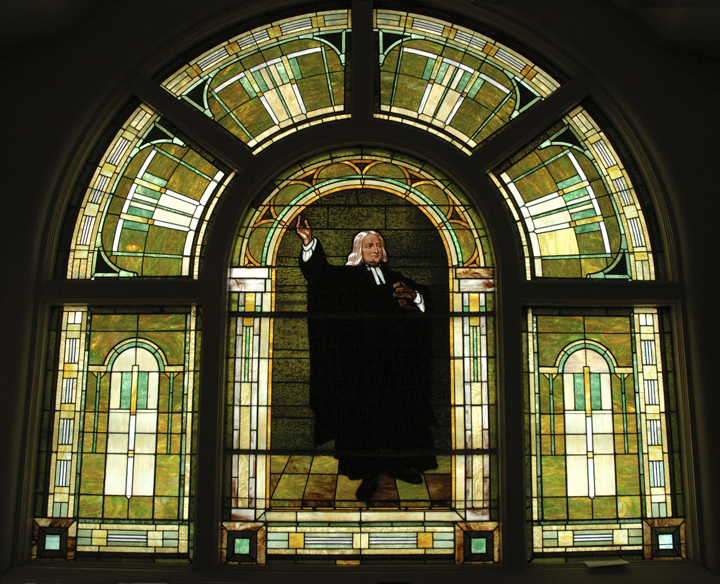
“What does it mean to use the Ancient-Future model of church in West LA?”17-85-BE3-134-08.0006-John Wesley

We come out of a United Methodist Church – which is a classic and beautiful expression of the Mainline tradition of Protestant Christianity.  The Loft is attempting to reclaim and hold onto the best of that inherited tradition … while at the same time engaging the culture around us in way that is contemporary and appropriate.
I’ll confess. It is a tricky section of water to navigate.

To use my favorite bowling analogy, there are gutters on each side that you want to avoid.
On the one side, you have a temptation to cater to the culture and concede so much of the Christian tradition that you have basically assimilated to the surrounding culture that you are nearly indistinguishable from it! This can happen in patterns of consumption, political views, sexuality, financial matters, or any other number of areas.

On the other side, you have the assumption that the inherited tradition, the given forms, are inherently relevant and effective in every place and in ever time since they were divinely delivered and historically proven. What this impulse to conserve leads to is reification of some previous era or expression of church that was culturally appropriate by which has since expired in its effectiveness in doing so. For a group whose gospel is, at its core, about incarnation … this is unacceptable.

This is why we think that the ‘Ancient-Future model’ of church is the best way forward for a young community.
Here is a short video about my recent experience with an old Apple TV that was given to me and why it triggered some thoughts about christian community for me.

Apple Updates and the Church from Bo Sanders on Vimeo.

In technology, when you fall enough behind on your updates, you can actually trap yourself with the inability to update. This is the definition of irrelevant. The christian spirituality that is employed in much of the North American church may be in this kind of danger. I am nervous that we are looking to get resources (updates) from sources (servers) that don’t exist anymore.

We are looking for solutions in things that don’t exist anymore.

The danger, for a religion that is at its core incarnation, is that the inability to be conversant with the surrounding culture in the epitome of irrelevance.

__________

Ancient-Future is a model that was popularized by Robert Webber before he changed his emphasis, focus and tone at the end of his life. His books on Faith, Worship, Evangelism and Time are supremely helpful and informative. 

My quoting him does not imply a wholesale endorsement of all of his works or thoughts. 

Critical Questions: part 1

Pepsi Super Bowl XLVII Halftime ShowOriginally published as ‘Beyoncé and the Bigger Question’.

Over the last 2 weeks I have watched  the blowback over the Beyoncé SuperBowl Half-Time Show with great interest. I have read several interesting articles – both in support and in criticism – of the spectacle.

This is a part of what is becoming a theme for me. I will link to part 2 and 3 as I post them today.

I get why people want to talk about her outfit, her moves, and her assembled cast of all females – about modesty, sexuality, and female empowerment. I get why those are conversation points.

What is becoming a trend, however, is that I have little interest in that conversation – not until we have a more significant conversation first.

I think that it is time I lay all my cards on the table.

While I was in seminary, my mentor Randy Woodley, showed me how to look at bigger systems and structures than I was used to. I have continued down that road and during my time at Claremont have been in dialogue with a school of thought called ‘Critical Theory’.

Critical Theory has taught me to ask 3 initial questions in order to examine an issue:

  1. Is there a pattern visible?
  2. Is there something behind the main thing?
  3. Is there any issue of power differential?

The Critical part is that we are going beyond the initial perceptions, the popular approach and the cultural conversation. The Theory part is that we are going to see if we might offer an explanation about the deeper issue.

SO let’s ask our 3 questions about the SuperBowl Half-Time hullaballoo.

  • Is there a pattern visible?  

I would argue that there is. I noticed it just before kickoff – during the Nation Anthem to be specific. Alecia Keys was introduced, Jennifer Hudson had just sang with the kids from Sandy Hook … and I knew that Beyoncé was the halftime show.

I thought to myself:

“It’s odd that the only 3 black women involved in this TV spectacular are all singers.” Pam oliver

I noticed that CBS didn’t even have a black female sideline reporter like Pam Oliver (on FOX) for its NFL broadcasts. I watched the rest of the festivities – including all the military stuff – and was struck by the noticeable lack of black women associated with the event. Walter Payton’s daughter presented Jason Witten with the NFL Man of the Year award … but that was about it.  None of the coaches or commentators … not even many of the commercials involved black women.  This seemed significant since so many of the on-screen TV personalities, coaches and players are black.

  • Is there something behind the main thing? 

It is easy to see the answer to this one. The answer is consumerism. While the game itself is ‘the main event’ the commercial aspect of the SuperBowl has become at-least or almost as big. Commercials this year sold for a reported 4 million dollars a piece. Like the controversy we covered earlier in the ‘So God Made a Farmer’, commercialism-capitalism-consumerism is the unspoken thing.

It might be hard to see in a short blog post like this but Beyoncé isn’t the telling controversy. The more telling one was the criticism of Alicia Keys’ soulful rendition of the national anthem. People criticized her not just for sitting at a piano (!) but for altering the tried and true version of the song.

In CT when something is assumed – even if unstated – as a dominant form, it is called hegemony. It is a type of power or influence that may or may not be overtly communicated. If one were to look at just the first half of the SuperBowl broadcast, it might be possible to say that the major narrative when it comes black women is twofold:

  • you can sing – we like that.
  • but make sure you do it our way. Don’t do anything too much or too … you know… that’s not why you are here.
  • Is there any issue of power differential?

This is the one that we never get around to talking about. Maybe it’s because we don’t know how to or don’t have frameworks for it.  There is a question that needs to be asked though: who decided that Jennifer Hudson, Alecia Keys and Beyoncé would sing? What did that committee look like?  Who are in those seats of power?

Did the group that decided who would sing look like Jennifer Hudson, Alecia Keys, and Beyoncé?

I don’t know, I’m asking an honest question. It’s the tough question that no one wants to ask. Who has the resources? Who has the influence? Who makes the decisions? Who sits in the seats of power?

Now you can see why I am not interested in talking about whether Beyoncé should have had more clothes on, should have gyrated less or is a model for taking back one’s physicality in the face of generations of oppression and marginalization. 

Those are all secondary conversations.

The primary conversation is about what place black women hold in our culture.

It is a much bigger conversation with much deeper consequences than if Beyonce’s hips and wardrobe were appropriate for a Half-Time show.

So God Made A Farmer – and other kinda true sentiments

Not feeling so well, I watched the Superbowl alone. When the commercial came on that featured Paul Harvey reading his ‘so God made a farmer’ piece, I thought “nice tribute” – and nothing more.paul-harvey-so-god-made-a-farmer

I woke up the next  morning to find a buzz surrounding the spot – both good and bad. Some are claiming it the winner of the prestigious ‘best SuperBowl add’ and others are decrying it as a rip off and an overly sentimentalized piece of blatantly romanticized platitude.

I am fascinated with the power of words and specifically how, in our culture, there seems to be no understanding OF language and examination of its use. We act like words are just what the appear to be – but don’t look at how the function to re-present (or signify) a greater reality to us.

Earlier that day at church we had a major conversation about masculine pronouns for god and use of the word Satan. We are going through the book StoryLine by Donald Miller and not only does Miller only refer to god as ‘He’, but god only has classically masculine attributes. I got taken to task for selecting the book as our new year reading.

My defense is that ‘it’s just language’. So while it may not be the best language, I never thought that we would swallow it whole – hook, line, and sinker.
When it comes to the ‘Satan’ thing, yes – I wish that Miller had used ‘the devil’ or ‘our enemy’ or ‘evil’ or ‘darkness’.  I assumed that we all knew it was a kind of personification. Maybe I am just secure in second naiveté for my own good. I didn’t know that we still had to clarify that we don’t believe in an actual ancient cosmic bad guy but that it was a way for us to talk about forces that hurt us and others and destroys the good that God has called us to.

Earlier in our gathering we sang the song “How can I keep for singing your praise” and it has the line “I am loved by the King, it makes my heart want to sing.”    It’s how language works! It is an analogy. It is comparison. It is not exacting or mathematical.  No – I don’t think that god is literally a King. The age of monarchs is over … it is just a classical way to conceptualize. It’s poetic.

Side Note: I have been clear that language about god is not univocal. It is not a 1:1 equation. I have also talked openly about female pronouns for god (in God never changes, or does She?So-God-Made-A-Farmer

Which brings us back to Paul Harvey’s “so God made a farmer”. Of course god didn’t make a farmer – it is being poetic.  Someone might say “well God did make Adam to care for the garden and to work the soil.” Which is a fair enough point … but in saying that, we are not saying that God made a modern farmer who uses double-axled combines and herbicides made in laboratories.

I am suspicious that the reason that we would either get so excited or so upset is if we were lacking a theory about how language works.  Then I have to remind myself, we are the same country where a lot of people try to read the book of Revelation as literal – a completely novel way to read the Bible that has sprung up in the just the past 200 years.

So maybe that explains both  the accolades and the criticism of the ‘So God Made a Farmer’ ad. If you don’t get imagery, poetry, analogy … and think that language represents exactly what it signifies … then I suppose this one would be worth getting all fired up about.

When we say that God created a farmer – we don’t mean that God literally created a farmer. It is a poetic tribute. Noting more. Not worth getting fired up by or upset about. It’s just nice language.

________________

I would be remiss if I didn’t point out that there is a huge racial component to the controversy that I didn’t even get to touch on! If you are interested in an examination of that aspect please see this article in The Atlantic about the WhiteWashing of farming 

5 Biggest Pastoral Changes in the Past 5 Decades

I’m preparing to facilitate a conversation with some colleagues in the new year about ministry and honoring tradition. I want to begin – and thus frame – the conversation with the changing culture that we are products of, interact with and attempt to minister to.

It is a different way to approach the topic of tradition, admittedly, but my thought is that we start where we are and then trace threads into the past to uncover their significance. I almost always find it unhelpful to start in the past – say at the Protest Reformation – and then slowly work our way up. It is simply too limiting (in scope) and cumbersome (in process) for the contemporary expectations of ministry.

I have been reading a little Gordon Kaufman. He has me thinking about the ‘nuclear age’ and how deeply that shift, from the end of WWII, has impacted us sociologically, psychologically, and spiritually. I take this as my launching off point.

 So here are my Big 5 – in no particular order. I wanted to throw them out here and see what others who are older, or wiser, or more insightful might add to the list or modify.

 Pervasive Pop Psychology  – My dad tells a story about interviewing retired pastors 30 years ago. He asked them when things seemed to change. All of them, without exception, pointed to the window from 1968-1970. They talked about Woodstock, Vietnam, and Nixon among other things.

Many of them also talked about people’s awareness and pop psychology. I will always remember the story of a son who came home from college to visit his folks on the farm. He tried to talk to his dad about his feelings, motivations, childhood memories, his subconscious, etc.  His dad responded, ‘Son, what the hell are going on about?’ He just had no frame of reference for it. Similar stories were repeated, in differing configurations, over and over by  the ministers.

Pop psychology has permeated every facet of society. From Oprah on daytime TV to Self-Help books – it impacts what people expect from a pastor and what they want from things like premarital counseling.
In my first 10 years of ministry, I often said that I would have more prepared for the actual way I spent my week if I had gotten a degree in psychology  rather than in Bible.

Biblical Scholarship – speaking of the Bible, I am shocked as to how much different those conversations go than they did 20 years ago when I was trained in Apologetics/Evangelism.  Between the Jesus Seminar, the Da Vinci Code and Bart Ehrman popularizing the stuff many pastors knew from seminary but were not allowed to say in the pulpit, it is a very different playing field.

It is an odd split: people often know little of the Bible – because they know so much stuff about the Bible. We can’t assume even a Sunday School understanding or a surface devotional reading. But at the same time, the culture wide awareness of critical Biblical scholarship is shocking. That was not true 50 years ago.

The Internet – The Internet changes everything. From the way people spend time to the way that they shop for a church. Facebook has changed how people connect to each other. Google has changed the way people access information. It is impossible to overstate how big of an impact the Internet has had on Western society. If you are still doing church the way you did 50 years ago – and think that it will have the same effect – you are fooling yourself. You may have the same seed, but the soil itself has changed. It will not grow the same crop or produce the same fruit.

Two little examples: When kids who grew up in your church come home from college and sit in on Sunday school (for example). They will assume that they get to share their opinion. They don’t sit quietly and honor the elders by talking last. They will raise their hands and talk first. Is it that they are over empowered? No. It is that they assume that they get to help shape the discussion and their opinion is valid. They don’t sit quietly and try to get up to speed or catch up on what they have missed.

  • This is the difference between Web 1.0 and Web 2.0.  A church website is 1.0 – the staff puts out the information that it wants people to see. You read it like a newspaper. It is not interactive. Facebook is 2.0 – it creates the environment but does not generate the content. Young people live in 2.0

Doug Paggitt talks of ‘the pastor as Google’. I love this. People don’t go to Google for Google. It is not a destination. It helps people get to their destination. If it does this well, people trust Google and go it often. Pastor used to be like encyclopedias. They were a resource, a destination for information. Now, the pastor’s office is not a destination, the art of pastoring is help people find theirs. If we do that well, they trust us and come back the next time they need direction.

Pastor as encyclopedia is a repository of information. Pastor as Google is a resource that knows how to find the information.

24 Hour News & Christian Media –  Cable news and Christian radio probably have a bigger impact on the people who fill the pews that any pastor can be expected to have in a 30 minute sermon once a week.  There is no other way to say it, the narrative that is being put out on media outlets like Fox News (Clash of Civilizations) or Christian Radio (the 6 Line Narrative) is so pervasive and so monolithic that it can feel as if your parishioners are being pastored far more by their TV and car radio that you will ever be able to.

This is also part of why our country and culture have become so:

  1. polarized
  2. adversarial

I am horrified by this trend more than all the others combined. I think that it hurts the heart of God and I know that it hurts our Christian witness.

Fractured Globalism  and PostModernity – People have great troubles conceptualizing and articulating how fractured, dislocated, overwhelmed and powerless they feel in the global marketplace. Things are not simple now. Things have never been more complex and overwhelming. Look at the food on your table? Do you know where it comes from? Think about your Thanksgiving dinner last week and imagine how many miles and from how many countries those ingredients were trucked to end up on your table. You might be shocked.

Think about your car. Was it all made and assembled at the same plant? Or even in the same country. The automotive industry was fairly straight forward 50 years ago. Now it is an example of inter-national, multi-corporation conglomerates. We have been de-centered, and people feel it. The way we conceptualize ourselves, our connection to family, the way we picture the world working, the universe and thus God. The best book I have read on the subject is “Identity, Culture, and the Postmodern World” by Madan Sarup.

The PostModern Turn – speaking of PostModern, this may be the biggest of the 5 changes. It is funny to me that some christians still want to debate if the category is real just because it can not be succinctly or universally defined (how very modern!)  Look, call it what you want: late-modernity, hyper-modernity, high-modernity, or some other thing – what can not be denied is that something big and deep has shifted. Blame it on the philosophers (Derrida, Lyotard, Foucault, etc) if you want. Make up a new name for it if you must. But please stop pretending that what we are looking at is nothing radical or unexpected. Even the ostrich thinks that it is time to pull your head out of the sand!

One interesting reaction, and this applies to denominations, is the counter-modern responses that want to go back to an imagined past and reclaim a romantic pre-shift relationship between the Christian religion and

  • society
  • the economy
  • science
  • other religions

You can see this in counter-modern responses like Radical Orthodoxy (retreating to the hills of Thomism), Post-Liberal thought, Hyper-Calvinism and the Tea-Party in politics. Even if you pastor with an established denomination (and many don’t) you have to contend with these fractious groups that will impact your congregation.

Those are my 5 Big changes for Pastors over the past 50 years. I would love your thoughts!  What would you take out and what would you add?
Race and things like Politics

by Bo Sanders 

[I initially wrote this for Ethnic Space & Faith
but thought it would be fun to cross pollinate.]  

Despite what the caller said on this week’s ‘Take Them to Task’ segment from the Smiley & West show said, race is still an issue in North America – not everyone is color blind. In fact, here are four stories that caught my attention in the past couple of days in the areas of politics, music, TV, and sport:

 Politics:  Much analysis is being done – and will continue to be done – about the U.S. Presidential election.  I had heard leading up to November 6 that if Gov. Romney was to win, he would have to do it with the largest percentage of white voters in recent history.

While he did not win yesterday, the ethnic breakdown was stark and is causing much consternation in conservative circles. Whites, and especially Evangelicals, reports say, voted over 80% for Romney. It is almost exactly the opposite (some reports say as high as 93%) of Latino voters went for Obama.

My only point is that if you think that the election of a Black president makes this a post-racial country, you have another thing coming. Race is still an issue and will continue to be an issue as we move to 2048 when Whites will not be a majority in America.

How will we lead? How will we transition? How will we hear new voices? 

Music: You may have seen the uproar over the music group No Doubt’s new video “Looking Hot”. Rolling Stone describes it this way:

The clip for the second single off their long-awaited new album, Push and Shove, featured a Wild-West theme, replete with tee-pees, feather headdresses and smoke signals. After releasing the video on Friday, No Doubt quickly drew complaints for using the stereotypical imagery, with threads such as “Appropriating Native American culture” appearing

The band did apologize and did remove the video.  Continue reading “Race and things like Politics”

Create a free website or blog at WordPress.com.

Up ↑