Search

Bo Sanders: Public Theology

updating & innovating for today

Tag

white

The Shape of Race

Race is a construct that configures us as humans.

This short sermon talks about how we are knit together as a society.

You can also download the free ‘Whiteness Workshop’ if you are interested.

Let me know if this was helpful or how I can make it better.

This Week in Whiteness

This is the first installment of what I fear will be an ongoing series.  At the end of the HBC review of the film 12 Years A Slave, I made a case that there is a deep and central ongoing problem related to race in this country – that we don’t quite know how to get at.

Now, some of you may be thinking ‘that is the simplest and most obvious thing I have ever read. Duh!’  and you would be right …

But here is the thing: that is not the problem.

The problem is that there are a near equal amount of people whose response is ‘What? No there is not. Stop making trouble and bringing this up all the time.’PuzzlePiece

The conversation is frustrating because of a complex little piece at the center of the cultural-historical puzzle. The mechanism is two-fold:

  • Many whites know-sense-feel-suspect-intuit that something is wrong but don’t know how to address it.
  • Race issues are supposed to be a thing of the past. You hear sentiments like ” I thought we fixed that whole problem,  I mean  MLK … and the election of Obama and I like Beyonce’s music and Michael Jordan was my favorite basketball player …”

Plus” , I hear this often, “if people wouldn’t make such a big deal about one celebrity who says something they shouldn’t have … if things were not so darn politically correct these days then it would just be one person sharing their opinion – right or wrong“.

If you have read my stuff before, you will know that I am often not that interested in talking about the thing itself (I usually sit back on these hot-button issues and let those closer to the issue handle it as a I read and learn – what I am looking for is patterns that develop).  My concern is usually the thing behind the thing.

Here then is my fear: the issues related to race in N. America are not isolated to a certain generation nor are they limited to celebrities (folks like Paula Deen or the Duck Dynasty crew).

The very nature of whiteness has a built-in mechanism (the privilege) that does not allow itself to see itself (or at least makes it extremely difficult to).

Jemar Tisby does a masterful job in breaking down the complexity of the situation when describes:

What Phil Robertson and others get wrong is how they diagnose the state of race relations in America.  They use external cues like the frequency of a smile, and their personal exposure to overt instances of racism to judge the climate of a culture.  But what some people fail to understand is that there are unwritten rules of conduct when Blacks interact with Whites.

“External cues” can be such a distracting data-set when diagnosing the culture around you.

But of course ‘external cues’ are not the only variable. The larger issue is related to ‘social construction’. Categories like race are constructed socially and all of us are acted-upon by them.

So when Megyn Kelley says that Santa and Jesus are white and that this is historically verifiable … while she is wrong (of course)  – it is not entirely her fault.  I have been reading a fascinating book called The Color of Christ: The Son of God and the Saga of Race in America. It turns out the images of Jesus have a long, complex and troubling history on this side of the Atlantic.  One is almost led to have mercy on Mrs. Kelly for her mistaken notion (joke or not) simply because the images that she would have had available to her formation are in-themselves skewed.

If you want to listen to a fascinating examination of race – and specifically why is can be so difficult to even address the underlying issues, track down a Canadian (CBC) ‘Ideas’ episode called Is Race A Fiction (video)  or download it on I-Tunes (audio).

I hear this sometimes:

“Since race is scientifically unverifiable and we are all part of the human race … why don’t we just stop with all of the talk about race and treat each other like human-beings?”

If only it were that easy. As you will hear in that CBC episode – The problem is that race is now a social and historical category that has been both acted upon and which has formed us (part of our social construction) and that makes it ‘real’ even if it doesn’t actually exist!

In the end, these flareups about the color of Santa or the opinions of guys who make duck calls are not just the death-flalings at the end of a post-racial era. Nor are they the isolated opinions of few backward folks in rural pockets of this continent.
These issues are not soon to disappear nor will they simply go away with time.

There is something deep in the heart of whiteness that is not going anywhere anytime soon. That is why we can not simply ‘let things run their course’ or be passive about the ongoing perpetuation of false categories and attitudes. In fact, the deeper I look into the issue, the deeper and scarier the issue of whiteness appears.

If you want to listen to my chat with Micky Jones about all of this you can find it here.

If you are going to comment- please do me a favor and remember that I am more concerned about the thing behind that thing than I am about the thing itself. 

_________________

For further reading:

Whiteness: a critical reader

The Heart of Whiteness: Confronting Race, Racism and White Privilege

After Whiteness: unmasking the american majority

I am going to cross-post this here and at Ethnic Space.

Be A Better White Male

Last week I was a part of conversation about privilege and racism/sexism/oppression. I was asked about some simple starting points and this is the list that I came up with.  I know that it is flawed and limited but it might be a good start.RoadPortraitSunsetD&B

I would love hear your additions.

I will venture to get this started – the suggestions are going to be provisional at best and will need to be supplemented (heavily) by others.

  1. Assume that you are definitely part of the problem and only possibly part of the solution.
  2. Put yourself under the leadership/care of someone or a group that is not like you in race-gender-sexuality. So … if you go to George Fox Evangelical Seminary in Portland and it is time for you write your Master’s thesis, ask Randy Woodley, Roger Nam or Mary Kate Morse to be your adviser.
  3. Listen to them. Just listen.
  4. Resist the temptation to ask questions that have numbers in them. Like don’t ask “how hot does a sweat-lodge get and how many rocks are used?” or “what percentage of people would be X ?”  White guys love numbers – it’s a european enlightenment thing I think.
  5. Listen some more and do not discredit any of it – don’t allow yourself to think ‘that seems over the top’ or ‘it couldn’t have been that bad / blatant’. Don’t do it. You will want to. Don’t.
  6. Buy books by people that are not like you in a greater percentage than ones by white males. Start with Randy Woodley’s Shalom and the Community of Creation and Mary Kate Morse’s Making Room for Leadership.  You will not be sorry.
  7. and most importantly! – do what they tell you. No… Do what they DO … if you can. If they say ‘Don’t go to that conference’ cancel your plans. Even if you like the topic and you will lose money. If they say ‘This group could use some volunteers’, ask them if that is something you could do. If they tell you that they are doing something next Saturday, ask if that is something you could come to. Cancel the other thing you were going to do. Someone else will probably do that other thing.
  8. Assume that you are definitely part of the problem and only possibly part of the solution. You will make mistakes. It’s ok – we all do. The problem is so large and so seemingly insurmountable that we can not afford to get dis-couraged or to entertain allusions of grandeur.
  9. This is gunna take a while. Pace yourself. Embrace your spirituality in a new way – you will need it for the long haul. Don’t chuck it like so many do when they figure out how shitty the world is.
  10. Listen to the Smiley & West podcast every week.
  11. Whenever you are in a group do not use your whole percentage of air-time. If you are in a discussion with 3 other people – don’t talk 25% of the time (let alone 50). Use less than your percentage. I’m not saying ‘don’t talk or ask questions’. We don’t need to be silent … just use less than your 25% allotment.

Please let me know any additions or adjustments that you would like to see.   -Bo

Liberal Question part 3: Music and Whiteness

I think a lot about issues of race, gender and class. I read about it and talk it over with people every week. I am working my way through an expensive program in order to write my dissertation about it.  I care about matters of diversity and justice a great deal. mumford_and_sons

Ever since talking to my mentor, Randy Woodley at Wild Goose West last fall I have been thinking about this a little differently. Then with the happenings of the Emergent Christianity thing in Memphis … I thought I would bring out what I have been whittling away at in my workshop.
This is something I am working on and I would love your constructive feedback. 

The problem isn’t Brian McLaren speaking at a conference.
The problem is if everyone speaking at the conference looks like McLaren.

The problem isn’t reading a book by a white guy.
The problem is only reading books by white guys.*

The problem isn’t having a man speak up front at church.
The problem is if we only hear men speak from up front at church.


You don’t even listen to podcasts! 

Here is what I want to avoid. There was some grumbling on facebook when The Culture Cast was released and it turned out that both Jordan and Christian were white guys. Ironically, almost all the grumbling came from white guys – but that is a different issue.

One female friend said “where are the women podcasters?”

I suggested that since it was a concern of hers … why didn’t she tell us some recommendations.  Why is she asking a question?

She responded that she didn’t listen to podcasts.

I was stunned.

I asked “then why do you care? What difference would it make to you?”

It would be like me complaining their aren’t enough black NASCAR drivers. I don’t watch NASCAR. I don’t even know how many black drivers there are. That reality is irrelevant to my existence.

I think that we need to care deeply about things that we are invested in. There are too many issues that matter for too much for us to get tangled in controversies vicariously.


We don’t except tokens.

We need to be careful of tokenism. Let me be clear on this: if you are group of white people who have organized a conference, already have 10 white speakers lined up and then think ‘we need some color – let’s see if we can get Randy Woodley’ … that is token.  Randy got no say in the direction and organization nor had any power or influence. You just want to put a microphone in his face and have him do his schtick.

Token is an afterthought that serves primarily to help one feel good about being able to check off a box. If Randy was on the organizing committee – trust me the no conference would look the same.

In contrast to ‘token’ let me offer 3 examples:

  • Anthony Smith is an emergent voice and influence. He was in the movement before me and helped bring me in. That is not token. That is influence. Anthony Smith is influential.
  • When Tripp and I organized the Emergent Village Theological Conversation we said “Monica Coleman is our marquee speaker, our cornerstone, our prima donna.” And we did not do anything until she agreed to be our first round draft pick. She got session 1 to start the conference to set the tone and she got session 5 to end the conference so that she had the final word. We built the conference around that structure. We then invited others to come in around her.
  • When we inherited the Phoenix Big-Tent Christianity event many of the speakers were already in place. It was great to have Richard Rohr, Marcus Borg and Brian McLaren to boost ticket sales. But we wanted to highlight some voices that people had not heard a lot before. So, for instance, we structured the actual sessions that one of the ‘marquee’ voices was asking questions of one of the ‘emerging’ voices. For many people, that was the first time they had heard of Rachel Held-Evans. I will never forget watching her debate Marcus Borg about church folks understanding of creation!


I’m with the band. 

Here is my big point:
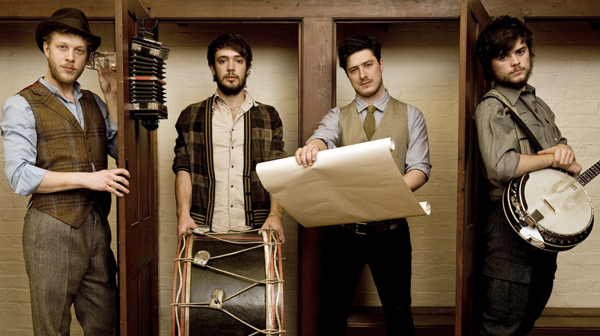
The problem isn’t that Mumford and Sons are all white guys. We have to look at the way that bands form. It makes sense that the guys of Mumford connect and play.

The problem is if every band on the radio is white guys.

The problem isn’t that Bono is a white guy or that U2 are all white guys.

The problem is if every band on a record label is a bunch of white guys.

We have to learn to distinguish between how a band come together and how the music industry functions.

We also need to do this for church … and for christian conferences.

No conference or podcast is or can be the full expression of the kingdom on earth. It is not nor can it be heaven. It is not supposed to be. Like no band can play every type of music …

I understand our desire for diversity – I just want us to manage our expectations. Our problem isn’t with Mumford and Sons, it’s with the music industry.

The answer isn’t “add a black guy”.  That is not how bands work.
Can you imagine somebody saying “why doesn’t Boys 2 Men have a women in it?” or “why doesn’t Destiny’s Child get Ricky Martin to join?”

The problem then isn’t with any church, podcast, organization, conference or person. Our concern is with how that all comes together in a less-diverse way than we would hope for and desperately need. 

The answer then is not to ‘add a women and stir’ or to ‘get some color’. That is what we call token – and it is insulting to everyone involved.

The need is to examine the bigger picture. This includes how things are planned, who makes decisions, and in what ways can people access resources.

Here is a timely example: Tripp and I are singers and songwriters. Our friends Callid Keefe-Perry and Steve Knight are as concerned about the impact of technology on the church as we are. We have talking about  it whenever we are together. We started this when we lived in 4 different parts of the country. Tomorrow, Steve Night is in town and we are going to record a podcast about the subject.

That is not a problem. We are Mumford, or U2, or The Stones, or the Beatles … we are just a band.
It is not a problem that we sing together – or in this case talk together. The problem comes if we are the only ones you hear.

Just to be clear: 1) I am using this an analogy. 2) I am using the music industry as a positive example.


___________________

*If you find yourself in this situation, here are some books suggestions

Quest for the Living God by Elizabeth Johnson

Christ the Key by Catherine Tanner

Teaching Community by bell hooks

Shalom and the Community of Creation by Randy Woodley

Many Colors or The Next Evangelicalism by Soong Chan-Rah

Triune Atonement: Christ’s Healing for Sinners, Victims, and the Whole Creation by Andrew Sung Park

 

Critical Questions: part 2

Originally published as ‘The Silent White Guy and Invisible Black Women’. beyonce-super-bowl1

I am glad that people liked the idea of Critical Theory (from part 1) and the structure of the questions that I put forward.

 I did notice 2 places where the conversation trickled to an drip. 

  • One is the issue of what white guys are allowed to talk about.
  • Two is the way to talk about the role of black women in our society without picking on Beyonce.

Let me give those some background:

My friend Hollie Baker-Lutz tweeted  a sentiment that I hear quite frequently

“Uh oh, overheard in the university cafe: “and I can’t say anything in that class cuz I’m a white male, which is the worst thing u can be.”

I get this all the time from guys young and old alike.  I think something may be missing from that equation however.
Here are two things it would be helpful to add to the mix:

  1. an acknowledgement that the world is changing.
  2. a familiarity of the word hegemony.

If you add those 2 things, it has been my experience that people are generally open to hear what you have to say. People are quite interested.

What they are not interested in is the hegemonic refrain.  See, here is the problem: because that is the dominant cultural narrative … they have already heard it. They know it well. They may know it better than you because they have had to deal with it –  whereas you have only assumed it and benefited uncritically from it.

The second issue came from my friend Janisha when she wrote in response to part 1 post:

I appreciate your article and your attempt to think deeply. I don’t think anyone except for black women can truly determine what are primary and secondary issues.
The place of black women in society as a primary issue has with it endless complications, including “taking back one’s physicality in the face of generations of oppression and marginalization.”
My place in this culture is directly linked to taking back my physicality, because my black womanhood is my physicality. They aren’t different. they cannot be separated. I will argue again, that this conversation is difficult to have unless you are a black woman, because who else can fully understand the implications of Beyonce?

MP responded: 

I get what you (Janisha) are saying about the black woman conversation and I don’t want to butt into it, white man that I am. But that conversation would be about actual black womanhood, whereas this one is about public spectacle, one created and much enjoyed by white men. So there’s a white man conversation to be had about why we (white men) have created a category of “black women” who occupy this particular place in our spectacle. 

… Bo, I wonder how to tackle the issue of “what place black women hold in our culture” without picking apart actual cases like Beyonce’s half-time show??

MP makes 2 excellent points!  

The first situation I would compare to ‘reader response’ approaches to text. We have the author-text-reader.
In this case we have Beyonce-Performance-Viewer.

So each of us viewers is related to the performance differently so ‘white men’ and ‘black women’ may be relating to the performance differently.

In the second I just think that we need to be VERY clear the difference between an example and an anecdote.  Focusing in one example can be illustrative or it can be problematic.

I would hesitate to use this performance by Beyonce as an example – she is not the only one who dances like this. Lots of performers do. Also white women (like Christina and Britney) do.   So it is not unprecedented.

NFL Cheerleading squads do many of the same moves in much the same outfits … the difference is that
A) they don’t have a microphone  and
B) we don’t know their name.

Which is a HUGE difference.
If we want to talk about male sexuality and football we should have the Cheerleader conversation. That is every team – every week.  Women walking

If we want to have the ‘place that black women hold in our society’ conversation, then we would ask a different set of questions. Like ‘where were the other black women during the 5 hour broadcast of America’s largest TV event of the year?’  Since it is a commercial event … maybe we would even take a look at the commercials and ask how black women were represented.

Either way – isolating the one performance by Beyonce is not our best starting point.

Race and things like Politics

by Bo Sanders 

[I initially wrote this for Ethnic Space & Faith
but thought it would be fun to cross pollinate.]  

Despite what the caller said on this week’s ‘Take Them to Task’ segment from the Smiley & West show said, race is still an issue in North America – not everyone is color blind. In fact, here are four stories that caught my attention in the past couple of days in the areas of politics, music, TV, and sport:

 Politics:  Much analysis is being done – and will continue to be done – about the U.S. Presidential election.  I had heard leading up to November 6 that if Gov. Romney was to win, he would have to do it with the largest percentage of white voters in recent history.

While he did not win yesterday, the ethnic breakdown was stark and is causing much consternation in conservative circles. Whites, and especially Evangelicals, reports say, voted over 80% for Romney. It is almost exactly the opposite (some reports say as high as 93%) of Latino voters went for Obama.

My only point is that if you think that the election of a Black president makes this a post-racial country, you have another thing coming. Race is still an issue and will continue to be an issue as we move to 2048 when Whites will not be a majority in America.

How will we lead? How will we transition? How will we hear new voices? 

Music: You may have seen the uproar over the music group No Doubt’s new video “Looking Hot”. Rolling Stone describes it this way:

The clip for the second single off their long-awaited new album, Push and Shove, featured a Wild-West theme, replete with tee-pees, feather headdresses and smoke signals. After releasing the video on Friday, No Doubt quickly drew complaints for using the stereotypical imagery, with threads such as “Appropriating Native American culture” appearing

The band did apologize and did remove the video.  Continue reading “Race and things like Politics”

Blog at WordPress.com.

Up ↑